Composition: the value pattern first
Before a viewer reads a subject, they read its pattern of light and dark. The big value shapes register first, faster than any edge or detail, so a painting is settled at the level of that pattern before the rendering ever starts. Which is why every workable approach decides the big pattern early, while it is still cheap to move.
The cheapest place to decide it is a thumbnail that collapses the whole value scale into three brackets, darks, mids, and lights. Below, that test runs on famous compositions, then on two masters’ own studies set beside the paintings they became, then on the light itself, the thing that hands you the pattern, and finally on the edge work and the drawing courses that drilled it first.
01Three famous compositions, each collapsed to three flat shapes. See how little it takes to read each one: Caravaggio hangs everything on a single diagonal shaft, Repin strings a dark line of figures low across a pale band, and Sorolla lets a light field carry the surface.

The three-value thumbnail. Mounted on The shaft, Caravaggio, The dark mass, Repin, and The light field, Sorolla.
02The same test on three more paintings, each panel drawn at the real canvas ratio. Watch the pattern change with the shape: a lit group low in Velazquez’s tall room, two lights in Rembrandt’s dark field, the children spaced through Sargent’s square interior.

The three-value thumbnail, three more compositions. Mounted on The lit group, Velazquez, The dark field, Rembrandt, and The dark interior, Sargent.
Those bracket versions are ours. But the masters made their own value plans, and some survive. Here is one set directly beside the painting it became.
03Repin’s 1870 oil study, sat under the finished canvas. See the same dark line of eleven haulers in both, the whole frieze already decided in the small study three years before the wall-sized version.
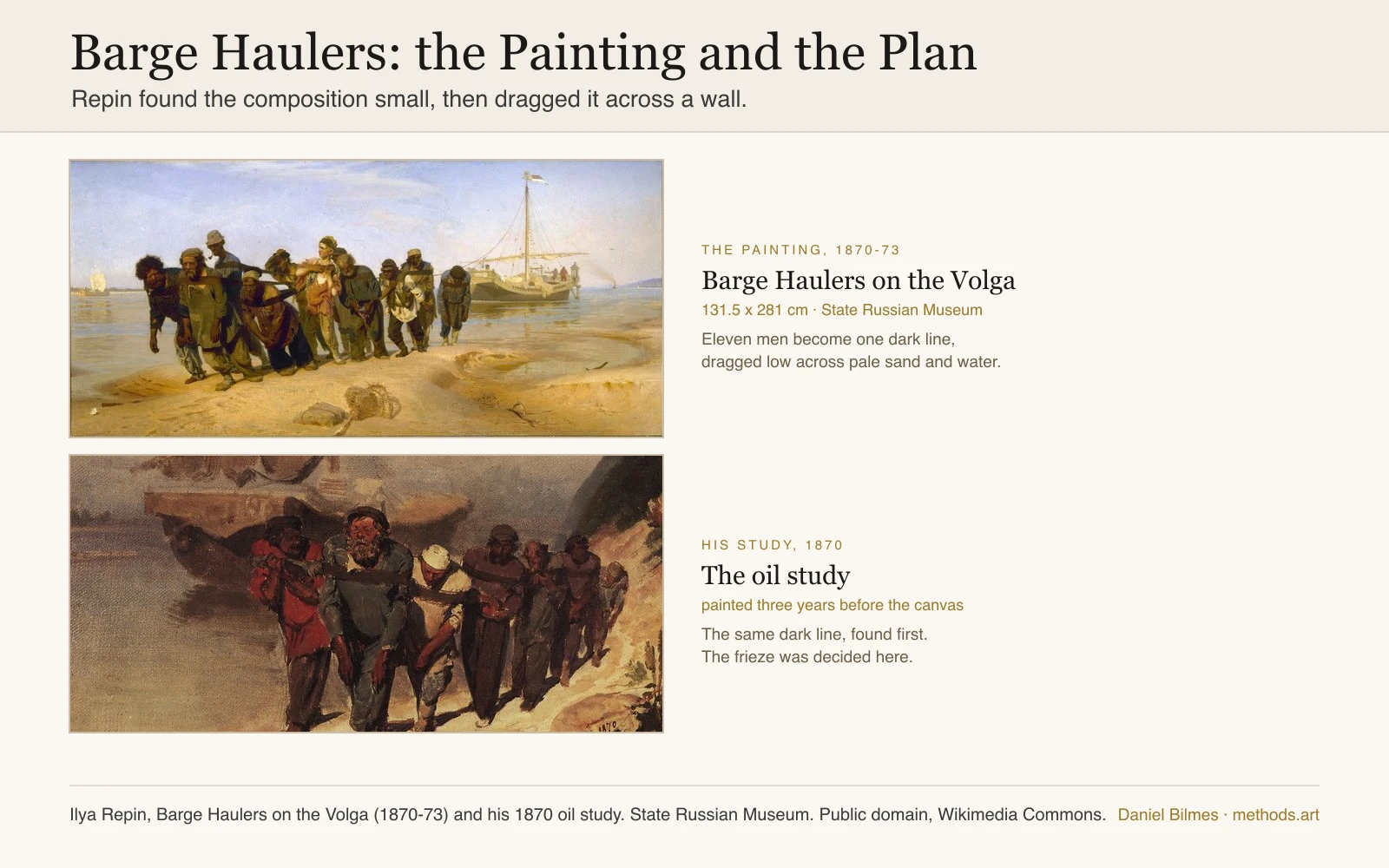
Ilya Repin, Barge Haulers on the Volga (final, 1870-73) and his 1870 oil study, both State Russian Museum. Public domain, Wikimedia Commons.
Repin: the painting and the plan. Mounted on the Repin page.
04The same move, fifty years later. Sargent’s oil study sits under Gassed: a file of blinded soldiers massed into one long band above the fallen, the whole thing solved small before the mural.
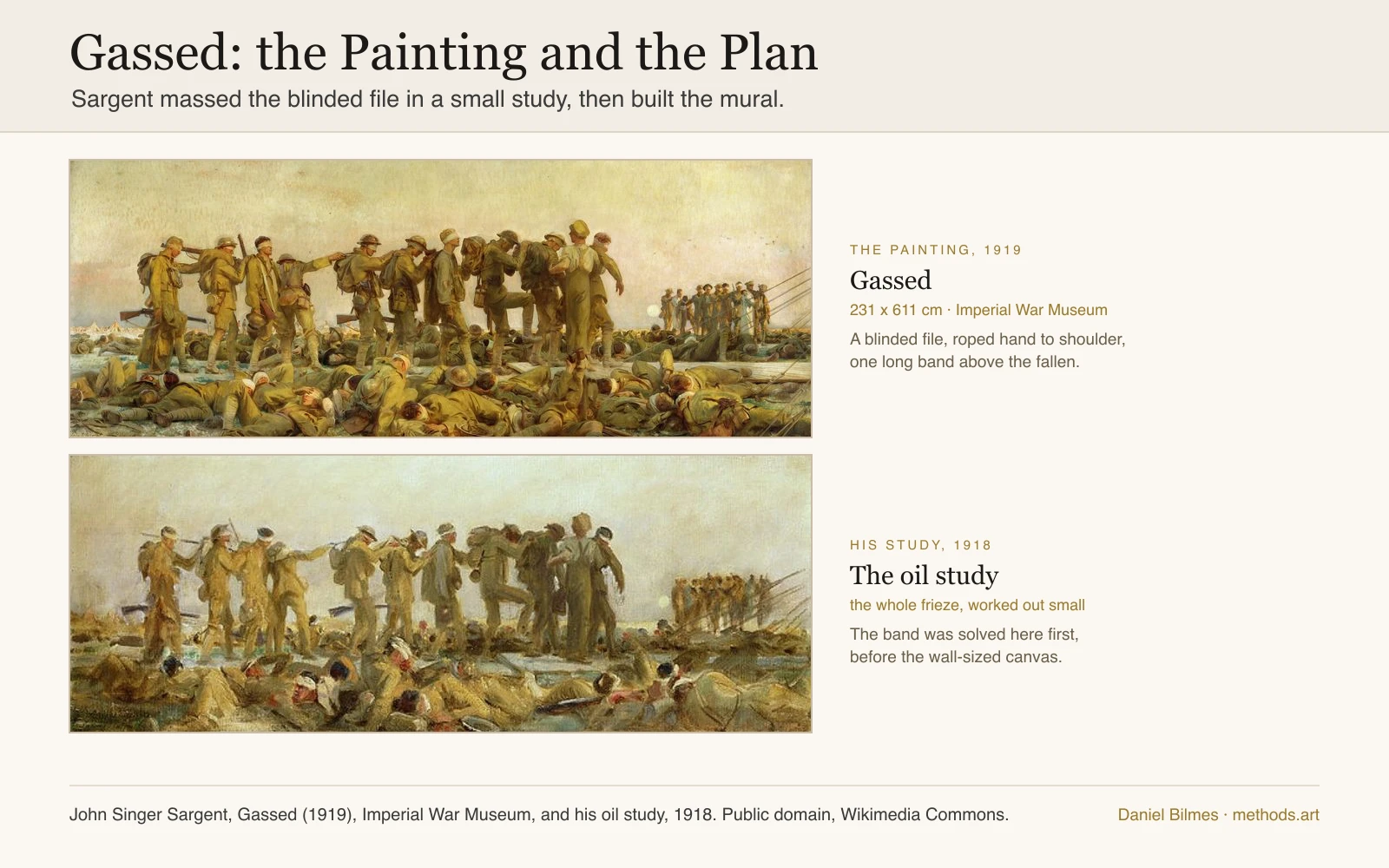
John Singer Sargent, Gassed (1919, Imperial War Museum) and his 1918 oil study. Public domain, Wikimedia Commons.
Sargent: the painting and the plan. Mounted on the Sargent page.
05Now the two studies alone, one above the other. Two crowds painted about fifty years apart, and both reach the identical answer: mass the figures into a single dark frieze laid along the foreground. The finished paintings could not feel less alike, yet the plan is the same.
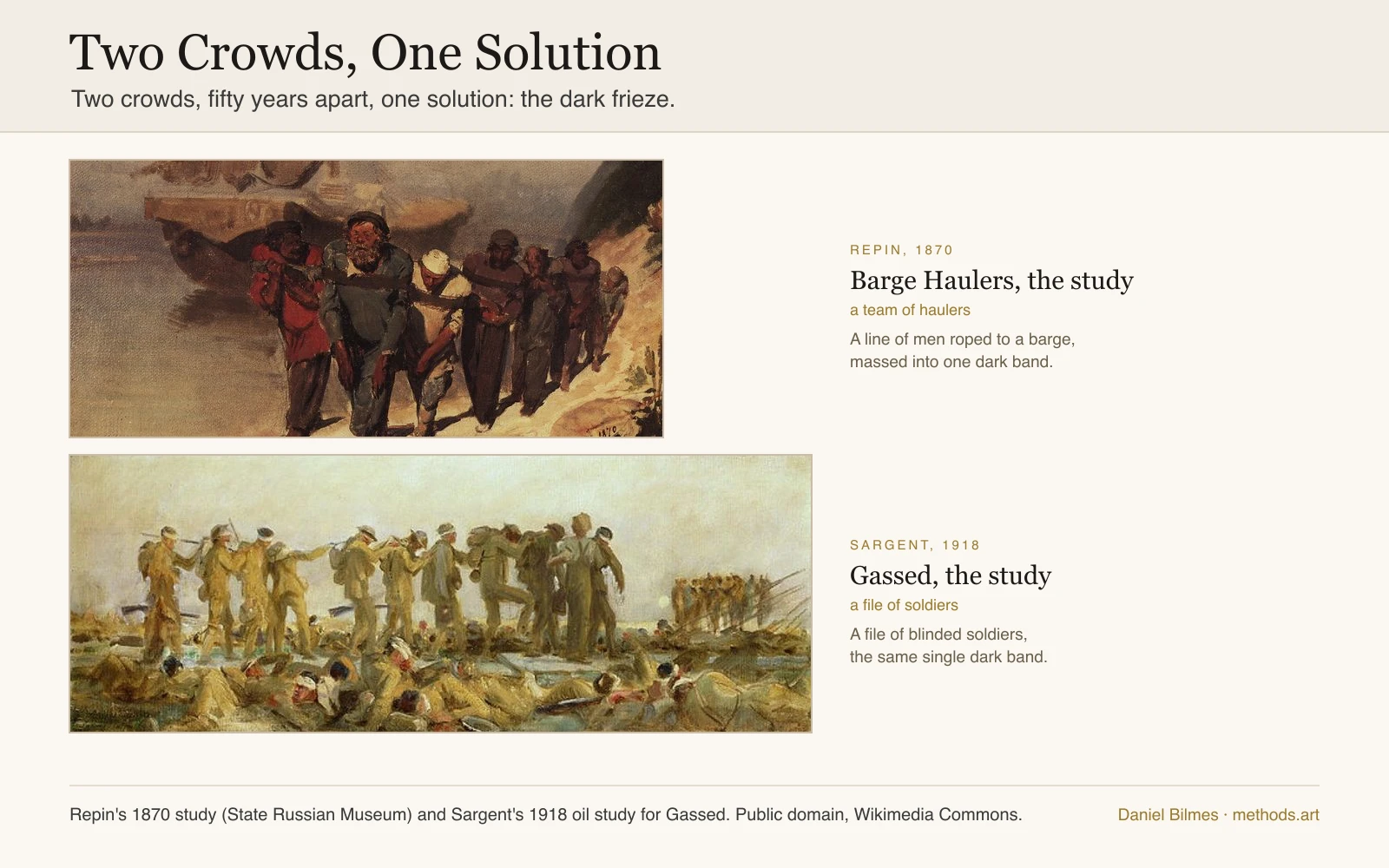
Repin's 1870 study (State Russian Museum) and Sargent's 1918 oil study for Gassed. Public domain, Wikimedia Commons.
Two studies, one solution. The painters: Repin, the study, and Sargent, the study.
Light decides the pattern
The studies above show painters planning the pattern. These next two show the thing that hands it to them. One light source builds one coherent set of light and shadow shapes, and the type of light you choose settles the whole value key before a single edge is drawn. Both sit at the front of the composition chapter for that reason.
06One simple scene, drawn twice. On the left a single light: every form shadow sits on the same side, every cast shadow runs the same way, and the three objects read as one space. On the right the sources contradict each other, the shadows disagree, and the read falls apart.

An original methods.art diagram, the case for a single unified light source in a composition.
The unified light source.
07Now the same scene under four kinds of light. Watch the value pattern change with each: north light spreads long soft midtones, direct sun cuts hard dark shadow shapes, a sunset fuses the forms behind a warm edge, and overcast flattens everything to close values. Each one hands a different bracket the picture.

An original methods.art diagram, the same scene under north light, direct sun, sunset, and overcast.
Choosing the light.
Shapes are the mapping of things
One light hands you clear shapes of light and shadow. The four figures below are Daniel Bilmes teaching what to do with them, his own doctrine in his own words. Shapes are the mapping of things: the accuracy of the shapes, the relationship of the shapes. The largest shapes are like continents, then countries, then states or regions. And without shape you don’t really have composition, because composition is a breakdown of simplified shape relationships.
08One Velazquez head, mapped three times. The continents come first, the two or three largest shapes, and the likeness is already in them. Then the countries inside those, then the states and regions inside those. Each smaller shape nests inside a larger one; nothing fits together like puzzle pieces.
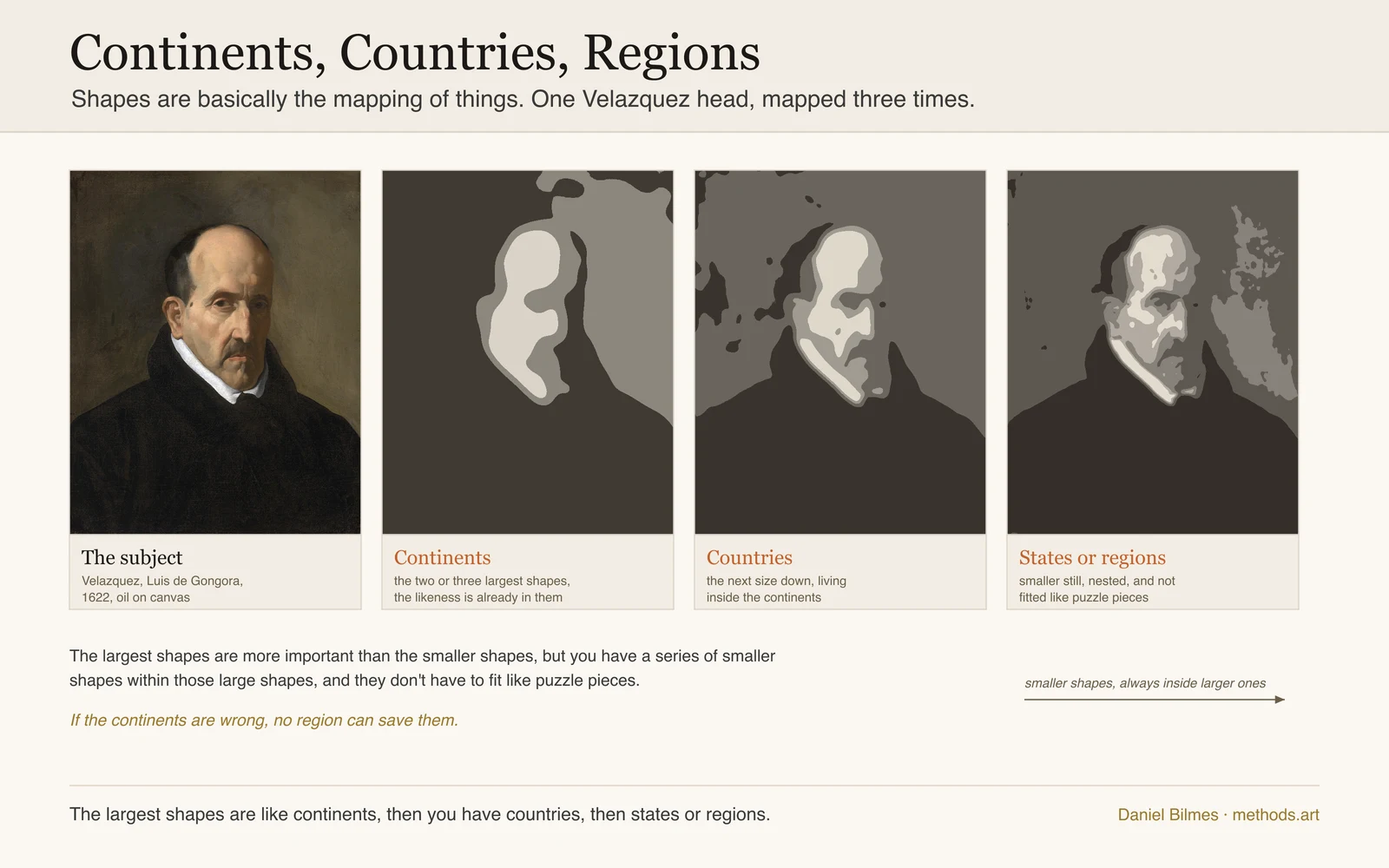
Diego Velazquez, Luis de Gongora (1622), Museum of Fine Arts, Boston. Public domain, Wikimedia Commons. The three maps are original methods.art diagrams. Shape doctrine per Daniel Bilmes, 2026.
Continents, countries, regions. The subject: Luis de Gongora, Velazquez.
09The same head under its one light, beside the two-value read. Average every value to one side or the other and the shadow shape comes out connected, one flat dark, and it already holds the head. That connected dark is the anchor a portrait is drawn from, and the interaction of light inside it stays quiet until the shape is right.
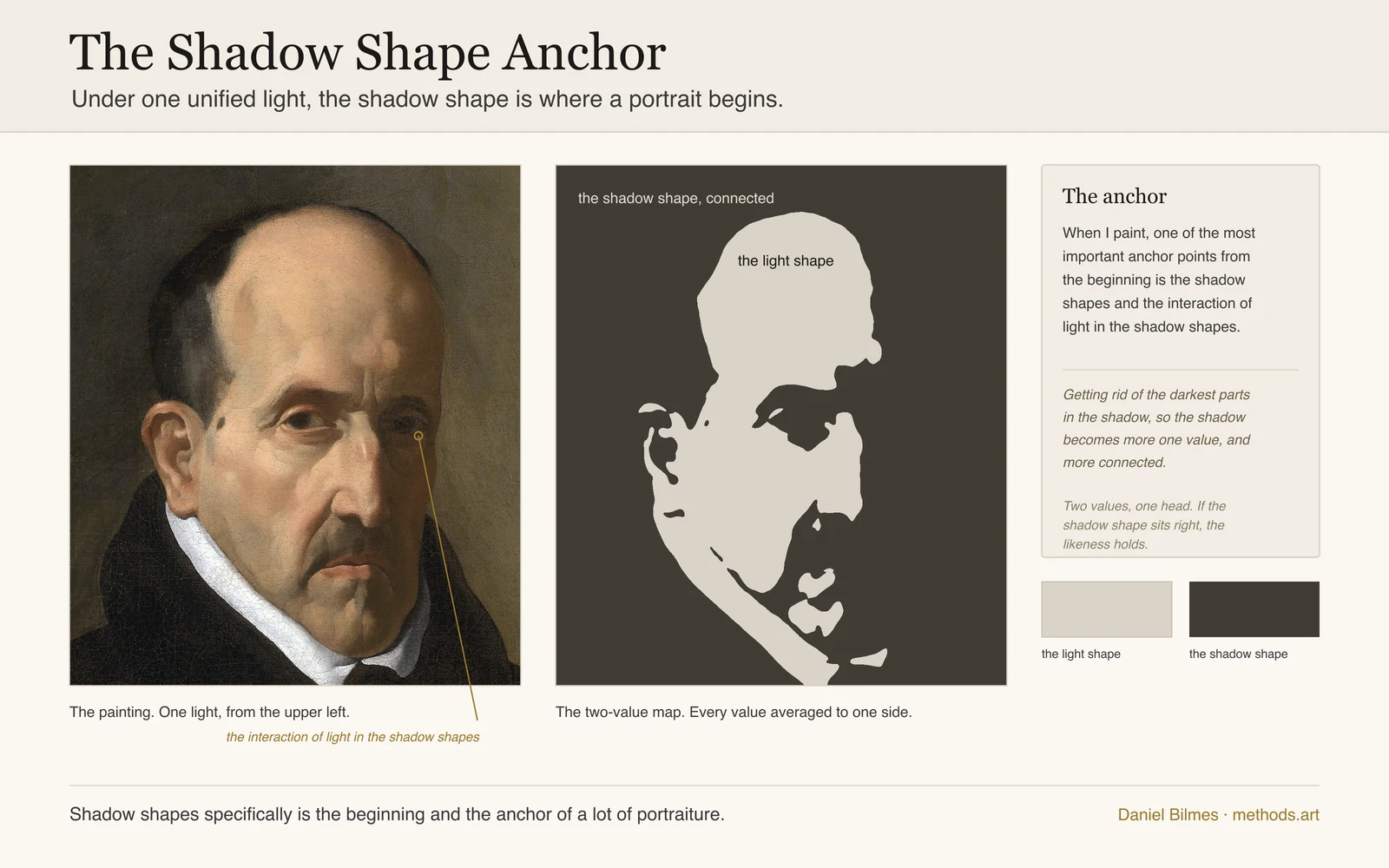
Diego Velazquez, Luis de Gongora (1622), Museum of Fine Arts, Boston. Public domain, Wikimedia Commons. The two-value map is an original methods.art diagram. Shadow-shape doctrine per Daniel Bilmes, 2026.
The shadow shape, the anchor. The subject: Luis de Gongora, Velazquez.
10The order of work, on a constructed head. The left head is flat, measured, and in the right place, as accurate as necessary, not as accurate as possible. The right head has its features modeled early, and they sit in the wrong place, so every rendered feature now has to move. Location first, then form and nuance.

An original methods.art diagram. Shape doctrine per Daniel Bilmes, 2026.
Shape before form.
11The unified light source from figure 06, read as shape. Reduce the scene to exactly two flat values, one connected light shape and one connected shadow shape, and the read survives. These larger graphic shapes are the compositional bracket that the three-value thumbnails in figures 01 and 02 run on.

An original methods.art diagram. Shape doctrine per Daniel Bilmes, 2026.
Light shape, shadow shape.
The paint changes overnight
The shapes above get solved over more than one sitting, and the paint changes overnight. Each state of the drying paint allows a different move. Wet is for adding, the massing and the big gestures. Tacky is for adjusting, once the thin layers have set and the thick darks are still movable. Dry is fixed, good for a glaze but not for relocating a shape. In his words: “day two you’re a bridge builder, day one I was a little chaos monkey.”
12The same start in three states, left to right. Wet on day one takes the massing and the big movements but cannot hold a flat value. Tacky on the second day sets the thin layers while the darks stay movable, so a shadow can be evened to one value and the darkest darks lifted out. Dry fixes the shape: glaze to darken, add if you must, but a two-inch move is a pain. The two questions of the second day sit under it.

An original methods.art diagram; the day-and-paint doctrine and the two questions of the second day in Daniel Bilmes's own words, 2026.
The second day, the drying clock.
Perspective is a composition decision
Perspective is usually taught as the trick that fakes depth. It is also a compositional tool, and two of its decisions get made before the drawing starts. The first is the horizon, which is the eye level. The second is where the converging lines are sent. One decides how the figures sit against ground and sky. The other decides where the eye lands.
13Set the eye level low and the ground shrinks to a band, so a figure rises through the frame and stands against the sky, and the viewer looks up. Set it high and the ground opens like a map, so a group spreads across it and reads as a field. Same scene, same figures, one decision moved.

An original methods.art diagram. The paintings are named for their eye-level structure; the compositional readings follow standard art history rather than any documented statement of the painters' intent. The named works are public domain.
The horizon is a choice.
14Every parallel edge in a scene runs back to a vanishing point, and where that point sits is where the eye is sent. One point gives a single focus you can aim, the way the Last Supper sets its one point behind the head of Christ. Two points trade the single focus for strong diagonals and a cornered view. Aerial perspective is the other half of it: contrast falls, edges soften, and color cools with distance, so depth is a value decision as much as a line one.

An original methods.art diagram. The vanishing-point placements in the named paintings are documented; aerial perspective follows Leonardo's Treatise on Painting and Pierre-Henri de Valenciennes (1800). Perspective is treated as part of composition after Harold Speed, The Practice and Science of Drawing (1913).
The vanishing point is a choice.
15Edges are the nuance that comes after the pattern is set, not before. See the same contour run hard to lost: knife-hard in Caravaggio, firm in Velazquez, soft in Sargent, dissolved to nothing in Rembrandt.
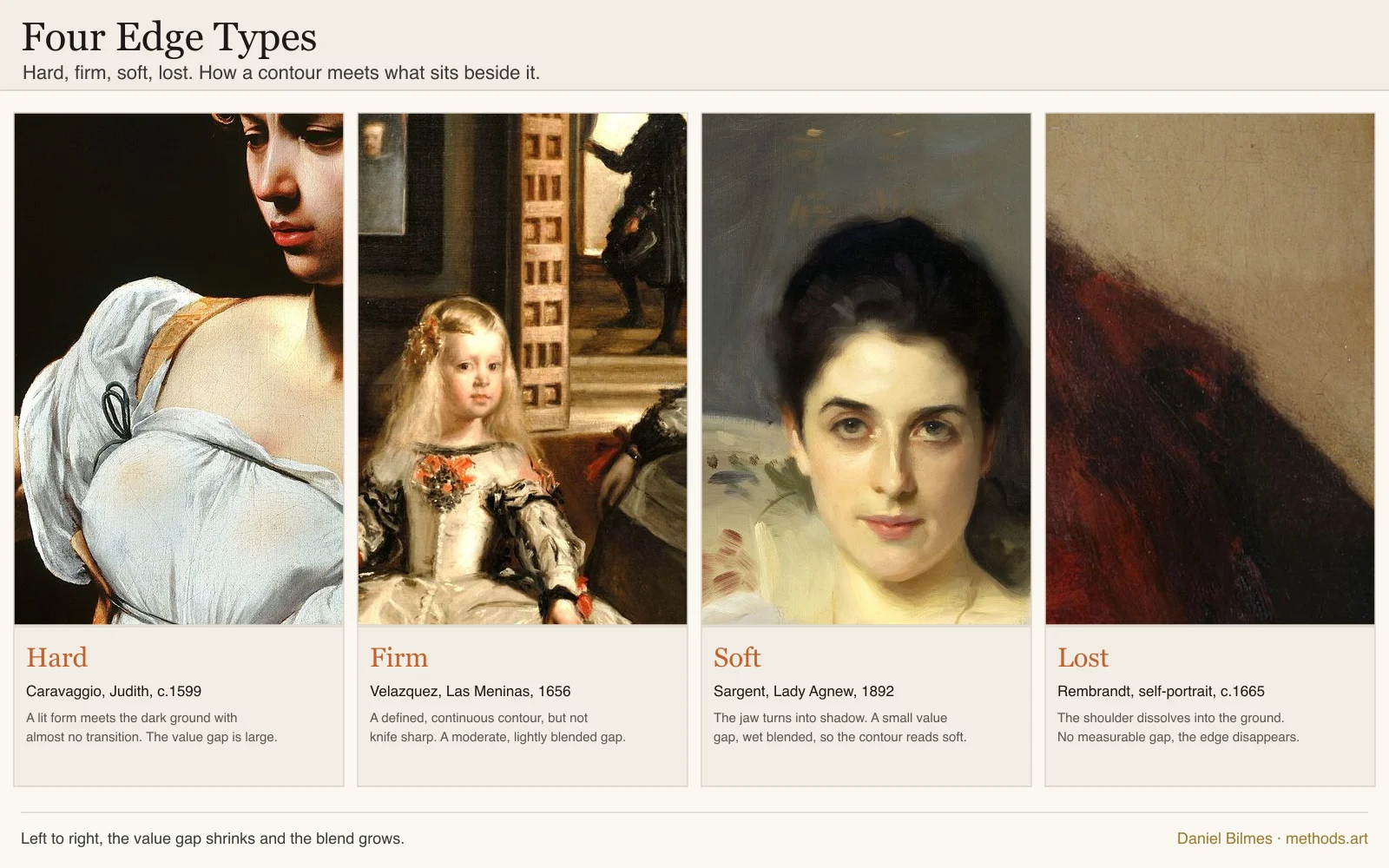
Public-domain painting details via Wikimedia Commons.
Four edge types, in master paintings. Mounted on Hard, Caravaggio, Firm, Velazquez, Soft, Sargent, and Lost, Rembrandt.
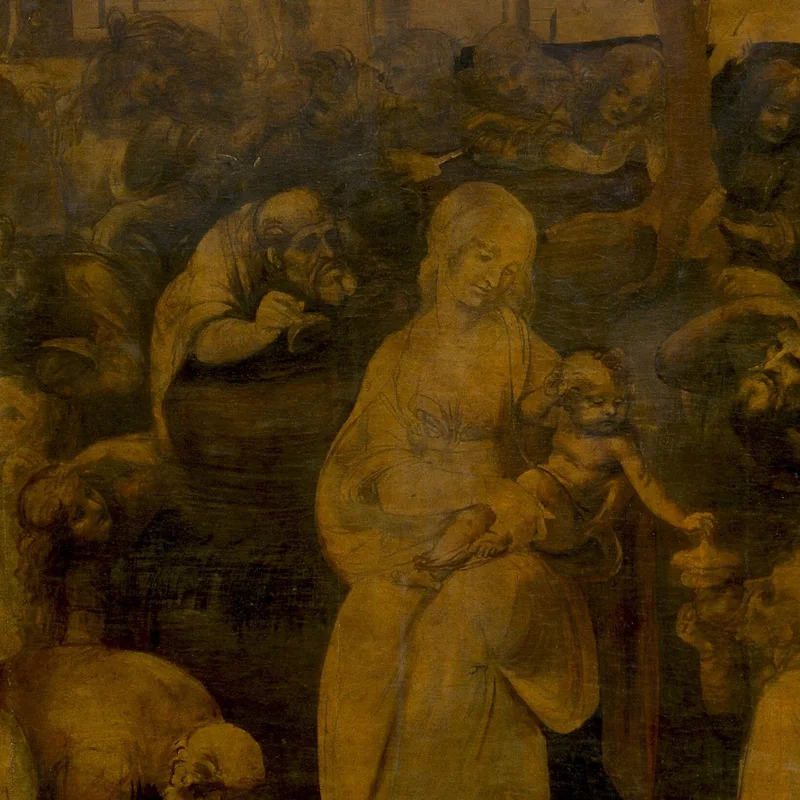
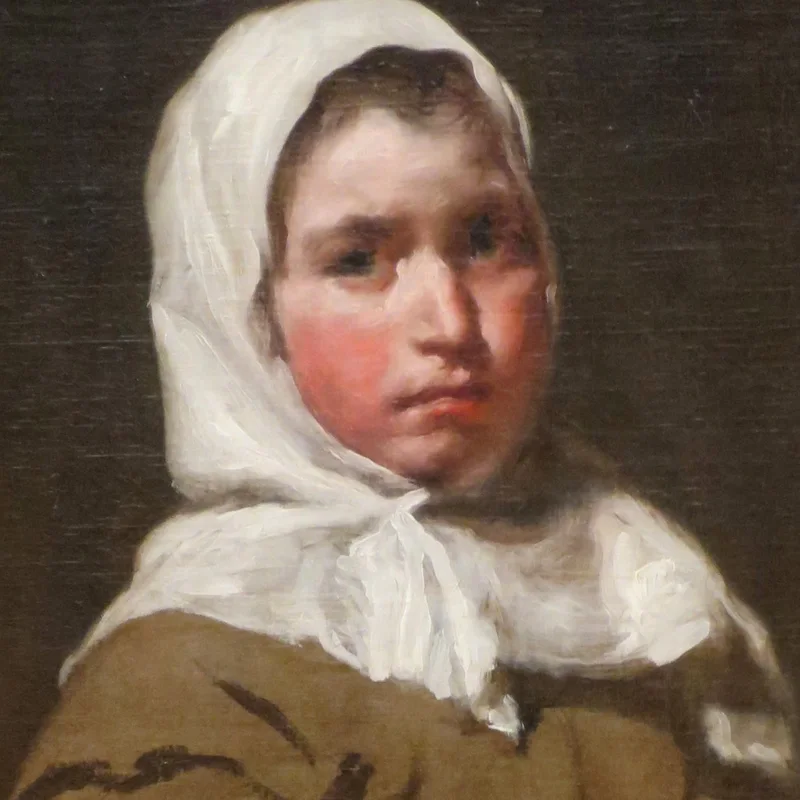
16Watch the pattern go in first, in monochrome, before a single local color. Two unfinished canvases caught it mid-process: Leonardo massed his whole design in brown, and Velazquez left one smock at the flat block-in beside a finished head.

Value block-in, stage by stage. Mounted on Leonardo, and Velazquez.
17None of this is instinct alone. It was drilled. See a single motif taken from a straight-line block-in to a finished tonal drawing, plate by plate, so construction before finish was trained before anyone touched paint.
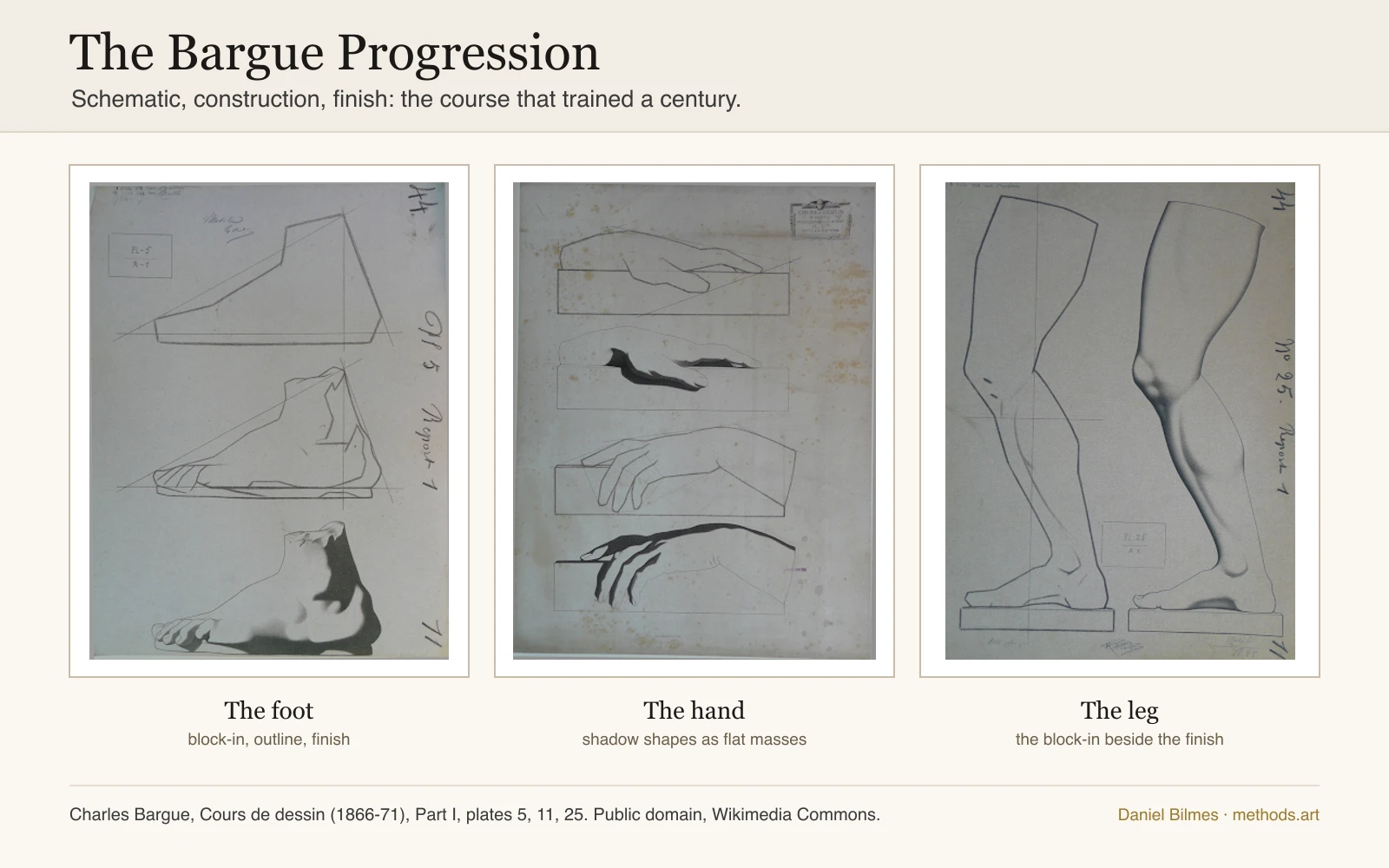
Plates from Charles Bargue, Cours de dessin (1866-71, with Jean-Leon Gerome), Part I, plates 5, 11 and 25. Public domain, Wikimedia Commons.
The Bargue plate progression. Mounted on Bargue drew the plates, and Gerome co-published the course.
18Harold Speed set the two ways of seeing on facing plates: line construction on one, tonal masses on the other. The same argument, that you decide the big structure first, taught with a brush instead of a pencil. Bargue and Speed are where the habit under every chart above came from.
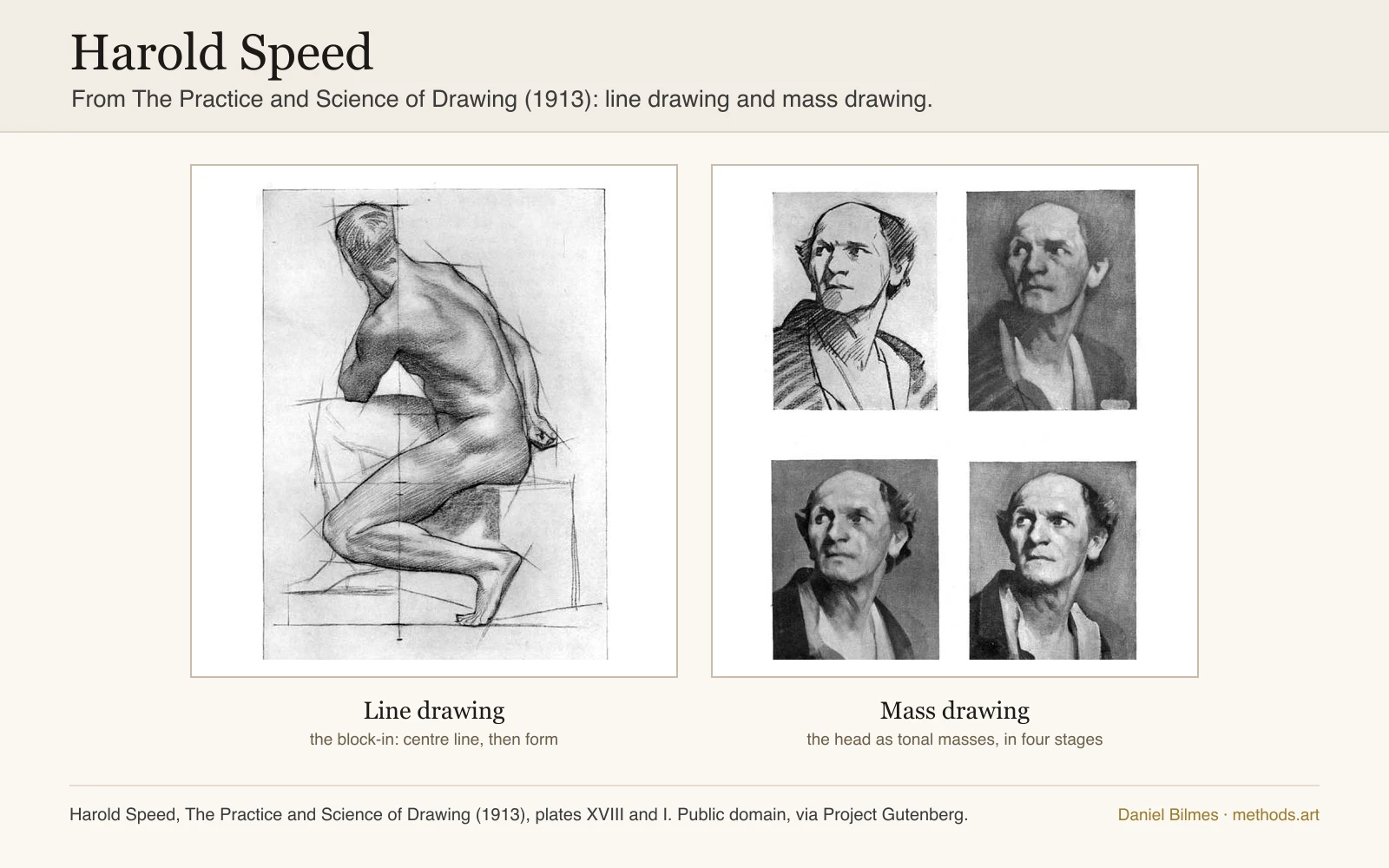
Plates from Harold Speed, The Practice and Science of Drawing (1913), plate XVIII and plate I. Public domain, digitised by Project Gutenberg (ebook 14264).
Line drawing and mass drawing. Mounted on Harold Speed.
The lessons run on the figures above, each with an exercise that needs a kitchen table, not a studio.
The whole value scale compressed to three brackets, and two exercises: Speed’s mass drawing, then thumbnails at true proportions.
Shapes ranked as continents, countries, regions, and two exercises: his day-two shadow-shape drill, then Speed’s location scaffold.
One light draws one border, and the one-light drill: the collapse test with one lamp, then the choosing study under four.
The day as the unit of the work, and the drying clock: wet adds, tacky adjusts, dry is fixed, then a two-day study.
Complete means when it doesn’t need anything else, not a high polish, and a call-it-done protocol to see when you are there.
These lessons are chapters of a larger plan. See where they sit on the curriculum.