Rembrandt built his light from the ground up. He worked on a quartz ground, made of ground quartz, lead white, and a little earth pigment, under a thin warm-brown imprimatura that stayed as the middle tone. He built the lit flesh in thick lead-white impasto and kept the shadows thin and glazed. The light sits physically higher than the dark, in real paint you can see standing off the surface.
Partition the studio with sailcloth — pedagogy as physical separation
Divided the upper-floor studio into individual working cells using sailcloth or paper screens so each pupil painted from a model in physical isolation. Argued that a painter "must be as separated from another as one mountain is from the next."
Why it matters · A studio without partitions produces students who paint like the master. The partitions are pedagogy in physical form — they force each pupil to develop a singular personal style uncontaminated by neighbours. The discipline is to engineer separation when the work demands it.
Samuel van Hoogstraten, Inleyding tot de hooge schoole der schilderkonst, 1678
Build the quartz ground for sculptural impasto
Used a "quartz ground" — ground quartz (clay and sand), lead white, small amount of earth pigment — that gave the surface a strong textured grip taking heavy impasto without sinking.
Why it matters · A specific paint handling requires a specific ground. Most painters accept generic priming and then wonder why the impasto sinks. Rembrandt engineered the support to take the load. Painters who use light grounds for heavy paint have already lost the surface.
Art in the Making: Rembrandt, National Gallery London, 2006
Work in islands — bring some passages to finish while others stay sketch
Brought specific passages near to finish while adjacent areas remained as sketch. The face in a history painting might be fully modeled while the hand at the canvas edge was still a brown ghost.
Why it matters · The test is emotional coherence, not uniform polish. When the face is carrying the "greatest and most natural movement," the rest of the painting can be resolved around it. Painters who advance everything in lockstep lose the ability to follow the painting where it actually wants to go.
Letter to Constantijn Huygens, 1639
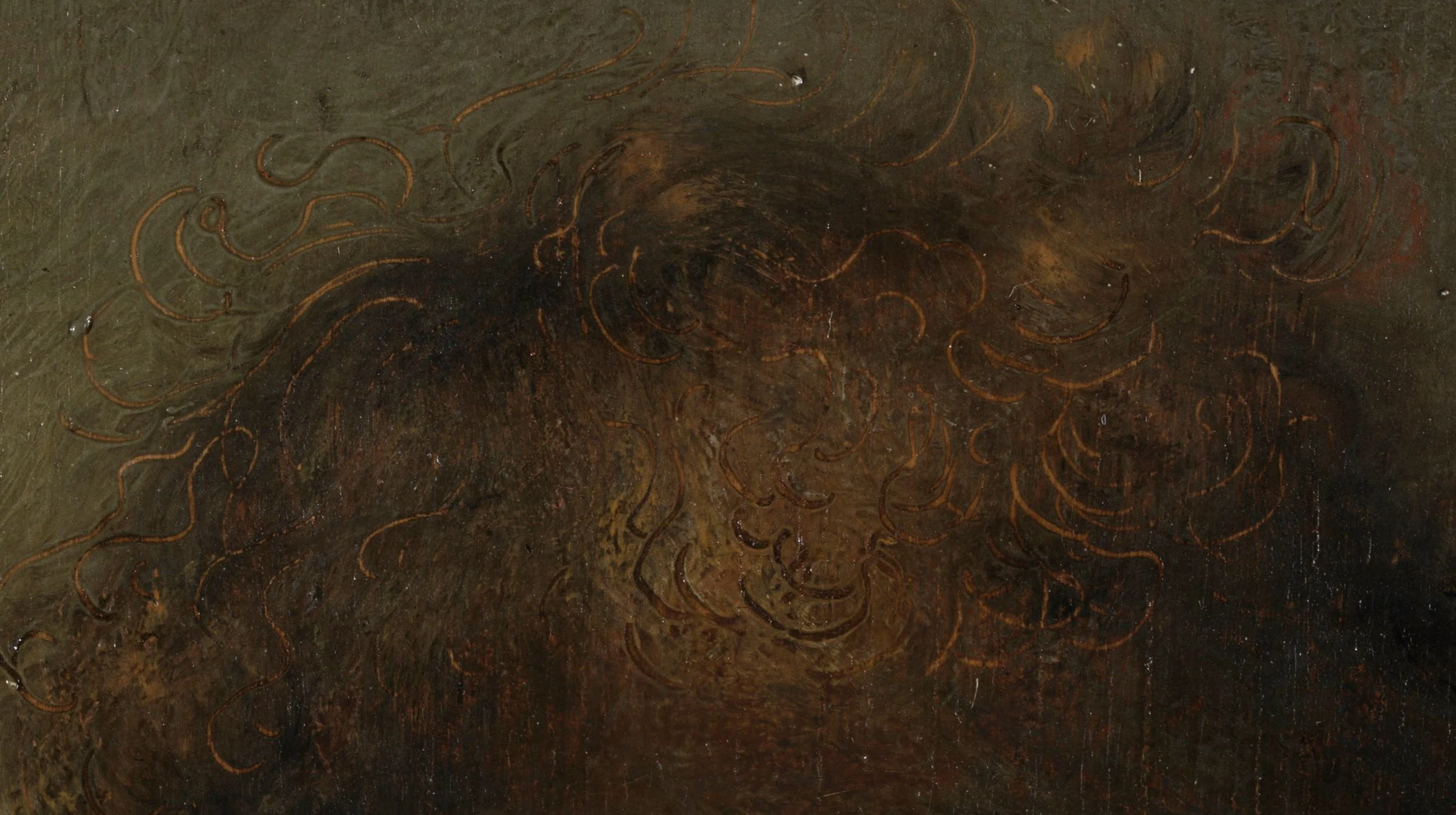
Scratch into wet impasto with the brush butt
Placed thick lead-white impasto and scratched into it with the butt end of the brush to pull out hair, lace, or the weave of fabric. Twirled the brush on the surface to blend wet pigments into a marbled effect in flesh.
Why it matters · The brush is two tools — bristle and handle. Most painters use only the first. Rembrandt's discipline argues that the working surface itself is the description, not a smooth window onto a description. The scratched line is faster and more specific than the painted one.
Detail of the 1629 self portrait, painted on an oak panel about sixteen centimetres tall: the curls are not painted on, they are scratched into the wet dark paint with a hard point, so the warmer layer underneath comes back up as the lit edge of the hair.
Rembrandt van Rijn, Self Portrait (detail), 1629, Alte Pinakothek, Munich. Public domain, Wikimedia Commons.
Keep the studio inventory of "rarities" as costume archive
Maintained a vast collection of ancient armor, oriental robes, weapons, shells, coral, stuffed birds, turbans, busts — recorded in the 1656 insolvency inventory. Dressed his models in them and painted them under the single north window.
Why it matters · The costume-and-prop method that Repin and Alma-Tadema would formalize two centuries later was already fully present in Rembrandt's working method. Painters who do not maintain a physical reference archive paint generic figures.
1656 inventory of the Rembrandthuis
Refuse uniform finish — finish when "intention has landed"
Houbraken: "A work is finished when the master has achieved his intention in it." Refused the academic criterion of uniform resolution.
Why it matters · Rembrandt's position is the structural opposite of Alma-Tadema's. A painting finishes when its intention lands, not when every square inch matches every other. The unresolved passage at the edge is the condition for the resolved passage at the center.
Arnold Houbraken, De groote schouburgh, 1718
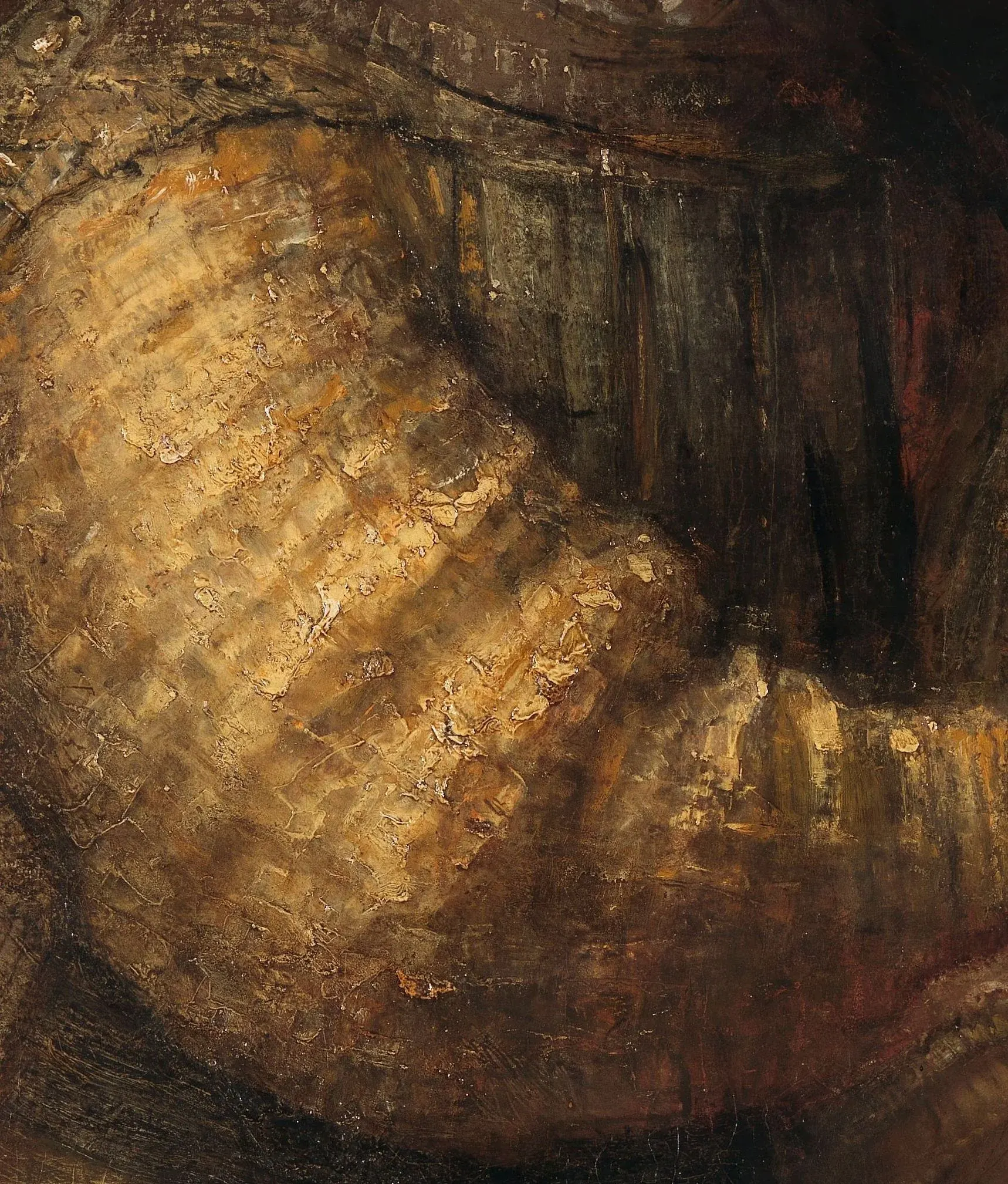
Glaze and wipe over dried impasto
After the thick lights had fully dried, he dragged a thin transparent glaze over the raised impasto and wiped the peaks clean with a rag, so pigment stayed only in the low spots between the ridges.
Why it matters · This turns a flat shadow into a real bas-relief. The glaze darkens the recesses while the high points of paint stay bright, so the texture of skin or fabric is built in actual relief, not faked with a brush. Depth comes from the physical surface, not from blending.
Virgil Elliott, The Technical Innovations of Rembrandt (Art Renewal Center); paint cross-section studies (Natural Pigments)
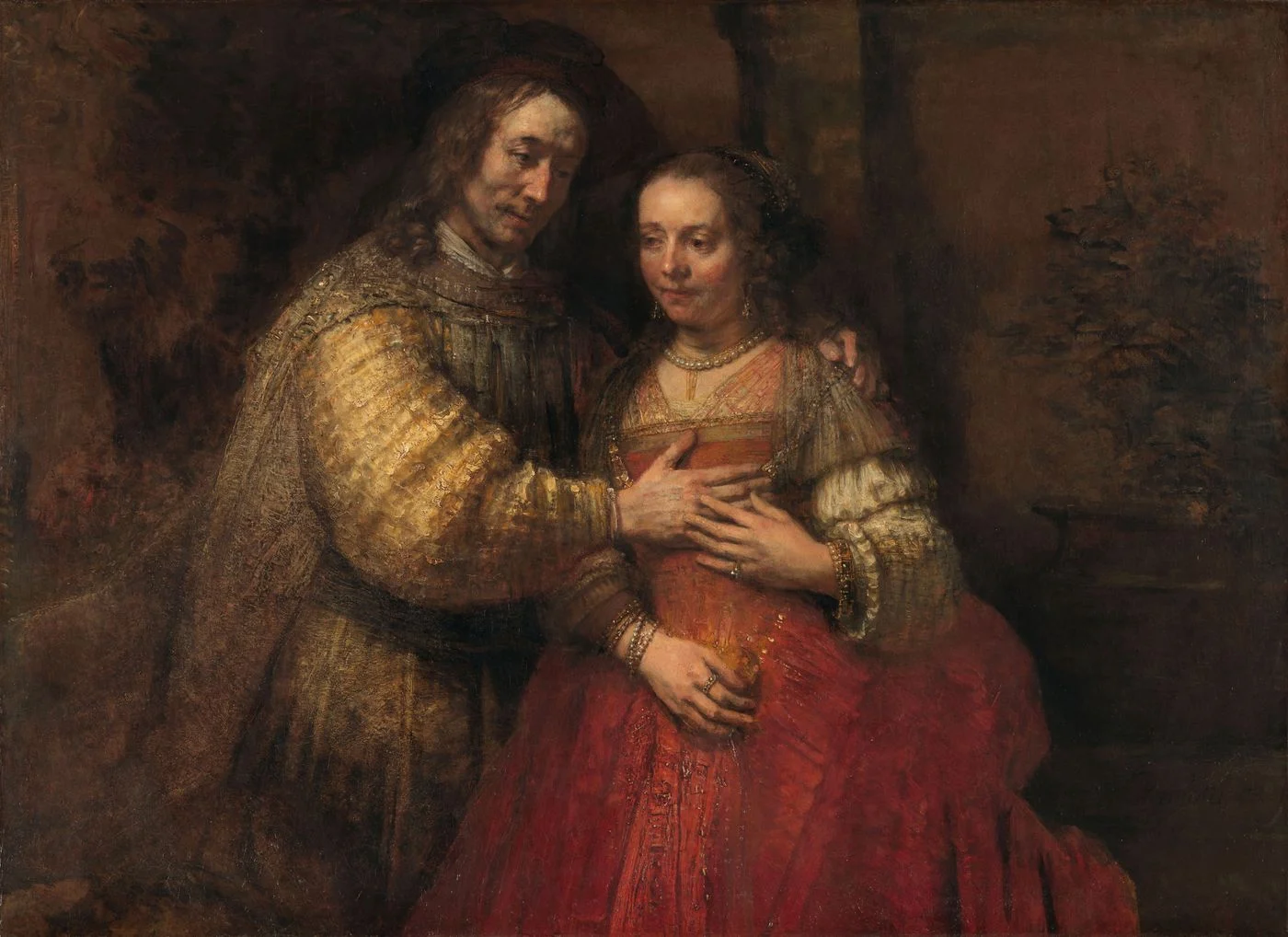
Detail of The Jewish Bride: the gold sleeve is built in ridges of paint thick enough to cast their own shadow, and the dark beside it stays thin and transparent. The light in the picture sits physically higher than the dark, so a raking light in the room finds it.
Rembrandt van Rijn, Portrait of a Couple as Isaac and Rebecca, known as The Jewish Bride (detail), circa 1662 to 1666, Rijksmuseum, Amsterdam. Public domain, Wikimedia Commons.
Bulk the glaze with chalk or ground glass
Conservation analysis of his glazes finds added chalk and finely ground glass, often smalt, which gave thin transparent passages some body and made them dry faster.
Why it matters · A pure oil glaze is slow and can stay slick and thin. The chalk adds transparent body so the glaze holds where it is put, and the glass speeds drying so the next layer can go on sooner. It keeps a transparent layer workable instead of fighting it.
Studies of smalt and ground glass in Rembrandt glazes (Saul and David c.1652; Homer 1663), Heritage Science / Microchemical Journal; De Mayerne manuscript, 1620
Print the plate, then cut into it again
Treated a finished copper plate as a stage and not an end. He printed it, looked at the impression, then took the drypoint needle back to the same plate and buried whole passages of the picture, so a late state of a print is a different picture from an early one.
Why it matters · Most painters keep their revisions private, under the top layer. A run of etching states makes the revision public, because both versions survive on paper and can be laid side by side. It is the closest thing we have to watching a master change his mind, and what it shows is that the late change is usually the large one.
The Cleveland Museum of Art, object record for Christ Crucified Between the Two Thieves, The Three Crosses, accession 1959.241
Draw with a cut reed instead of a quill
Drew many of the mature sheets with a reed pen, a cut length of reed with a blunt split nib, over washes of brown ink laid with a brush. The nib holds a lot of ink, spreads under pressure, and runs dry after a few strokes.
Why it matters · A blunt nib that runs dry cannot make an even line, so it forces a decision about where the weight goes and in what order. The stroke starts black and wide, then breaks up as the ink gives out, which means the light and dark come out of the tool rather than out of shading. A painter who draws with a tool that runs out learns to place the load-bearing marks first.
Medium recorded by the National Gallery of Art, Washington: reed pen and brown ink with brown wash, heightened with white, on laid paper
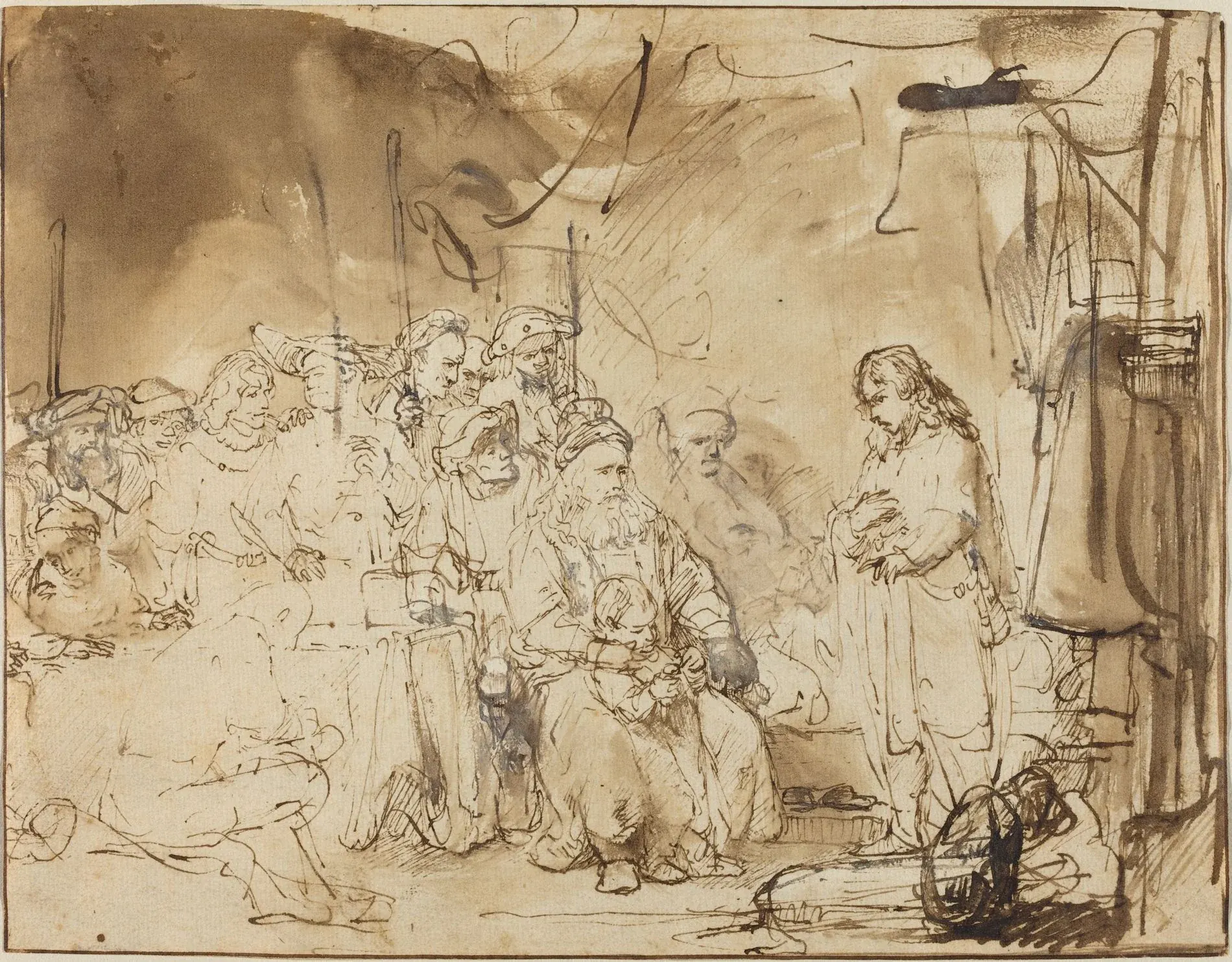
Joseph Recounting His Dreams, drawn with a reed pen in brown ink over brown wash on a sheet about seventeen by twenty two centimetres. The figures go down in blunt strokes that widen and then break as the ink runs out, and the white heightening is put back over the top where a light was needed.
Rembrandt van Rijn, Joseph Recounting His Dreams, early 1640s, National Gallery of Art, Washington. Public domain, Wikimedia Commons.
In the studio
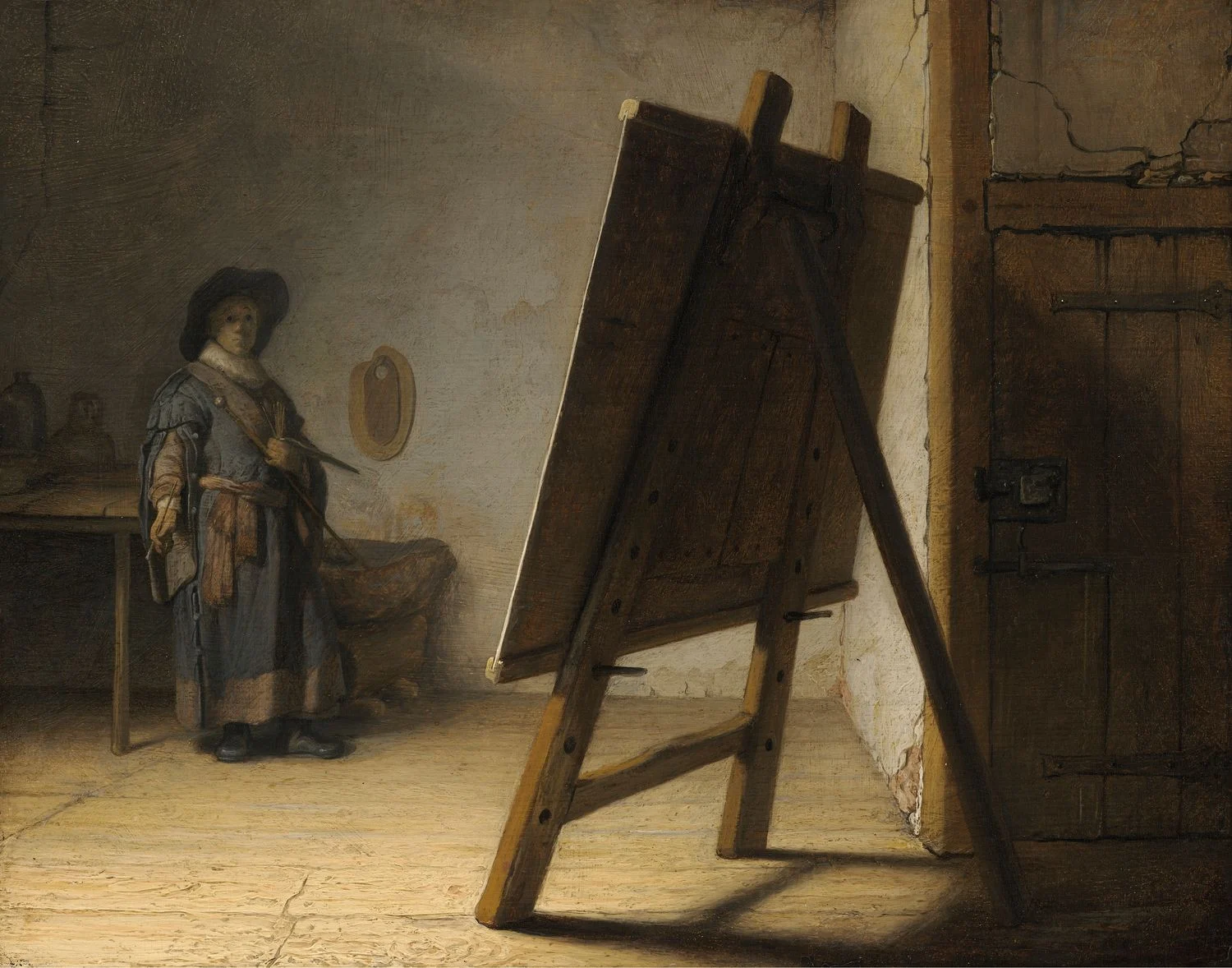
Rembrandt van Rijn, The Artist in his Studio, c. 1628 (Museum of Fine Arts, Boston)
Studio
Light
Single high-positioned north-light window. Advised patrons to hang his paintings in rooms with strong concentrated illumination — the same light condition the pictures were designed under.
Position
Standing at large studio easel; partitioned cells for pupils.
Session length
Multi-month working period per major canvas; iterative reworking on the final surface.
Tools
Hog-bristle brushes for textured passages and impasto · Soft-haired brushes for transitions · Brush butt scratched into wet paint for hair, lace, fabric weave · Full-sized etching press for the parallel monochrome practice · Thousands of "rarities" — ancient armor, oriental robes, weapons, shells, turbans, busts (1656 inventory)
Notes
Withdrew from elite Amsterdam society after Saskia's death in 1642. Houbraken: he sought "freedom, not honor." Studio was a destination for "common types" — fellow artists, working-class Amsterdammers, old men with strong bone structure.
Source: Samuel van Hoogstraten, Inleyding tot de hooge schoole der schilderkonst, 1678
Palette
Ground
Quartz ground on linen (mixture of ground quartz, lead white, and earth pigment) — strong textured grip for heavy impasto. Chalk ground on oak panels in early Leiden years. Thin warm-brown imprimatura over the ground; the warm middle value remained as a working colour in the finished painting.
Whites
Lead white (heavy impasto in lights)
Earths
Yellow ochre · Red ochre · Raw sienna · Burnt sienna · Raw umber · Burnt umber
Colors
Lead-tin yellow (sharpest opaque highlights)
Blacks
Bone black · Vine black
Medium
Oil; layered build with iterative reworking on final surface.
Quantity
Heavy in lights and impasto; thin washes in shadows where the imprimatura reads through.
Source: Rembrandt Research Project, A Corpus of Rembrandt Paintings (6 volumes), 2014
Four edge types, in master paintings
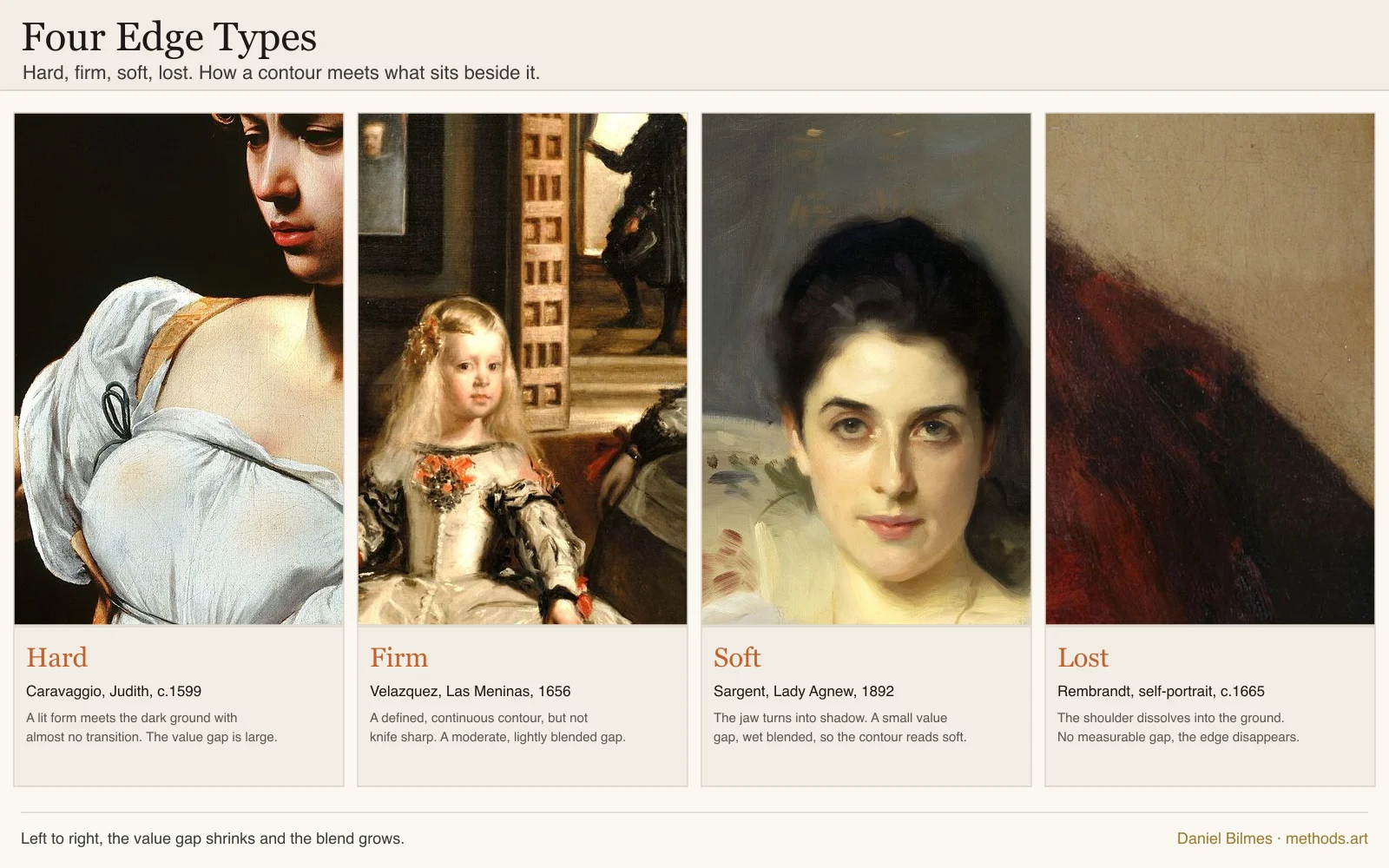
Four edge types in oil painting, from hard to lost: a hard edge in Caravaggio, a firm edge in Velazquez, a soft edge in Sargent, and a lost edge in Rembrandt dissolving into the ground.
The three-value thumbnail, three more compositions
The three-value thumbnail, second set: three more compositions reduced to three value brackets (darks, mids, lights) at each painting's true proportions, Velazquez's Las Meninas (318 by 276 cm), Rembrandt's The Night Watch (363 by 437 cm), and Sargent's The Daughters of Edward Darley Boit (222 by 222 cm).
Quartz ground on linen or chalk ground on oak, followed by a thin warm-brown imprimatura.
Why: The canvas starts at a middle value, never white. The warm imprimatura is a working colour through the finished painting.
2. Tonal block-in (dead-coloring)
Thin brown paint establishing the major masses of light and shadow across the whole composition. Often very loose, more like a thought than a drawing.
Why: Establishes the painting's tonal architecture quickly. Infrared shows this stage was deliberately rough — Rembrandt left himself room to find the painting.
3. Working in islands
Brought specific passages near to finish while adjacent areas remained sketch.
Why: The test is emotional coherence, not uniform advance. When the face carries the natural movement, the rest can resolve around it.
4. Reworking on the final surface
Repeated substantial revision — hands moved, hats shifted, figures painted out entirely. In many paintings the pentimento remains faintly visible.
Why: The canvas is the thinking space. Composition is found in paint, not transferred from a finished drawing.
Lead-white impasto, often scratched into with the brush butt. Lead-tin yellow for the sharpest accents.
Why: This is where the "rough manner" lived. The surface of paint is the subject, not a transparent window onto the subject.
How they studied
Rembrandt was formally taught for under four years and then never again. Jan Orlers, the burgomaster of Leiden who wrote him up in 1641 while he was still working, records three years with Jacob van Swanenburch, which was the ordinary term of an apprenticeship there, and says the boy could learn little beyond the first principles of his art from that master. Then came Amsterdam and Pieter Lastman, the history painter, and Orlers says he was there under six months. He went home to Leiden in 1624 to study and practise painting alone, in his own fashion, and he never went to Italy at all. The schooling he did not take, he later built for other people. Gerrit Dou entered his studio on 14 February 1628, seven weeks short of his fifteenth birthday, and stayed about three years, and Rembrandt was twenty one when he took him. After the move to Amsterdam came Carel Fabritius, Samuel van Hoogstraten, Nicolaes Maes and a long list of others, each paying about a hundred florins a year for the place. Hoogstraten is the one who wrote the teaching down, in his own treatise of 1678, which is why we have any of it at all.
The Artist in his Studio, from the Leiden years: a bare room with cracked plaster, jars on a table at the left, a second palette hanging on the wall and a heavy stone slab on a stand. The panel on the easel is turned away from us and the painter has walked back to the far wall to look at it, which is the actual subject of the picture.
Rembrandt van Rijn, The Artist in his Studio, circa 1626 to 1628, Museum of Fine Arts, Boston. Public domain, Wikimedia Commons.
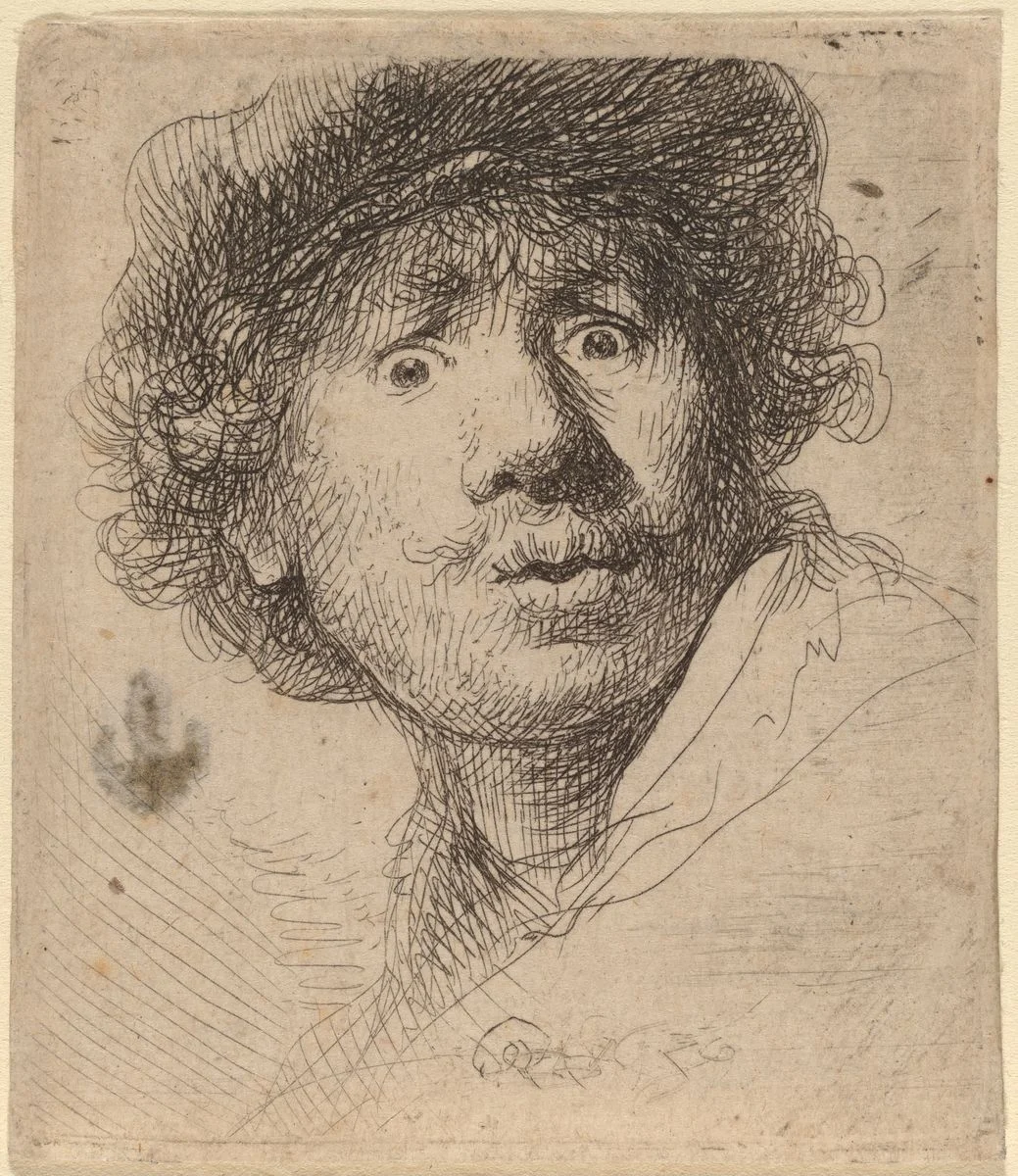
Self Portrait in a Cap, Open Mouthed, etched in 1630 on a plate five centimetres high: eyes wide, mouth open, the whole head built out of crosshatching. He worked expressions out on his own face in a mirror, at a scale small enough to try one in an afternoon.
Rembrandt van Rijn, Self Portrait in a Cap, Open Mouthed, 1630, National Gallery of Art, Washington. Public domain, Wikimedia Commons.
Source: The two apprenticeships and their terms, and the 1624 return to Leiden: Jan Orlers, Beschrijvinge der Stadt Leyden, 1641, quoted in Emile Michel, Rembrandt: His Life, His Work, and His Time, translated by Florence Simmonds, 1894, volume 1, pages 14, 15 and 23. Dou's birth date and the day he entered the studio: the same book, volume 1, page 38. The pupil fees: Joachim von Sandrart, quoted in the same book, volume 1, page 196. Medium, date, dimensions and holding museum for each figure: read from the museum record through the Commons file.
Up close
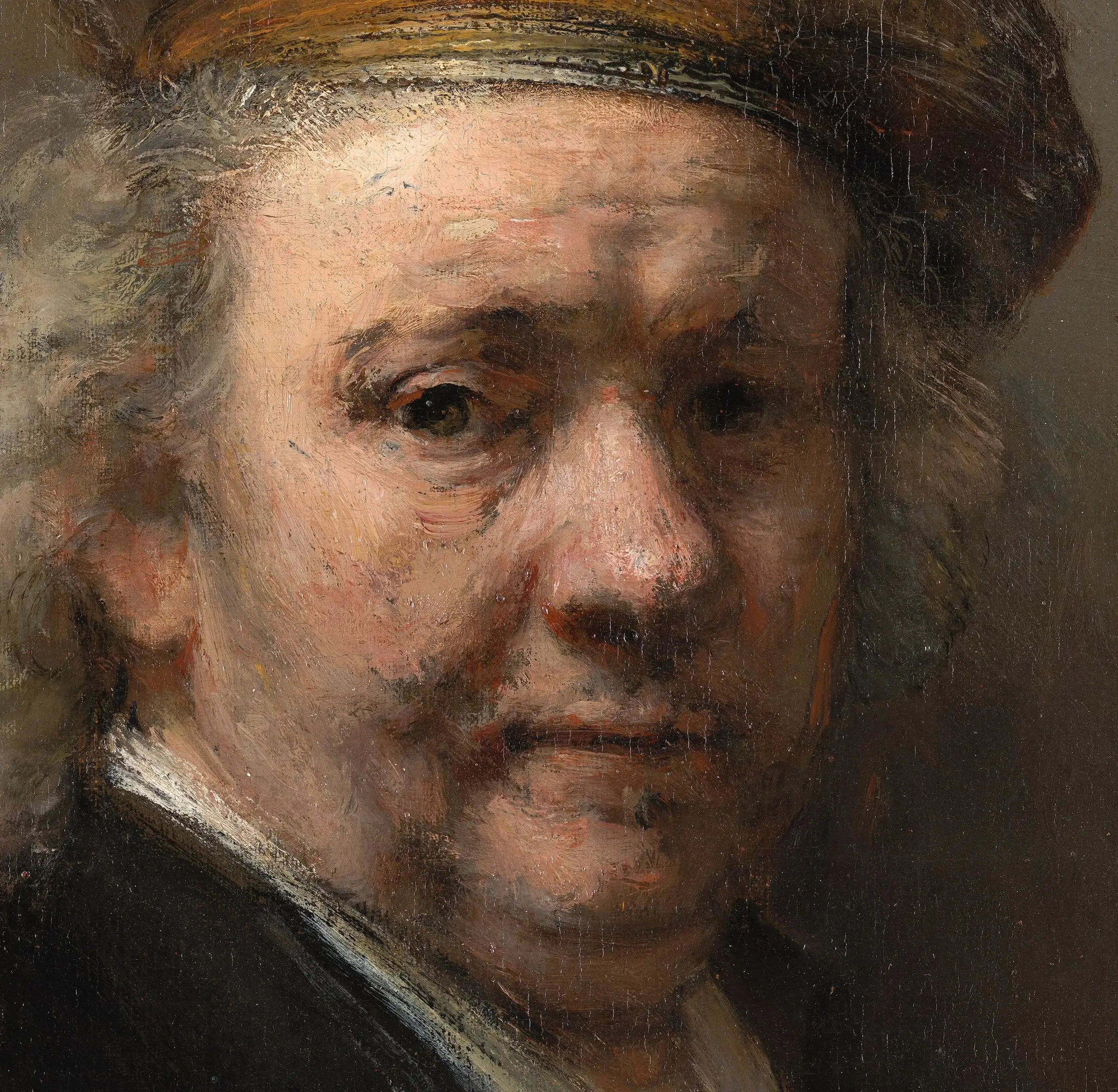
Detail of the last self portrait, painted in the year he died: the lit forehead, the cheek and the end of the nose are laid on thick and left rough, with the paint standing up off the canvas, while the shadow side of the face stays thin and smooth. The brightest part of the picture is also the highest.
Rembrandt van Rijn, Self Portrait (detail), 1669, Mauritshuis, The Hague. Public domain, Wikimedia Commons.
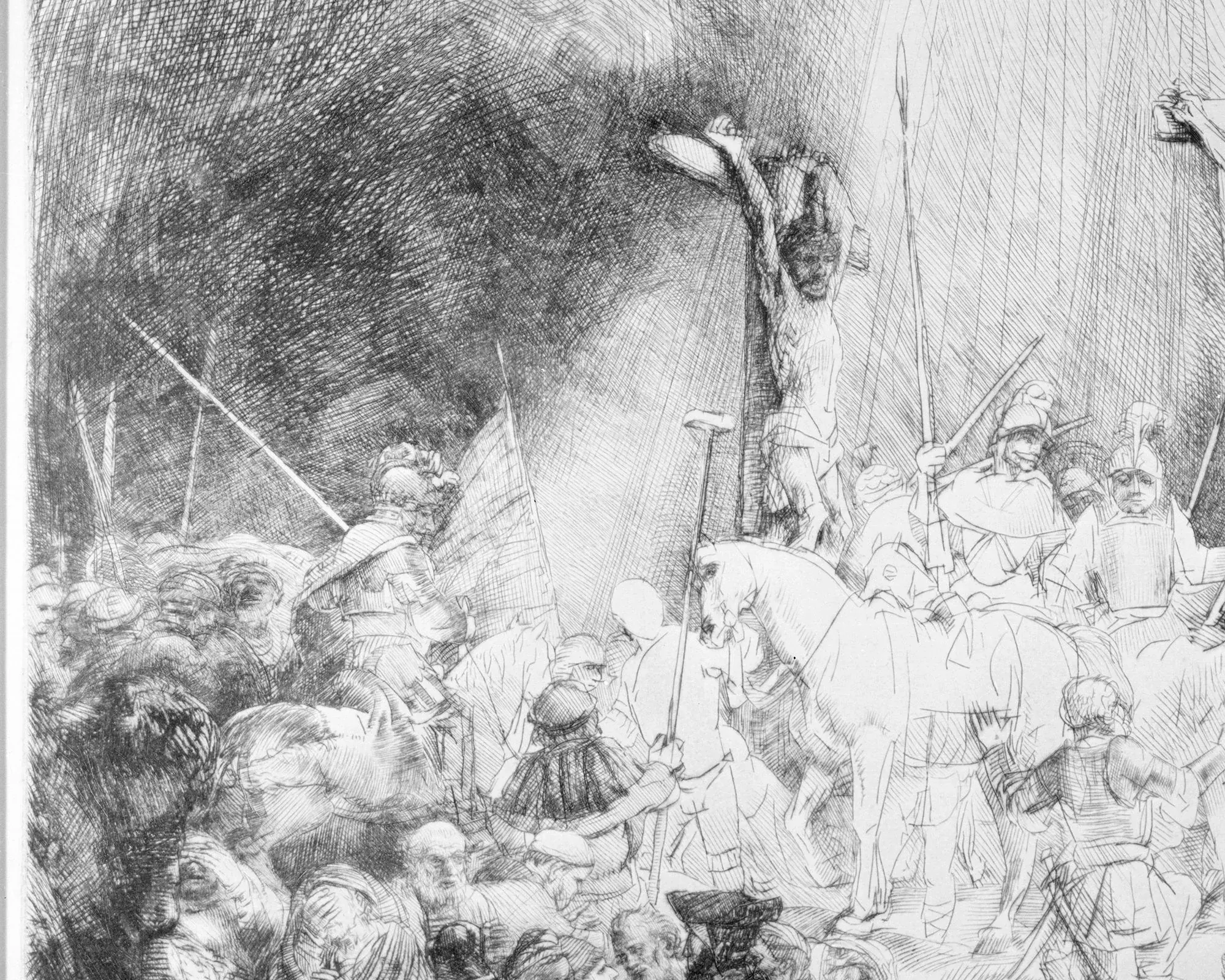
Detail of The Three Crosses in its third state, dated 1653: the left of the plate is a crowd in full light, the pikes, the white horse, the soldier in armour and the row of onlookers all held in clear open line, with the bare paper doing most of the work.
Rembrandt van Rijn, Christ Crucified between the Two Thieves, The Three Crosses (detail, third state), 1653, The Metropolitan Museum of Art, New York. Public domain, Wikimedia Commons.
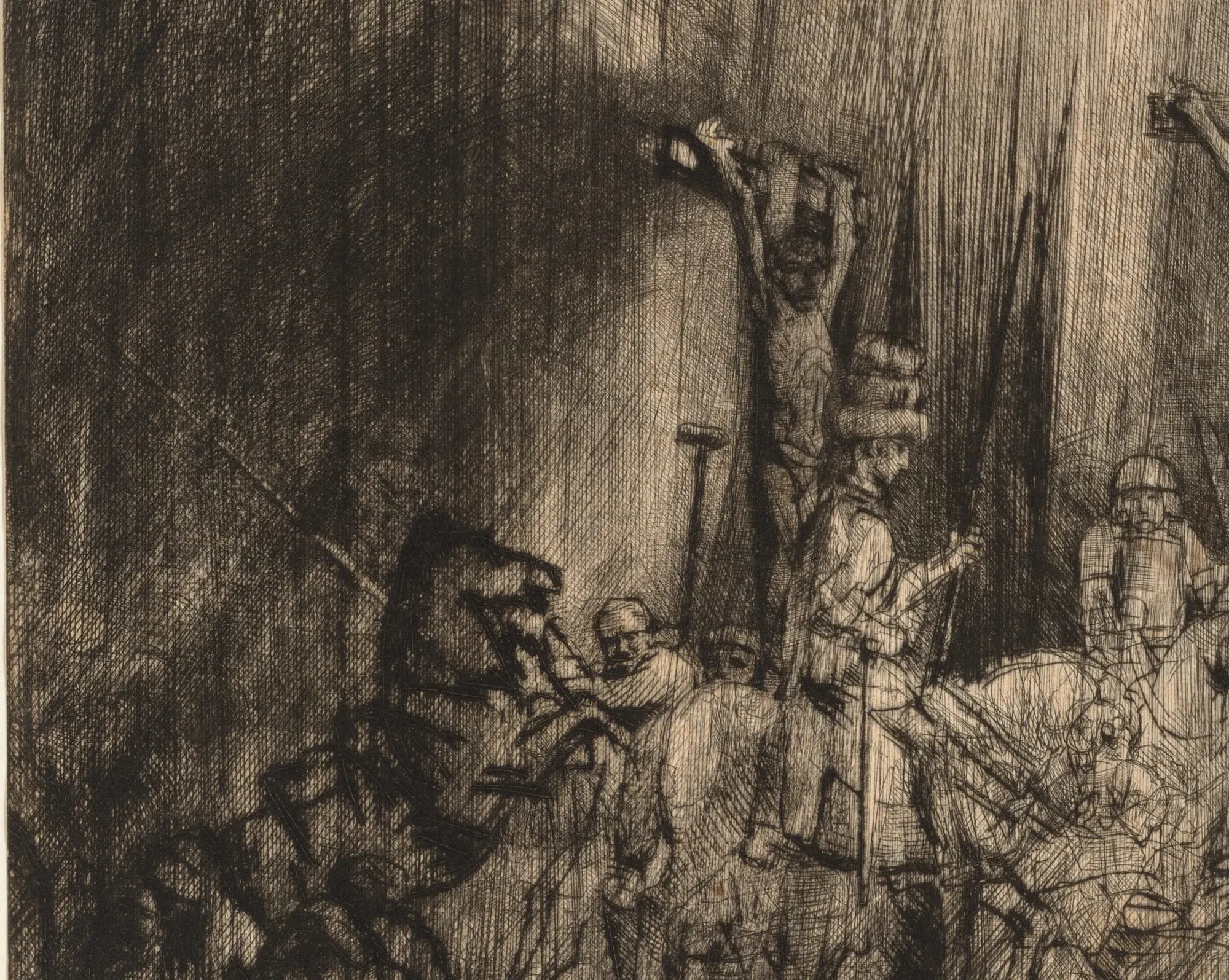
The same part of the same copper plate in the fourth state: he cut new drypoint straight across the crowd until it went dark, and drove a horseman in where the onlookers had been standing. The Cleveland Museum of Art records that the plate was worn out after about forty impressions of the first three states, which is why he went back into it.
Rembrandt van Rijn, Christ Crucified between the Two Thieves, The Three Crosses (detail, fourth state), 1653 to about 1660, The Cleveland Museum of Art. Public domain, Wikimedia Commons.
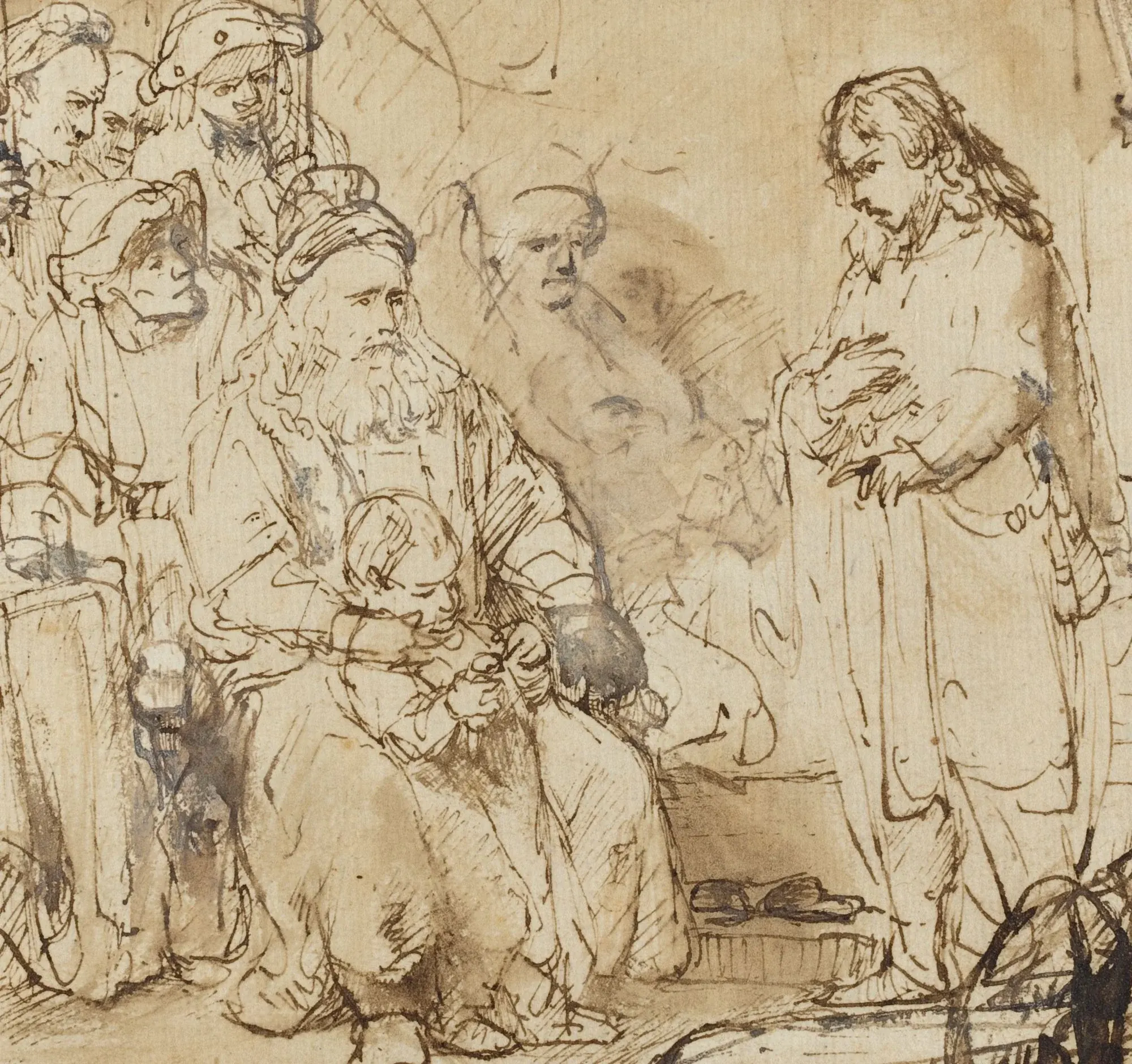
Detail of Joseph Recounting His Dreams: the reed nib is blunt, so the beard and the heavy folds are a few wide strokes with dry breaks running through them. The head behind the seated man was washed back with the brush and left standing as a ghost instead of being taken out.
Rembrandt van Rijn, Joseph Recounting His Dreams (detail), early 1640s, National Gallery of Art, Washington. Public domain, Wikimedia Commons.
Watching him work
“Make it your endeavour to turn the knowledge you already possess to good account; the unknown things that torment you will reveal themselves in due season.”
Rembrandt to his pupil Samuel van Hoogstraten, who had been plying him with questions, Hoogstraten, Inleyding tot de hooge schoole der schilderkonst (1678), rendered in Emile Michel, Rembrandt: His Life, His Work, and His Time, translated by Florence Simmonds, volume 2, pages 63 and 64, 1894 [source]
Across media
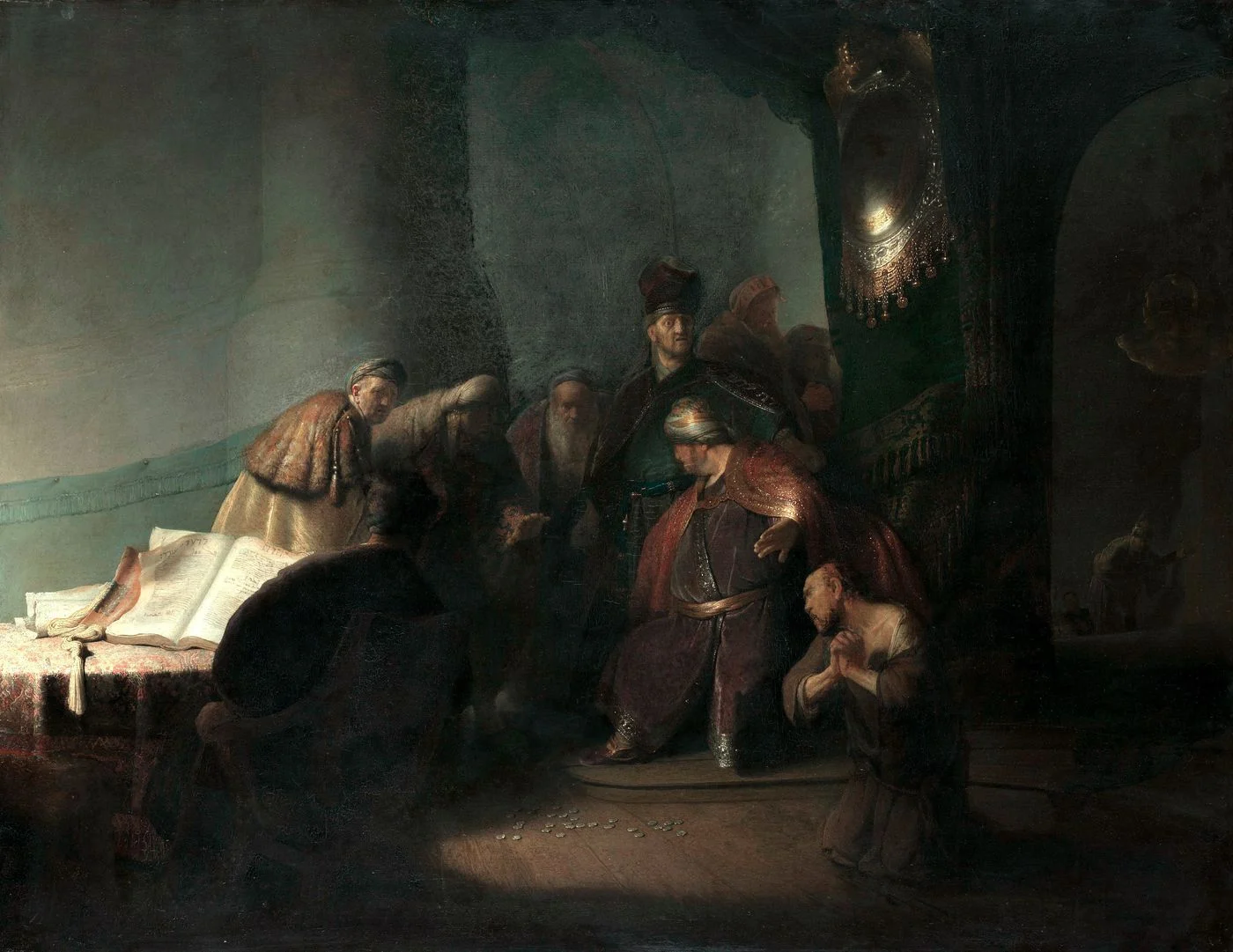
Judas Returning the Thirty Pieces of Silver, 1629, painted in Leiden at about twenty three. This is the picture Constantijn Huygens singled out, writing of the figure of Judas, beside himself, bewailing his crime, imploring the pardon he dares not hope for.
Rembrandt van Rijn, Judas Returning the Thirty Pieces of Silver, 1629, private collection. Public domain, Wikimedia Commons.
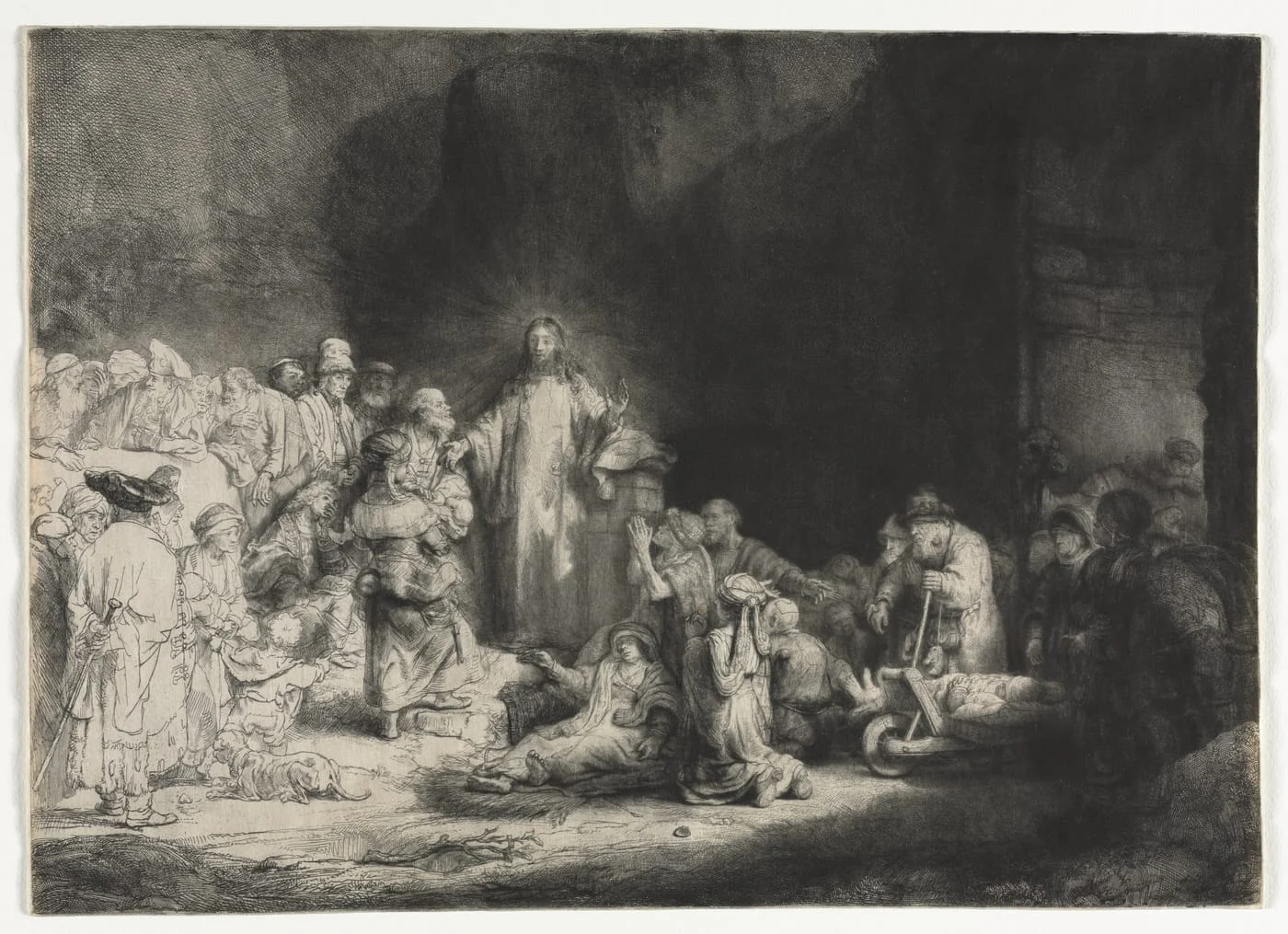
The Hundred Guilder Print, about 1649: three tools on one copper plate about twenty eight by thirty nine centimetres. Etched line bitten by acid, drypoint scratched dry into the metal so the raised burr holds ink and prints velvet black, and engraving cut with a burin.
Rembrandt van Rijn, The Hundred Guilder Print, circa 1649, The Cleveland Museum of Art. Public domain, Wikimedia Commons.
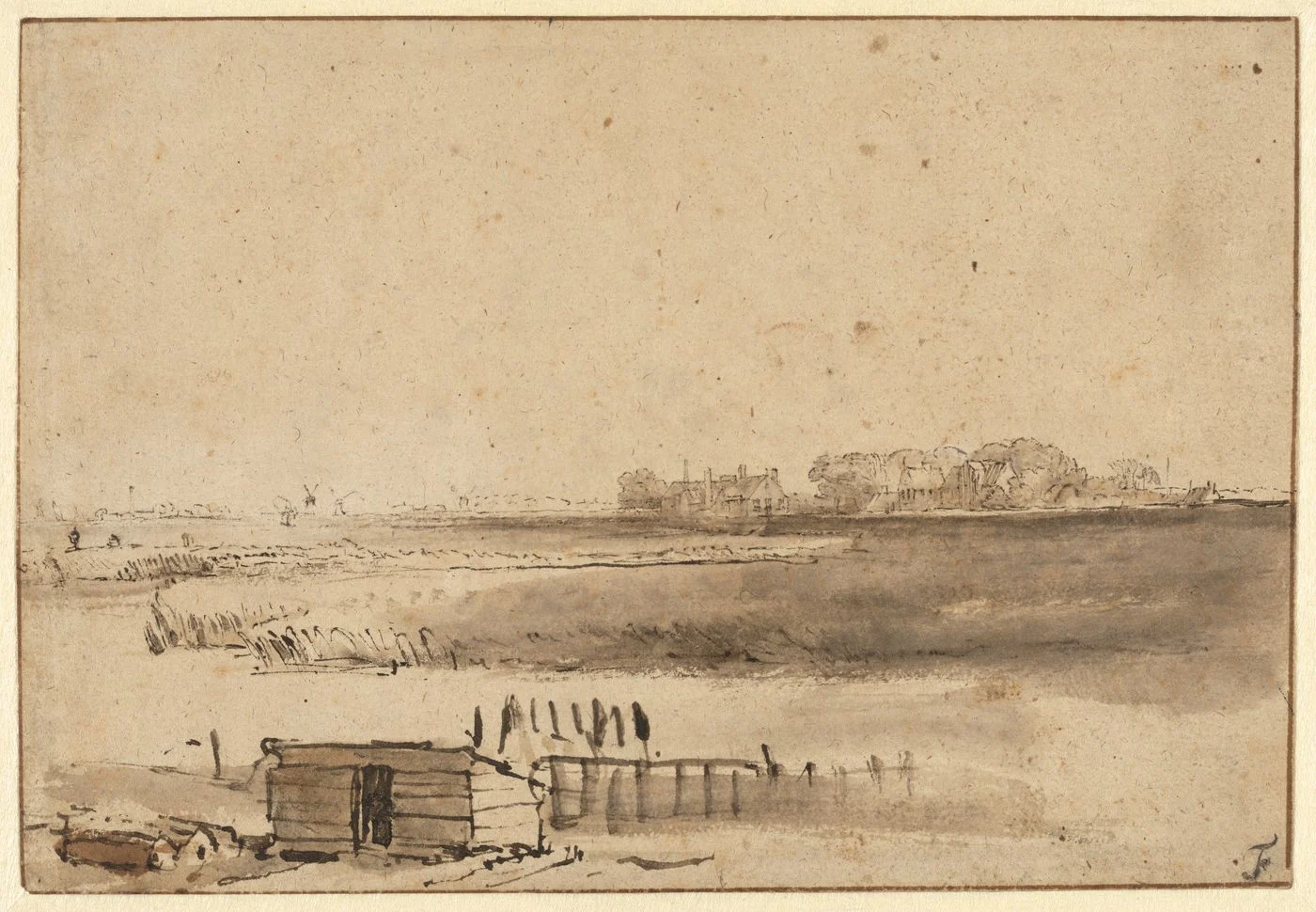
View of Houtewael near the Sint Anthoniespoort, about 1650: reed pen and brown ink with a grey brown wash, on a sheet twelve and a half by eighteen centimetres, made on the edge of Amsterdam. The far town is one dry line and the near shed carries all the dark.
Rembrandt van Rijn, View of Houtewael near the Sint Anthoniespoort, circa 1650, National Gallery of Art, Washington. Public domain, Wikimedia Commons.
The Jewish Bride, painted in the last years, a canvas one hundred and twenty one by one hundred and sixty six centimetres. Almost all of it is held quiet, which is what lets the one loaded passage, the gold sleeve, carry the whole picture.
Rembrandt van Rijn, Portrait of a Couple as Isaac and Rebecca, known as The Jewish Bride, circa 1662 to 1666, Rijksmuseum, Amsterdam. Public domain, Wikimedia Commons.
The record, deeper
The money
Sandrart, who was in Amsterdam between 1637 and 1641 and knew him, recorded that his house was frequented by numerous pupils of good family, each of whom paid him as much as a hundred florins yearly, exclusive of his profits from their pictures and engravings, which, in addition to his personal gains, brought him in some 2,000 to 2,500 florins. Michel prints the passage and adds that Sandrart probably overstated how many pupils there were.
Joachim von Sandrart, quoted in Emile Michel, Rembrandt: His Life, His Work, and His Time, translated by Florence Simmonds, 1894, volume 1, pages 196 and 251.
For a portrait or a picture in the same years he was taking between five hundred and six hundred florins, and he was counting on that income to pay off the house.
The Hundred Guilder Print is named for a price there is no record of him getting. An old inscription on the back of a first state impression in the Vienna Print Room gives forty eight florins as the price paid for the sixth impression.
When the creditors finally moved, the Bankruptcy Court ordered an inventory of all the pictures, furniture and household goods of the debtor, Rembrandt van Ryn, inhabiting the Breestraat, near St. Anthony's Lock. It was taken on 25 and 26 July 1656.
Bankruptcy Court order, 1656, quoted in Emile Michel, Rembrandt, translated by Florence Simmonds, 1894, volume 2, page 112.
The reworks
The Three Crosses is the clearest surviving record of him changing his mind where anyone can check it. The plate is worked entirely in drypoint, which throws up a burr of metal that holds ink and wears down fast. The Cleveland Museum of Art records that the plate was worn after about forty impressions of the first three states, that he reworked it to keep using it, and that in the fourth state slashing strokes obscure the spectators visible in the earlier version.
The Cleveland Museum of Art, object record for Christ Crucified Between the Two Thieves, The Three Crosses, accession 1959.241.
What they told students
Sandrart reported the position he held against the schools, that nature should be the artist's guide, and to her rules only should he submit. The same passage lists what he was setting at naught to hold it: established principles, the usefulness of antiques, Raphael's draughtsmanship and his admirable works, and the academic teaching so necessary to the profession.
Joachim von Sandrart, Teutsche Academie, 1675, quoted in Emile Michel, Rembrandt, translated by Florence Simmonds, 1894, volume 1, page 259.
Hoogstraten later told his own brother, who wanted to go to Rome, that he would find in his own country so many beauties that his life would be too short for their comprehension and expression, and that Italy, with all her loveliness, would be useless to him if he were unable to render the nature around him. Michel, who prints the passage, reads his old master in it.
Samuel van Hoogstraten, quoted in Emile Michel, Rembrandt, translated by Florence Simmonds, 1894, volume 2, page 64.
The studio
He bought the house on 5 January 1639, in the Jodenbreestraat, then a continuation of the Sint Anthonisbreestraat, for thirteen thousand florins, a quarter due a year after he took possession and the rest across five or six years. He wanted a place where he could set up his studio, install his pupils and arrange his collections. It still stands, as the Rembrandt House Museum at Jodenbreestraat 4.
Purchase terms: Emile Michel, Rembrandt, translated by Florence Simmonds, 1894, volume 1, page 257. Address: Museum Het Rembrandthuis.
The bankruptcy inventory doubles as a plan of the working floor. The studios were on the second storey, where the light was best. One was his own and opened into a small room where he kept his furs. The other, the same size, was for the pupils and was divided into five compartments, one of which held plaster casts of statues, models of arms and legs, and a quantity of antique fabrics.
The inventory of 25 and 26 July 1656, described in Emile Michel, Rembrandt, translated by Florence Simmonds, 1894, volume 2, pages 84 and 85.
Houbraken is the source for how the pupils were kept apart: each pupil worked in a cell, divided from his neighbour by partitions of canvas, or even of paper, so that he might be entirely undisturbed and independent of others, in his studies from nature. He was writing two generations later and his facts come mixed with anecdote, which Michel says plainly, so it is best read as studio memory rather than as a document.
Arnold Houbraken, De groote schouburgh, 1718, quoted in Emile Michel, Rembrandt, translated by Florence Simmonds, 1894, volume 1, pages 251 and 252. The reliability caveat is Michel's own, in the author's introduction to volume 1.
The materials
The ground changed when the method did. In the earlier Amsterdam years he often used a double ground on canvas, a cheap red brown earth layer to fill the weave and a cooler light grey layer of lead white and chalk over it. From about the time of the Night Watch the studio switched to a single rough ground of clay and finely ground quartz, and no other Amsterdam workshop of the period is known to have used one.
Karin Groen, Grounds in Rembrandt's Workshop and in Paintings by His Contemporaries, in Art in the Making: Rembrandt, National Gallery, London.
The drawing kit was a reed pen and brown ink over brush washes. The nib is cut from a length of reed, holds a lot of ink, spreads under pressure and goes dry in a few strokes, and several of the sheets carry white heightening put back over the top.
Medium lines for the two drawings on this page, National Gallery of Art, Washington.
Refusals — what they would not do
Refused academic uniform finish — let some passages stay sketch.
Refused to hide pentimenti — the changes remained faintly visible.
Refused to imitate Italian smoothness — the rough manner was a deliberate position.
Refused to confine training to a single style — partitioned the studio so each pupil could develop their own.
Refused elite social demands after Saskia's death — sought "freedom, not honor."
Reference
Primary source
Live models — wide and deliberately unfashionable sitter base. Common types from Amsterdam alongside elite commissions.
Photography
Predates photography. Reference archive was the "rarities" collection in the studio plus prints and drawings of other masters.
Exceptions
For landscapes: pen-and-ink sketches in the fields around Amsterdam, then composed finished etchings and paintings in the studio from the sketches and from memory.
Used "reverse-proofing" in his etching practice — pressed a wet print against a fresh plate to create a mirror image — for re-composing landscapes on the second plate.
Jacob van Swanenburgh · from around 1621 — Foundational training in Leiden — basics of painting and etching.
Pieter Lastman · around 1624 — Six critical months in Amsterdam. Lastman taught history painting — the dramatic narrative mode, figure in action, lighting of biblical or classical scene as theater. Foundation of Rembrandt's subject vocabulary.
Influences
Caravaggio (via Italian prints and through the Utrecht Caravaggisti).
Through Hoogstraten's treatise, the lineage runs into eighteenth-century Dutch academic thinking and through nineteenth-century rediscovery into Manet, the French Realists, the German Expressionists, Auerbach and Freud.
In their own words
“In these two paintings, the greatest and the most natural movement is observed, which is also the reason I have kept them so long in my hands.”
— Rembrandt van Rijn, Letter to Constantijn Huygens, January 12, 1639, 1639
On the long duration of the Passion paintings commissioned by Prince Frederik Hendrik.
“The work will show best in the gallery of His Excellency, as there is a strong light there.”
— Rembrandt van Rijn, Letter to Constantijn Huygens, 1639
“A work is finished when the master has achieved his intention in it.”
— Rembrandt van Rijn, Recorded by Arnold Houbraken, De groote schouburgh, 1718
“I am a painter, not a dyer.”
— Rembrandt van Rijn, Recorded by Roger de Piles, L'Abrégé de la vie des peintres, 1699
Responding to criticism of the rough, visible brushwork in his late paintings.
“Because I want to keep my spirit unfettered, I seek freedom, not honor.”
— Rembrandt van Rijn, Recorded by Arnold Houbraken, De groote schouburgh, 1718
“A painter should be as separated from another as one mountain is from the next.”
— Rembrandt van Rijn, Recorded by Samuel van Hoogstraten, Inleyding tot de hooge schoole der schilderkonst, 1678
A quartz ground on linen, made of ground quartz, lead white, and a little earth pigment, which gave a strong textured grip that held heavy impasto without sinking. Over it he laid a thin warm-brown imprimatura that stayed visible as the middle tone, and his early Leiden panels used a chalk ground on oak.
What was Rembrandt's palette?
A restrained, earth-anchored palette: lead white for the impasto lights, the full earth range of yellow and red ochre, raw and burnt sienna, and raw and burnt umber, lead-tin yellow for the sharpest accents, and bone and vine black.
What brushes and tools did Rembrandt use?
Hog-bristle brushes for the textured passages and impasto, soft-haired brushes for transitions, and the butt end of the brush scratched into wet lead white to pull out hair, lace, and fabric weave.
How did Rembrandt build a painting?
He blocked the whole composition in thin brown dead-color, then worked in islands, bringing some passages near to finish while others stayed as sketch, and revised heavily on the final surface. Many paintings keep faint pentimenti from the reworking.
How long did a Rembrandt take?
Major canvases were worked over many months, with repeated revision on the final surface rather than a single pass.
What is a quartz ground?
A quartz ground is a canvas priming made of clay mixed with a high proportion of finely ground sand, or quartz, which gives a rough, gritty, semi-translucent surface with strong tooth. Rembrandt's studio used it from about 1642 onward, and because no other Amsterdam workshop of the period used it, finding one is a strong sign a painting came from his studio.
How did Rembrandt prepare his canvas?
In his earlier Amsterdam years he often used a double ground: a cheap red-orange earth layer to fill the canvas weave, then a cooler light-gray layer of lead white, chalk, charcoal, and earth on top. From about 1642 his studio switched to a rough quartz ground of clay and sand. Over either ground he laid a thin warm-brown imprimatura that stayed visible as the middle tone.
How did Rembrandt paint skin?
He built the lit flesh in thick lead-white impasto, laid on to physically catch the light and stand off the surface, then once it dried he dragged thin glazes over the texture and wiped the peaks clean, leaving color in the low spots. The result is rough, lifelike skin built in real relief rather than smooth blending.
Did Rembrandt use glazes?
Yes. He glazed thin transparent color, often red lake, over dried impasto and wiped it back so it settled in the recesses. Conservation analysis shows he bulked these glazes with chalk for body and ground glass to speed drying.
If this painter is your match
You believe a painting is finished when its intention lands, not when every square inch has been brought to the same polish. The unresolved passage at the edge of the canvas is not a failure. It is the condition for the resolved passage at the center.
Borrow this: Prepare a canvas with a warm buff or brown imprimatura and keep it as the middle tone in the finished painting. Paint only the lights and the deepest shadows. Leave a third of the surface as the preparation layer, untouched.
Rembrandt van Rijn, Correspondence with Constantijn Huygens, 1639. The only substantial surviving letters in Rembrandt's own hand. Seven letters to the secretary of Prince Frederik Hendrik, 1636–1639.[link]
Samuel van Hoogstraten, Inleyding tot de hooge schoole der schilderkonst, 1678. Written by Rembrandt's former pupil. Primary source on his teaching method and studio arrangement.
Arnold Houbraken, De groote schouburgh der Nederlantsche konstschilders en schilderessen, 1718. Houbraken was a pupil of Hoogstraten — second-generation studio memory. The most detailed biographical source on Rembrandt's working life within living memory of his circle.
Roger de Piles, L'Abrégé de la vie des peintres, 1699. French theorist writing within a generation of Rembrandt's death. Source for several of his most-cited aphorisms on the rough manner.
Rembrandt Research Project, A Corpus of Rembrandt Paintings (6 volumes), 2014. Half-century collaborative technical examination. Primary modern source for ground preparations, layer structure, pigment identification, and attribution.
Art in the Making: Rembrandt, National Gallery London, 2006. Identifies the quartz ground, documents the layer sequence, and analyzes specific passages (including A Woman Bathing in a Stream) in detail.
Emile Michel, Rembrandt: His Life, His Work, and His Time, volume 1, translated by Florence Simmonds, 1894. The public-domain English edition, checked against the full text. Prints Orlers on the three years with Swanenburch and the under six months with Lastman, Huygens on the Judas of 1629, Sandrart on the pupil fees and on nature as the only guide, Houbraken on the partitioned cells, and the terms of the 1639 house purchase. Michel also states the reliability caveat on Houbraken in his introduction.[link]
Emile Michel, Rembrandt: His Life, His Work, and His Time, volume 2, translated by Florence Simmonds, 1894. Carries the advice Hoogstraten remembered being given, the same pupil on Rome, the room by room reading of the 1656 inventory including the pupils' five compartments, the Bankruptcy Court wording, and the price recorded in Vienna for an early impression of the Hundred Guilder Print.[link]
Jan Orlers, Beschrijvinge der Stadt Leyden, 1641. The earliest account, written by the burgomaster of Leiden while Rembrandt was alive and working. Source for both apprenticeships, their length, and the 1624 return to Leiden to study and practise painting alone.
The Cleveland Museum of Art, object record for Christ Crucified Between the Two Thieves, The Three Crosses, accession 1959.241. Documents the drypoint wear after about forty impressions of the first three states and the fourth-state reworking that buries the spectators.