Van Dyck painted the head and hands from life in swift, direct opaque colour, pure oil with no added medium, on fine-weave linen primed with a light gray or warm buff tinted ground that stayed visible in the halftones. He never worked more than one hour at a time on a single portrait, so multiple canvases advanced in parallel across a working day. After the block-in he sketched the costume onto the canvas and handed it to assistants, who copied the drapery in thin Venetian glazes from the sitter's actual garments left in the studio. At a second one-hour sitting he finished the head and hands from life and retouched the workshop passages into his own handling.
Never worked for more than one hour at a time on a single portrait — whether in initial sketch stage or final retouching. After an hour rose, bowed to the client, and dismissed them; the next sitter was prepared in an adjacent room.
Why it matters · Multi-portrait parallel production becomes possible when each session has a hard cap. Drying time is built into the natural gaps between appointments. Painters who let sittings run produce one portrait at a time and starve the studio.
Roger de Piles, Cours de peinture par principes, 1708
Hand the clothing to assistants — keep the head and hands
Painted head and hands from life himself; sketched the costume and posture onto the canvas, then handed the canvas to assistants. The sitter's actual garments were left in the studio for the assistants to copy directly into the painting.
Why it matters · The painter's hand has to be reserved for the decisions that actually require it. Head and hands carry the painting. Painters who execute every inch themselves are spending the master's attention on infrastructure.
Roger de Piles, L'Abrégé de la vie des peintres, 1699
Retain sitters for dinner to observe them off-pose
Often kept sitters for dinner after the session so he could observe them "free from the constraint of posing" — research for what would go into the head and hands at the next sitting.
Why it matters · A held pose is a held face. The dinner is methodological — the painting requires character that cannot be captured during the sitting itself. Same logic Repin would document two centuries later.
Roger de Piles, Cours de peinture par principes, 1708
Two registers — direct for head and hands, glazed for drapery
Head and hands worked in relatively direct, swift opaque colour ("merveilleux promptitude") closer to Hals's alla-prima than Rubens's layered method. Draperies, silks, armor, backgrounds shifted toward the thin luminous glazes of the Venetian tradition.
Why it matters · The painting has different parts requiring different handling. Most painters apply one register to everything. Van Dyck's discipline of switching modes within a single canvas is the cleanest case for matching technique to passage.
Maintain the Iconography as a working reference library
From the mid-1630s onward produced a series of etched portraits of famous contemporaries (the Iconography) — independent work and a reference collection he could pull from for poses, facial constructions, and typologies when planning new commissions.
Why it matters · A painter's previous work is part of the archive. The Iconography is both finished work and ongoing reference. Painters who treat finished work as terminal lose the option to draw on their own vocabulary later.
"Nature is not as she is, but as we think she ought to be"
The portrait was simultaneously a specific likeness and an idealized nobility — the ideal extracted from the sitter, not imposed on them.
Why it matters · The painter's job is to render the sitter accurately as a specific person and to elevate them into the ideal version of that person. The ideal is not invented. It is found in the specific.
Recorded by Roger de Piles, Cours de peinture par principes, 1708
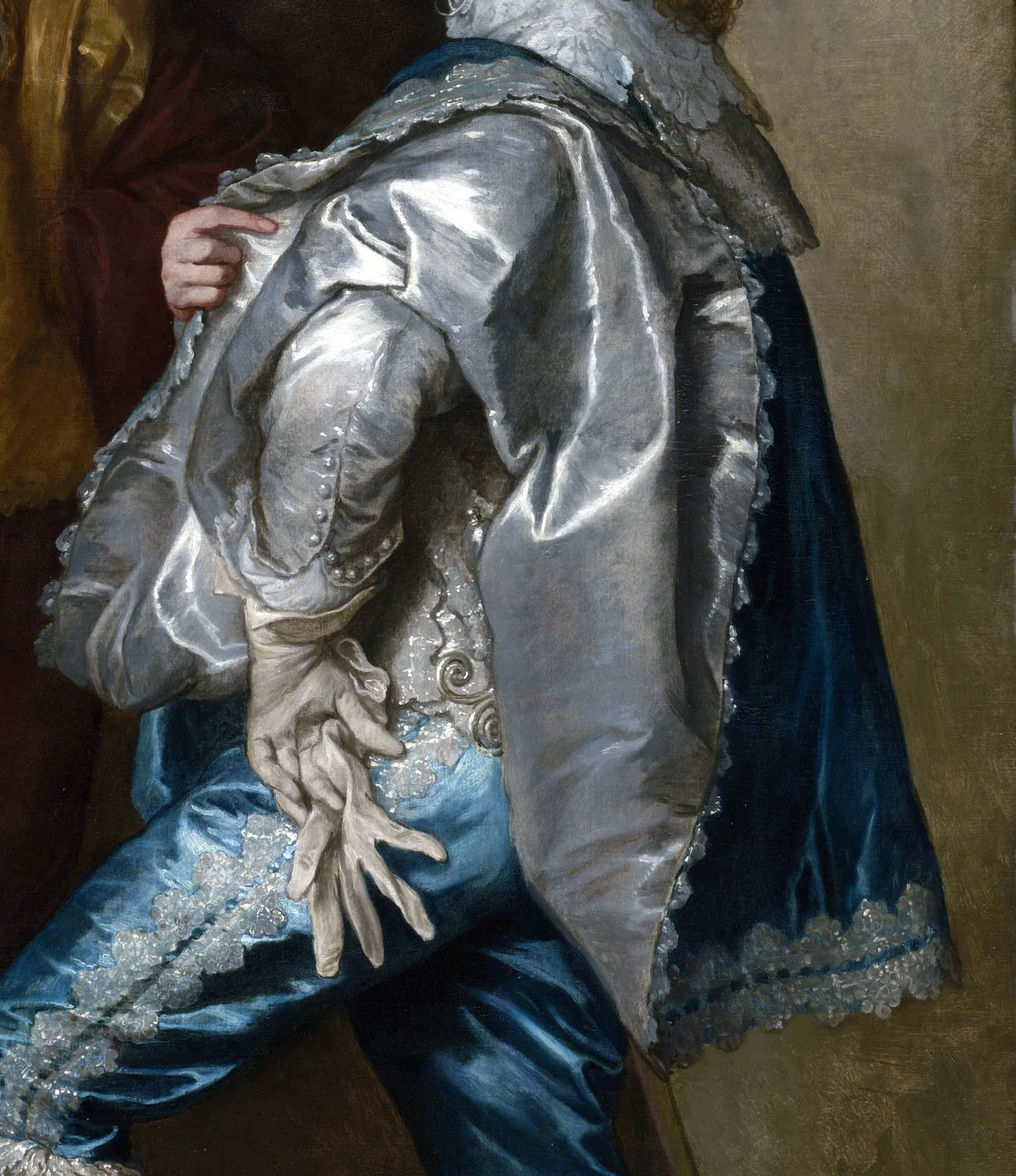
Undermodel the satin, then scumble the colour loosely over it
The National Gallery found that the blue satin in the Stuart double portrait was built in two separate operations. First the shadows were undermodelled in indigo and the mid tones in indigo mixed with white. Then greenish mineral azurite, and azurite mixed with indigo, was scumbled over the dry surface.
Why it matters · The sheen in satin is not a highlight. It is a broken top layer sitting loosely over a darker layer that is already right in value. Build the fabric in one pass and it stays a coloured shape. Build the dark first and drag the colour across it and the cloth starts reflecting light, because the surface of the paint is now doing what the surface of the cloth does.
Ashok Roy, The National Gallery Van Dycks: Technique and Development, National Gallery Technical Bulletin, volume 20, 1999
Detail of the Stuart double portrait: Lord Bernard's blue is not one blue. The National Gallery found indigo undermodelling in the shadows, indigo mixed with white in the mid tones, then a scumble of greenish mineral azurite dragged over the top. The shine is the last thin layer sitting loosely on a darker one, not a light painted on.
Anthony van Dyck, Lord John Stuart and his Brother, Lord Bernard Stuart (detail), circa 1638, The National Gallery, London. Public domain, Wikimedia Commons.
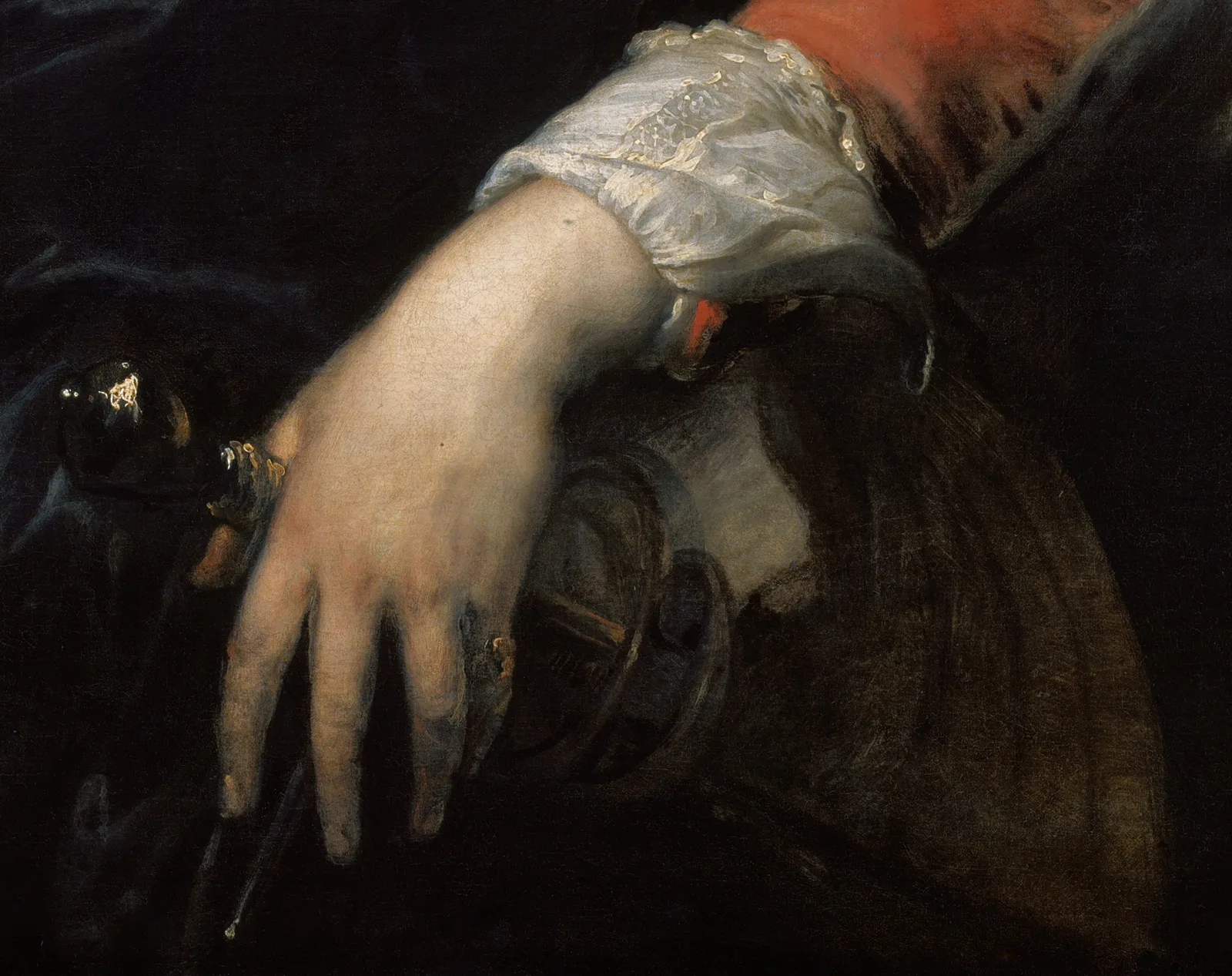
Keep paid models in the house for the hands
The sitter gave him an hour and the hands were not painted in it. Jabach, who sat to him three times, told Roger de Piles that as for hands, he had in his house people of both sexes, whom he paid, and who served as models.
Why it matters · A hand takes longer than a face and nobody holds one still. Separating the two means the hand can be studied from a model who is being paid to hold the pose, at the painter's pace, while the sitter's hour is spent entirely on the head. De Piles adds the cost of the arrangement in his own words, that there is nothing so rare as fine hands, either in design or colouring.
Eberhard Jabach to Roger de Piles, The Principles of Painting, London, 1743, pages 177 and 178, the English translation of the Cours de peinture par principes, 1743
Detail of the portrait of Nicolas Lanier: the hand is longer than a hand, the fingers taper and separate, and the shape is designed before any colour goes on it. Roger de Piles told painters that if an opportunity serves of copying hands after Vandyke, it must not be let slip.
Anthony van Dyck, Nicolas Lanier (detail), circa 1628, Kunsthistorisches Museum, Vienna. Public domain, Wikimedia Commons.
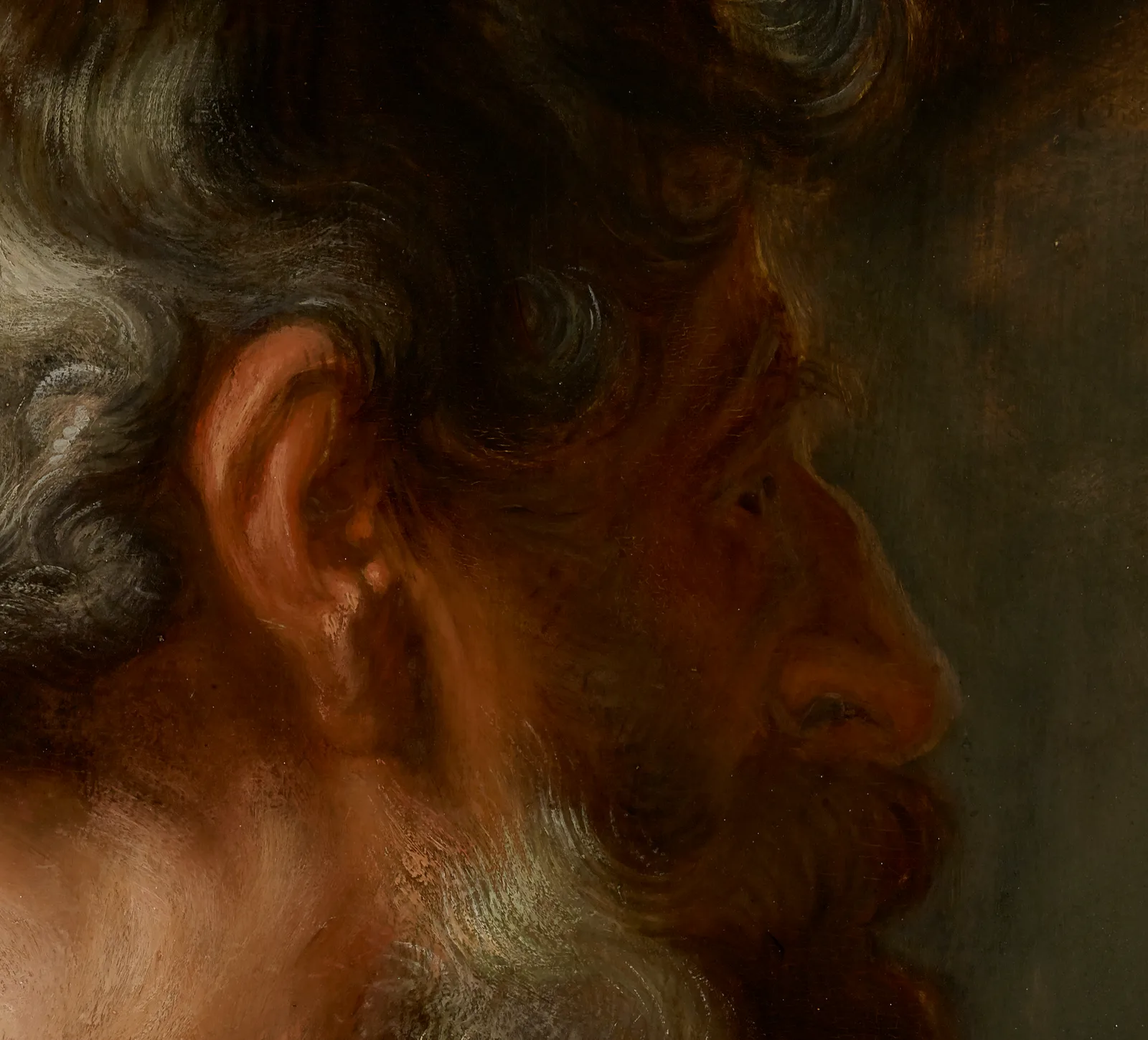
Blend the flesh while it is still soft, and let the tool leave the mark
Bellori says plainly that his way of painting was to work alla prima. In the early Antwerp study heads the transitions in the flesh are made by dragging one wet colour into the next, and the curls in the hair are twisted in with the point of the brush before the paint sets.
Why it matters · Wet paint joins to wet paint without an edge. Wait a day and the same join has to be faked with a glaze or a soft brush, and it never looks the same. The cost is that the whole passage has to be finished in one sitting, which is exactly why the hour was capped and why the head came first while the palette was fresh.
Giovanni Pietro Bellori, Le vite de' pittori, scultori et architetti moderni, first published Rome 1672, 1672
Detail of the Apostle Simon, painted on an oak panel sixty four centimetres tall when he was about nineteen: the warm red behind the ear runs straight into the cool grey of the temple with no seam between them, because both were wet at once. The curls are twisted in with the point of the brush while the paint is still soft.
Anthony van Dyck, The Apostle Simon (detail), about 1618, The J. Paul Getty Museum, Los Angeles. Public domain, Wikimedia Commons.
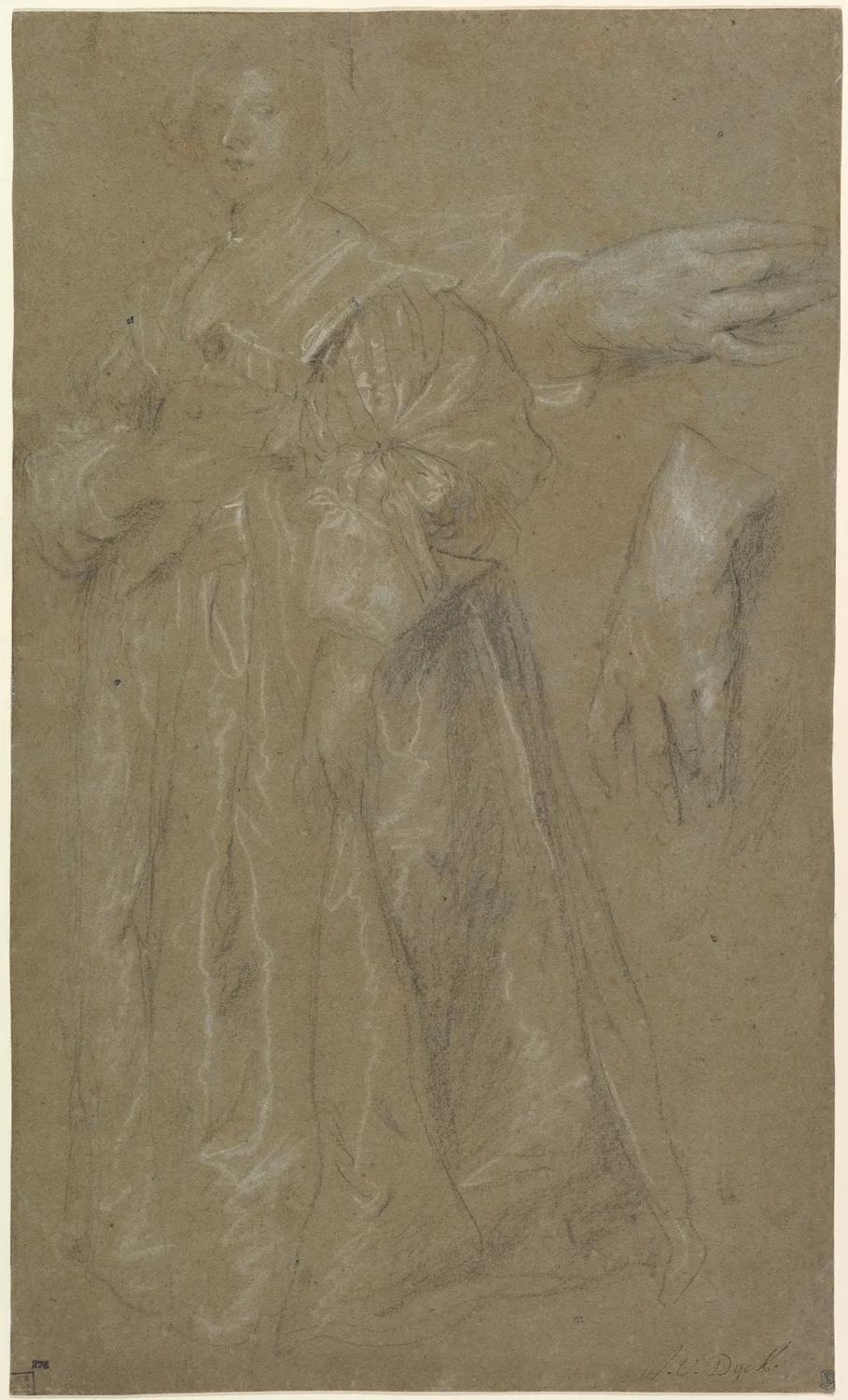
Draw the figure and the clothes in a quarter of an hour, then hand the drawing over
Jabach described the step between the sitting and the workshop. After the face had been lightly dead coloured, the sitter was put into a pose he had contrived beforehand, and on grey paper, with white and black chalks, he designed in a quarter of an hour the shape and the drapery. That sheet went to the assistants along with the sitter's actual clothes.
Why it matters · The drawing is the brief. It fixes the pose, the fall of the cloth and the light before anyone else touches the canvas, which is what makes delegation safe. Hand a painter a garment with no drawing and you get their taste in the picture. Hand them a garment and a chalk sheet made in front of the sitter and you get yours.
Eberhard Jabach to Roger de Piles, The Principles of Painting, London, 1743, page 177, 1743
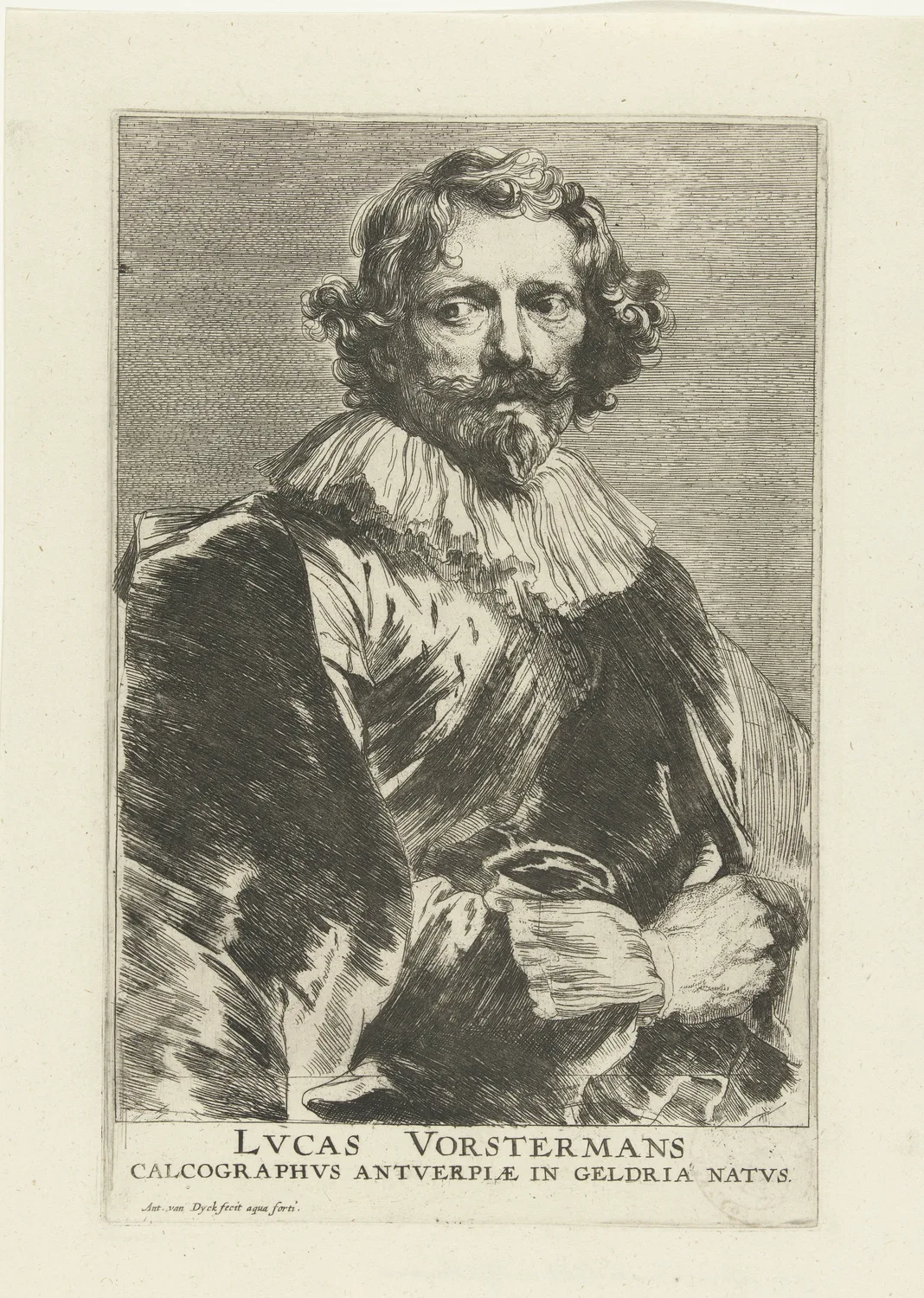
Etch the head yourself and leave the rest of the plate to the engraver
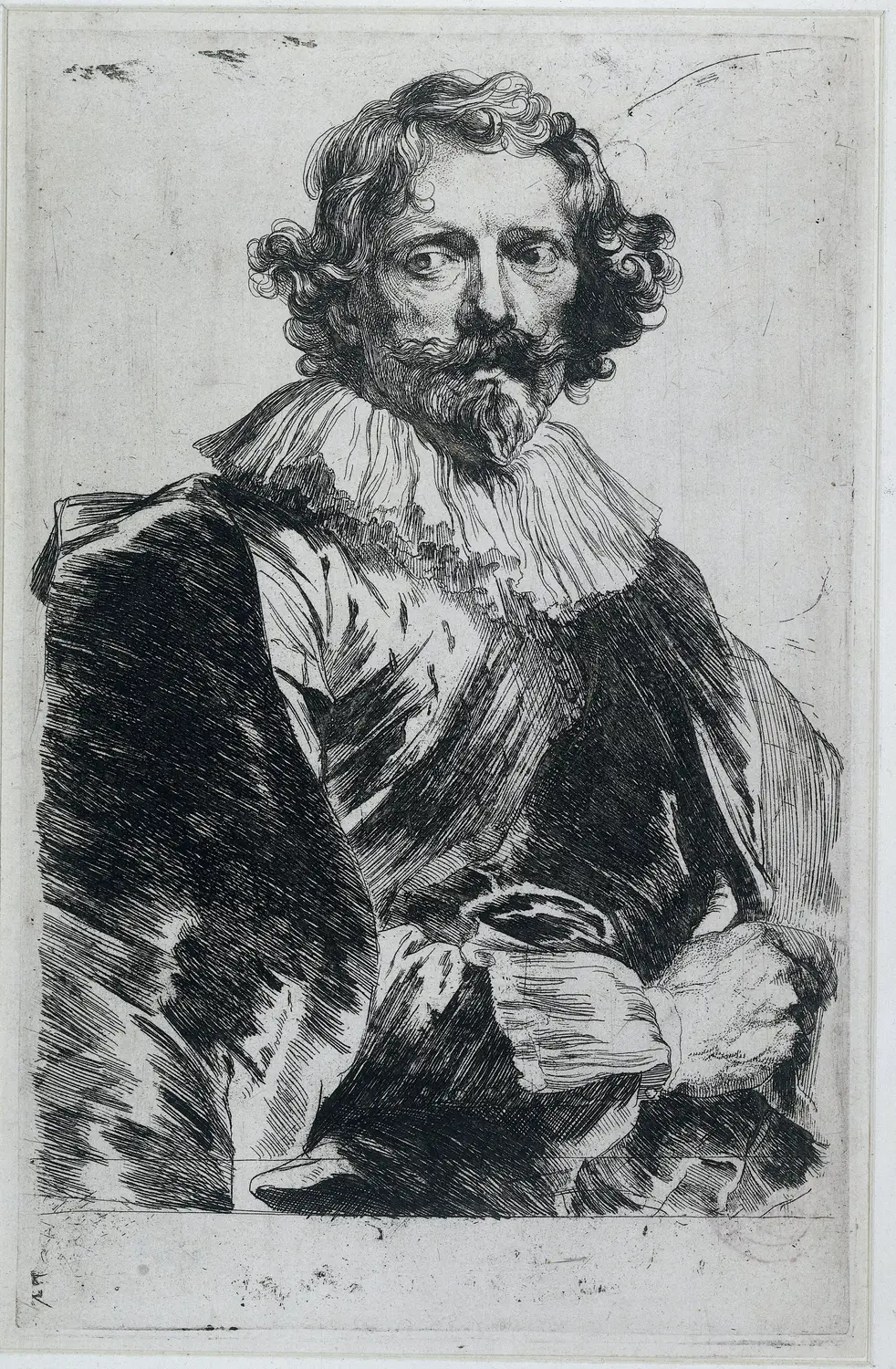
The Iconography plates he worked himself exist in a first state that is nothing but his own etched line: a finished head, a shorthand coat, and bare paper behind it. Later states of the same copper carry a ruled background, a border and lettering cut by an anonymous engraver.
Why it matters · Printmaking made the division of labour public. The same rule he ran in paint, his hand on the head and other hands on everything around it, is visible here as two impressions of one plate that anyone can lay side by side. It also shows what he thought was worth his own time, which was the face and nothing else.
Rijksmuseum object records for RP-P-BI-7417 and RP-P-OB-11.728, with the New Hollstein and Mauquoy-Hendricx state numbers
In the studio
Anthony van Dyck, Self-portrait, c. 1620
Studio
Light
London Blackfriars studio provided by King Charles I after his 1632 appointment as Principal Painter.
Position
Standard easel work; sitter physically present for one hour at a time.
Session length
Strict one-hour cap per sitting. Multiple portraits run in parallel across a single working day, each advancing one hour per appointment.
Tools
Soft brushes optimized for aristocratic sprezzatura · Chalk on gray paper for life studies of head and hands during the sitting · Sitters' actual garments retained in the studio for workshop completion · Etching tools (the parallel Iconography practice from mid-1630s onward)
Notes
Studio was a destination for courtiers, collectors, and other painters. Held a prestigious royal appointment; knighted by Charles I in 1632. The social atmosphere was part of the pitch — a sitting with Van Dyck was a social event as well as a commission.
Source: Roger de Piles, Cours de peinture par principes, 1708
Palette
Ground
Fine-weave linen with light gray or warm buff tinted ground (the Flemish standard inherited from Rubens). Remained visible in the halftones of the finished painting.
Whites
Lead white
Earths
Range of pearly grays mixed from lead white and earths · Standard Flemish earth range for darks
Pure oil for head and hands (no-medium direct-oil register); thin Venetian glazes for drapery and backgrounds.
Source: Susan Barnes, Nora De Poorter, Oliver Millar, Horst Vey, Van Dyck: A Complete Catalogue of the Paintings, 2004
Workflow, from blank canvas
1. The one-hour life sitting (block-in)
Lightly blocked in the portrait on canvas — pose, head angle, general masses. During the same hour made a separate chalk drawing of head and hands on gray paper.
Why: The sitter's living presence is required for the head and hands. The chalk drawing is the immediate reference record for the next sitting.
2. Hand-off to assistants
Sketched costume and posture onto the canvas, then handed the canvas to assistants. The sitter's actual garments left in the studio. Assistants copied the clothing from the physical garments under his supervision.
Why: Production pipeline. The painter's attention is reserved for the head and hands; assistants execute the rest from physical reference.
3. The return sitting
Brought the sitter back for a second one-hour session after the assistants had completed their passages. Personally completed head and hands from life; added final highlights, refined eyes, and "retouched" assistants' work to pull the canvas into his own handling.
Why: The retouching makes the seams between his hand and the workshop's invisible. Without it the assistant work would read as workshop.
4. The finish — majestic serenity
Considered done when it achieved "majestic serenity" — the specific combination of individual likeness and idealized nobility.
Why: The portrait is both accurate and elevated. The ideal is extracted from the sitter, not imposed.
How they studied
Van Dyck grew up inside the cloth trade. His father's firm in Antwerp dealt in silk, linen and wool and traded into Amsterdam, Paris, Cologne and London, and Bellori records that his mother worked in embroidery and painted with the needle, making landscapes and figures in stitch. He was put with Hendrick van Balen at ten. What followed was not a school. Bellori says Rubens set him to drawing the master's own inventions on paper for the engravers to cut, then to copying, then to blocking in on Rubens's own canvases and carrying Rubens's drawings and sketches into paint, and that he made the cartoons and the painted pictures for the Decius tapestries. It was production work, and Bellori adds the figure that was going round at the time, that Rubens was drawing a good hundred florins a day out of the young man's labour. Italy came next, from 1621 to 1627, where he filled a sketchbook now in the Devonshire collection at Chatsworth with pen copies after Titian and notes on what he was looking at. No page of it is in the public domain, so it cannot be shown here. What can be shown is the habit that ran under everything: heads. Heads invented on a small sheet in pen, and heads painted from life on panels before he was twenty.
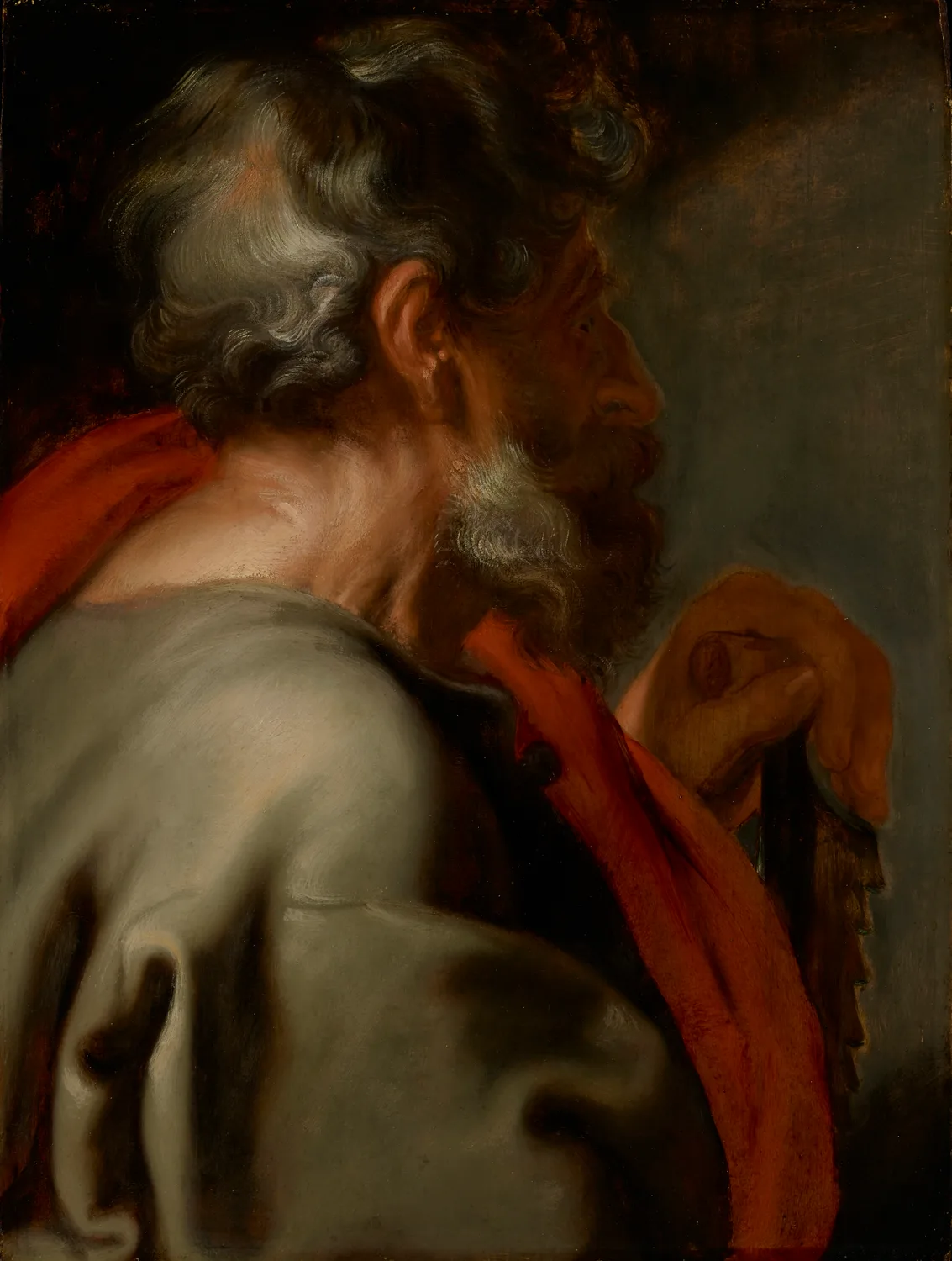
The Apostle Simon, oil on an oak panel sixty four by forty eight centimetres, painted about 1618. It belongs to a series of apostles, since broken up and scattered, that he made in Antwerp before he was twenty. The head is fully worked and the drapery stays broad, which is what a study head is for.
Anthony van Dyck, The Apostle Simon, about 1618, The J. Paul Getty Museum, Los Angeles, 85.PB.99. Public domain, Wikimedia Commons.
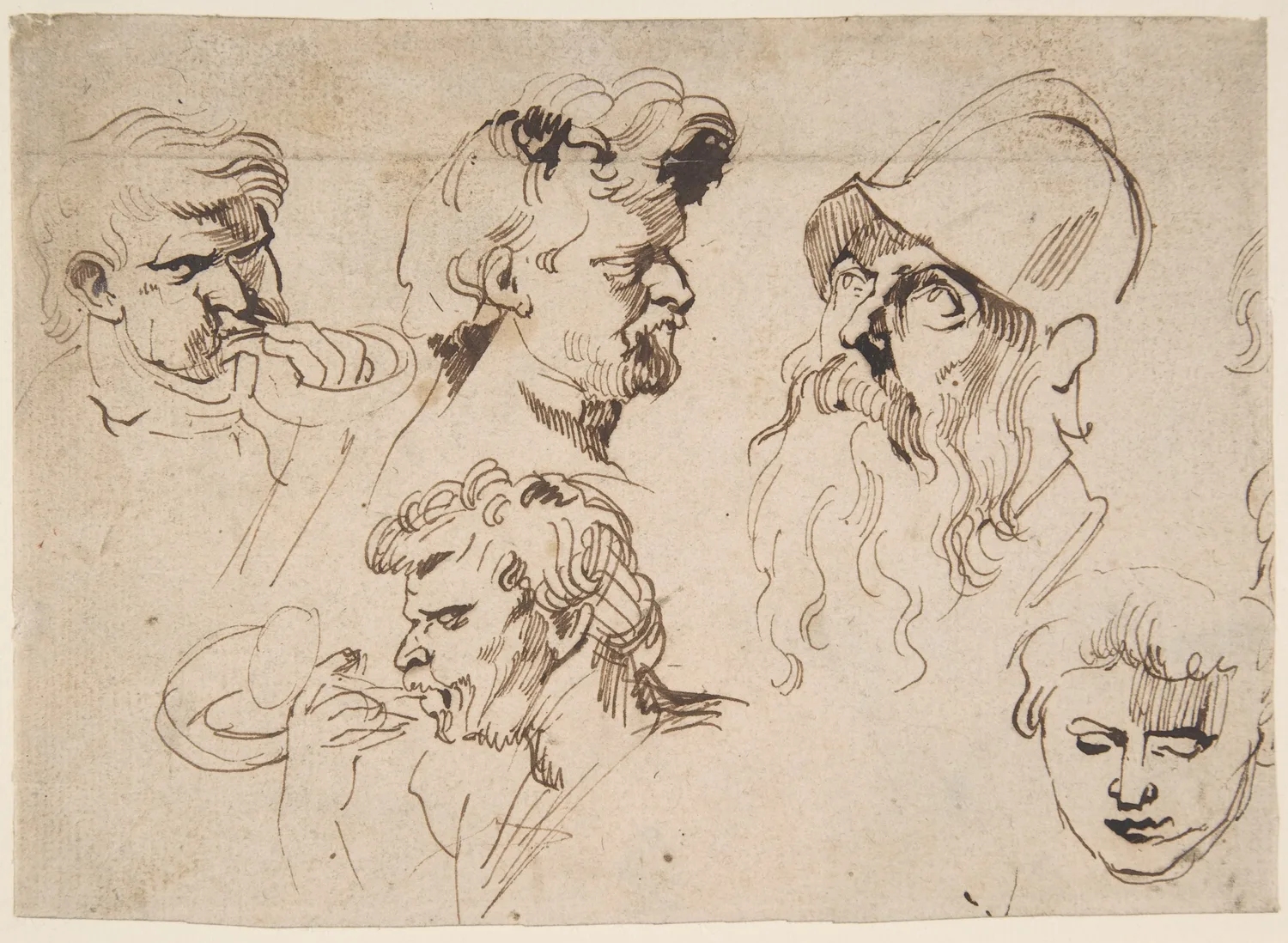
Sheet of Studies of Heads, pen and brown ink on a page thirteen by eighteen centimetres. Six heads, each a different age and a different set of features, none of them a sitter. The character types that turn up in the finished pictures were worked out at this size first.
Anthony van Dyck, Sheet of Studies of Heads, The Metropolitan Museum of Art, New York, 64.38.6. Public domain, Wikimedia Commons.
Source: The family firm, its trade and its cities, and the mother's embroidery: Lionel Cust, Anthony van Dyck: An Historical Study of His Life and Works, 1900, pages 3 and 4. The tasks in the Rubens shop, the Decius cartoons and the hundred florins a day: Giovanni Pietro Bellori, Le vite de' pittori, scultori et architetti moderni, first published Rome 1672, read in the 1728 edition. The Chatsworth sketchbook: Lionel Cust, A Description of the Sketch-Book by Sir Anthony Van Dyck Used by Him in Italy, 1621 to 1627, 1902. Medium, date, dimensions and holding museum for each figure: read from the museum record through the Commons file.
Up close
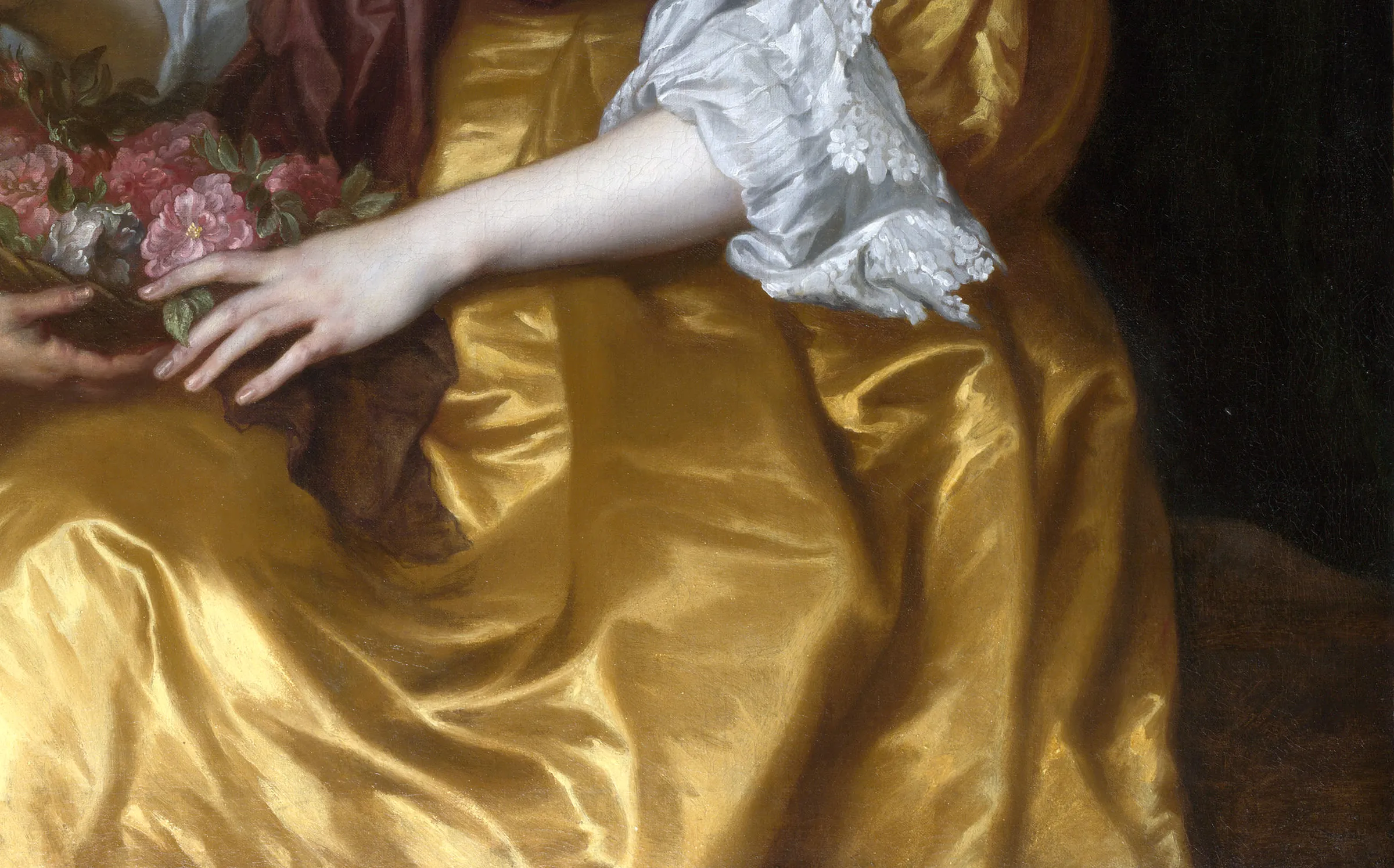
Detail of Viscountess Dorothy's dress: the National Gallery identified pure lead tin yellow in the brightest and thickest ridges of the satin, deep yellow ochre with white and a little crystalline red earth in the duller golds, and more of that red earth again in the orange of the sleeve. Three named mixtures laid beside each other carry the whole fabric.
Anthony van Dyck, Lady Elizabeth Thimbelby and Dorothy, Viscountess Andover (detail), circa 1637, The National Gallery, London. Public domain, Wikimedia Commons.
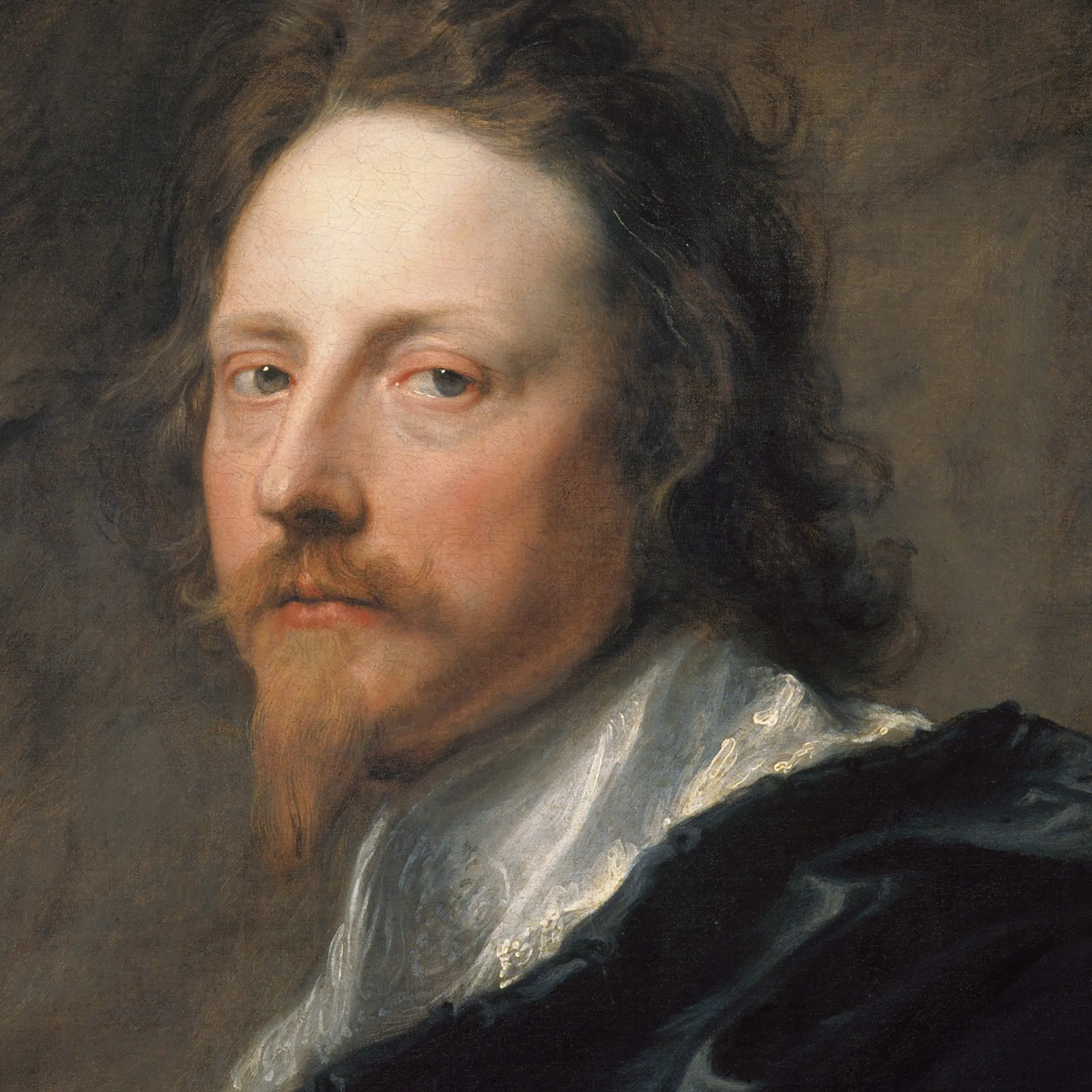
Detail of the head in the portrait of Nicolas Lanier: the lit cheek and the shadow under it sit within a narrow band of value, so almost none of the modelling is being done by contrast. The drawing carries it instead, in the edge of the nose, the set of the eye and the one hard accent at the nostril.
Anthony van Dyck, Nicolas Lanier (detail), circa 1628, Kunsthistorisches Museum, Vienna. Public domain, Wikimedia Commons.
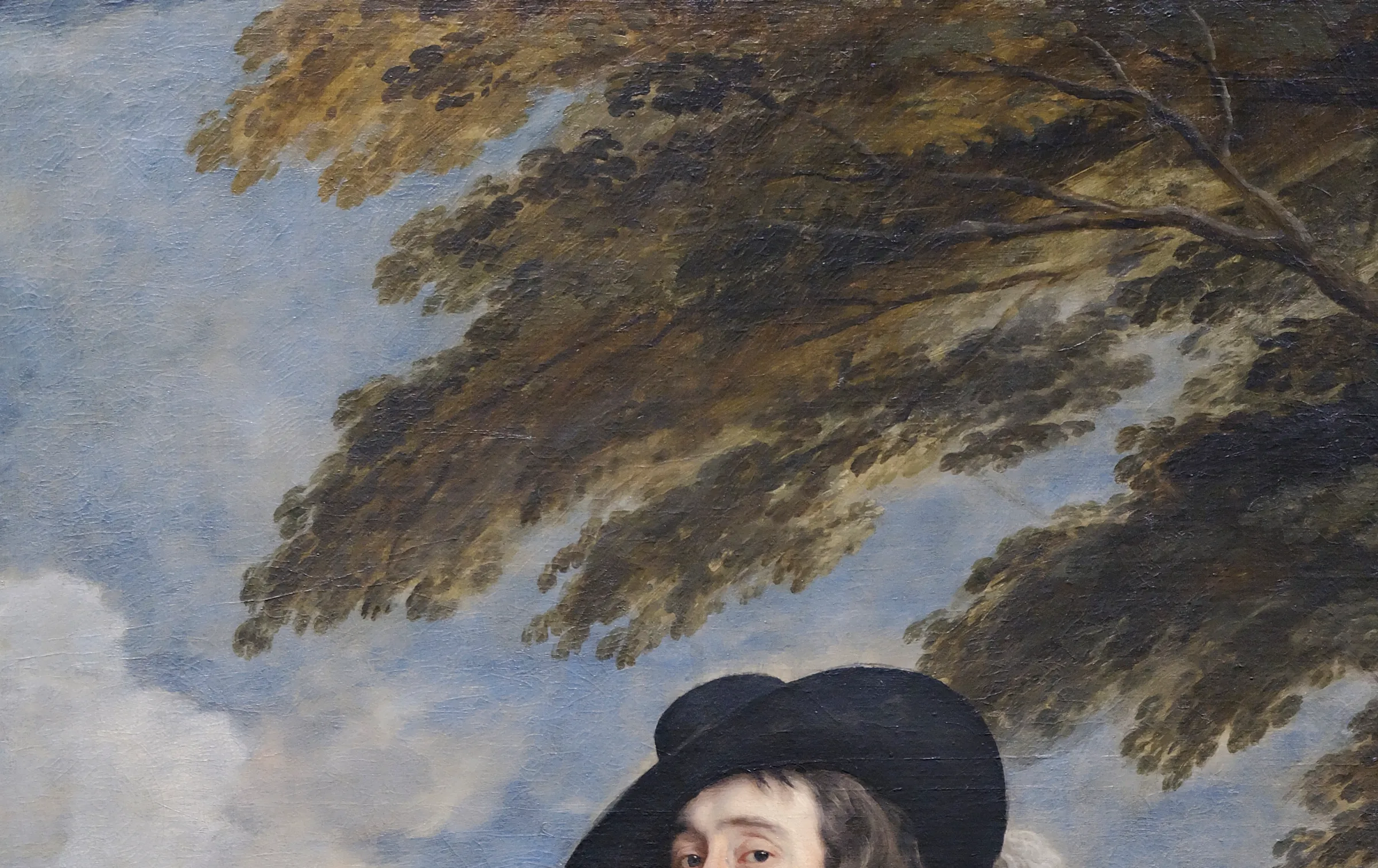
Detail above the King's hat in Charles I at the Hunt: the canopy is a few loaded drags of grey green over a thin sky and not one leaf is drawn. The setting is left at the speed of a sketch on purpose, so the figure standing under it is the only fully resolved thing in the picture.
Anthony van Dyck, Charles I at the Hunt (detail), circa 1635, Musée du Louvre, Paris. Public domain, Wikimedia Commons.
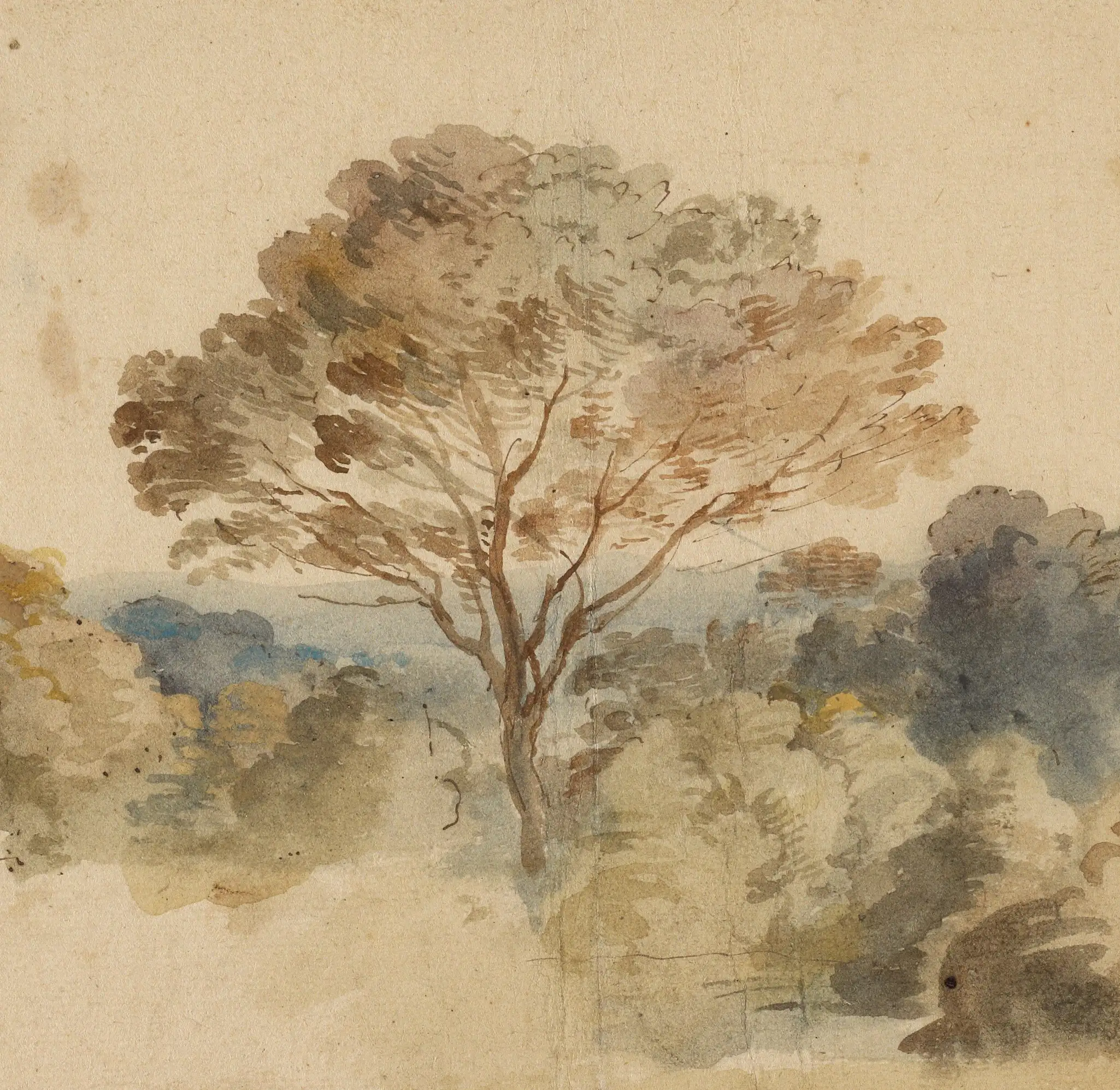
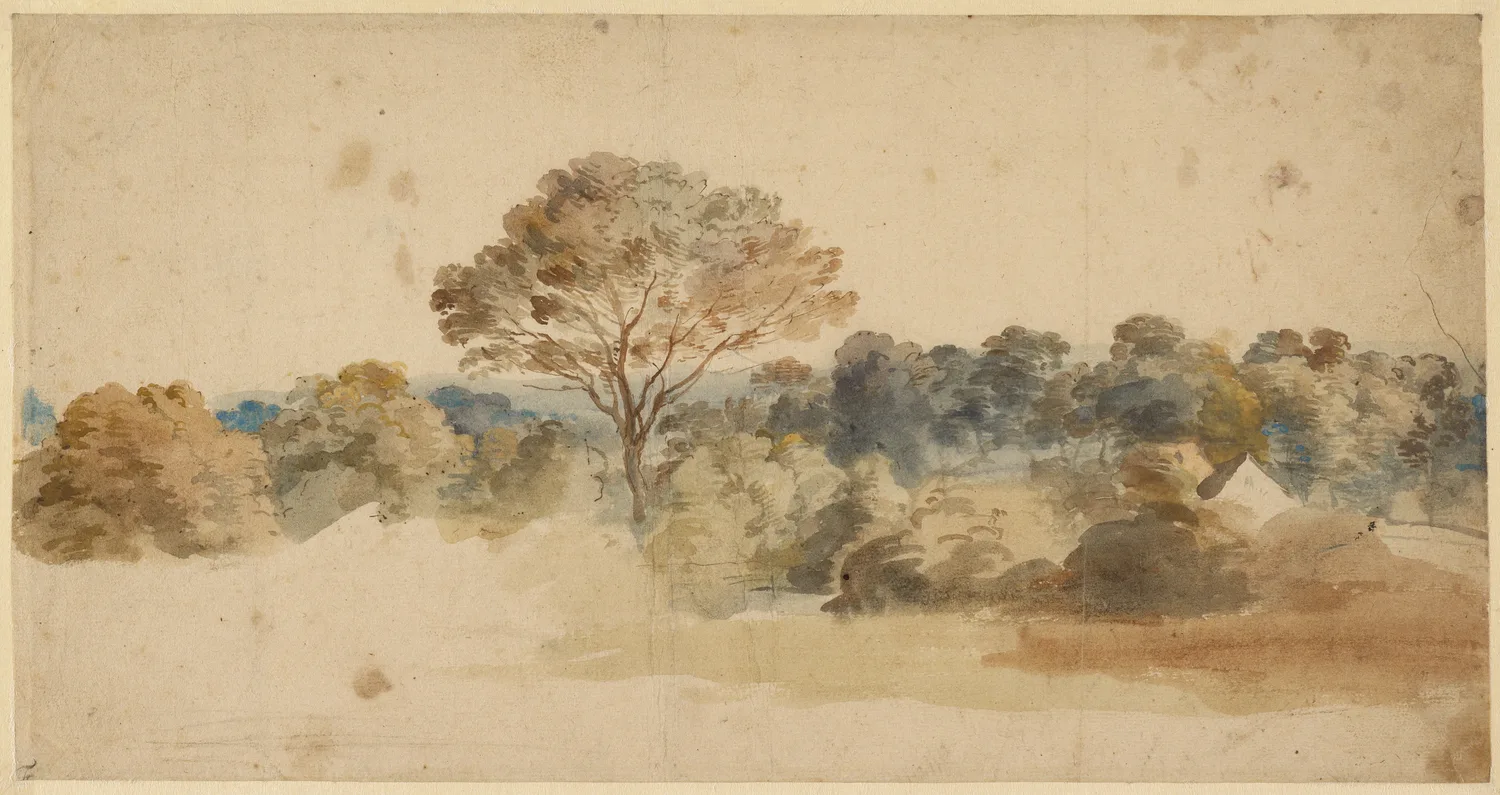
Detail of the Getty landscape: the sky is bare paper, the tree is one drawn trunk with dabs of dilute brown laid over it, and the far distance is a single band of blue. Watercolour gave him a way to record a light in a few minutes with nothing to dry and nothing to scrape.
Anthony van Dyck, Landscape (detail), about 1640, The J. Paul Getty Museum, Los Angeles. Public domain, Wikimedia Commons.
Watching him work
“He appointed both the day and hour for the person's sitting, and work'd not above an hour on any portrait, either in rubbing in or finishing; so that as soon as his clock informed him, that the hour was out, he rose up, and made a bow to the sitter, to signify, that he had done enough for that day.”
Eberhard Jabach, a collector who sat to him three times, telling Roger de Piles, Roger de Piles, The Principles of Painting, London, 1743, pages 176 and 177, the English translation of the Cours de peinture par principes, 1743 [source]
Across media
Study for a Portrait of a Lady, black chalk heightened with white on grey paper, a sheet about fifty centimetres tall. This is the object Jabach described: the figure and the clothes set down in a quarter of an hour with the sitter in front of him, and the two hands worked out separately at the side of the page.
Anthony van Dyck, Study for a Portrait of a Lady, The Metropolitan Museum of Art, New York, 1972.118.279. Public domain, Wikimedia Commons.
Landscape, about 1640: pen and brown ink with watercolour on a sheet only nineteen by thirty six centimetres. The Getty reads it as an English view and as a momentary impression, and possibly as a study for the background of a painting. The paper is left bare for the sky and most of the field.
Anthony van Dyck, Landscape, about 1640, The J. Paul Getty Museum, Los Angeles, 85.GG.96. Public domain, Wikimedia Commons.
Portrait of Lucas Vorsterman, first state of seven. Everything on this sheet is his own etched line bitten into the copper. The head is carried to finish, the coat is shorthand, and behind it there is nothing at all.
Anthony van Dyck, Portrait of Lucas Vorsterman, etching, first state, Rijksmuseum, Amsterdam, RP-P-BI-7417. Public domain, Wikimedia Commons.
The same copper plate in the sixth state. An anonymous engraver has ruled a sky in behind the head, closed the border and cut the lettering, and the Rijksmuseum records the print from here on as etching and engraving by two hands. The face has not been touched.
Anthony van Dyck and an anonymous engraver, Portrait of Lucas Vorsterman, etching and engraving, sixth state, Rijksmuseum, Amsterdam, RP-P-OB-11.728. Public domain, Wikimedia Commons.
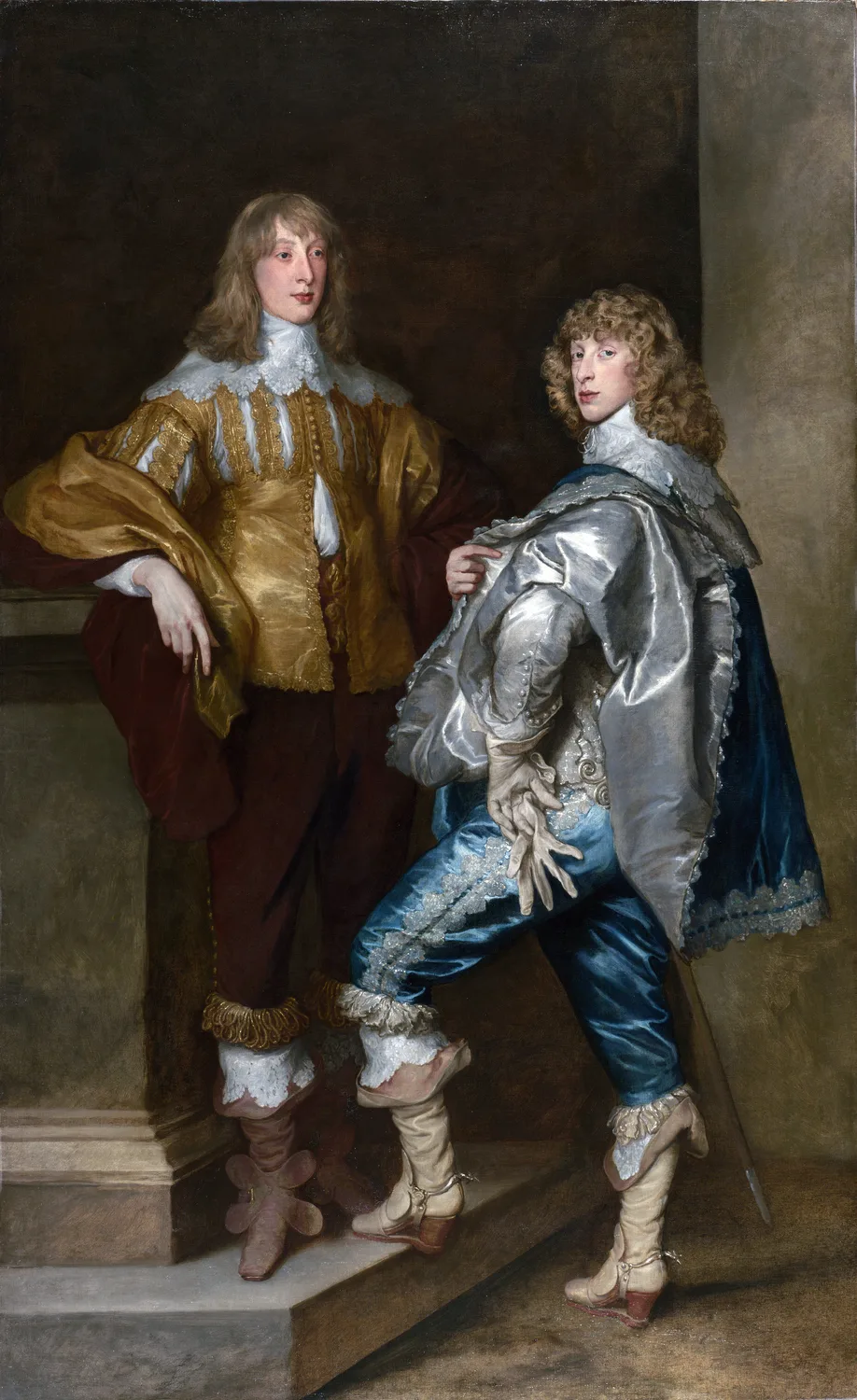
Lord John Stuart and his Brother, Lord Bernard Stuart, a canvas two and a third metres tall. The two figures and their clothes are carried to full finish and the architecture behind them is thin, grey and unresolved, with the ground showing through the paint on the plinth and the steps.
Anthony van Dyck, Lord John Stuart and his Brother, Lord Bernard Stuart, circa 1638, The National Gallery, London. Public domain, Wikimedia Commons.
The record, deeper
The money
The knighthood has a date and a job title attached to it. A manuscript list of the knights Charles I made, kept in the State Paper Office, reads: July 5. 1632. Sir Anthony Vandike principalle Paynter in Ordinary to their Majesties at St. James's. He had been in England about three months.
Manuscript list of knights made by Charles I, State Paper Office, printed in W. H. Carpenter, Pictorial Notices... of Sir Anthony Van Dyck, London, 1844, page 29.
On 17 October 1633 the King settled a pension on him by letters patent, granting to our trusty and wellbeloved Sir Anthony Vandike Knight, and his Assigns, one Annuity or yearly Pension of two hundred pounds, of lawful Money of England by the year, payable quarterly at the Exchequer.
Letters patent of 17 October 1633, Rymer's Foedera, volume 8 part 4, page 26, printed in W. H. Carpenter, Pictorial Notices, 1844, Appendix III.
A bill in his own hand survives, headed Memoire pour Sa Majesté Le Roy, listing the pictures with a price against each. The King went down it and wrote his own lower figures beside them. The note attached settles the account: the pictures the King allowed came to five hundred and twenty eight pounds, five years of unpaid pension came to one thousand pounds at two hundred a year, and seventy five pounds more was owed for pictures Sir Arthur Hopton carried into Spain. The total is one thousand six hundred and three pounds.
The Memoire pour Sa Majesté Le Roy and the note attached to it, printed in W. H. Carpenter, Pictorial Notices, 1844, pages 67 and 68.
The Countess of Sussex sat to him in November 1639 and the price of her portrait was fifty pounds. A copyist was standing by to copy the finished picture for eight pounds.
The Verney letters at Claydon House, in Lionel Cust, Anthony van Dyck, 1900, pages 175 and 176.
He negotiated hard and it was noticed. Lord Conway wrote to Thomas, Lord Wentworth on 22 January 1636 that he had fallen out with Lady Stanhope over money, because he disputed with her about the price of her Picture and sent her word, that if she would not give the price he demanded, he would sell it to another that would give more.
Lord Conway to Lord Wentworth, 22 January 1636, quoted in Lionel Cust, Anthony van Dyck, 1900, page 137.
The reworks
He said himself that the care went out of the later portraits, and he said why. Asked by a friend the reason he had begun to run them over hastily, he replied: I workt a long Time for my Reputation, and I do it now for my Kitchen. De Piles, who prints it, adds his own verdict that his last Portraits want much of the Beauty and Correctness of his First.
Roger de Piles, The Art of Painting, and the Lives of the Painters, London, 1706, pages 304 and 305.
The Countess of Sussex made him alter her picture twice and still did not like it. In January 1640 she wrote that she was glad they had prevailed with Sir Vandike to make my pictuer lener, for truly it was to fat. When the finished canvas arrived she wrote: the pictuer is very ill favourede, makes me quite out of love with myselfe, the face is so bige and so fate that it pleses me not att all. It lokes lyke on of the windes poffinge. Then she conceded that she thought it was like the original.
The Countess of Sussex to Ralph Verney, the Verney letters at Claydon House, in Lionel Cust, Anthony van Dyck, 1900, pages 175 and 176.
Her letters also record what a finished Van Dyck portrait was and was not. Cust reads them as showing that the picture was not completed from actual sittings given by the lady, and that the jewels the painter put into it were not hers.
Lionel Cust, Anthony van Dyck, 1900, page 176.
The studio
The King housed him. A memorandum in Sir Francis Windebanke's hand in the State Paper Office, headed Things to be done, includes the line: To speak with Inigo Jones concerning a house for Vandike. He was given apartments in the Blackfriars and a summer residence at Eltham in Kent.
W. H. Carpenter, Pictorial Notices, 1844, page 28.
A return of all the aliens living in London in 1634, in the State Paper Office, gives the size of the household in one line. Under the Blackfriars: Dutch. Sir Anthony Vandike Limner 2 Years 6 Servants.
W. H. Carpenter, Pictorial Notices, 1844, page 32, footnote.
The Crown built a landing stage so the King could reach the studio by water. The Works accounts for 1635 allow twenty pounds for making a new Cawsey Way and a new paire of Staires for the King's Majesty to land to goe to Sir Anthoney Vandike's house there to see his Paintings in the monethes of June and July 1635.
Audit Office records, Works accounts of the Crown, 1635, quoted in Lionel Cust, Anthony van Dyck, 1900, page 108.
The hour was run by a clock and staffed. Jabach told De Piles that as soon as the clock informed him the hour was out he rose and bowed, appointed another hour on another day, and while he was receiving the next sitter his servant came to clean his pencils and brought a fresh pallet. By this method he work'd on several pictures the same day, with extraordinary expedition.
Eberhard Jabach to Roger de Piles, The Principles of Painting, London, 1743, pages 176 and 177.
The clothes came to the house without the sitter in them. Jabach: he gave the drawing to the skilful people he had about him, to paint after the sitter's own cloaths, which, at Vandyke's request, were sent to him for that purpose. When his disciples had done what they could to these draperies, he lightly went over them again.
Eberhard Jabach to Roger de Piles, The Principles of Painting, London, 1743, page 178.
The sitters were kept for dinner and it was a working meal. Bellori writes that he began portraits early in the morning and, without interrupting the work, kept those gentlemen to dine with him, then returned to the picture afterwards. Carpenter puts the purpose plainly, that he detained them to dinner with the view of studying their expression, in order that he might retouch the portrait at a second sitting in the afternoon.
Giovanni Pietro Bellori, Le vite de' pittori, 1672; and W. H. Carpenter, Pictorial Notices, 1844, page 32.
The hour was not absolute. Nicholas Lanier told Sir Peter Lely that he sat seven entire days to Van Dyck for his portrait, morning and afternoon. Cust prints the account and notes that the picture recorded in Charles I's collection could not be traced in his own day, so the identification with any surviving canvas rests on later work.
Lionel Cust, Anthony van Dyck, 1900, page 52.
Roger de Piles set the system out for painters to copy and then declined to recommend all of it. I mention this conduct of Vandyke, rather to gratify the reader's curiosity, than to excite his imitation. For my part, I dislike no part of it, except that of sitting only one hour, which I think too little.
Roger de Piles, The Principles of Painting, London, 1743, page 178.
The materials
He did not carry a ground recipe from country to country. The National Gallery survey found that he worked over a coloured ground of some sort, rarely very dark, usually a double ground on canvas with an upper layer of light brown or light to mid grey, and that he was content to use the priming method in common currency in the country in which he was painting, which suggests he was buying canvas ready primed locally.
Ashok Roy, The National Gallery Van Dycks: Technique and Development, National Gallery Technical Bulletin, volume 20, 1999, page 51.
The Stuart double portrait of about 1638 has a single light biscuit coloured ground of lead white with a little translucent brown earth, probably Cassel earth. Under the paint there is an unusually detailed drawing in thin dark paint, visible at the surface and in infrared along the edges of the cloak, the chin, the gloved hand and the boots, and a dark oval patch of charcoal black behind Lord Bernard's head, used to frame and place the head before it was painted.
Ashok Roy, The National Gallery Van Dycks, National Gallery Technical Bulletin, volume 20, 1999.
The gold in the same picture is a stack. The brightest highlights are pure lead tin yellow, the middle golds are yellow ochre with lead white and crystalline red earth, and the deep shadows are reddish ochre with Cassel earth and yellow ochre. Analysis of the organic part of those dark yellows found a bistre or pitch-like material made from pyrolysed birch bark, and the medium in those passages is walnut oil, while the same bistre in the dark background is bound in linseed.
Ashok Roy, The National Gallery Van Dycks, National Gallery Technical Bulletin, volume 20, 1999.
The flesh is nearly all white. The National Gallery found virtually pure lead white with very small quantities of finely ground red earth, vermilion and Cassel earth in the lights, going a shade darker and creamier with a little translucent golden ochre and some black, and for the distinctly cool shadows, such as a raised hand, just a trace of lapis lazuli ultramarine.
Ashok Roy, The National Gallery Van Dycks, National Gallery Technical Bulletin, volume 20, 1999.
The pigments identified in the double portrait of Lady Elizabeth Thimbelby and Viscountess Andover are smalt, azurite, ultramarine in minor quantities, green verditer, vermilion, red and yellow lakes, lead tin yellow, a range of earths including Cassel earth, blacks and white. The binding medium across the whole picture is linseed oil.
Ashok Roy, The National Gallery Van Dycks, National Gallery Technical Bulletin, volume 20, 1999.
Even the hair was planned as a gap. In the same picture the ringlets on Viscountess Dorothy's forehead were left in reserve, allowed for before the flesh went down, so they are not painted over the flesh tone.
Ashok Roy, The National Gallery Van Dycks, National Gallery Technical Bulletin, volume 20, 1999.
Refusals — what they would not do
Refused to work more than one hour at a time on a single portrait.
Refused to paint costume and drapery himself in production work — handed off to assistants.
Refused photography (predates it). Required physical presence of the sitter for head and hands.
Refused to invent the noble ideal — extracted it from the specific sitter.
Reference
Primary source
Live sitters for head and hands. Sitter's actual physical garments retained in studio for workshop drapery passages.
Photography
Predates photography.
Exceptions
Italian sketchbooks (1621–1627 Genoa, Rome, Palermo, Venice, Turin) full of Titian and Veronese copies — drew on this Venetian visual memory throughout his career.
Iconography etchings — independent body of work and a working reference collection for poses, facial constructions, and typologies.
Hendrick van Balen · around 1609 onward — Antwerp studio entered at age ten. Became master in the Antwerp Guild of Saint Luke in 1618 at nineteen.
Peter Paul Rubens · 1618–1621 — Worked alongside Rubens as the most skilled of his assistants. Rubens referred to Van Dyck as his "best pupil." Collaborated on several major projects, most importantly the ceiling of the Jesuit Church in Antwerp.
Influences
Titian — exhaustively studied during the 1621–1627 Italian years; the source for the aristocratic-portrait vocabulary and the management of the full-length figure.
Direct successors: Peter Soutman, Erasmus Quellinus II, Jan Boekhorst (Antwerp); Adriaen Hanneman (carried the Van Dyck manner back to the Dutch Republic).
Most importantly Peter Lely — took over Van Dyck's role as principal court painter after the Restoration in 1661 and inherited the whole production system: the one-hour sittings, the workshop completion, the aristocratic-sprezzatura handling.
From Lely the system runs through Kneller, Reynolds, and Gainsborough into the entire modern tradition of high-volume formal portraiture. Sargent's Tite Street studio three hundred years later was still running a modified version of Van Dyck's rule.
In their own words
“He never worked for more than one hour at a time on one portrait, whether to sketch or to finish.”
— Roger de Piles, Cours de peinture par principes, 1708
De Piles's documentation of Van Dyck's one-hour rule, drawn from former assistants and contemporary sitters.
“He would often retain a sitter to dinner so he could study their expression when they were free from the constraint of posing.”
— Roger de Piles, Cours de peinture par principes, 1708
“After having lightly blocked in a portrait, he made the sitter pose while he worked on the head and hands.”
— Roger de Piles, L'Abrégé de la vie des peintres, 1699
“Nature is not as she is, but as we think she ought to be.”
— Anthony van Dyck (attributed), Recorded by Roger de Piles, Cours de peinture par principes, 1708
The explicit statement of the "majestic serenity" principle.
He never worked more than one hour at a time on a single portrait, whether sketching or finishing. When the hour was up he rose, bowed to the client, and dismissed them, with the next sitter already prepared in an adjacent room. The hard cap let multiple portraits advance in parallel across a working day, and drying time fell naturally into the gaps between appointments.
What palette did Van Dyck use?
Lead white, a range of pearly grays mixed from lead white and earths, and the standard Flemish earth range for the darks. For colour he used natural ultramarine for the most important blues, vermilion, and lead-tin yellow for the sharpest opaque accents. Head and hands were worked in pure oil with no added medium; drapery and backgrounds shifted to thin Venetian glazes.
What did Van Dyck paint on?
Fine-weave linen primed with a light gray or warm buff tinted ground, the Flemish standard he inherited from Rubens. The ground was left to show through and remained visible in the halftones of the finished painting.
Did Van Dyck use assistants?
Yes, for everything except the head and hands. He sketched the costume and posture onto the canvas, then handed it to assistants, and the sitter's actual garments stayed in the studio so the assistants could copy the clothing directly from the physical fabric. At a second sitting he retouched their passages to pull the whole canvas into his own handling, so the seams between master and workshop became invisible.
How did a Van Dyck portrait start?
With a one-hour life sitting. He lightly blocked in the pose, head angle, and general masses on the canvas, and during the same hour made a separate chalk drawing of the head and hands on gray paper. The chalk drawing served as the reference record for the next session, because the head and hands were the passages he kept for himself.
Who taught Van Dyck, and whom did he influence?
He entered Hendrick van Balen's Antwerp studio at age ten and became a master in the Antwerp Guild of Saint Luke in 1618, at nineteen. From 1618 to 1621 he worked as the most skilled of Rubens's assistants; Rubens called him his "best pupil." His production system passed to Peter Lely, and from Lely it runs through Kneller, Reynolds, and Gainsborough into the whole modern tradition of high-volume formal portraiture.
If this painter is your match
You believe the painter's hand has to be reserved for the decisions that actually require it. The head and the hands, in life, are what the painting is about. Everything else is infrastructure.
Borrow this: For your next portrait, structure the work in strict one-hour life sessions. Do not work from life for more than sixty minutes at a time. Complete the head and the hands in the sittings; handle the costume, background, and secondary passages in separate studio sessions from reference.
Roger de Piles, Cours de peinture par principes, 1708. Principal documentary source for Van Dyck's working method, the one-hour rule, the studio production sequence, and the aristocratic-portrait philosophy. De Piles drew on first-hand accounts from former assistants and sitters.
Roger de Piles, L'Abrégé de la vie des peintres, 1699. Earlier biographical dictionary. Contains the original documentation of the block-in-then-hand-off sequence.
Peter Paul Rubens, Workshop correspondence and contracts, 1620. Rubens's surviving workshop correspondence, including the period 1618–1621 when Van Dyck was his most senior assistant.
Arnold Houbraken, De groote schouburgh der Nederlantsche konstschilders en schilderessen, 1718. Cross-references the French account of Van Dyck's London studio with Dutch-language sources from the Antwerp period.
Susan Barnes, Nora De Poorter, Oliver Millar, Horst Vey, Van Dyck: A Complete Catalogue of the Paintings, 2004. Definitive modern catalogue raisonné. Documents the distinction between autograph head-and-hands passages and workshop drapery passages across the corpus.
Roger de Piles, The Principles of Painting, London, the English translation of the Cours de peinture par principes, 1743. The public-domain English text, checked in full. Pages 176 to 178 print Eberhard Jabach's account word for word: the appointed day and hour, the hour on the clock, the bow, the servant with clean brushes and a fresh palette, the quarter-hour chalk drawing on grey paper, the sitter's own clothes sent to the house for the assistants, and the paid models of both sexes kept for the hands. De Piles adds his own objection to the one-hour rule on the same page.[link]
Roger de Piles, The Art of Painting, and the Lives of the Painters, London, the English translation of the Abrégé de la vie des peintres, 1706. Pages 304 and 305 carry the reputation and kitchen answer in English, the statement that he designed his heads and hands with the utmost perfection, and the judgement that the last portraits fall short of the first.[link]
Lionel Cust, Anthony van Dyck: An Historical Study of His Life and Works, London, George Bell and Sons, 1900. The standard public-domain monograph, checked against the full text. Source for the family firm and its trade, the Countess of Sussex letters and the fifty pound price, the Lord Conway letter on Lady Stanhope, the twenty pound causeway and stairs built at the Blackfriars in 1635, Lanier's seven days told to Lely, and the French text of the Jabach account as De Piles printed it.[link]
W. H. Carpenter, Pictorial Notices, Consisting of a Memoir of Sir Anthony Van Dyck, London, 1844. Prints the documents themselves: the manuscript entry for the knighthood of 5 July 1632, the letters patent of 17 October 1633 for the two hundred pound pension, the 1634 return of aliens giving six servants in the Blackfriars, and the bill in Van Dyck's own hand with the King's amended prices and the totals attached to it.[link]
Giovanni Pietro Bellori, Le vite de' pittori, scultori et architetti moderni, Rome, 1672. The near-contemporary life, read in the 1728 edition. Source for the father's linen trade and the mother's embroidery, the tasks Rubens gave him and the hundred florins a day reported from them, the statement that he worked alla prima, the sitters kept to dinner, and the rule that on a history picture he measured how much work he could finish in one day and no more. It carries no phrase in which Rubens calls him the best of his pupils.[link]
Ashok Roy, The National Gallery Van Dycks: Technique and Development, National Gallery Technical Bulletin, volume 20, pages 50 to 83, 1999. The technical survey of eight National Gallery Van Dycks. Source for the coloured and double grounds, the thin brown brushed underdrawing, the indigo and azurite build of the blue satin and the lead tin yellow build of the gold in the Stuart double portrait, the birch-bark bistre and the walnut and linseed media, the flesh mixtures with their trace of ultramarine in the cool shadows, and the ringlets left in reserve.
Rijksmuseum, object records for the Portrait of Lucas Vorsterman from the Iconographie, RP-P-BI-7417 and RP-P-OB-11.728. The two states of one copper plate, both from the same plate mark of 245 by 156 millimetres. The first is catalogued as etching by Van Dyck alone, New Hollstein Dutch 12-1(7) and Mauquoy-Hendricx 14-I(7). The sixth is catalogued as etching and engraving by Van Dyck and an anonymous printmaker, New Hollstein Dutch 12-6(7) and Mauquoy-Hendricx 14-6(7).
%20-%20Google%20Art%20Project.jpg)