Repin built his big paintings from studies, not from imagination. He traveled to where his subjects lived and drew their heads, hands, and clothing from life. Only then did he square the composition up to the canvas and block it in with a thin tonal wash. He reworked each figure until it read as alive, and when one didn't, he scraped it back and started again. His teachers Ivan Kramskoy and Pavel Chistyakov both held that skill was the floor, not the end.
Built his Penaty studio with a glazed ceiling so a single shadowless zenith light fell on the canvas; a side-lit studio shifts color every hour, a top-lit one does not.
Why it matters · A painter who cannot trust the studio light cannot trust the value judgements made under it. Repin engineered the constancy into the architecture. Most painters accept whatever light a room happens to offer and then wonder why the painting drifts.
Museum-Estate of I.E. Repin "Penaty" — Archival Records
Stand. Always. Belt-mounted palette in late life.
Believed sitting produced a lazy eye and weak brushstroke; after right-hand atrophy, trained himself to paint left-handed and built a leather-belted palette so his hips carried the paint and both hands stayed free.
Why it matters · Standing forces the whole arm into the stroke. Repin's belt-palette is the cleanest case of a painter rebuilding the rig around his body when the body changed. The discipline is to keep the work going by changing the tools, not by softening the standard.
The sitting as conversation, not pose
Worked with friends or family reading aloud and sitters encouraged to talk; treated speech and thought as where character actually shows up, and the silent held pose as a death mask.
Why it matters · A static sitter gives a static painting. Repin's social sitting is a deliberate technical strategy — the painter is reading the face between sentences rather than copying a held expression. The same logic translates to still life: an animated setup gives a different painting than a frozen one.
Scrape failed figures back to the ground
If a character did not feel alive, scraped the paint down to the canvas and started that figure again; the surfaces of his major paintings are thick with pentimenti from this cycle.
Why it matters · A figure painted on top of a dead figure stays dead. Repin's discipline was that the cheapest way to fix a passage is to remove it. The pentimenti are not failures of finish; they are the visible record that a painter knew the difference between a struggle and a wreck.
Kornei Chukovsky, Ilya Repin: Memoirs and Essays, 1945
Multi-year preparation through field observation
For the Zaporozhye Cossacks, spent months in Ukraine filling sketchbooks with heads, hands, clothing, and weapons; for Kursk Province, travelled annually to observe specific social types in the procession.
Why it matters · The studio painting is the last stage. Repin's monumental scenes are not invented — they are reconstructed from years of physical research. Painters who skip the research stage paint inventory, not document.
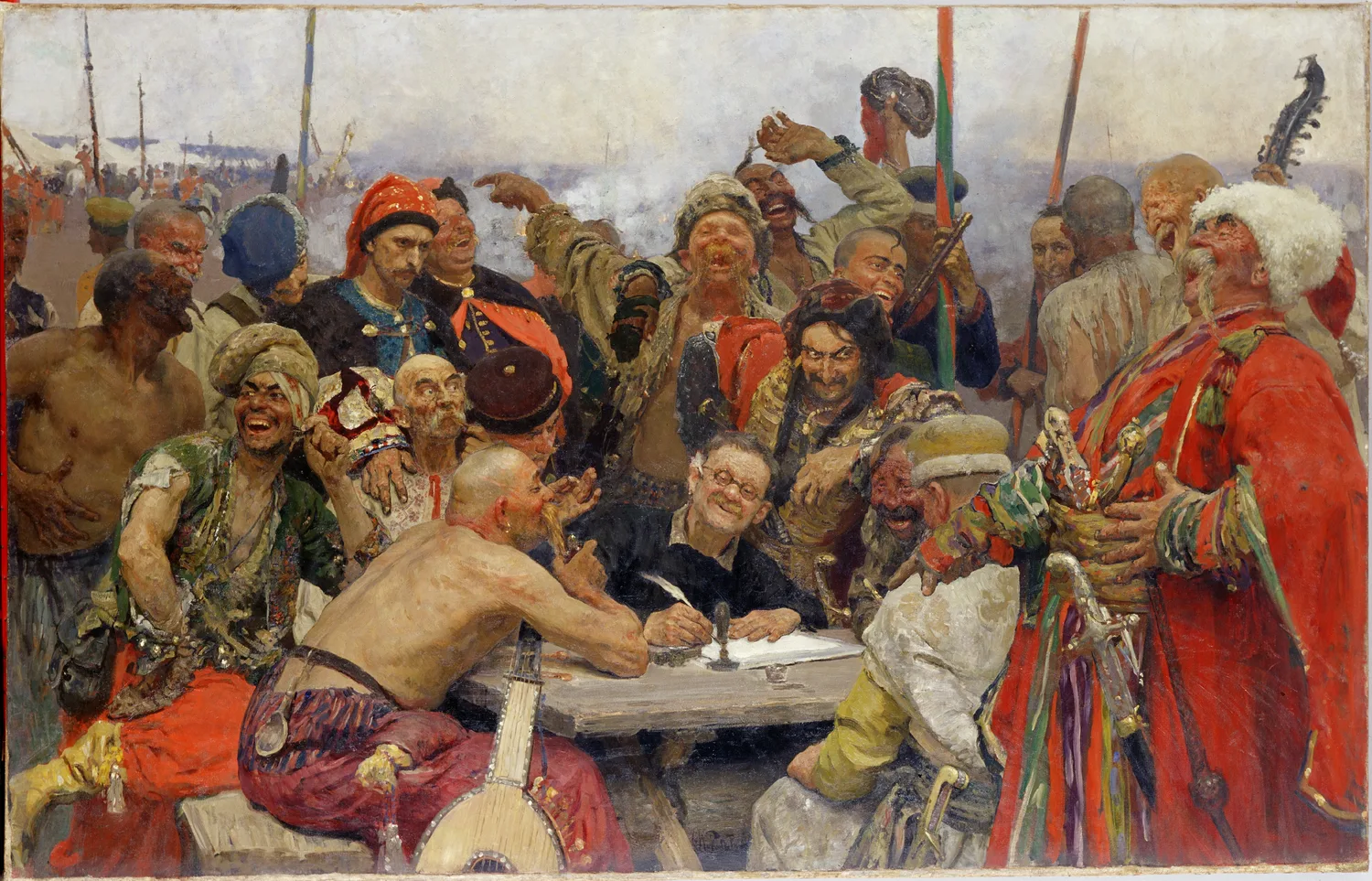
The second, looser version of Reply of the Zaporozhian Cossacks, one of the studies and variants Repin worked through across roughly eighteen years on the subject. A contemporary counted a hundred or more sketches, and he painted the composition more than once before he let it go.
Ilya Repin, Reply of the Zaporozhian Cossacks (second version), 1889 to 1896, Kharkiv Art Museum. Public domain, Wikimedia Commons.
Use scumbling to build atmosphere
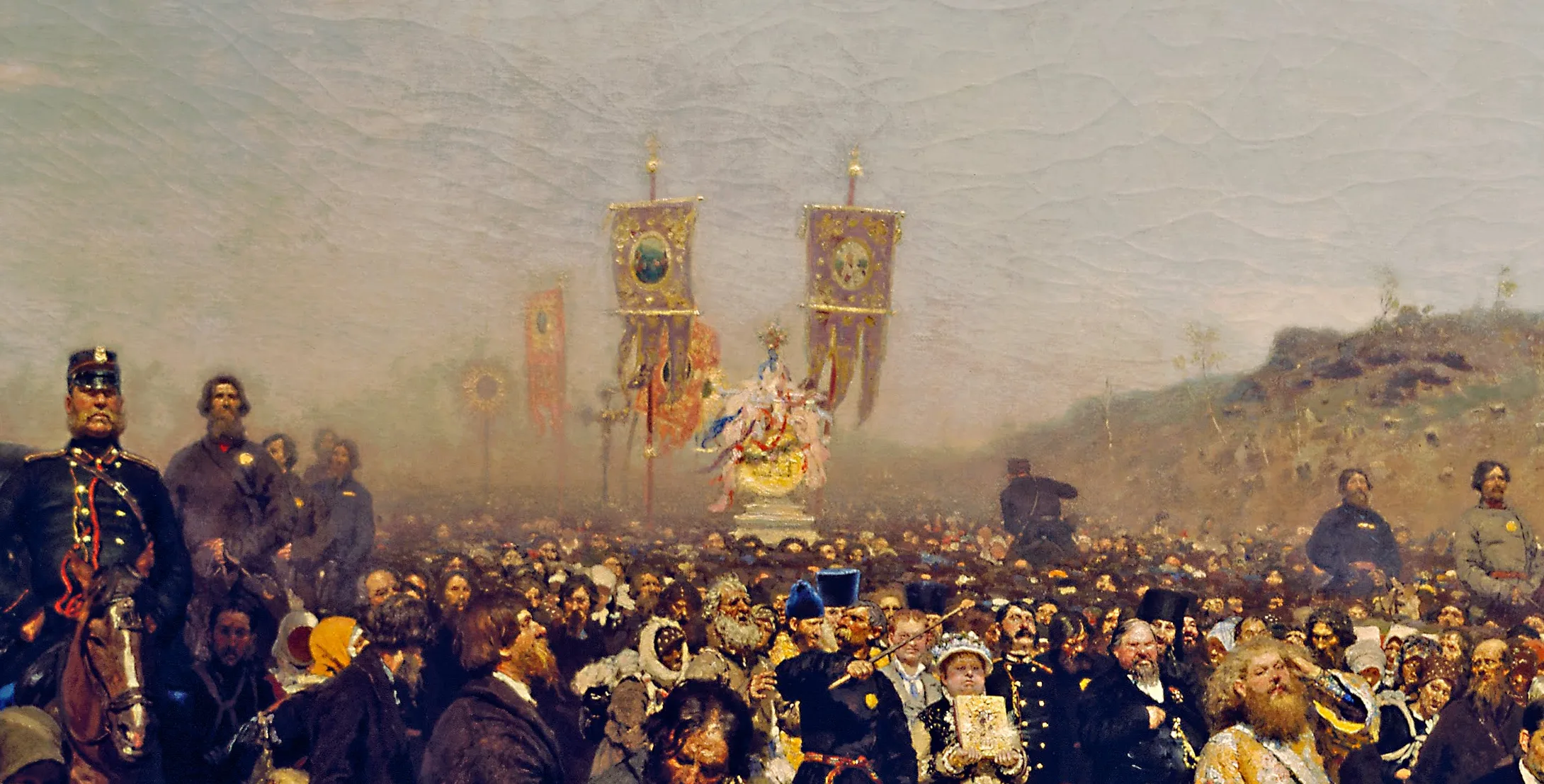
Generated the "smoke screen of dust" in Religious Procession in Kursk Province through hundreds of dry-brush passes — thin lighter color dragged over a darker layer.
Why it matters · Atmosphere is built by repetition, not by a single grand gesture. The scumbled veil is patient work; the result is air a viewer can feel. Most painters reach for one transparent glaze and accept what it gives them; Repin built the haze from many.
Detail of Religious Procession in Kursk Province: the mass of people behind the raised gold banners dissolves into a haze of heat and dust, built not from one glaze but from many dry scumbled passes of light color dragged over the darker crowd.
Ilya Repin, Religious Procession in Kursk Province (detail), 1880 to 1883, State Tretyakov Gallery, Moscow. Public domain, Wikimedia Commons.
Repaint the face after the gallery owns it
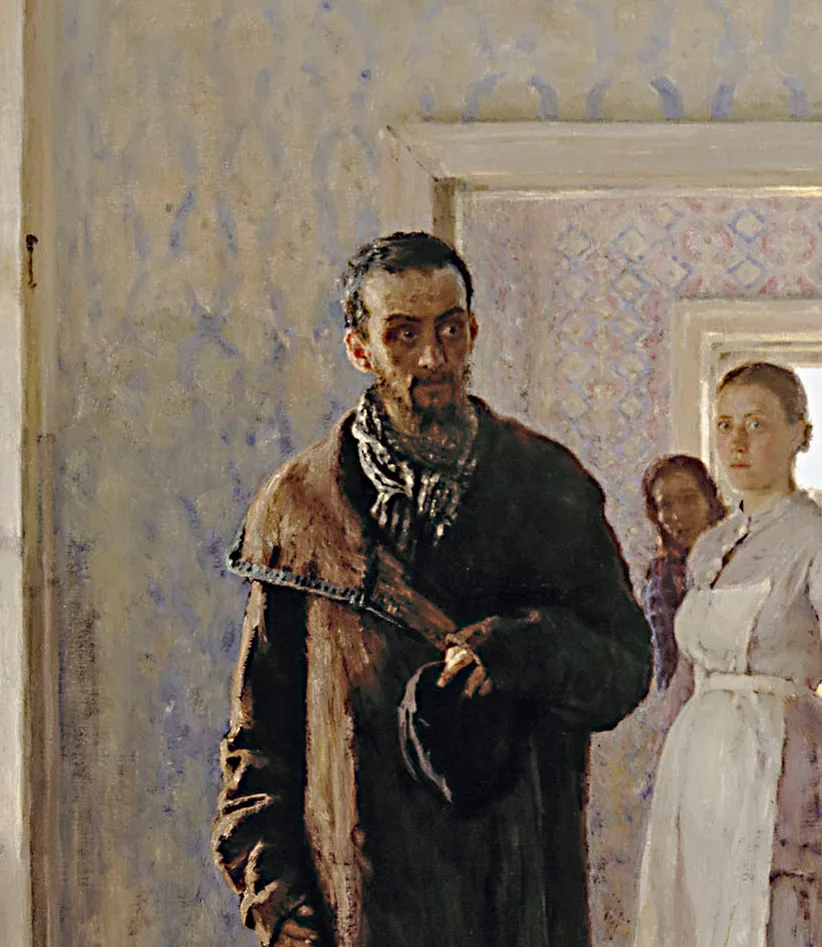
Kept reworking the returning man's face in "They Did Not Expect Him" in 1885, 1887, and 1888, after Pavel Tretyakov had already bought the canvas and hung it in his gallery.
Why it matters · A sale is not a verdict on the work. Repin treated ownership as no reason to stop fixing the one passage the whole picture turns on. The central expression earns more attention than the rest combined, and a piece is done when that reads true, not when it leaves the studio.
I.E. Repin, Far and Near (memoir); documented revisions to "They Did Not Expect Him", 1884–88, Tretyakov Gallery, 1888
Detail of They Did Not Expect Him: the face of the returning exile, the one passage Repin went back into in 1885, 1887, and 1888 after Pavel Tretyakov had already bought the canvas. The uncertainty in the expression is the note he kept chasing.
Ilya Repin, They Did Not Expect Him (detail), 1884 to 1888, State Tretyakov Gallery, Moscow. Public domain, Wikimedia Commons.
One day for visitors, the rest for the canvas
At the Penaty estate he received guests only on Wednesdays and kept every other day clear for work in the studio.
Why it matters · Repin protected the working week by walling visitors into a single fixed day. The discipline is structural, not willpower: a recurring open day absorbs the social pull so the rest of the week stays for painting.
Ilya Repin, formal photograph by Rentz and Schrader, St. Petersburg, 1900
Studio
Light
Glazed-ceiling zenith light at the Penaty estate, Kuokkala — top-down, even, shadowless, stable across the full working day.
Position
Standing, always. In late life, after right-hand atrophy, trained the left hand and built a leather-belted palette so the hips carried the paints.
Session length
10:30 a.m. until the light failed — 6:30 p.m. in summer, 4 p.m. in winter.
Tools
Wide flat bristle brushes for broad passages · Small pointed rounds for highlights, jewels, and metal cross detail · Belt-mounted custom palette (late life, two-handed work) · Heavy-duty linen with coarse pronounced weave
Notes
Studio rarely silent. Friends or family read aloud during work; sitters encouraged to talk. Repin held that the living character of a person showed up in speech, not in held pose.
Source: Museum-Estate of I.E. Repin "Penaty" — Archival Records
Palette
Ground
Heavy-duty coarse-weave linen — the texture caught impasto and kept thick paint from flattening as it dried.
Whites
Lead white (chosen specifically for its luminosity in age and its ability to hold a loaded mark)
Earths
Earth tones throughout — the anchor of his palette
Colors
Mixed complementaries to compose darks (no black)
Medium
Linseed oil diluted with turpentine, adjusted in fluidity for each passage. Wet-on-wet for skin transitions; dried fully before glazing.
Quantity
Extensive but earth-anchored.
Source: I.E. Repin, Far and Near (Далекое близкое), 1937
The painting and the plan
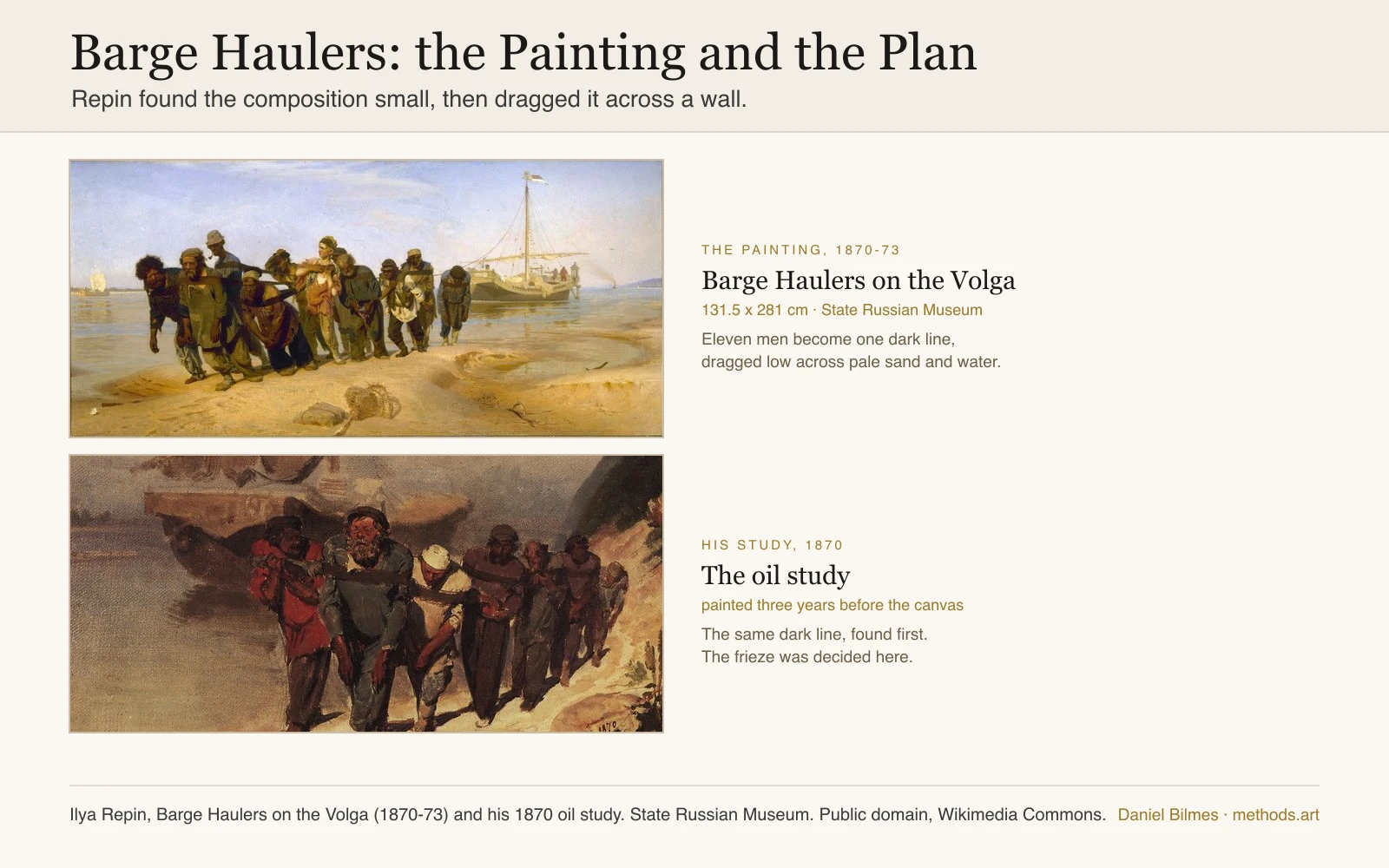
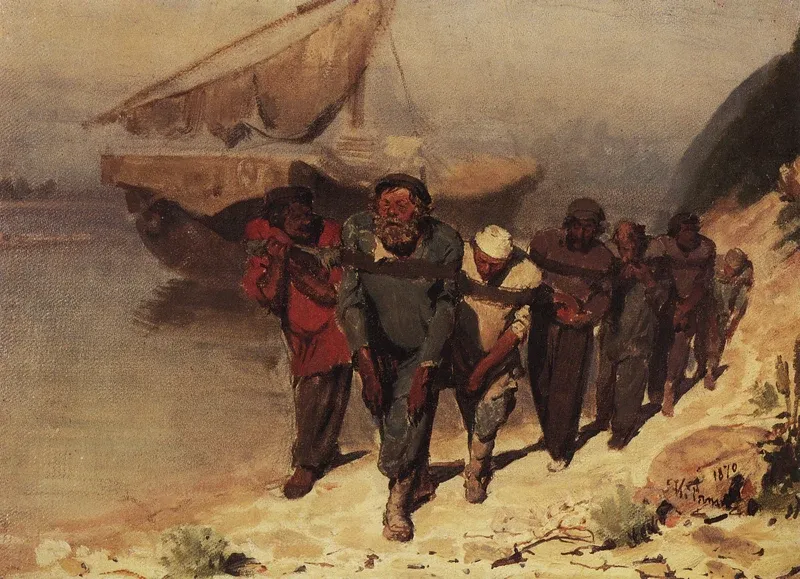
Ilya Repin's Barge Haulers on the Volga (1870-73, State Russian Museum) set above his own 1870 oil study, both shown as wide friezes: eleven barge haulers massed into one dark line dragged low across pale sand and water, the composition worked out in the small study years before the large canvas.
Ilya Repin, Barge Haulers on the Volga (final, 1870-73) and his 1870 oil study, both State Russian Museum. Public domain, Wikimedia Commons.
The three-value thumbnail: the full value scale collapsed into three brackets (darks, mids, lights), with three famous compositions reduced to three-value thumbnail sketches: Caravaggio's Calling of Saint Matthew, Repin's Barge Haulers on the Volga, and Sorolla's Strolling along the Seashore.
Travelled to the actual places his subjects came from; filled sketchbooks with individual studies of heads, hands, clothing, weapons.
Why: The studio painting is built on physical research. A history scene reconstructed from books reads as costume drama; a scene reconstructed from field sketchbooks reads as document.
2. Square up the composition onto the main canvas
Transferred the master sketch to the final canvas by squaring up; blocked in the major forms with a thin tonal wash.
Why: The tonal imprimatura is the skeleton of the light-shadow structure that every later passage gets judged against. Skipping it leaves no reference frame.
3. Iterative characterization, scraping when needed
Worked and reworked individual figures; scraped down to the ground and restarted any figure that did not feel alive.
Why: Corrected paint on top of a dead figure stays dead. The cheapest way forward is to remove the failed paint, not to bury it.
4. Build atmosphere by scumbling
Dragged thin dry lighter color over darker layers in hundreds of passes to produce dust, smoke, haze.
Why: Atmosphere is patient layered work; one heroic glaze cannot replicate it.
5. Rework after exhibition until "psychological truth" holds
Often returned to paintings after they had been shown publicly; reworked until every gesture and expression served the central idea of the work.
Why: Finish is not a deadline. A painting is complete when its psychological reading is unified — not when the gallery hangs it.
How they studied
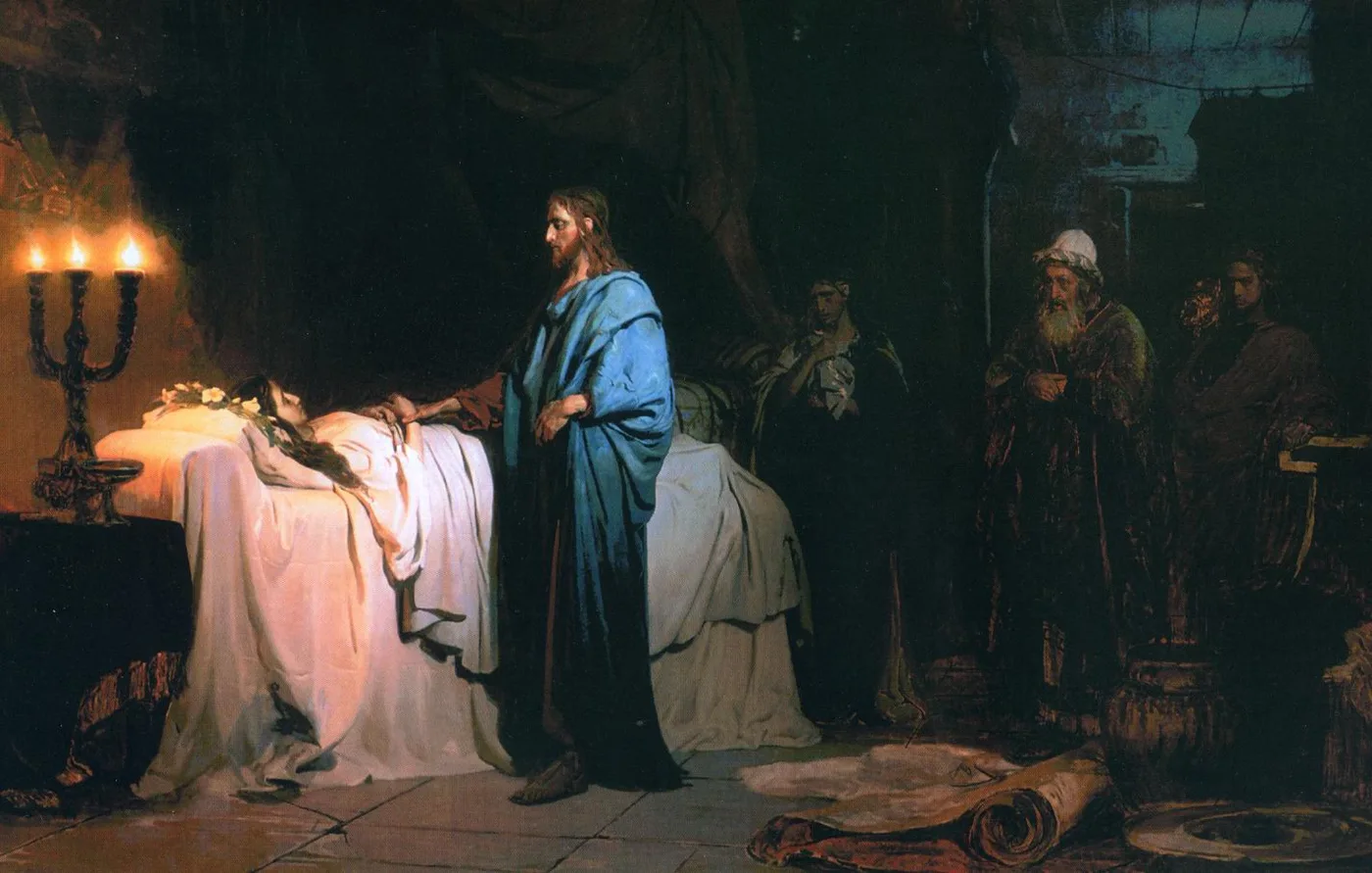
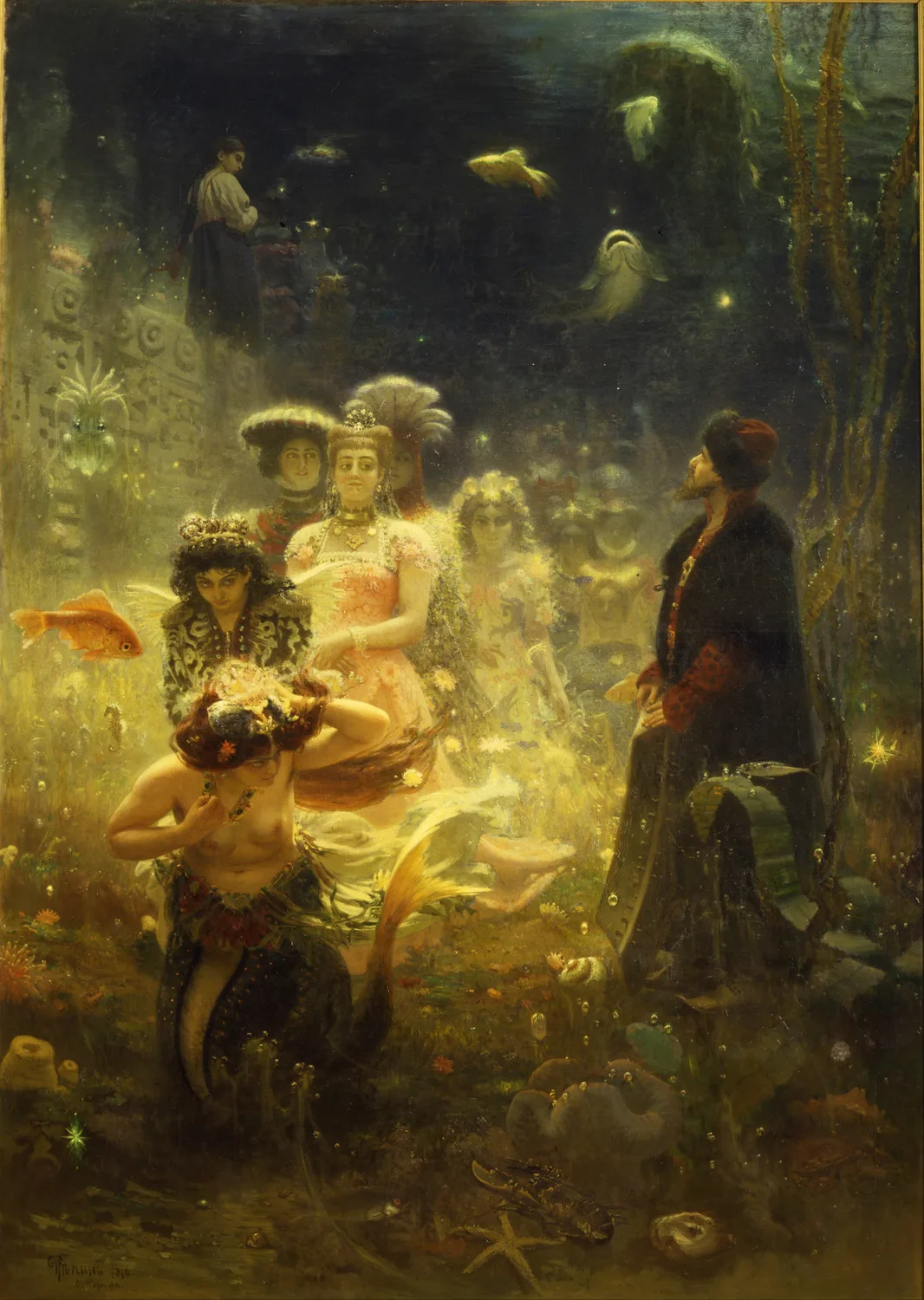
Repin trained the long academic way, and the drawing came first. He started as a boy retouching icons in the provinces, then entered the Imperial Academy of Arts in Saint Petersburg, where he spent six years. His formation there rested on two men. Ivan Kramskoy, met just before he enrolled, held that a picture had to carry a truth about real life rather than decorate a wall. Pavel Chistyakov gave him the drawing discipline that outlasted every fashion, a constructive method that built a form from its underlying structure and moved from the general shape to the particular detail, so that a head was understood before it was rendered. The Academy ran on medals. In 1869 Repin took the small gold medal, and in 1871 the large gold medal for The Resurrection of Jairus's Daughter, which carried the travelling scholarship that sent him abroad. The summer after, he went down the Volga filling sketchbooks, and out of that field work came Barge Haulers. On the scholarship years abroad he painted Sadko in 1876. The two figures below stand at the start of that road, the candlelit gold-medal painting and the underwater fantasy he made abroad.
The Resurrection of Jairus's Daughter, the painting that won Repin the large gold medal at the Academy in 1871 and with it the scholarship abroad: a dark, candlelit academic composition, Christ reaching to the dead girl on the white bier while the mourners wait in the shadow.
Ilya Repin, The Resurrection of Jairus's Daughter, 1871, State Russian Museum, Saint Petersburg. Public domain, Wikimedia Commons.
Sadko, painted abroad in 1876 during the scholarship years: the merchant of the old Russian legend stands at the right in the underwater kingdom while a procession of brides drifts past him, the one plain Russian girl he will choose glimpsed far at the back. The picture earned him election as an academician.
Ilya Repin, Sadko, 1876, State Russian Museum, Saint Petersburg. Public domain, Wikimedia Commons.
Source: The Academy years and the medals: Christian Brinton, Modern Artists, 1908, which records the small gold medal of 1869, the large gold medal of 1871 for The Resurrection of Jairus's Daughter, and the Volga sketching trip. The Chistyakov drawing method follows Igor Grabar's Repin monograph.
Up close
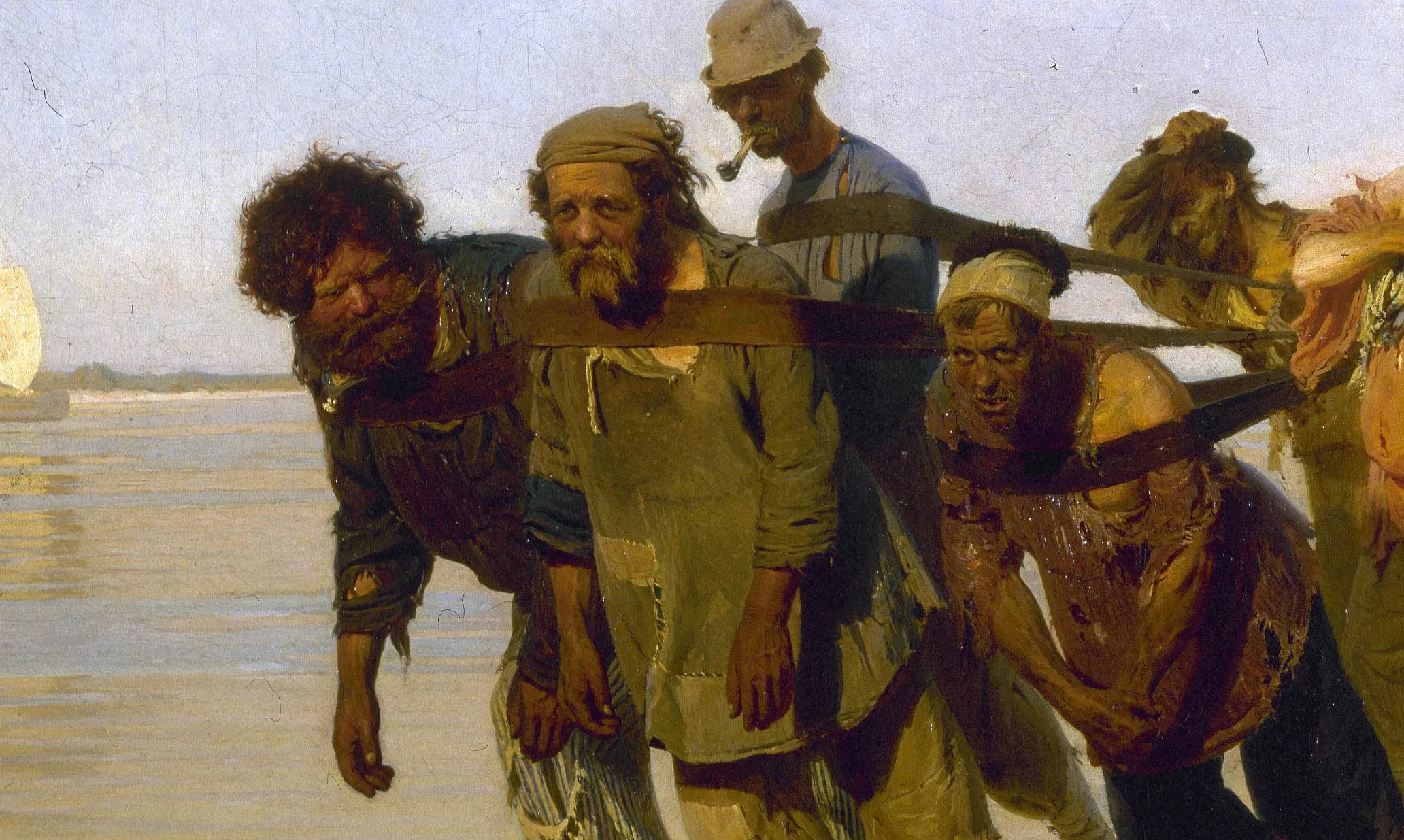
Detail of Barge Haulers on the Volga: the front rank of the team, each face a separate portrait drawn from a real man Repin met on the river, the leather tow strap biting into the chest and the hands hanging heavy with the pull.
Ilya Repin, Barge Haulers on the Volga (detail), 1870 to 1873, State Russian Museum, Saint Petersburg. Public domain, Wikimedia Commons.
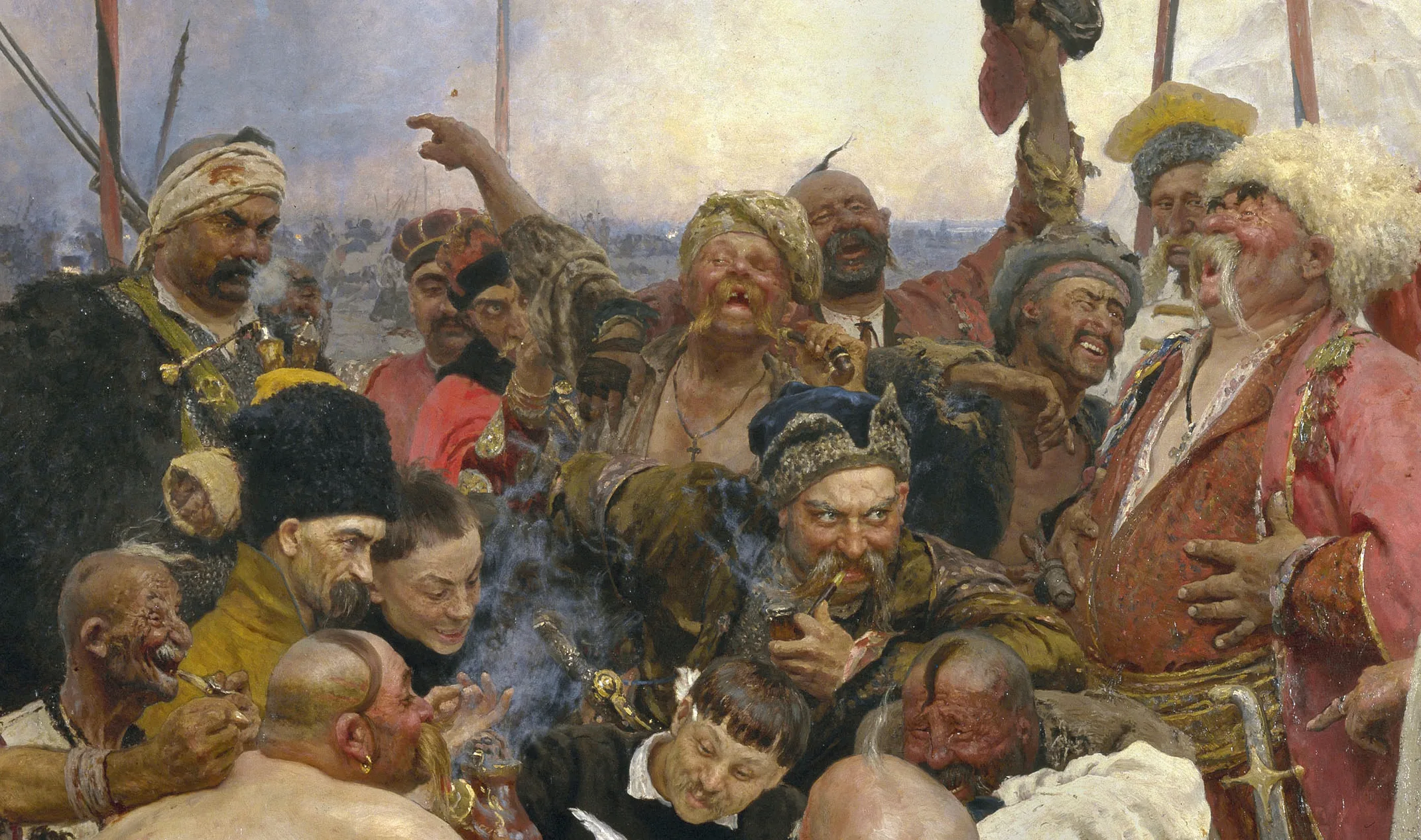
Detail of Reply of the Zaporozhian Cossacks: a row of men caught in every separate kind of laughter, from the wide toothless roar to the sly grin, each head worked up from its own study so that no two laughs are the same.
Ilya Repin, Reply of the Zaporozhian Cossacks (detail), 1880 to 1891, State Russian Museum, Saint Petersburg. Public domain, Wikimedia Commons.
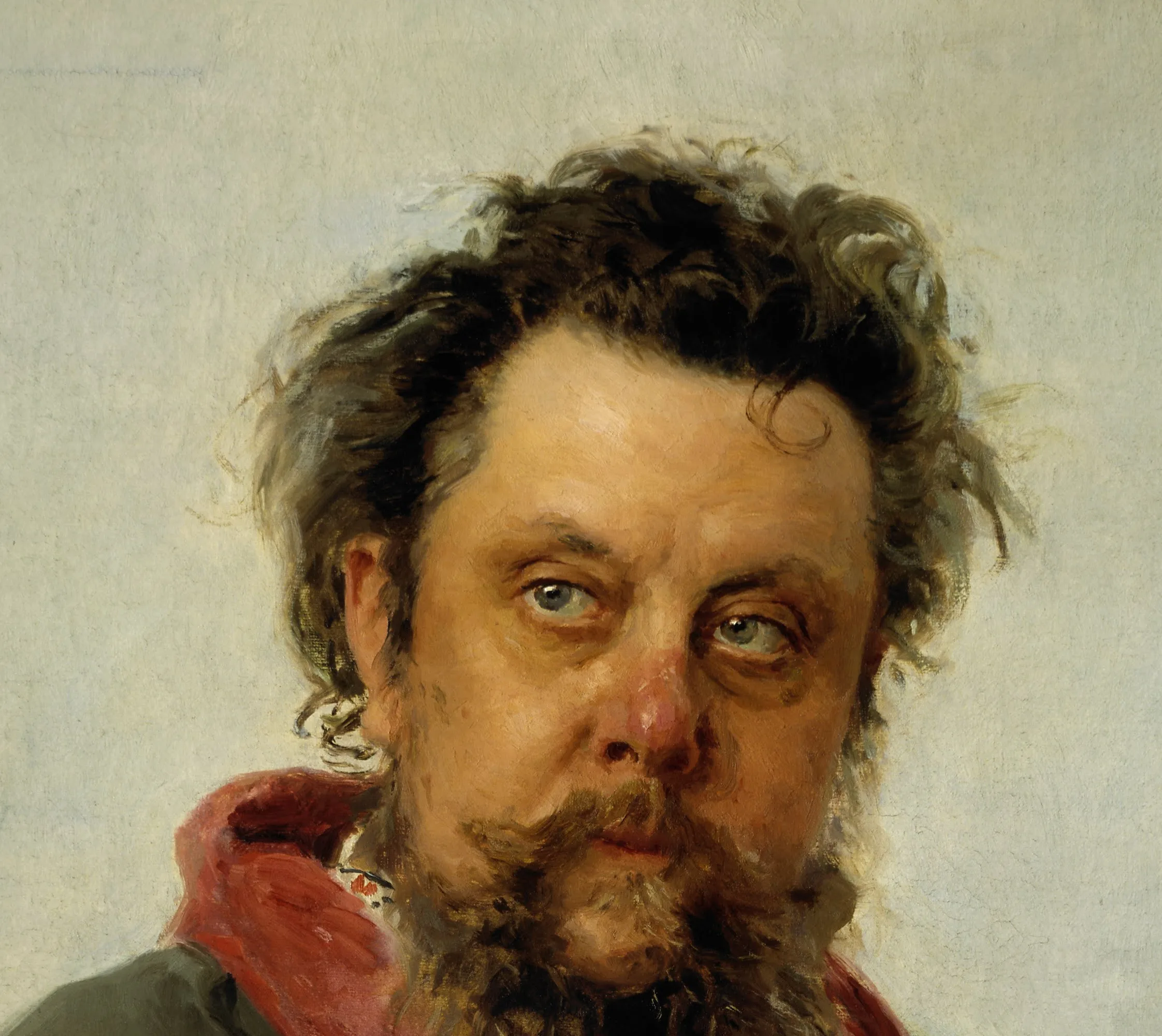
Detail of the portrait of the composer Modest Mussorgsky, painted over a few days in a hospital ward just before his death: the flushed nose, the unfocused eyes, and the loose hair set down plainly, the crimson facing of the gown struck in wet, a sick man reported without flattery.
Ilya Repin, Portrait of the Composer Modest Mussorgsky (detail), 1881, State Tretyakov Gallery, Moscow. Public domain, Wikimedia Commons.
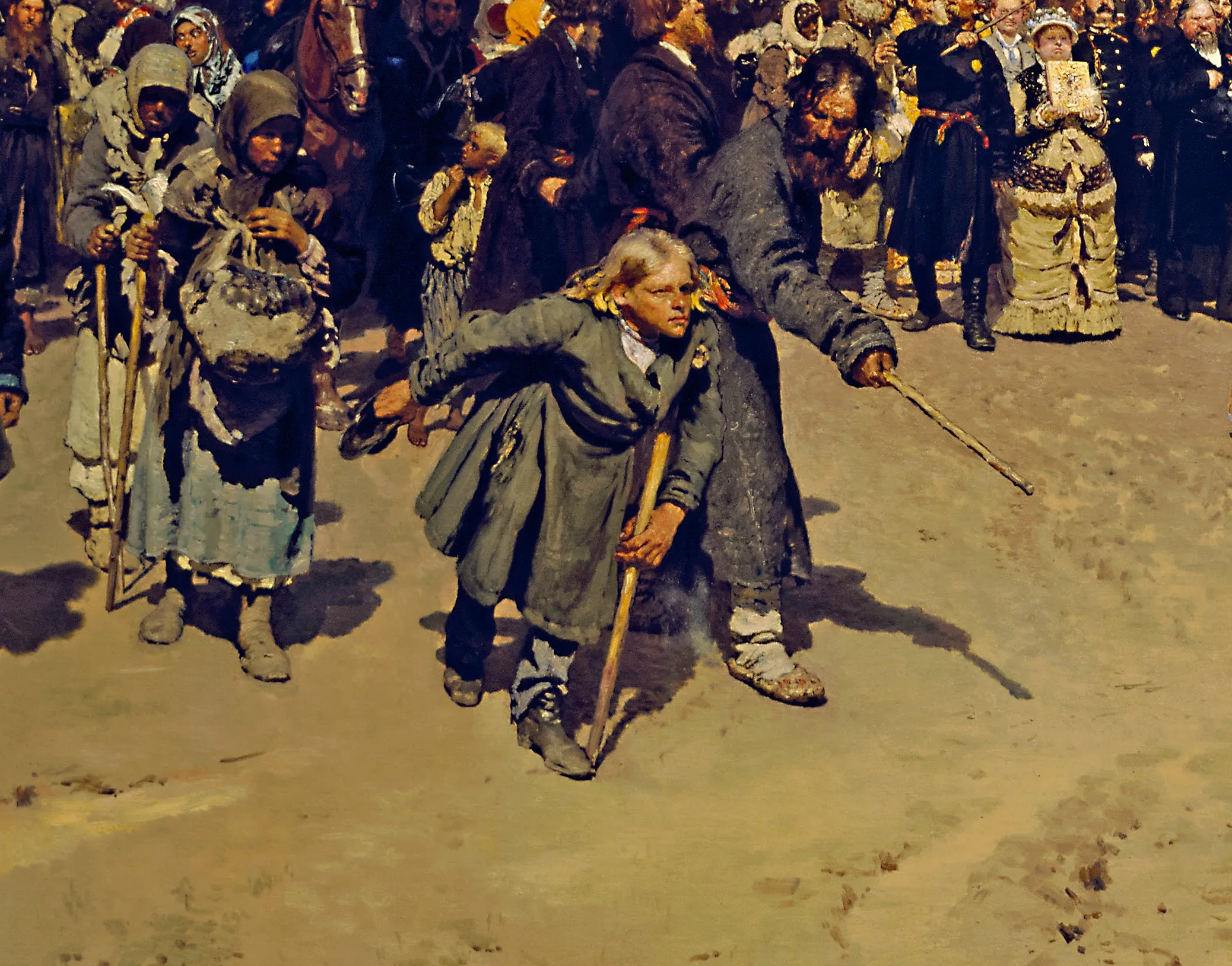
Detail of Religious Procession in Kursk Province: the hunchbacked boy lunging forward on his stick, the ragged pilgrim women on crutches beside him, an official swinging a whip to hold the line. Each figure in the crowd is a separate type Repin built from a study, not a face repeated from a formula.
Ilya Repin, Religious Procession in Kursk Province (detail), 1880 to 1883, State Tretyakov Gallery, Moscow. Public domain, Wikimedia Commons.
Watching him work
“As many as a hundred preliminary studies were made for The Cossacks, of which, during some ten years, he painted three finished versions. He is never satisfied, he constantly strives to attain a verity which seldom seems final.”
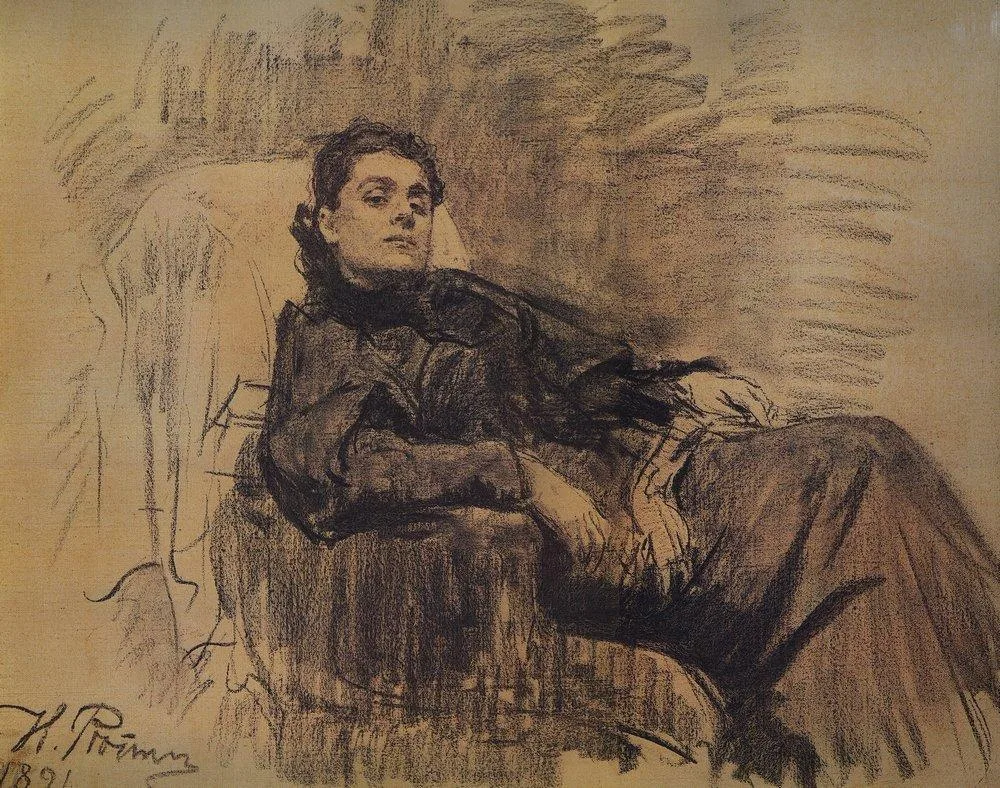
A charcoal portrait of the actress Eleonora Duse, worked on canvas: the head found in rubbed and dragged charcoal, the light of the toned ground left bare for the face and the collar. A drawing carried to the finish of a painting.
Ilya Repin, Portrait of Eleonora Duse, 1891, State Tretyakov Gallery, Moscow. Public domain, Wikimedia Commons.
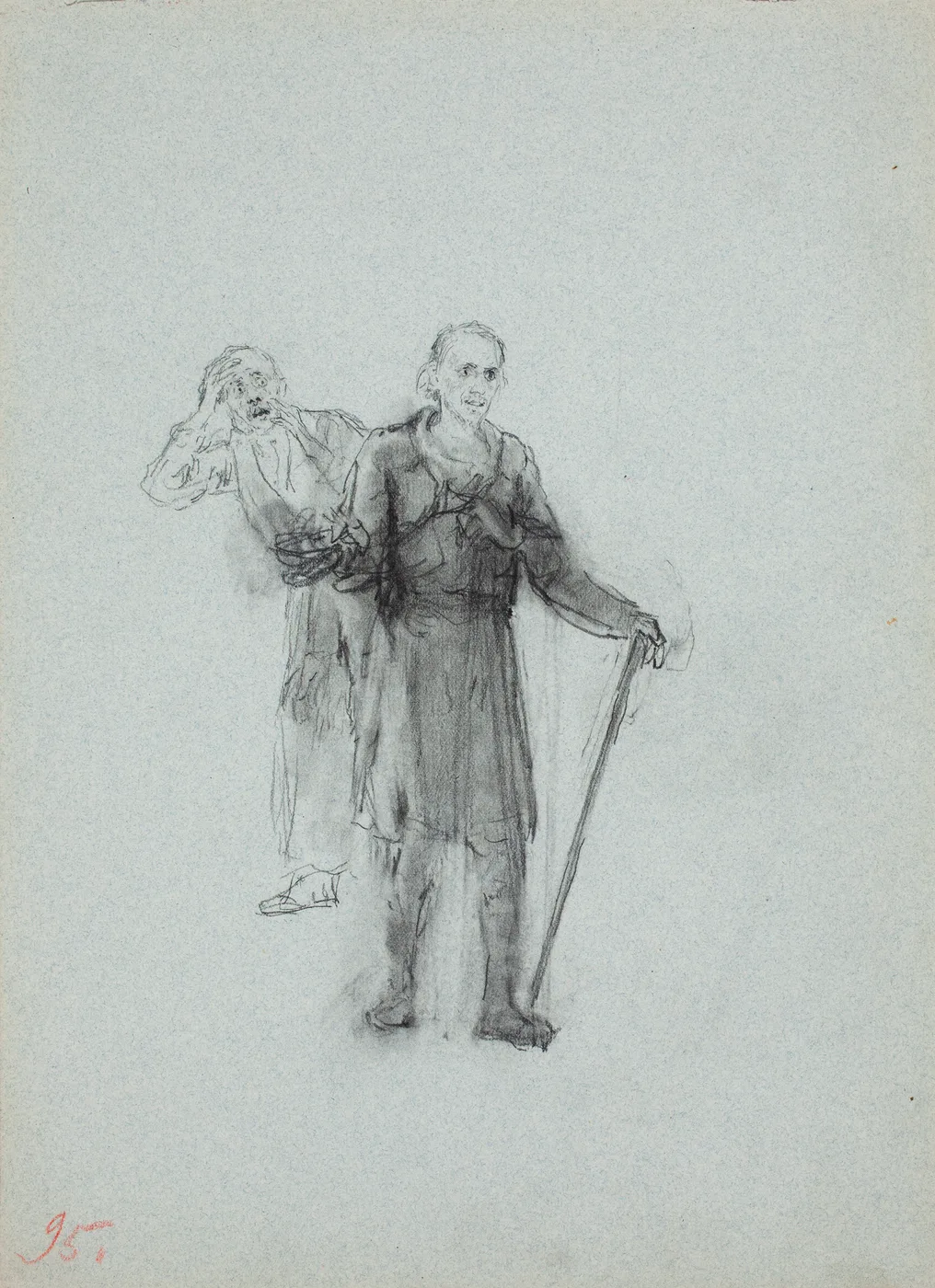
A preparatory figure study in graphite, one of the drawings from life Repin worked up before committing a figure to the canvas. The pose is searched out in loose lines, a second head roughed in behind it, the sheet carried only as far as it needed to go.
Ilya Repin, figure study for They Did Not Expect Him, circa 1883 to 1884, Ateneum, Helsinki. Public domain, Wikimedia Commons.
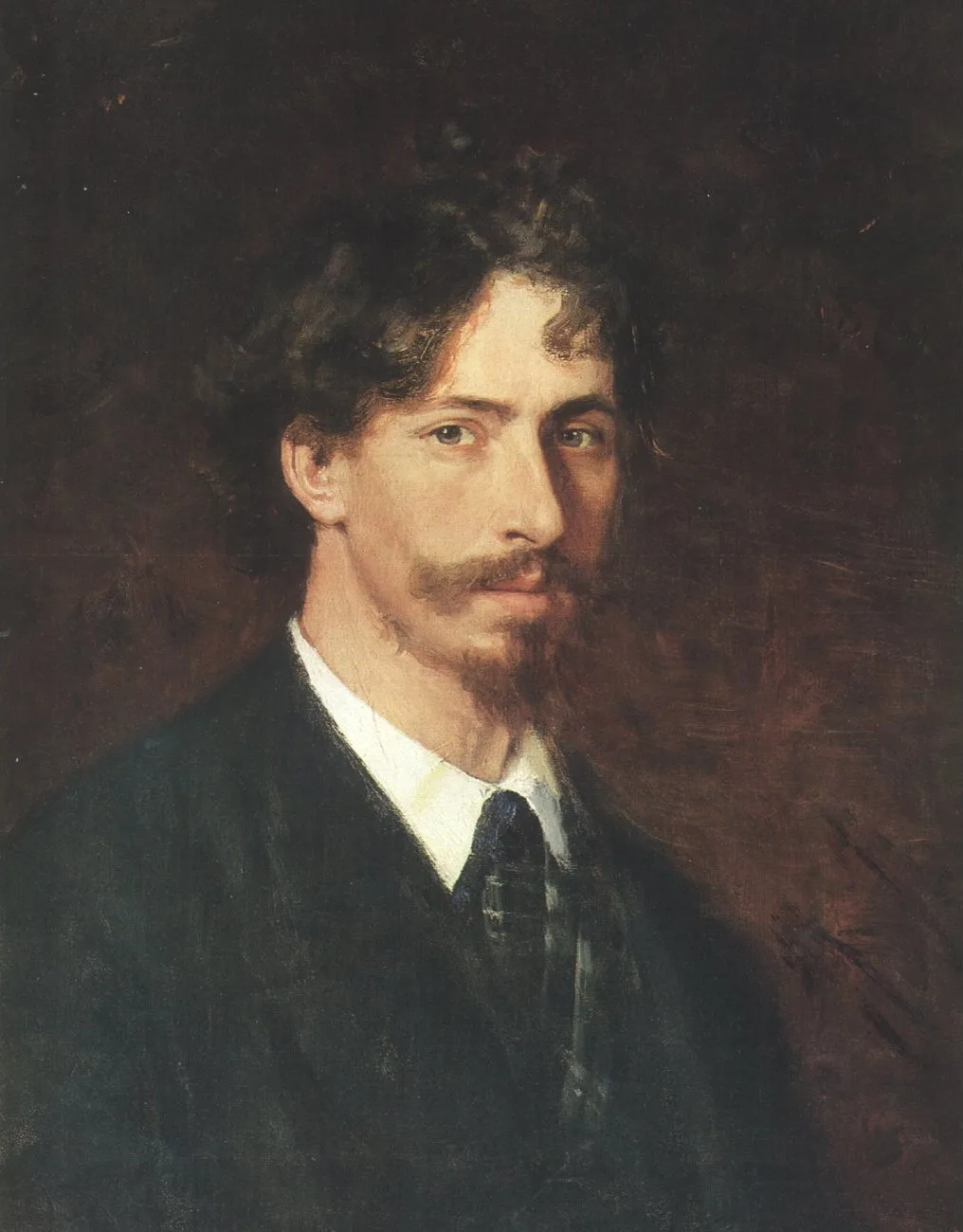
Self-portrait at thirty-four, painted the year after he came home from the scholarship abroad: the head lit out of a dark ground, the collar and tie set down quickly, the eyes doing the work.
Ilya Repin, Self-Portrait, 1878, State Tretyakov Gallery, Moscow. Public domain, Wikimedia Commons.
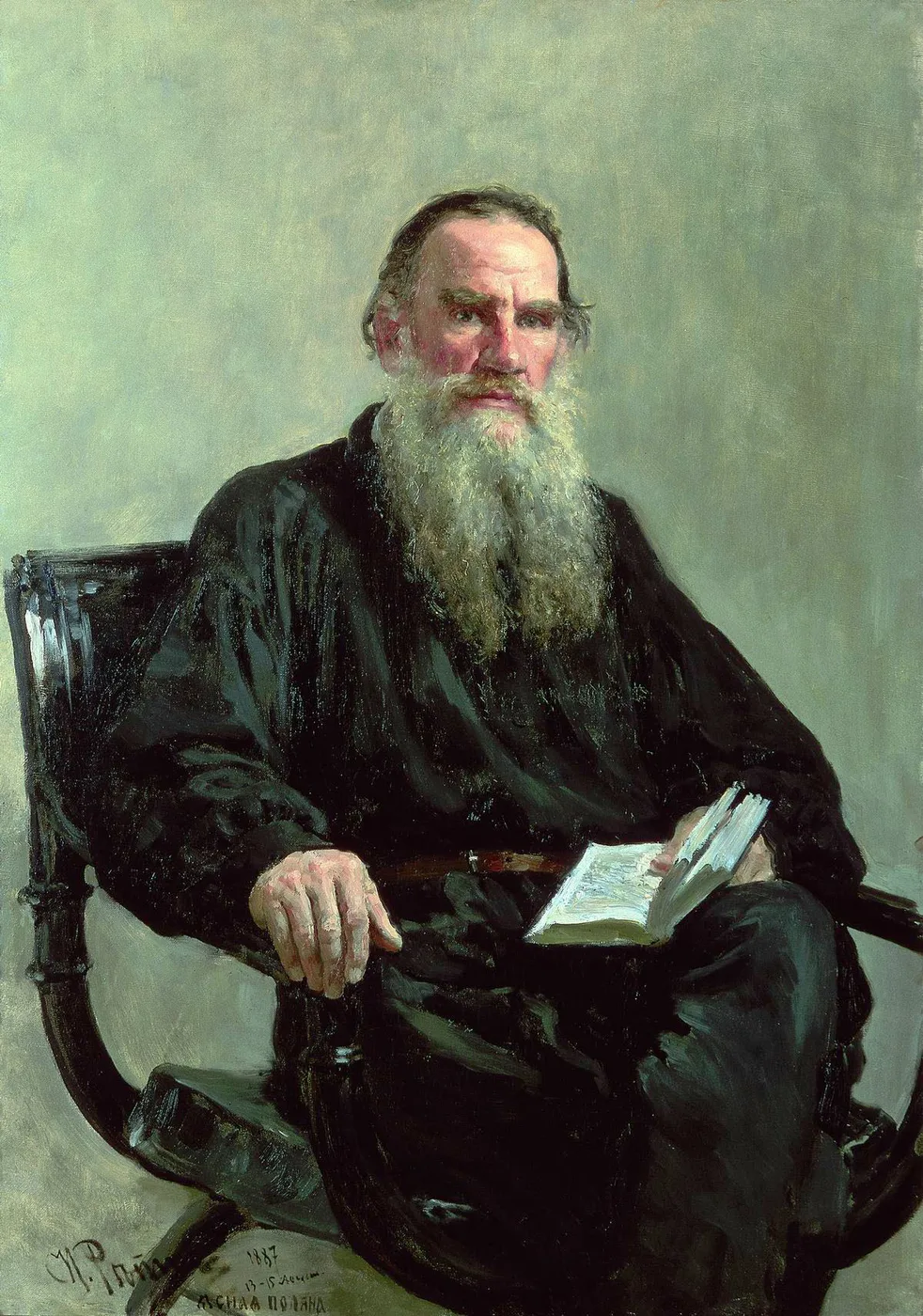
Portrait of Leo Tolstoy, painted at the writer's estate at Yasnaya Polyana in 1887: the black peasant blouse laid in broad and dark, a book held open in the lap, the whole picture built to carry the head and the hands.
Ilya Repin, Portrait of Leo Tolstoy, 1887, State Tretyakov Gallery, Moscow. Public domain, Wikimedia Commons.
The record, deeper
The reworks
He could not leave the Reply of the Zaporozhian Cossacks alone. A contemporary account records a hundred or more preliminary studies and three finished versions of the composition, worked over some ten years before he let it go.
Christian Brinton, Modern Artists, 1908; catalogue of the Ilya Repin exhibition, 1921.
The face of the returning exile in They Did Not Expect Him was repainted at least three times, in 1885, 1887, and 1888, after Pavel Tretyakov had already bought the canvas and hung it in his Moscow gallery.
Documented revisions, State Tretyakov Gallery; Igor Grabar, Repin.
The studio
From about 1899 Repin lived and worked at Penaty, his house at Kuokkala in Finland, now the I.E. Repin Museum-Estate near Saint Petersburg. Visitors and sitters travelled out to the estate to pose, and he painted there until his death in 1930.
Catalogue of the Ilya Repin exhibition, 1921; Museum-Estate of I.E. Repin "Penaty" archival records.
Refusals — what they would not do
Refused to sit while painting — sitting produced lazy eye and weak stroke.
Refused black for shadows — composed darks from complementary colors and earth pigments.
Refused to let a sitter freeze into a held pose — required conversation.
Refused smooth academic finish — wanted the path of the brush visible in the final painting.
Refused to slavishly copy from photographs — used photography for facts only, not for life.
Reference
Primary source
Life. Field observation of actual places and actual people. Physical period artifacts brought into the studio.
Photography
Used as a memory aid for complex details — embroidery patterns, church architecture, the cut of a costume — but refused to let photographic flatness dictate volume in the painting.
Exceptions
For historical work, sourced authentic seventeenth-century Cossack clothing, weapons, and furniture and lit them by the same studio light as the model.
Ivan Kramskoy · Imperial Academy of Arts and beyond — Mentor and harshest critic. Taught Repin that art had to serve a social and psychological purpose — that technical skill was a floor, not an end.
Influences
The Peredvizhniki social-realist program — art as document of Russian life rather than decoration of palaces.
Students
Valentin Serov (carried Repin's psychological depth into Silver Age portraiture).
Boris Kustodiev (adapted Repin's taste for vibrant crowds).
Isaak Brodsky (extended Repin's realist method into the early Soviet era).
In their own words
“You have to look for the very essence of a person. In Religious Procession every figure — the way they walk, how they hold their head — has to express their inner nature and the main idea of the scene.”
— Ilya Repin, Cited in contemporary reviews of the Kursk paintings, 1883
On the standard he set for figures inside a crowd.
“I do not value these sketches as art. They are only drafts. It is embarrassing that there are so many of them, but they are necessary to find the final form.”
— Ilya Repin, Spoken to contemporaries about his studies for the Zaporozhye Cossacks, 1891
“The studio is a place for hard labor. I have to stand in front of the canvas to feel the energy of the subject.”
— Ilya Repin, Personal correspondence, 1885
“You have to capture the shimmering heat and the dust. The environment is as much a character as the people are.”
— Ilya Repin, On the atmosphere of his outdoor scenes
He built big paintings from studies, not imagination: years of field observation, drawing heads, hands, and clothing from life, then squared the composition onto the canvas, blocked it in with a thin tonal wash, and reworked each figure until it read as alive.
What materials and palette did Repin use?
Oil on heavy coarse-weave linen whose texture caught the impasto. His palette was earth-anchored, with lead white chosen for its luminosity, and he composed his darks from mixed complementaries rather than black.
What medium did Repin use?
Linseed oil thinned with turpentine and adjusted in fluidity for each passage, working wet-on-wet for skin transitions and letting areas dry fully before glazing.
Did Repin use photographs?
Only for facts such as embroidery patterns, architecture, or the cut of a costume. He refused to let photographic flatness dictate volume, and worked the figures themselves from life.
Why did Repin scrape figures back?
He held that paint laid on top of a dead figure stays dead, so if a character did not feel alive he scraped it to the ground and restarted. The pentimenti on his major canvases are the record of that cycle.
Where did Repin paint?
From 1899 Repin painted at his Penaty estate in Kuokkala, then in Finland, now Repino near St. Petersburg. He built a studio there lit from above through a glazed, pyramid-roofed ceiling, and lived and worked there until his death in 1930.
How did Repin paint Reply of the Zaporozhian Cossacks?
Repin worked on it on and off for roughly eighteen years (1878–1896), making hundreds of studies and two finished versions. He traveled to the Kharkiv region to draw descendants of the Cossacks from life and tracked down authentic seventeenth-century clothing and weapons, then built the crowd in the studio from that field research rather than from imagination.
How did Repin paint Religious Procession in Kursk Province?
He built the picture (1880–83) from hundreds of preparatory studies of individual figures, drawn from the kind of people who walked in the real procession, with around 300 sketches now in the Tretyakov Gallery. The haze of heat and dust over the crowd was built up with many dry scumbled passes rather than a single glaze.
If this painter is your match
You share the commitment to observation applied to subjects that carry social and historical weight. The painting is never just about paint.
Borrow this: Paint a portrait of someone you actually know, in one sitting, while they are talking. Not a commission. Not a stranger. The knowing is part of the painting.
I.E. Repin, Far and Near (Далекое близкое), 1937. Repin's own late-life memoir, compiled and published posthumously. The central document for his self-reporting on method.
Kornei Chukovsky, Ilya Repin: Memoirs and Essays, 1945. Chukovsky knew Repin personally for decades at Penaty. The richest first-hand account of Repin's working habits.
Museum-Estate of I.E. Repin "Penaty" — Archival Records and Studio Schedules, 2024. The preserved Penaty studio itself, including its daily schedule board. Curatorial material corroborates the hours quoted.
Christian Brinton, Modern Artists, 1908. A contemporary American critic's chapter on Repin. The public-domain source used here for the study-per-canvas discipline (a hundred studies and three versions of the Cossacks), the never-satisfied working temperament, and the Academy formation (the 1869 and 1871 gold medals and the Volga sketching trip).[link]
Christian Brinton, catalogue of the Ilya Repin exhibition (American traveling exhibition), 1921. Brinton's introduction and catalogue for the 1921 American exhibition. Corroborates the hundred-plus sketches and three versions of the Cossacks over some ten years, and records that sitters came out to the Penaty estate to pose.[link]
%20-%20Volga%20Boatmen%20(1870-1873).jpg)