Sargent painted alla prima, wet paint placed once, in pure oil color with no medium added. He worked from a north-lit London studio in sight-size, standing, his easel beside the sitter. He retreated six to twelve feet to judge the whole, then dashed forward and placed one decisive mark. When a passage failed he scraped the canvas down to the ground rather than correcting it. Correcting wet paint with more wet paint only makes worse paint.
Used a small amount of turpentine only to rub in the first general tones; everything after went down in pure tube oil color.
Why it matters · Mediums change drying time, surface quality, and color temperature. Removing them means the paint you see on the canvas is the paint you will see a hundred years later. Also forces you to stop hiding behind glazes.
Julie Heyneman, Notes on Sargent's Technique, 1900
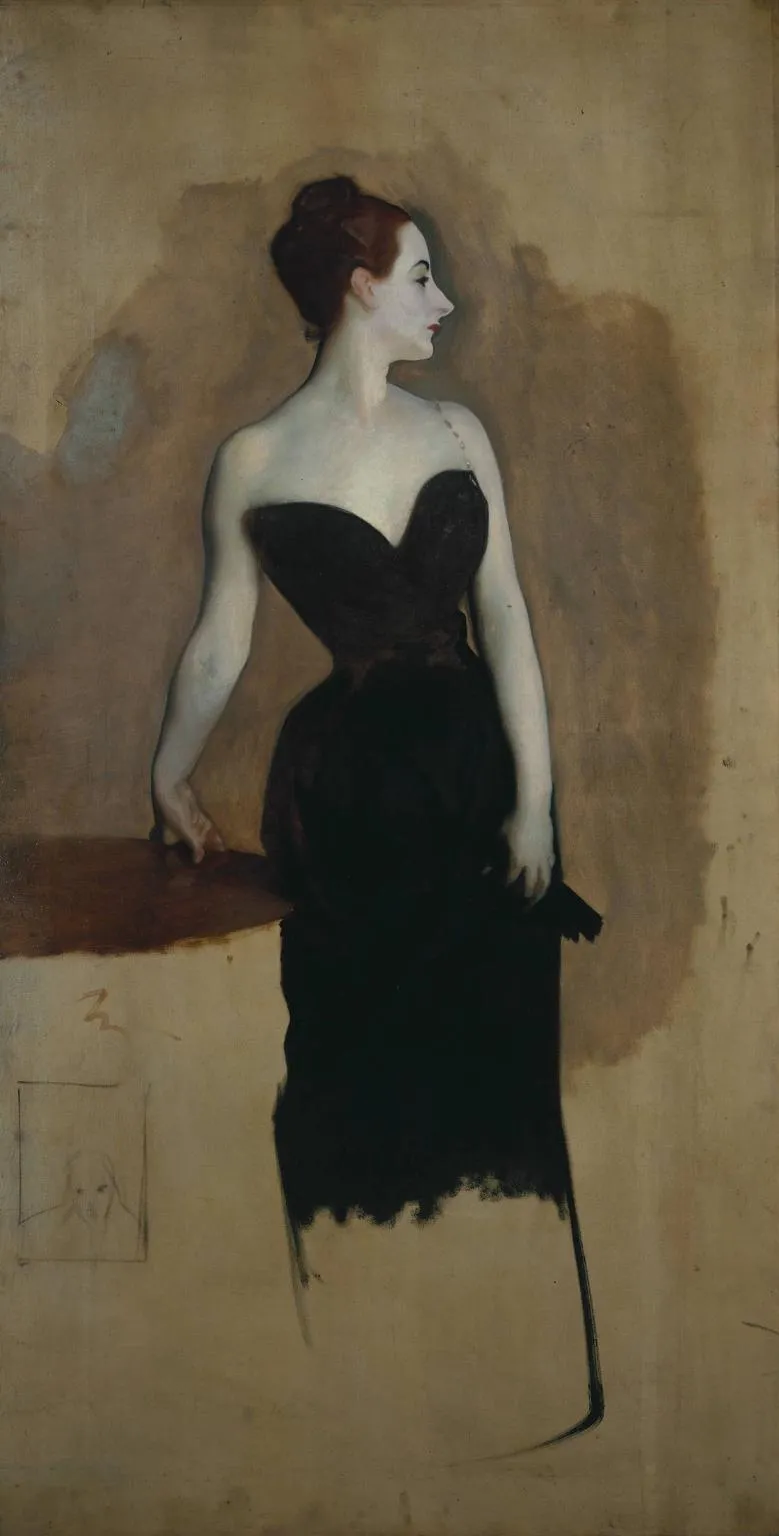
Study of Mme Gautreau, left unfinished: the brown around her is the thin turpentine rub in he started with, thin enough that the bare canvas still shows at the edges, and the arm and the shoulder laid on top of it are pure tube colour. Both stages sit on the one canvas.
John Singer Sargent, Study of Mme Gautreau, circa 1884, Tate, London. Public domain, Wikimedia Commons.
Piles, not dabs
Set out 'piles enough for a dozen pictures' of paint per session; scraped the palette clean and refreshed daily.
Why it matters · Small palettes produce small paintings. A loaded brush cannot be loaded from a thin smear. This is material — the physical quantity of paint available shapes the marks you're willing to make.
Julie Heyneman, Notes on Sargent's Technique, 1900
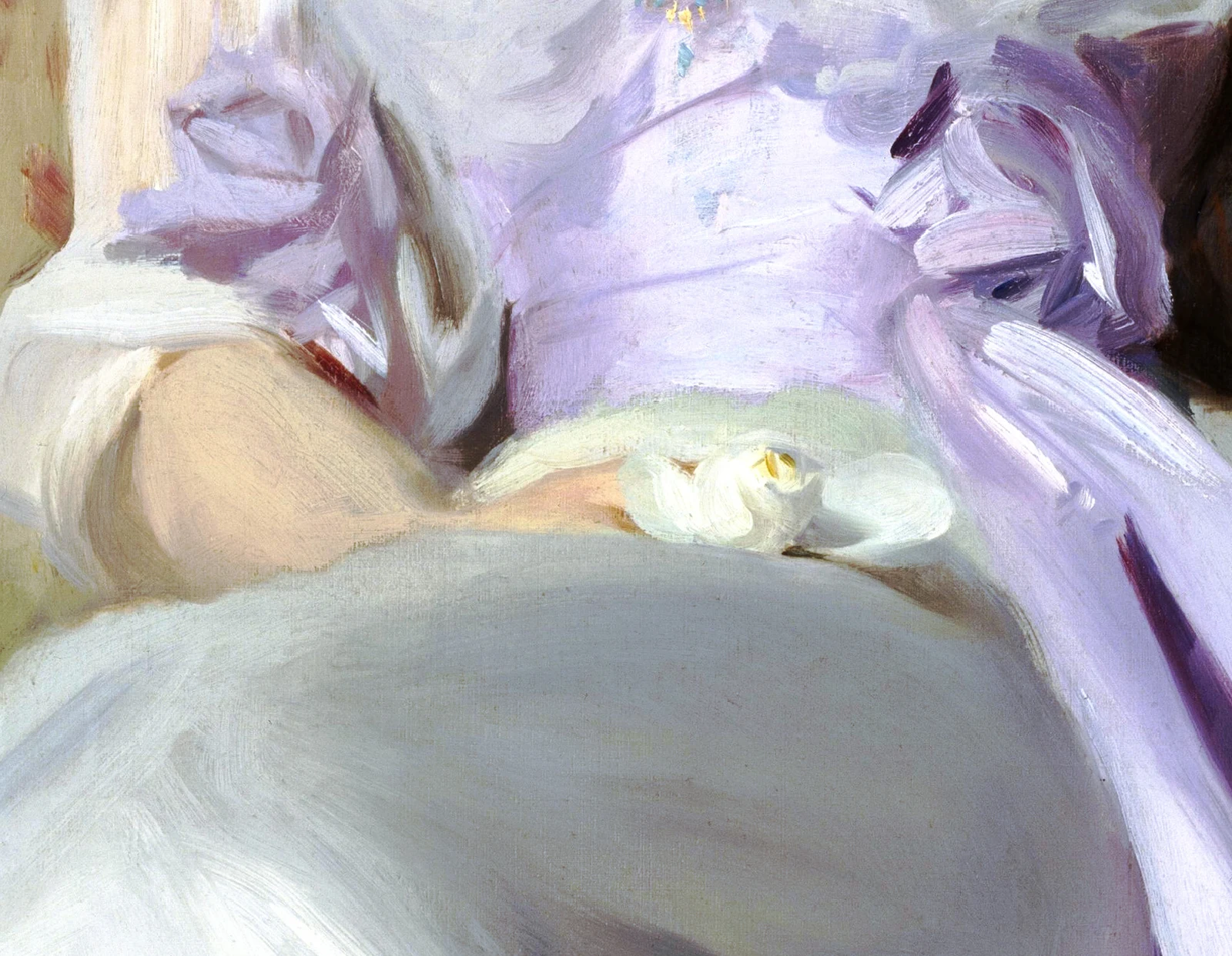
Detail of Lady Agnew of Lochnaw: the lavender sash and white sleeve carried in thick loaded strokes, each one laid down once and left standing, none of them gone back into.
John Singer Sargent, Lady Agnew of Lochnaw (detail), 1892, National Galleries of Scotland. Public domain, Wikimedia Commons.
Scrape to ground when a passage fails
Refused to correct failed wet paint with more wet paint; removed it entirely with a palette knife and restarted the passage.
Why it matters · Corrected wet paint becomes mud. The discipline is visible in every surviving Sargent face — no built-up sludge around the eyes or mouth. If a passage will not come right, the fastest way forward is backward.
William Rothenstein, Men and Memories, 1931
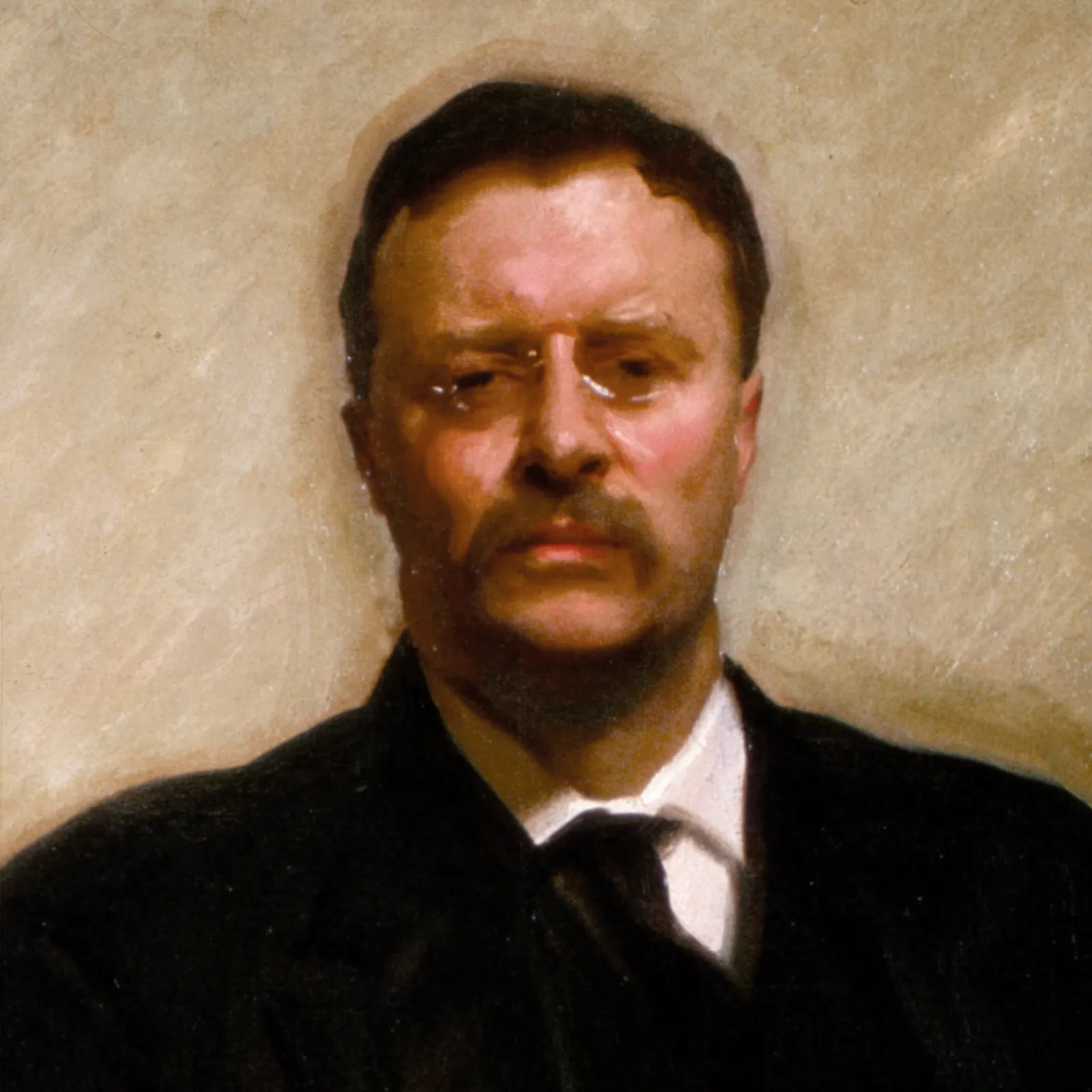
Detail of Theodore Roosevelt: the pince nez is a few flicks of light across the eyes, the paint around them was never gone back into, and the head keeps the unworried look of a fresh sketch. A badly placed eye meant the construction under it was wrong, so the head came off the canvas and went back on from the start.
John Singer Sargent, Theodore Roosevelt (detail), 1903, The White House, Washington. Public domain, Wikimedia Commons.
Standing, pacing, retreating
Worked standing, retreated six to twelve feet from the easel between marks, advanced to place a decisive stroke, retreated again.
Why it matters · You cannot judge a whole painting from eighteen inches away. The retreat is not theatrical — it is the only distance at which the canvas reads as a single visual field. Sitting-down painters overwork.
Evan Charteris, John Sargent, 1927
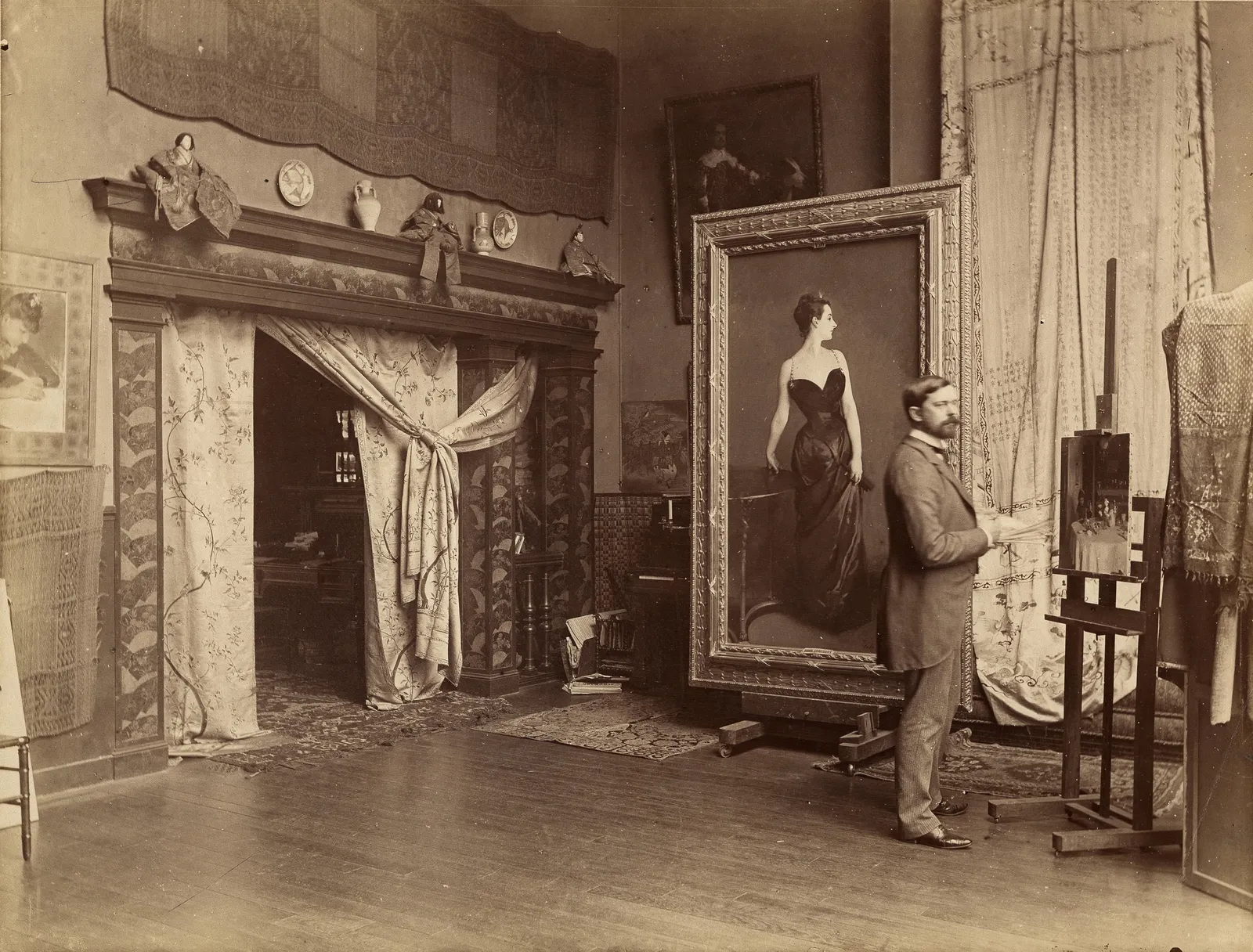
Sargent standing in his Paris studio in 1884, the portrait of Madame X on a rolling stand beside him and a working easel at the right. The room in front of the easel is bare floor for several paces, which is the distance he judged a canvas from.
Photograph of John Singer Sargent in his studio at 41 boulevard Berthier, Paris, 1884. Public domain, Wikimedia Commons.
The live sitting as animation
Required conversation, cigars, piano music during portrait sittings; refused to paint a face that had frozen into a held pose.
Why it matters · A held face is a death mask. Character shows up in speech and between sentences. Paint the person between the poses, not the pose. Applies equally to still life — a 'held' setup produces a held painting.
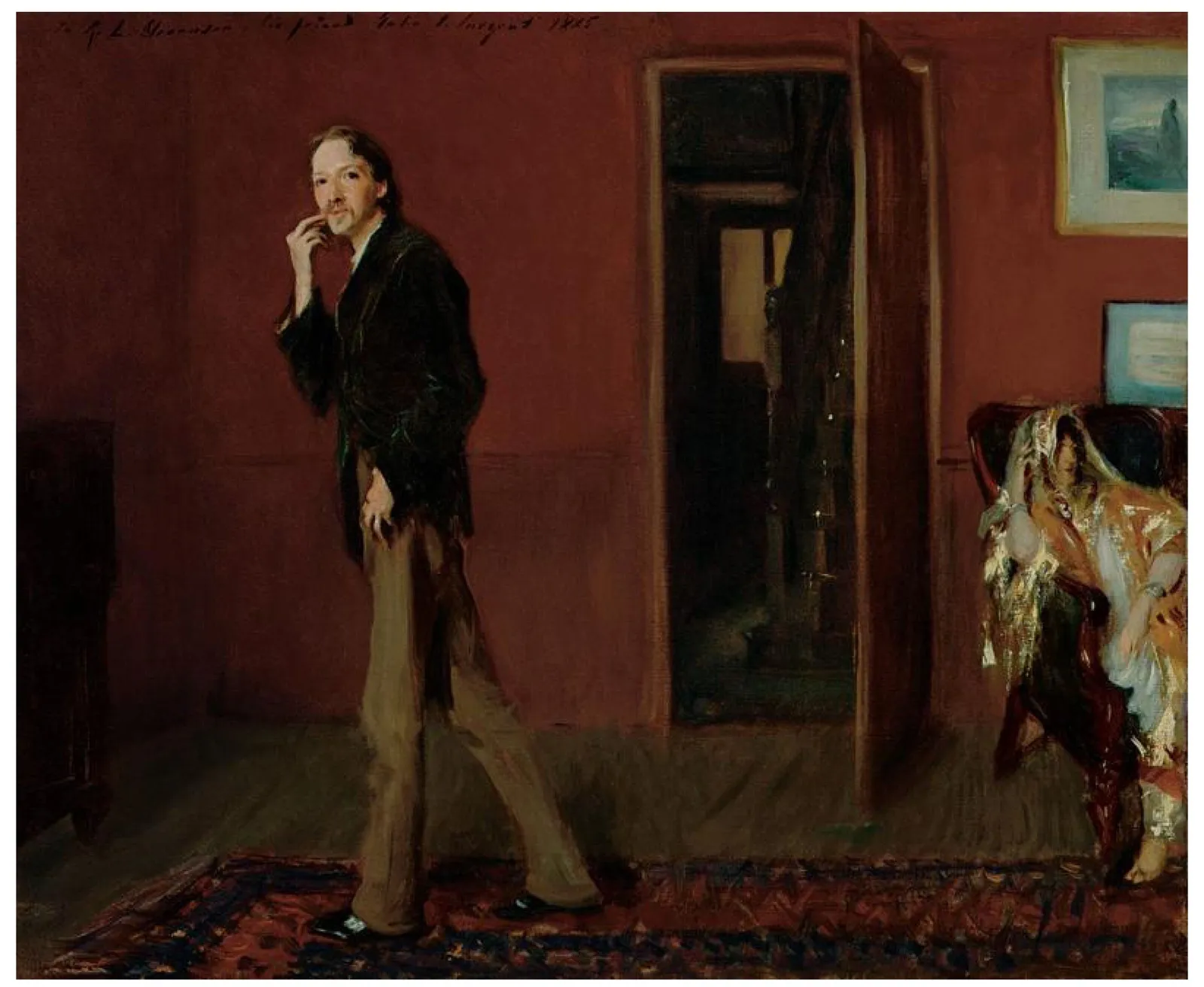
Robert Louis Stevenson and His Wife: Stevenson is painted mid stride across his own room, one hand up at his moustache, and his wife is pushed out to the far edge of the canvas in a gold shawl. Nobody in this picture is holding a pose.
John Singer Sargent, Robert Louis Stevenson and His Wife, 1885, Crystal Bridges Museum of American Art, Bentonville. Public domain, Wikimedia Commons.
The light-shadow edge as skeleton
After charcoal placement, outlined the boundary between light and shadow on the face as the fourth step — before any internal feature.
Why it matters · Features are consequences of the light-shadow edge, not the other way round. Painters who build a face from the eyes outward end up with features glued to a skull they never established. The edge is the skeleton everything hangs from.
Evan Charteris, John Sargent, 1927
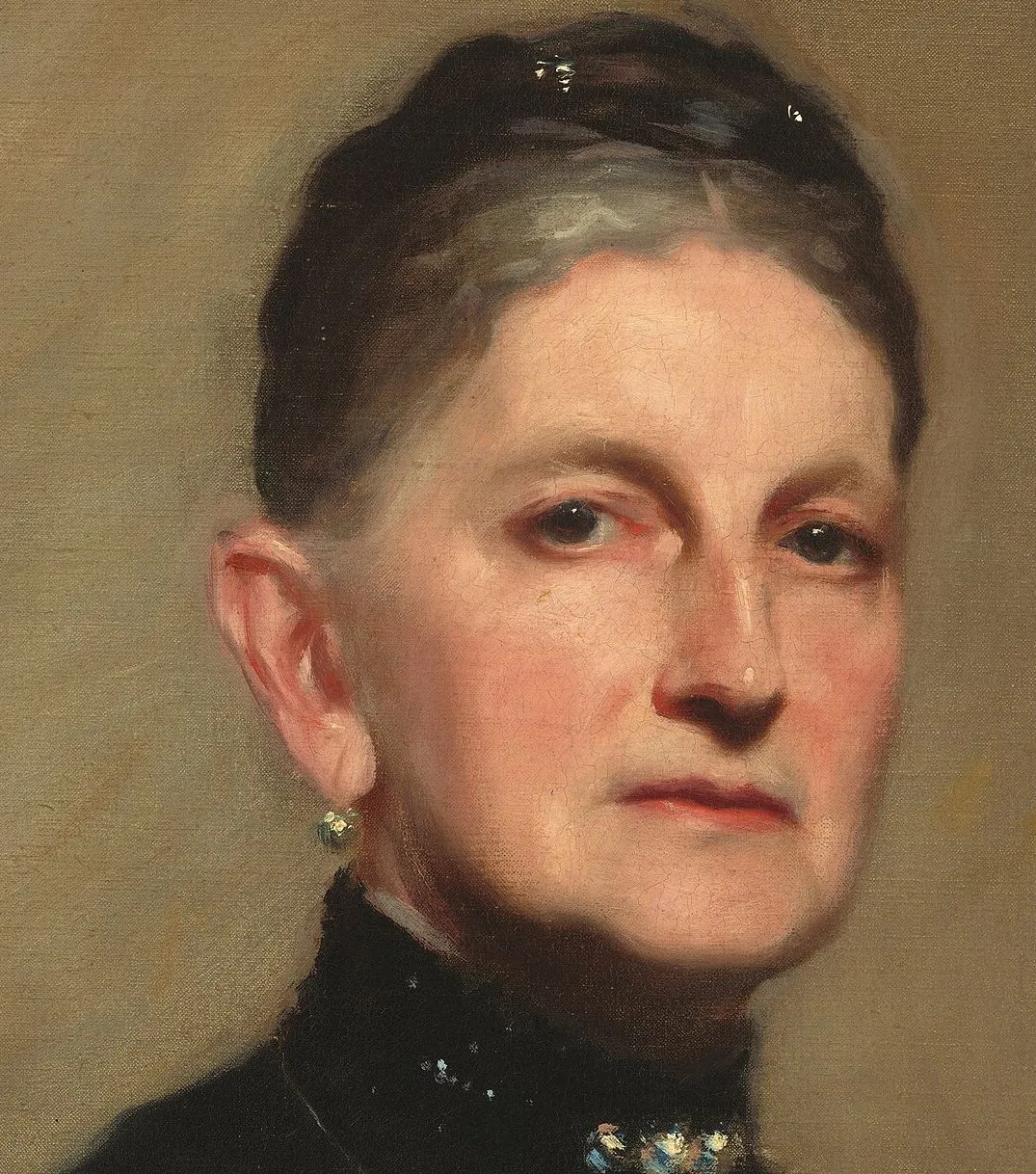
Detail of Mrs. Adrian Iselin: the light crosses the forehead and the far cheek while the shadow gathers on the ear side of the face and under the jaw, and that one boundary carries the structure of the whole head. The eye, the nostril and the mouth are small marks set inside it rather than drawn first and filled in.
John Singer Sargent, Mrs. Adrian Iselin (detail), 1888, National Gallery of Art, Washington. Public domain, Wikimedia Commons.
Destroy finished paintings that lost spontaneity
Burned or scraped completed paintings he felt had been overworked, even when they were commercially finished.
Why it matters · A painting is finished when the character and the light are captured — not when every inch is resolved to the same level. Reading this as optional is the single biggest error developing painters make.
Halftone first, accents last
Modeled the head in the middle transition tones first, the way you would model an apple, and saved the lightest lights and darkest darks for the very end.
Why it matters · Placing your strongest accents early locks you into false contrast you then have to fight. Building the form in halftones first means the darks and highlights land into a structure that already reads, so a few final accents do the work of many.
Evan Charteris, John Sargent (1927), on the Carolus-Duran method, 1927
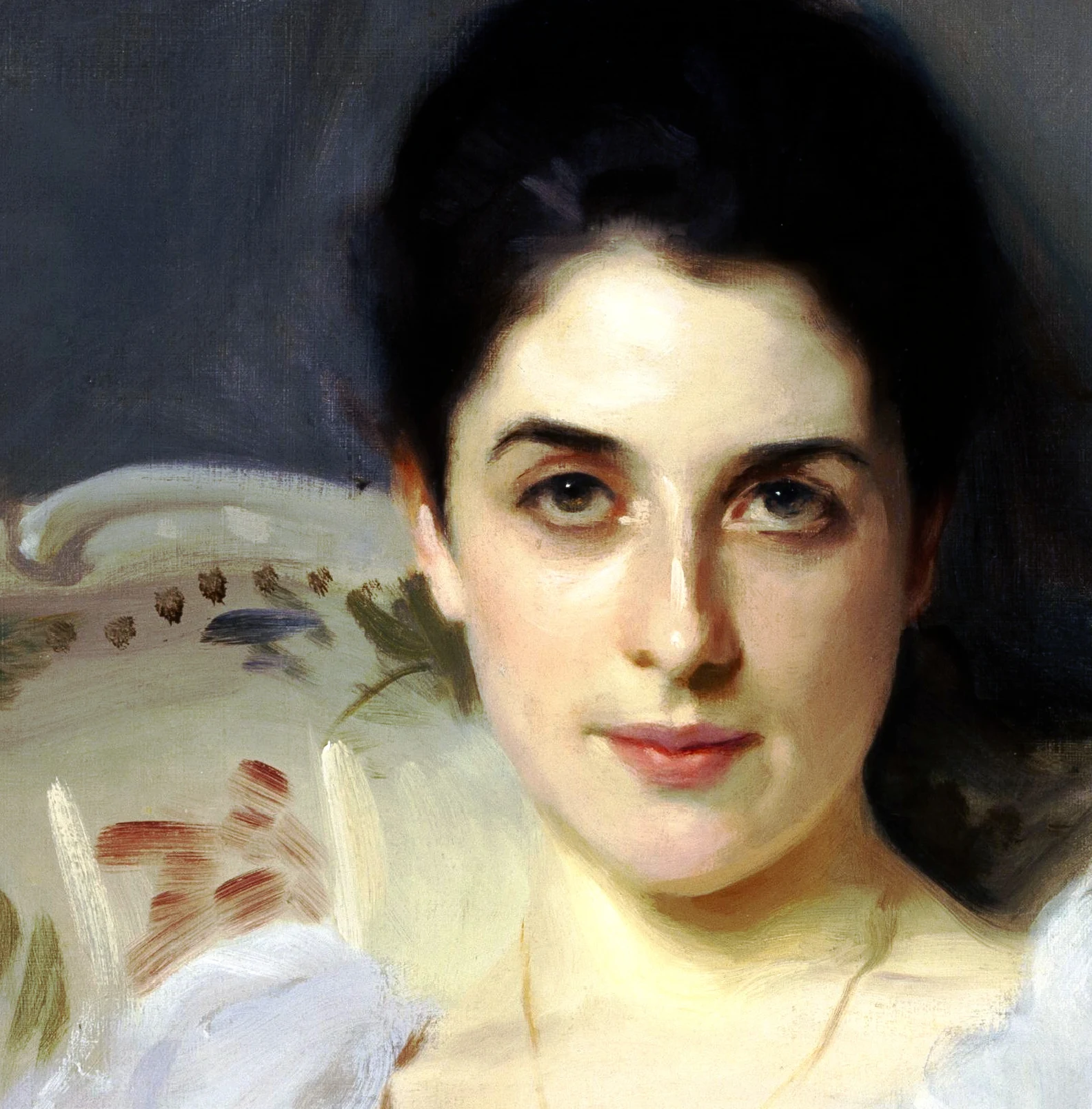
Detail of Lady Agnew of Lochnaw: the face built first in its middle halftones, with the sharpest lights and darks, the eyes and the lower lip, held back for a few final strokes.
John Singer Sargent, Lady Agnew of Lochnaw (detail), 1892, National Galleries of Scotland. Public domain, Wikimedia Commons.
Brush poised before the strike
Loaded the brush, held it still in the air while eye and hand settled on exactly where and how the stroke should fall, then placed it in one move.
Why it matters · The decision happens before the brush touches the canvas, not during the stroke. A mark placed once after a real pause stays clean; a mark hunted for on the surface turns to mud. The pause is the work.
Evan Charteris, John Sargent, 1927
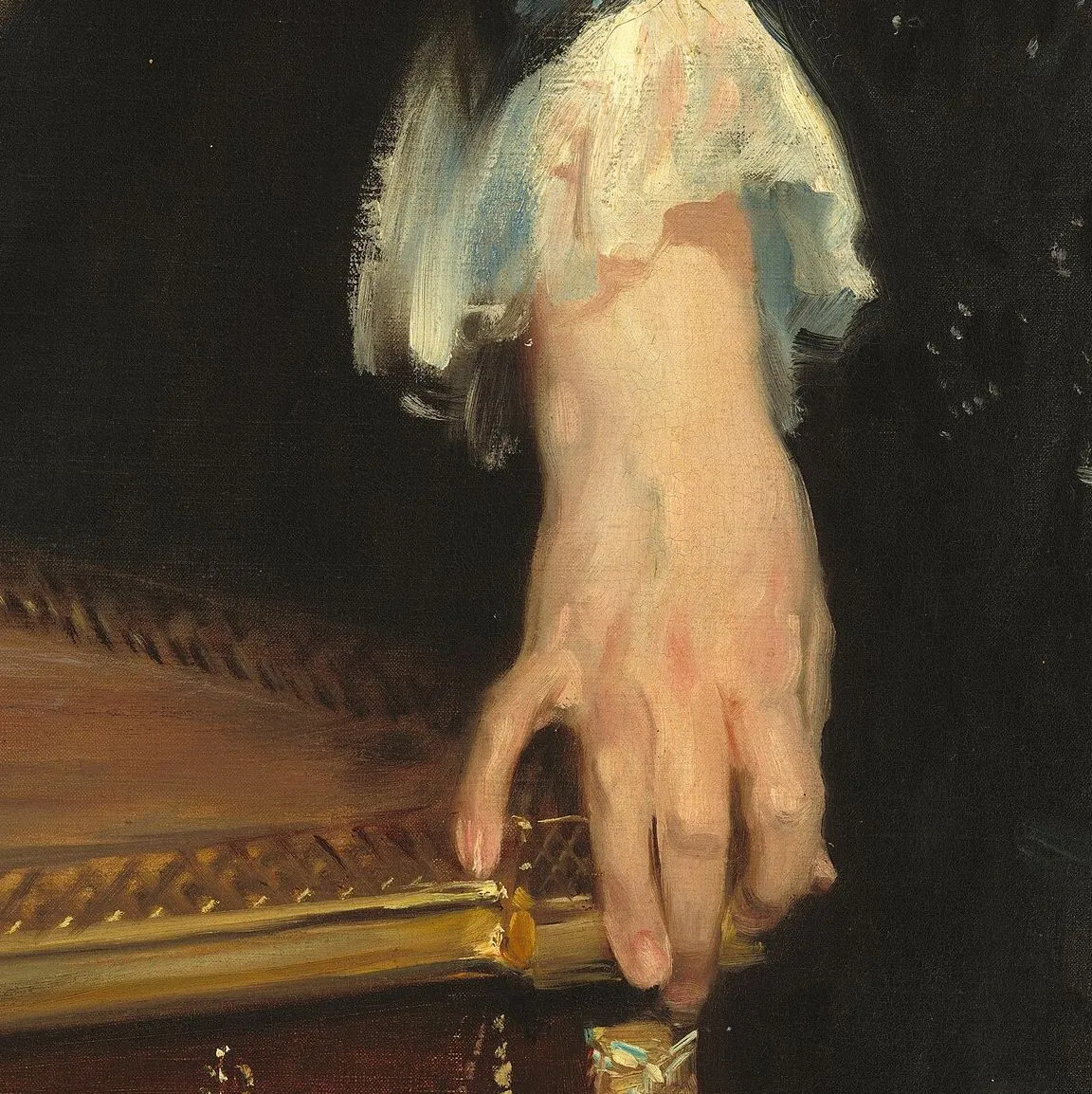
Detail of Mrs. Adrian Iselin: the lace cuff is a handful of loaded strokes of white and blue, each finger is carried on one light stroke with a shadow laid beside it, and the gilt edge of the table is a single drag with a few brighter accents dropped into it. Nothing here was hunted for on the surface.
John Singer Sargent, Mrs. Adrian Iselin (detail), 1888, National Gallery of Art, Washington. Public domain, Wikimedia Commons.
Watercolor: reserve the white, wax the lights
In watercolor he left the bare paper as his brightest light and brushed clear wax onto the sheet to fence off highlights before flooding a wash across them.
Why it matters · Watercolor has no white that stays luminous, so the light has to be the paper itself. Choosing which flecks of paper to save, and waxing them so a loaded wash cannot drown them, is most of the discipline. Once a dark sits on top, the white is gone for good.
Erica E. Hirshler and Teresa A. Carbone, John Singer Sargent Watercolors, 2012 — Museum of Fine Arts Boston and Brooklyn Museum catalogue; the technical essay by conservator Annette Manick documents the reserved paper, wax resist, and opaque passages.
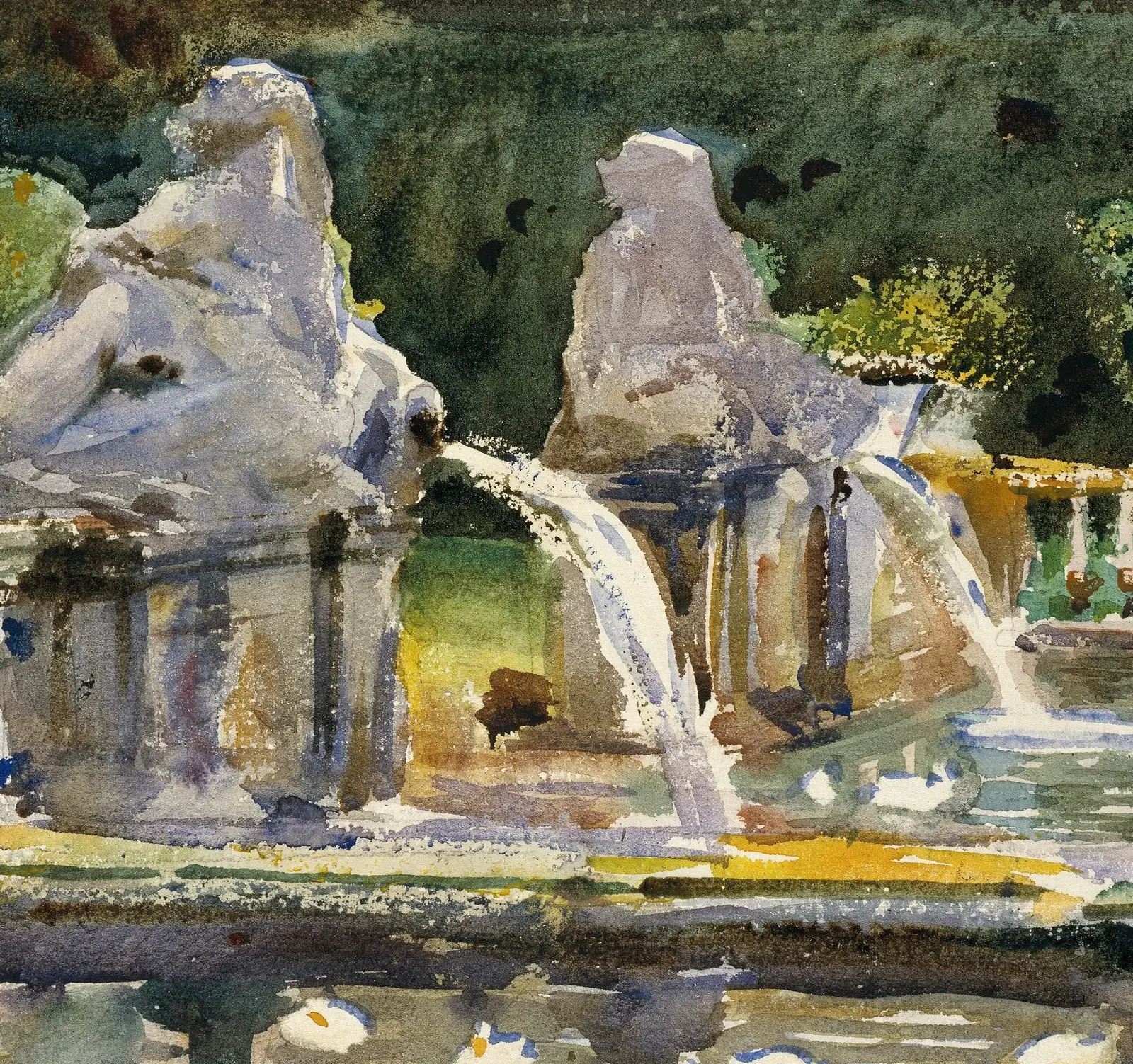
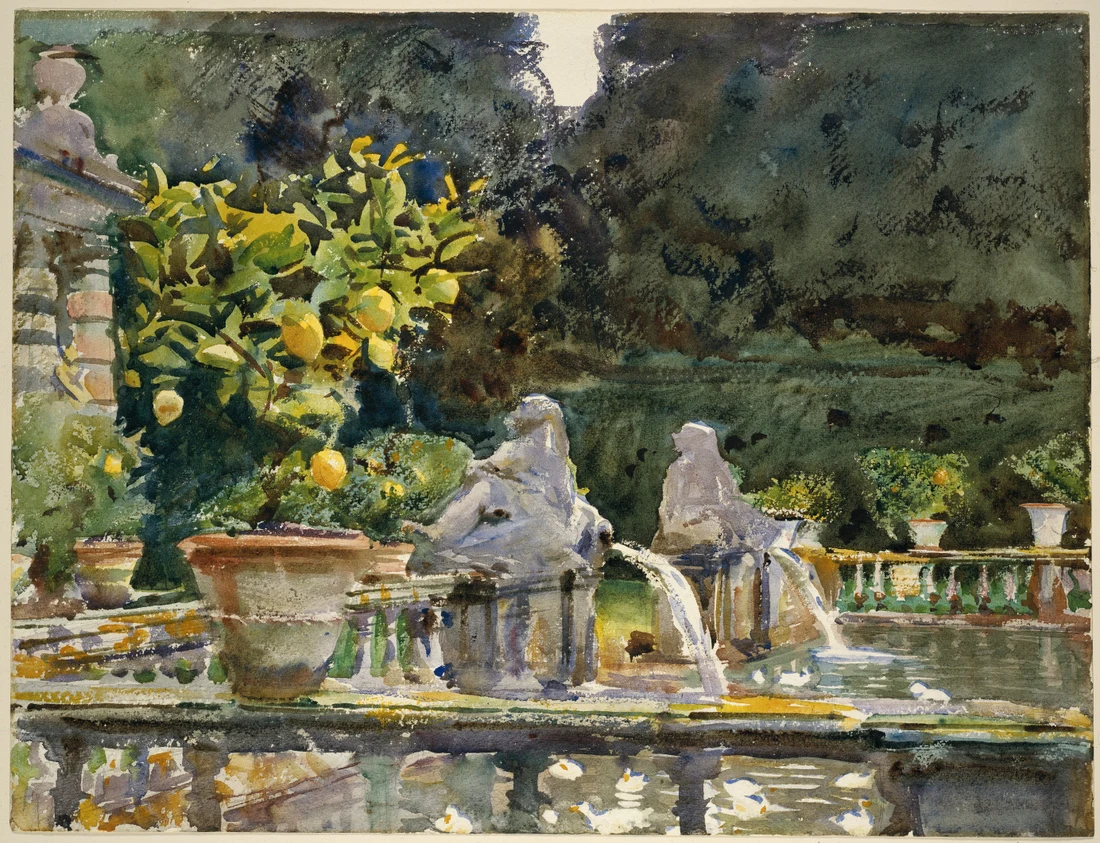
Detail of Villa di Marlia, Lucca: A Fountain: the falling water is the bare paper itself, reserved and scraped back to white while the dark washes were laid around it.
John Singer Sargent, Villa di Marlia, Lucca: A Fountain (detail), 1910, Museum of Fine Arts, Boston. Public domain, Wikimedia Commons.
In the studio
John Singer Sargent in his Paris studio, photograph, 1885
Studio
Light
North-facing window, 31 Tite Street, London.
Position
Standing; easel placed directly adjacent to the sitter, both at eye level, both in the same light.
Working distance
Six to twelve feet between marks. Wore visible tracks into the studio carpet from the repeated retreat-and-advance.
Session length
Portrait sittings two to four hours. Required conversation, cigars, and often live piano to keep the sitter animated.
Tools
Long, thick hog-bristle brushes (chosen to hold large quantities of paint) · Palette knife (used for scraping, not mixing) · Large studio easel, fixed height matched to sitter · Wooden palette, scraped clean daily
Notes
Under a difficult passage Sargent muttered and growled at the canvas; William Rothenstein recorded him barking "Demons, demons!" before attacking a resistant section.
Source: Evan Charteris, John Sargent, 1927 — Written within two years of Sargent's death from firsthand student and contemporary accounts.
Palette
Ground
Clean grayish canvas — not a white ground, not a heavily tinted one. A neutral middle value.
Whites
Lead white (flake white)
Earths
Yellow ochre · Raw umber · Burnt sienna · Venetian red
Colors
Vermilion · Rose madder · Viridian · Cobalt blue · Ultramarine
Blacks
Ivory black · Mars black
Medium
Sparing turpentine for the block-in only. Pure tube oil color thereafter — no linseed, no varnish, no glaze medium.
Quantity
"Piles enough for a dozen pictures" — set out daily in large mounds, scraped clean at end of session.
Source: Rebecca Hellen and Joyce Townsend, John Singer Sargent's Painting Methods and Materials, 2017 — Tate conservation department's technical examination of layer samples from multiple canvases.
The painting and the plan
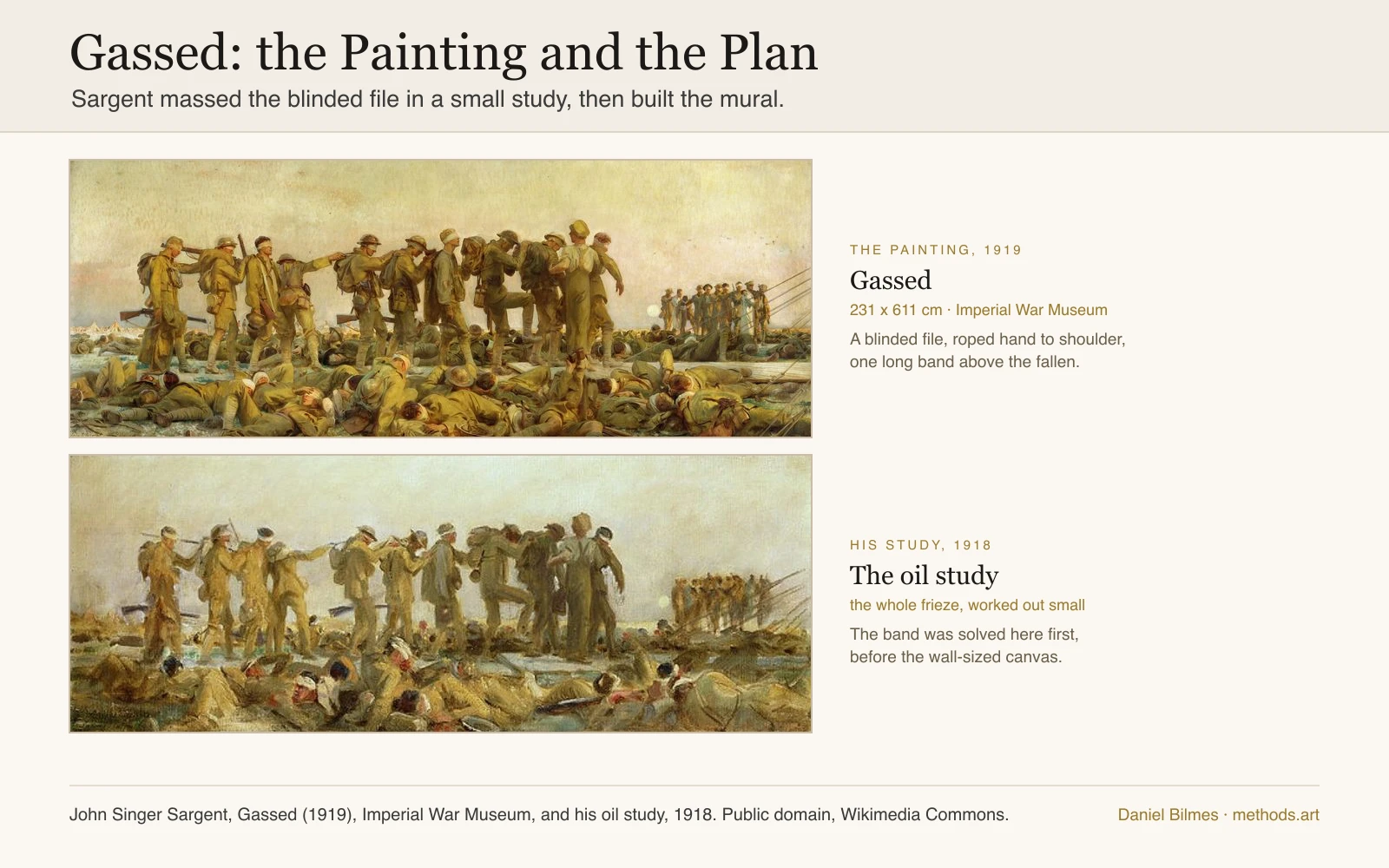
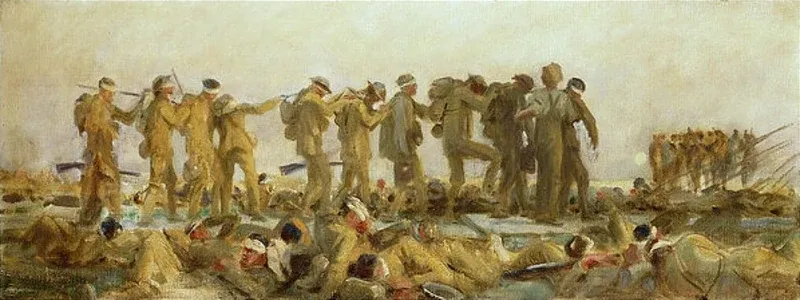
John Singer Sargent's Gassed (1919, Imperial War Museum) set above his own 1918 oil study, both shown as wide friezes: a file of blinded soldiers roped hand to shoulder into one long band above the fallen men, the whole composition solved in the small study before the wall-sized mural.
John Singer Sargent, Gassed (1919, Imperial War Museum) and his 1918 oil study. Public domain, Wikimedia Commons.
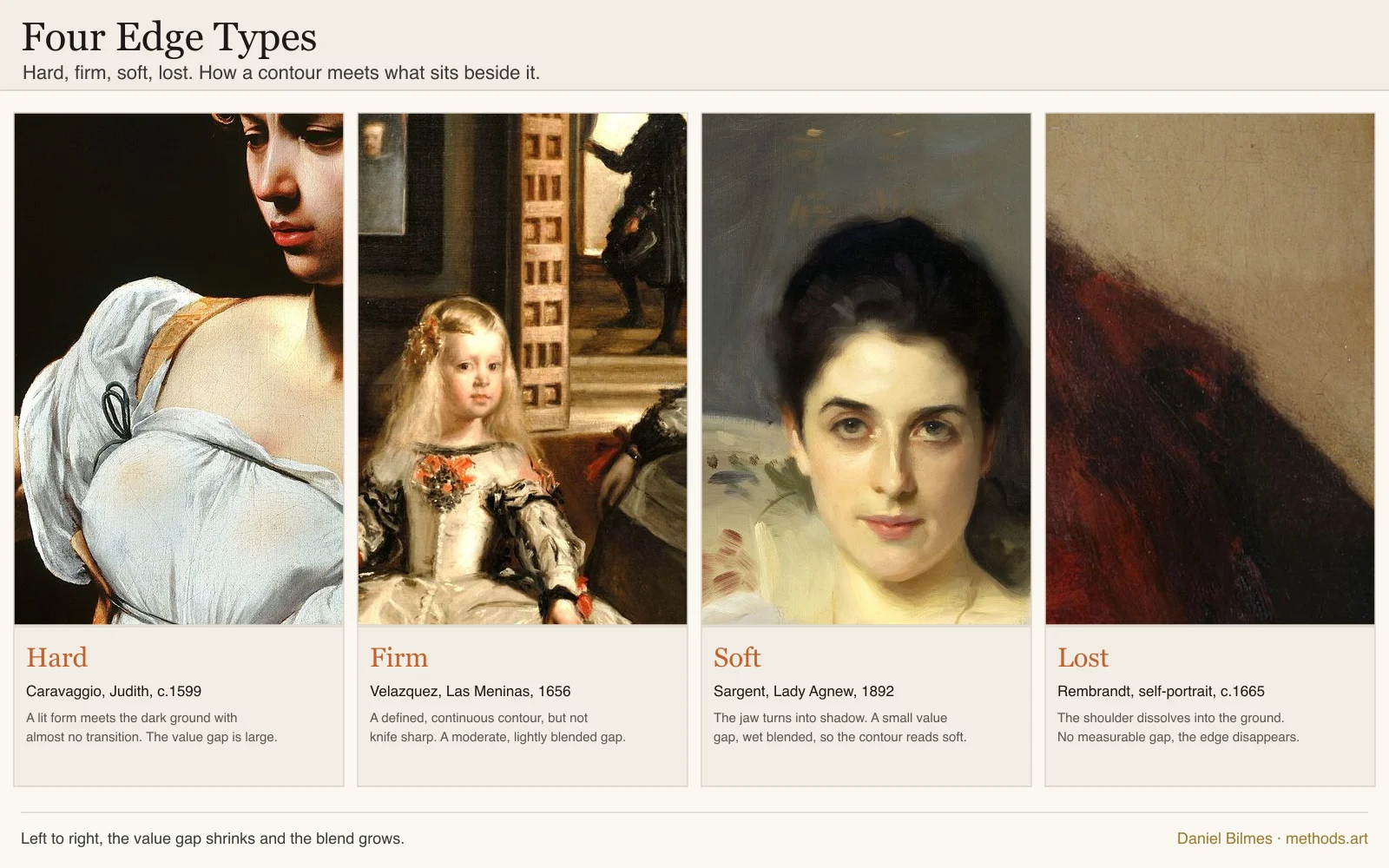
Four edge types in oil painting, from hard to lost: a hard edge in Caravaggio, a firm edge in Velazquez, a soft edge in Sargent, and a lost edge in Rembrandt dissolving into the ground.
The three-value thumbnail, three more compositions
The three-value thumbnail, second set: three more compositions reduced to three value brackets (darks, mids, lights) at each painting's true proportions, Velazquez's Las Meninas (318 by 276 cm), Rembrandt's The Night Watch (363 by 437 cm), and Sargent's The Daughters of Edward Darley Boit (222 by 222 cm).
The head placed on the canvas with a few careful lines of charcoal — the only preparatory drawing the canvas would receive.
Why: A skeleton, not a template. Too much drawing means painting to a line rather than painting the head.
2. Rag-wipe the charcoal
A rag passed over the charcoal lines until only faint grayish traces remained.
Why: Leaves the canvas receptive to paint. A charcoal line under wet oil turns the paint muddy.
3. Rub in the general tone
A general middle value rubbed into the background and the mass of the hair, using a small amount of turpentine.
Why: Establishes the painting's key before any decisive mark. Prevents working against a raw white canvas.
4. Outline the light-shadow edge
The boundary between light and shadow on the face was outlined — the real outline, not the physical edge of the head. Internal features deliberately left unindicated.
Why: The light-shadow edge is the skeleton everything else hangs from. Features placed on this structure integrate. Features placed without it float.
5. Thick opaque paint, side by side
Pure tube oil, placed in exact strokes one next to the other. Each stroke judged from several paces back before being placed.
Why: The face is modeled by integrating features into the mass of the head, rather than painting features on top of it.
6. Deft final details
The glint of an eye, the wet edge of a lip, the highlight on jewelry — indicated at the end with a small number of decisive, economical strokes.
Why: A portrait is finished when the character and the light are captured. Resolving every inch to the same level is overwork, and overwork is death.
How they studied
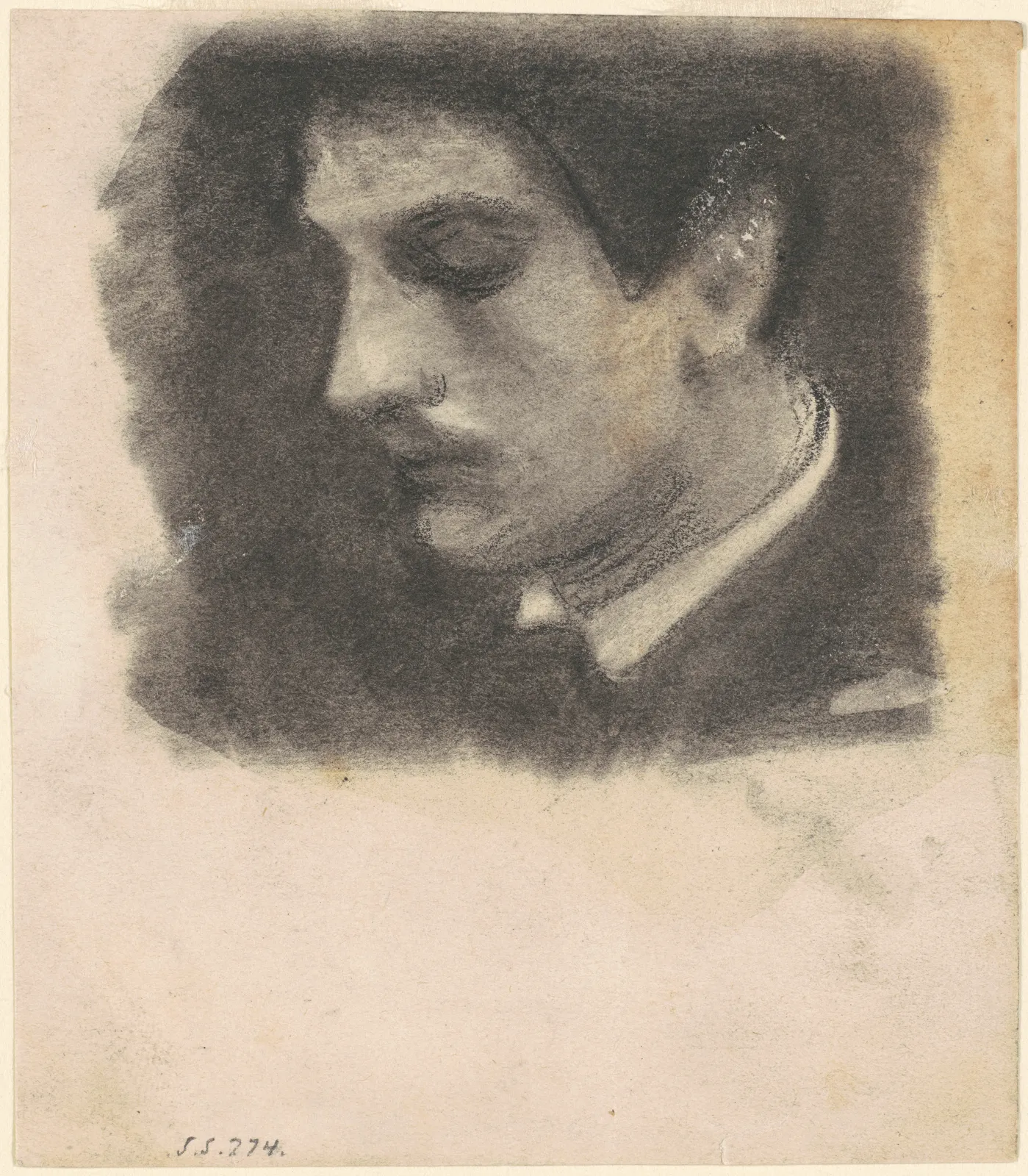
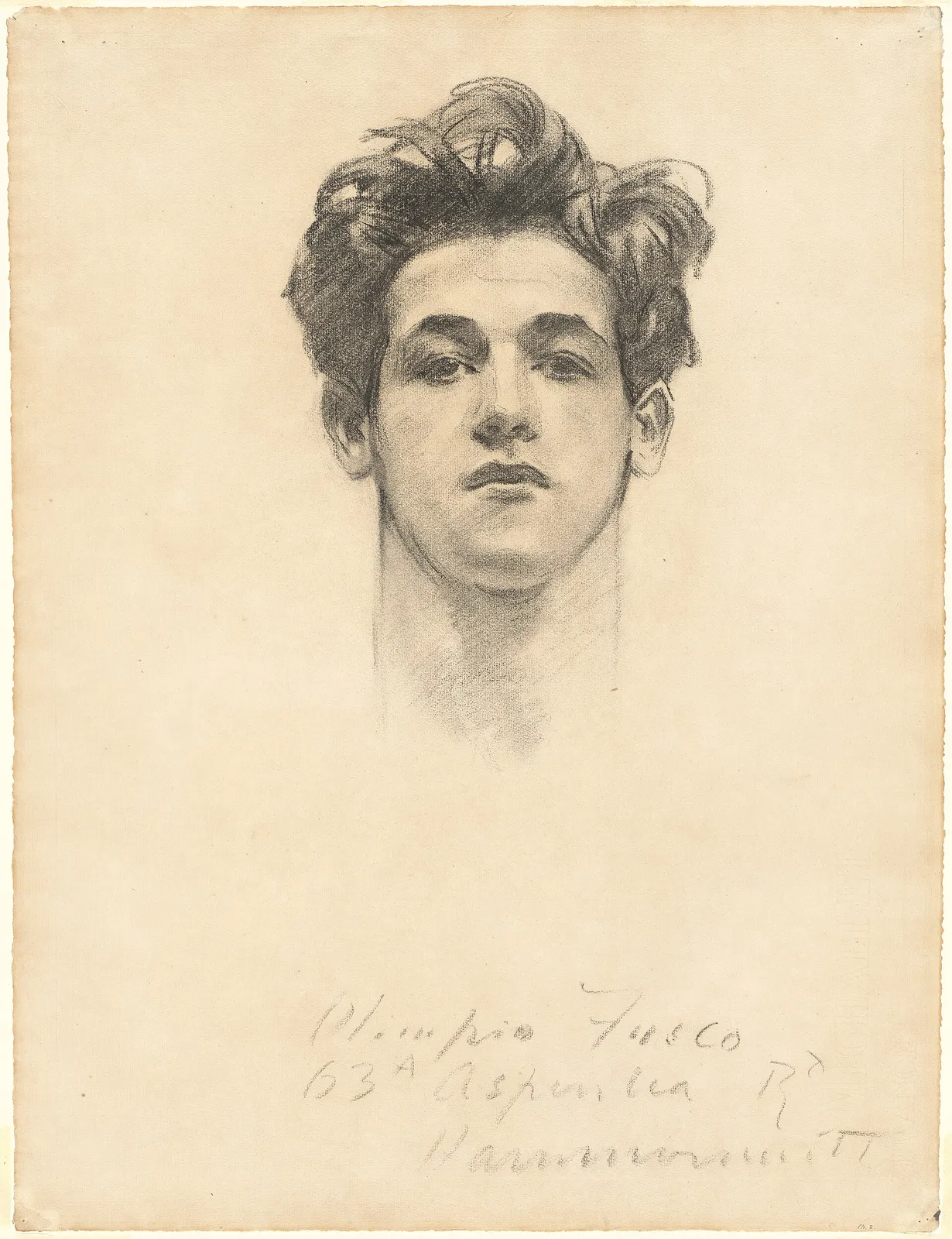
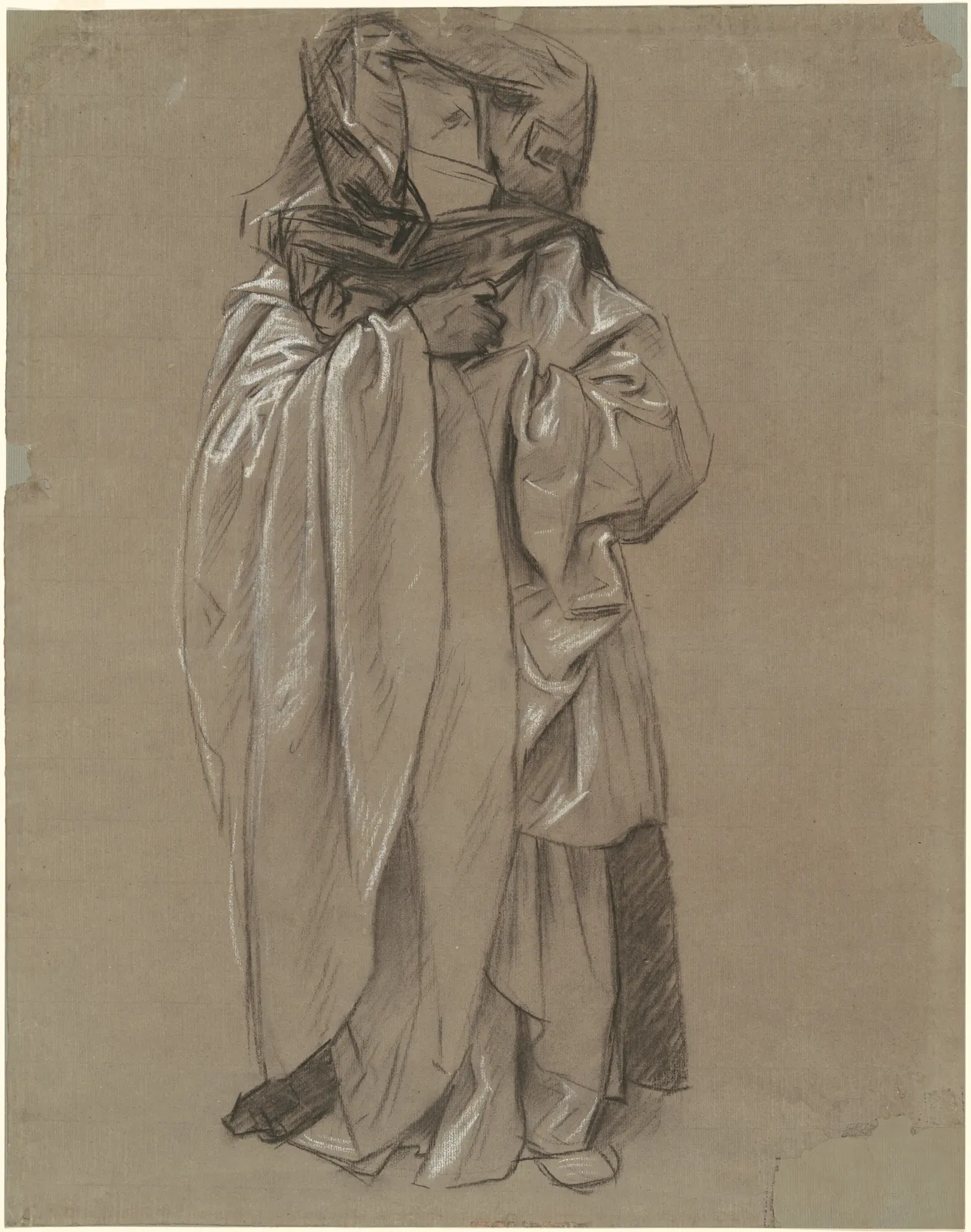
Sargent drew before he painted, and he never stopped. He passed through the Accademia in Florence as a teenager, then in 1874 entered the École des Beaux-Arts in Paris, where the drawing course climbed from plaster casts up to the living model. His atelier master, Carolus-Duran, drilled the opposite of the École's careful outline, teaching him to build a head from masses of tone laid straight in with the brush rather than from a contour filled in afterward. The habit that outlasted every teacher was the sketchbook, which he carried for life, and Harvard's Fogg and the Metropolitan hold them now. After about 1907 he largely left the commissioned oil portrait for charcoal, finishing a head in a single sitting of two or three hours and making close to seven hundred of them, alongside hundreds of charcoal figure studies for his Boston murals. His standing instruction to a pupil, set down by Julie Heyneman, was plain: "You can't do sketches enough. Sketch everything and keep your curiosity fresh."
A charcoal head from Sargent's student years in Paris, the face turned down and modeled in soft rubbed tone, the one clean light in the head left as the bare paper of the collar. This is the kind of academic head study he drew before he was twenty.
John Singer Sargent, Head of a Man, 1875 to 1880, National Gallery of Art, Washington. Public domain (CC0), Wikimedia Commons.
Olimpio Fusco, one of the professional models Sargent kept drawing from, the head lit from below and the hair cut in with fast open strokes while the throat fades into untouched paper. A working study, carried only as far as it needed to go.
John Singer Sargent, Olimpio Fusco, circa 1900 to 1910, National Gallery of Art, Washington. Public domain (CC0), Wikimedia Commons.
A drapery study for the Frieze of the Prophets in the Boston Public Library, drawn on toned paper in three values: black charcoal for the shadow, the gray of the sheet for the halftone, white chalk struck on for the light. Hundreds of studies like this stood behind the murals.
John Singer Sargent, Study of Ezekiel for Frieze of Prophets, 1890 to 1892, National Gallery of Art, Washington. Public domain (CC0), Wikimedia Commons.
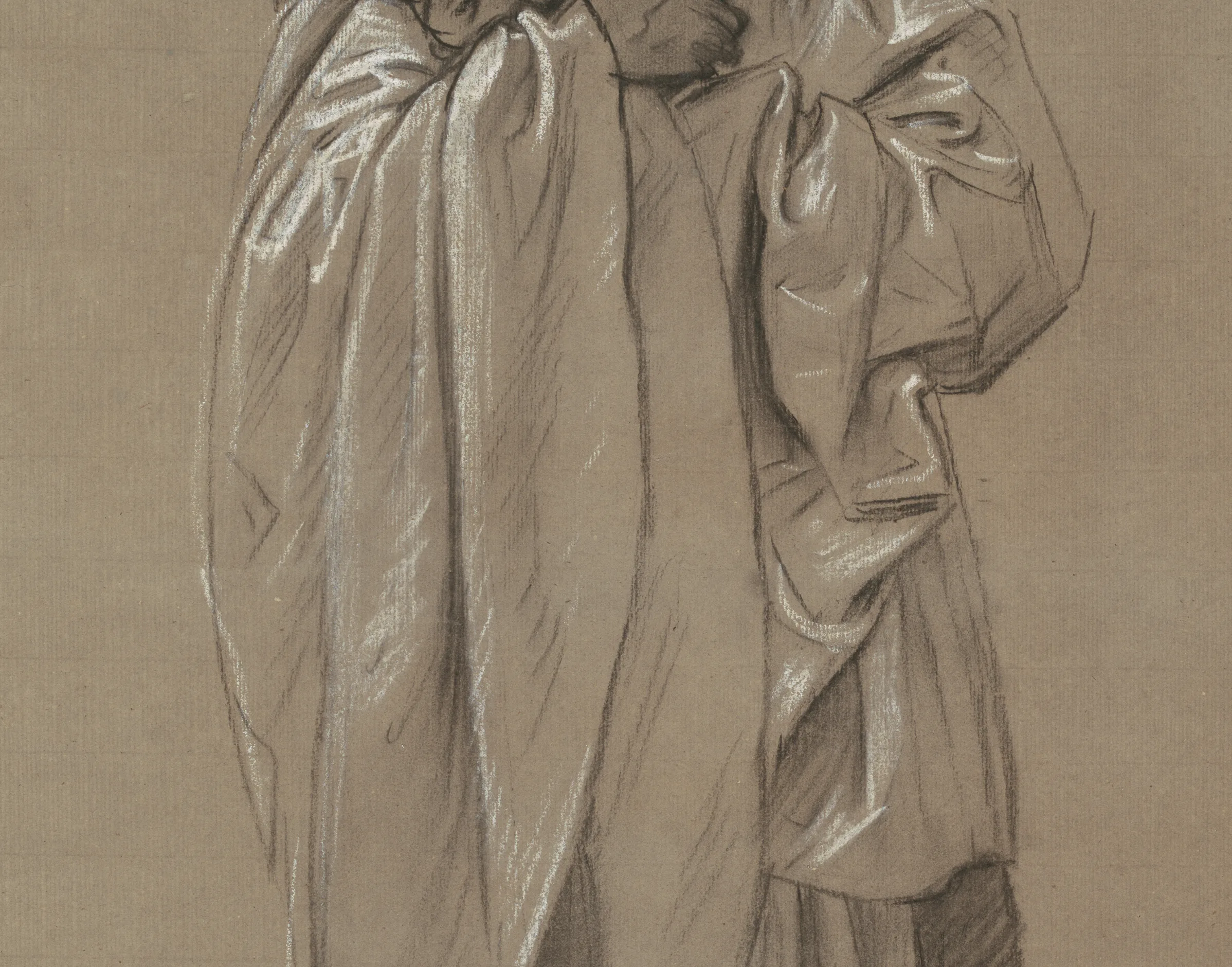
Detail of the Ezekiel study: the folds are found with a few searching charcoal lines, then the highlights are struck back on top in single strokes of white chalk. Nothing is blended smooth, and the toned paper does the middle work.
John Singer Sargent, Study of Ezekiel for Frieze of Prophets (detail), 1890 to 1892, National Gallery of Art, Washington. Public domain (CC0), Wikimedia Commons.
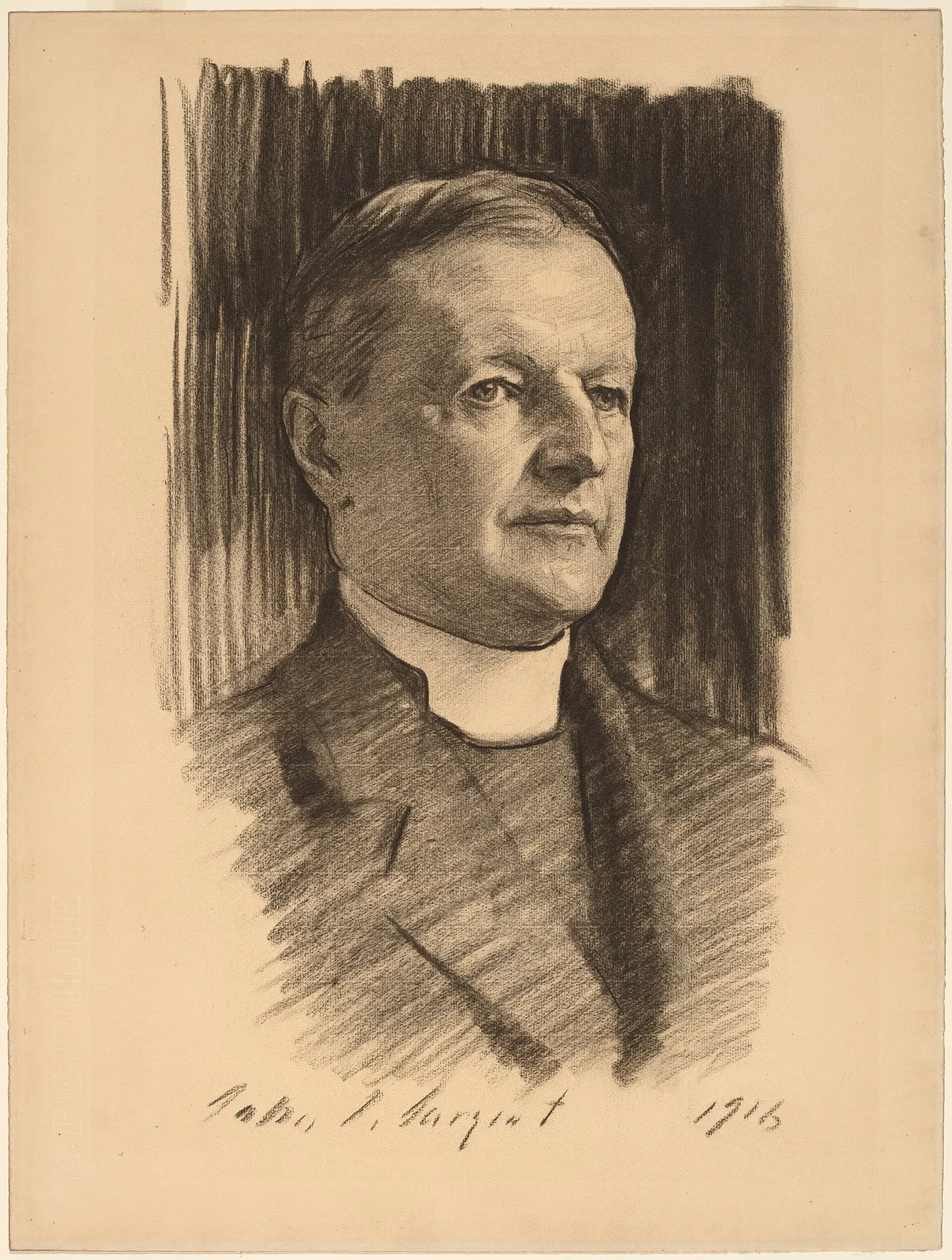
A charcoal portrait of Bishop William Lawrence from 1916, the head built in patient halftone while the coat and the dark ground behind it are cut in with a handful of blunt vertical strokes. The white collar is the bare paper again. This is the economy of the late heads Sargent called his mugs.
John Singer Sargent, The Rt. Reverend William Lawrence, 1916, National Gallery of Art, Washington. Public domain (CC0), Wikimedia Commons.
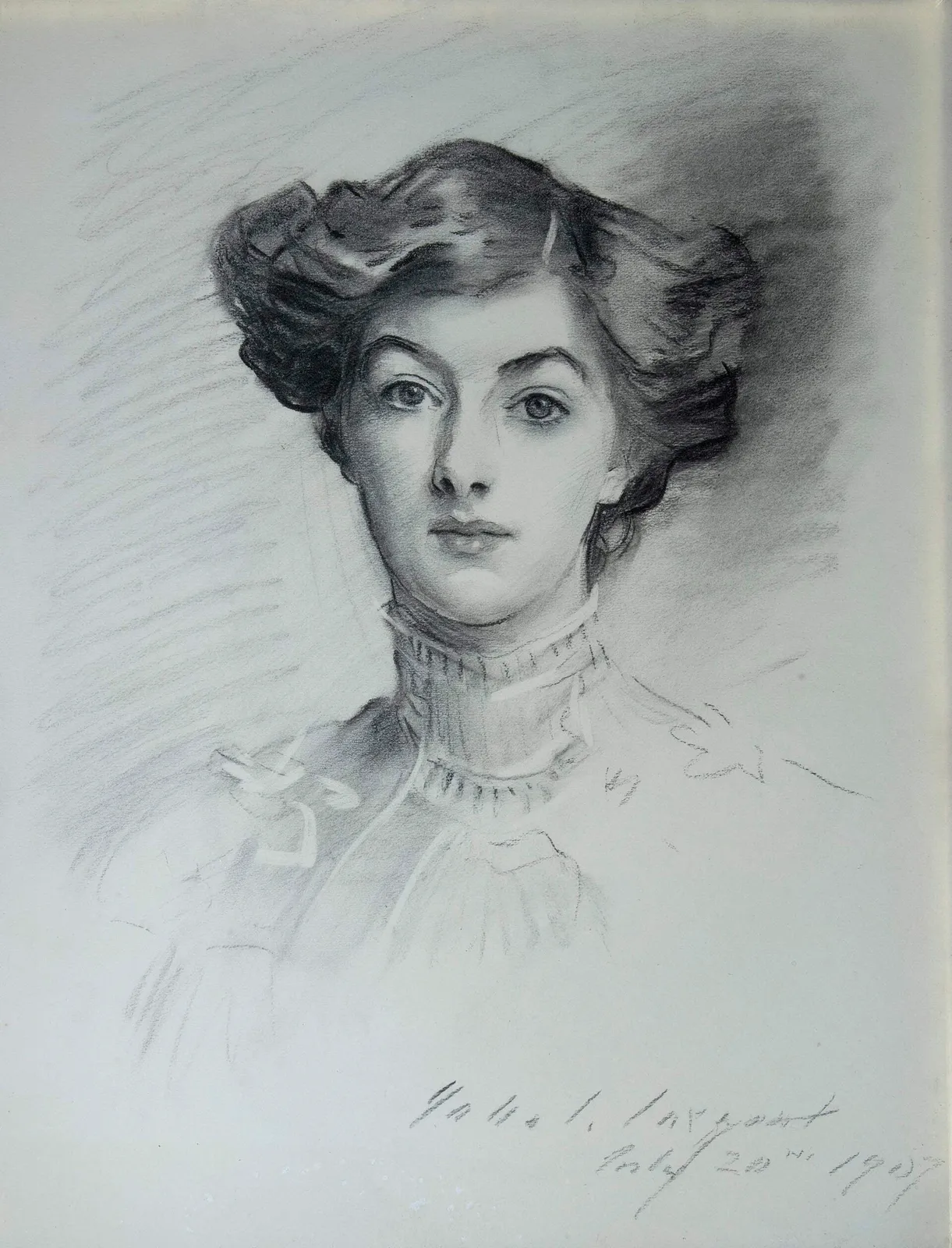
A charcoal portrait of Katharine Horner from 1907, the face and hair worked to a finish while the blouse is left as a few open lines that stop where the information stops. Sargent finished the part that carries the likeness and let the rest stay a drawing.
John Singer Sargent, portrait of Katharine Horner, 1907. Public domain, Wikimedia Commons.
Source: Formation, the Carolus-Duran atelier method, and the Heyneman instruction: Evan Charteris, John Sargent, 1927. The charcoal portrait count follows Richard Ormond and Elaine Kilmurray, John Singer Sargent: The Charcoal Portraits.
Up close
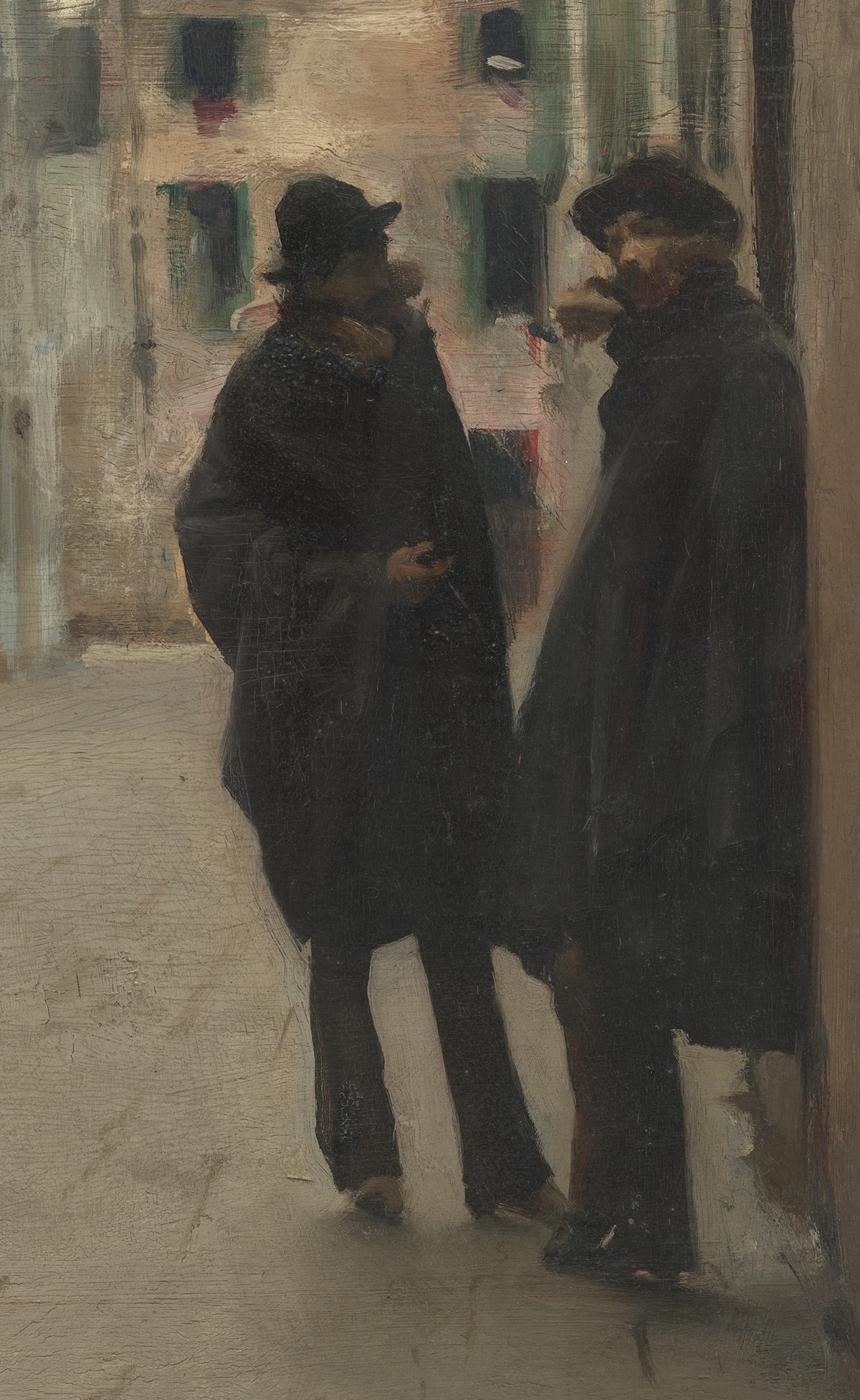
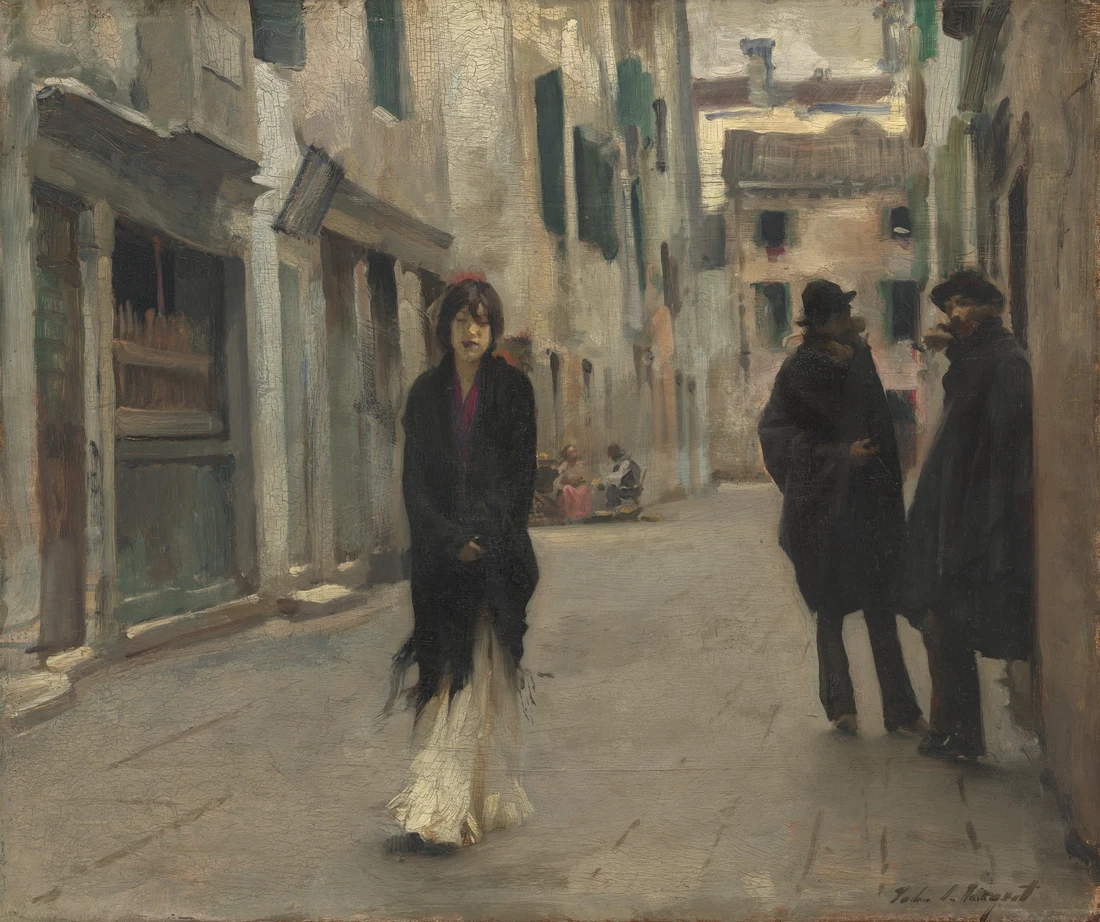
Detail of Street in Venice: the two men read as flat black from across a room, but up close the dark coats are built from warm brown, cool gray, and a deep green laid side by side.
John Singer Sargent, Street in Venice (detail), 1882, National Gallery of Art, Washington. Public domain, Wikimedia Commons.
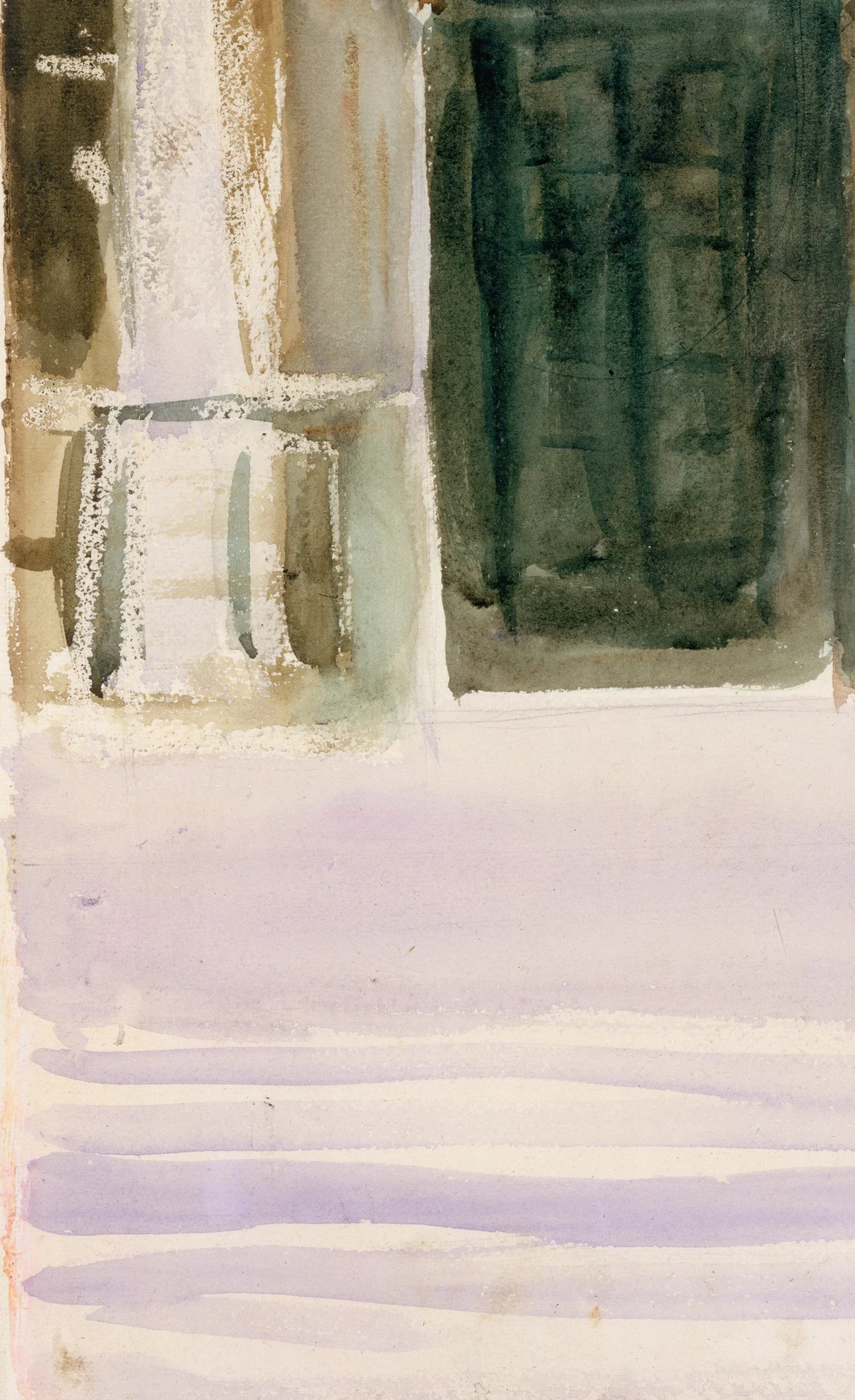
Detail of Green Door, Santa Maria della Salute: the sunlit stone is the untouched paper, left bare so it stays the brightest note beside the dark of the doorway.
John Singer Sargent, Green Door, Santa Maria della Salute (detail), circa 1906, Metropolitan Museum of Art. Public domain (CC0), Wikimedia Commons.
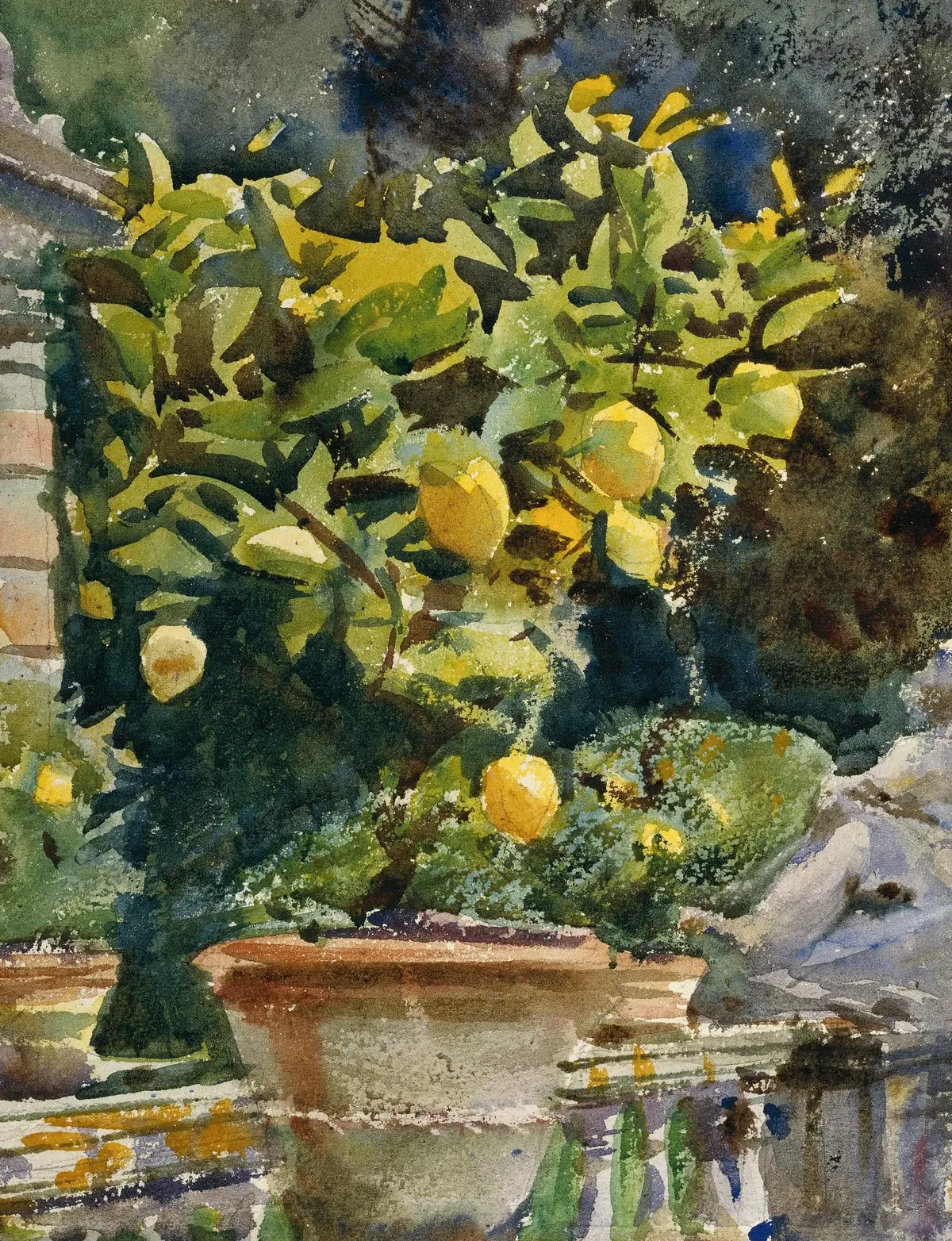
Detail of Villa di Marlia, Lucca: A Fountain: the lemon tree built up in layered transparent washes, the ripe fruit lifted back to the light of the paper underneath.
John Singer Sargent, Villa di Marlia, Lucca: A Fountain (detail), 1910, Museum of Fine Arts, Boston. Public domain, Wikimedia Commons.
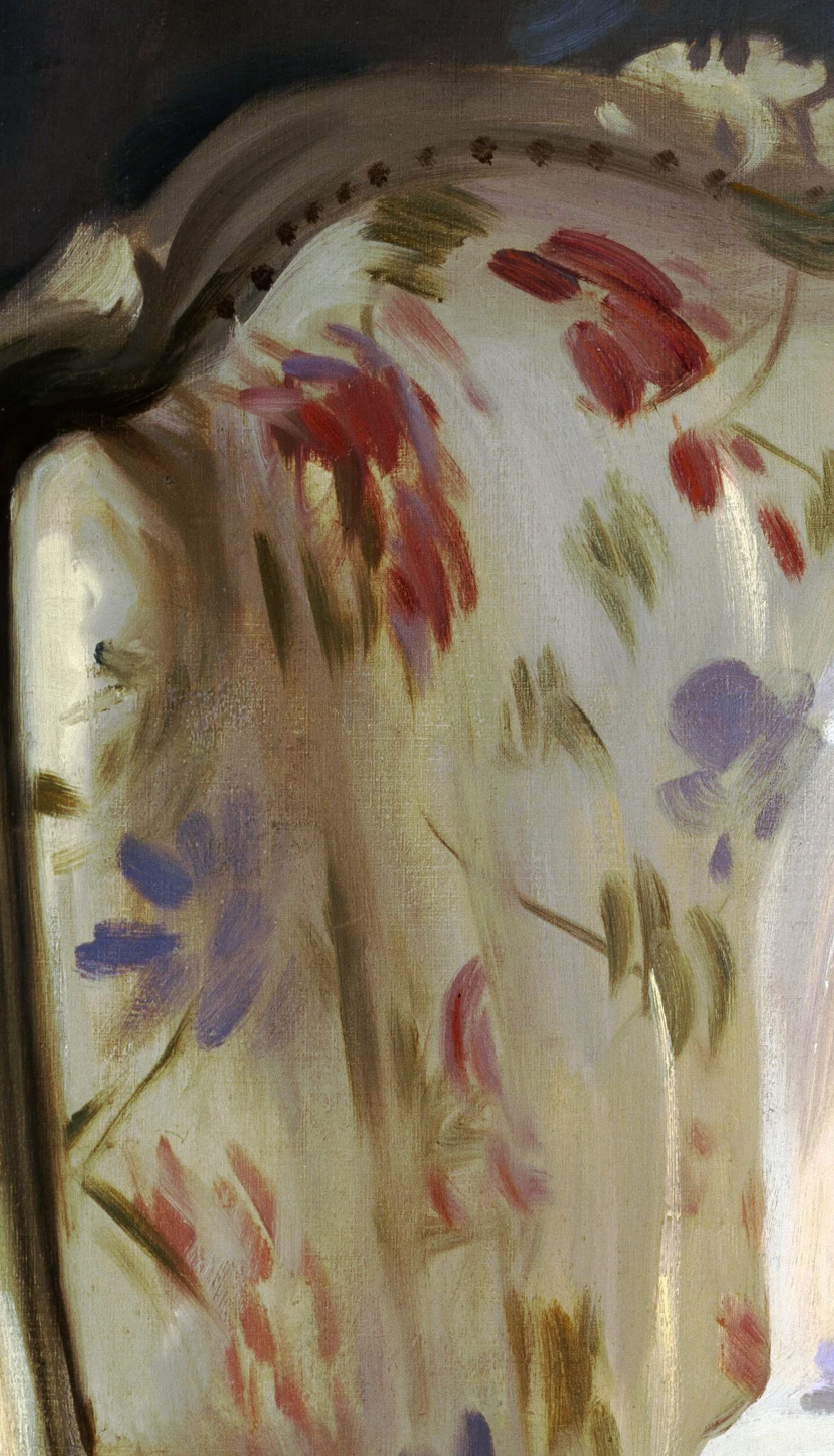
Detail of Lady Agnew of Lochnaw: the flowered chintz of the chair drawn straight in paint, each blossom a couple of quick strokes rather than a drawn outline filled in.
John Singer Sargent, Lady Agnew of Lochnaw (detail), 1892, National Galleries of Scotland. Public domain, Wikimedia Commons.
Watching him work
“Those who watched Sargent painting in his studio will be reminded of his habit of stepping backwards after almost every stroke of the brush on the canvas, and the track of his paces so worn on the carpet that it suggested a sheep-run through the heather.”
Villa di Marlia, Lucca: A Fountain, a garden watercolor: transparent washes for the shadowed foliage, the paper itself kept bare for the falling water and the marble.
John Singer Sargent, Villa di Marlia, Lucca: A Fountain, 1910, Museum of Fine Arts, Boston. Public domain, Wikimedia Commons.
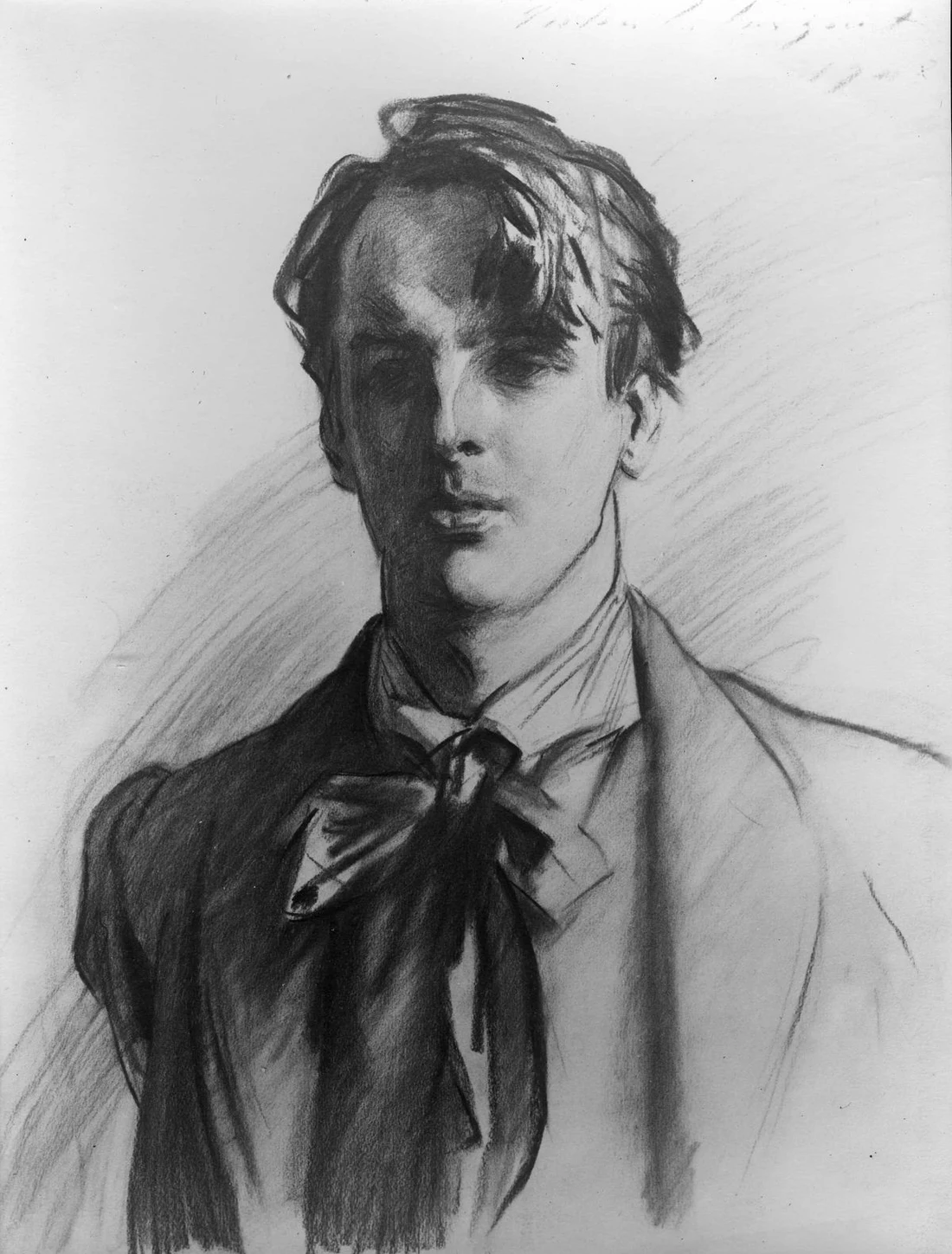
Charcoal portrait of William Butler Yeats: the darks pressed in with the side of the stick, the bare paper kept for the light, a head of the kind Sargent finished in one sitting.
John Singer Sargent, charcoal portrait of William Butler Yeats, 1908. Public domain, Wikimedia Commons.
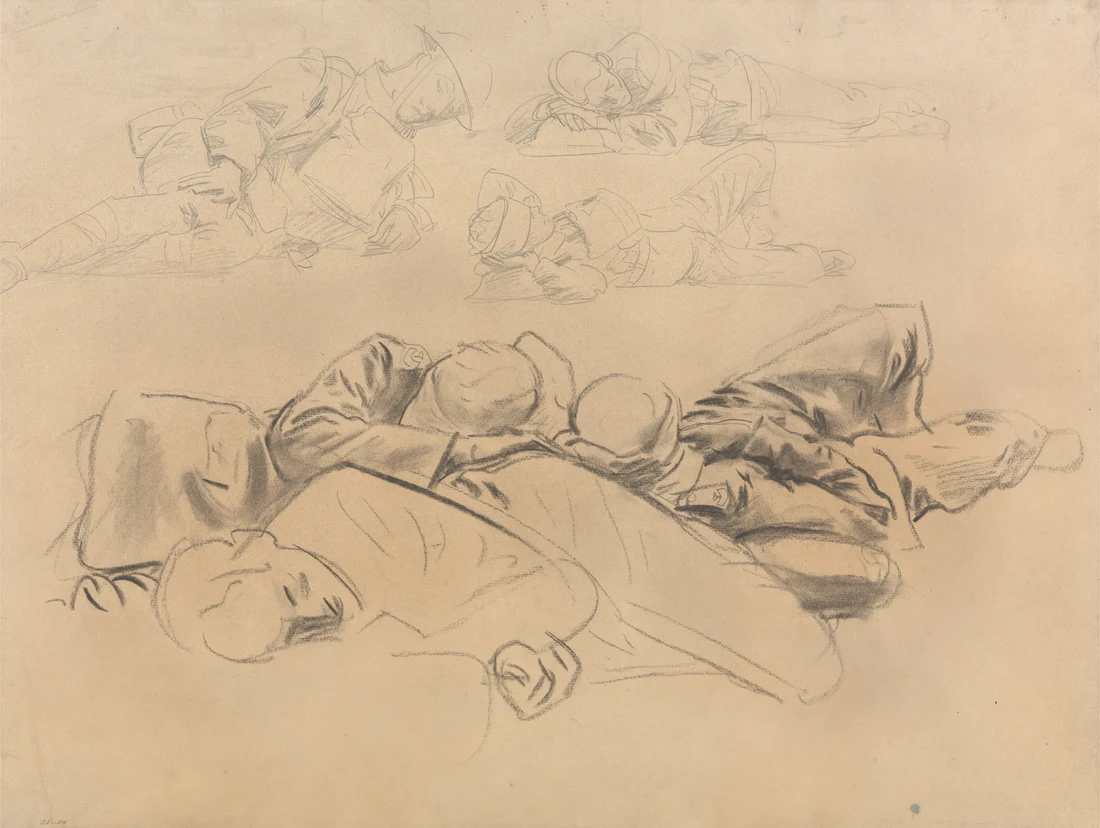
A study sheet for Gassed: the same fallen soldier worked out in several poses on one page, the composition solved on paper before the wall-sized canvas was begun.
John Singer Sargent, Study for Gassed, 1918. Public domain, Wikimedia Commons.
Street in Venice, a small oil on panel: a few figures in a narrow calle, the whole scene held together by the pale ground and the dark accents of the two men.
John Singer Sargent, Street in Venice, 1882, National Gallery of Art, Washington. Public domain, Wikimedia Commons.
Refusals — what they would not do
Never corrected failed wet paint with more wet paint — scraped to ground and restarted.
Refused photography as reference for portraits (allowed it for mural commissions only).
No medium other than sparing turpentine for the block-in — no linseed, no glaze medium, no varnish mixed into working paint.
Refused to paint a sitter who had frozen into a held pose; required live conversation or music.
Refused to finish a painting by resolving every inch to the same level; stopped when character and light were captured.
Reference
Primary source
Life, always, for heads and hands. Portraits required the sitter physically present for every stage.
Photography
Considered photography unable to report true values or binocular depth; refused it for portrait work.
Exceptions
Boston Public Library and Widener Library murals (period-accurate architecture, costume, allegorical figures) — used photography as disciplined reference for the mechanical facts only; heads and hands still studied from life.
Carnation, Lily, Lily, Rose (1885–86) — painted outdoors over two summers, in twenty-five-minute daily windows when the twilight was exactly right. A documented case of monumental plein air executed at the pace the light allowed.
Carolus-Duran · 1874–1877 — Broke with Beaux-Arts drawing-first tradition. Taught direct painting in thick oil color, building form through massed tones rather than outlined drawing. Emphasized the "tache" (the placed spot of color) and sight-size as the physical condition of accurate value judgment.
Influences
Velázquez — studied the Prado holdings obsessively during and after his Paris years.
Frans Hals — the precedent for wet-into-wet alla prima portraiture without underpainting.
Students
Taught informally. Working habits recorded in detail by William Rothenstein, Julie Heyneman, and others; their accounts gathered into Evan Charteris's 1927 biography.
Through that documented record, Sargent's method became the primary source for the modern Atelier Movement in Europe and the United States.
In their own words
“You do not want dabs of color. You want plenty of paint to paint with.”
— John Singer Sargent, Instruction to a student, recorded by Julie Heyneman, 1900
Correcting a pupil who had set out too little paint on the palette.
“You want good thick brushes that will hold the paint and that will resist, in a sense, the stroke on the canvas.”
— John Singer Sargent, Instruction to a student, recorded by Julie Heyneman, 1900
“Painting is quite hard enough without adding to your difficulties by keeping your tools in bad condition.”
— John Singer Sargent, Instruction to a student, recorded by Julie Heyneman, 1900
Scolding a pupil for dirty brushes.
“I am quite used up.”
— John Singer Sargent, Letter on finishing Carnation, Lily, Lily, Rose, 1886
He burned out on commissions. In 1907 he wrote to his friend Ralph Curtis, 'No more paughtraits. I abhor and abjure them and hope never to do another especially of the Upper Classes.' He kept the promise in oil and compromised in charcoal, producing roughly 750 charcoal portrait heads he called mugs, each finished in a single sitting (documented in the Charteris biography and by the Metropolitan Museum).
Did Sargent paint alla prima?
Yes. He placed wet paint once, in pure oil color with no medium added, and when a passage failed he scraped it down to the ground rather than correcting wet paint with more wet paint.
What medium did Sargent use?
A little turpentine to rub in the first tones, then pure tube oil color with no linseed, no glaze medium, and no varnish in the working paint.
What was Sargent's palette?
Lead white; the earths (yellow ochre, raw umber, burnt sienna, Venetian red); vermilion, rose madder, and viridian; cobalt blue and ultramarine; and ivory and Mars black, worked on a neutral grayish ground.
What brushes did Sargent use?
Long, thick hog-bristle brushes chosen to hold large quantities of paint, plus a palette knife used for scraping rather than mixing. He set out "piles enough for a dozen pictures" of paint per session.
How did Sargent build a portrait?
A few charcoal lines, rag-wiped to a trace, then the light-shadow edge of the face outlined before any feature, then thick opaque strokes placed side by side and judged from six to twelve feet back. He stopped when the character and the light were caught, not when every inch was resolved.
Did Sargent use sight-size?
Yes. He set his easel directly beside the sitter so canvas and model sat in the same light at the same distance, then stepped back after almost every stroke to compare the two at a glance. He wore visible tracks into the studio carpet from the constant retreat and advance.
How did Sargent hold his brush?
He used a long, thick hog-bristle brush loaded with paint and held it poised still in the air for a moment, settling on exactly where the stroke should fall, before placing it in a single decisive move. The decision was made before the brush touched the canvas.
What pigments did Sargent use in Madame X?
X-ray fluorescence analysis at the Metropolitan Museum found cerulean blue in the background, viridian green, vermilion, bone black, and iron-based earth pigments for the browns, reds, and yellows. The pale flesh was built largely from lead white, rose madder, and a transparent red lake rather than from opaque reds.
How did Sargent paint his watercolors?
He treated the white of the paper as his brightest light and protected it, brushing clear wax onto the sheet so a wash could not cover the sparkle and lifting or scraping paint back where he wanted a smaller light. Over transparent washes he added opaque gouache and white where a passage needed body, kept black out of his darks in favor of blues mixed with browns at the same value, and worked wet and fast with large brushes. Documented in the Museum of Fine Arts Boston and Brooklyn Museum catalogue John Singer Sargent Watercolors, 2012.
If this painter is your match
You share the commitment to placing the stroke from a judged distance and letting it stand. The correction you want to make is almost always worse than the mark you wanted to correct.
Borrow this: Set out three times as much paint as you think you need. Work standing. Step back twelve feet before every mark. When a passage fails, scrape it off and restart the passage — do not correct it.
Evan Charteris, John Sargent, 1927. Written within two years of Sargent's death. Firsthand accounts from students and contemporaries. The primary source for studio routine, brush and palette choices, and working rhythm.
William Rothenstein, Men and Memories, 1931. Knew Sargent personally. Recorded specific working habits including the pacing, the shouting, and the scraping.
Julie Heyneman, Notes on Sargent's Technique, 1900. A former pupil. Preserves specific studio instruction — the material basis for most documented quotes on brushes and paint quantity.
Rebecca Hellen and Joyce Townsend, John Singer Sargent's Painting Methods and Materials, 2017. Tate conservation department's technical examination of Sargent's oil layers, palette choices, and canvas preparations.
Erica E. Hirshler and Teresa A. Carbone, John Singer Sargent Watercolors, 2012. Museum of Fine Arts Boston and Brooklyn Museum exhibition catalogue. The technical essay by conservator Annette Manick documents the watercolor method: reserved paper, wax resist, opaque gouache, and scraping.
%2C%20John%20Singer%20Sargent%2C%201884%20(unfree%20frame%20crop).jpg)