Diego Velázquez painted directly, wet into wet, with a loaded brush and an economy that still looks impossible up close. As court painter to Philip IV he worked from life, set the big tonal masses first, and let a few confident strokes stand for a hand or a collar rather than rendering every detail. Step back and it resolves. Step in and it is almost abstract.
Worked on canvas prepared with a tinted ground (the greenish-brown barro de Sevilla in Seville, the warmer red-ochre in mid-career Madrid, cooler browns again in late work) and left untouched ground visible in halftones as a working colour.
Why it matters · A tinted ground saves the painter the labour of mixing middle values the canvas is already supplying. Painters who work on white grounds spend half the painting building back to a middle key. Velázquez engineered the middle value into the preparation and reserved his energy for lights and shadows.
Carmen Garrido, Velázquez: Técnica y Evolución, 1992
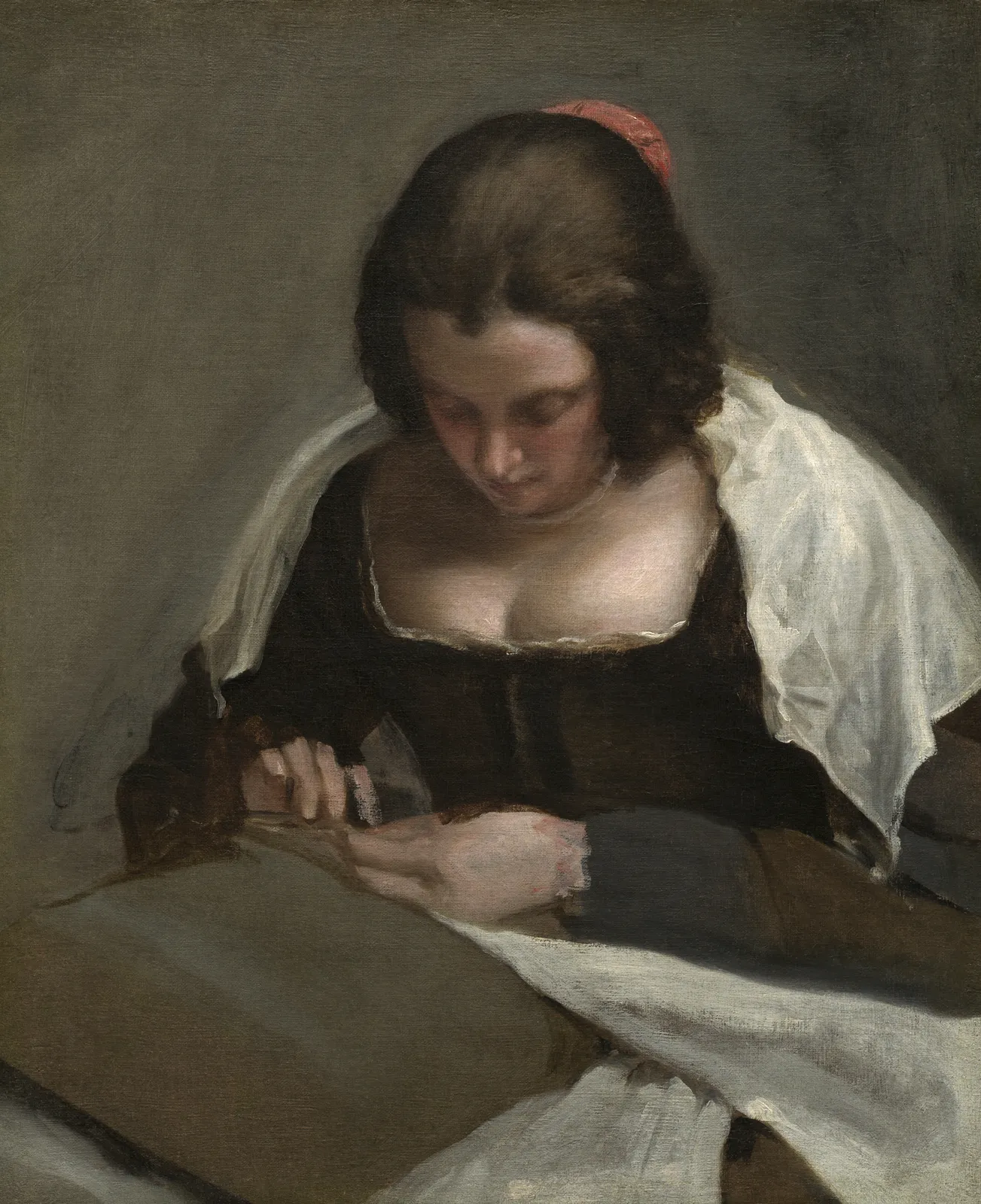
The Needlewoman, left unfinished: the head is carried to a finish while the hands are still sketched in, and everywhere the picture stops it is the toned priming that carries the middle value. That tone was in the canvas before the first stroke, so the work left to do was the lights and the darks.
Diego Velazquez, The Needlewoman, circa 1640 to 1650, National Gallery of Art, Washington. Public domain (CC0), Wikimedia Commons.
Long-handled brushes for the retreat-and-place rhythm
Used brochas unusually long for the period, some nearly a meter, that allowed him to strike the canvas from several paces back — retreat, judge, step forward, place the mark.
Why it matters · The same rhythm Sargent would describe two centuries later. Long handles are a physical instrument for the working distance. A short brush forces the wrist; a long one forces the body. Painters who never extend the brush never escape the wrist.
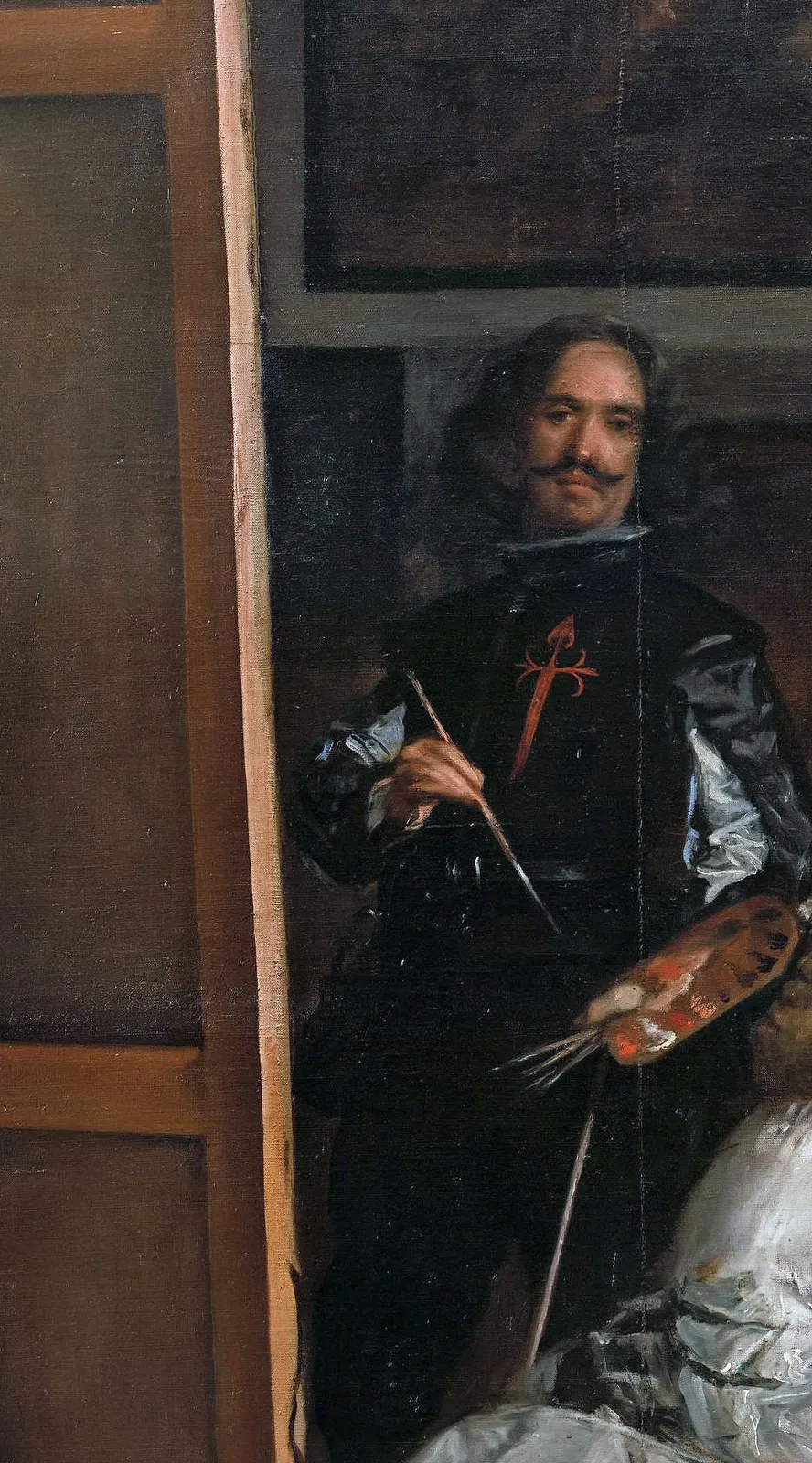
Detail of Las Meninas: he painted himself standing well back from the tall canvas, the brush raised in his right hand, a bundle of further long handles resting against the palette in the other. The length of the tool is what buys that working distance.
Diego Velazquez, Las Meninas (detail), 1656, Museo del Prado, Madrid. Public domain, Wikimedia Commons.
Manchas — economical stains that resolve at distance
Developed loose applications of colour Pacheco called manchas (stains) — broad strokes that read as "incomprehensible brushstrokes" up close and resolve into convincing reality from a distance.
Why it matters · A painting only works at one viewing distance. Velázquez built his late work for that distance and accepted that close inspection would not flatter the surface. Painters who finish for close inspection lose the larger reading.
Antonio Palomino, El museo pictórico y escala óptica, 1724
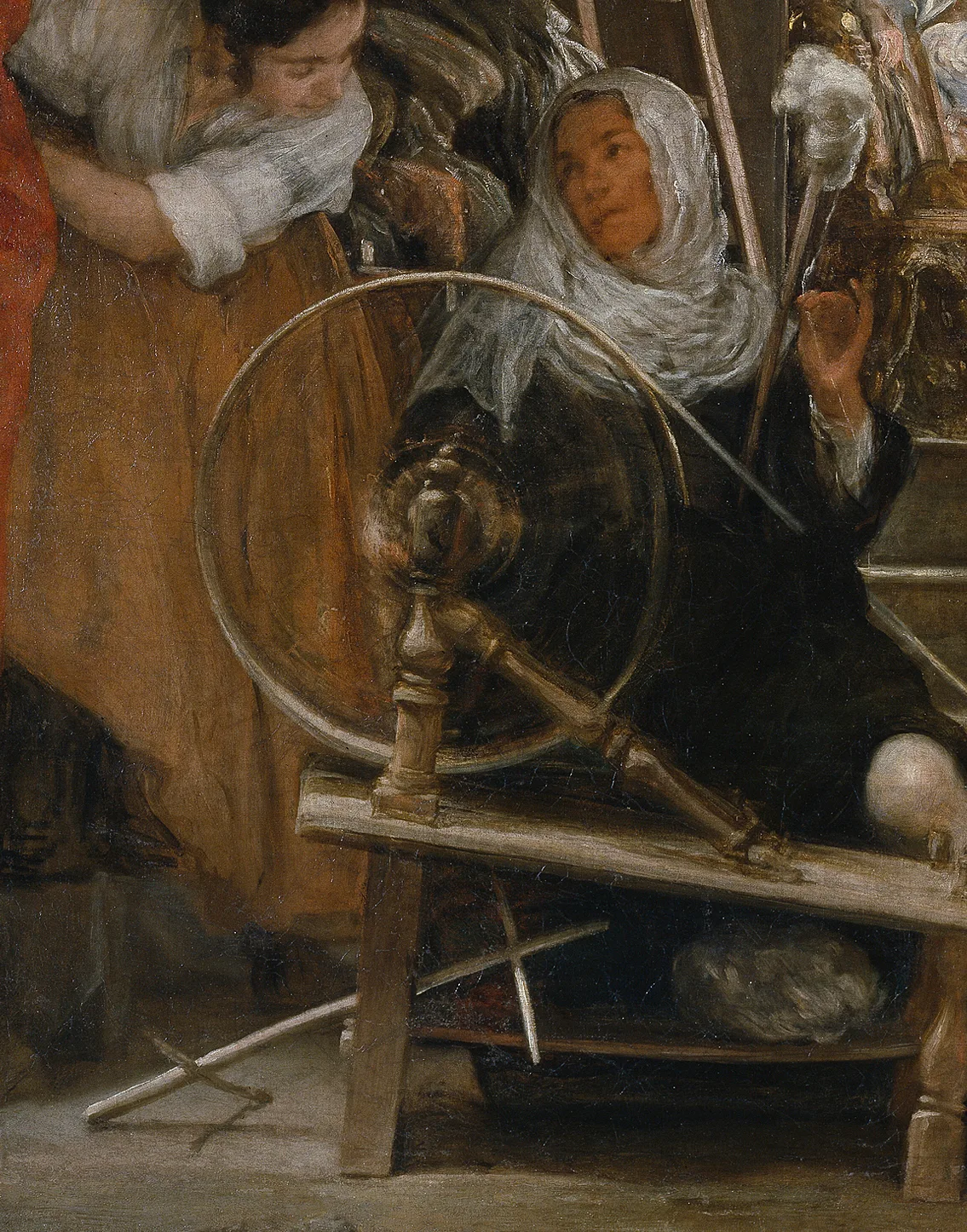
Detail of Las Hilanderas: the spokes of the spinning wheel dissolve into a blur of loose strokes, one of the first times a painter set down the motion itself instead of a wheel stopped still.
Diego Velazquez, Las Hilanderas (The Spinners) (detail), circa 1657, Museo del Prado, Madrid. Public domain, Wikimedia Commons.
Restricted palette built on touch, not chemistry
Worked from lead white, vermilion, iron-oxide reds, azurite, bone black, and the standard earths — and produced the full tonal and coloristic range of royal portraiture from this restricted kit.
Why it matters · Most painters reach for more pigments when the painting fails. Velázquez's record argues the opposite — that range comes from value judgement and touch, not from material variety. The discipline of restriction is what produces the range.
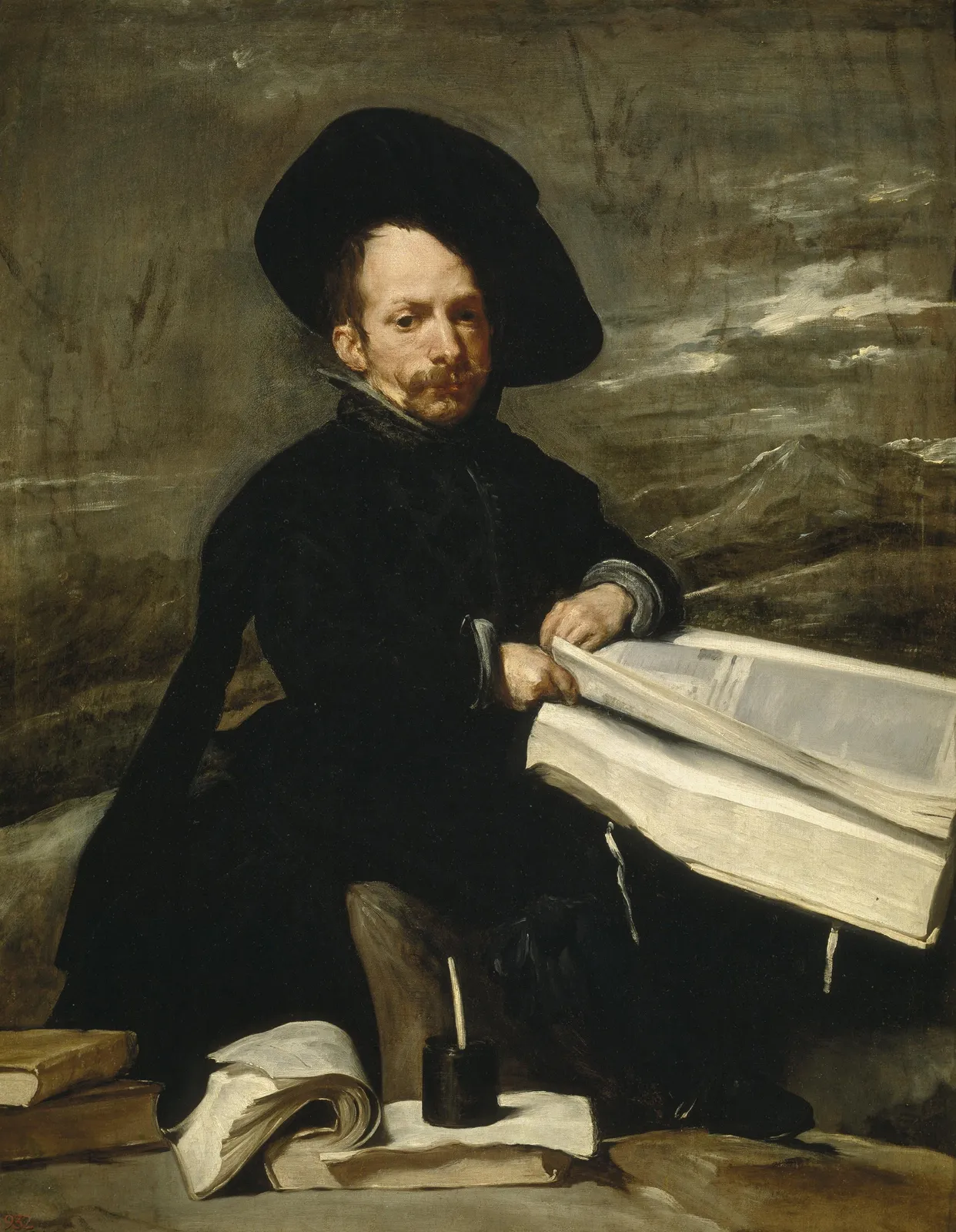
The jester known as El Primo, sitting with his books: a black coat, a brown ground, white paper, and a face. No bright colour enters the picture anywhere, and the whole range still runs from the pale page to the black of the coat.
Diego Velazquez, The Jester Don Diego de Acedo (El Primo), circa 1644, Museo del Prado, Madrid. Public domain, Wikimedia Commons.
Three or four impasto highlights as final theatrical work
Built tonally restrained portraits that were finished with sharp impasto in tightly limited places — the glint on a metal cross, the wet edge of a lower lip, the highlight on jewelry.
Why it matters · A few decisive points of thick white can do most of the theatrical work in a portrait. Painters who load every highlight equally lose the hierarchy. Velázquez reserved impasto as a punctuation mark, not as ambient surface.
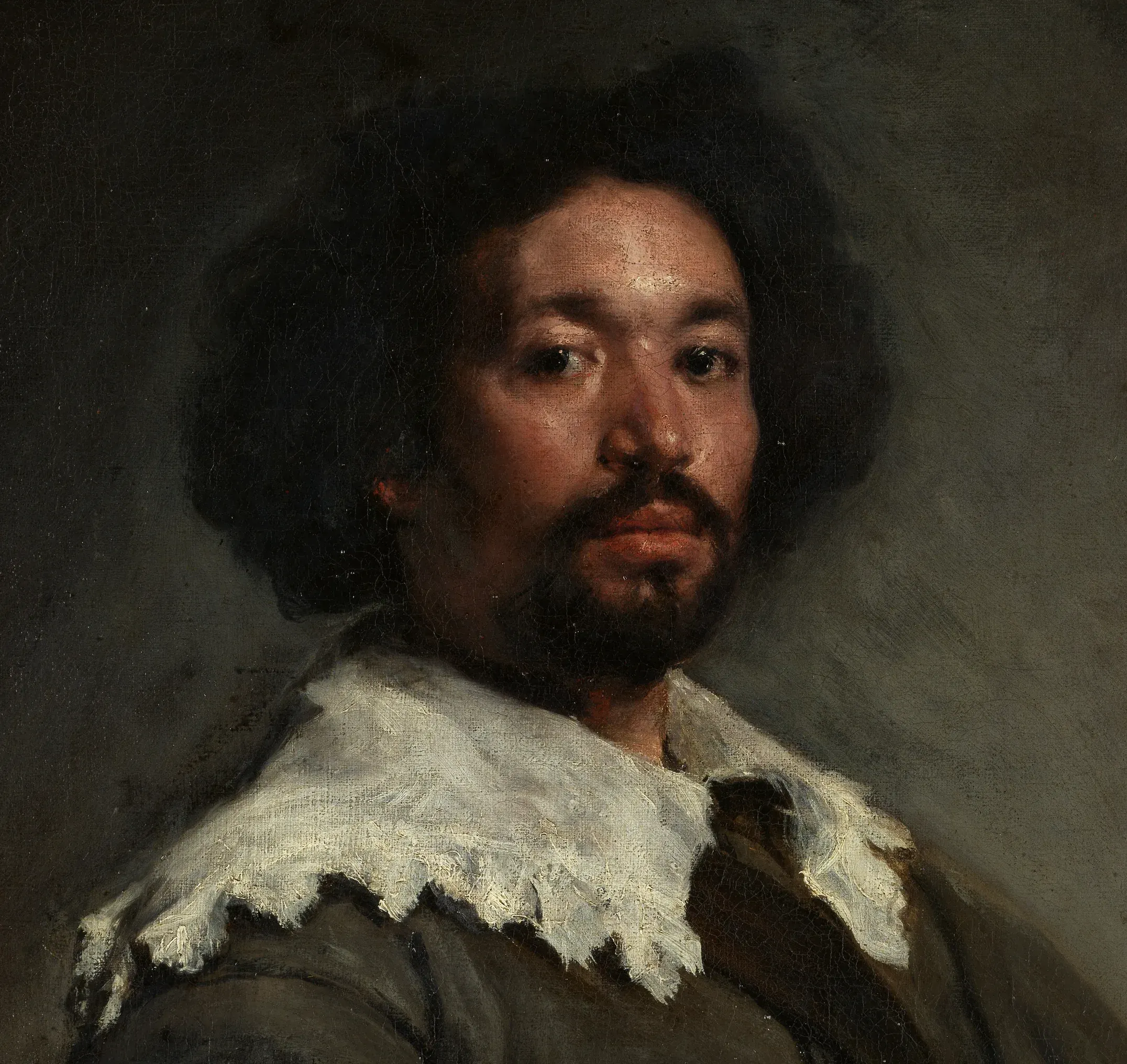
Detail of Juan de Pareja: the whole restrained head turns on a handful of loaded whites, the ragged collar struck in wet and left standing, the brightest note held back for last.
Diego Velazquez, Juan de Pareja (detail), 1650, The Metropolitan Museum of Art, New York. Public domain, Wikimedia Commons.
Compose in paint, not on paper
X-ray and infrared examination of the major canvases shows extensive pentimenti — arms moved, heads turned, figures added and subtracted. Changed compositions on the final surface, not in preparatory drawings.
Why it matters · A painting that is the transfer of a finished drawing is rigid. Velázquez treated the final surface as the place where decisions actually got made. Painters who lock the composition before paint touches canvas have already given up the option of finding the painting in paint.
Carmen Garrido, Velázquez: Técnica y Evolución, 1992
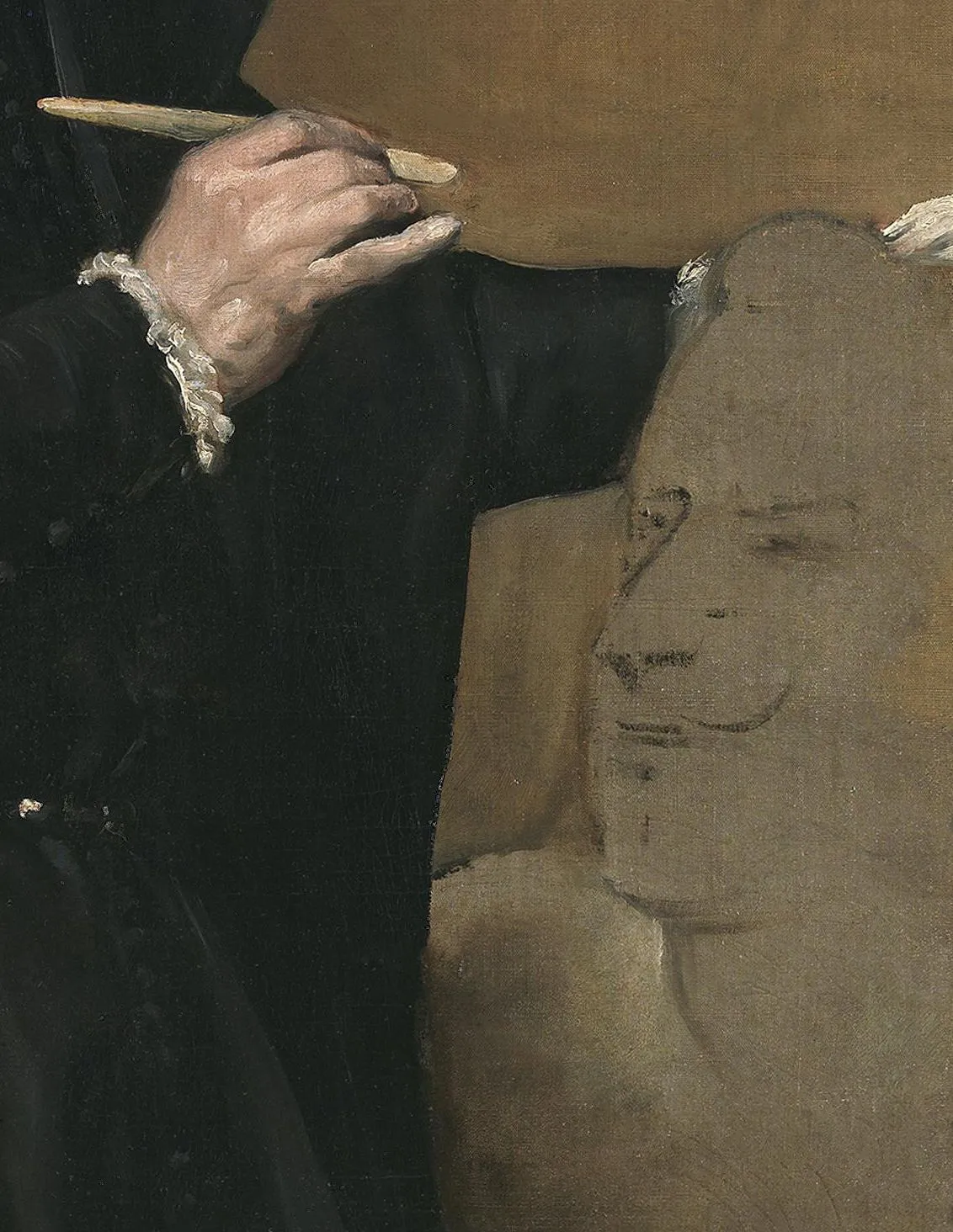
Detail of Juan Martínez Montañés: the clay head the sculptor is modelling is left at the lay-in stage, a thin pale mass with the features found in a few dark strokes straight on the surface, while the hand beside it is carried all the way to a finish. Both ends of the process sit in one canvas.
Diego Velazquez, Juan Martínez Montañés (detail), 1635 to 1636, Museo del Prado, Madrid. Public domain, Wikimedia Commons.
In the studio
Diego Velázquez, self-portrait at his easel — detail of Las Meninas, 1656
Studio
Light
Dedicated studio within the royal Alcázar in Madrid; large enough to accommodate Las Meninas and The Surrender of Breda.
Position
Standing; retreated several paces between marks to judge the canvas at distance.
Working distance
A pace or several paces between marks — long-handled brushes (some nearly a meter) made this physically possible.
Session length
Constant flow of formal sittings as painter-chamberlain to the Spanish crown; royal duties (eventually as Aposentador Mayor) ate substantial working time. Total surviving output only around 120 works.
Tools
Long-handled brushes (brochas) — some nearly a meter long · Standard wooden palette · Library of more than 150 books on optics, perspective, geometry, military engineering, and architectural theory (inventoried at his death)
Notes
Philip IV kept a private key to the studio and would sit for hours watching Velázquez paint.
Source: Antonio Palomino, El museo pictórico y escala óptica, 1724
Palette
Ground
Tinted ground baked into the canvas at preparation — greenish-brown clay (barro de Sevilla) in Seville; brighter red-ochre in mid-career Madrid; cooler brown again in late work. Ground visible in halftones as a working colour.
Whites
Lead white
Earths
Iron-oxide reds · Standard earth range — ochres, umbers, siennas
Colors
Vermilion · Azurite
Blacks
Bone black
Medium
Pure oil — no mediums. The same no-medium discipline Sargent would adopt centuries later.
Quantity
Restricted but loaded.
Source: Carmen Garrido, Velázquez: Técnica y Evolución, 1992
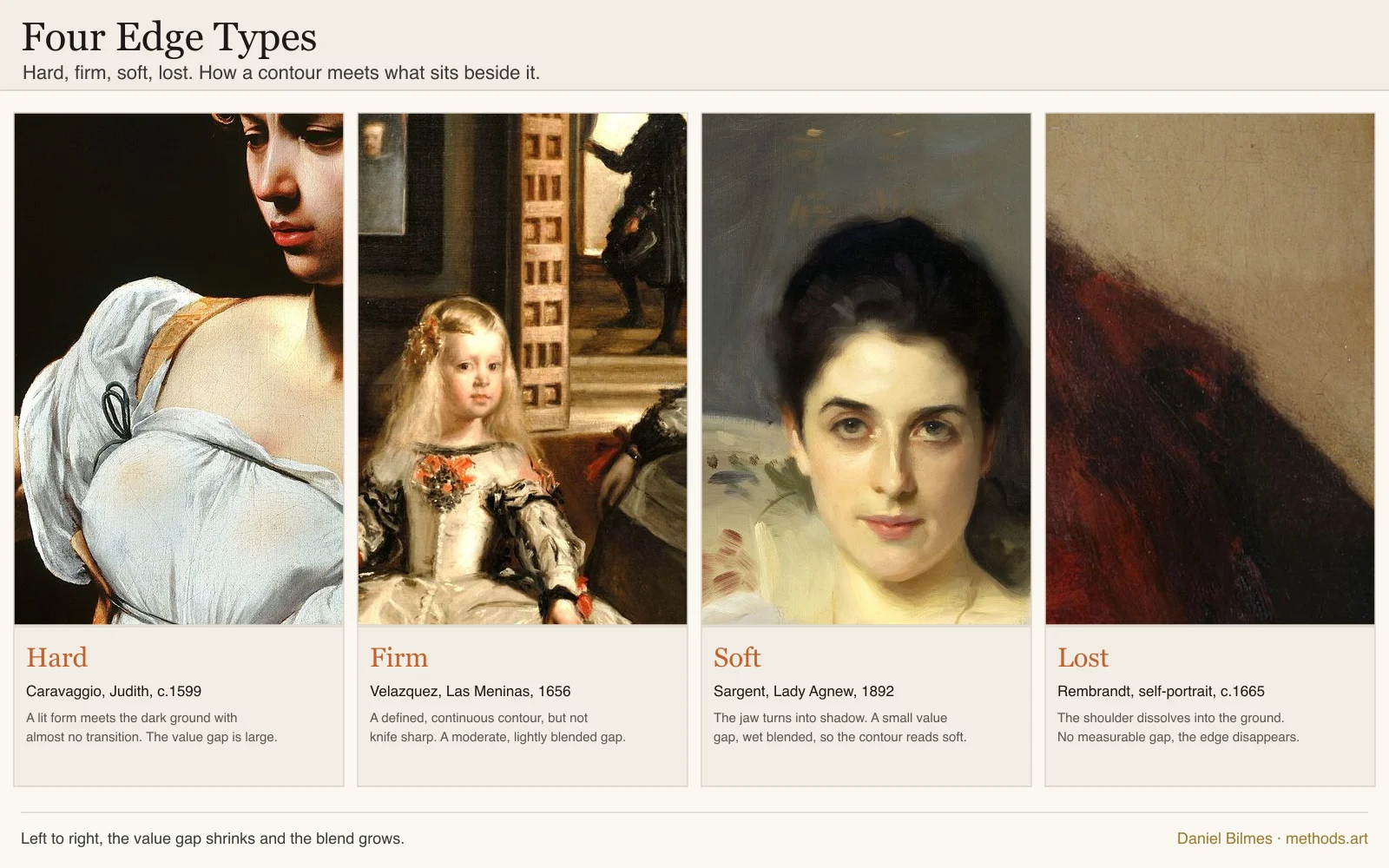
Four edge types, in master paintings
Four edge types in oil painting, from hard to lost: a hard edge in Caravaggio, a firm edge in Velazquez, a soft edge in Sargent, and a lost edge in Rembrandt dissolving into the ground.
The three-value thumbnail, three more compositions
The three-value thumbnail, second set: three more compositions reduced to three value brackets (darks, mids, lights) at each painting's true proportions, Velazquez's Las Meninas (318 by 276 cm), Rembrandt's The Night Watch (363 by 437 cm), and Sargent's The Daughters of Edward Darley Boit (222 by 222 cm).
Canvas prepared with a brownish-tinted ground before the first mark.
Why: The middle value is established as a condition of the painting, not as a layer of work. Saves the painter from mixing back to it later.
2. Stain contours and primary shadows directly onto the ground
Used streaks and washes of heavily diluted oil to lay in contours and shadows. No academic chalk-or-charcoal drawing.
Why: The composition is established in thin paint, not transferred from paper. Keeps the option of moving figures and limbs as the painting develops.
3. Build lights with dry opaque scumbles
Drag-applied lighter areas in opaque scumbles, letting the tinted ground show through in places.
Why: Scumbling produces broken surface — the ground reads through, atmosphere is built into the lights.
4. Leave specific passages as raw ground
Left the halftones of the face, the shadow side of hands, and reflected warmth in drapery folds entirely untouched as the raw preparation layer.
Why: The most distinctive economy of his method. Painters who paint every inch produce constructed surfaces. Velázquez's portraits feel inhabited because parts of them are literally not painted.
5. Sharp impasto highlights placed last
Three or four decisive points of thick white at the final stage — glint of a cross, wet edge of a lip, edge of a collar.
Why: A restrained tonal study can still carry theatrical weight when impasto is reserved for a few specific points. Resolving every highlight equally drowns the hierarchy.
How they studied
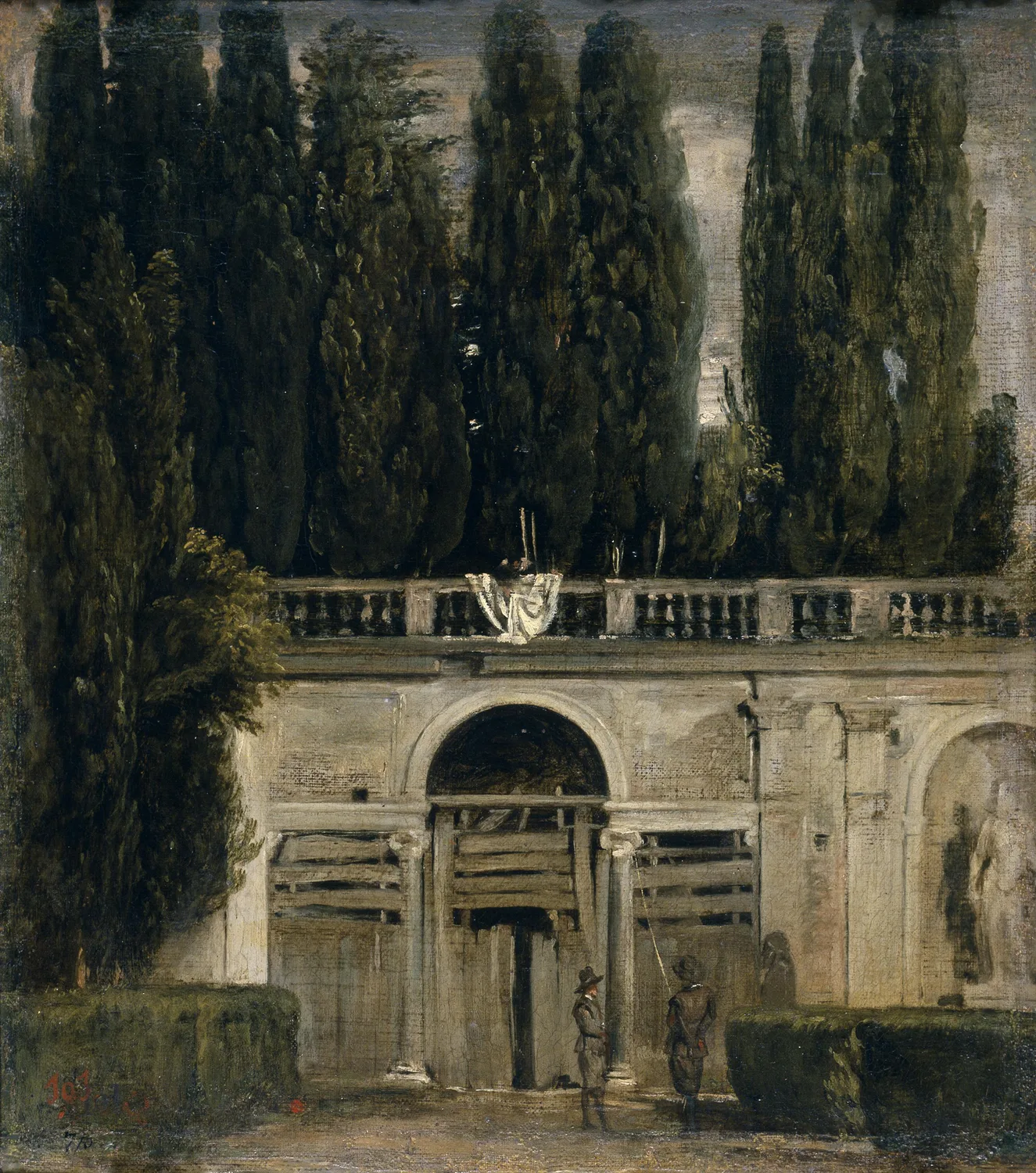
Velázquez trained the long way. At about eleven he was apprenticed to Francisco Pacheco in Seville on a six-year contract signed in 1611, and Pacheco drilled the discipline that outlasted every fashion, which was to draw the thing itself, from life and from sculpture, before painting it. The early Seville bodegones, the kitchen and tavern scenes, are where that drawing turned into paint, ordinary people and copper pots studied at close range. He passed the guild examination in 1617 and opened his own shop. The deeper second education came later, on two study campaigns in Italy. On the first, from 1629 to 1631, he copied Tintoretto and Titian in Venice and gave his Roman days to Michelangelo and Raphael, and his handling loosened and lightened for good. On the second, from 1649 to 1651, he bought paintings and sculpture for the crown and painted the Pope and his own assistant Juan de Pareja along the way. The two figures below stand at the two ends of that formation, a Seville bodegon and a small oil study made on the spot in a Roman garden.
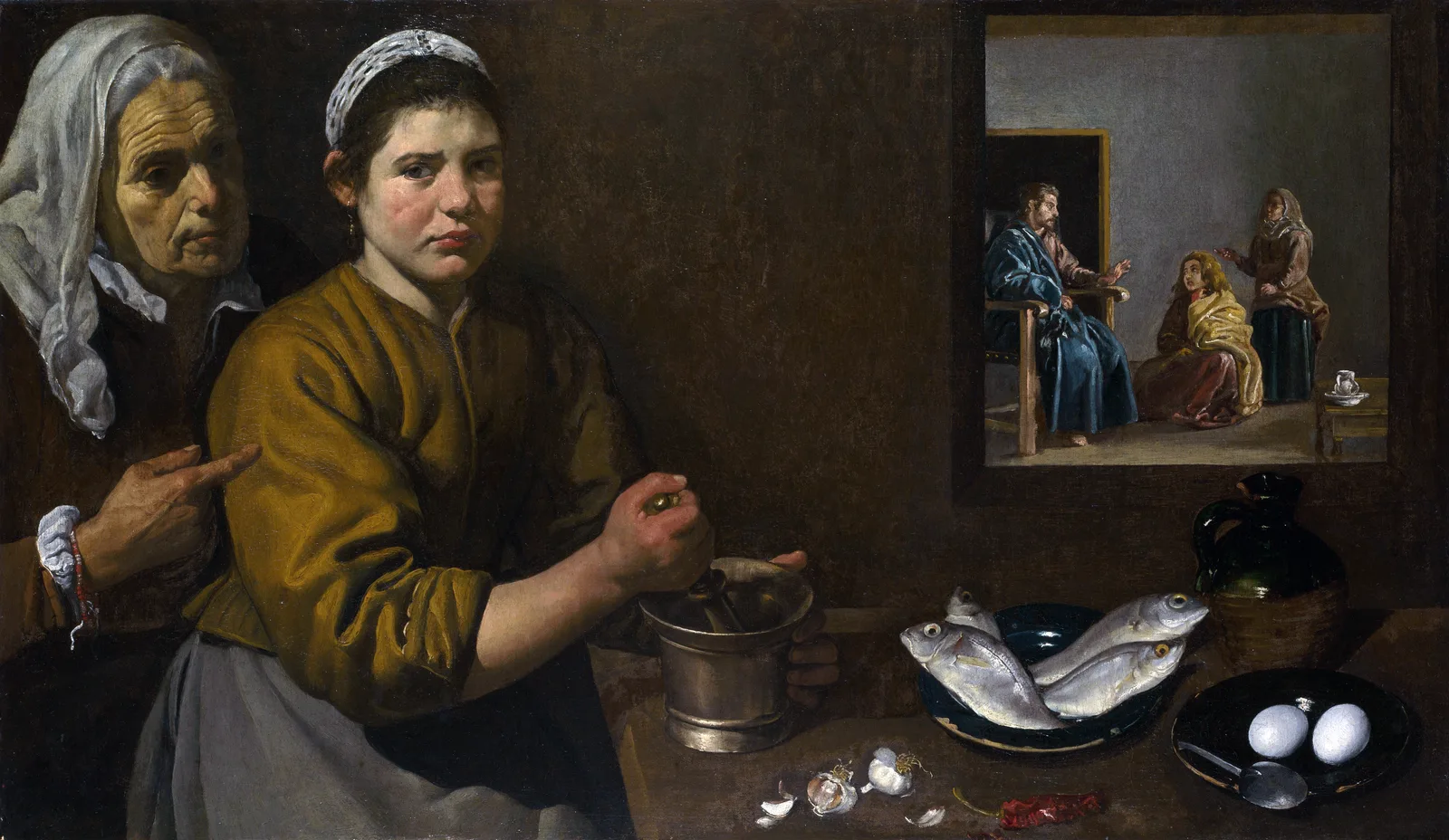
Christ in the House of Martha and Mary, from the Seville years: a kitchen maid and a still life of fish, eggs, and garlic painted from life at close range, with the religious scene set small and far behind. Under Pacheco the training was to paint the pots and the faces in front of you first.
Diego Velazquez, Christ in the House of Martha and Mary, 1618, The National Gallery, London. Public domain, Wikimedia Commons.
View of the Garden of the Villa Medici in Rome, painted outdoors on the first Italy trip: cypresses and a stone loggia laid in thin and quick, the kind of direct study from nature that loosened his hand for the late manner.
Diego Velazquez, View of the Garden of the Villa Medici in Rome, circa 1630, Museo del Prado, Madrid. Public domain, Wikimedia Commons.
Source: Formation, the Pacheco apprenticeship, and the two Italy study campaigns: Francisco Pacheco, Arte de la pintura, 1649, and Jonathan Brown, Velázquez: Painter and Courtier, 1986.
Up close
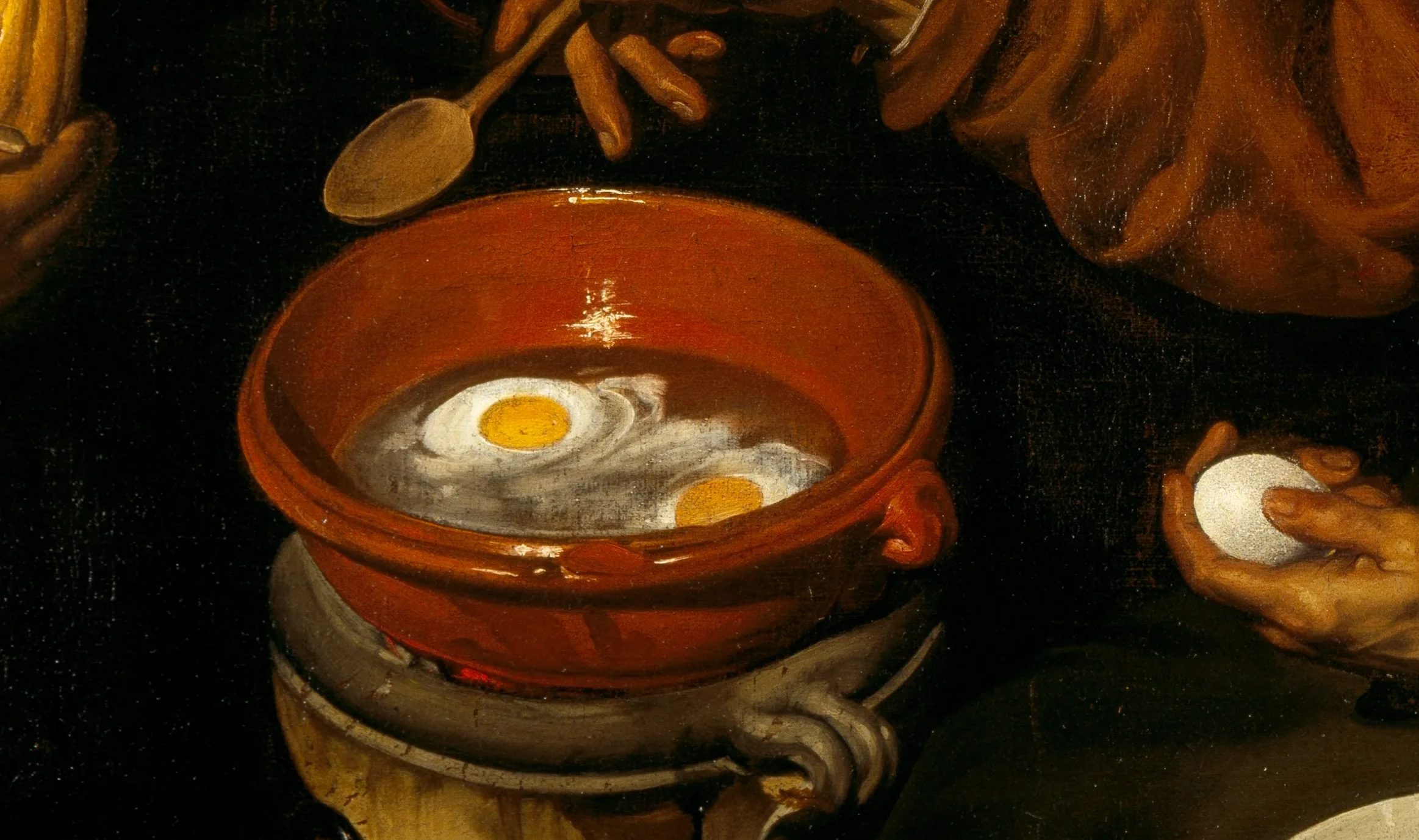
Detail of Old Woman Frying Eggs: the eggs setting in hot oil, the clear white turning opaque at the rim, the red earthenware and the brass each built from its own weight of paint. He was about nineteen when he painted the states of matter this closely.
Diego Velazquez, Old Woman Frying Eggs (detail), 1618, National Galleries of Scotland, Edinburgh. Public domain, Wikimedia Commons.
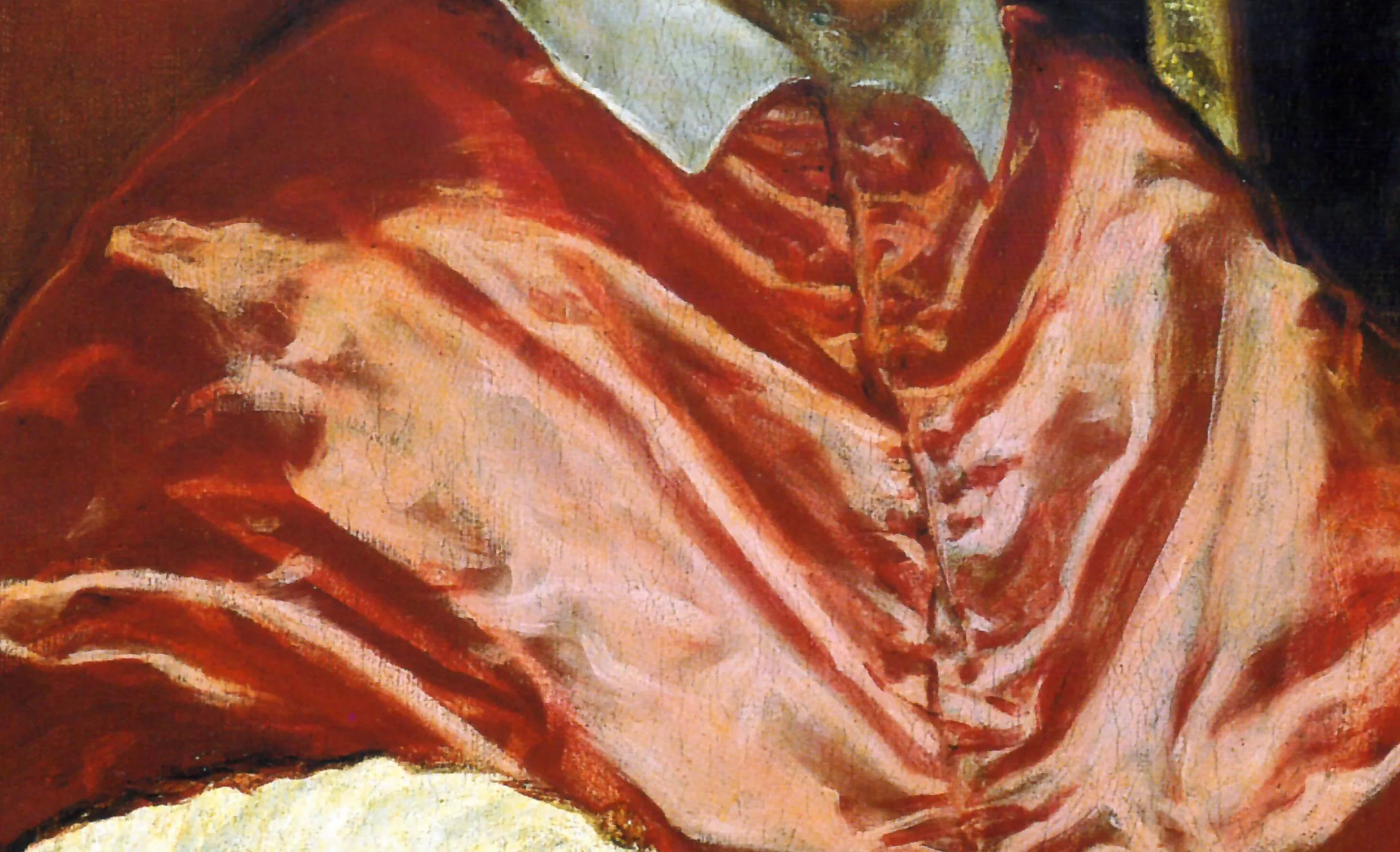
Detail of Portrait of Innocent X: the watered silk of the cape is not drawn and filled but struck in, loose strokes of rose, white, and deep red laid side by side that resolve into shimmering silk only when you step back.
Diego Velazquez, Portrait of Pope Innocent X (detail), 1650, Galleria Doria Pamphilj, Rome. Public domain, Wikimedia Commons.
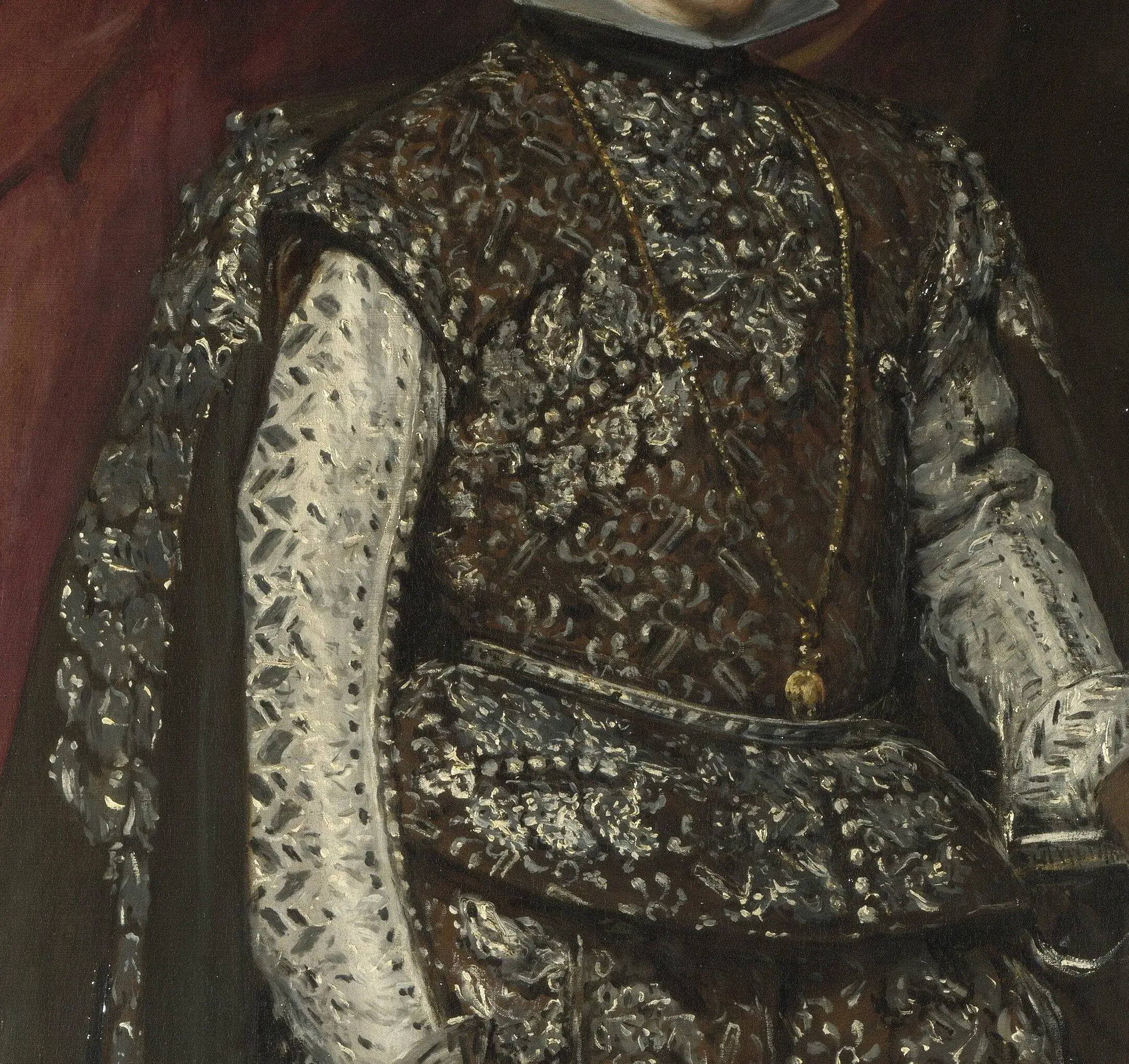
Detail of Philip IV in Brown and Silver: the silver embroidery is a scatter of loaded grey and white dabs over the brown ground, tied together with quick black lines. Up close it is abstract, at distance it reads as thread and light.
Diego Velazquez, Philip IV of Spain in Brown and Silver (detail), circa 1632, The National Gallery, London. Public domain, Wikimedia Commons.
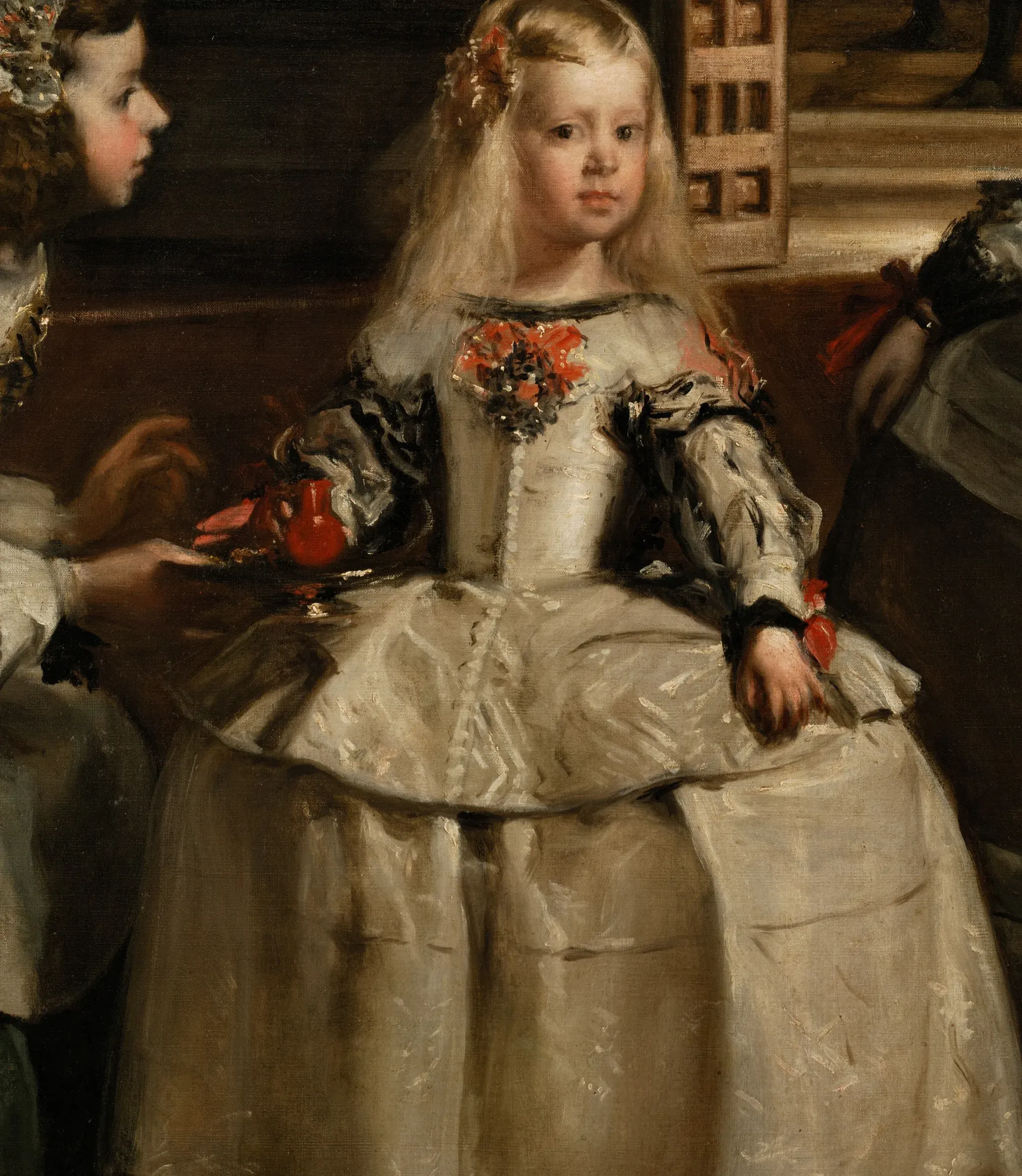
Detail of Las Meninas: the Infanta's pale gown carries the late economy in the open, a few loaded strokes of grey and cream dragged over the ground for the whole sheen of the satin, the red of the flask and the ribbons set in as the one warm accent.
Diego Velazquez, Las Meninas (detail), 1656, Museo del Prado, Madrid. Public domain, Wikimedia Commons.
Watching him work
“He kept a peasant lad, as an apprentice, who served him for a study in different actions and postures, sometimes crying, sometimes laughing, till he had grappled with every difficulty of expression; and from him he executed an infinite variety of heads in charcoal and chalk on blue paper, by which he arrived at certainty in taking likenesses.”
Francisco Pacheco, Arte de la pintura (1649), translated in William Stirling, Velazquez and his Works, 1855 [source]
Across media
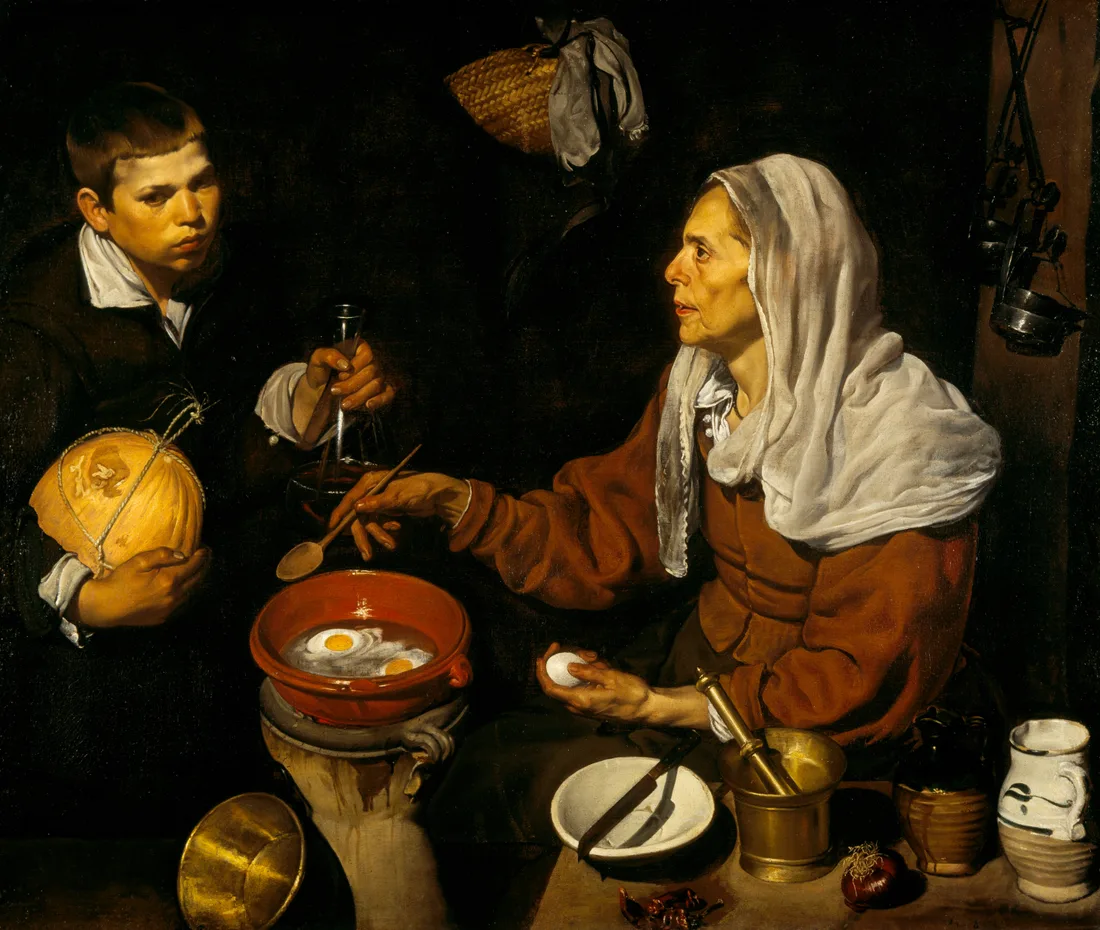
Old Woman Frying Eggs, painted at about nineteen in Seville: a whole picture made from a few plain things in a raking light, the bodegon discipline that taught him to paint what stood in front of him.
Diego Velazquez, Old Woman Frying Eggs, 1618, National Galleries of Scotland, Edinburgh. Public domain, Wikimedia Commons.
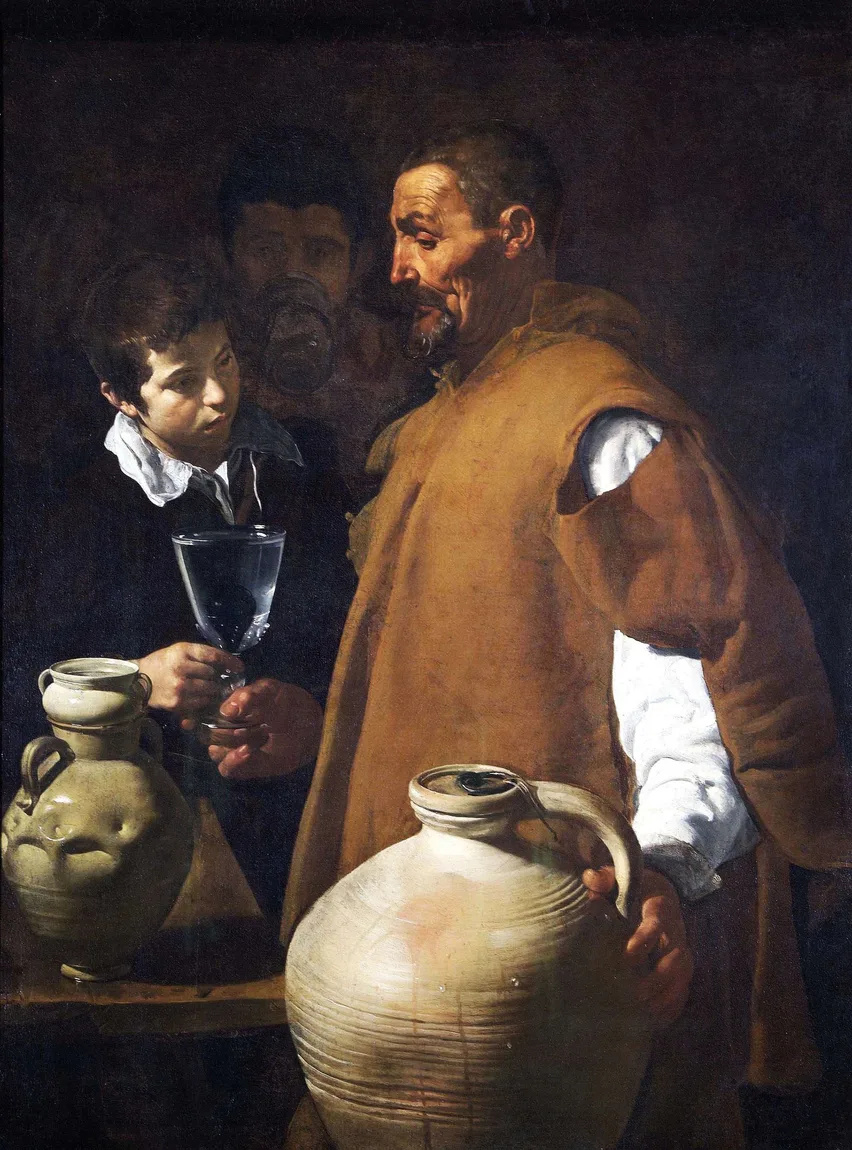
The Waterseller of Seville, another early bodegon: the rough glazed jug, the bead of water on its side, and the clear glass all studied from life, the tight dark manner of the years before Madrid and Italy.
Diego Velazquez, The Waterseller of Seville, circa 1620, Apsley House, London. Public domain, Wikimedia Commons.
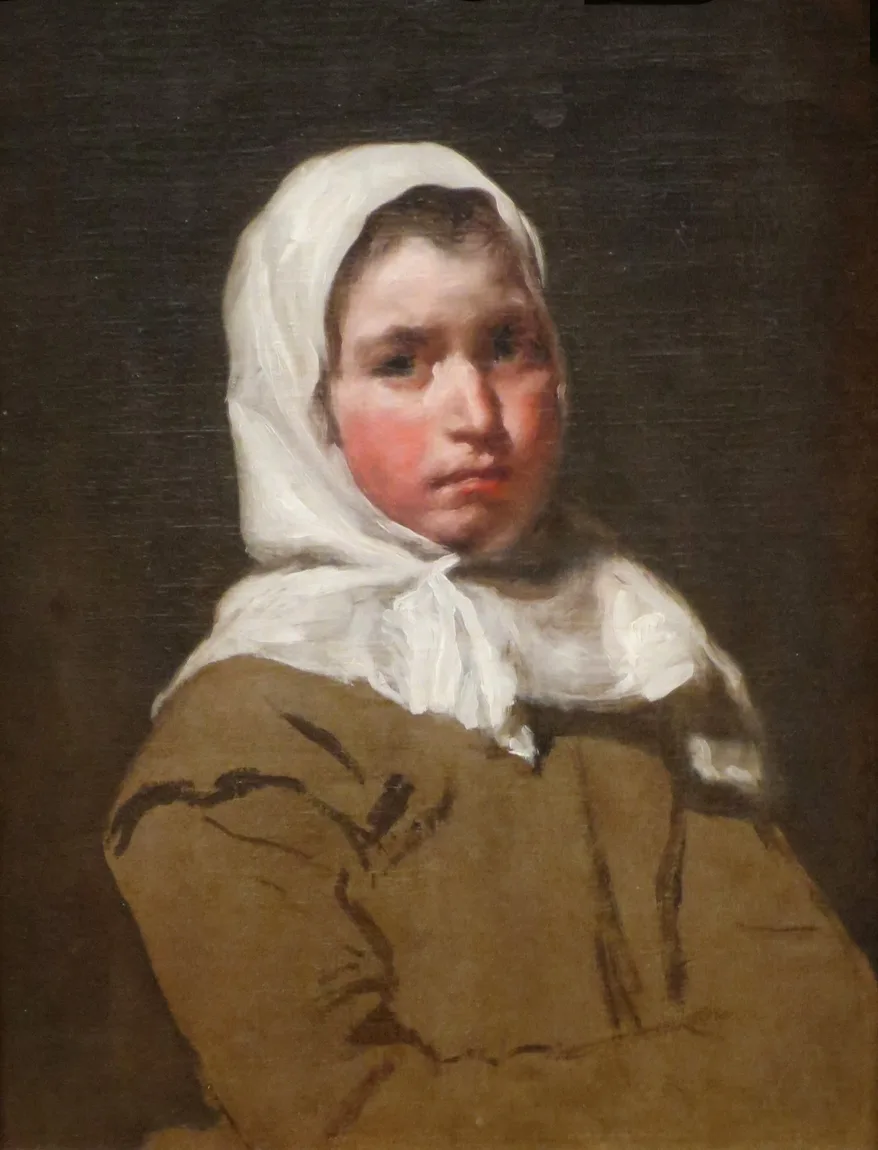
Peasant Girl, left unfinished: the head is carried to a finish while the smock is still only a few brown contour lines over the bare ground. One canvas that shows both ends of his process at once, the block-in and the finish.
Diego Velazquez, Peasant Girl (La Gallega), circa 1645. Public domain, Wikimedia Commons.
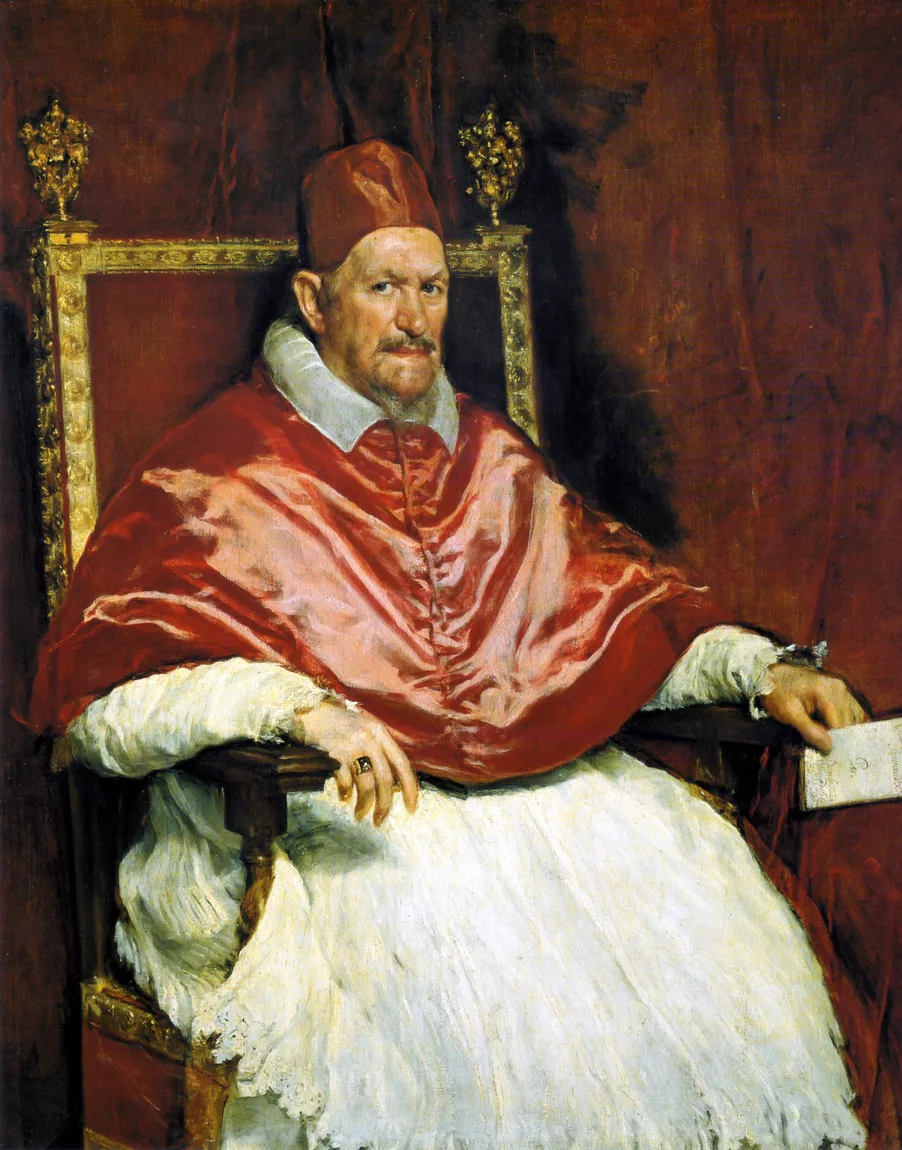
Portrait of Innocent X, painted in Rome on the second Italy trip: the full late power in one head, so alive that the Pope is said to have called it too true. He painted it as a warm up before the portrait of Juan de Pareja.
Diego Velazquez, Portrait of Pope Innocent X, 1650, Galleria Doria Pamphilj, Rome. Public domain, Wikimedia Commons.
The record, deeper
The money
In 1623 Philip IV took Velázquez into royal service at twenty ducats a month, with lodging, a doctor's care, and separate payment for every picture he painted.
Court appointment terms, 1623; Jonathan Brown, Velázquez: Painter and Courtier, 1986.
In 1624 the crown paid him a further three hundred ducats to move his household from Seville to Madrid.
Court records; Jonathan Brown, Velázquez: Painter and Courtier, 1986.
The reworks
The Prado's standing portrait of Philip IV is painted directly over an entirely earlier portrait of the king. The radiograph shows the first figure was heavier, the cloak wider, and the feet placed differently before Velázquez covered it with the new one.
Javier Portús, Velázquez: The Early Court Portraits, 2012.
In Las Meninas he changed the angle of his own head and the tilt of the tall canvas on the easel while the picture was already under way.
Jonathan Brown and Carmen Garrido, Velázquez: The Technique of Genius, 1998.
The studio
His court studio was a room in the Cuarto bajo del Príncipe, the ground floor apartment of the dead prince Baltasar Carlos in the Alcázar of Madrid. The wall of windows in Las Meninas matches the plan of that room.
Alcázar plans; Jonathan Brown and Carmen Garrido, Velázquez: The Technique of Genius, 1998.
Juan de Pareja, enslaved in that household, learned to paint by watching him in the studio. The deed Velázquez signed to free Pareja in Rome in 1650 still survives in the state archive there.
Antonio Palomino, El museo pictórico, 1724; the manumission deed, Archivio di Stato, Rome.
The materials
His early Seville grounds were a local red brown clay the shop called terra de sevilla. After Italy he switched to pale grey grounds of lead white and calcite for a cooler, more silver light.
Jonathan Brown and Carmen Garrido, Velázquez: The Technique of Genius, 1998.
He mixed calcite, ground chalk, into his oil paint to change how transparent it was and how it moved under the brush.
Brown and Garrido, Velázquez: The Technique of Genius, 1998.
He used smalt, a coarse blue cobalt glass, as much to help a paint layer dry as for its color.
Carmen Garrido, Velázquez: Técnica y evolución, 1992.
Refusals — what they would not do
Refused conventional white grounds — every canvas began on tinted preparation.
Refused academic preparatory drawings — composition was stained directly onto the ground in thin paint.
Refused to paint the halftones — left passages of the canvas as raw ground.
Refused chemists' palettes — built tonal range from a restricted kit through value judgement and touch.
Reference
Primary source
Direct observation. Royal family, court dwarfs, jesters, foreign ambassadors, and his own household. Bodegones from specific Seville kitchen servants and neighbours.
Photography
Predates photography. Worked from optical theory and direct observation; no record of camera obscura use.
Exceptions
Studied optics, perspective, geometry, and architectural theory through his 150-book library — the "extraordinary perspective" of Las Meninas was constructed from theory, not improvised atmospherically.
Francisco Pacheco · 1611–1617 — Six-year apprenticeship in Seville from age eleven. Pacheco was a conventional late-Mannerist painter and a scholar; his treatise Arte de la pintura (1649) records the technical training, material preparations, and working conventions Velázquez learned. Pacheco also became Velázquez's father-in-law in 1618.
Influences
Caravaggio and Ribera — the Seville bodegone tradition of direct observation.
Titian — studied in the royal collection in Madrid; the loose handling of the late Spanish style descends from Titian's late work.
Rubens — encountered the painter in person during Rubens's 1628 diplomatic mission to Madrid; Rubens's example shaped Velázquez's decision to travel to Italy.
Students
Juan de Pareja — enslaved in Velázquez's household for many years, freed in Rome in 1650, and the subject of one of Velázquez's greatest portraits painted as a public demonstration of his capabilities; Pareja became a master painter in his own right.
Juan Bautista Martínez del Mazo — son-in-law, took over the royal painter position after Velázquez's death.
The Spanish tradition of tinted-ground tonally economical portraiture reached Goya through this lineage and through nineteenth-century study of the Prado reached Manet, Whistler, and Sargent.
In their own words
“He attained the true imitation of nature, following in the footsteps of Caravaggio and Ribera.”
— Francisco Pacheco, Arte de la pintura, 1649
Pacheco — Velázquez's teacher and father-in-law — describing his former pupil's early method.
“Velázquez was the first to use stains to achieve the effect of reality from a distance.”
— Antonio Palomino, El museo pictórico y escala óptica, Volume III, 1724
Palomino's technical description of the late manchas method.
“I would rather be the first painter of common things than second in higher art.”
— Diego Velázquez (attributed), Recorded by Antonio Palomino, El museo pictórico
Palomino's account of Velázquez's defense of his early Seville bodegones against the contempt for genre painting in seventeenth-century Spanish art theory.
“The painter of painters.”
— Édouard Manet, Letter to Henri Fantin-Latour from Madrid, 1865
Manet's verdict after spending his 1865 visit to Madrid in the Prado.
A tinted ground, never white: the greenish-brown barro de Sevilla early on, a warmer red-ochre in mid-career Madrid, and cooler browns again late. He left that ground visible in the halftones as a working color.
What was Velazquez's palette?
A deliberately restricted kit: lead white, vermilion, iron-oxide reds, azurite, bone black, and the standard earths. He built the full range of royal portraiture from it through value judgment and touch rather than pigment variety.
What brushes did Velazquez use?
Unusually long-handled brushes (brochas), some nearly a meter, which let him strike the canvas from several paces back and judge the mark at the viewing distance.
Did Velazquez draw before painting?
Not in the academic sense. He stained contours and shadows directly onto the tinted ground in thin paint and changed compositions on the final surface, which is why the canvases carry extensive pentimenti.
How did Velazquez finish a face?
He left passages such as the halftones and the shadow side of the hands as raw ground, then placed only three or four decisive impasto highlights (a glint on a cross, the wet edge of a lip) at the very end.
If this painter is your match
You share the belief that restraint is a sharper tool than description. The untouched passage, the ground left visible, the one highlight that does the work of twenty — these are the painter's real vocabulary.
Borrow this: Prepare a canvas with a warm brownish ground — not white. Paint a portrait that deliberately leaves 30% of the ground untouched in the halftones. You will find out how much of your finished surface was never doing anything.
Francisco Pacheco, Arte de la pintura (The Art of Painting), 1649. Pacheco's treatise. Written by Velázquez's teacher and father-in-law; documents the technical training, material preparations, and working methods Velázquez learned in Seville. The closest thing we have to a first-person source on his formation.
Carmen Garrido, Velázquez: Técnica y Evolución, 1992. Museo del Prado conservation department's technical study. X-ray, infrared reflectography, and cross-section analysis — the primary modern evidence for his ground preparations, layer structure, and pentimenti.
Antonio Palomino, El museo pictórico y escala óptica, Volume III: El Parnaso español pintoresco laureado, 1724. Palomino wrote within living memory of Velázquez's circle and drew on first-hand accounts from people who had known the painter.