Sorolla painted outdoors, in the actual light of the subject, on canvases up to three yards across stretched on site and braced against the beach wind with ropes and stakes. He worked in pure tube oil with no medium, a small amount of turpentine in the first block-in only, loading the lights with thick opaque color and leaving the shadows as thin transparent washes. He placed the figures in sparse charcoal, covered the whole canvas in twenty to thirty minutes of thinned paint, then built the opaque pass wet into wet. When the light shifted, the session ended; he returned at the exact same time of day.
Worked on canvases up to three yards across, stretched on site, with assistants holding the stretcher and ropes/stakes bracing it against the wind off the water; large umbrellas managed glare on the palette without putting the canvas in shade.
Why it matters · Most plein-air painting accepts a small canvas because monumental scale outdoors is logistically punishing. Sorolla's rig is the cleanest argument that the constraint is solvable. The light at 4 p.m. on a specific beach is what the painting is about — bring the canvas to it.
Joaquín Sorolla and Clotilde Garcia del Castillo, Epistolario (Correspondence), Museo Sorolla
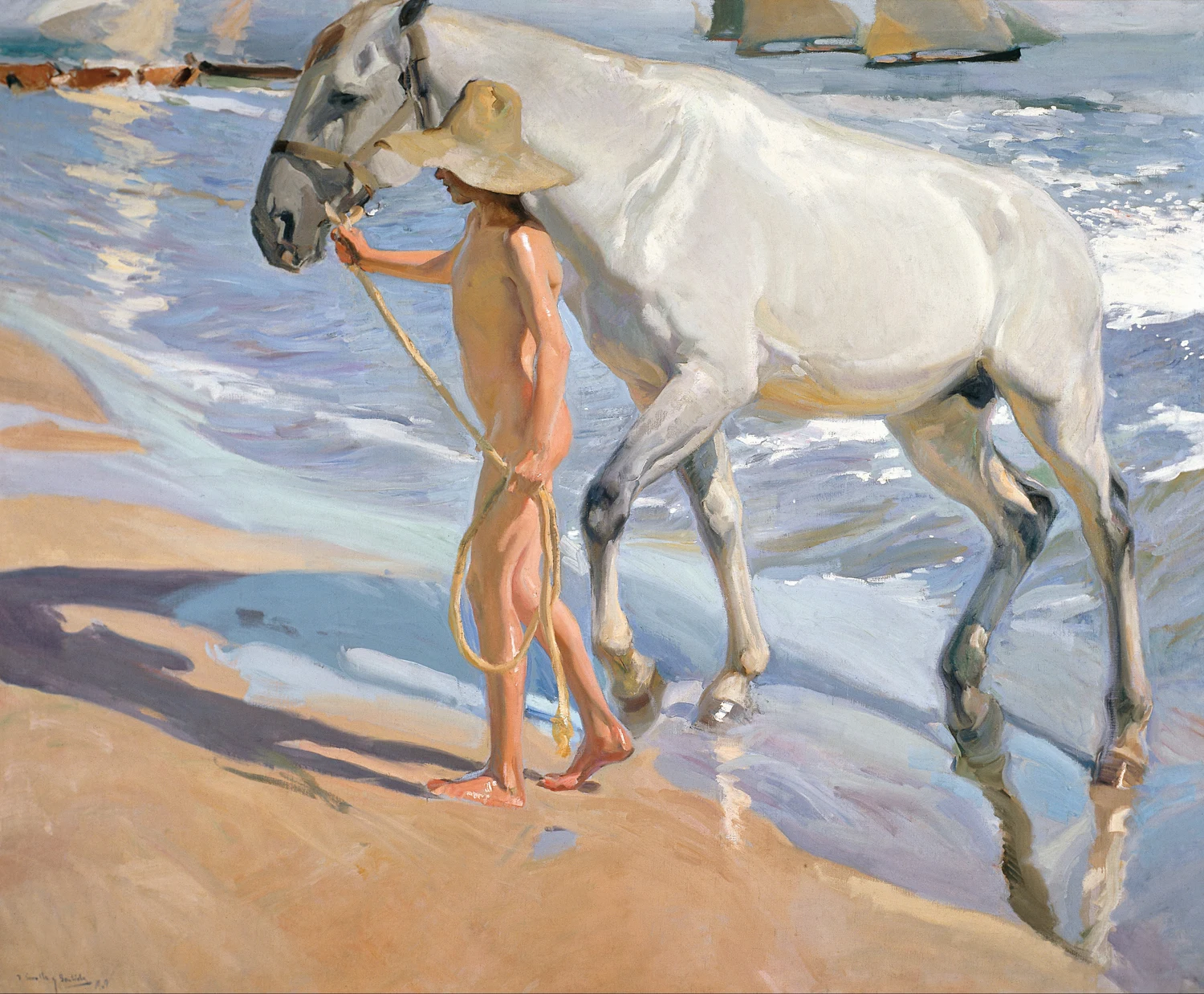
El baño del caballo, two metres by two and a half, painted on the Valencia beach in 1909: the whole picture is sand, wet sand and shallow water, and almost none of it is drawn. The horse is a few loaded sweeps of warm white, the boy is a flat silhouette of flesh against the glare, and the shadow the two of them throw is blue.
Joaquín Sorolla, El baño del caballo (The Horse's Bath), 1909, oil on canvas, 205 by 250 centimetres, Museo Sorolla, Madrid. Public domain, Wikimedia Commons.
Thick in the lights, thin in the darks
Loaded opaque pure tube colour where the sun hit and let the shadows stay as thin transparent washes — the surface of a Sorolla beach painting reads as a relief map of sunlit ridges and shadowed valleys.
Why it matters · The inverse of the academic layering his Valencia training had taught and the same rule Velázquez and Rembrandt had used two centuries earlier. Painters who load shadow as well as light flatten the canvas. The differential thickness is structural.
Institute of Materials Science of Valencia, Technical Analysis of Sorolla's Palette and Materials, 2015
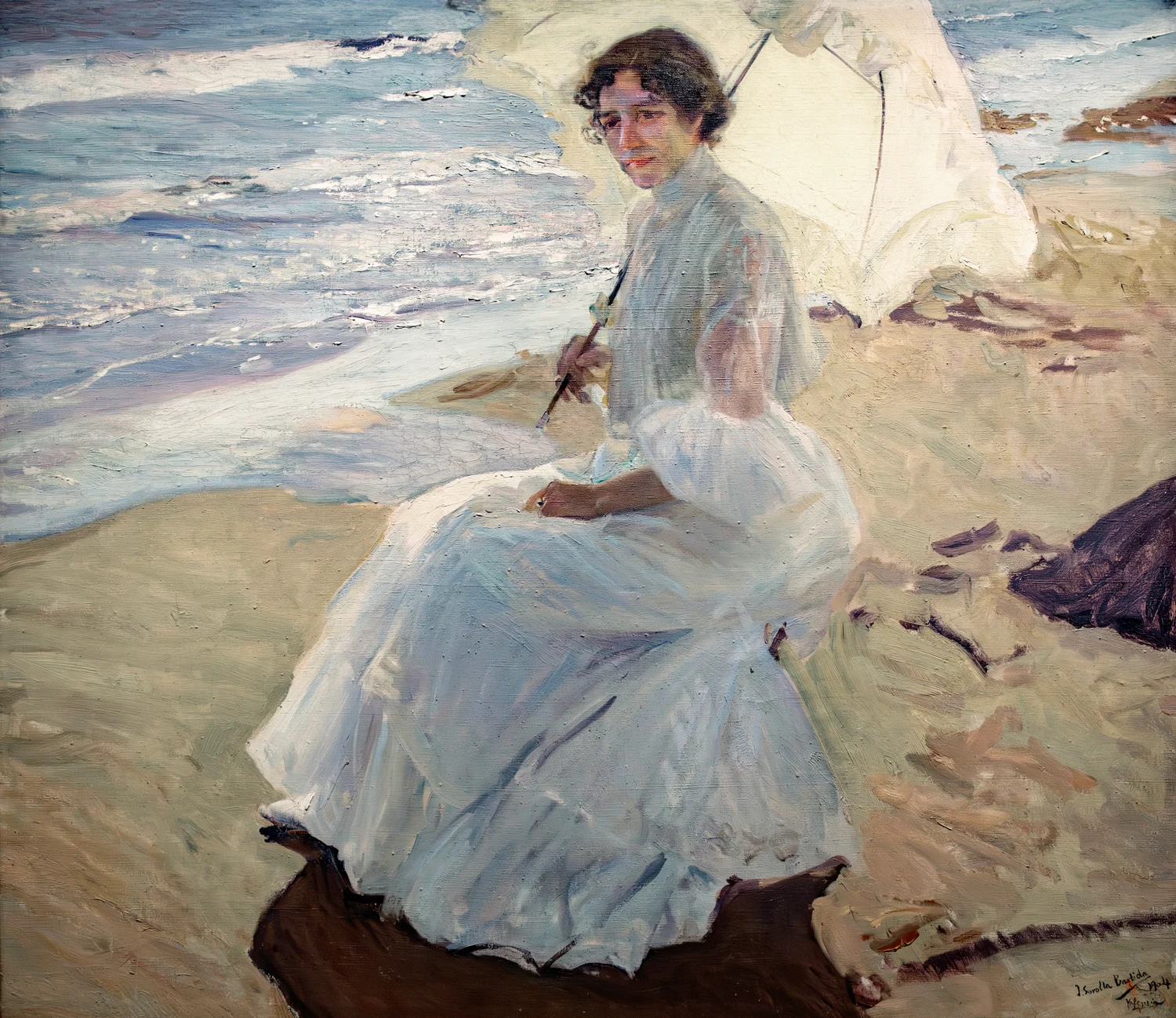
Clotilde en la playa: the dress is the whole light system in one object. Where the sun lands on it the white goes on thick and opaque. Where the folds turn away, the paint thins to blue and grey over the ground, and the sand beneath her runs the same two temperatures.
Joaquín Sorolla, Clotilde en la playa (Clotilde at the beach), 1904, oil on canvas, 129 by 150 centimetres, Museo Sorolla, Madrid, Inv. MS 670. Public domain, Wikimedia Commons.
Paint at the speed the light demands
Wrote: "I could not paint slowly if my life depended on it. Every effect is so transient, it must be rapidly painted." Sessions had to end when the light shifted; returning on a different light would destroy the unity.
Why it matters · The transient subject sets the working speed. Sorolla's discipline is to refuse the painter's preference for sustained slow work when the subject demands speed. Painters who hold their preferred pace against the subject paint a different subject.
Discover violet as the colour of shadow
Wrote about violet with the intensity of conversion — violet was what shadow really is in Mediterranean sunlight, never black, never brown.
Why it matters · Most painters reach for black or brown for shadow. Sorolla's record argues that the colour of shadow in sunlit conditions is specific and chromatic. Painters who default to black flatten outdoor light; painters who name the colour of shadow specifically expand the painting's range.
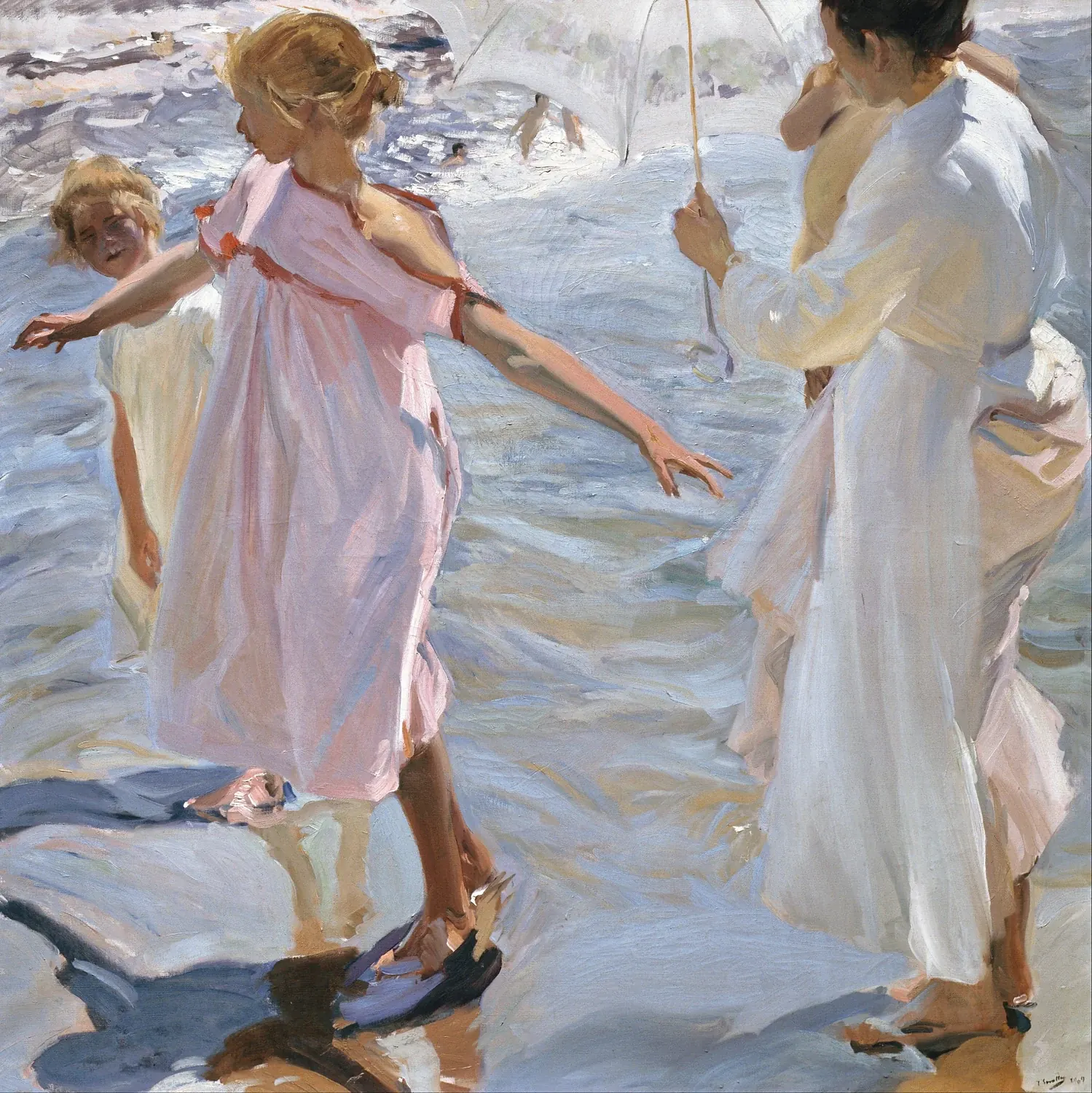
La hora del baño, Valencia: every shadow on this beach is blue or violet and not one of them is grey. The shadow under the girl in pink is laid straight onto the wet sand as colour, and her reflection sits inside it.
Joaquín Sorolla, La hora del baño, Valencia (Time for a Bathe, Valencia), 1909, Museo Sorolla, Madrid. Public domain, Wikimedia Commons.
Build a garden as a controlled outdoor studio
Designed his Madrid house garden himself as a controlled outdoor painting environment — full of orange trees, tile fountains, and specific light conditions that allowed him to paint outdoor subjects at will without leaving the city.
Why it matters · A working space is a tool. Sorolla built the outdoor environment he needed rather than waiting for travel. The discipline of constructing the conditions is methodological — most painters either accept whatever environment is available or wait indefinitely for the right one.
Museo Sorolla Archive, Madrid
Paint without parti pris
Told students: "Go to nature with no parti pris. You must not know in advance what your picture is going to look like. Paint what you see."
Why it matters · A painter who arrives at the subject with the image already decided cannot see what is in front of him. Sorolla's discipline is the refusal to impose the idea onto the subject — let the subject arrive through the eye and the hand without the mind cleaning it up.
Recorded instruction to a student
In the studio
Joaquín Sorolla painting his wife Clotilde, photograph by Christian Franzen, 1905
Studio
Light
Outdoor — Valencian beaches, Madrid garden, regional locations during the eight-year Vision of Spain campaign. "The studio is a garage."
Position
Standing; moved constantly — retreating to judge, advancing to place a mark.
Session length
Sessions ended when the light shifted. Multi-session work returned at the exact same time of day.
Tools
Long hog-bristle brushes · Three-yard canvases stretched on site for major beach paintings · Ropes and stakes to brace canvas against wind · Large umbrellas to manage glare on the palette · Photography (used as secondary tool for frozen motion of water and the postures of children running through waves)
Notes
Madrid house on the Paseo del General Martínez Campos preserved as the Museo Sorolla. Easels, palettes, and the multi-decade correspondence with his wife Clotilde held there.
Source: Museo Sorolla Archive, Madrid
Palette
Ground
Standard primed canvas; thick paint in lights, thin in darks where the ground reads through.
Whites
Lead white
Earths
Yellow ochre
Colors
Cobalt violet · Rose madder · Cadmium reds · Cadmium orange · Cadmium yellows · Chrome green · Viridian · Prussian blue · Cobalt blue · French ultramarine
Medium
Pure tube oil. Small amount of turpentine in the block-in only — undiluted paint from the first opaque layer onward. Same no-medium discipline as Sargent and Zorn.
Quantity
Generous, especially in the lights.
Source: Institute of Materials Science of Valencia, Technical Analysis of Sorolla's Palette and Materials, 2015
The three-value thumbnail
The three-value thumbnail: the full value scale collapsed into three brackets (darks, mids, lights), with three famous compositions reduced to three-value thumbnail sketches: Caravaggio's Calling of Saint Matthew, Repin's Barge Haulers on the Volga, and Sorolla's Strolling along the Seashore.
Returned to the same Valencian beaches, the same hours, the same families of fishermen and children year after year. The subject was decided before the canvas arrived.
Why: A painter who knows the light and when it appears can paint at the speed the light demands. Painters who do not scout arrive unprepared.
2. Charcoal block-in directly on canvas
Sparse charcoal placement of figures and major shadow shapes — no elaborate preparatory cartoons.
Why: The painting itself is the working document. Loaded preparation freezes the subject; sparse marks leave room for the light to dictate.
3. Rapid thin block-in
Twenty to thirty minutes of turpentine-diluted block-in establishing major value masses and the temperature of the light.
Why: The whole canvas covered in a first coherent state. Skipping this leaves the painter chasing local colour on raw canvas.
4. Opaque pass — wet-into-wet
Loaded the lights with thick pure colour; let the shadows stay as thin transparent passages showing the ground. Wet-into-wet in a single session if scale allowed; multiple same-time-of-day sessions if not.
Why: The differential thickness is the structural rule. Sessions had to end when light shifted.
5. Final accents
A few terminal strokes for highlights on a wave, the wet edge of a child's eye, the glint on a fishing net.
Why: A painting is finished when the impression of the scene and its light is captured. Bringing every inch to the same level destroys freshness.
How they studied
Sorolla was put to the forge as a boy. His parents died of cholera before he was three, the aunt and locksmith uncle who raised him had little money, and when school did not take he was sent to work in the shop. He drew through it at a night school for artisans until, at fifteen, he was let into the Real Academia de San Carlos in Valencia, where he took the prizes for colour, for drawing from the model and for perspective almost at once. Then the useful part started. He copied Velázquez as a young man, closely enough that a painter who knew the work could name the debt in his first portraits. In 1884 the city of Valencia sent him to Rome on a scholarship, where he copied the Italian masters and spent more than a year on the largest picture of his youth, a Burial of Christ nearly seven metres long. He came to regard the Italian years as effort spent in vain. What he told students afterwards is the part worth keeping: go to him and study, reverence him, but do not copy him, it would be of more value to you to put up a basket of oranges and paint them than to repeat Las Meninas. Below are what the academy got out of him and what Rome got out of him. He had left both directions behind before he was thirty.
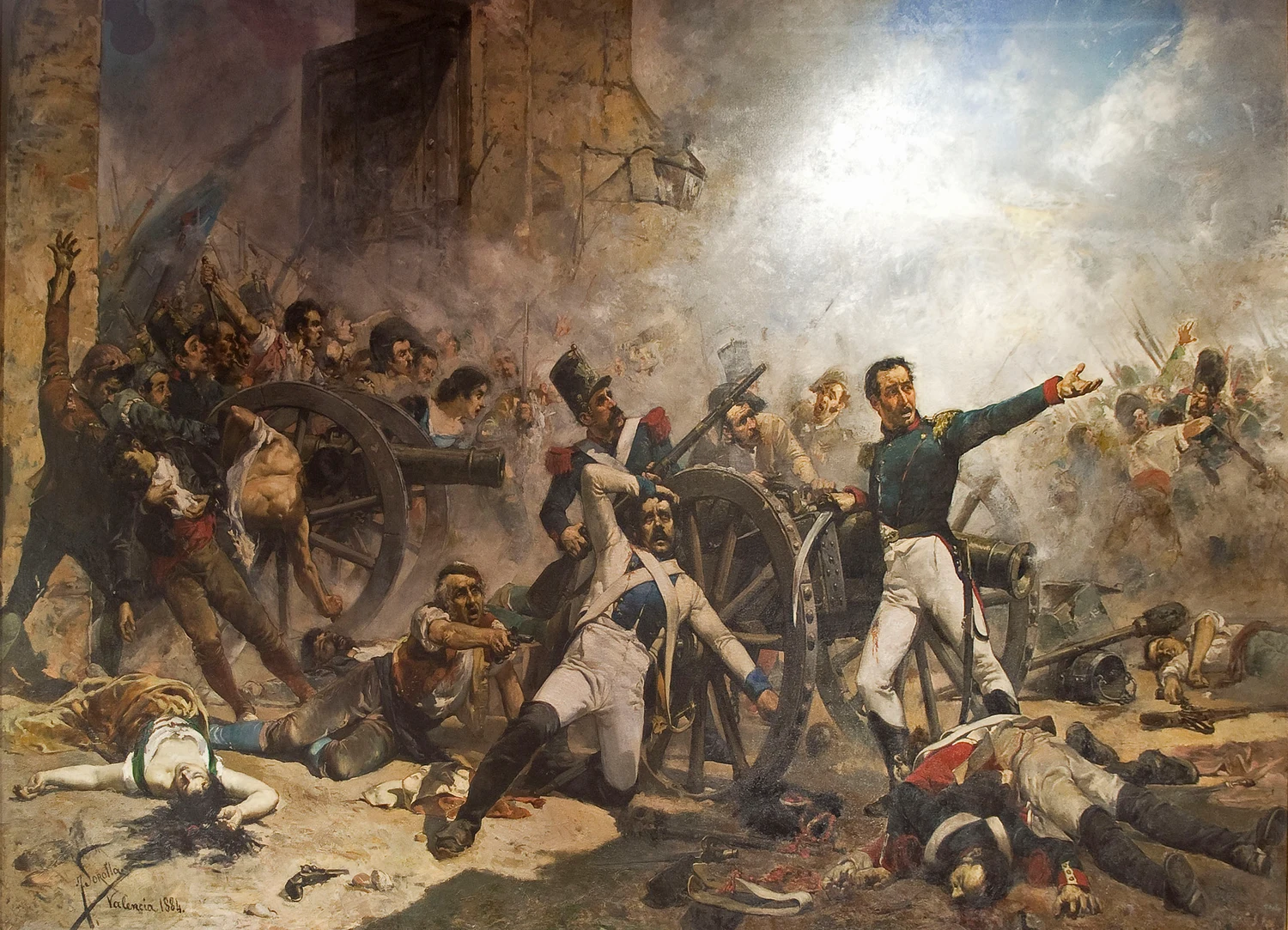
El dos de mayo, painted at twenty on a canvas twelve feet across: smoke, a dying artillery officer, and every device the Valencia academy could teach. He set the scene up in the open bull ring of his own town and had the models stand in real smoke, because even here he would not build the light indoors.
Joaquín Sorolla, El dos de mayo (the death of Pedro Velarde at the Monteleón artillery park), 1884, Museo del Prado, on deposit at the Biblioteca Museu Víctor Balaguer, Vilanova i la Geltrú. Public domain, Wikimedia Commons.
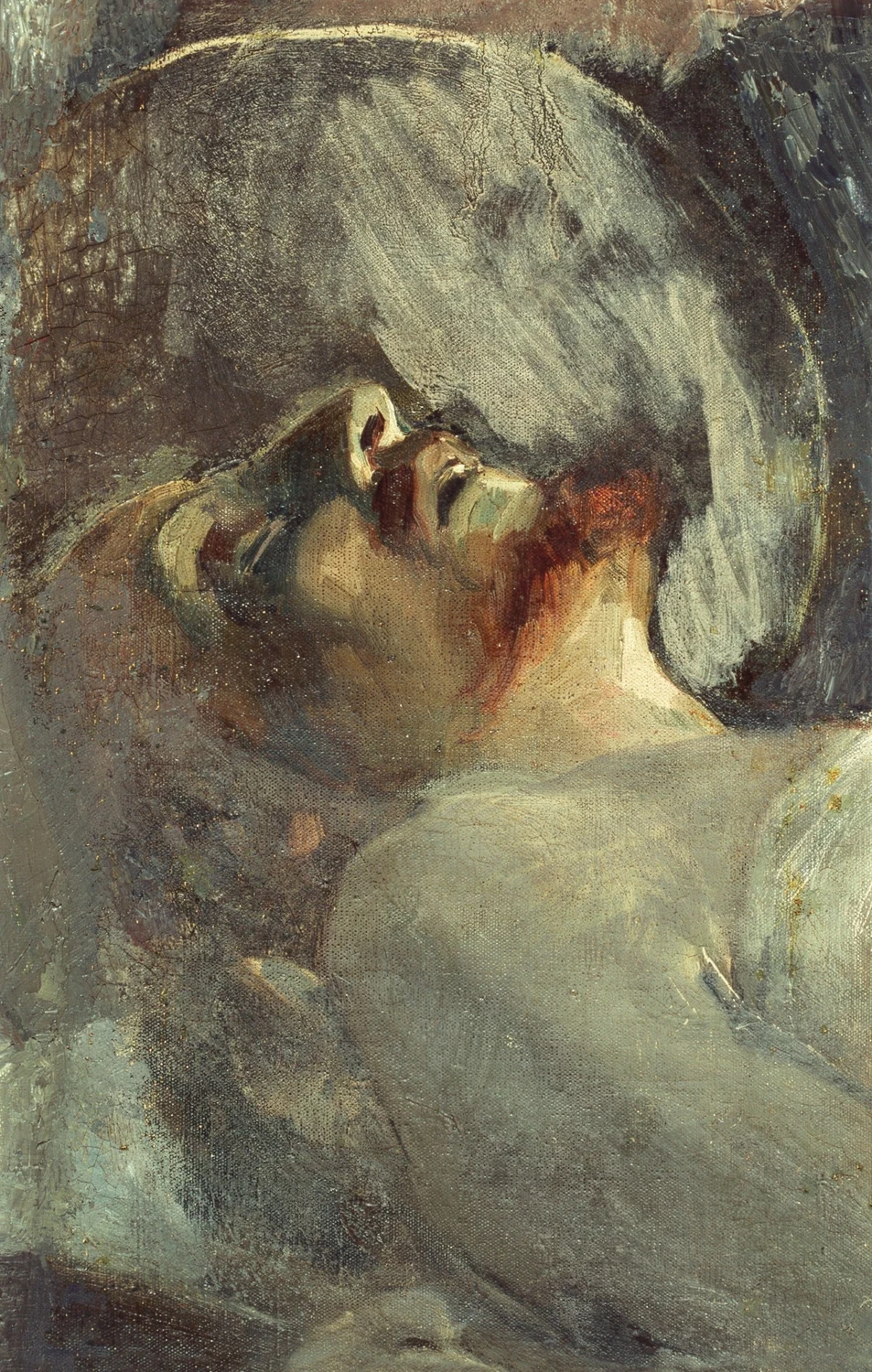
A surviving fragment of El entierro de Cristo, the seven metre canvas he painted in Rome on the Valencia scholarship. It did not bring him the first medal at the 1887 National Exhibition, he gave up on restoring it and left it in the cellars, and when it was taken out on 11 June 1979 only four pieces could be saved. This head is one of them.
Joaquín Sorolla, Fragmento I de El entierro de Cristo (Fragment I of The Burial of Christ), 1885 to 1887, oil on canvas, Museo Sorolla, Madrid, inv. 158. Public domain, Wikimedia Commons.
Source: The forge, the artisans' night school, the San Carlos prizes, the copying after Velázquez and the advice about not copying him: William E. B. Starkweather, Joaquin Sorolla: The Man and His Work, and the Appreciations of the Press, in Eight Essays on Joaquin Sorolla y Bastida, Volumes I and II, The Hispanic Society of America, 1909. The fate of El entierro de Cristo: Museo Sorolla, catalogue record for the surviving fragments.
Up close
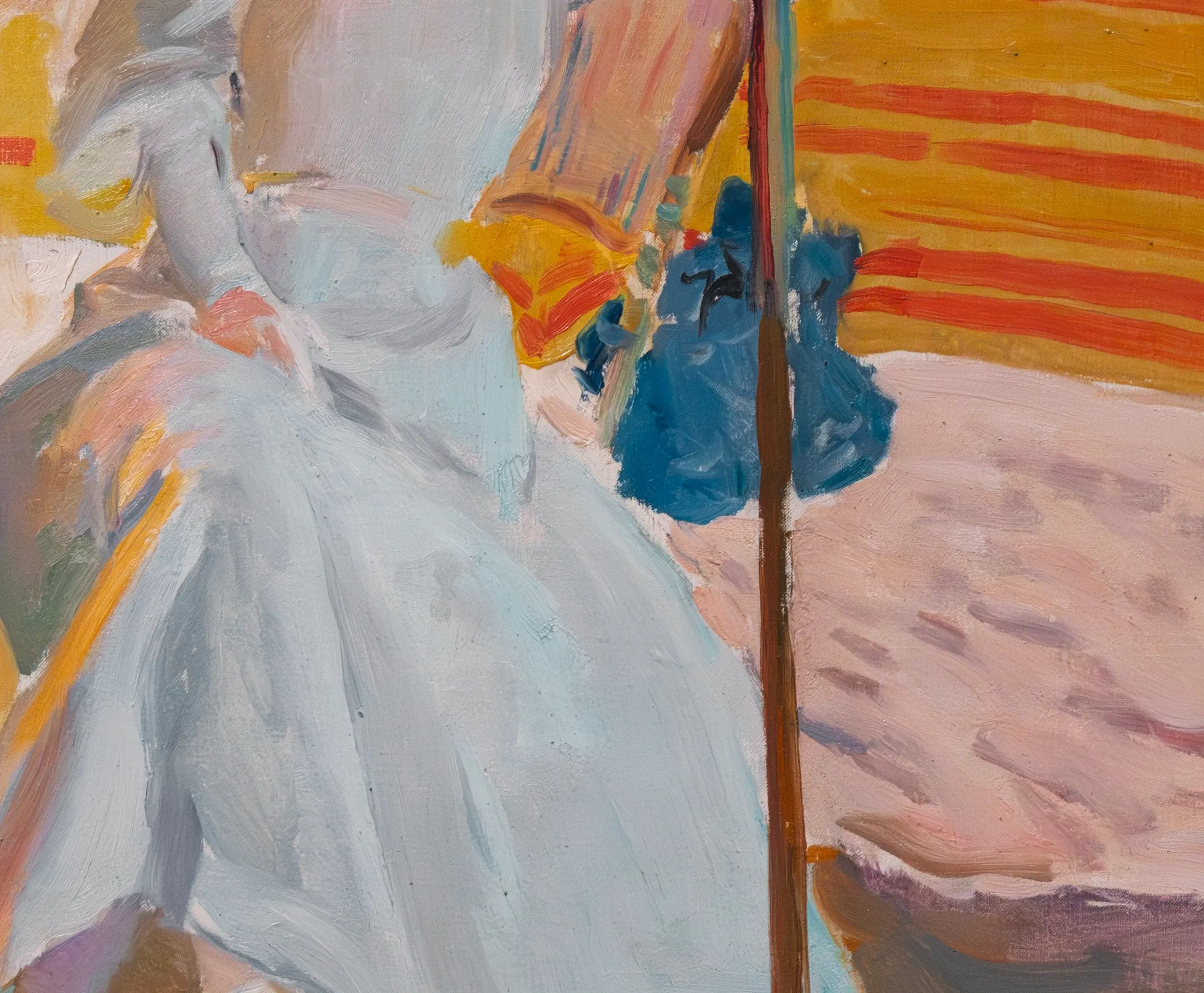
Detail of Clotilde under the awning: the white dress is grey, blue, pink and yellow, and the warm band running down its left edge is the striped awning bouncing back into it. Sorolla said the chocolate brown shadows the old masters painted on the side of a face do not exist. This is what he put there instead.
Joaquín Sorolla, Clotilde under the awning, Biarritz (detail), 1906, oil on canvas, 61 by 92 centimetres, Museo Sorolla, Madrid, Inv. MS 774. Public domain, Wikimedia Commons.
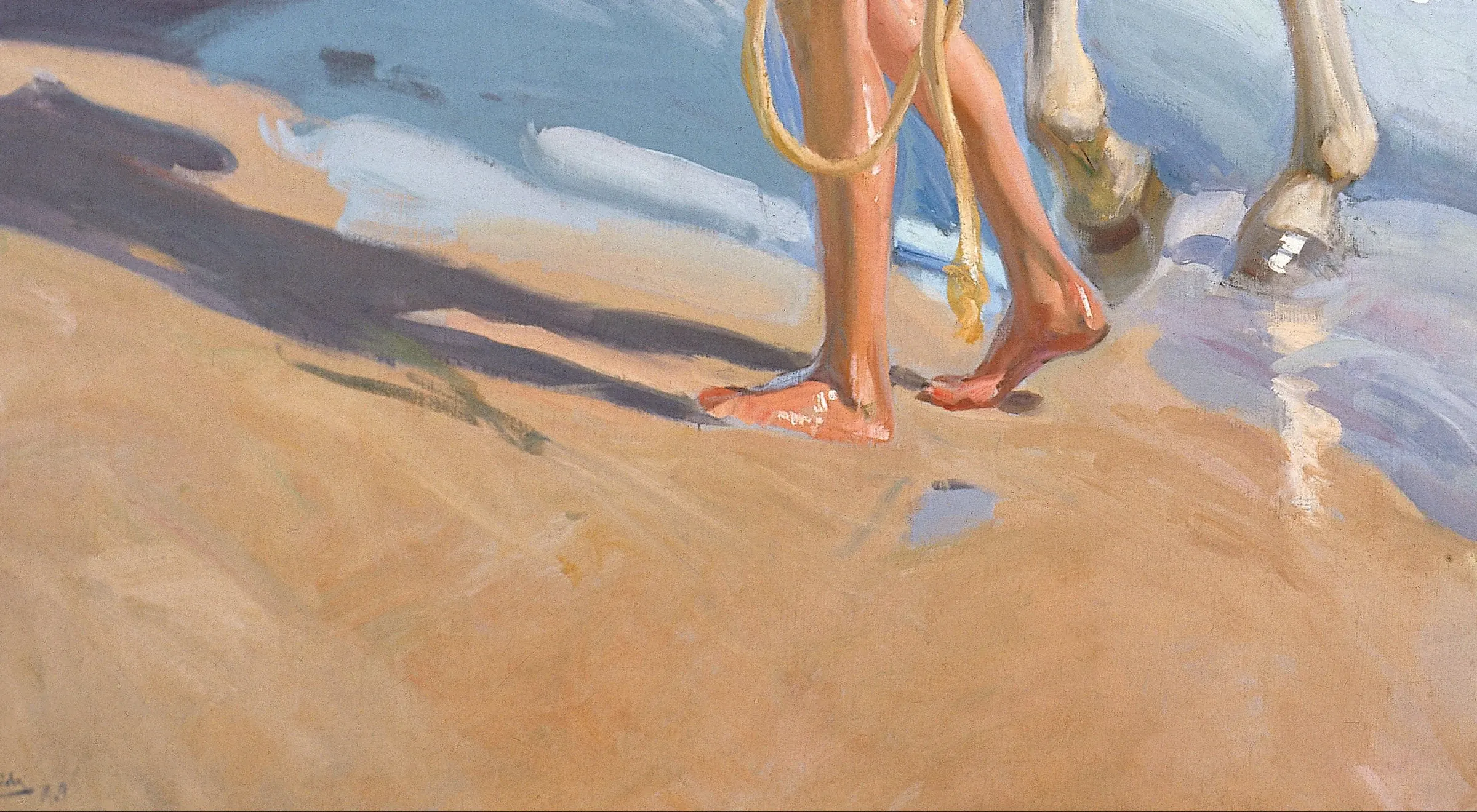
Detail of El baño del caballo at the boy's feet: the reflection is not painted under him, it is painted as its own cool shape lying flat on the wet surface. The long shadow behind is violet and blue and it holds that colour all the way to the edge of the picture.
Joaquín Sorolla, El baño del caballo (detail), 1909, Museo Sorolla, Madrid. Public domain, Wikimedia Commons.
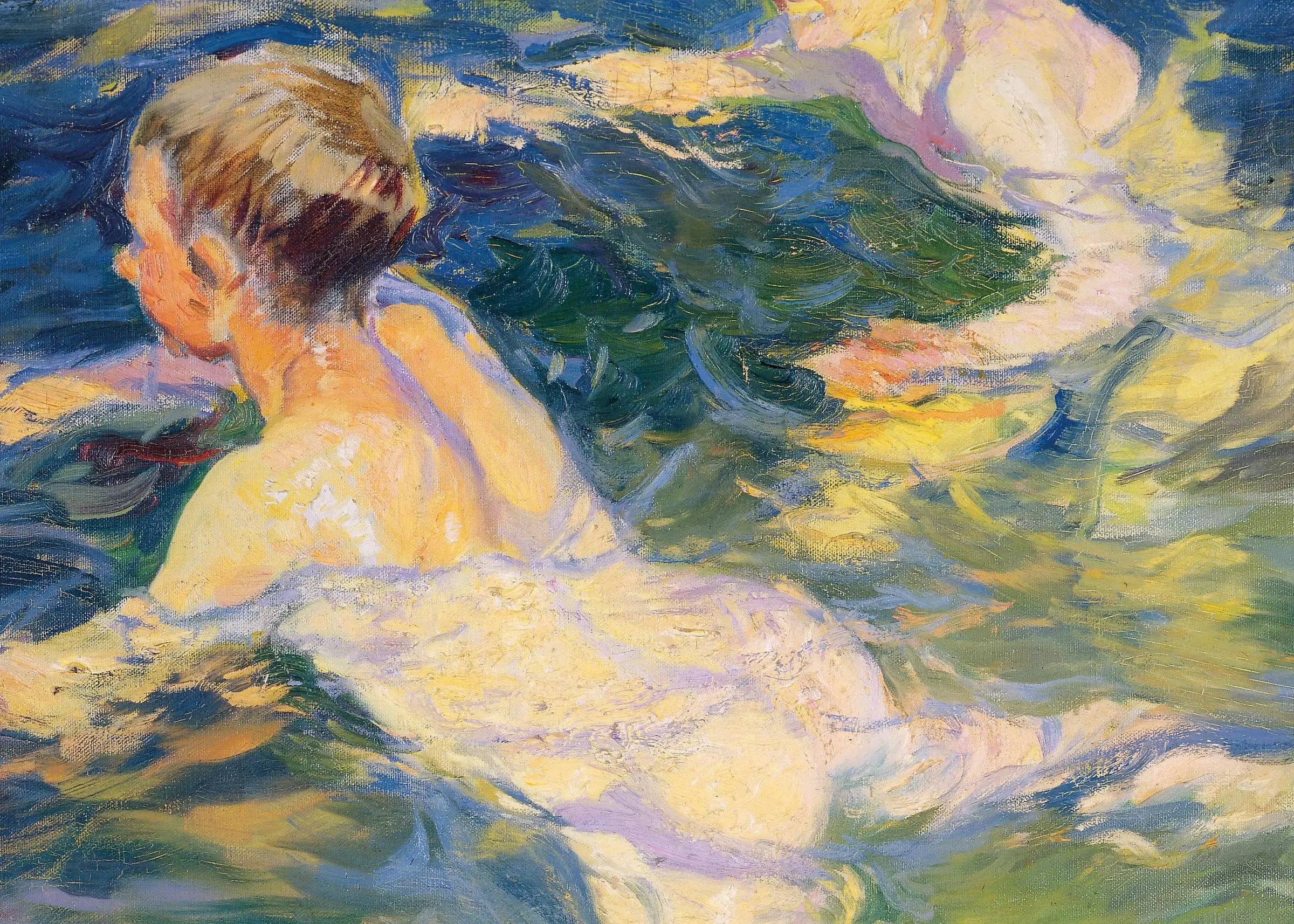
Detail of Nadadores, Jávea: below the surface the boy's back goes green and violet, above it the same skin goes cream and gold, and the join between them is one wet edge. Nothing is glazed. The water is opaque paint dragged across opaque paint.
Joaquín Sorolla, Nadadores, Jávea (Swimmers, Jávea) (detail), 1905, Museo Sorolla, Madrid. Public domain, Wikimedia Commons.
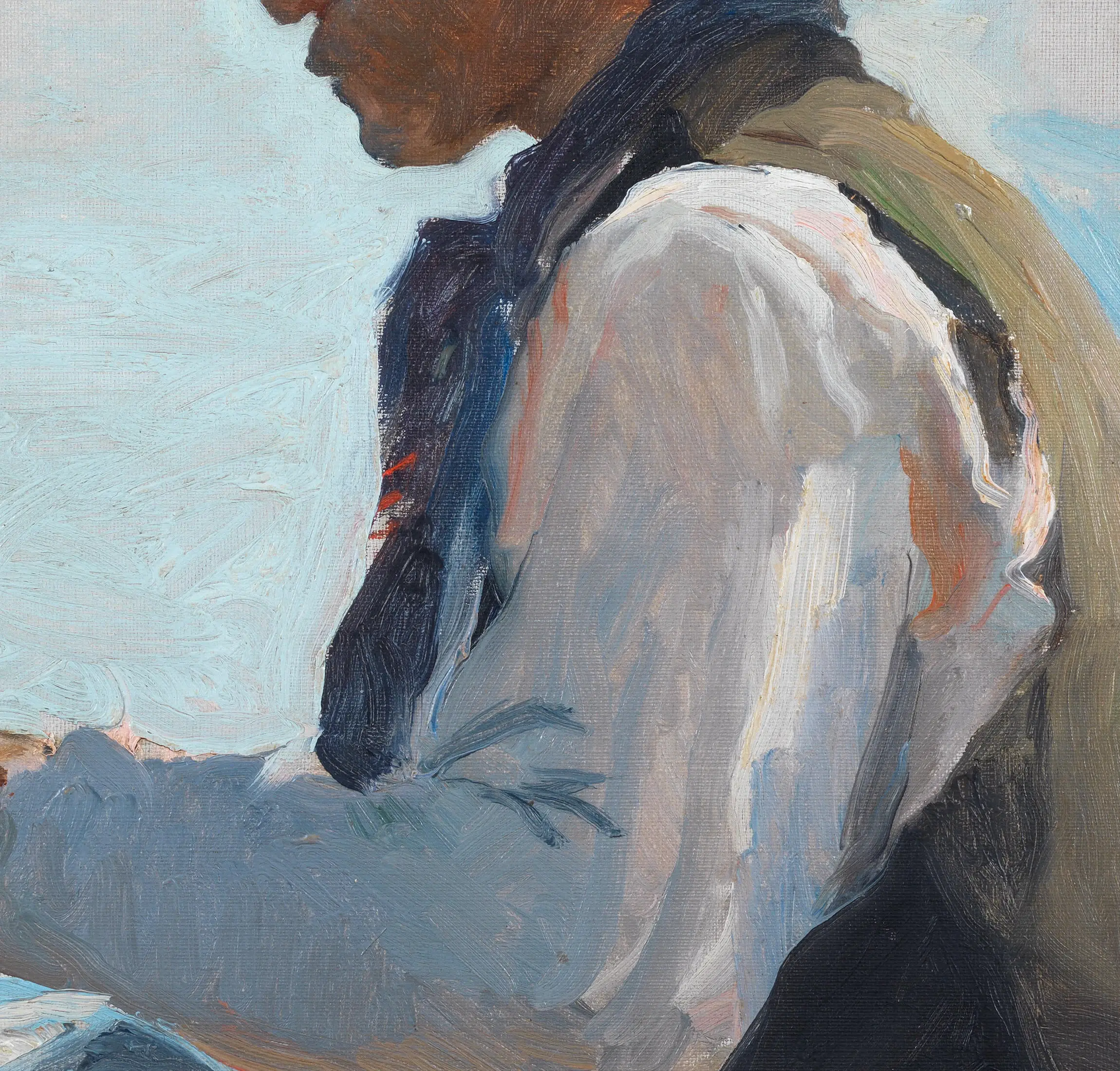
Detail of a study for La vuelta de la pesca: the sleeve is four or five strokes, the canvas weave shows straight through the sky beside it, and nothing has been closed up. The finished canvas this fed is four metres wide.
Joaquín Sorolla, Estudio para La vuelta de la pesca (detail), oil on canvas, 66.3 by 45.5 centimetres, private collection. Public domain, Wikimedia Commons.
Watching him work
“Two little girls and a boy waded into the water hand in hand, laughing, making no particular effort to stand still. They were, indeed, washed here and there by the waves. Sorolla painted the three wet figures, gleaming in the gold of the setting sun, in fifteen minutes.”
William E. B. Starkweather, an American painter who worked beside him on the Valencia beach, William E. B. Starkweather, Joaquin Sorolla: The Man and His Work, in Eight Essays on Joaquin Sorolla y Bastida, Volume II, The Hispanic Society of America, 1909 [source]
Across media
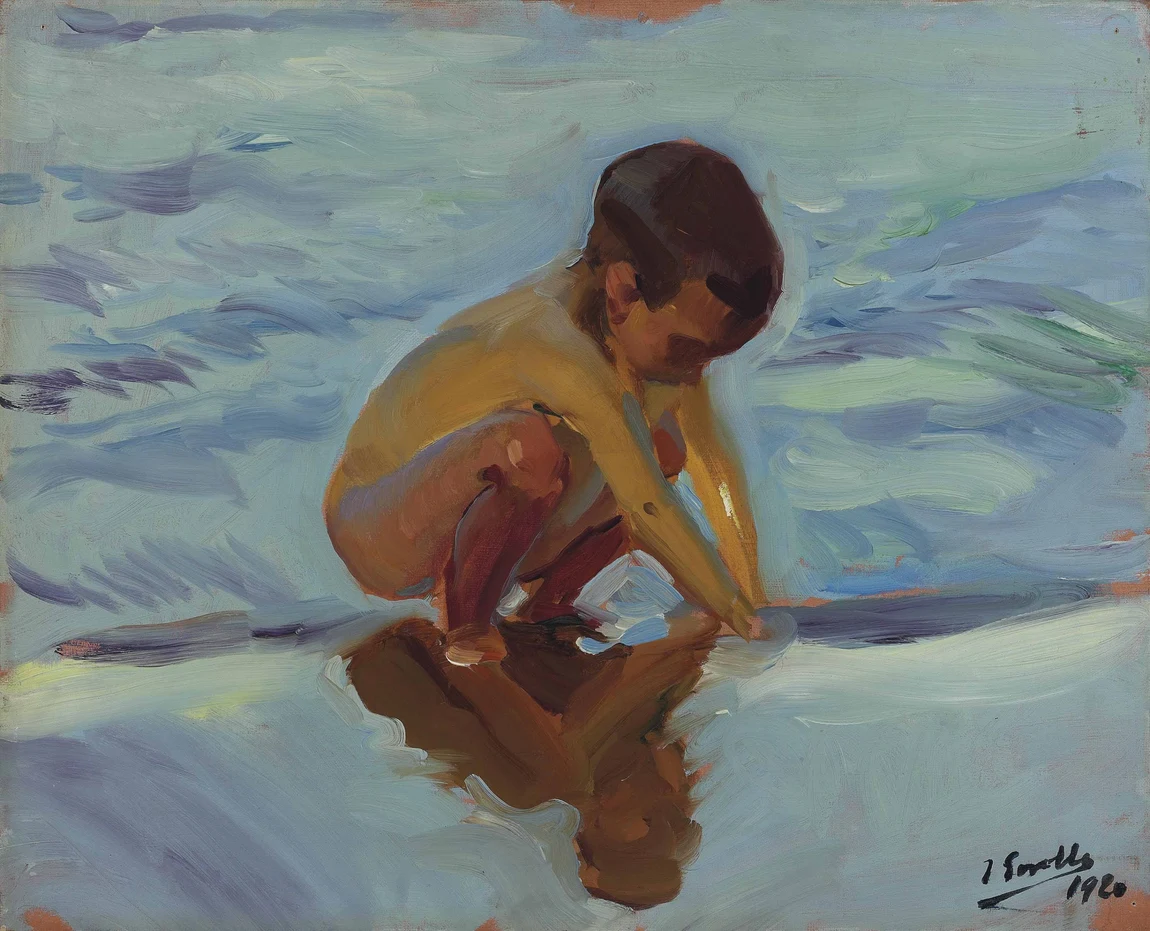
Contraluz en la playa. Niño agachado, 1920, on a canvas under sixty centimetres wide: a boy against the light, his own reflection beneath him, and the sea behind set down in loose horizontal drags. Over a hundred of the three hundred and fifty pictures in his 1909 New York exhibition were small notes of this kind.
Joaquín Sorolla, Contraluz en la playa. Niño agachado, 1920, oil on canvas, 47 by 57.8 centimetres, private collection. Public domain, Wikimedia Commons.
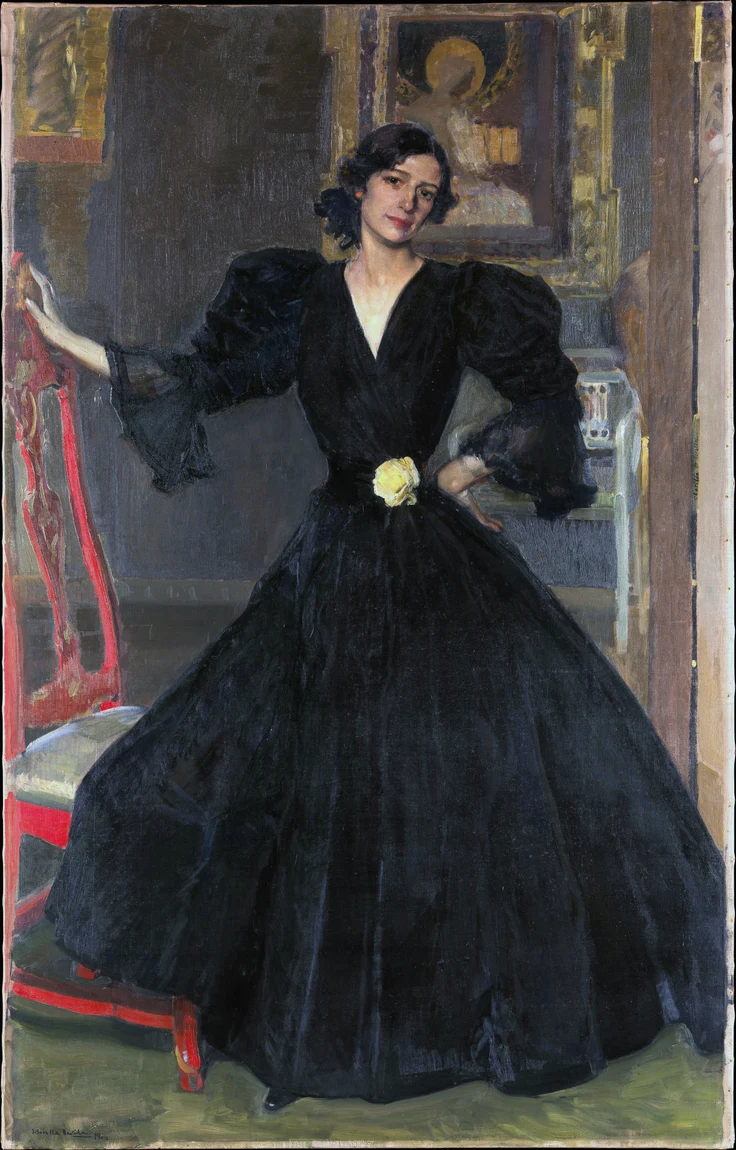
Señora de Sorolla in black, 1906: the other Sorolla, indoors, with the sun shut out and the whole picture carried on one black dress in a dim room. He rated it among his best work. The Metropolitan Museum bought it off the wall of the 1909 New York exhibition.
Joaquín Sorolla, Clotilde García del Castillo in Black (Señora de Sorolla), 1906, The Metropolitan Museum of Art, New York. Public domain, Wikimedia Commons.
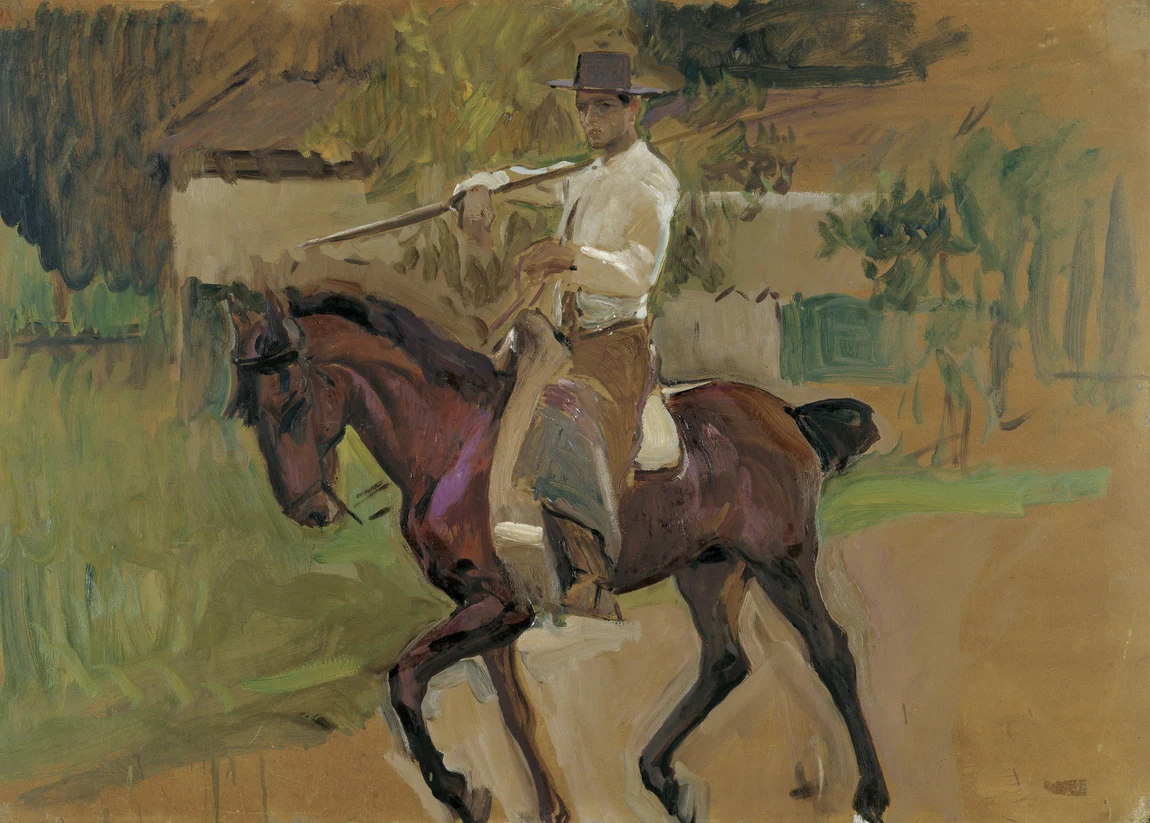
Garrochista, Sevilla, 1914: one of seven studies of horsemen made for the Andalusian panel of the Hispanic Society commission. It is oil thinned with turpentine on cardboard, and the brown of the cardboard is left doing the work of the road, the field and most of the background.
Joaquín Sorolla, Garrochista. Sevilla, 1914, oil on cardboard, 75 by 105 centimetres, Colección Carmen Thyssen-Bornemisza, on loan to the Museo Carmen Thyssen Málaga. Public domain, Wikimedia Commons.
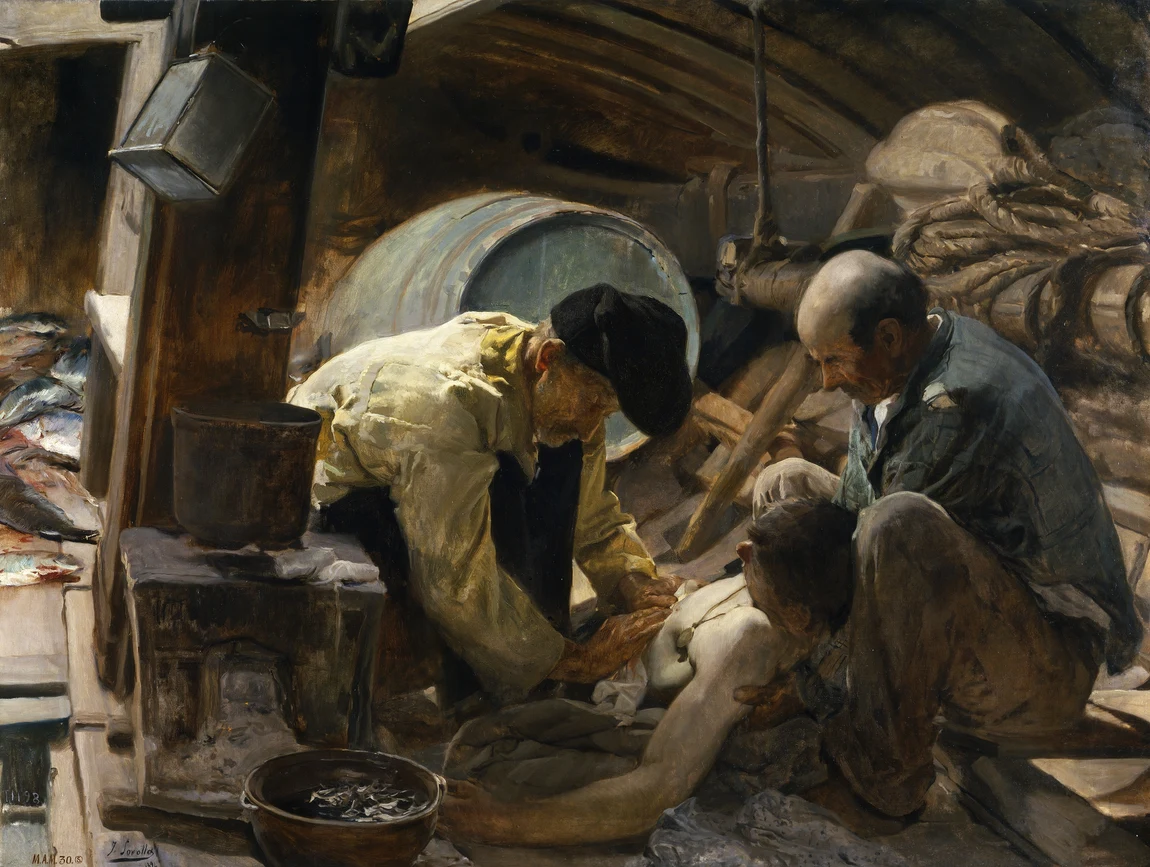
Aún dicen que el pescado es caro, 1894: the Valencia years before the sun. Two old fishermen work on a boy hurt at sea, inside the hull, by lamp light, in browns and greys. He was thirty one, and there is not a violet shadow anywhere in it.
Joaquín Sorolla, Aún dicen que el pescado es caro (And They Still Say Fish Is Expensive), 1894, oil on canvas, 151.5 by 204 centimetres, Museo del Prado, Madrid, P04649. Public domain, Wikimedia Commons.
The record, deeper
The money
The first picture he sold, a landscape, brought seven pesetas, about a dollar and forty cents at the time. In the same years he painted small portrait heads at a dollar apiece.
William E. B. Starkweather, Joaquin Sorolla: The Man and His Work, in Eight Essays on Joaquin Sorolla y Bastida, Volume II, The Hispanic Society of America, 1909.
The Metropolitan Museum bought Señora de Sorolla in black off the wall of the 1909 Hispanic Society exhibition in New York. That show ran from 4 February to 9 March and 160,000 people went through it, 29,461 of them on the last Sunday alone.
The Evening Post, 9 March 1909, in the Appreciations of the Press, Eight Essays Volume II; and the Metropolitan Museum of Art provenance record for the painting.
Archer Milton Huntington commissioned the fourteen Vision of Spain panels in 1911. They stand nearly twelve feet high, run about two hundred feet in combined length, and were painted at locations across Spain between 1912 and 1919. They were not inaugurated in New York until 1926, three years after he died. The fee is widely quoted at 150,000 dollars, but no named source we could fetch carries the figure, so it is not stated here.
Hispanic Society Museum and Library, Sorolla's Vision of Spain.
The reworks
The largest picture of his youth was a Burial of Christ nearly seven metres long, worked on between 1885 and 1887. It went to the National Exhibition in Madrid in 1887 and did not bring him the first medal he was after. He tried to restore it, then left it in the cellars. When it was taken out and examined on 11 June 1979 the state of it allowed only four fragments to be saved.
Museo Sorolla, catalogue record for the fragments of El entierro de Cristo.
Painters who watched him said he did not correct. The Evening Post printed it in February 1909 on the authority of an artist who had painted beside him, in that artist's own phrase, that he paints with the hand of God. Starkweather, who had also painted beside him, put it more carefully: there seems to be no mistake, no undoing. Then he added the working number. Most of the pictures took four to six mornings, many took one or two.
The Evening Post, 5 February 1909, and Starkweather, in Eight Essays Volume II, 1909.
What they told students
On a pupil's study, and on not deciding the picture in advance: This looks fixed up, as if you had an idea before you started of what you would make of the scene. Go to nature with no parti pris. You should not know what your picture is to look like until it is done.
Starkweather, Eight Essays Volume II, 1909, page 88.
On copying Velázquez, which he had done himself as a young man and told students not to do: Go to him and study, reverence him, but do not copy him. It would be of more value to you to put up a basket of oranges and paint them than to repeat Las Meninas.
Starkweather, Eight Essays Volume II, 1909.
On the single stroke: Twice in your life you might, through happy accident, arrive at painting a nose with a single stroke of the brush. Chasing that afterwards he called the maddest folly, because the height reached was accidental. When an artist begins to count strokes instead of regarding nature he is lost.
Starkweather, Eight Essays Volume II, 1909, page 39.
A student said he had got fairly far in drawing and in the technic of painting, but found it hard to watch for fine quality while working from nature. Ah, that is the last thing one arrives at, Sorolla said. Then he tapped his forehead. It is here you do it.
Starkweather, Eight Essays Volume II, 1909.
The question he put to students over and over, even to ones he knew left no hour unoccupied, was: Have you worked?
Starkweather, Eight Essays Volume II, 1909.
The studio
Nine o'clock found him at work on the beach. He worked standing, at the water's edge, with the models often in the wash of the sea. The Mediterranean is practically tideless, so he could work beside it all morning without moving.
Starkweather, Eight Essays Volume II, 1909, page 81.
Behind him stood a large piece of canvas stretched on poles and painted black, to keep reflections off the picture and to screen him from onlookers. Pepe, a Valencian fisherman, carried the canvases on his head, cleaned the palettes and found the models. Pepe posed, and so did Pepe's children.
Starkweather, Eight Essays Volume II, 1909, page 81.
The wind off the sea made a sun umbrella impossible to keep up, so there was no shade at all. He painted through it all day and every day of the summer, and after six and a half hours would sometimes start another study by the sea at five and work until sunset. He had been doing it for twenty five years.
Starkweather, Eight Essays Volume II, 1909.
For one large Jávea canvas the composition was scrawled in charcoal on the side of his house while the servants stretched the linen. The stretcher was then tied with ropes to posts set on a ledge of rock that had been chiselled flat for the purpose. Six boys worked in relays, three swimming round and round while three warmed themselves in the sun. He made several studies first, then painted the big canvas in four afternoons.
Starkweather, Eight Essays Volume II, 1909.
The Madrid house was his own project. He bought the plot in 1905, commissioned the architect Enrique María de Repullés y Vargas in 1909 on the strength of the American exhibitions, and moved the family in before the end of 1911. The ground floor is three studios with high ceilings, overhead light and their own door to the garden. He laid the garden out himself and chose the plants, and it became the subject of much of his late work. Clotilde left the house to the State in her will of 1925 and it opened as the Museo Sorolla in 1932.
Museo Sorolla, Ministerio de Cultura, The Building and History.
What he thought of studios, said at Jávea: as far as outdoor work is concerned, a studio is only a garage, a place in which to store pictures and repair them, never a place in which to paint them.
Starkweather, Eight Essays Volume II, 1909, page 106.
The materials
For outdoor work he had cleared the palette of the earthy and opaque colours painters used for shadow. Aureliano de Beruete, a painter himself, described what took their place: a great variety of blues and violets balanced and juxtaposed with reds and yellows, and with these and the skilful use of white a colour scheme of great simplicity.
Starkweather, Eight Essays Volume II, 1909; Beruete quoted in Leonard Williams, The Art of Joaquin Sorolla, Eight Essays Volume I, 1909.
In his own words on the old masters: the chocolate brown shadows which they painted on the side of a face, for example, do not exist. With all its excesses, the modern impressionistic movement has given us one discovery, the color violet.
Starkweather, Eight Essays Volume II, 1909, page 40.
In the poor years he painted on the coarse back of the canvas instead of the smoother prepared side, so the picture would carry the tooth of a heavier and more expensive canvas than he could afford.
Starkweather, Eight Essays Volume II, 1909.
On what the scale costs: the great difficulty with large canvases is that they should by right be painted as fast as a sketch. By speed only can you gain an appearance of fleeting effect. But to paint a three yard canvas with the same despatch as one of ten inches is well nigh impossible.
Starkweather, Eight Essays Volume II, 1909, page 39.
The Garrochista study of 1914 is oil thinned with turpentine on cardboard, with the cardboard's own colour left showing through the composition. It is one of seven studies of cattle drivers and horsemen made for the Andalusian panel of the Hispanic Society commission.
Museo Carmen Thyssen Málaga, catalogue entry for Garrochista, Sevilla.
Refusals — what they would not do
Refused indoor reconstruction of outdoor subjects — the studio was a garage.
Refused mediums during painting — pure tube oil only.
Refused black for shadows — used violet, blue, green.
Refused to bring every inch to the same level of finish.
Refused to start a new session under different light than the previous one.
Reference
Primary source
Direct observation in the actual light of the subject — beach paintings on the beach, garden paintings in the garden, portraits in the Madrid studio under a controlled window.
Photography
Used as a secondary tool for capturing frozen motion of water and the postures of children running through waves. Explicit about its limits — the camera gave mechanical information about a specific instant; the painting was built from sustained observation of the whole moving scene.
Exceptions
Vision of Spain commission — fourteen enormous canvases for the Hispanic Society of America. Travelled with a team for eight years, painting on site in each province rather than assembling panels from studio studies in Madrid.
Academy of San Carlos, Valencia · from 1878 — Foundational training in academic Spanish social realism — dark, narrative, tightly resolved.
Rome (scholarship) · 1884 — Brief study period in Rome on a scholarship.
Paris · 1885 — Saw the work of Bastien-Lepage and the French naturalists. The shift toward sun-flooded plein-air method began here.
Influences
Bastien-Lepage and the French naturalists.
The Mediterranean light itself — a conscious rejection of "brown painting" in favour of what the actual sun was showing him.
Students
Maintained no formal atelier. Influence ran through massive international exhibitions — the 1909 Hispanic Society show in New York brought 195,000 visitors — and through the students and admirers who studied his technique at the Museo Sorolla after his death.
His method has become foundational for twentieth and twenty-first century plein-air painting, particularly in the United States, where his commitment to painting outdoor light directly has been absorbed by generations of landscape and figure painters in the alla-prima tradition.
In their own words
“The studio is a garage.”
— Joaquín Sorolla, Recorded remark, Museo Sorolla archive
On why he painted outdoors whenever he could.
“I could not paint slowly if my life depended on it. Every effect is so transient, it must be rapidly painted.”
— Joaquín Sorolla, Letter to Clotilde Garcia del Castillo
“Go to nature with no parti pris. You must not know in advance what your picture is going to look like. Paint what you see.”
— Joaquín Sorolla, Recorded instruction to a student
“There is no black in nature. Shadow is color — violet, blue, green — never the absence of light.”
— Joaquín Sorolla, Letter to Clotilde, on Valencian beach painting
Lead white, yellow ochre, cobalt violet, rose madder, cadmium reds, cadmium orange, cadmium yellows, chrome green, viridian, Prussian blue, cobalt blue, and French ultramarine. He painted in pure tube oil with a small amount of turpentine in the block-in only, the same no-medium discipline as Sargent and Zorn. A 2015 technical analysis by the Institute of Materials Science of Valencia confirmed the cadmium-heavy chromatic palette and the thick-lights, thin-darks layer structure.
What painting technique is Sorolla known for?
Monumental plein-air painting in direct oil, at the speed the light demanded. He carried canvases up to three yards across onto the beach and stretched them on site, with assistants holding the stretcher and ropes and stakes bracing it against the wind. He painted the transient Mediterranean sun in pure tube color, thick where the sun hit and thin in the shadows. He wrote that he could not paint slowly if his life depended on it; every effect was so transient it had to be rapidly painted.
Who taught Sorolla, and whom did he teach?
Sorolla trained at the Academy of San Carlos in Valencia from 1878, in academic Spanish social realism, dark, narrative, and tightly resolved. A scholarship took him to Rome in 1884, and in Paris in 1885 he saw Bastien-Lepage and the French naturalists, which began the shift toward his sun-flooded plein-air method. He maintained no formal atelier. His influence ran through massive international exhibitions (the 1909 Hispanic Society show in New York brought 195,000 visitors), and his method has become foundational for plein-air painting in the United States.
How did Sorolla start a painting?
He scouted first, returning to the same Valencian beaches, the same hours, and the same families of fishermen and children year after year, so the subject was decided before the canvas arrived. On site he placed the figures and major shadow shapes in sparse charcoal directly on the canvas, with no elaborate preparatory cartoons. Then he covered the whole canvas in twenty to thirty minutes of turpentine-diluted block-in, establishing the major value masses and the temperature of the light.
What would Sorolla refuse to do?
He refused to reconstruct outdoor subjects indoors; in his words, the studio is a garage. He refused mediums during painting, working in pure tube oil only. He refused black for shadows, refused to bring every inch of a canvas to the same level of finish, and refused to start a new session under different light than the previous one.
What color did Sorolla use for shadows?
Violet, blue, and green, never black. He wrote to his wife Clotilde that there is no black in nature, that shadow is color, never the absence of light, and he named violet as what shadow really is in Mediterranean sunlight. He kept those shadow passages thin and transparent while loading the sunlit areas with thick opaque paint.
If this painter is your match
You believe the painting is made in the conditions of its subject, not reconstructed afterward. The light at 4 p.m. on a specific beach in July is what the painting is about, and the painting has to be made in that light, at that time, or it will not carry the thing that made you want to paint it.
Borrow this: Pick a subject you can only paint for one hour a day — a specific light, a specific tide, a specific interior at a specific time. Paint it across as many consecutive days as you need. Do not try to finish it in one session and do not try to reconstruct it from memory later. Work only in that one hour.
Museo Sorolla Archive, Madrid. Sorolla's home, studio, palettes, easels, and the full correspondence with Clotilde Garcia del Castillo. Established by his widow and daughter as a museum after his death.
Joaquín Sorolla and Clotilde Garcia del Castillo, Epistolario (Correspondence). Multi-decade correspondence between Sorolla and his wife. The primary first-person record of his daily working method.
Blanca Pons-Sorolla, Joaquín Sorolla y Bastida: Catálogo Razonado, 2019. Definitive modern catalogue raisonné, compiled by Sorolla's great-granddaughter.
Institute of Materials Science of Valencia, Technical Analysis of Sorolla's Palette and Materials, 2015. XRF and cross-section studies identifying the cadmium-heavy chromatic palette and confirming the thick-lights / thin-darks layer structure.
William E. B. Starkweather, Joaquin Sorolla: The Man and His Work, in Eight Essays on Joaquin Sorolla y Bastida, Volume II, The Hispanic Society of America, 1909. Starkweather was an American painter who worked beside Sorolla on the beach at Valencia. The fullest first-hand account in English of the working day: the nine o'clock start at the water's edge, the black canvas screen on poles, Pepe the fisherman who carried the canvases on his head, the three children painted in fifteen minutes, four to six mornings a picture, the seven pesetas, the coarse back of the cheap canvas, the Javea rope rig, the studio-as-garage line, and the advice about not copying Velazquez. The same volume carries the Appreciations of the Press, the source for the 1909 exhibition attendance and the count of small sketches in the show.[link]
Aureliano de Beruete and Leonard Williams, in Eight Essays on Joaquin Sorolla y Bastida, Volume I, The Hispanic Society of America, 1909. Beruete was a painter and the Spanish authority on Velazquez. His description of the palette, quoted by Leonard Williams, is the period evidence for the banished blacks and browns and for the blues and violets set against reds and yellows.[link]
Museo Sorolla, Ministerio de Cultura: The Building, and History. The museum's own record of the Madrid house: the 1905 plot, Repulles y Vargas commissioned in 1909, completed 1911, three ground-floor studios with overhead light, the garden Sorolla laid out himself, Clotilde's 1925 will and the 1932 opening.[link]
Museo Carmen Thyssen Málaga, catalogue entry for Garrochista, Sevilla, 1914. Documents the study as oil thinned with turpentine on cardboard with the support left showing, and as one of seven horseman studies for the Andalusian panel of the Hispanic Society commission.