Vermeer painted in a north-lit upstairs room in Delft, building each picture in four phases (inventing, dead-coloring, working-up, glazing) with drying time between layers. He set the perspective with a pin pushed into the central vanishing point and strings run to the edges; the pinholes survive in finished canvases. He likely studied the scene through a camera obscura, which flattened it and showed him the soft beady highlights he transcribed in lead white. Two or three pictures a year was the cost.
Worked at a documented rate of two to three finished paintings a year — slowness that baffled contemporaries. When Balthasar de Monconys called in August 1663 and asked to see work, Vermeer had nothing in the studio to show him; Monconys was sent on to a baker's house to see one.
Why it matters · The slow painting is the cost of the precise one. The pace was the consequence of the working method — small sessions, one passage at a time, with drying periods between layers. Painters who optimize for output produce a different painting.
Balthasar de Monconys, Journal des voyages, entry of 11 August 1663, 1663
Use ultramarine even where you cannot see blue
Mixed natural ultramarine (the most expensive pigment of the period, ground from lapis lazuli) into shadows on white walls, into highlights on black marble floors, and into half-tones of flesh — not just into blue drapery.
Why it matters · The pervasive ultramarine is why Vermeer's paintings read with such specific cool unity. The painter who uses an expensive pigment only where it is named (blue cloth, blue sky) misses the structural use. Painters who restrict expensive pigments to the obvious passages flatten the optical key.
Hermann Kühn, A Study of the Pigments and the Grounds Used by Jan Vermeer, Reports and Studies in the History of Art, National Gallery of Art, Washington; and the Girl in the Spotlight examination, Mauritshuis, 1968
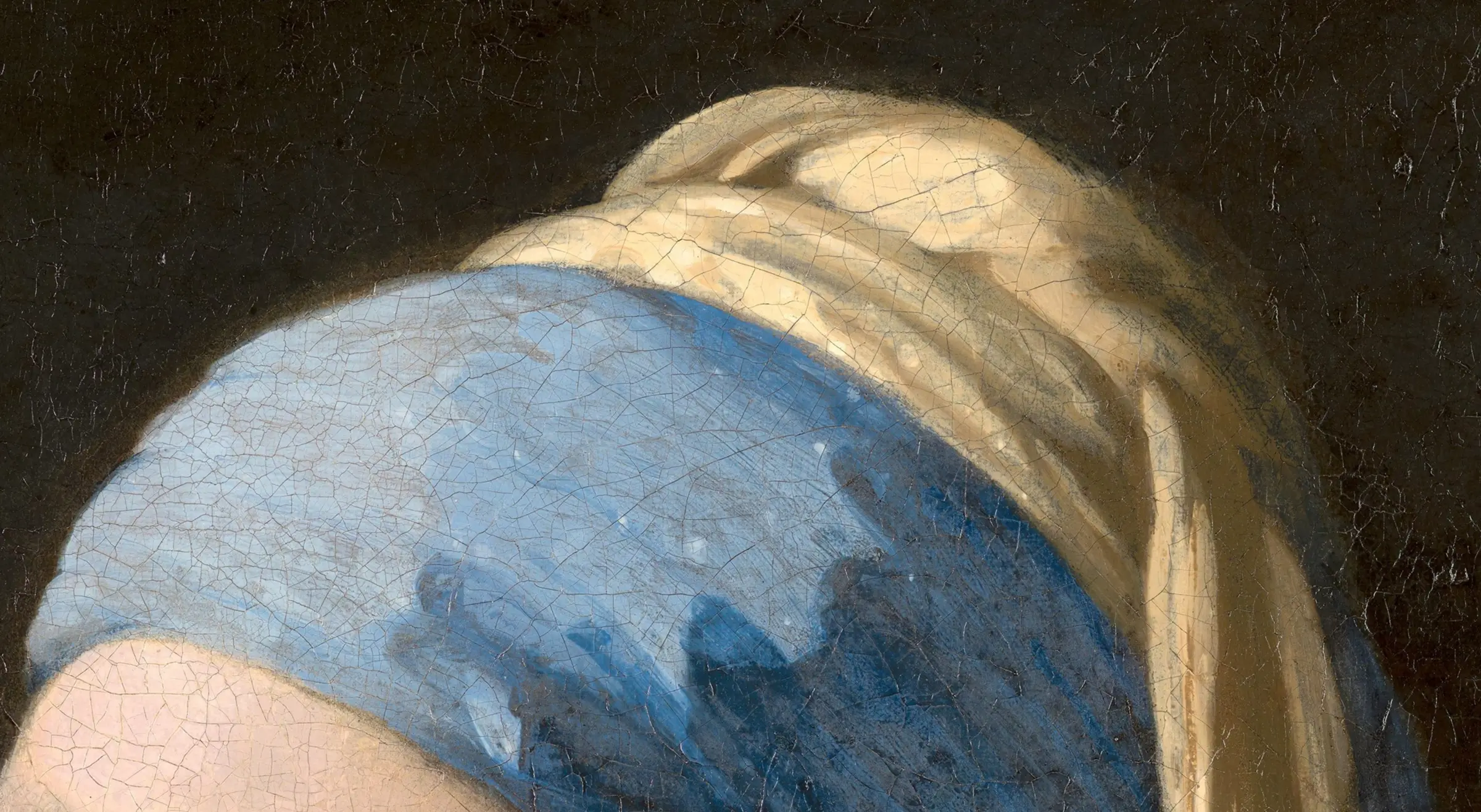
Detail of the headscarf in Girl with a Pearl Earring: the blue is natural ultramarine, ground from lapis lazuli brought out of what is now Afghanistan, and in the seventeenth century it cost more than gold. He did not keep it for the blue cloth. The 2018 examination found it in the scarf and in the jacket, and across his other pictures it turns up mixed into shadows and into whites where nothing blue is named.
Johannes Vermeer, Girl with a Pearl Earring (detail), circa 1665, Mauritshuis, The Hague. Public domain, Wikimedia Commons.
Place beady lead-white pointillé highlights
Applied small circular dots of thick lead white or lead-tin yellow on bread, pearls, brass, or window edges — visible in raking light. The pointillé corresponds to the "circles of confusion" that appear around bright points in early optical lenses.
Why it matters · A painter working from direct observation of a projected image would see and faithfully transcribe these beads. The signature is also a teaching about what light actually does at high contrast — a sharply lit edge dissolves into a beady halo.
The beads themselves are observable across the paintings. The reading of them as the look of a lens image is Philip Steadman, Vermeer's Camera, Oxford University Press, and it remains contested, 2001
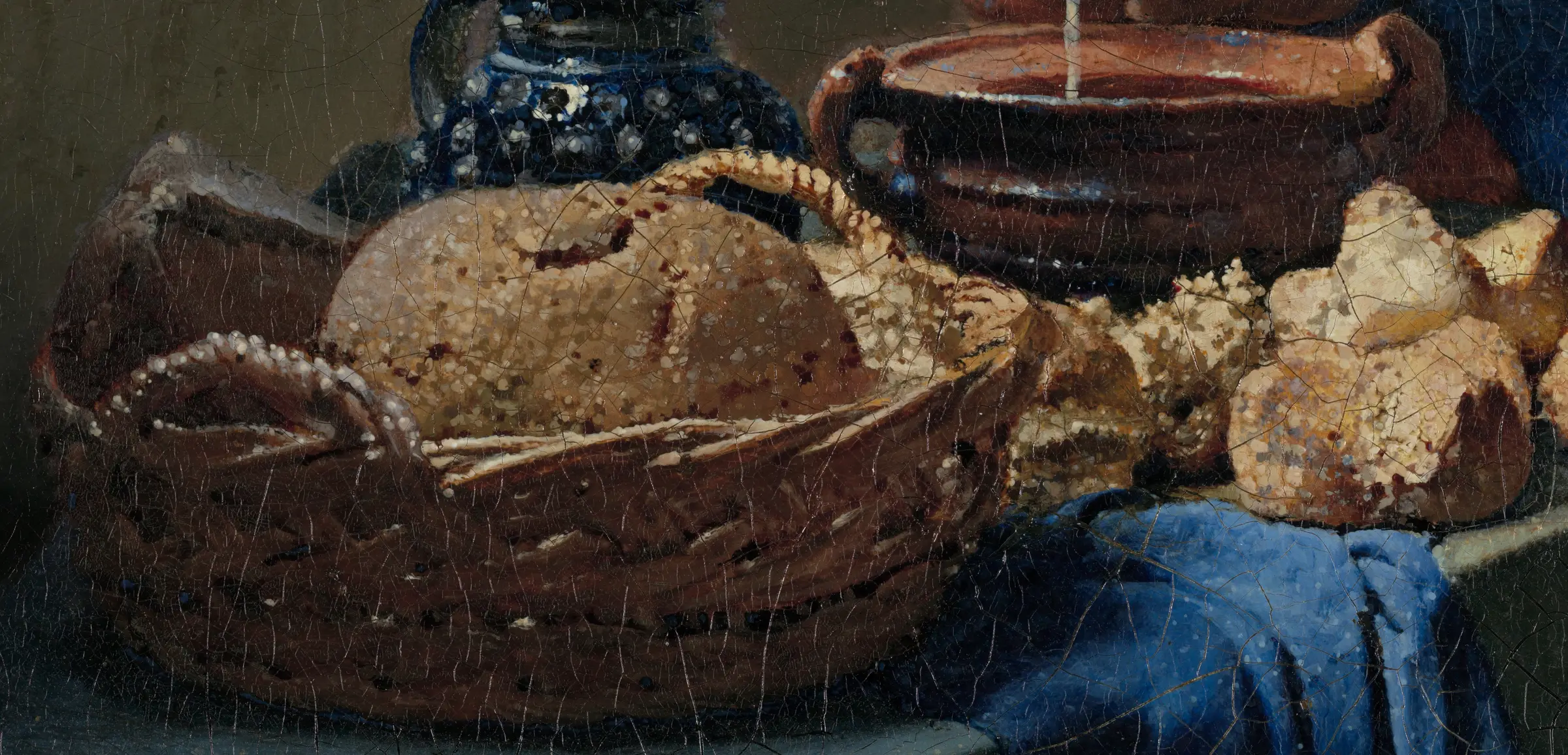
Detail of the bread in The Milkmaid: the crust is built from small round beads of pale paint sitting on top of the dried colour under them, some on the loaf, some on the wicker, some out on the rim of the basket where there is no bread at all. Close up they are dots. From across a room they are crumbs catching the window.
Johannes Vermeer, The Milkmaid (detail), circa 1660, Rijksmuseum, Amsterdam. Public domain, Wikimedia Commons.
Build the perspective with a pin and string
Established compositions on the prepared canvas using a pin-and-string system to locate the central vanishing point. Tiny holes from this pin survive in the paint surface of several finished pictures at precisely the right geometrical positions.
Why it matters · Direct material evidence of how he built his perspectives. Painters who eyeball perspective drift; Vermeer's pin holes are a documented physical instrument. The discipline is to use the simple tool that produces the verifiable result.
Jørgen Wadum, Vermeer in Perspective, in the catalogue of the Johannes Vermeer exhibition, National Gallery of Art, Washington, and the Mauritshuis, The Hague. Wadum found the pinhole at the vanishing point in thirteen paintings, 1995
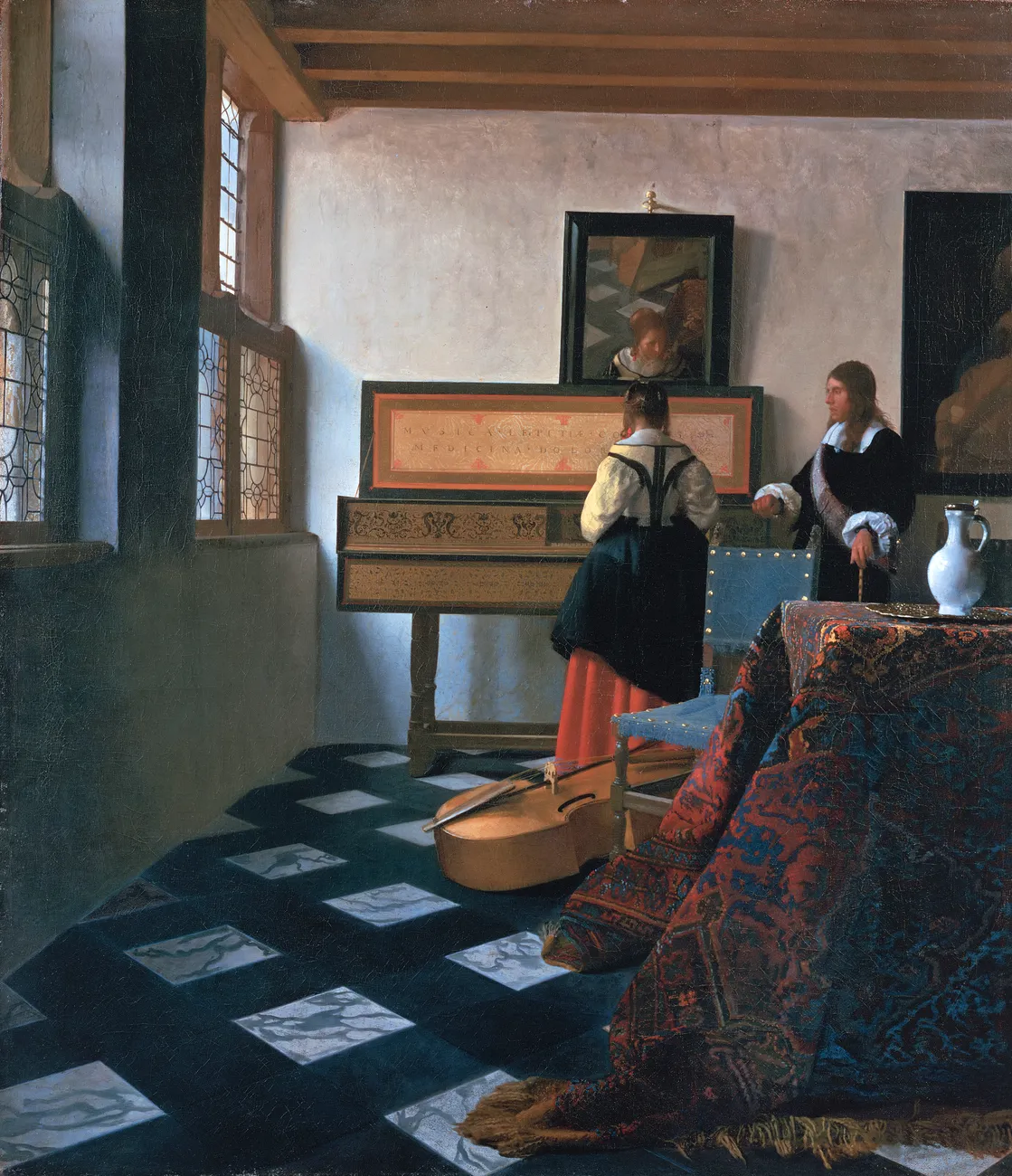
The Music Lesson, a canvas about seventy three centimetres high, in the Royal Collection. Every line running back into the room, the ceiling beams, the window frames, the edges of the floor tiles, meets at one point in the sleeve of the woman at the keyboard. That is where the pin went into the canvas, and the hole is still in the paint.
Johannes Vermeer, Lady at the Virginals with a Gentleman, known as The Music Lesson, circa 1662 to 1664, Royal Collection. Public domain, Wikimedia Commons.
Lay the whole thing in fast, then take things out of it
Scans made at the Rijksmuseum in 2022 found a quick underpainting under the smooth surface of The Milkmaid, including a thick line of black paint put down in a hurry beneath her left arm. The same scans found two objects he painted out, a wooden jug rack on the back wall and a fire basket on the floor.
Why it matters · The finish is not the method. He set the picture down fast in light and dark first, then removed what crowded it, then polished. A painter who tries to start at the level of finish he wants to end on has skipped the stage where the picture is still cheap to change.
Rijksmuseum, Rijksmuseum reveals major discoveries on Vermeer's painting The Milkmaid, 8 September 2022, macro-XRF and RIS scanning, paintings conservator Anna Krekeler, 2022
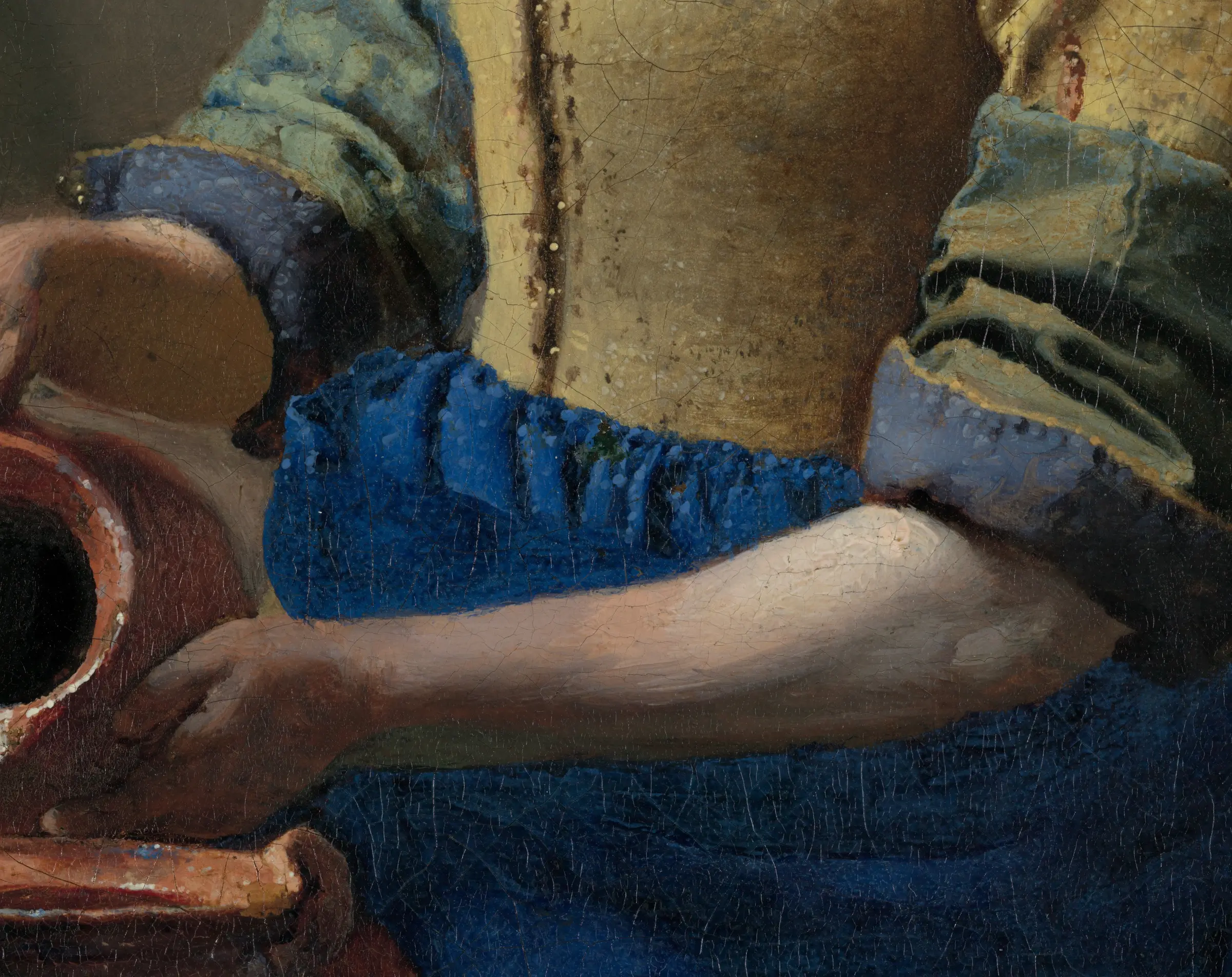
Detail of The Milkmaid at her lower arm: the blue sleeve and the bodice carry rows of small raised beads of paler paint, and the arm below them is one smooth run of warm light with almost no drawing in it. Under her left arm the 2022 scans found a thick line of black paint laid down fast, part of a rough underpainting the finished surface hides completely.
Johannes Vermeer, The Milkmaid (detail), circa 1660, Rijksmuseum, Amsterdam. Public domain, Wikimedia Commons.
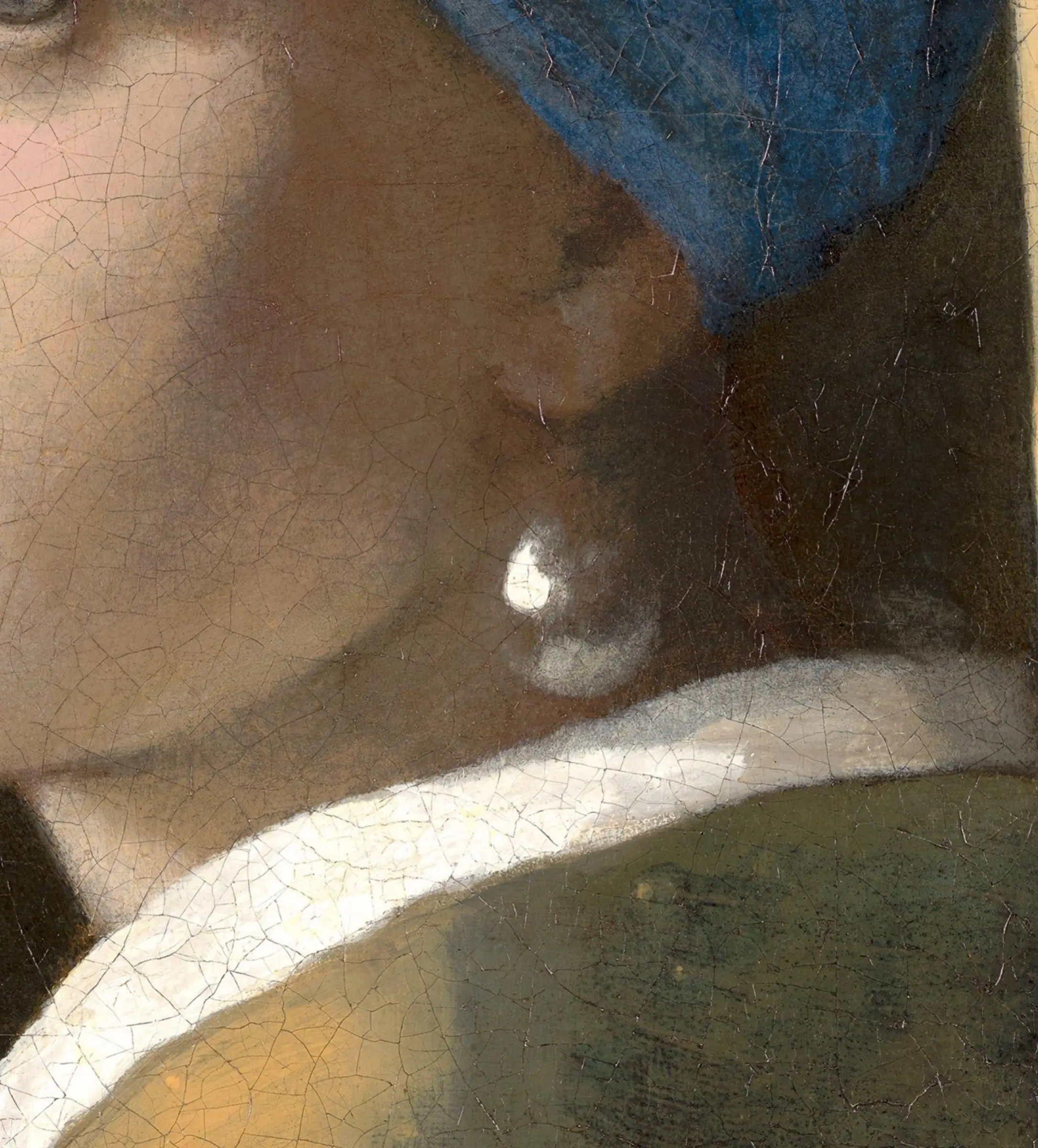
Make a pearl out of two strokes
The pearl in the Mauritshuis picture is two touches of white paint, a soft one low down where the collar reflects up into it and a thicker dab above. There is no hook, no outline and no drawn edge. Nothing attaches it to the ear.
Why it matters · The eye builds an object out of its two brightest facts when the value around them is right. He spent the work on the shadow and the transition, then let the description be two marks. Draw the whole pearl and you get a bead. Place the reflection and the highlight at the right value and you get a pearl.
The Girl in the Spotlight research project, Mauritshuis, examined February and March 2018, published 2020, 2020
Detail of Girl with a Pearl Earring at the ear: the pearl is two marks of white, a thicker one on the upper left and a soft one low down where the white collar throws light back up into it. There is no hook and no drawn outline, and the shadow under the jaw runs straight through where the top of the pearl should be.
Johannes Vermeer, Girl with a Pearl Earring (detail), circa 1665, Mauritshuis, The Hague. Public domain, Wikimedia Commons.
Put green earth in the shadow of a face
Laid a dull green earth into the shadow side of flesh, so the mass shadow of a head goes cool and silvery instead of ruddy. Pigment studies find it in the flesh of several of the late pictures, and no Dutch contemporary of his is known to have done it.
Why it matters · Shadow on skin is not the light colour made darker, it is a different colour. Green sits opposite red, so a green earth over a pink shadow kills the ruddiness without adding black, and the head stays luminous as it turns away from the light. Darken flesh with brown instead and you get leather.
E. Melanie Gifford and Lisha Deming Glinsman, Collective Style and Personal Manner: Materials and Techniques of High-Life Genre Painting, in Vermeer and the Masters of Genre Painting, 2017; and Hermann Kühn, A Study of the Pigments and the Grounds Used by Jan Vermeer, 1968, 2017
Hang a picture on the back wall and let it argue with the scene
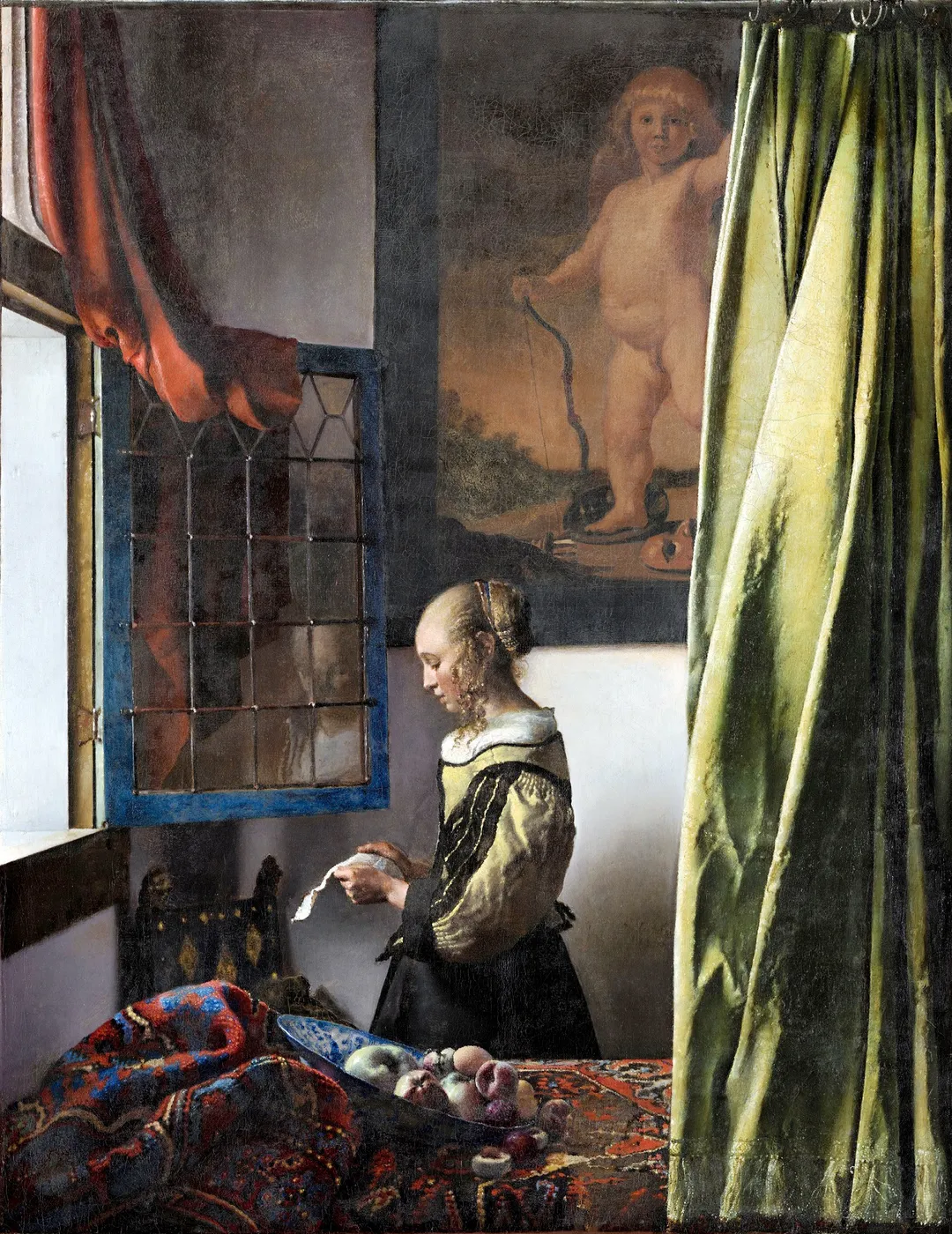
Put paintings inside his paintings and used them as the comment on the figure below. In the Dresden letter picture a large Cupid stands on the back wall behind the girl, under a layer of overpaint that the restoration of 2017 to 2021 established was not his and removed.
Why it matters · The back wall is not background, it is the second half of the sentence. He keeps the figure quiet and puts the meaning behind her, at a distance, so a viewer finds it second. What a picture is about can be placed somewhere other than the subject.
Gemäldegalerie Alte Meister, Dresden, restoration of Girl Reading a Letter at an Open Window, 2017 to 2021, conservators Christoph Schölzel and Uta Neidhardt. A layer of dirt and binding medium between the Cupid and the overpaint showed decades had passed between them, 2021
Girl Reading a Letter at an Open Window after the Dresden restoration: the large Cupid on the back wall had been under overpaint for more than two centuries, and laboratory work showed that overpaint went on decades after Vermeer died. The picture he actually made has the god of love standing over the letter, lit from the same window.
Johannes Vermeer, Girl Reading a Letter at an Open Window, circa 1657 to 1659, Gemäldegalerie Alte Meister, Dresden, photographed after the later overpaint was removed. Public domain, Wikimedia Commons.
Resolve one passage per session before the paint turns
Worked one area at a time — a map, a dress, a wall, a face — completing each section across one or two sessions before moving on. Hand-grinding pigment for a single passage meant the paint on the palette had a short working life.
Why it matters · Materials dictated the working unit. Vermeer's discipline turned the constraint into a method — every passage resolves in its own time rather than everything advancing in lockstep. The opposite of Hals's alla-prima but the same structural logic of working unit-by-unit.
Leave the studio set in place for months
The 1676 inventory identifies recurring props (Spanish chair with lion-head finials, Turkish carpet, blue cloth, set of maps, ebonized picture frames) left in position for weeks or months as the painting developed.
Why it matters · A painter who breaks down the setup at the end of each session restarts the painting every time. Vermeer's permanent studio set is the cleanest case for treating subject preservation as part of the practice.
Catharina Bolnes, Inventory of the Vermeer household, February 29, 1676, 1676
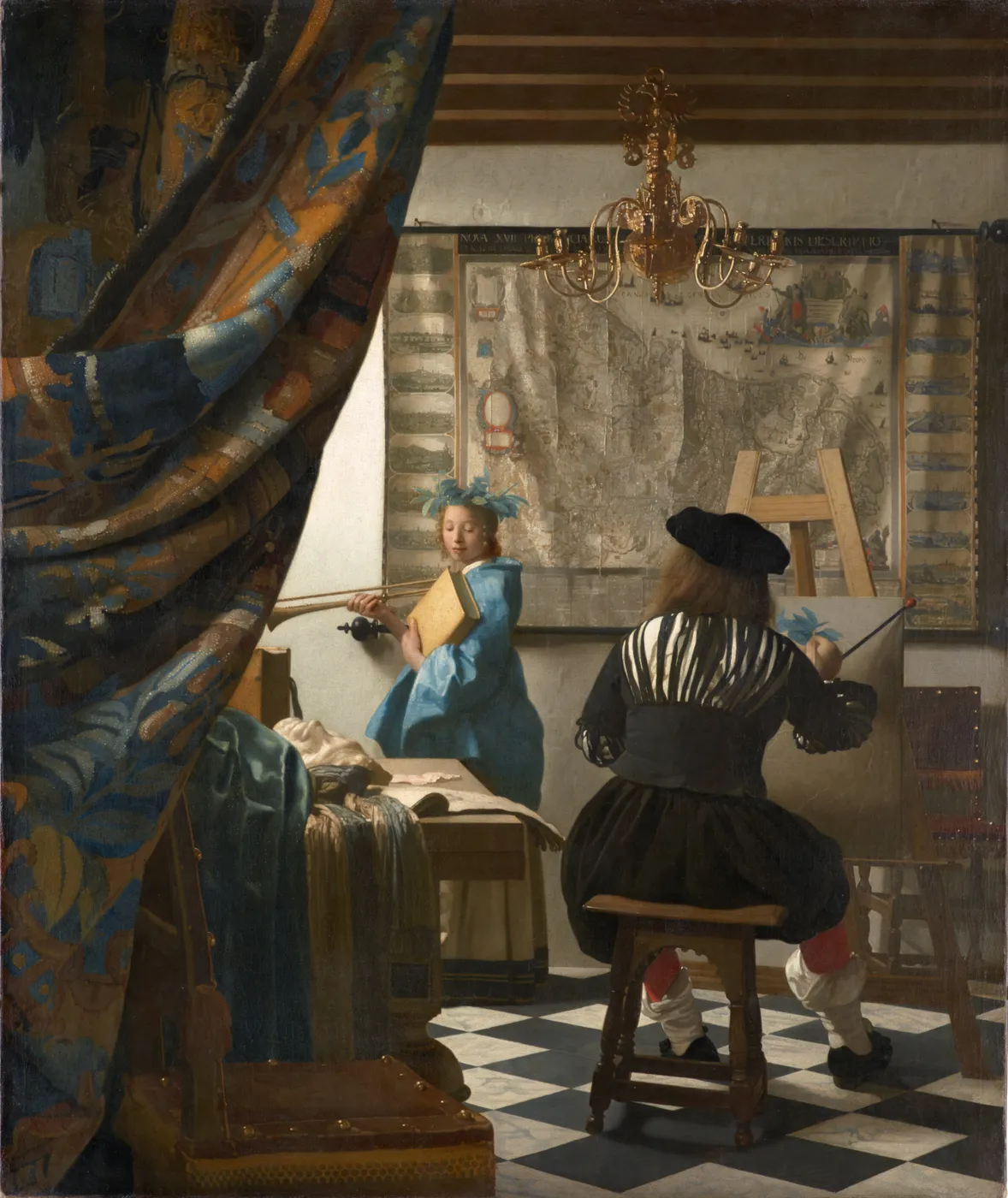
The Art of Painting, about a metre and a fifth high: the room itself is the subject. The heavy curtain pulled back on the left, the map of the Netherlands on the back wall, the brass chandelier, the plaster cast and the book on the table, and a painter at a small canvas who has begun at the top of the model's head. It is not in the household inventory taken after his death.
Johannes Vermeer, The Art of Painting, circa 1666 to 1668, Kunsthistorisches Museum, Vienna. Public domain, Wikimedia Commons.
In the studio
Jan Vermeer, The Art of Painting, c. 1666 — the painter at work in his studio
Studio
Light
North-facing windows on the upper floor of his mother-in-law Maria Thins's house on the Oude Langendijk in Delft. The same windows appear in modified form in many surviving pictures.
Position
Technical evidence (extreme manual precision of fine glazes, static vanishing points, controlled brushwork) suggests a seated position much of the time, at a low easel.
Session length
Multiple short sessions across days; passage-by-passage advance with drying time between.
Tools
Two easels (recorded in the 1676 inventory) · Palettes and grinding stones · Pin and string (for locating the central vanishing point) · Camera obscura (cumulative evidence — soft-edged highlights, specific perspective behaviors, tonal compression in bright passages) · Stiff hog-bristle for textured passages (whitewashed walls, coarse fabric) · Soft badger-hair for invisible transitions in silk and flesh
Notes
Two adjoining upstairs rooms identified in the 1676 inventory: one for grinding pigments and preparing materials, one for painting itself. Pieter Teding van Berckhout visited the Delft studio twice in 1669 and wrote, after the second visit on 21 June, that the most extraordinary aspect of the paintings consisted in the perspective.
Source: Catharina Bolnes, Inventory of the Vermeer household, 1676
Palette
Ground
Fine-weave linen prepared with light gray or warm buff ground (chalk, lead white, small amount of umber or burnt sienna). Killed the white of the raw canvas and gave a cool or neutral middle value.
Whites
Lead white (used in pointillé and in mixtures throughout)
Earths
Ochres · Umbers · Green earth
Colors
Natural ultramarine (ground from lapis lazuli — used pervasively, not only in blue drapery) · Lead-tin yellow (bright opaque yellow accents and pointillé highlights) · Vermilion · Iron-oxide reds · Madder and cochineal lakes · Azurite, smalt and indigo (the cheap blues, used alongside the expensive one)
Blacks
Bone black
Medium
Oil; thin semi-transparent glazes over a monochrome underpainting. Color built as layered light rather than as pigment.
Quantity
Hand-ground per passage; small working life on the palette.
Source: Gerrit de Lairesse, Groot schilderboek, 1707
Workflow, from blank canvas
1. Inventing — establish the perspective
Established the composition on the prepared canvas using a pin-and-string system to locate the central vanishing point. Likely also studied the scene through a camera obscura.
Why: The painting's perspective is its structural foundation. The pin-and-string is a verifiable instrument; the camera obscura clarifies value relationships the eye's depth perception hides.
2. Dead-coloring (doodverf)
Monochrome or limited-palette underpainting laying out the major light and shadow masses, often with ultramarine mixed with earth tones. Scanning of The Milkmaid in 2022 showed this stage was fast and rough, with a thick black line dashed in under the arm.
Why: Establishes the cool tonal foundation that persists through the later layers, and does it while the picture is still cheap to change.
3. Working-up (opmaken) — one area at a time
Completed one section (a map, a dress, a wall, a face) across one or two sessions before moving on.
Why: Hand-ground pigment has a short working life. The piecemeal approach was dictated by the materials and made the discipline structural.
4. Glazing and retouching
Once the working-up layer was dry, applied thin oily glazes to deepen specific colors and unify the cool atmosphere through ultramarine-rich shadows. Placed final pointillé highlights.
Why: The optical "beady" highlights give the surfaces their characteristic focused-lens quality.
How they studied
Nobody knows who taught him. The Delft Guild of Saint Luke registered Johannes Vermeer as a master painter on 29 December 1653, when he was twenty one, and the register carries no apprenticeship entry before that, which is the whole of the documentary record on his formation. One hard fact about his circumstances survives from the same day. The master's entrance fee was six guilders and he paid one and a half of it, settling the rest in July 1656. Scholars name candidates for the teacher and each has a hole in it. Leonaert Bramer was a senior Delft painter who stood up for Vermeer in the argument over his marriage in April 1653, so the two men certainly knew each other, but Bramer painted dark dramatic scenes that look nothing like this work. Carel Fabritius, the Rembrandt pupil killed in the Delft powder explosion of 1654, was working in the town, and a Delft poem of 1667 says Vermeer trod in his path, but Fabritius joined the guild only about fourteen months before Vermeer did, which leaves little room for a formal apprenticeship. Walter Liedtke argued he may have been largely self taught, with his father's dealing in pictures giving him things to look at. Nothing settles it. And there are no drawings. Not one sheet is securely given to him, so the ordinary evidence of a painter's formation, the copies and the studies and the abandoned attempts, does not exist in his case. What survives instead is the early work. The two pictures below are what his formation looks like from outside: a large history painting in a borrowed manner, and then, a few years later, the first canvas he signed and dated.
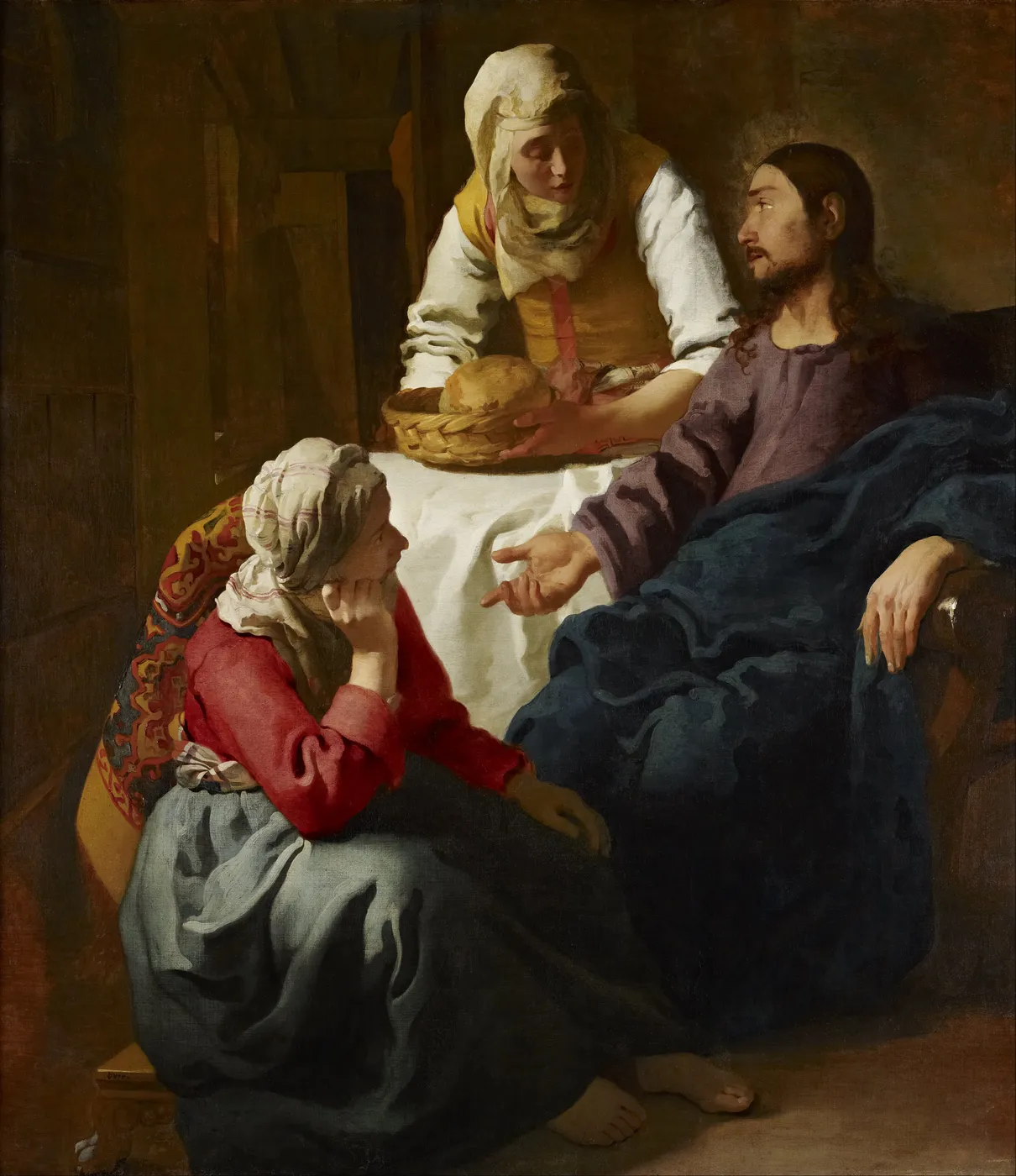
Christ in the House of Martha and Mary, about a metre and a half high, the largest canvas that survives and one of the earliest. Big figures, a borrowed Italian manner, thick loose paint in the sleeves and the cloth. Almost nothing here is the painter of the small quiet rooms except the white of the tablecloth and the light coming from one side.
Johannes Vermeer, Christ in the House of Martha and Mary, circa 1654 to 1656, National Galleries of Scotland, Edinburgh. Public domain, Wikimedia Commons.
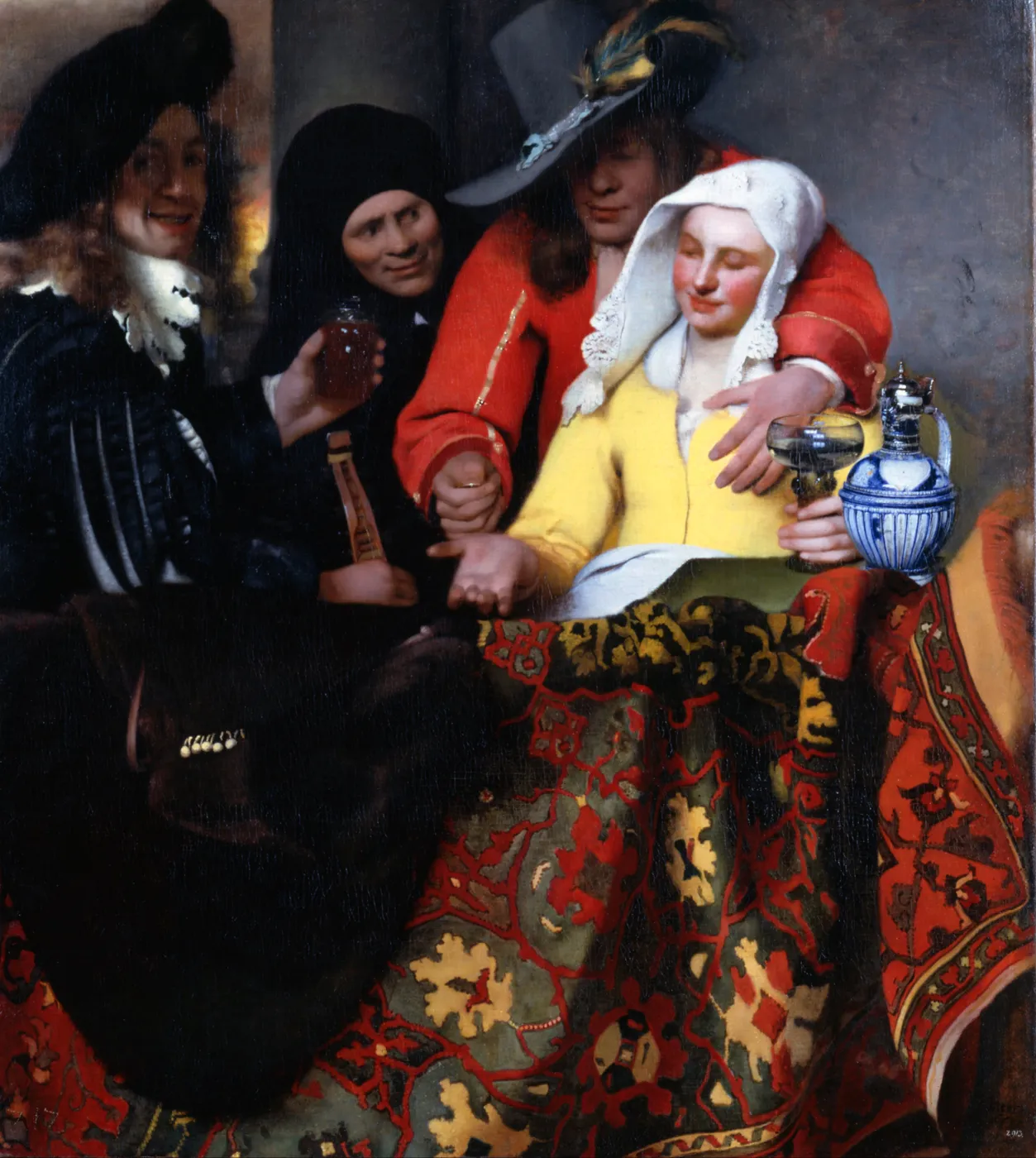
The Procuress, 1656, the first picture he signed and dated. It is one hundred and forty three by one hundred and thirty centimetres, still large, still a crowded scene, but the subject has come indoors and into his own century. Within a few years the figures drop to one or two and the canvases get small.
Johannes Vermeer, The Procuress, 1656, Gemäldegalerie Alte Meister, Dresden. Public domain, Wikimedia Commons.
Source: The guild admission of 29 December 1653, the six guilder fee paid in instalments and the terms as hoofdman: the Delft chronology at essentialvermeer.com, which follows the guild books. Bramer, Fabritius, Arnold Bon's poem of 1667 and the Liedtke self-taught argument: the same archive, teachers section. Medium, date, dimensions and holding museum for both figures: read from the museum record through the Commons file.
Up close
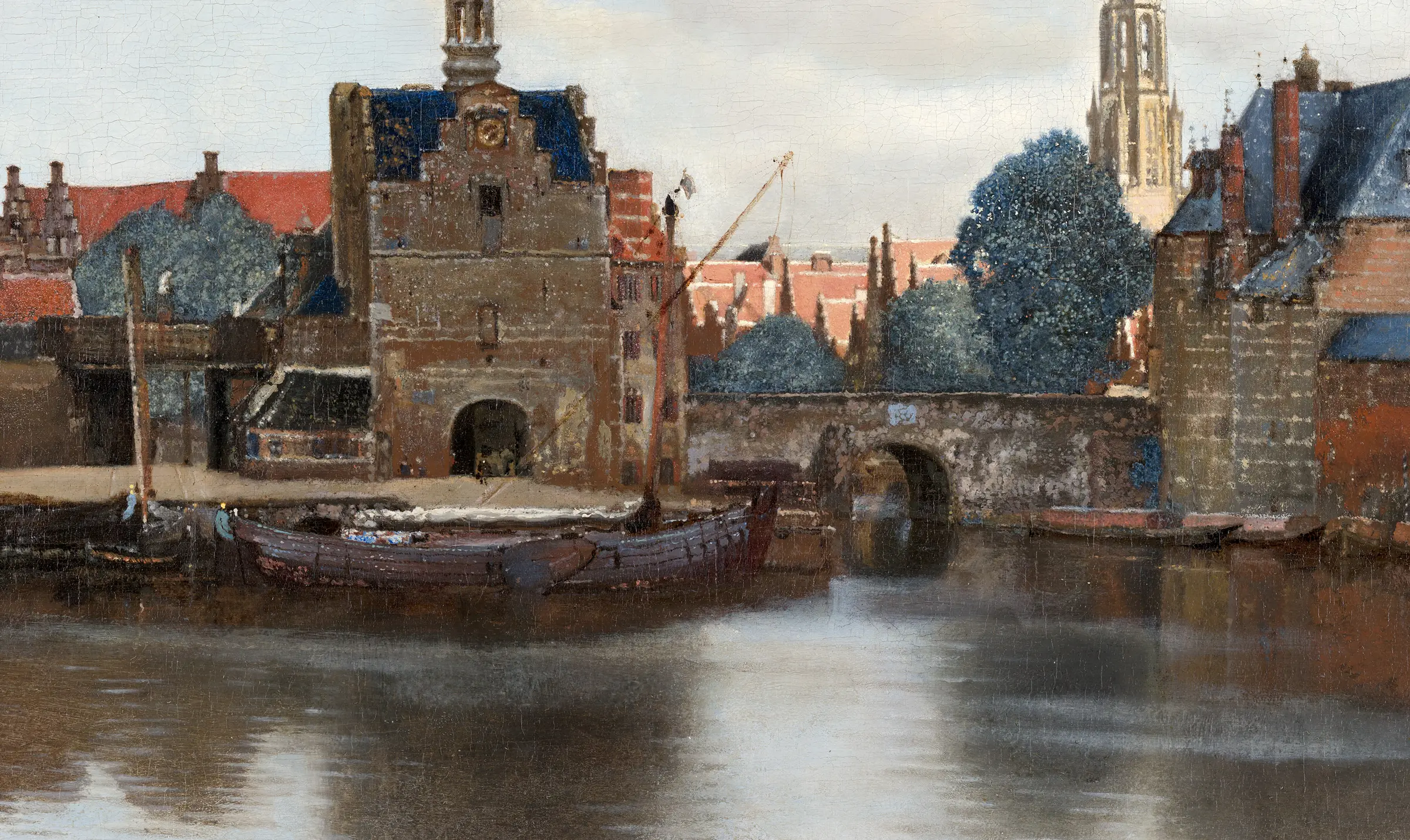
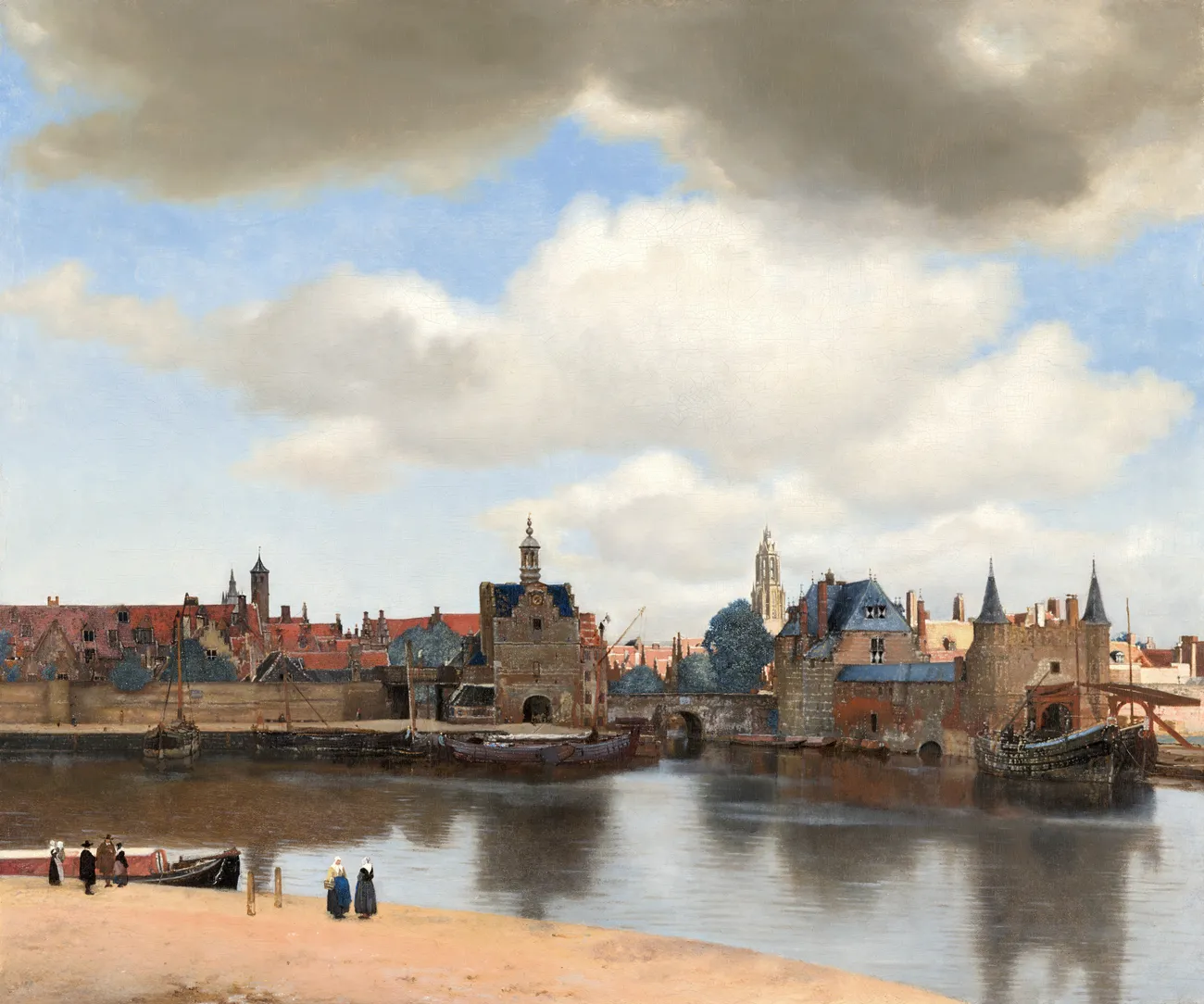
Detail of View of Delft along the water: the gate and the near quay are in shadow and the roofs behind them are in sun, and the line between the two runs right through the middle of the picture. The mortar in the wall, the roof tiles and the hull of the near boat are laid on thick enough to catch a raking light, and the reflection below is its own flat shape rather than a copy of the boat.
Johannes Vermeer, View of Delft (detail), circa 1660 to 1661, Mauritshuis, The Hague. Public domain, Wikimedia Commons.
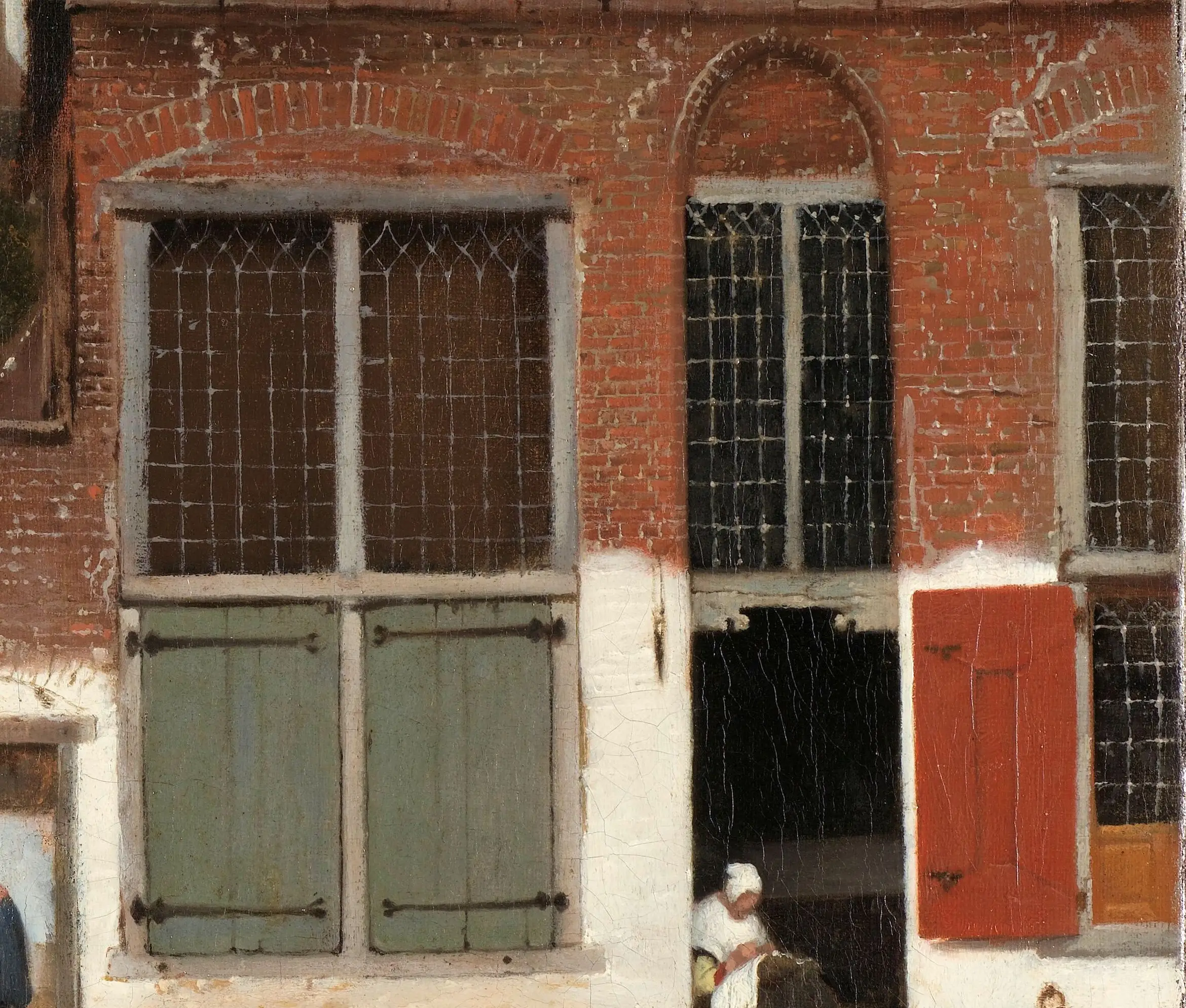
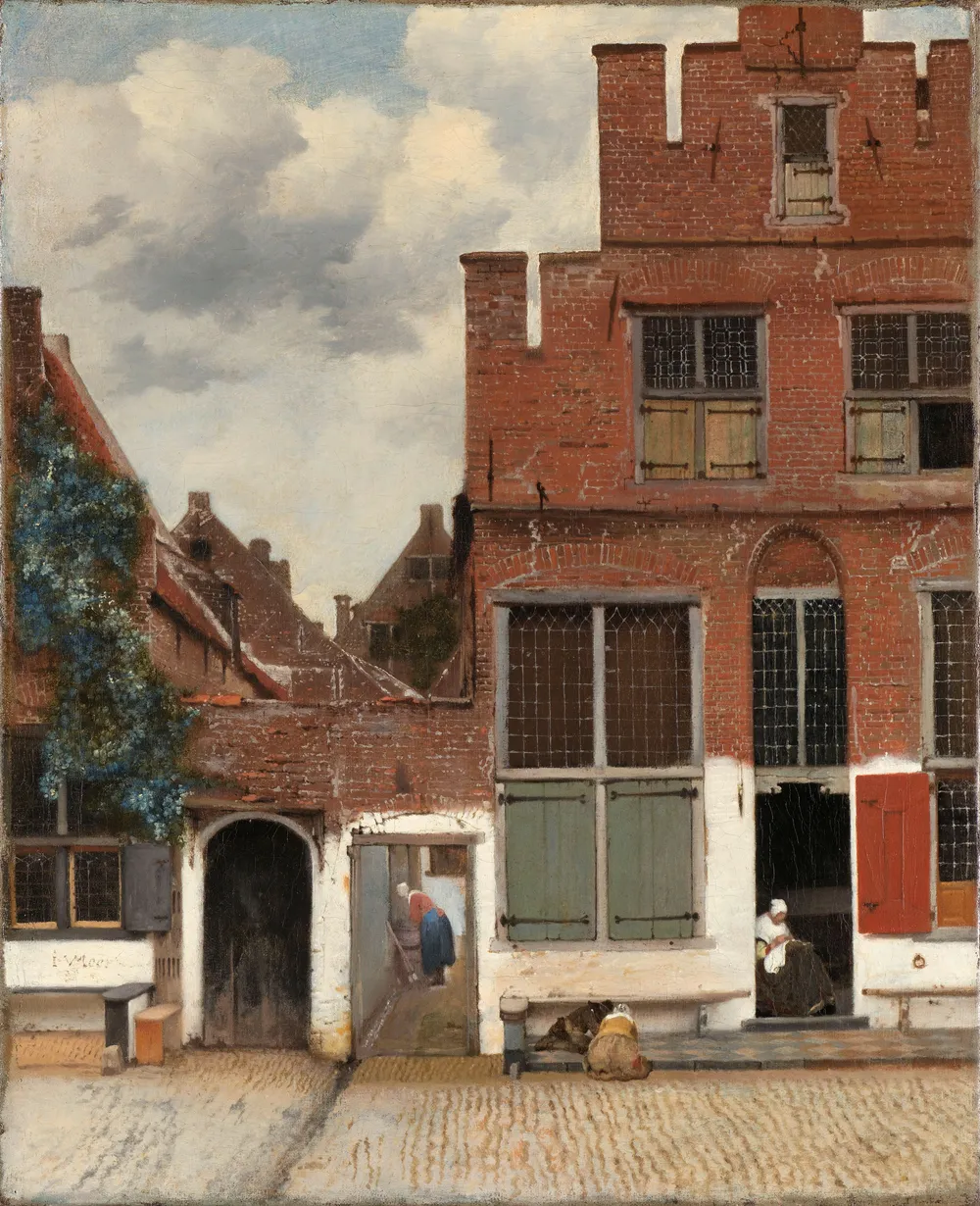
Detail of The Little Street: the brick is one warm red mass with the mortar drawn back into it in short pale strokes, and the whitewash along the bottom of the wall is a separate opaque band laid over the top. A whole house front comes out of two decisions about paint. Thick and dry for the wall, thin and dark for the openings.
Johannes Vermeer, The Little Street (detail), circa 1658, Rijksmuseum, Amsterdam. Public domain, Wikimedia Commons.
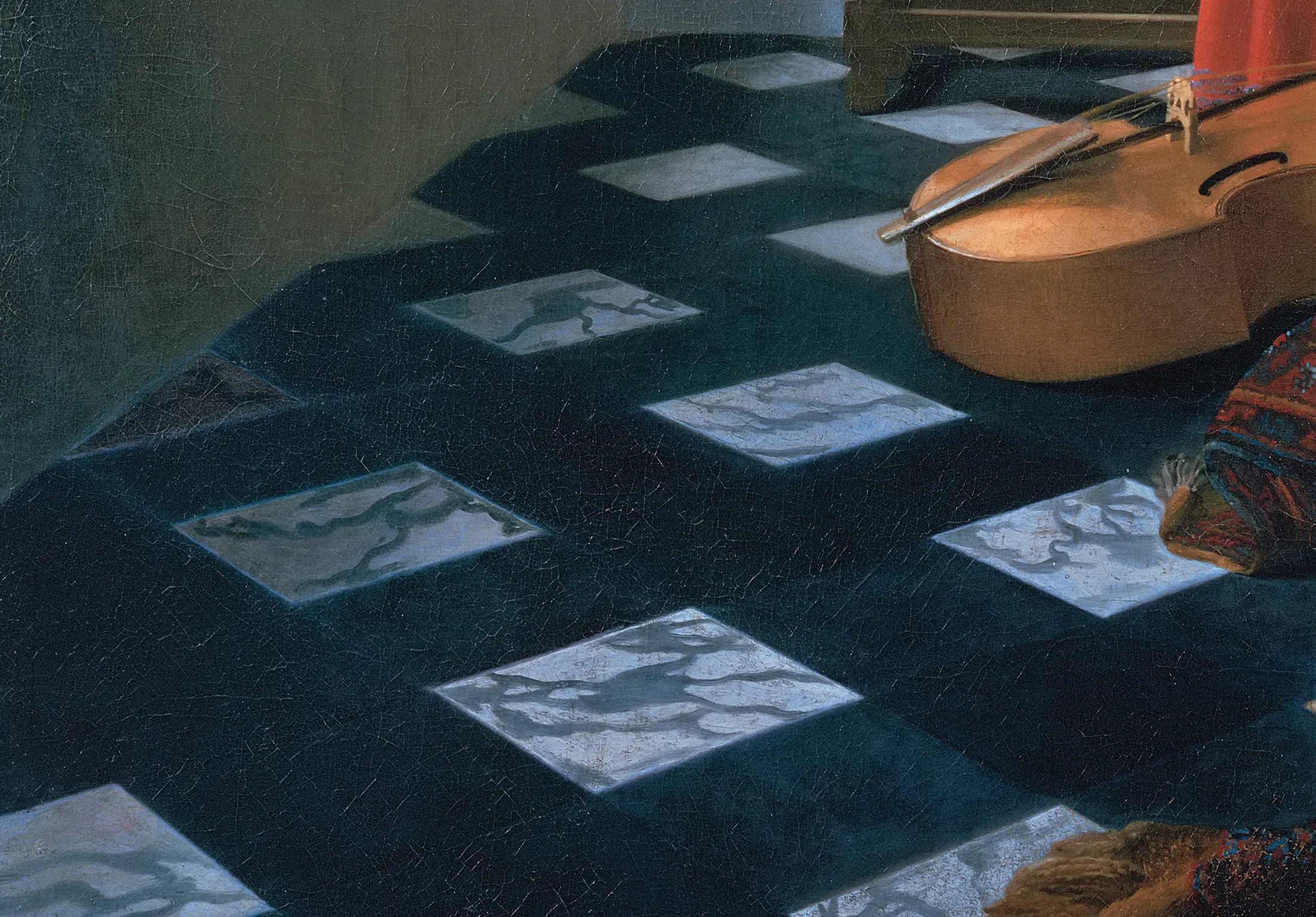
Detail of the floor in The Music Lesson: the tiles run back on lines that all converge on the one point up in the woman's sleeve, and the veining inside each pale tile is drawn smaller and greyer the further away it gets. The dark tiles are not black. They are the same cool blue grey as the shadow in the rest of the room.
Johannes Vermeer, Lady at the Virginals with a Gentleman, known as The Music Lesson (detail), circa 1662 to 1664, Royal Collection. Public domain, Wikimedia Commons.
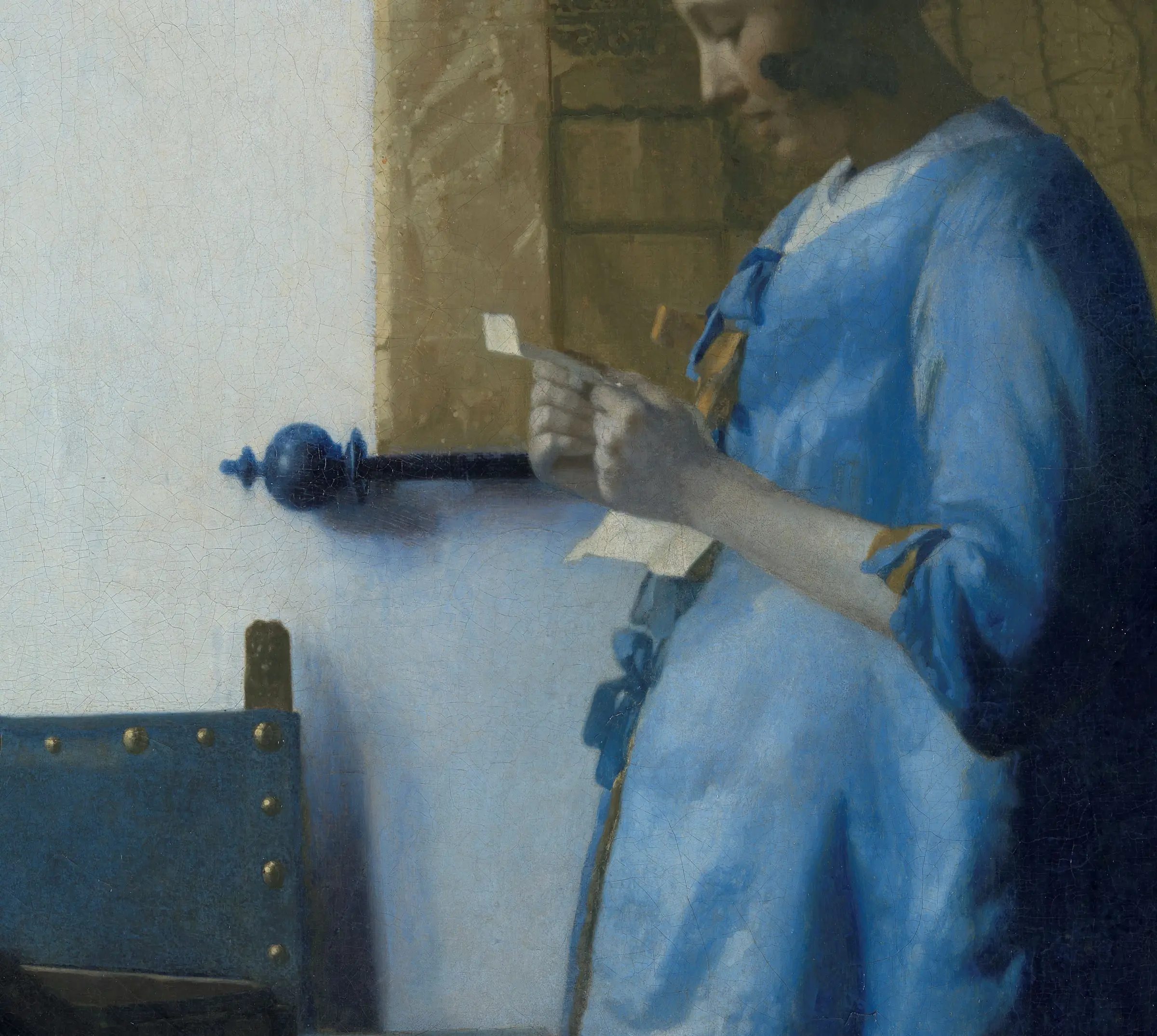
Detail of Woman Reading a Letter: the wall behind her is not white, it is a cool grey blue that lightens and warms where the window light lands. Her jacket is ultramarine and it meets that wall without one drawn edge anywhere. The map, the chair back and the curtain rod carry every hard line in the passage.
Johannes Vermeer, Woman Reading a Letter (detail), circa 1663, Rijksmuseum, Amsterdam, on loan from the City of Amsterdam, A. van der Hoop bequest. Public domain, Wikimedia Commons.
Watching him work
“visited a famous painter named Vermeer who showed me some examples of his art, the most extraordinary aspect of which consists in the perspective.”
Pieter Teding van Berckhout, a young gentleman from The Hague, on his second visit to the studio, 21 June 1669, Diary of Pieter Teding van Berckhout, Koninklijke Bibliotheek, The Hague, entry of 21 June 1669, French original and English translation as printed in the Delft eyewitness archive at essentialvermeer.com, 1669 [source]
Across media
View of Delft, about ninety seven by one hundred and sixteen centimetres, one of only two outdoor pictures that survive. The town sits in a narrow band low in the canvas and two thirds of the picture is given to cloud. It brought two hundred guilders in 1696, the highest price of the twenty one Vermeers in that sale.
Johannes Vermeer, View of Delft, circa 1660 to 1661, Mauritshuis, The Hague. Public domain, Wikimedia Commons.
The Little Street, fifty four by forty four centimetres, the other outdoor picture. Frans Grijzenhout matched the house widths in the Delft quay dues register of 1667 to this pair of gateways and placed the spot at what is now Vlamingstraat 40 and 42, where an aunt of Vermeer's lived. Not every scholar accepts the identification.
Johannes Vermeer, The Little Street, circa 1658, Rijksmuseum, Amsterdam. Public domain, Wikimedia Commons.
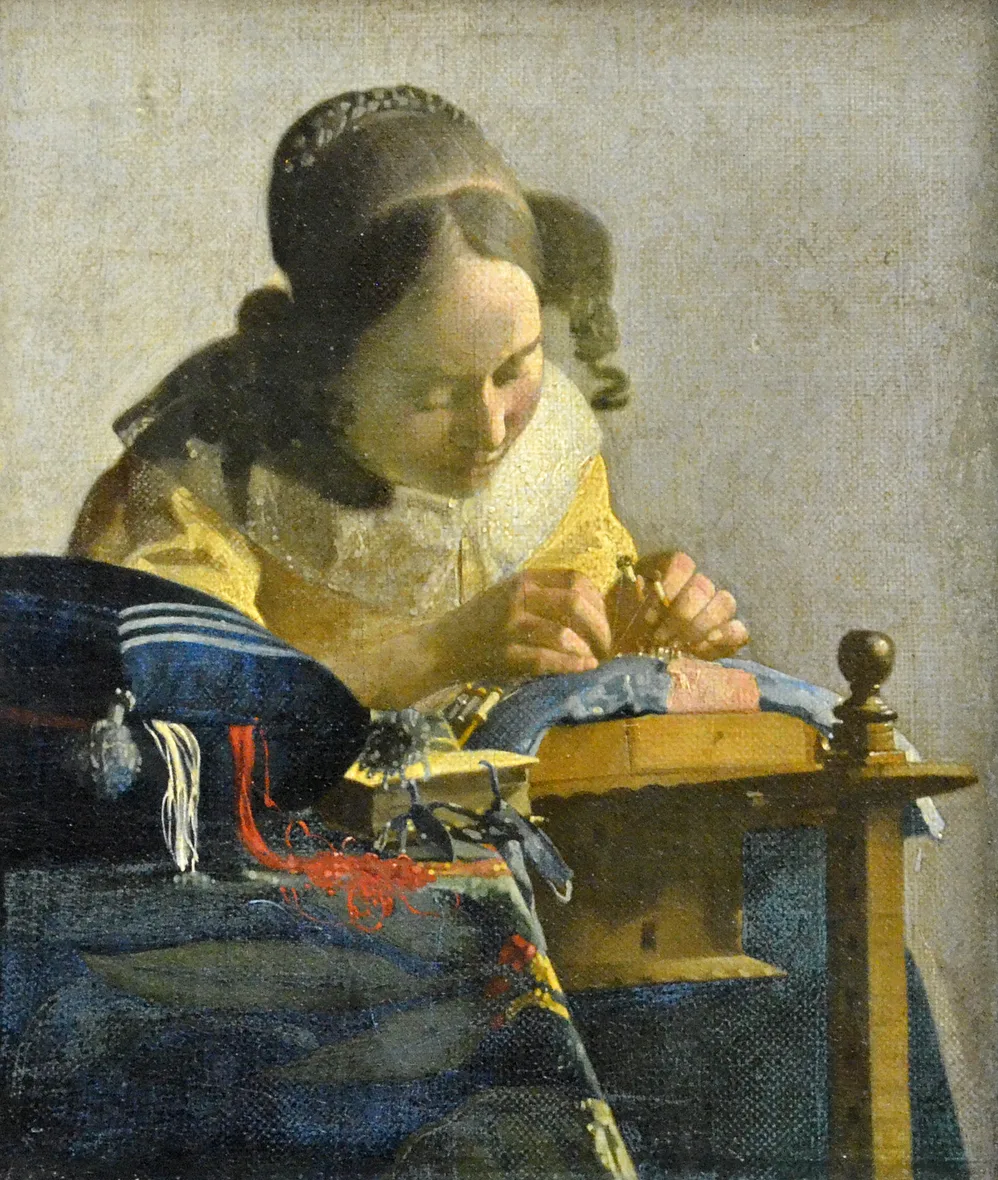
The Lacemaker, twenty four by twenty one centimetres, the smallest picture he left. The red and white threads spilling from the cushion on the left are put down as loose paint with no drawing in them at all, while the hands and the pins a few centimetres behind are exact.
Johannes Vermeer, The Lacemaker, circa 1669 to 1670, Musée du Louvre, Paris. Public domain, Wikimedia Commons.
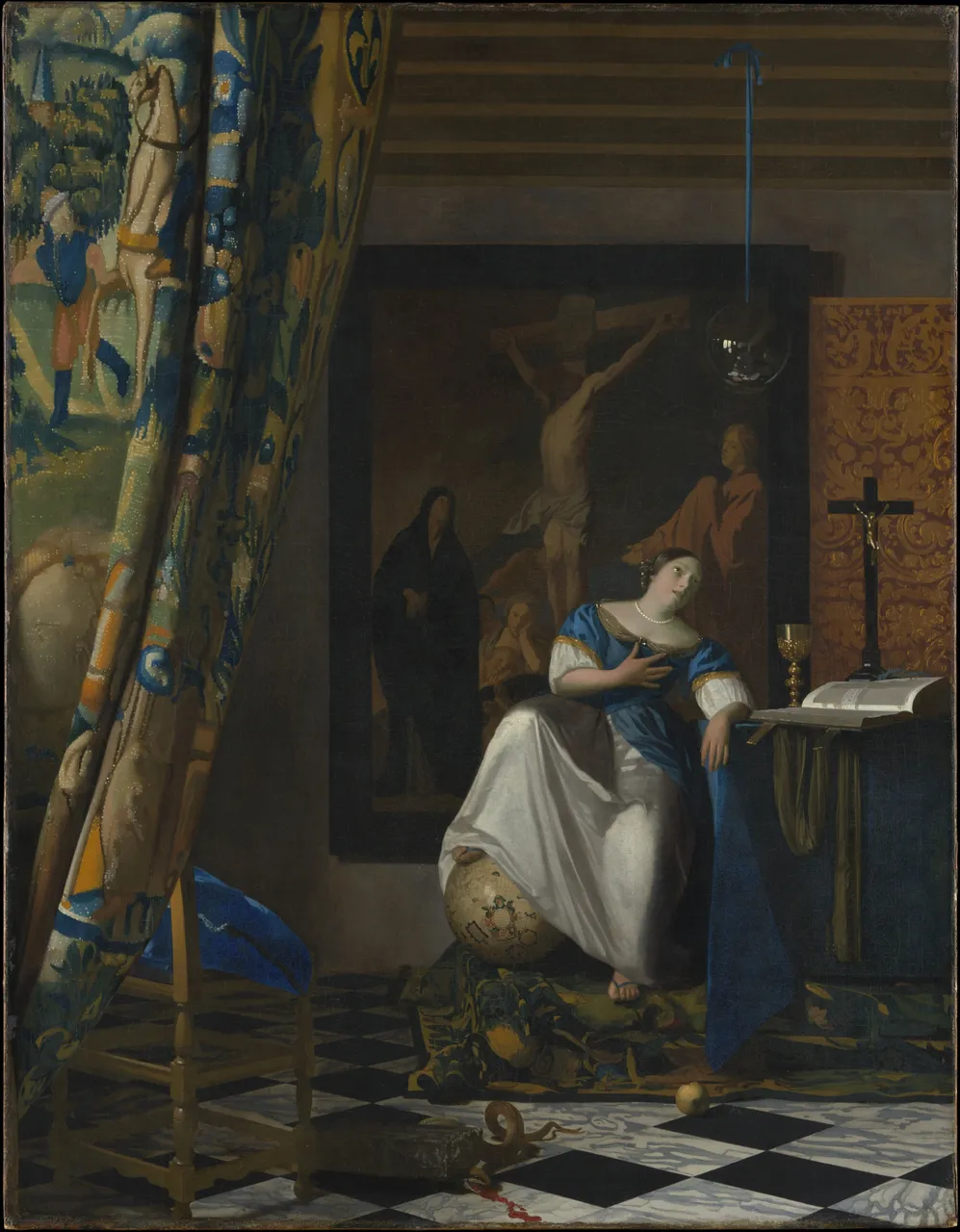
Allegory of the Catholic Faith, one hundred and fourteen by eighty nine centimetres, from the last years. A commissioned religious allegory with a glass sphere hung from the ceiling, a snake crushed under a cornerstone and a woman with her foot on a globe. The quiet rooms are what he is known for. This is also him.
Johannes Vermeer, Allegory of the Catholic Faith, circa 1670 to 1674, The Metropolitan Museum of Art, New York. Public domain, Wikimedia Commons.
The record, deeper
The money
The only price anyone recorded in his lifetime comes from a Frenchman who did not get to see the studio. Balthasar de Monconys called on 11 August 1663, found the painter with none of his own work in the house, and was sent on to a baker's, where a picture with a single figure in it had been paid six hundred livres. Monconys thought six pistoles would have been too much for it.
Balthasar de Monconys, Journal des voyages, volume 2, Lyon, 1665 to 1666, pages 148 and 149, French original and translation as printed in the Delft eyewitness archive at essentialvermeer.com.
Maria de Knuijt, wife of the Delft collector Pieter van Ruijven, left Vermeer five hundred guilders in her will, the only person outside her own family named in it. It was never paid, because Vermeer died before she did. Her husband had lent him two hundred guilders in 1657. Rijksmuseum research published in 2023 argues she, not her husband, was the principal buyer, and that the couple acquired about half of everything he painted.
The Art Newspaper, 7 February 2023, reporting Pieter Roelofs and the Rijksmuseum exhibition catalogue; the bequest was already known to John Michael Montias.
In May 1672 he rode to The Hague with two other headmen of the Delft guild to judge a group of paintings sold to the Elector of Brandenburg as Italian masters. They declared before a notary that the pictures were not outstanding Italian work but great pieces of rubbish and bad paintings. The asking prices collapsed.
Notarial statement of 1672, quoted in the Delft chronology at essentialvermeer.com.
Six weeks after his death his widow settled the bread bill. On 26 January 1676 Catharina Bolnes transferred two paintings to the baker Hendrick van Buyten against a debt of six hundred and seventeen guilders for bread already delivered.
The Delft chronology at essentialvermeer.com; the transaction is documented by John Michael Montias, Vermeer and His Milieu.
Twenty one of his paintings were sold together at the Oude Heeren Logement in Amsterdam on 16 May 1696 out of the Dissius estate, and the whole lot made one thousand five hundred and three guilders and ten stuivers. View of Delft took two hundred guilders, The Milkmaid one hundred and seventy five, the woman weighing gold one hundred and fifty five, and a picture of him in a room forty five.
The Dissius auction record of 16 May 1696, lot prices as printed at essentialvermeer.com.
Catharina Bolnes petitioned the States of Holland and West Friesland about a year and a half after his death. Her account of it: during the long and ruinous war with France he not only had been unable to sell any of his art but also, to his great detriment, was left sitting with the paintings of other masters that he was dealing in. As a result and owing to the very great burden of his children, having no means of his own, he had lapsed into such decay and decadence, which he had so taken to heart that, as if he had fallen into a frenzy, in a day or day and a half he had gone from being healthy to being dead.
Catharina Bolnes, petition to the States of Holland and West Friesland, translation as printed at essentialvermeer.com.
The reworks
The Milkmaid was rearranged while he worked. Macro-XRF and RIS scanning at the Rijksmuseum in 2022 found a wooden jug rack with hanging pots on the wall behind her head and a woven fire basket on the floor, both painted out by Vermeer himself. The foot stove, the tiles and the bare floor went on top of the basket.
Rijksmuseum, press release of 8 September 2022, research by Rijksmuseum conservators and scientists with colleagues from the Mauritshuis.
The same scans found the underpainting, which changes the picture of how he worked. Beneath the polished surface the scene was set down quickly in light and dark, and a thick line of black paint sits under the milkmaid's left arm, applied in a hurry. The Rijksmuseum states plainly that the old assumption of extreme precision at every stage is now being revised.
Rijksmuseum, press release of 8 September 2022, Anna Krekeler, paintings conservator and researcher.
The Cupid on the back wall of the Dresden letter picture was hidden under overpaint for more than two centuries, and it was long assumed Vermeer removed it himself. Restoration between 2017 and 2021 found a layer of dirt and binding medium between his paint and the overpaint, which means decades had passed. Someone else painted the Cupid out after he died, and the picture now hangs as he left it.
Gemäldegalerie Alte Meister, Dresden, restoration completed 2021, conservators Christoph Schölzel and Uta Neidhardt.
Time has reworked Girl with a Pearl Earring too. The 2018 examination found that the flat dark background was originally a green curtain, with folds, which changed physically and chemically until it read as empty space, and that he painted fine hairs around both eyes that the naked eye can no longer see.
The Girl in the Spotlight research project, Mauritshuis, examined 2018, published 2020.
The studio
The working room is listed in the inventory taken on 29 February 1676. In the front room upstairs: two painter's easels, three palettes, six panels, ten painter's canvases, three bundles with all sorts of prints, a lectern, two Spanish chairs and a cane with an ivory knob. The stone table to grind colours on, with its stone, was up in the attic in a separate room.
Inventory of the movable goods in Vermeer's house, 29 February 1676, English transcript room by room at kalden.home.xs4all.nl and at essentialvermeer.com.
There is no camera obscura in that inventory, which is the strongest single argument against the device. The evidence on the other side is geometric: Philip Steadman reconstructed the room from the perspective of a group of the interiors and argued the pictures match projections from one camera position. Jørgen Wadum found the pinhole at the vanishing point in thirteen paintings, which shows he was also using the ordinary pin and chalked string that architectural painters used. Both can be true. Neither is settled.
Philip Steadman, Vermeer's Camera, Oxford University Press, 2001; Jørgen Wadum, Vermeer in Perspective, 1995; the 1676 inventory.
He worked in his mother in law's house. Maria Thins owned the property on the Oude Langendijk in Delft, the family lived there from about 1660, and the studio was the front room on the upper floor with the windows that appear, modified, in one picture after another.
The 1676 inventory and the Delft chronology at essentialvermeer.com.
Two visits to the studio were written down and that is the whole of the eyewitness record. Monconys in August 1663, who saw nothing, and Pieter Teding van Berckhout twice in 1669. On 14 May van Berckhout wrote that Vermeer showed him some curiosities of his own hand. On 21 June he wrote the line about the perspective.
Delft eyewitness archive at essentialvermeer.com, printing the French originals from Monconys and from the van Berckhout diary in the Koninklijke Bibliotheek.
The materials
The pigment survey everything else rests on is Hermann Kühn's, commissioned by the National Gallery of Art in Washington and published in 1968. It detected about twenty pigments across the work, of which roughly ten were in regular use. The samples were few and taken from the outer edges of the canvases, so it is a partial picture and should be read as one.
Hermann Kühn, A Study of the Pigments and the Grounds Used by Jan Vermeer, Reports and Studies in the History of Art, National Gallery of Art, Washington, 1968.
Natural ultramarine was ground from lapis lazuli carried out of what is now Afghanistan and was worth more than gold by weight. He used it lavishly and not only for blue: it goes into shadows, into whites and into half tones. He also had the cheap blues, azurite, smalt and indigo, and used them too.
Kühn, 1968; and the Girl in the Spotlight examination, Mauritshuis, 2018 to 2020.
Green earth in the shadows of flesh is the odd one. It has been identified in the skin of several of the later pictures, among them Girl with a Red Hat, The Guitar Player, A Lady Standing at a Virginal and the Allegory of Faith, laid lightly over shadows first put in with pinks and muted browns. No exact contemporary of his is known to have done it, and nobody has explained where he got it.
E. Melanie Gifford and Lisha Deming Glinsman, Collective Style and Personal Manner, in Vermeer and the Masters of Genre Painting, 2017.
The bright opaque yellow is lead-tin yellow, used at full strength in places like the bodice of The Milkmaid, and the reds are vermilion and the transparent lakes, madder and cochineal.
Kühn, 1968, and the pigment surveys built on it.
Refusals — what they would not do
Left no drawings. Not one sheet is securely attributed to him, so no preparatory stage can be checked on paper.
Refused to hurry — accepted two or three paintings a year as the cost of the optical resolution.
Refused white grounds — used a tinted middle value.
Refused to disassemble the studio set between sessions.
Took no registered pupils, and no school of followers formed after his death.
Reference
Primary source
The staged interior in front of him. Elaborate figure and still-life arrangements set up in the studio and left in place for months.
Photography
Camera obscura — cumulative evidence rather than documentary, but one of the strongest technical cases in Dutch painting. Used to study the scene as a flattened projected image, revealing value relationships the eye's depth perception tends to hide. No such device appears in the 1676 inventory, and the argument remains open.
Exceptions
The "natural perspective" of the room itself — how light from the left-hand windows fell across walls, floors, and surfaces, producing soft-edged shadows translated directly.
Training not documented — No apprenticeship record survives in the Delft Guild of Saint Luke registry before his admission as master in December 1653. Most plausible scenarios link him to Leonaert Bramer (a Delft senior who witnessed his marriage agreement) or to Carel Fabritius, the former Rembrandt pupil killed in the 1654 gunpowder magazine explosion.
Influences
Carel Fabritius (probable Delft link to the Rembrandt lineage).
The Dutch dead-coloring + working-up + glazing tradition documented in Lairesse's 1707 treatise.
Students
Took no recorded students. No surviving paintings can be attributed to a pupil working in his specific manner.
Immediate seventeenth-century influence was local and limited.
International reputation essentially invented in the 1860s by the French critic Théophile Thoré-Bürger. From that rediscovery, his lineage runs forward into the careful observational tradition of Chardin's late followers, into nineteenth-century Dutch interior painters, and into the modern photography-aware conversation about painting as optical art.
In their own words
“In Delft I saw the painter Vermeer who did not have any of his works: but we did see one at a baker's, for which six hundred livres had been paid.”
— Balthasar de Monconys, Journal des voyages, volume 2, Lyon, 1665 to 1666, pages 148 and 149, entry of 11 August 1663, 1663
The earliest documented account of a call at Vermeer's house. Monconys found nothing finished there and was sent on to a Delft baker to see a Vermeer. He added that he would have thought six pistoles too much for it.
“Upon arrival I saw an excellent painter named Vermeer, who showed me a few curiosities made with his own hand.”
— Pieter Teding van Berckhout, Diary, entry of 14 May 1669, Koninklijke Bibliotheek, The Hague, 1669
The first of his two visits that year. The remark about the perspective comes from the second, on 21 June.
“Twenty-six paintings of various sizes, of which some belonged to the children of the deceased.”
— Catharina Bolnes, Inventory of the Vermeer household, 1676
Post-mortem inventory listing studio props, two easels, palettes, grinding stones, and ebonized picture frames that appear in the backgrounds of his pictures.
Oil on fine linen with a light gray or warm buff ground. His pigments included lead white, ochres and umbers, green earth, vermilion and iron-oxide reds, bone black, lead-tin yellow, and, above all, natural ultramarine ground from lapis lazuli.
Why did Vermeer use so much ultramarine?
He mixed expensive natural ultramarine through shadows, half-tones, and even highlights on white walls and black floors, not only into blue cloth. That pervasive cool unity is a large part of why his light reads the way it does.
Did Vermeer use a camera obscura?
It is an open question. The evidence for it is cumulative rather than documentary: soft beady highlights, specific perspective behavior, and tonal compression in bright passages, plus Philip Steadman's reconstruction of one camera position that fits a group of the interiors. Against it, no such device appears in the 1676 inventory of his house, and Jørgen Wadum found the pinhole of a traditional pin-and-string construction at the vanishing point of thirteen paintings. Both tools could have been in use.
Are there any Vermeer drawings?
No. Not one drawing is securely attributed to him, which is why everything known about his preparatory process comes from technical analysis of the paintings themselves rather than from paper.
Who taught Vermeer?
Nobody knows. The Delft guild registered him as a master on 29 December 1653 with no apprenticeship entry before that. Leonaert Bramer, Carel Fabritius and Abraham Bloemaert are the usual candidates and each has an evidence gap; Walter Liedtke argued he may have been largely self-taught.
What medium and method did Vermeer paint in?
Oil, built in four phases: inventing, dead-coloring, working-up, and glazing, with drying time between layers. He built color as thin layered light over a monochrome underpainting. Scanning of The Milkmaid in 2022 showed the first stage was fast and rough, not precise.
How long did a Vermeer take?
He finished only two or three paintings a year, working one passage at a time because his hand-ground pigment had a short working life on the palette.
How did Vermeer paint the pearl in Girl with a Pearl Earring?
With two touches of white paint: a thicker dab on the upper left and a soft one low down where the white collar reflects light back up into it. There is no hook, no outline, and nothing attaching it to the ear. The 2018 Mauritshuis examination confirmed the pearl is an illusion built from those two marks.
If this painter is your match
You accept that the slow painting is the cost of the precise one. Two or three finished pictures a year is not a failure of productivity. It is what a specific level of optical resolution actually takes to make.
Borrow this: Pick a single interior corner of your life — a windowsill, a table, a chair by a specific window — and paint it across six weeks, in short sessions, one passage at a time, letting each layer dry before the next. Do not start a second painting during those weeks.
Balthasar de Monconys, Journal des voyages de Monsieur de Monconys, volume 2, 1666. French diplomat and traveler. Earliest documented account of a call at Vermeer's house, 11 August 1663, and the only price recorded in his lifetime.
Pieter Teding van Berckhout, diary, Koninklijke Bibliotheek, The Hague, 1669. A young gentleman from The Hague who called twice, on 14 May and 21 June 1669. The second entry, on the perspective, is the only surviving contemporary comment on what the paintings actually did.
Catharina Bolnes, Inventory of the Vermeer household, 1676. Post-mortem inventory drawn up on 29 February 1676. Primary source for the studio contents, and for what is absent from them.
Guild of Saint Luke, Delft, Guild Book of Master Painters, 1675. Records Vermeer's admission on 29 December 1653, the six guilder entrance fee paid in instalments to July 1656, and his terms as hoofdman in 1662 to 1663 and 1670 to 1671. The absence of an apprenticeship entry before 1653 is the basis for the continuing question of his training.
Gerrit de Lairesse, Groot schilderboek, 1707. Dutch theoretical treatise written a generation after Vermeer's death. Documents the period working method (dead-coloring, working-up, glazing) on which the four-phase analysis of Vermeer's technique is built.
Hermann Kühn, A Study of the Pigments and the Grounds Used by Jan Vermeer, Reports and Studies in the History of Art, National Gallery of Art, Washington, 1968. The foundational technical survey, commissioned by the National Gallery of Art. About twenty pigments detected, roughly ten in regular use. Samples were few and taken from the canvas edges, so it is partial by design.
Jørgen Wadum, Vermeer in Perspective, in the catalogue of the Johannes Vermeer exhibition, Washington and The Hague, 1995. Documents the pinhole at the vanishing point in thirteen paintings and the pin and chalked string that made the orthogonals.
Philip Steadman, Vermeer's Camera: Uncovering the Truth behind the Masterpieces, Oxford University Press, 2001. The geometric case for the camera obscura, built by reconstructing the room from the perspective of a group of the interiors. Contested by Wadum and Liedtke, and no device appears in the 1676 inventory.
The Girl in the Spotlight, Mauritshuis, technical examination of Girl with a Pearl Earring, 2020. Non-invasive imaging, digital microscopy and paint sample analysis, examined in February and March 2018. Source for the two-stroke pearl with no hook, the eyelashes, the green curtain behind her, and the ultramarine in the scarf and jacket.[link]
Rijksmuseum, research on The Milkmaid, macro-XRF and RIS scanning, 2022. Announced 8 September 2022. Source for the fast rough underpainting, the black line under the arm, and the jug rack and fire basket that Vermeer painted out.[link]
E. Melanie Gifford and Lisha Deming Glinsman, Collective Style and Personal Manner: Materials and Techniques of High-Life Genre Painting, in Vermeer and the Masters of Genre Painting, 2017. Source for green earth in the flesh shadows of several late pictures, a practice with no known parallel among his exact contemporaries.
Gemäldegalerie Alte Meister, Dresden, restoration of Girl Reading a Letter at an Open Window, 2021. Restoration 2017 to 2021, conservators Christoph Schölzel and Uta Neidhardt. Established that the overpaint covering the Cupid went on decades after Vermeer died, and removed it.