Painters
Pollice Verso (1872) by Jean-Léon Gérôme
Jean-Léon Gérôme, Pollice Verso, 1872

Jean-Léon Gérôme

18241904 · French
Researched by Daniel Bilmes, painter and educator.

Jean-Léon Gérôme taught a rigorous, hierarchical system at his influential École des Beaux-Arts atelier from 1864 to 1904. His method rested on the absolute mastery of drawing before a student was allowed to paint. Students began by drawing from plaster casts of antique sculpture and only then moved to the live model. The core of the curriculum was the week-long figure study, or académie, a staged build from outline to monochrome underpainting to final colour. Gérôme was famous for severe, "terrifying" critiques focused on "mathematical accuracy," yet he judged the final result rather than imposing a set painterly technique. That demanding training shaped a generation of international artists, the American realist Thomas Eakins among them, and stood in flat opposition to the emerging Impressionist movement.

Signature moves

Master the cast before touching the live model

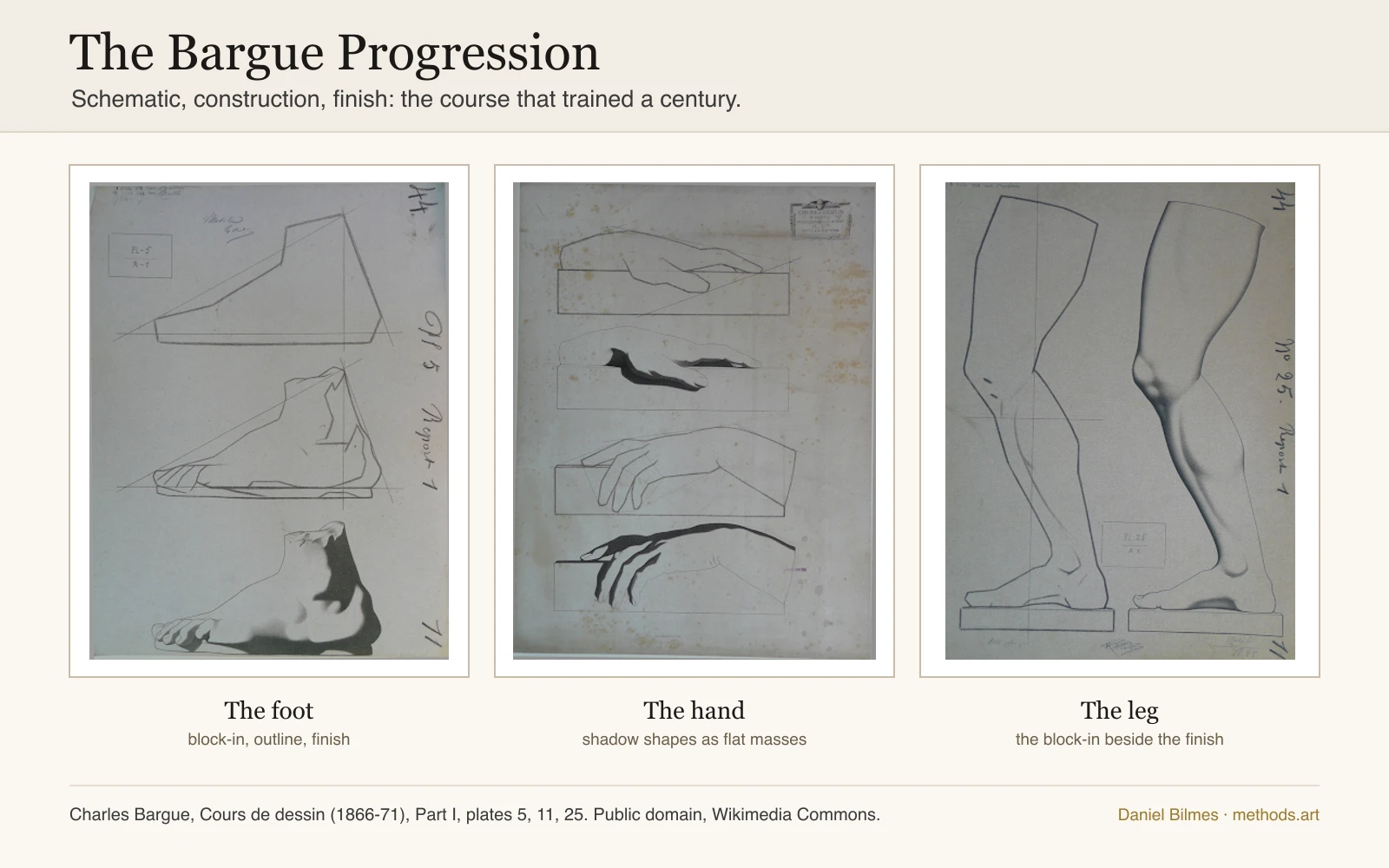
Held a strict hierarchy: students first drew from plaster casts of antique sculpture, mastering parts of a bust before the whole, before they were ever allowed to draw from life.

Why it matters · Working from the static cast builds discipline and a grip on ideal form in a controlled setting. By the time the student faced the living, breathing model, the eye and hand were already trained to see and render form without being overwhelmed.

Documented progression of the Atelier Gérôme (student accounts: Shinn, Eakins)

Demand accuracy in drawing above all else

Preached that art must be allied to science, that a student's work rest on "reason and mathematical accuracy" to reach any real truth.

Why it matters · This is the spine of the academic system. For Gérôme, feeling and expression stood on a non-negotiable foundation of correct drawing. That discipline is why students like Eakins could go on to make work of such powerful realism.

Jean-Léon Gérôme, quoted in Fanny Field Hering, The Life and Works of Jean-Léon Gérôme, 1892

Build the week-long figure study (the académie)

Made the week-long study of the nude model the central exercise for advanced students, the pose set on Monday and worked across six mornings.

Why it matters · The académie was a sustained investigation of one problem. It taught endurance and a method: catch the pose, work the light and shadow, build the form over days rather than in a single alla prima dash. The theory was that if you can paint the figure, you can paint anything.

Earl Shinn, articles in The Nation on the Gérôme atelier, 1869

Correct in public, and spare no one

Twice a week he moved through the crowded atelier pointing out every fault, sometimes disfiguring a drawing to make the point, sometimes reducing students to tears.

Why it matters · This "terrifying" method, as Thomas Eakins called it, made students face their weaknesses with nowhere to hide. Harsh as it was, the focused attention and high bar meant those who stayed the course made rapid progress.

The Paris Letters of Thomas Eakins

Judge the result, not the recipe

For all his severity on drawing, he rarely imposed his own painting technique, palette, or brushwork, aiming his criticism at the final result's truth to nature.

Why it matters · This is the counterweight to his reputation for rigidity. His student Kenyon Cox recorded that Gérôme was no dogmatist about how to paint. So long as the drawing and form were true, individual expression was allowed, which is how such different painters came out of one atelier.

Kenyon Cox, student in the Gérôme atelier
In the studio
Photograph of Jean-Léon Gérôme by Nadar
Jean-Léon Gérôme, photograph by Nadar
Studio
Light
The large, sometimes smoky rooms of the École des Beaux-Arts, the life studies lit from high north windows for a steady, cool light.
Position
He was a visiting critic, not a resident painter. He came twice a week, Wednesdays and Saturdays, moving easel to easel to correct the 40 to 60 students at work.
Session length
He taught for forty years, 1864 to 1904. The core student exercise, the académie, was a week-long pose worked across six mornings.
Tools
Plaster casts of antique sculpture for drawing practice · The live model, holding a pose on a dais for a full week · Student materials: crayons and paper for drawing, oils and canvas for painting · Moistened bread, wrung into balls, used as erasers
Notes
His atelier was one of three official painting studios at the École. Admission was highly competitive, but tuition was free for students of every nationality. The atmosphere was boisterous and crowded. Over his tenure more than 2,000 students, including over 150 Americans, passed through the studio.
Source: Compiled from student letters and articles (Eakins, Shinn) on the Atelier Gérôme.
Palette
Ground
Paper for the crayon drawings. Canvas for the oils, with one documented student sequence laying a thinned red-ochre underpainting over a traced drawing.
Earths
Red ochre, for the underpainting
Medium
Crayon for drawing, oils for painting. Gérôme set his own palette in a way suited to form over colour, but by Kenyon Cox's account he did not impose it on his pupils, so no single colour method defines the atelier.
Quantity
Not applicable to a teacher who judged results over any set painterly method; left blank rather than guessed.
Source: Kenyon Cox, on Gérôme not imposing his methods; Earl Shinn, on the student ébauche sequence.
Workflow, from blank canvas
  1. 1. Draw from the antique

    Begin with crayon drawings from plaster casts of classical sculpture. Start with fragments, an eye, a nose, then a bust, then a full figure.

    Why: To master the rendering of ideal form, light, and shadow on a static, colourless subject before facing the complexity of the live model.

  2. 2. Outline the live model

    For the week-long académie, the first session goes to catching the outline of the pose in crayon on the canvas.

    Why: To fix the correct proportions and gesture of the figure before any paint. That drawing is the foundation for everything that follows.

  3. 3. Lay the shadow masses in monochrome

    Trace the outline, then lay in the large shadow shapes with a thin, transparent mixture of turpentine and red ochre.

    Why: This ébauche, or underpainting, separates the problem of value from the problem of colour, settling the form in monochrome first.

  4. 4. Render the flesh and forms

    In the third session, bring in the opaque local colours for flesh, hair, and background, modelling the forms from shadow into light.

    Why: With the drawing and value structure fixed, the painter can turn to colour and to turning the form in three dimensions.

  5. 5. Unify the whole (tout ensemble)

    The final session completes the study with attention to the overall effect, so every part reads correctly against the whole.

    Why: To keep the figure from looking assembled piece by piece, and to reach a unified, convincing illusion judged on its total truth to nature.

Refusals — what they would not do
  • Refused to let a student paint before the drawing was mastered.
  • Refused inaccurate or "carpentered" drawing, demanding an almost scientific precision.
  • Refused broken or meaningless lines, telling a student "Nature never, absolutely never, breaks a line."
  • Refused Impressionism, which he condemned in public as unskilled and a disgrace to French art.
Reference
Primary source
Plaster casts of antique sculpture and, for the advanced students, the live model holding a pose in the studio. His teaching rested on direct observation of ideal or natural form.
Photography
His atelier training was based on the classical progression from cast to living model, not on photographic reference.
Exceptions
  • Students competed in compositional-sketch problems that called for invention, but always built on the foundation of life study.
Lineage

Every teacher and student below sits on the site-wide teacher-student map.

Teachers
  • The French academic tradition · his own training, 1840sGérôme came up through the French academic system and then led it. He had failed to win the Prix de Rome in his youth, by his own account for weak figure drawing, and that failure hardened into the lifelong obsession with drawing accuracy he drilled into his students.
Influences
  • The French classical line of line, form, and historical subject over colour and spontaneity.
  • His own failure at the Prix de Rome, which drove the relentless focus on figure drawing in his teaching.
Students
  • Thomas Eakins, the great American realist, who took Gérôme's rigorous methods back to Philadelphia.
  • Frederick Arthur Bridgman, the American Orientalist painter and one of Gérôme's most prominent pupils.
  • Mary Cassatt, who studied with him briefly before turning to the Impressionists.
  • Odilon Redon, who passed through the atelier before going his own way as a leading Symbolist.
  • Vasily Vereshchagin, the Russian realist painter of battle scenes.
  • Kenyon Cox, the American painter and writer who left the most nuanced account of Gérôme's teaching.
In their own words
Your color rages. That of the model is lambent. It is not to be attacked with fury. It is to be caressed. Your lights are too white, your shadows too black. In the Orient, where the sun is a tyrant, the shadows are not black; they are colored. How do you suppose it is in this studio, where the sun is only a constitutional monarch?
Jean-Léon Gérôme, to a student, Earl Shinn, The Nation, 1869
A verbatim critique a student wrote down, showing how precise and observational his demands were, down to the quality of light in the studio versus the world outside.
There can be no serious and durable work if it is not based upon reason and mathematical accuracy, if, in a word, art is not allied to science.
Jean-Léon Gérôme, Fanny Field Hering, The Life and Works of Jean-Léon Gérôme, 1892
Gérôme stating his core doctrine: great work is not born of feeling alone but of a rational, scientific grasp of form.
I am delighted with Gerome. He will look carefully and a long time at the model and then at the drawing and then he will point out every fault. He treats all alike good and bad. What he wants to see is progress. Nothing escapes his attention.
Thomas Eakins, The Paris Letters of Thomas Eakins
A letter from Gérôme's most famous American student to his father, on the value he found in his master's severe but total attention.
Techniques and practices
academic-drawing-progression
drawing-from-the-antique
life-drawing-as-foundation
emphasis-on-accurate-form
atelier-teaching-system
severe-correction
compositional-studies
Where they trained and taught
The École des Beaux-Arts
Questions and answers

How did Jean-Léon Gérôme teach drawing and painting?

In sequence. Students first had to master drawing from plaster casts. Only then could they draw from the live model. Only after drawing did they paint, usually by building a monochrome underpainting (the ébauche) before laying in colour.

Who were Jean-Léon Gérôme's most famous students?

Gérôme taught over 2,000 students. Among the best known are the American realists Thomas Eakins and Frederick Arthur Bridgman, the Russian painter Vasily Vereshchagin, and the French artists Odilon Redon and Pascal Dagnan-Bouveret. Mary Cassatt also studied with him briefly.

What was Gérôme's teaching style like?

Famously severe. His student Thomas Eakins called his critiques "terrifying," and he would point out every fault in a drawing. But other students noted that while he was rigid about drawing accuracy, he left painting technique free, judging the final result's truth to nature.

What is an "académie" in the context of his studio?

The central exercise: a week-long figure study from a single pose of a nude model. It trained a sustained, systematic approach to painting the figure, which Gérôme held to be the foundation for painting anything.

What did Gérôme think of the Impressionists?

He was one of their most powerful and vocal opponents. He considered their work unskilled, incompetent, and a disgrace to the traditions of French art.

Was it expensive to study at Gérôme's atelier?

No. Instruction at the École des Beaux-Arts was tuition-free for students of every nationality. Students did have to cover their own living expenses in Paris and the cost of their materials, the paint, canvas, and paper.

If this painter is your match

You believe drawing is not a suggestion, it is a science. You think the right to paint is earned by first mastering form. You want a teacher who will point out every single fault, because you know that is the only way to build a foundation that actually holds.

Borrow this: Run the week-long académie. Monday, catch the pose in line on the canvas. Tuesday, establish the whole value structure with a transparent monochrome underpainting. Wednesday through Saturday, build the colour and form on top of that foundation, and unify the whole at the end.

Adjacent painters
Andrew Loomis18921959
The American illustrator-teacher who built heads from a ball and plane, unified pictures under one light with his form principle, and wrote the six drawing books painters still start with.
Louise Bourgeois19112010
A French-American sculptor who returned compulsively to drawing and painting through six decades of nightly insomnia, treated the daily mark as self-administered psychoanalysis, and built a private cosmology of red, spirals, spiders, and houses.
George Bridgman18641943
The Art Students League drawing teacher who built the figure from blocky masses set in perspective, fixed the structure and the movement before any surface detail, and trained a generation of American illustrators.
Pieter Bruegel the Elder15251569
A Flemish master who sketched the Alps on horseback in 1552 and for the rest of his life composed his panel paintings in the studio from a library of those drawings, a set of peasant-wedding field notes, and a habit of "moralizing" every scene through absurdist humor.
Shared the workbench
Other researched painters who used at least one of Gérôme’s techniques.
Solomon J. Solomon18601927
The Royal Academy teacher whose 1910 book built a painting from a monochrome underpainting, layered colour over it in glazes, and found the drawing through negative space.
Primary sources
  1. Earl Shinn, articles on the Gérôme atelier in The Nation, 1869. The most vivid primary source: an American student's eyewitness account of the studio, with verbatim critiques.
  2. The Paris Letters of Thomas Eakins (ed. William Innes Homer), 2009. Firsthand testimony from Gérôme's most important student on the "terrifying" but valuable teaching.
  3. Fanny Field Hering, The Life and Works of Jean-Léon Gérôme, 1892. An authorised biography written with Gérôme's cooperation. Source for his own statements and the "mathematical accuracy" doctrine. [link]
  4. Jean-Léon Gérôme, "True Gods and False in Art," Harper's Magazine, Vol. CVI, No. 633, 1903. A late-life article laying out his doctrine and his opposition to modern movements like Impressionism.
  5. Writings of Kenyon Cox. Cox, a former student, wrote widely on art. His accounts give the crucial nuance that Gérôme judged results, not painterly method, correcting the picture of him as wholly rigid.
Last researched: 2026-07-14methods.art / painters / jean-leon-gerome

Educational reference. Artworks remain © their respective rights holders. Removal requests: daniel@methods.art.

See how every master in the atlas worked, indexed by method →