Painters
GB

George Bridgman

18641943 · United States (born Canada)
Researched by Daniel Bilmes, painter and educator.

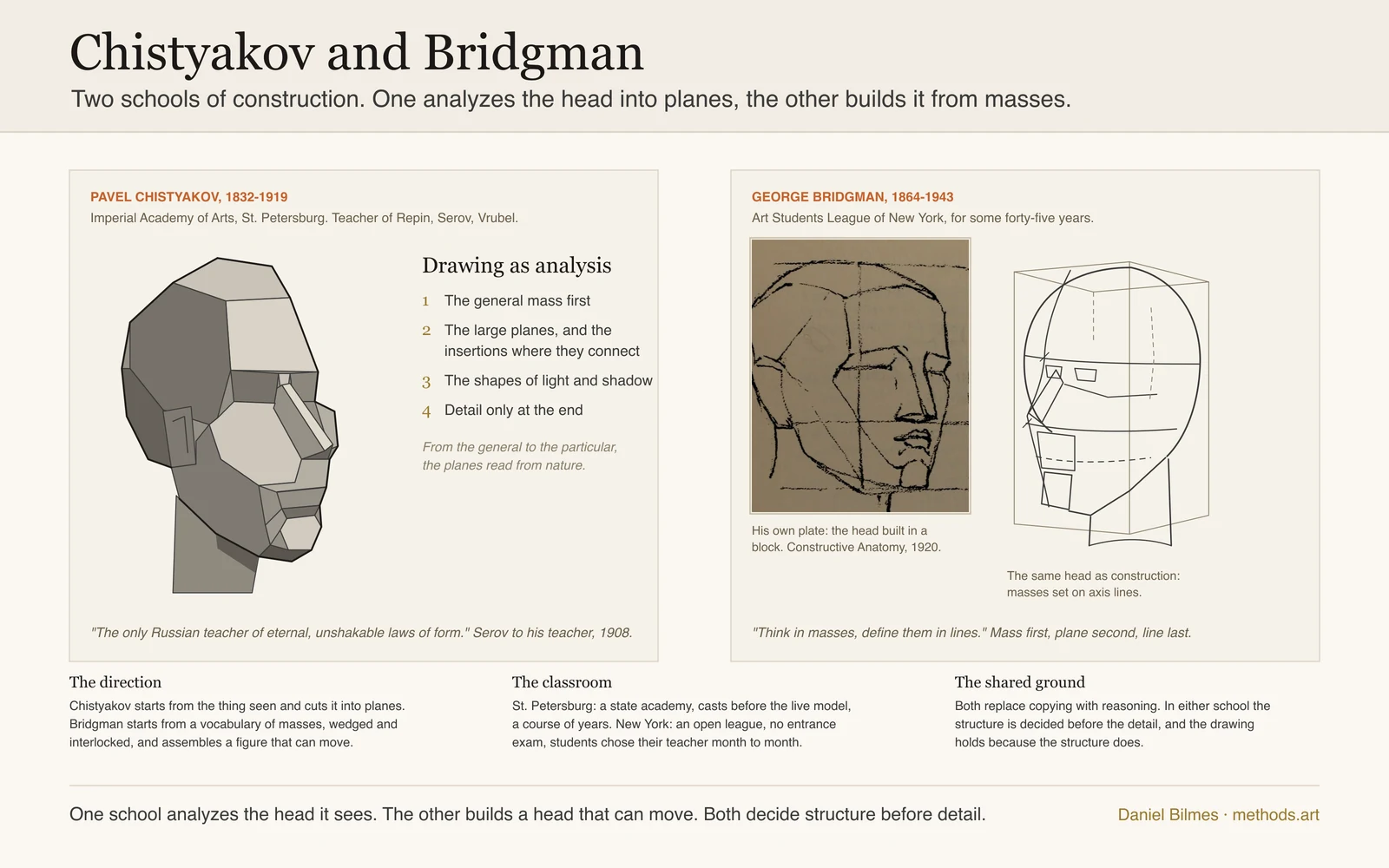
George Bridgman drew the figure by building it from simple solid masses before any detail. He treated the head, chest, and pelvis as three blocks, each with a front, a side, and a top, set them turning in perspective, then wedged them together so they interlocked into a pose with weight and movement. Anatomy and surface came last, fitted onto a structure that already read in three dimensions. He taught this system at the Art Students League in New York for about four decades, from the late 1890s to 1943, where Norman Rockwell was among his students, and he set it down in Constructive Anatomy (1920), which is still in print. The method is anatomy for action, a compact formula a beginner can carry to any figure, with the honest tradeoff that the formula can override observation if you let it.

Signature moves

Conceive the head, chest, and pelvis as blocks

Treated the three big masses of the torso as solid boxes with a front, a side, and a top, before any contour or muscle was drawn.

Why it matters · A box has planes, and planes turn in light and in space. Starting from the block means the figure has volume and direction from the first mark, so the detail later sits on a form that already reads in three dimensions instead of a flat outline.

George Bridgman, Constructive Anatomy, the masses of head, chest and pelvis conceived as blocks, 1920

Drive the masses in perspective before drawing detail

Set the blocks turning and tilting in space, in perspective, and settled their direction and tilt first, leaving anatomy and surface for last.

Why it matters · Most figure drawing dies because the detail is correct but the big forms do not sit in space. Bridgman reversed the order. Get the masses pointing the right way first, and a roughly drawn arm on a true structure beats a beautifully shaded one on a collapsed one.

George Bridgman, Constructive Anatomy; The Human Machine, 1920

Wedge the masses into each other

Saw the body as masses that interlock by wedging, one form driving like a wedge into the next, the high point of one mass meeting the low point of its neighbour.

Why it matters · Wedging is how Bridgman kept a built figure from reading as stacked boxes. The opposed, interlocking masses give the pose torsion and life. It is the idea that turns a constructed figure into one that twists and carries weight.

George Bridgman, Constructive Anatomy, "the effective conception is that of wedging", 1920

Find the movement through the whole figure

Tracked a continuous movement, an active line or plane or mass running through the pose, so the figure was built around its action, not assembled part by part in isolation.

Why it matters · Bridgman taught the figure as anatomy for action, not the inert anatomy of a medical plate. The eye follows a moving line, plane, or mass, so the drawing is organised around where the body is going, which is what makes a pose look alive rather than posed.

George Bridgman, Constructive Anatomy, "the eye in drawing must follow a line or a plane or a mass", 1920

Teach from a repeatable formula

Reduced figure construction to a compact, teachable system of masses, planes, and wedges that a student could carry to any pose, and drilled it for about four decades at the Art Students League.

Why it matters · A formula is a double-edged thing, and Bridgman knew it. The Lloyd Goodrich line is that he could not have taught without one. The system gives a beginner a way in on any figure. The cost, which his own school records honestly, is that the formula can override what is actually in front of you.

The Art Students League of New York, LINEA essays on Bridgman (Goodrich on the "formula")

Subordinate the model to the construction

Drew from the living model in the League class, but bent what he saw toward the underlying blocks and movement rather than copying the surface of the pose.

Why it matters · This is the discipline and the risk in one move. Drawing the construction, not the appearance, is why his students could draw a convincing figure from imagination later. The honest caveat, made by later League teachers, is that a stylised construction can read as mechanical if observation is dropped entirely.

The Art Students League of New York, LINEA essays (the Jerry Weiss "too mechanical" critique)
Studio
Light
The drawing classrooms of the Art Students League on West 57th Street in New York, a teaching atelier rather than a private painting studio. He worked from the live model in front of a class.
Position
Teaching at the board and at the easel, demonstrating construction over the student's drawing or on his own sheet, often reworking a student's figure in front of them.
Session length
Class-length sessions across about four decades, from the late 1890s to 1943. His lectures and demonstrations were the core of the League's drawing instruction for a generation.
Tools
Charcoal and chalk on newsprint and drawing paper, the media of construction drawing · Blackboard demonstration for the lecture audience · The live model as the working subject, reshaped toward the construction
Notes
He was a draughtsman and teacher first, so the working record is about drawing the figure, not oil colour. His successor in the League drawing chair was his student Robert Beverly Hale. By some counts he taught tens of thousands of students across his tenure, though the League's own historian treats the largest figures as hyperbole.
Source: The Art Students League of New York, LINEA essays on Bridgman
Palette
Ground
Drawing paper and newsprint. Bridgman's teaching lived in line and mass, so the "ground" is the page, not a primed canvas.
Whites
White chalk for the lit planes of a mass on toned paper
Earths
Charcoal and graphite, the working media of construction drawing
Blacks
Vine and compressed charcoal
Medium
Charcoal, chalk, and ink in his published plates. This record describes a figure-drawing pedagogy, not an oil palette, and is left honest about that rather than inventing pigments.
Quantity
Not applicable to a drawing teacher; left blank rather than guessed.
Source: George Bridgman, Constructive Anatomy and The Book of a Hundred Hands (the published plates), 1920
Workflow, from blank canvas
  1. 1. Block the three big masses

    Lay in the head, the chest (thorax), and the pelvis as three simple boxes, each with a clear front, side, and top plane.

    Why: These three masses are the unchanging core of the figure. Fixing them as blocks first gives the drawing volume and a clear sense of which way each part faces.

  2. 2. Set the masses in perspective and movement

    Tilt and turn the boxes in space, establishing the angle of each and the line of action running through the whole pose.

    Why: A figure reads as alive when the masses point and lean correctly. Settling that before detail means the pose has direction and weight from the start.

  3. 3. Wedge and connect the masses

    Link the boxes with the intervening forms, wedging one mass into the next so the high point of one meets the hollow of its neighbour.

    Why: Wedging gives the figure torsion and keeps a constructed body from looking like stacked blocks. It is where the built figure starts to twist and carry weight.

  4. 4. Lay the rhythm and the active line

    Draw the long, continuous lines that carry the movement through limbs and trunk, grouping the smaller forms under the larger rhythm.

    Why: Rhythm ties separate parts into one action. Without it a correctly proportioned figure can still read as assembled rather than moving.

  5. 5. Add anatomy and surface last

    Only now bring in the specific muscles, the modelling, and the surface detail, fitting them onto the structure already established.

    Why: Detail placed on a true structure sits correctly and reads in three dimensions. Detail drawn first, without the structure, is the common way a figure drawing collapses.

Refusals — what they would not do
  • Refused to start from the outline. The contour is the last thing found, after the masses, not the first thing drawn.
  • Refused inert, medical-plate anatomy, teaching anatomy for action and movement instead.
  • Refused to let surface detail precede the big forms, holding muscles and modelling until the structure was settled.
  • Refused to copy the model's appearance faithfully, bending what he saw toward the underlying construction.
Reference
Primary source
The living model in the Art Students League class, observed and then reshaped toward the constructive masses rather than transcribed at the surface.
Photography
He worked from the life model in the studio. His published teaching is drawn construction, not photographic transcription.
Exceptions
  • His textbook plates are idealised constructions drawn to teach the system, not portraits of specific sitters.
Lineage
Teachers
  • Jean-Léon Gérôme · from 1883, at the École des Beaux-Arts, ParisAcademic training in Paris under one of the most rigorous nineteenth-century draughtsmen, the structural French schooling Bridgman later compressed into his own system.
  • Gustave Boulanger · Paris, 1880sA second academic master in Paris, part of the French atelier grounding behind the Constructive Anatomy method.
Influences
  • The French academic anatomical and life-drawing tradition, reduced to a compact, transmissible system of masses and planes.
Students
  • Norman Rockwell, who studied under Bridgman at the Art Students League around 1911 and credited his wrist-and-structure demonstrations.
  • Andrew Loomis, whose own widely used drawing books carry Bridgman's constructive approach forward.
  • Will Eisner, the comics artist, who cited Bridgman's anatomy.
  • Robert Beverly Hale, his student and successor in the League drawing chair.
  • Frank J. Reilly, who built his own teaching system on a Bridgman foundation.
  • Lee Krasner and Arshile Gorky, who passed through his League classes; Jackson Pollock drew from Bridgman's books.
In their own words
The masses of the head, chest and pelvis are unchanging. Whatever their surface form or markings, they are as masses to be conceived as blocks.
George Bridgman, Constructive Anatomy, 1920
Bridgman stating the core of his system in his own textbook: the figure is built from three block-like masses before anything else.
"See that," he'd say, folding the wrist back toward the forearm, "this structure here does it." "It's a damned wonderful thing," he'd say.
Norman Rockwell, recalling Bridgman's teaching, Norman Rockwell, My Adventures as an Illustrator (Abrams, 1988), p. 58, 1988
Rockwell's memory of Bridgman demonstrating how the structure under the surface drives the form, from his student years at the League.
Techniques and practices
constructive-anatomy
block-mass-construction
figure-as-solids-in-perspective
wedging-of-masses
rhythm-and-movement
anatomy-for-action
teaching-by-formula
Questions and answers

What is Constructive Anatomy?

Constructive Anatomy is George Bridgman's 1920 figure-drawing book and the name of his method. Instead of copying surface anatomy, it builds the figure from simple solid masses, the head, chest, and pelvis as blocks, set in perspective and wedged together, with muscle and detail added last. It has stayed in print for a century in a Dover edition.

Did George Bridgman teach Norman Rockwell?

Yes. Norman Rockwell studied under Bridgman at the Art Students League of New York around 1911. In his memoir Rockwell recalled Bridgman demonstrating how the structure under the surface drives the form. The Norman Rockwell Museum holds a body of Bridgman drawings and confirms the teaching link.

What is the block method of figure drawing?

It is Bridgman's habit of seeing the figure as boxes. The three big masses, head, chest, and pelvis, are drawn as solid blocks with clear planes, set turning in space, before any contour or muscle. Detail on a true block structure reads in three dimensions; detail drawn first, without it, tends to collapse.

What does "wedging" mean in Bridgman's system?

Wedging is how Bridgman connected the masses. One form drives like a wedge into the next, the high point of one mass meeting the hollow of its neighbour, so the body interlocks and twists instead of reading as stacked boxes. It is what gives a constructed figure torsion and weight.

How long did Bridgman teach at the Art Students League?

About four decades, from the late 1890s until his resignation in 1943. He was one of the League's defining drawing teachers, and his student Robert Beverly Hale took over the drawing chair after him. By some counts he taught tens of thousands of students, though the largest figures are treated with caution by the League's own historians.

Are Bridgman's drawing books still worth using?

They remain in print and in wide use a century on, which is the simplest evidence of their staying power. Constructive Anatomy, The Book of a Hundred Hands, and The Human Machine are still studied. The fair criticism, made by later League teachers, is that the system is a formula, so it works best when you keep observing the model rather than leaning only on the construction.

If this painter is your match

You build the figure, you do not trace it. You want the head, chest, and pelvis sitting in space as solid masses before you will let yourself draw a single muscle, because you know detail on a true structure holds and detail on a guess does not.

Borrow this: Before any contour, block the head, chest, and pelvis as three boxes and decide which way each one faces. Tilt them into the pose, wedge them together so they interlock, run one long line of movement through the whole figure, and only then add the anatomy. Structure first, surface last.

Adjacent painters
Ivan Shishkin18321898
The Peredvizhniki landscape master who lived in the forest in summer and reconstructed its anatomy in the studio in winter, using photography and projection as tools of discipline rather than shortcuts.
Vasily Surikov18481916
The Peredvizhniki monumental reconstructionist, who built history paintings like buildings—over years, from authentic artifacts, trained crowds of real faces, and a structural drawing logic inherited from Pavel Chistyakov.
John William Waterhouse18491917
The late-Victorian painter who built mythological narratives by staging them physically—an atelier stocked with authentic antique props, real costumes, and specific hand-selected models rather than invented fictions.
Giovanni Battista Tiepolo16961770
The Venetian Rococo master who planned monumental ceilings through small, fully resolved oil modelli and executed them in wet plaster at the speed a buon fresco giornata demanded.
Primary sources
  1. George Bridgman, Constructive Anatomy, 1920. His foundational text, public domain. Source for the block masses, the wedging conception, and the moving line, plane, and mass. [link]
  2. George Bridgman, The Human Machine, 1939. Later Bridgman title on the mechanics of the figure in movement, extending the constructive system.
  3. The Art Students League of New York, LINEA essays on George Bridgman. The League's own history. Source for the teaching span, the succession to Robert Beverly Hale, the Goodrich "formula" remark, and the "too mechanical" critique. Also the basis for hedging the student-count figure. [link]
  4. Norman Rockwell, My Adventures as an Illustrator (Harry N. Abrams), 1988. Source for Rockwell studying under Bridgman and the wrist-structure demonstration quote (p. 58).
  5. Norman Rockwell Museum / Illustration History, biography of George Bridgman. Confirms the Rockwell teaching link and holds a body of Bridgman drawings. Spells the middle name "Brandt." [link]
  6. Dover Publications, Constructive Anatomy (current in-print edition, ISBN 9780486211046). Evidence the demand is sustained: the 1920 text has stayed in print for a century in an inexpensive Dover edition.
Last researched: 2026-06-25methods.art / painters / bridgman

Educational reference. Artworks remain © their respective rights holders. Removal requests: daniel@methods.art.

See how every master in the atlas worked, indexed by method →