Painters
CB

Charles Bargue

18261883 · France
Researched by Daniel Bilmes, painter and educator.

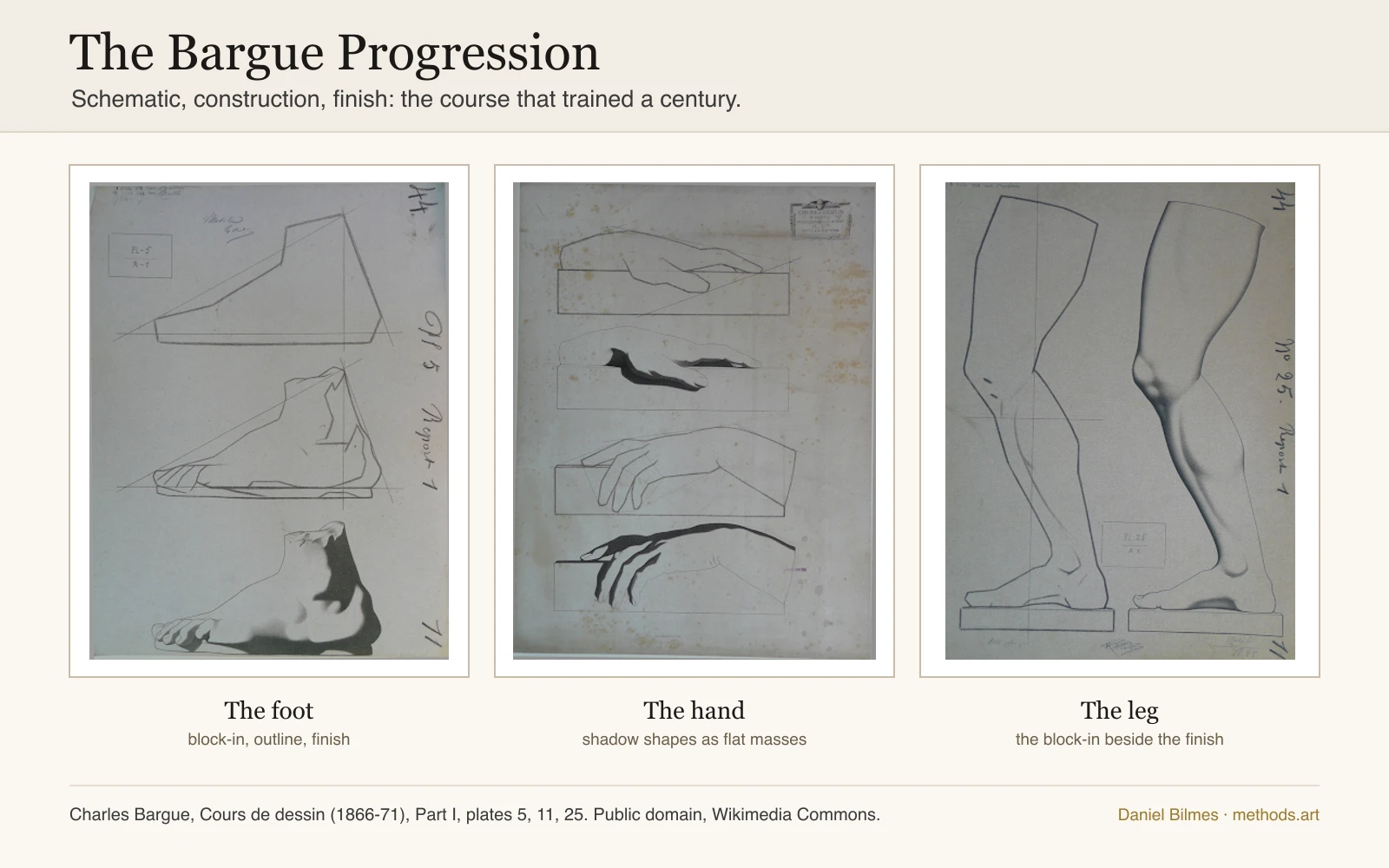
Charles Bargue, with Jean-Leon Gerome, created the drawing course that classical ateliers still start students on. The Cours de dessin, issued by Goupil in parts from 1866 to 1871, is a fixed progression of about 197 lithographed plates in three sections, casts, master copies, and the male nude, each copied exactly: the big outline stated and corrected first, the shadow massed as one accurately drawn flat shape, modelling earned last, and no advancing until the plate is genuinely solved. Van Gogh worked through the course on his own in 1880-81 and returned to it near the end of his life. Out of general use for much of the twentieth century, the course came back to the centre of classical training with Gerald Ackerman and Graydon Parrish's 2003 republication, and it remains the cleanest printed curriculum the academic tradition ever produced. Bargue's own paintings, small and exact, stayed in its shadow; the course is the masterpiece.

Signature moves

Train accuracy through the plates

Built the Cours de dessin as a fixed progression of about 197 lithographed models to be copied exactly: casts first, then master drawings, then the male nude.

Why it matters · Copying a perfect flat model isolates one skill, seeing and stating shape exactly, from all the others. The student confronts their own inaccuracy with nowhere to hide, which is why ateliers still start beginners here before the cast and the model.

Charles Bargue with Jean-Leon Gerome, Cours de dessin (Goupil, published in parts), 1866

State the outline before anything

Demanded the big, accurate contour first, checked and corrected until true, before any interior work was permitted.

Why it matters · The outline is the drawing's contract with proportion. An error caught at the contour costs a correction; the same error discovered after rendering costs the drawing. The discipline transfers directly to painting, where a wrong big shape defeats any amount of good paint.

The plate structure of the Cours de dessin, part I (the cast plates with their schematic first states), 1866

Mass the shadow as one shape

Reduced light and shade to a single big shadow shape against the light, flat and correctly drawn, before any halftone or gradation.

Why it matters · Two values, drawn accurately, already produce form. The big shadow shape is the same discipline the tonal painters used at the easel, taught at its cleanest, and it inoculates the student against the beginner's disease of modelling with fifty timid greys.

The shaded states of the cast plates, Cours de dessin, 1866

Progress only through mastery

Ordered the course so each plate's problem must be genuinely solved before the next, from schematic cast outlines to full academies.

Why it matters · The progression is the pedagogy: difficulty arrives in single increments, so failure always has one cause you can find. It is the same unskippable-sequence principle as Chistyakov's system, embodied in a printed object any student anywhere could use.

The three-part structure of the Cours de dessin (casts; master copies; academies), 1868

Keep the painter's own work small and exact

Painted little himself: refined, small-format genre and orientalist cabinet pictures, finished with the same exactness the plates teach.

Why it matters · The honest shape of his career: the teaching object is the masterpiece. But the pictures matter as proof that the discipline was his own practice, not theory, and their polish shows what the plate training is for.

The standard accounts of Bargue's independent painting (Goupil circle, d. 1883)
Studio
Light
The Goupil publishing house's orbit in Paris: Bargue worked as a lithographer-draughtsman of exceptional exactness, alongside a small painting practice.
Position
At the lithographic stone and the easel; the course was drawn plate by plate across five years in collaboration with Gerome, the Ecole des Beaux-Arts's most famous master.
Session length
The Cours de dessin was issued in parts from 1866 to 1871; his painting career ran refined and small until his death in 1883.
Tools
Lithography of near-photographic exactness: the plates themselves · Pencil and crayon in the drawing models · Oil in the small cabinet pictures
Notes
The course was commissioned by Goupil for art schools and went worldwide; Van Gogh worked through the plates on his own, twice, at the start of his artistic life in 1880-81 and again near its end. Out of general use for much of the twentieth century, the course returned to the centre of classical training after Gerald Ackerman's 2003 republication with Graydon Parrish, and it is now the standard first curriculum of the atelier revival.
Source: Gerald M. Ackerman with Graydon Parrish, Charles Bargue: Drawing Course (ACR Edition), 2003
Palette
Ground
The lithographic plate and the drawing sheet: the record of a draughtsman whose masterpiece is a curriculum.
Whites
The paper reserved as the light: the plates teach light by leaving it
Earths
Crayon and lithographic chalk in the models
Blacks
The single shadow value of the schematic states
Medium
Lithography and pencil for the course; oil in the small pictures. The teaching object addresses drawing only, and stays honest about it.
Source: The plates of the Cours de dessin, 1866
Workflow, from blank canvas
  1. 1. Place the big outline

    State the model's largest contour accurately: measured, compared, corrected until true.

    Why: Proportion errors are cheapest at the contour. Everything after inherits it.

  2. 2. Mark the schematic points

    Fix the key landmarks and angle-changes the plates make explicit in their first states.

    Why: The schematic state is the plate's teaching: what to check, in what order, before committing.

  3. 3. Draw the shadow shape

    Mass the entire shadow as one flat, accurately drawn shape against the light.

    Why: Two true values already read as form; gradation earned later refines what is already right.

  4. 4. Model within the masses

    Only now grade the halftones inside light and shadow, keeping the two families distinct.

    Why: Modelling that respects the big separation keeps carrying power; modelling that blurs it goes grey.

  5. 5. Advance one plate at a time

    Move to the next plate only when this one is genuinely solved; casts, then master copies, then the figure.

    Why: Single-increment difficulty means every failure has a findable cause. The progression is the teacher.

Refusals — what they would not do
  • Refused interior detail before the outline was true.
  • Refused gradation before the big shadow shape was stated and right.
  • Refused to let the student skip plates: mastery, not completion, advanced the course.
  • Refused prose: the course teaches by plates and progression, not by text.
Reference
Primary source
The plate as the model: a perfected flat original that isolates accuracy of seeing from every other problem, before the student graduates to the cast and the live model.
Photography
The plates are the era's answer to mechanical aids: exactness trained in the hand and eye rather than delegated.
Exceptions
  • Part II is master copies: the course itself institutionalises copying-to-learn from Holbein and the masters.
Lineage

Every teacher and student below sits on the site-wide teacher-student map.

Teachers
  • Jean-Leon Gerome · collaboration, 1866-1871The Ecole des Beaux-Arts master co-authored and authorised the course; Bargue drew it. The plates carry the Beaux-Arts standard into print.
Influences
  • The French academic cast-and-copy tradition, distilled into the cleanest printed curriculum the tradition ever produced.
Students
  • Vincent van Gogh, who copied the course through on his own in 1880-81 at the start of his artistic life, and returned to the plates near its end.
  • The classical atelier revival worldwide, which readopted the course as its first curriculum after the 2003 Ackerman-Parrish republication.
Techniques and practices
bargue-plates
sight-size-copying
accurate-outline-first
big-shadow-shape
staged-plate-progression
Questions and answers

What is the Bargue Drawing Course?

A three-part progression of about 197 lithographed plates by Charles Bargue with Jean-Leon Gerome (Goupil, 1866-1871): plaster casts, master copies, then male academies. Students copy each plate exactly, outline first, shadow massed as one shape, advancing only on mastery. It is the standard first curriculum of classical ateliers today.

Did Van Gogh use the Bargue plates?

Yes, intensively. He worked through the course on his own in 1880-81 at the very start of his artistic life, and returned to copying the plates near the end. The letters document it, which makes the course one of the few teaching objects connecting academic training to Van Gogh's formation.

Why do ateliers still start with Bargue plates?

Because copying a perfected flat model isolates the first skill, seeing and stating shape exactly, from every other problem. Difficulty arrives one increment at a time, so failure always has a findable cause. Most classical programs run Bargue plates before casts, and casts before the live model.

What does a Bargue plate actually teach?

Three disciplines: an accurate big outline before any interior work, light and shade reduced to one correctly drawn shadow shape, and restraint in modelling so the two value families stay distinct. All three transfer directly to painting, where the big shapes decide everything.

Where can I get the Bargue course today?

Gerald M. Ackerman and Graydon Parrish's republication, Charles Bargue: Drawing Course (ACR Edition, 2003), restored the full plate set and is the edition ateliers use. High-resolution scans of individual plates also circulate for study; working at sight-size from good prints is standard practice.

If this painter is your match

You believe accuracy is trainable and worth training pure: one problem at a time, the outline before the modelling, the big shadow before the halftones, and no advancing on a fudge.

Borrow this: Run a Bargue plate the atelier way: copy one cast plate at sight-size, outline first, corrected until true, then the shadow massed as one flat shape, then restrained modelling. One plate done to mastery teaches more than ten done to completion.

Adjacent painters
Andrew Loomis18921959
The American illustrator-teacher who built heads from a ball and plane, unified pictures under one light with his form principle, and wrote the six drawing books painters still start with.
Louise Bourgeois19112010
A French-American sculptor who returned compulsively to drawing and painting through six decades of nightly insomnia, treated the daily mark as self-administered psychoanalysis, and built a private cosmology of red, spirals, spiders, and houses.
George Bridgman18641943
The Art Students League drawing teacher who built the figure from blocky masses set in perspective, fixed the structure and the movement before any surface detail, and trained a generation of American illustrators.
Pieter Bruegel the Elder15251569
A Flemish master who sketched the Alps on horseback in 1552 and for the rest of his life composed his panel paintings in the studio from a library of those drawings, a set of peasant-wedding field notes, and a habit of "moralizing" every scene through absurdist humor.
Primary sources
  1. Charles Bargue with Jean-Leon Gerome, Cours de dessin (Goupil, issued in parts), 1866. The course itself: about 197 plates in three parts (casts; master copies; male academies), issued 1866-1871.
  2. Gerald M. Ackerman with Graydon Parrish, Charles Bargue: Drawing Course (ACR Edition), 2003. The modern republication that returned the course to atelier training; the standard scholarly account of Bargue's life and the course's structure.
  3. The Van Gogh letters and the standard Van Gogh literature on his Bargue copies. Documents Van Gogh working through the course in 1880-81 and returning to the plates late in life.
  4. Goupil et Cie records and the standard accounts of Bargue's painting (d. 1883). The publishing context and the small, refined independent painting career.
Last researched: 2026-07-13methods.art / painters / charles-bargue

Educational reference. Artworks remain © their respective rights holders. Removal requests: daniel@methods.art.

See how every master in the atlas worked, indexed by method →