Van Gogh built his impasto by loading stiff fitch and hog-bristle brushes with paint straight from the tube and driving them into the canvas under heavy pressure. No medium, no blending. Each mark stayed where it landed, so its direction had to describe the form: spiraling strokes in the Starry Night sky, furrows across the wheat fields. His palette ran on synthetic pigments (chrome yellows, geranium lake) that he knew would fade, so he laid them on at higher intensity to compensate.
Build a homemade perspective frame with iron spikes
Designed and built a wooden grid in The Hague in 1882 — iron spikes on the legs to drive into the ground at the motif, a grid of string or thread dividing the aperture into quarters with both diagonals. Looked through it to crop the scene and establish perspective lines before drawing.
Why it matters · The frame is the technical device that lets a painter draw "at lightning speed" and fix the composition before the light shifts. Painters who do not use a mechanical aid for perspective drift through every plein-air session. Van Gogh's frame underwrites the entire rapid landscape production.
Letter to Theo van Gogh, The Hague, 5 or 6 August 1882, 1882
Paint for a future state — apply non-lightfast pigments at higher intensity
Knew geranium lake (eosin-based red) and certain chrome yellows would fade. Deliberately applied them at higher chromatic intensity to compensate for the future fade.
Why it matters · A painting changes over decades. Van Gogh's discipline of painting for a hypothetical future state is the cleanest case for treating temporal change as part of the medium. Painters who only paint for the present finish miss what the painting will look like in fifty years.
Letter to Theo van Gogh, Arles, 1888
Use brushwork direction as form description
The radiating strokes of the olive groves, the spiral strokes of the Starry Night sky, the directional furrows of the wheat fields. Brushwork is form. Mark of the brush is the final mark — Van Gogh did not blend his impasto.
Why it matters · Most painters use brushwork to describe surface. Van Gogh used direction to describe rhythm. Painters who only ever vary tone miss the second axis the brushwork can carry.
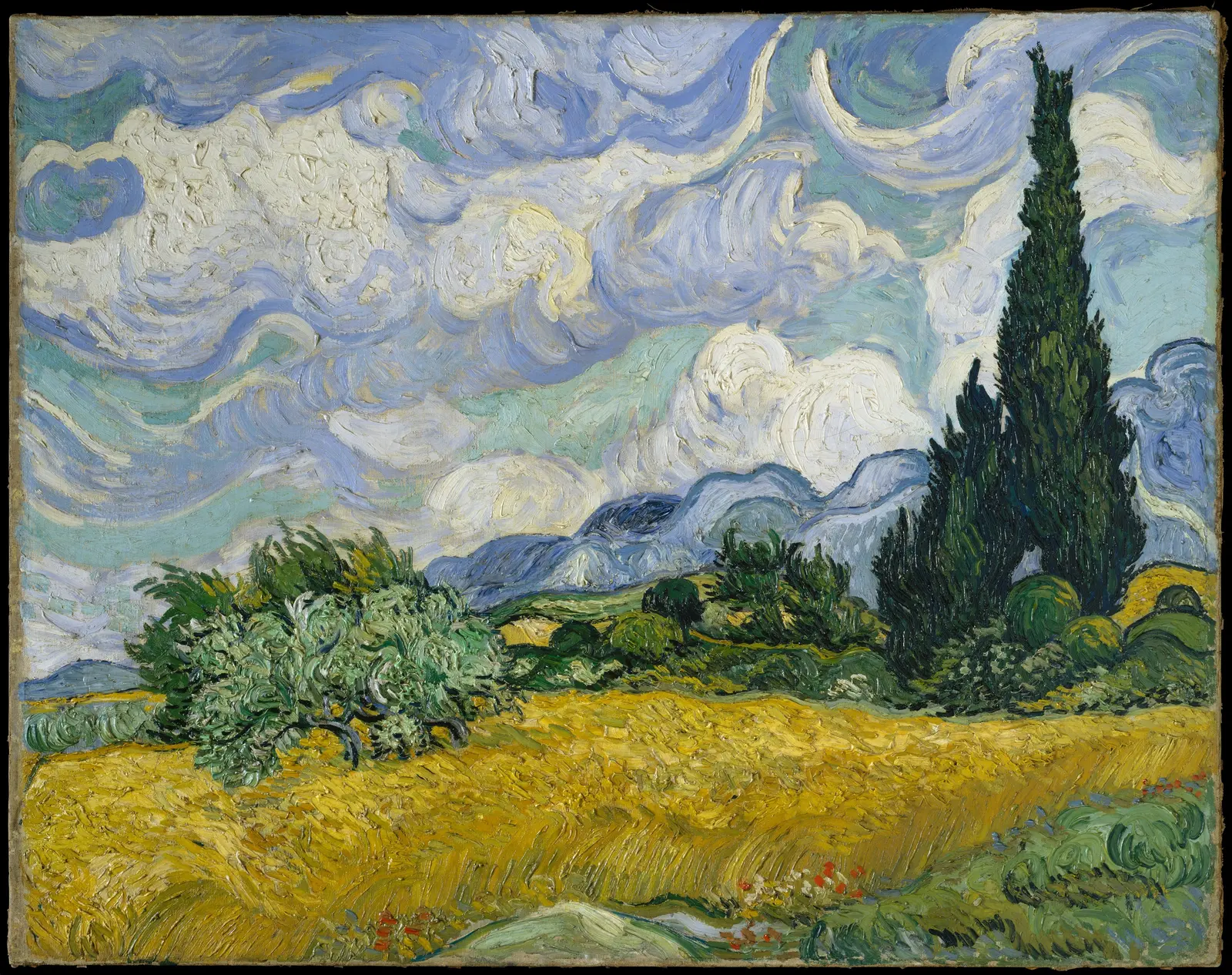
Wheat Field with Cypresses, painted at Saint Remy in 1889 on a canvas seventy three by ninety three centimetres. Every part of it is built from strokes that run the way the thing itself runs. The wheat lies over in flat horizontal drags, the olive bush curls back on itself, the cypress climbs in one continuous twist, and the cloud turns. Nothing is blended, so the direction of the mark is doing the drawing.
Vincent van Gogh, Wheat Field with Cypresses, 1889, oil on canvas, 73.2 by 93.4 centimetres, The Metropolitan Museum of Art, New York, accession 1993.132. Public domain, Wikimedia Commons.
Order paint by the kilogram from Theo
Heavily dependent on his brother Theo for materials. Arles period saw Van Gogh ordering paint from Tasset et L'Hôte in Paris through Theo in bulk: ten tubes of zinc white, five chrome yellow, five emerald green at a time.
Why it matters · A specific painter's output requires a specific supply line. Van Gogh's production rate was contingent on Theo's logistics. Painters who do not budget materials in proportion to their working rate run out at the worst moment.
Translate prints into color as compositional control
In Saint-Rémy translated black-and-white photographic prints by Millet, Rembrandt, and Delacroix into color. Treated them as compositional scores he would "orchestrate" — explicit in his letters that the method was analogous to a musician performing another composer's work.
Why it matters · A fixed compositional structure as a control variable lets the painter focus on color decisions in isolation. Painters who only ever invent compositions miss what they could learn from translating fixed structures into their own register.
Stand at the easel and press loaded brush into canvas
Painted standing, pressing the loaded brush into the canvas with significant physical force — one reason the impasto stands in high ridges across his mature surfaces.
Why it matters · The mark records the body. Painters who paint seated produce different surfaces. Van Gogh's standing pressure is methodological.
Key the whole picture to one pair of opposites
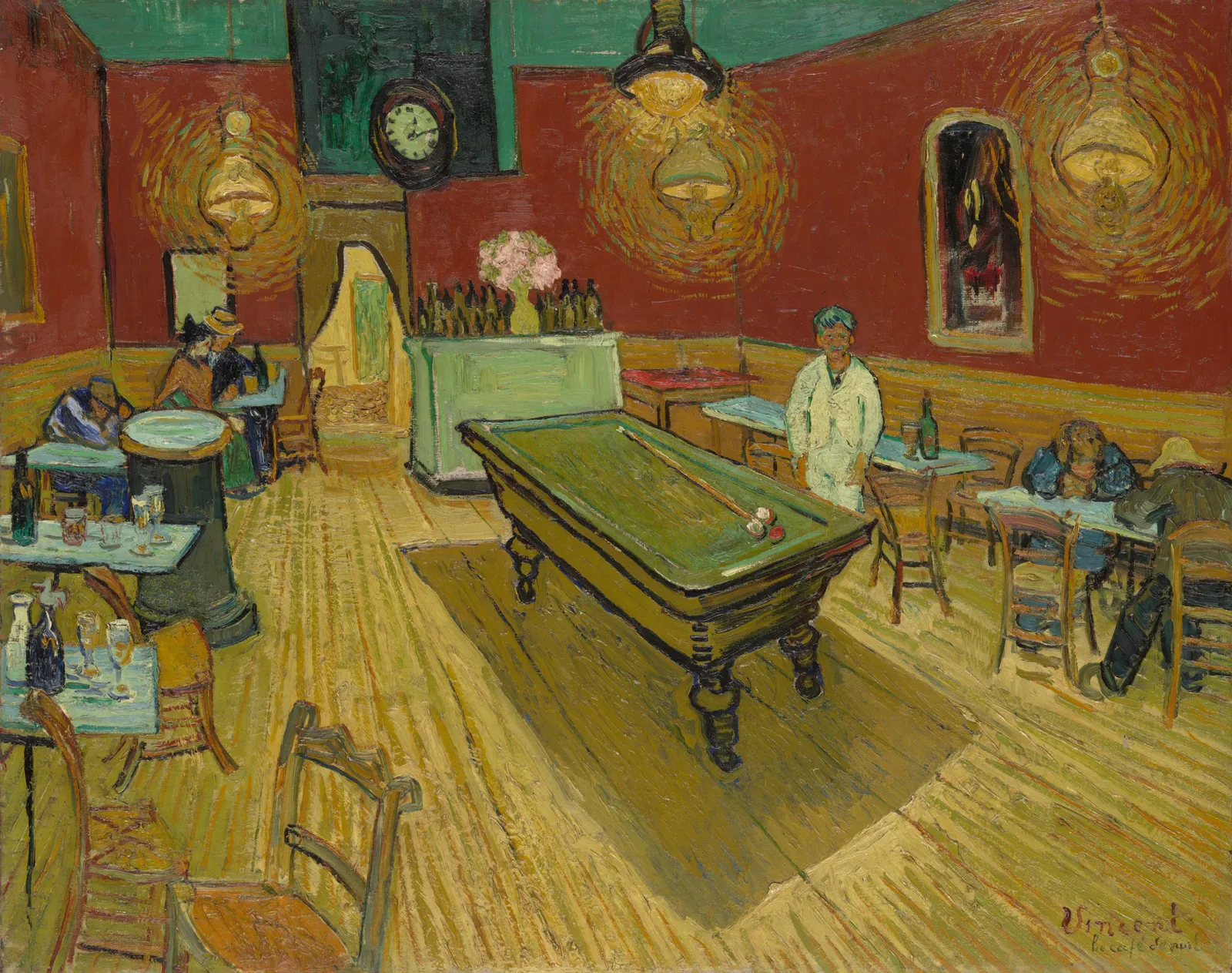
Chose the colour pair before the subject and let it run the picture. Of the Night Cafe he wrote to Theo: "I've tried to express the terrible human passions with the red and the green." The wall is blood red, the ceiling green, and nothing neutral is put between them.
Why it matters · Two colours opposite each other on the wheel get louder where they touch and quieter the moment anything grey is set between them. Van Gogh used that as the structure of the picture and not as a finishing accent, so the choice is made before the first mark. A painter who mixes everything toward grey never finds out what one opposition can carry on its own.
Letter 676 to Theo van Gogh, Arles, Saturday, 8 September 1888, 1888
The Night Cafe, painted over three nights in September 1888 on a canvas seventy two by ninety two centimetres. Red wall against green ceiling, green billiard table on a yellow floor, four gas lamps ringed in orange. He listed it to Theo as blood red and dull yellow with a green billiard table, and called it everywhere a battle and an antithesis of the most different greens and reds.
Vincent van Gogh, The Night Cafe, September 1888, oil on canvas, 72.4 by 92.1 centimetres, Yale University Art Gallery, New Haven, accession 1961.18.34. Public domain, Wikimedia Commons.
Draw with a reed pen when there is no money for paint
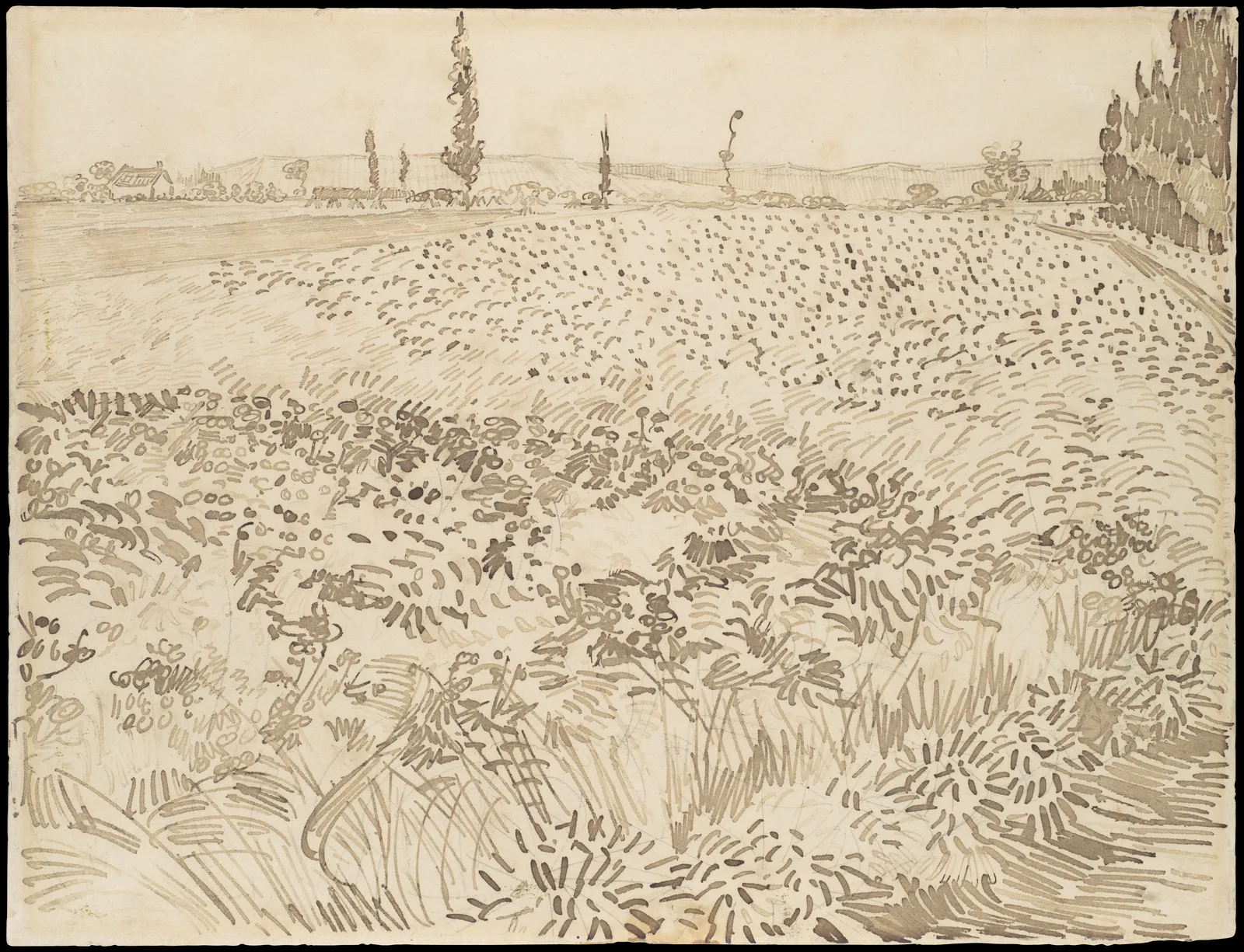
Switched to a reed pen in Arles, a nib cut from a length of reed, used with logwood or brown ink over a fast graphite lay-in. The nib is blunt and holds little ink, so the line comes out as dots, hooks, dashes and short parallel strokes rather than as continuous contour.
Why it matters · A tool that cannot make a smooth tapering line forces every mark to be a decision about weight and direction, which is exactly the decision the paintings are made of. The drawings cost a reed and some ink, so he could keep working at full rate through the months when a paint order had not arrived. In his own accounting to Theo: canvases and paints only cost us money, drawings, though, don't cost us much.
Medium recorded by The Metropolitan Museum of Art for both sheets used here: reed pen and logwood ink over graphite on wove paper (64.125.3), and reed pen, quill, and brown ink over graphite on wove paper (48.190.1). The line on the cost of drawings: letter 628 to Emile Bernard, Arles, on or about 19 June 1888, 1888
Wheat Field, drawn at Arles in July 1888 on a sheet twenty four by thirty two centimetres. The far hills are one thin line, the middle field is stippled in dots, and the near corn is drawn in the same hooked strokes he was putting down in paint that month. The paper carries the light and the ink carries everything else.
Vincent van Gogh, Wheat Field, July 1888, reed pen and logwood ink over graphite on wove paper, 24.1 by 31.7 centimetres, The Metropolitan Museum of Art, New York, accession 64.125.3. Public domain, Wikimedia Commons.
In the studio
Vincent van Gogh, Self-portrait, 1889 — painted during his confinement at the Saint-Rémy asylum
Studio
Light
Outdoor sessions at the motif; modest temporary studios. Yellow House in Arles (rented May 1888). Asylum room at Saint-Rémy (May 1889 – May 1890). Auberge Ravoux room at Auvers-sur-Oise (last seventy days).
Position
Standing, pressing loaded brush into canvas with physical force.
Session length
First light to evening — 7 a.m. to 6 p.m. with brief food breaks. One finished work every two working days across a decade.
Tools
Homemade perspective frame (wooden grid with iron spikes; thread dividing aperture into quarters and diagonals) · Fitch brushes (polecat hair) and large black hog-bristle brushes — often ordered twenty-five at a time · Bulk pigments ordered through Theo from Tasset et L'Hôte in Paris · Candles clipped to hat brim for night drawing scenes
Notes
Across roughly ten years (1880–1890) produced ~860 oil paintings and ~1,200 works on paper. Letters to Theo are the most complete working record any major painter has left. September 1889 letter records working "from seven in the morning till six in the evening without stirring except to take some food a step or two away."
Source: Vincent van Gogh — The Letters, Van Gogh Museum/Huygens ING [link]
Palette
Ground
Commercially prepared linen or cotton, often the lightweight "absorbent" cheapest grade. Stretched some canvases himself when Arles suppliers ran out. Single-layer commercial priming, sometimes a warm chalk-oil imprimatura modified by painting a colored underlayer directly over the commercial ground (combined-ground-and-underpainting shortcut).
Whites
Lead white · Zinc white (increasingly replaced lead in later work)
Earths
Yellow ochre · Red ochre
Colors
Chrome yellows (primary, middle, deep) · Cadmium yellow · Vermilion · Carmine lake, geranium lake, madder · Cobalt blue · French ultramarine · Prussian blue (retained as economical deep blue) · Emerald green · Viridian · Chrome green
Blacks
Ivory black
Medium
No medium beyond a little turpentine for thinner passages. Provence heat evaporated turpentine too fast, leaving paint film under-bound — significant long-term preservation problems with Arles and Saint-Rémy surfaces.
Quantity
Loaded; bulk-ordered.
Source: Inge Fiedler et al., Van Gogh's Materials and Techniques, 2016
Workflow, from blank canvas
1. The perspective frame
Drove the iron-spiked frame into the ground at the motif. Looked through the gridded aperture to crop the scene and establish perspective lines.
Why: Locks the composition before any drawing or paint. Lets the painter draw at speed.
2. The drawing
Bold outlines in pencil, pen, or brush placed directly on canvas or paper. Contour remained visible in the finished painting.
Why: The drawing is structural. Sent "croquis" sketches to Theo in letters showing the composition just completed in paint — these small sketches are the most reliable surviving record of what many lost works looked like.
3. Underpainting and ground modification
Colored imprimatura applied directly over the commercial ground to establish the chromatic key — yellow or chrome-yellow ground in the Arles sunflowers; pink or pale-violet in the wheat fields.
Why: The ground colour is the painting's base chord.
4. Impasto application
Loaded fitch or hog-bristle brushes driven directly into the canvas without medium. Mark of the brush is the final mark; impasto unblended. Direction of stroke describes form.
Why: The painting's rhythm is the subject.
5. Repetitions and translations
Several versions of Sunflowers, Bedroom, Postman Roulin. Translations of black-and-white prints by Millet and Rembrandt into color.
Why: Translations were systematic colour experiments using a fixed compositional structure as a control variable.
How they studied
Van Gogh started drawing at twenty seven with no training, so he set himself a course. In September 1880, from Cuesmes in the Borinage, he told Theo he had wanted to do Bargue's Exercices au fusain, which Mr Tersteeg has been so kind as to lend me, and now I've finished the 60 sheets. Those are sixty lithographed plates, a graded drill in contour and proportion, copied one after another at the same size. Everything after that was short. Anton Mauve, a Hague School painter and his cousin by marriage, set up a still life in front of him in December 1881 and began by saying, this is how you should hold your palette, then looked at the studies and told him, you're too close to your model. He enrolled at the Antwerp academy in January 1886 and was gone by March. Of the atelier in Paris he wrote, in his own English, to a painter he had known in Antwerp: I have been in Cormons studio for three or four months but did not find that as useful as I had expected it to be. It may be my fault however, any how I left there too as I left Antwerp and since I worked alone, and fancy that since I feel my own self more. What he did instead of school was build a tool. In August 1882 he came back from the blacksmith, who has put iron spikes on the legs and iron corners on the frame, and wrote that with it, on the beach or in a meadow or a field you have a view as if through a window, and that with considerable practice it enables one to draw at lightning speed.
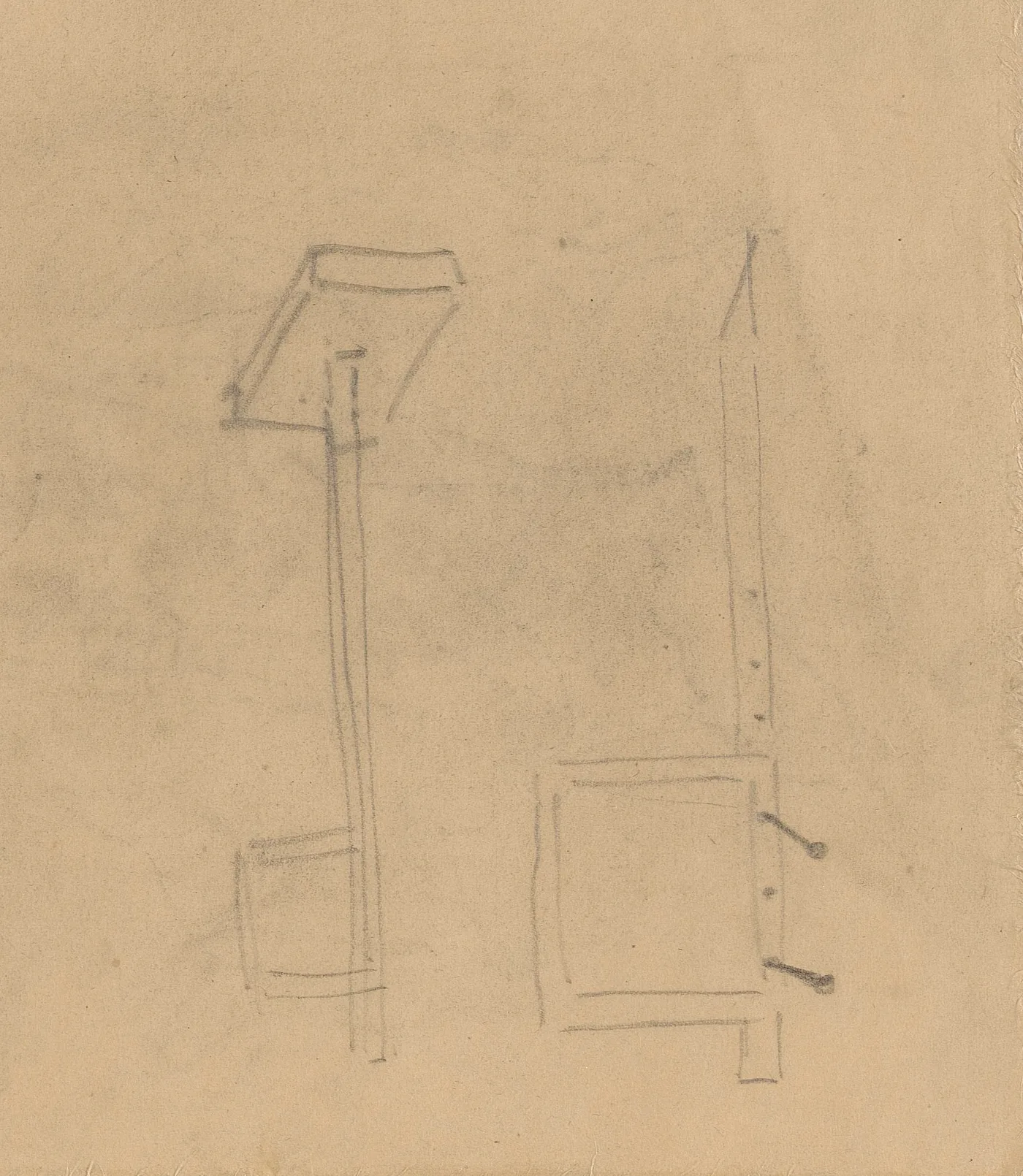
Two small pencil studies of the perspective frame, on a sheet in the Van Gogh Museum the catalogue dates to Auvers in 1890, eight years after he had the first one made. He is still working out the joint: the frame head sitting on its post at the left, the leg and its stake at the right. The whole sketch is about twelve centimetres tall, in faint pencil, drawn to be used and not to be looked at.
Vincent van Gogh, Sketches of a Perspective Frame (F1611v), pencil on paper, on a sheet also carrying Bird's-Eye View of the Village, Van Gogh Museum, Amsterdam, d0209V1969v. Public domain, Wikimedia Commons.
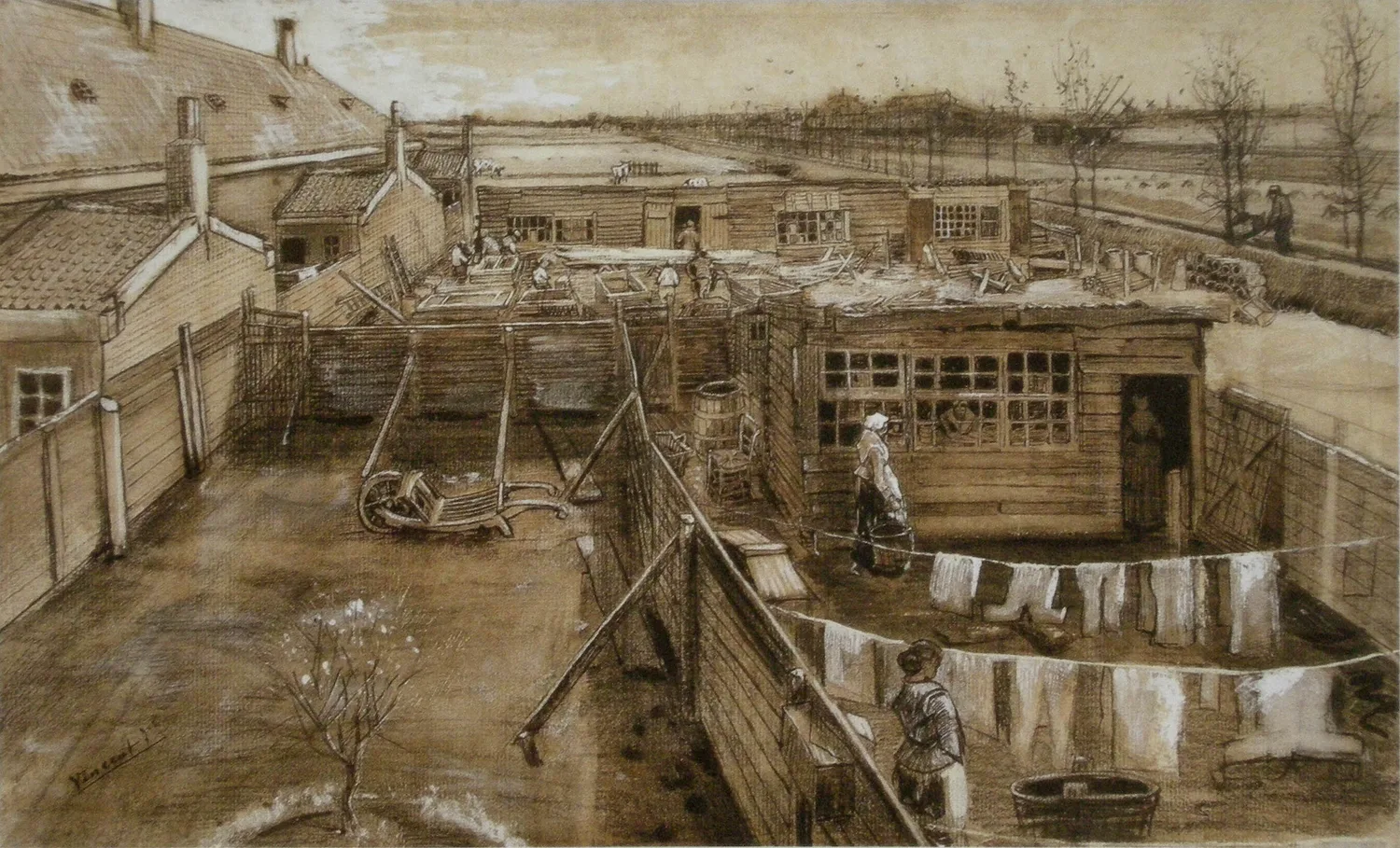
Carpenter's Yard and Laundry, drawn in The Hague in May 1882 on a sheet twenty eight by forty seven centimetres, in pencil, ink, pen and brush heightened with white. Every fence rail, roof line and washing line runs back to the same point. It is also a job: this sheet is one of the townscapes his uncle Cornelis commissioned and paid for.
Vincent van Gogh, Carpenter's Yard and Laundry, May 1882, pencil, ink, pen and brush heightened with white on paper, 28.5 by 47 centimetres, Kroller-Muller Museum, Otterlo. Public domain, Wikimedia Commons.
Source: The sixty Bargue sheets: letter 157, Cuesmes, 7 September 1880. Mauve on the palette and on standing too close: letter 193, Etten, on or about 23 December 1881. Cormon: letter 569 to Horace Mann Livens, Paris, September or October 1886, written by Van Gogh in English. The blacksmith, the iron spikes, the view as if through a window and drawing at lightning speed: letters 253 and 254, The Hague, 5 and 5 or 6 August 1882. All read in Vincent van Gogh: The Letters, Van Gogh Museum and Huygens ING. Carpenter's Yard and Laundry as one of the drawings made for Cornelis Marinus van Gogh: the editorial note to letter 214, The Hague, on or about 2 April 1882. Medium, date, dimensions and holding museum for each figure: read from the museum record through the Commons file.
Up close
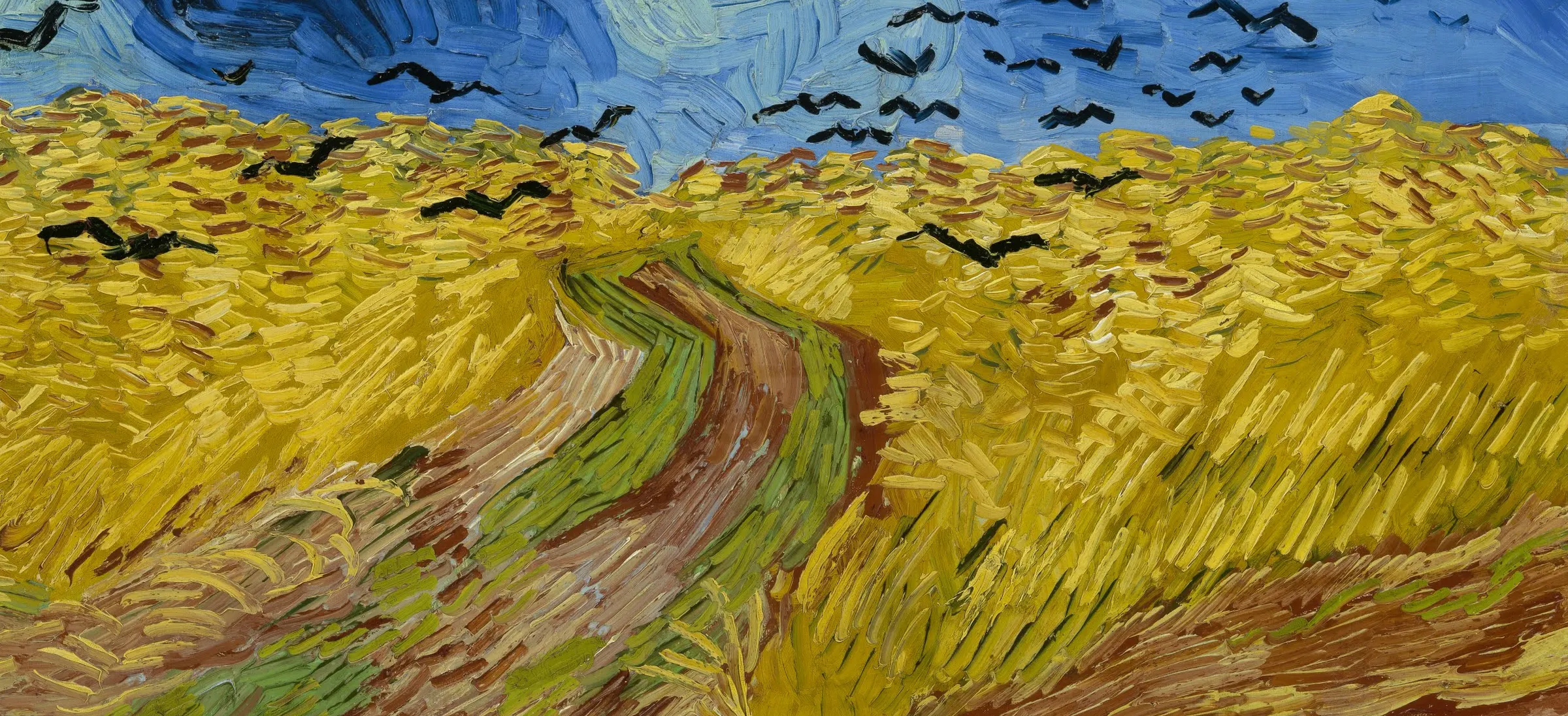
Detail of Wheatfield with Crows, painted at Auvers in the last summer: the corn is laid in short flat blocks lying the way cut corn lies, the track is dragged in long strokes running away from the viewer, and the sky is scrubbed across in bands. No edge is blended anywhere in it, so the direction of each mark is the only thing telling you which way the ground turns.
Vincent van Gogh, Wheatfield with Crows (detail), 1890, Van Gogh Museum, Amsterdam, s0149V1962. Public domain, Wikimedia Commons.
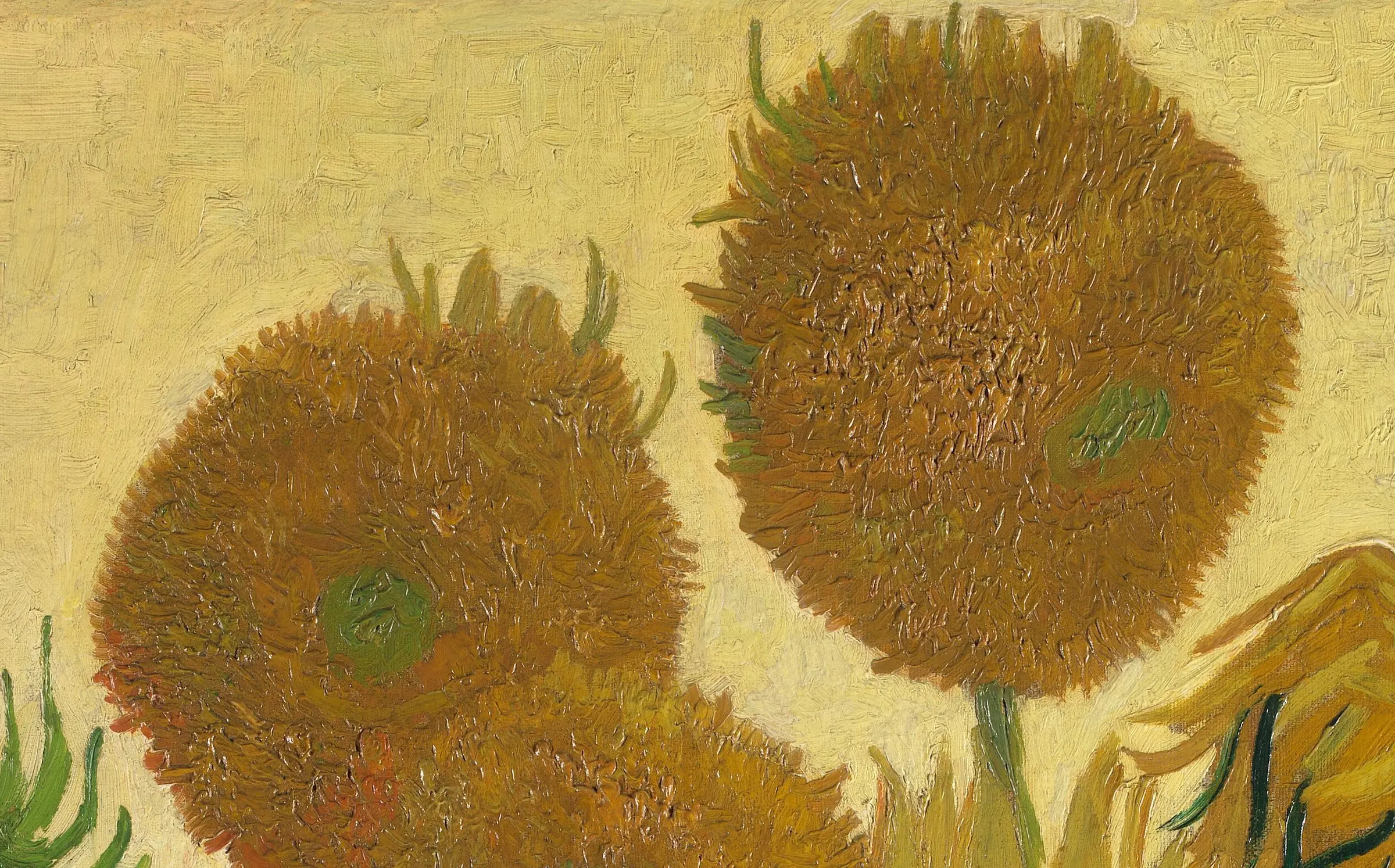
Detail of the London Sunflowers: the seed heads are built in paint thick enough to stand off the canvas and hold the shape of the bristle, and the petals are drawn with the loaded brush rather than filled in afterwards. The ground behind is a slightly cooler yellow, so the whole picture is working inside one colour and the drawing is done by thickness.
Vincent van Gogh, Sunflowers (detail), August 1888, oil on canvas, 92.1 by 73 centimetres, The National Gallery, London, NG3863. Public domain, Wikimedia Commons.
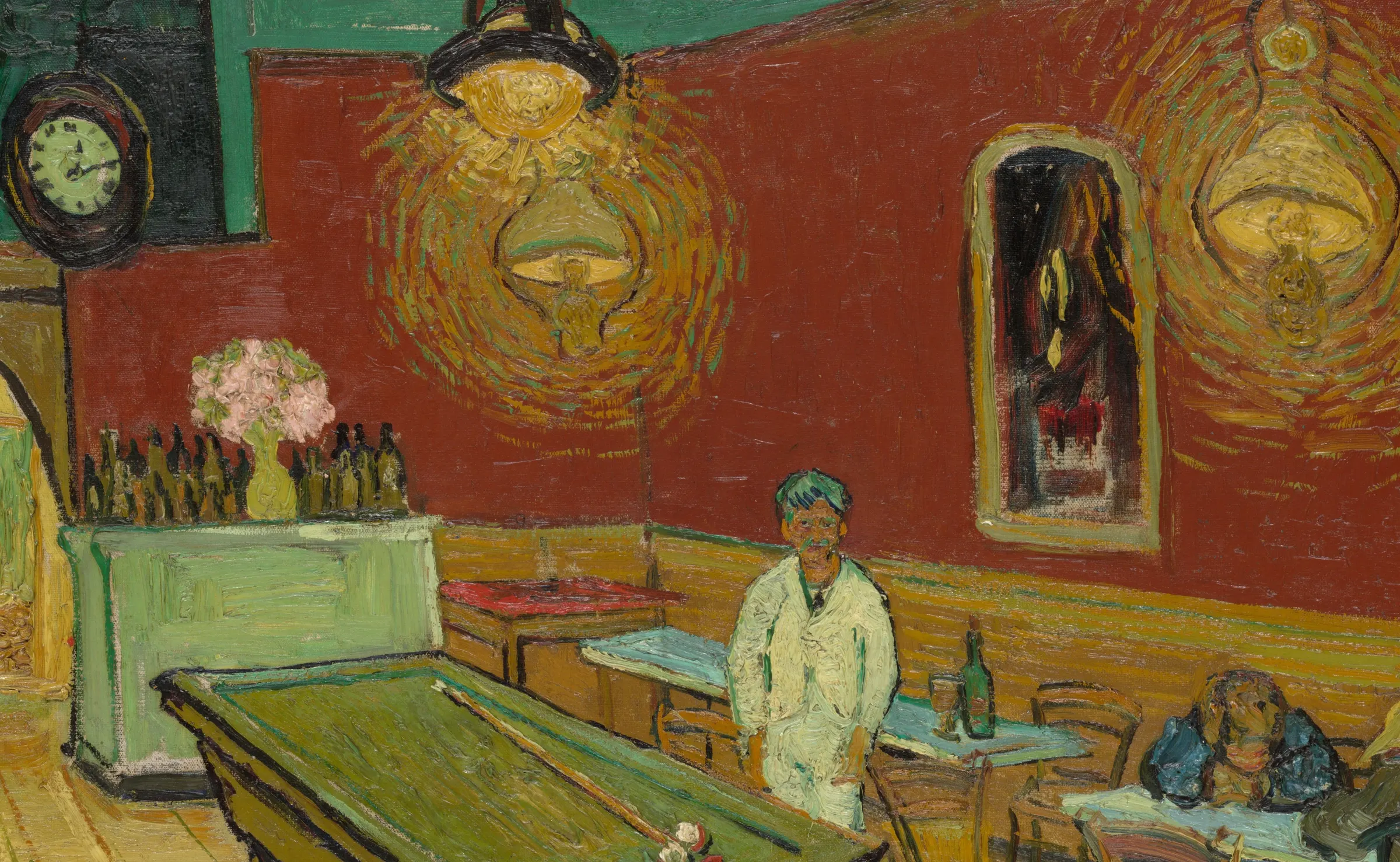
Detail of the Night Cafe: the red wall runs straight into the green ceiling with nothing neutral between them, and the gas lamps are ringed with orange strokes laid over green. The one figure in the room is painted in pale green so it reads against the red without being a third colour.
Vincent van Gogh, The Night Cafe (detail), September 1888, oil on canvas, 72.4 by 92.1 centimetres, Yale University Art Gallery, New Haven, accession 1961.18.34. Public domain, Wikimedia Commons.
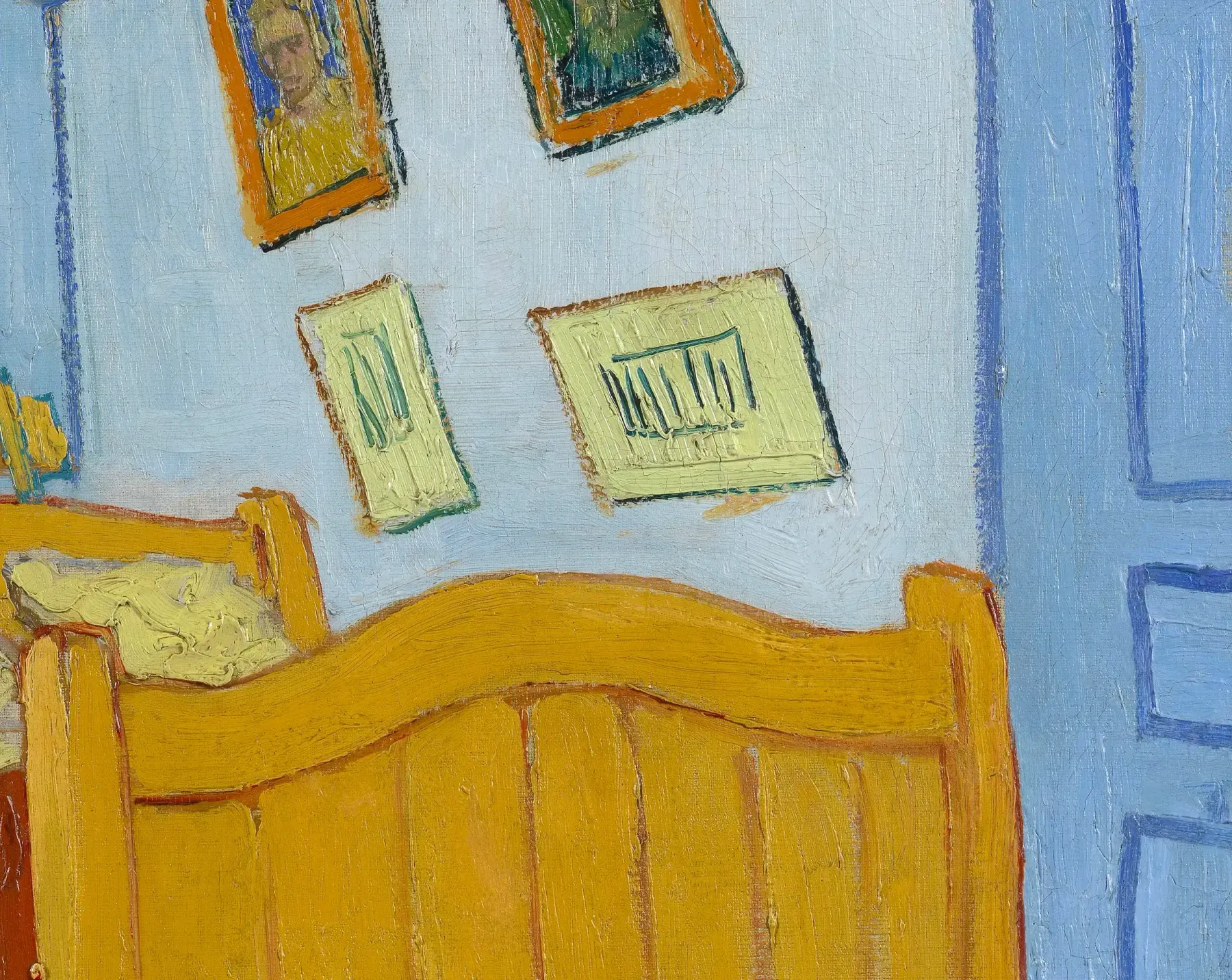
Detail of the first Bedroom. On 16 October 1888 he wrote down what he had just painted: the walls are of a pale violet, the doors lilac. Both read blue now. The red lake that made the violet has gone out of the mixture in the century since, so the colour on this wall today is the colour that survived and not the colour he set.
Vincent van Gogh, The Bedroom (detail), October 1888, Van Gogh Museum, Amsterdam, s0047V1962. Public domain, Wikimedia Commons.
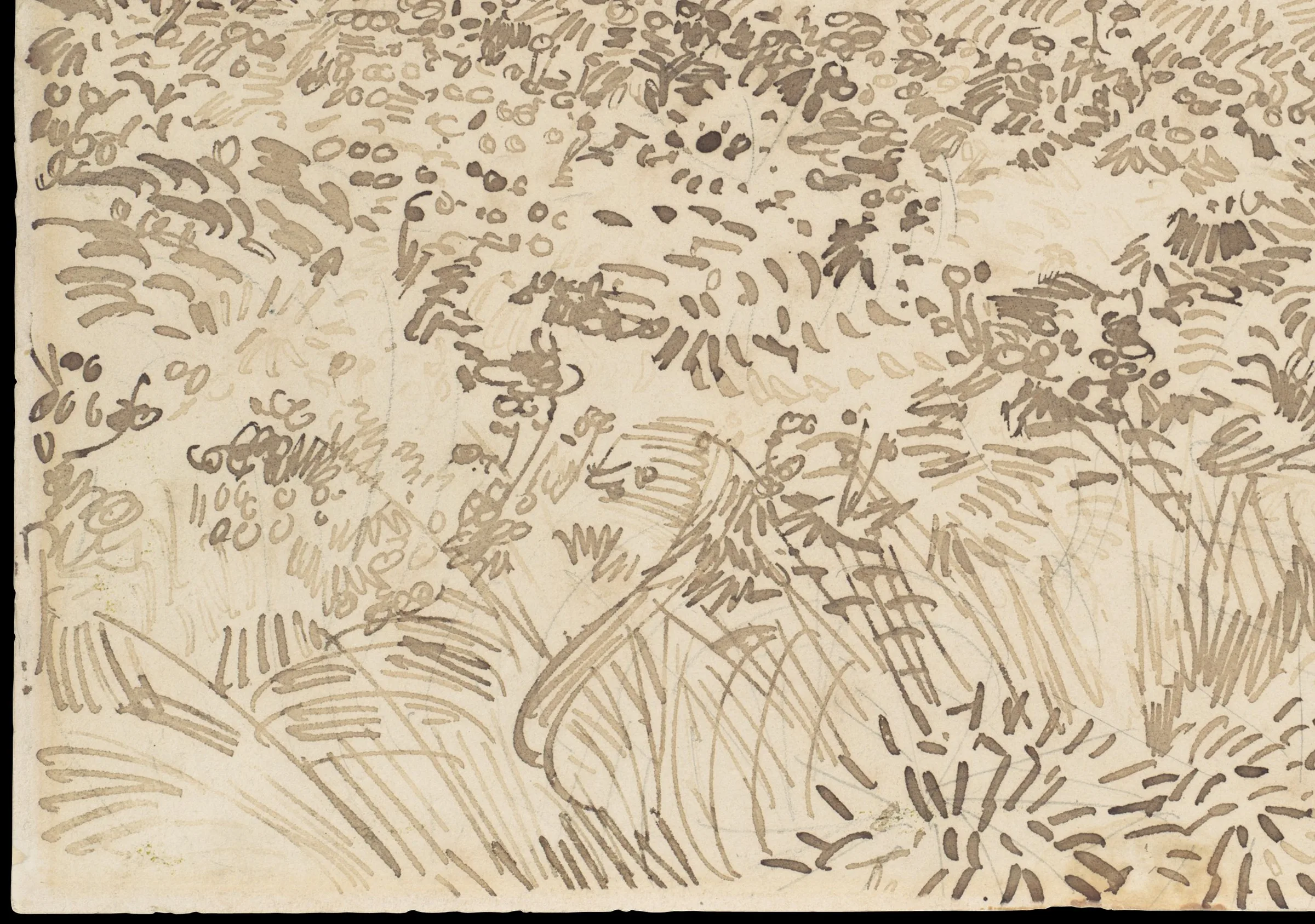
Detail of the reed pen Wheat Field: the graphite lines he set down first are still visible under the ink, and everything over them is dots, hooks, blunt dashes and short parallel strokes. A reed nib cannot taper, so the mark can only change by pressure and by how much ink is left in it.
Vincent van Gogh, Wheat Field (detail), July 1888, reed pen and logwood ink over graphite on wove paper, 24.1 by 31.7 centimetres, The Metropolitan Museum of Art, New York, accession 64.125.3. Public domain, Wikimedia Commons.
Watching him work
“I painted it out in the mistral. My easel was fixed in the ground with iron pegs, a method that I recommend to you. You shove the feet of the easel in and then you push a 50-centimetre-long iron peg in beside them. You tie everything together with ropes; that way you can work in the wind.”
Vincent van Gogh to Emile Bernard, on the wheatfield at sunset he had just painted through the Provence wind, Letter 628, Arles, on or about Tuesday, 19 June 1888, in Vincent van Gogh: The Letters, edited by Leo Jansen, Hans Luijten and Nienke Bakker, Van Gogh Museum and Huygens ING, 1888 [source]
Across media
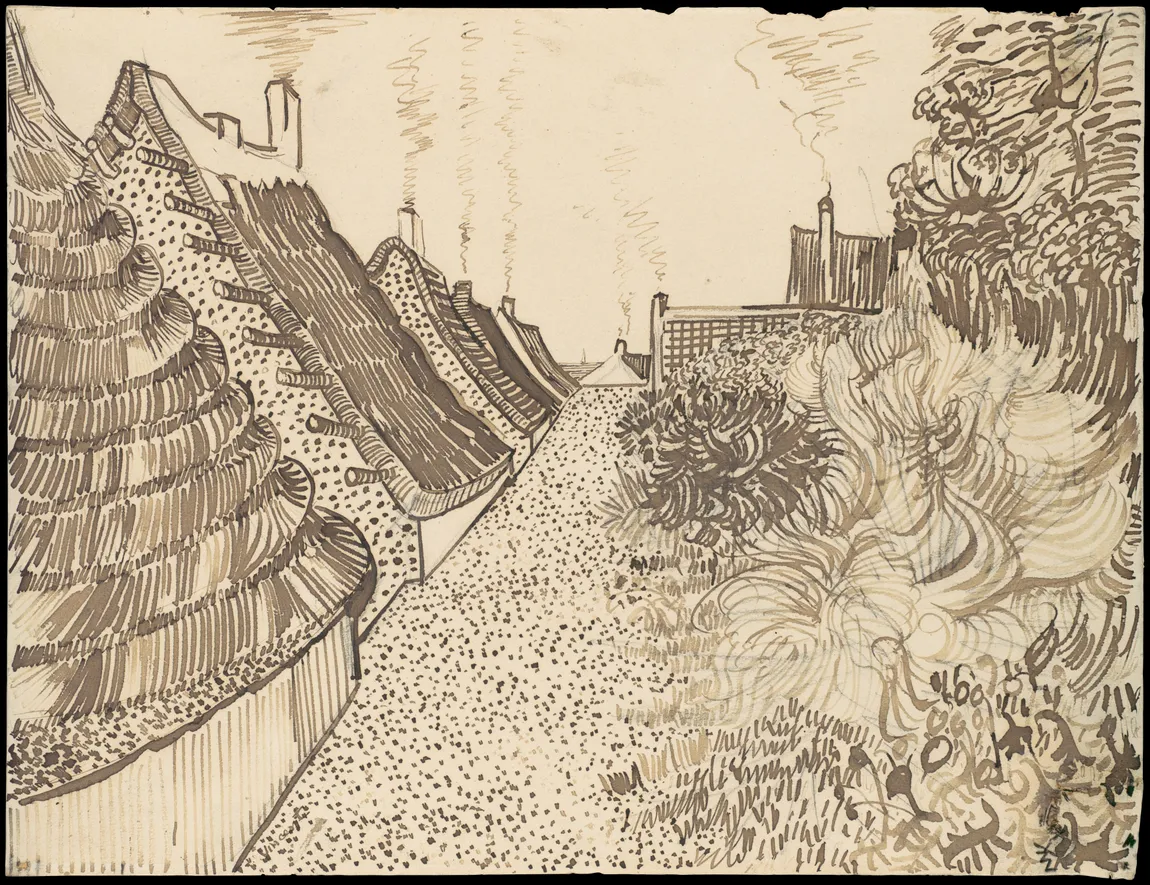
Street in Saintes Maries de la Mer, made on the Mediterranean coast in about the middle of July 1888 on a sheet twenty four by thirty two centimetres, in reed pen and quill and brown ink over graphite. The bare paper is doing the sunlight, and every dark is a cluster of separate strokes rather than a wash.
Vincent van Gogh, Street in Saintes-Maries-de-la-Mer, circa 15 July 1888, reed pen, quill, and brown ink over graphite on wove paper, 24.3 by 31.7 centimetres, The Metropolitan Museum of Art, New York, accession 48.190.1. Public domain, Wikimedia Commons.
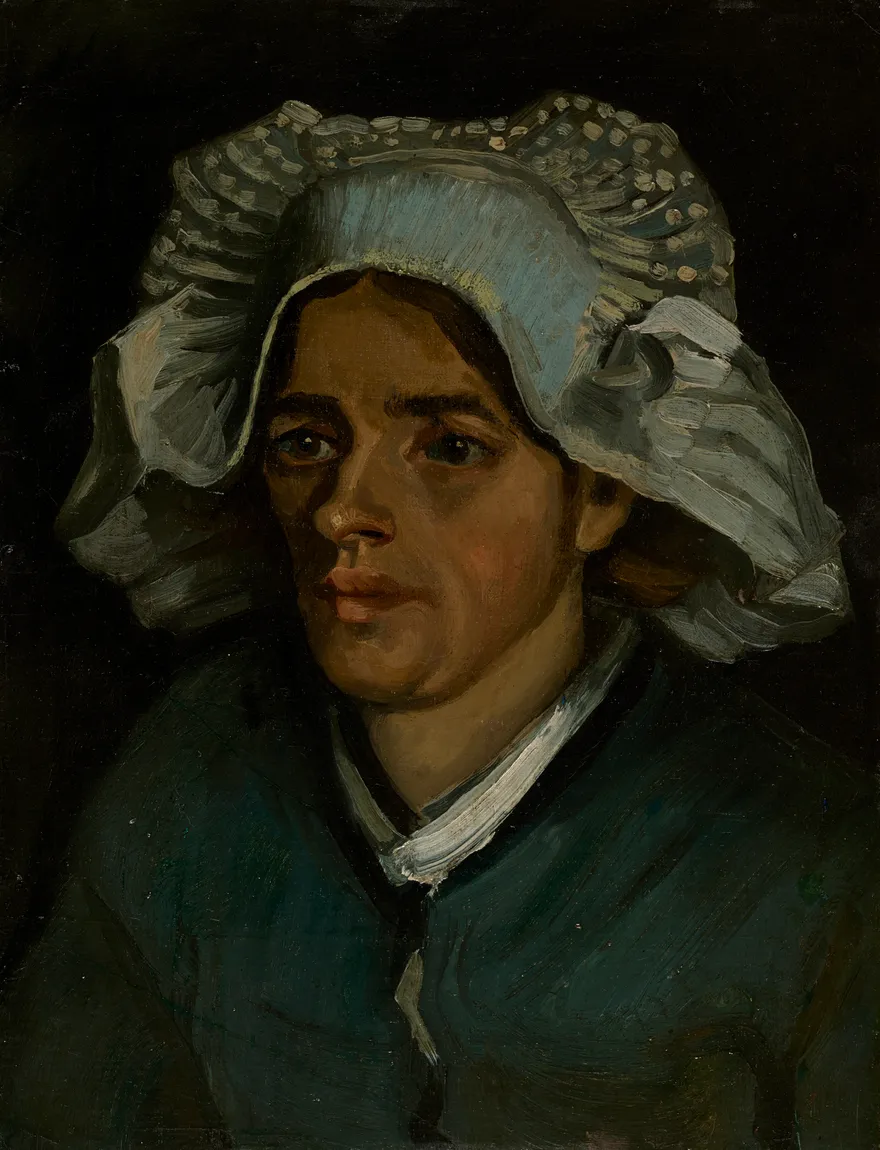
Head of a Peasant Woman with White Cap, Nuenen, 1885: oil on canvas laid on card, under fifty centimetres tall, in the earths he was using before Paris. He painted a run of these heads through that winter as the working material for The Potato Eaters. In 2022 the National Galleries of Scotland x-rayed this one and found a self portrait on the back of the canvas.
Vincent van Gogh, Head of a Peasant Woman with White Cap, 1885, oil on canvas on cardboard, 47.5 by 35.5 centimetres, National Galleries of Scotland, Edinburgh. Public domain, Wikimedia Commons.
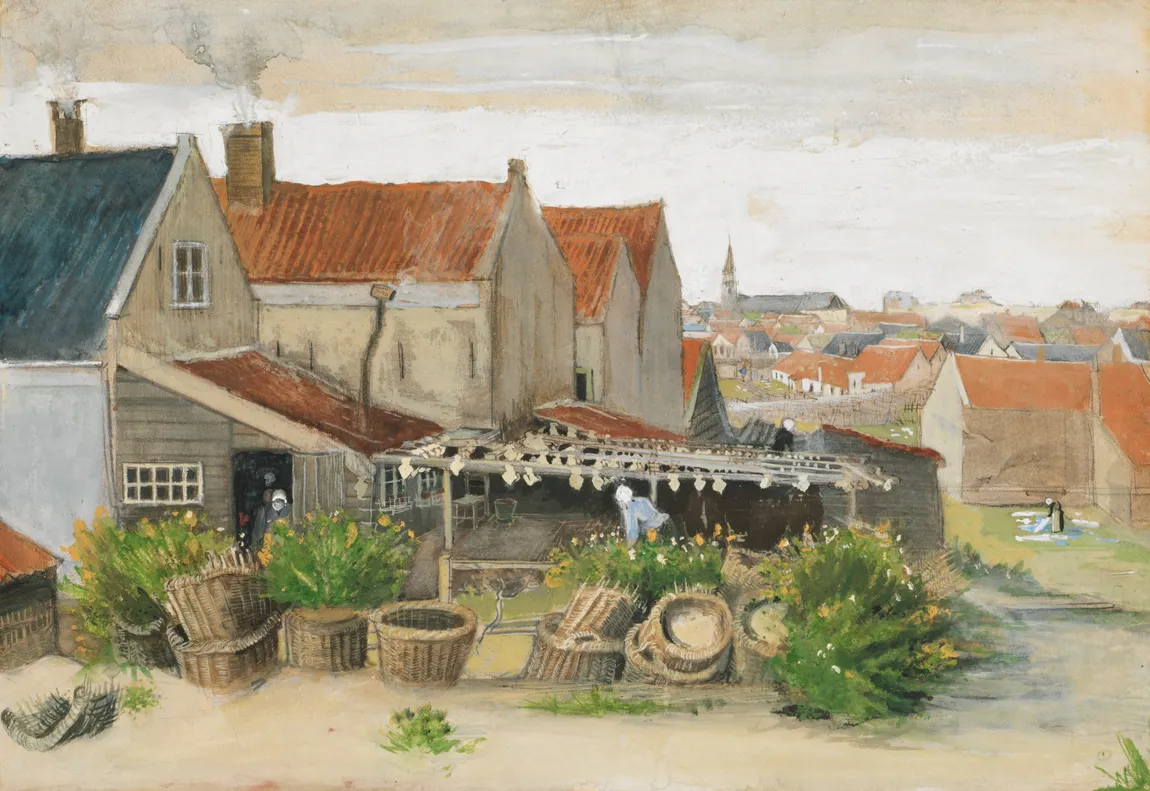
The Fish Drying Barn at Scheveningen, July 1882: opaque and transparent watercolour worked over graphite with pen and ink, on a sheet thirty six by fifty two centimetres. Six years before Arles the colour is held down and local, the drawing runs under all of it, and the light on the sand is bare paper.
Vincent van Gogh, The Fish Drying Barn at Scheveningen, July 1882, watercolour, graphite, pen and ink on wove paper laid on cardboard, 36.2 by 52.1 centimetres, private collection. Public domain, Wikimedia Commons.
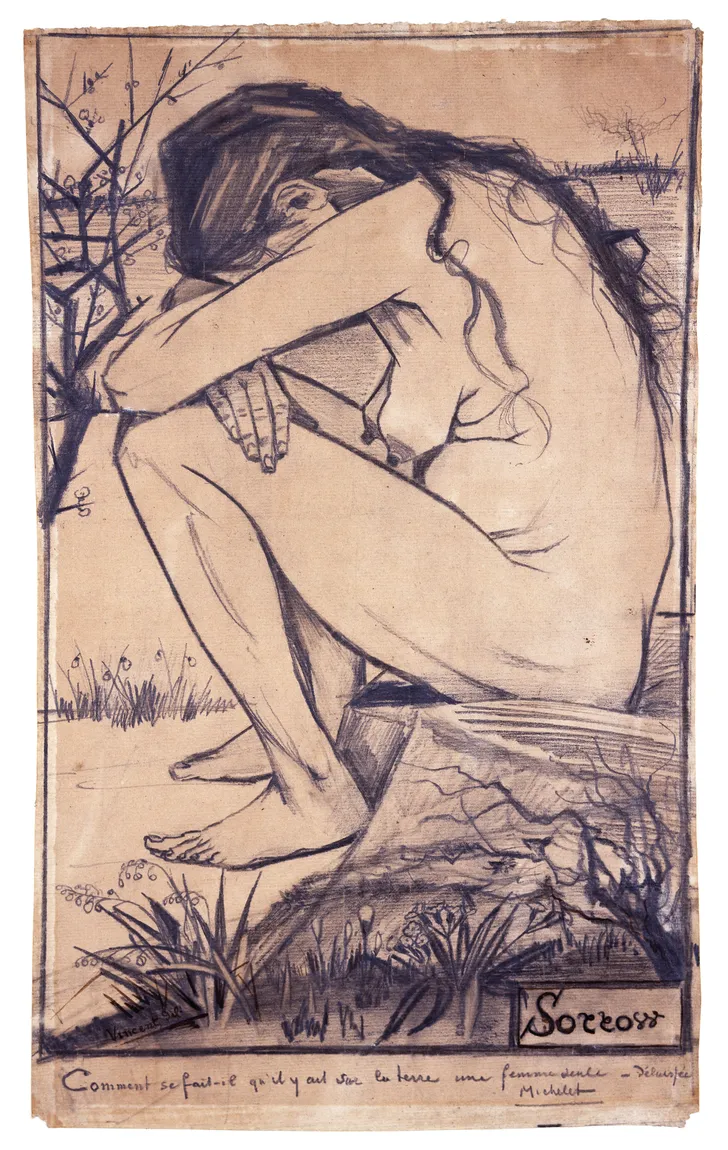
Sorrow, black chalk, about April 1882, on a sheet forty four centimetres tall. The model was Clasina Hoornik, who was living with him. He made three versions at once by laying two spare sheets under the first study and working up the pressed impressions, sent Theo the one he thought the best figure he had drawn, and kept the other two. The sent one is lost. This is one that stayed with him.
Vincent van Gogh, Sorrow, circa April 1882, black chalk, 44.5 by 27 centimetres, The New Art Gallery Walsall, accession 1973.128.GR. Public domain, Wikimedia Commons.
The record, deeper
The money
The famous sale is real and it is documented twice. Anna Boch, a painter and a member of Les Vingt, bought The Red Vineyard at the group's exhibition in Brussels early in 1890. On 6 March 1890 Theo entered the money in his account book under Rekening Vincent: 400 francs, received from Mlle Bock pour tab Vigne rouge.
Theo van Gogh's account book, 6 March 1890, cited in the editorial note to letter 855, Vincent van Gogh: The Letters, Van Gogh Museum and Huygens ING.
It was not the only money the work made, which is the part the one-painting story leaves out. In The Hague his uncle Cornelis Marinus van Gogh commissioned twelve townscape drawings and paid for them, then ordered six more. Van Gogh to Theo in April 1882: C.M. paid me, and a new order, but difficult enough, 6 detailed, specific, town scapes. I'll see that I make them in any case, because if I understand correctly I'll get for these 6 as much as for the first 12.
Letter 214 to Theo van Gogh, The Hague, on or about Sunday, 2 April 1882.
By 1886 he had a price and dealers holding stock. Writing in English from 54 Rue Lepic in Paris: At this present moment I have found four dealers who have exhibited studies of mine. And I have exchanged studies with several artists. Now the prices are 50 francs.
Letter 569 to Horace Mann Livens, Paris, September or October 1886, written by Van Gogh in English.
The money going the other way is the number that actually explains the output. Sending Theo a paint order from Arles in April 1888: Up to now I've spent more on my colours, canvases, &c. than on myself.
Letter 593 to Theo van Gogh, Arles, on or about Thursday, 5 April 1888.
The reworks
He painted over his own canvases because canvas cost money, and the imaging has caught him at it. In 2008 a team from Delft, Antwerp, Hamburg and the Kroller-Muller Museum scanned a seventeen and a half centimetre square of Patch of Grass, painted in Paris in 1887, at the DORIS synchrotron in Hamburg over two days. Mapping the mercury and the antimony gave back the head of a peasant woman underneath, from the Nuenen years, in something close to her own flesh colours.
Joris Dik, Koen Janssens and others, Visualization of a Lost Painting by Vincent van Gogh Using Synchrotron Radiation Based X-ray Fluorescence Elemental Mapping, Analytical Chemistry, 2008.
Head of a Peasant Woman with White Cap, one of the Nuenen study heads, carries a second picture on its back. The National Galleries of Scotland x-rayed it in 2022 and found a bearded self portrait in a hat and neckerchief, hidden under a cardboard backing and glue that had been put on for an exhibition early in the twentieth century.
National Galleries of Scotland, Edinburgh, on the x-ray of Head of a Peasant Woman with White Cap, announced 14 July 2022.
What they told students
He did teach, once. In Arles he gave drawing lessons to a second lieutenant of the Zouaves named Milliet, using the perspective frame, and told Bernard the man was beginning to make drawings and was eager to learn.
Letter 628 to Emile Bernard, Arles, on or about Tuesday, 19 June 1888.
What he passed on to Bernard about working outdoors was carpentry, not theory. Drive the feet of the easel into the ground, push a fifty centimetre iron peg in beside them, tie the lot together with ropes, and you can work in the wind. He called it a method that I recommend to you.
Letter 628 to Emile Bernard, Arles, on or about Tuesday, 19 June 1888.
Explaining colour to his sister Willemien in June 1888 he did it with flowers instead of a wheel. Cornflowers with white chrysanthemums and a few marigolds. There you have a motif in blue and orange. Heliotrope and yellow roses, motif in lilac and yellow. Poppies or red geraniums in bold green leaves, motif in red and green. Then the point: there are colours that make each other shine, that make a couple, complete each other like man and wife.
Letter 626 to Willemien van Gogh, Arles, between Saturday, 16 and Wednesday, 20 June 1888.
The studio
The first problem he solved after Mauve was a distance problem. Mauve had looked at his studies and said he stood too close to his model, so Van Gogh wrote that he had to find a room large enough to be able to take a sufficient distance, and priced it on the spot: a labourer's cottage in these parts costs 30 guilders a year to rent, so a room twice as large would come to something like 60 guilders.
Letter 193 to Theo van Gogh, Etten, on or about Friday, 23 December 1881.
The Yellow House was taken on 1 May 1888 and he sent Theo the terms the same day: the right hand wing of the building, four rooms, painted yellow outside and whitewashed inside, a floor of red bricks, fifteen francs a month. He wanted it partly so he could see his own canvases in a bright interior.
Letter 602 to Theo van Gogh, Arles, Tuesday, 1 May 1888.
The Night Cafe was painted in the room it shows, at night, across three sittings. He told Theo that for 3 nights I stayed up to paint, going to bed during the day, and added that it often seems to me that the night is much more alive and richly coloured than the day.
Letter 676 to Theo van Gogh, Arles, Saturday, 8 September 1888.
The materials
The Arles palette can be read straight off one order. On about 5 April 1888 he sent Theo a list to place with Tasset and Lhote of rue Fontaine in Paris: 20 large tubes of silver white, 10 of zinc white, 15 double tubes of Veronese green, 10 of lemon chrome yellow, 10 of chrome yellow number two, 3 of chrome yellow number three, 3 of vermilion, 6 small tubes of geranium lake, 12 of ordinary lake, 2 of carmine, 4 of Prussian blue, 4 of very light cinnabar green, 2 of orange lead and 6 of emerald green. Beside the geranium lake he wrote: freshly ground, if they're greasy I'll send them back.
Letter 593 to Theo van Gogh, Arles, on or about Thursday, 5 April 1888.
The same letter asks the lowest price for 10 metres of his primed or absorbent canvas, because the colourman in Arles would not make it fast enough: he's so lazy about doing it that I've decided to have everything sent from Paris or Marseille. An absorbent ground pulls oil out of the paint as it dries and leaves the surface matt, which is the finish the Arles canvases have.
Letter 593 to Theo van Gogh, Arles, on or about Thursday, 5 April 1888.
He knew the new colours were not stable and bought them anyway. When the geranium lake arrived he wrote: all the colours that Impressionism has made fashionable are unstable, all the more reason boldly to use them too raw, time will only soften them too much. Geranium lake is an eosin lake and it fades, which is why the room he described in October 1888 as pale violet walls and lilac doors now reads blue.
Letter 595 to Theo van Gogh, Arles, on or about Wednesday, 11 April 1888, and letter 705, Arles, Tuesday, 16 October 1888. The identification of the faded red lake in the Bedroom paintings: the technical comparison of the three versions published by the Art Institute of Chicago with Van Gogh's Bedrooms, 2016.
The Hague palette is on paper too. Beside a sketch of the palette in a letter of 5 August 1882 he wrote the nine colours in the positions they sat in: silver white, Naples yellow, yellow ochre, red ochre, burnt ochre, terra sienna, cobalt or Prussian blue, ivory black, vermilion. Six years before Arles that is one blue, no green and no lake.
Letter 253 to Theo van Gogh, The Hague, Saturday, 5 August 1882, letter sketch A.
He bought paper by the batch and by the grain. In the attic of the Smulders paper warehouse on the Laan in The Hague he found double Ingres sold as Papier Torchon, with a grain as coarse as a piece of sailcloth, and took half a quire. He also kept cheap Honig paper, which came in large tinted sheets and suited charcoal.
Letter 253 to Theo van Gogh, The Hague, Saturday, 5 August 1882.
The same week he bought a large moist colour box for 12 pieces or tubes of watercolour with a folding lid that serves as a palette when open, with room for six brushes. He called it absolutely essential for working out of doors, and the point of it was that it fitted inside the painting box, so everything for watercolour and for oil travelled as one object.
Letter 253 to Theo van Gogh, The Hague, Saturday, 5 August 1882.
Refusals — what they would not do
Refused academic blending — kept brushstrokes unblended and visible.
Refused medium beyond minimal turpentine — pure tube paint loaded onto canvas.
Refused to wait for lightfast pigments — applied non-lightfast at higher intensity, painting for the future state.
Refused to copy the prints he translated — orchestrated them in colour as new pictures.
Reference
Primary source
Direct life — peasants, weavers, miners, asylum inmates, his own face. Self-portraits across 1886–1889 are the largest single body of self-observation in nineteenth-century European painting.
Photography
Did not use photographs of models for portraits. Sitter present in the room. For Provence landscapes worked from direct observation in the field with the perspective frame.
Exceptions
In Saint-Rémy, confined to the asylum grounds, turned to memory and reproduction prints — translations of Millet, Rembrandt, Delacroix from black-and-white prints.
Owned Japanese ukiyo-e prints (now in Van Gogh Museum archive) — radiant composition of Bedroom at Arles and flattened space of several Arles portraits reflect Hiroshige and Hokusai.
Constantijn Huysmans · around 1866–1868 — Tilburg. Elementary drawing instruction.
Anton Mauve (his cousin by marriage) · 1881–1882 — Hague School painter. First lessons in oil and watercolour. Set the technical foundation for the Dutch-period tonal paintings. Relationship broke off in 1882 over a personal dispute, but the technical transmission was complete.
Fernand Cormon's atelier (Paris) · 1886 — Brief enrollment. Met Toulouse-Lautrec, Émile Bernard, and John Peter Russell. Dropped within months but the Paris years (1886–1888) were the decisive exposure to Impressionism, Pointillism, Japanese prints, and the modern synthetic palette.
Influences
Hague School (Mauve) earth-toned tonal painting.
Impressionism, Pointillism, Japanese ukiyo-e prints — Paris years.
Millet, Rembrandt, Delacroix — translation reference.
Gauguin — two-month studio collaboration in Arles (October–December 1888).
Students
Took no students. No formal pedagogical lineage.
Posthumous influence immediate. Fauves (Matisse, Derain, Vlaminck) cited him within a decade. Letters published by Theo's widow Jo van Gogh-Bonger became the foundational text on the painter's interior process for the whole twentieth century.
In their own words
“Today again, from seven in the morning till six in the evening, I worked without stirring, except to take some food a step or two away.”
— Vincent van Gogh, Letter to Theo van Gogh, Saint-Rémy, 1889
The specific working-day record. Eleven hours at the easel, standing, with brief food breaks.
“The frame has perpendicular and horizontal lines, and in addition diagonal lines and crosses, so that one can divide it into eight triangles. It enables one to draw at lightning speed the lines and quick proportions.”
— Vincent van Gogh, Letter to Theo van Gogh, The Hague, 5 or 6 August 1882, 1882
“I have just told you that I am still under the impression of that wheat field. The problem is to give an equivalent of the aspect, the rhythm, the feeling. When I feel that, then it becomes clear to me, the painting paints itself.”
— Vincent van Gogh, Letter to Theo van Gogh, Arles, 1888
“The colors that are not lightfast have all the more reason to be laid on shamelessly, with time they will only grow paler and more pleasant.”
— Vincent van Gogh, Letter to Theo van Gogh, Arles, 1888
Explicit acknowledgment that geranium lake and certain chrome yellows were not lightfast, and the deliberate decision to apply them at higher chromatic intensity to compensate for the known future fade.
Oil on cheap commercially primed linen or cotton, with a synthetic palette: lead and zinc white, chrome yellows, cadmium yellow, vermilion, the red lakes (carmine, geranium, madder), cobalt blue, French ultramarine, Prussian blue, emerald green, viridian, and yellow and red ochre. He knew geranium lake and some chrome yellows were not lightfast and laid them on at higher intensity to compensate.
What medium did Van Gogh paint in?
Oil, with almost no added medium beyond a little turpentine for thinner passages. In the Provence heat the turpentine evaporated fast, which left some Arles and Saint-Remy surfaces under-bound.
What brushes did Van Gogh use?
Stiff fitch brushes (polecat hair) and large black hog-bristle brushes, often ordered twenty-five at a time, loaded with paint straight from the tube.
Did Van Gogh blend his paint?
No. He drove loaded brushes into the canvas and left each mark where it landed, so the direction of the stroke describes the form: spiraling strokes in the Starry Night sky and furrows across the wheat fields.
How fast did Van Gogh work?
He finished about one work every two working days across the decade 1880 to 1890, often standing at the easel from seven in the morning to six in the evening with brief food breaks.
If this painter is your match
You believe the rhythm of the painting is the subject, and the mark of the brush on the canvas is the direct record of that rhythm. Intensity is the criterion for finish — not resolution.
Borrow this: For your next landscape, build a perspective frame — a wooden rectangle the proportion of your canvas, with thread dividing it into four quarters and both diagonals. Drive it into the ground at the motif. Sight your composition through it and fix the major lines on the canvas in under five minutes. Then paint the whole thing in one day, loaded brush, no medium, no blending.
Vincent van Gogh — The Letters (Leo Jansen, Hans Luijten, Nienke Bakker, eds.), 2009. Complete scholarly edition of the 902 surviving letters, published by the Van Gogh Museum and Huygens ING. The single most important primary-source document for any painter in the nineteenth century.[link]
Inge Fiedler et al., Van Gogh's Materials and Techniques: Material, Intention, and Evolution, 2016. Art Institute of Chicago technical survey. Principal modern material study of pigment selection, ground preparation, impasto structure, and fade history.
Jan Hulsker, The Complete Van Gogh: Paintings, Drawings, Sketches, 1996. Catalogue raisonné with JH numbering now standard in Van Gogh scholarship.
Van Gogh Museum Archive, Amsterdam. Principal Van Gogh family archive. Original letters, preparatory drawings, Japanese print collection, palette and brushes, and material study infrastructure.[link]
Vincent van Gogh, letters 157, 193, 214, 216, 253, 254, 569, 593, 595, 602, 626, 628, 663, 676, 705 and 855. The letters read in full for the 2026 human-breadth pass, in the web edition of the 2009 scholarly edition. Between them they carry the sixty Bargue sheets, Mauve setting up the still life and saying he stood too close to his model, the second commission from his uncle Cornelis, the three Sorrow sheets pressed from one study, the palette sketch with its nine named colours and the papers bought at Smulders, the blacksmith who put iron spikes on the perspective frame, Cormon in Van Gogh's own English, the Tasset and Lhote order in full, the unstable colours laid on raw, the Yellow House at fifteen francs a month, the colour pairs explained to his sister, the easel pegged into the ground against the mistral, the red and the green of the Night Cafe, the Bedroom walls written down as pale violet, and the editorial note recording the 400 francs Anna Boch paid for The Red Vineyard.[link]
Joris Dik, Koen Janssens and others, Visualization of a Lost Painting by Vincent van Gogh Using Synchrotron Radiation Based X-ray Fluorescence Elemental Mapping, Analytical Chemistry, 2008. The Patch of Grass scan. A seventeen and a half centimetre square of the 1887 canvas was mapped over two days at the DORIS synchrotron at DESY in Hamburg, and the distributions of mercury and antimony returned the head of a peasant woman painted underneath in the Nuenen years.
The Metropolitan Museum of Art, object records for Wheat Field (64.125.3) and Street in Saintes-Maries-de-la-Mer (48.190.1). The catalogue medium lines that document the reed pen practice: reed pen and logwood ink over graphite on wove paper, and reed pen, quill, and brown ink over graphite on wove paper. Both sheets are July 1888 and both are open access.[link]
National Galleries of Scotland, on the x-ray of Head of a Peasant Woman with White Cap, 2022. The 2022 x-ray of the Nuenen study head that found a bearded self portrait on the reverse of the canvas, under a cardboard backing and glue applied for an exhibition early in the twentieth century.[link]