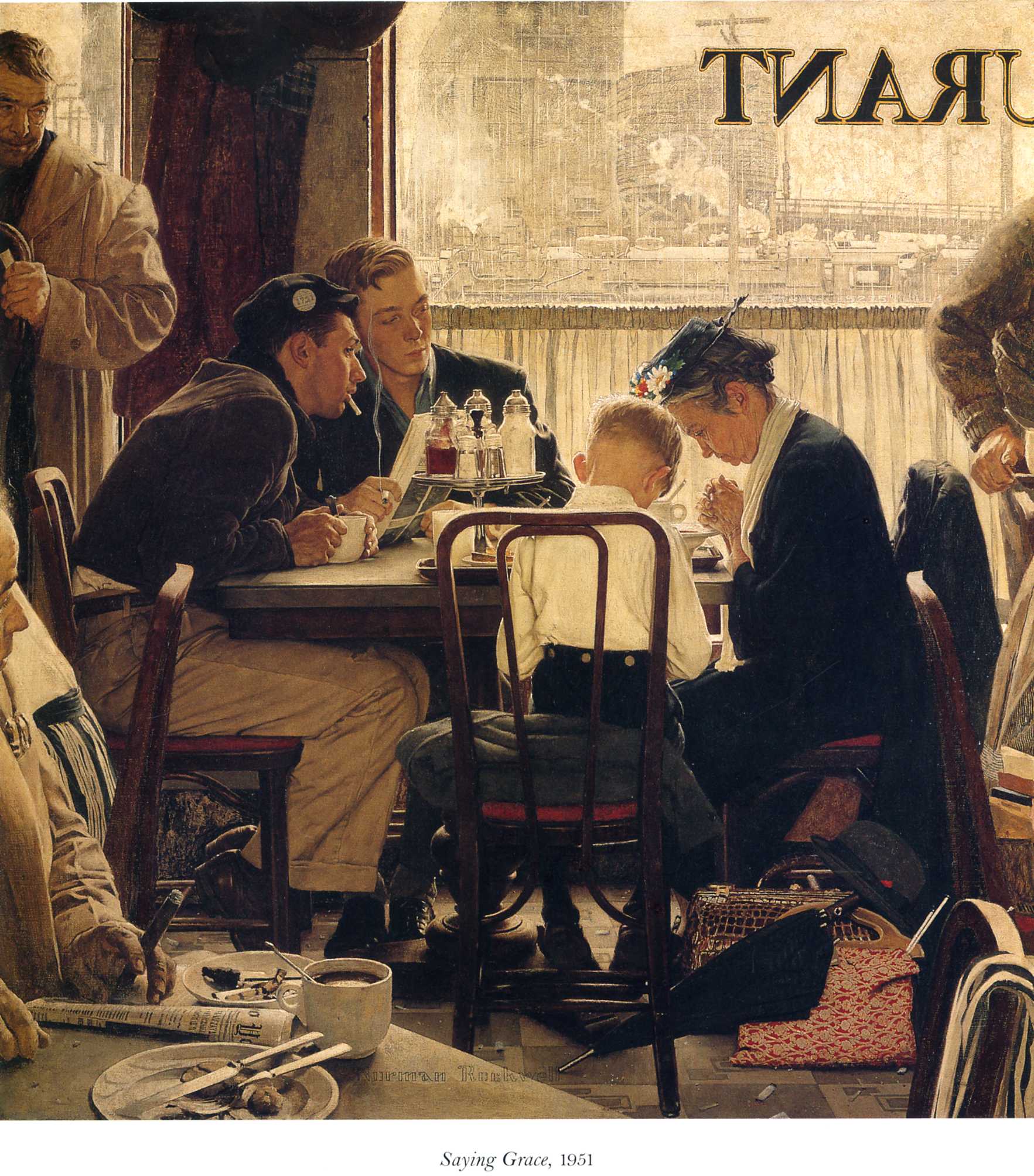
Norman Rockwell
The Saturday Evening Post cover painter (323 covers, 1916-1963) whose multi-stage process—casting, staging, photographing, charcoal cartoon, color comprehensive, full oil—industrialized narrative realism and turned the American small-town tableau into one of the most widely disseminated image systems of the twentieth century.
Rockwell worked in three major studios across his career. First, a New Rochelle, New York studio from 1915 to 1939, next door to the town that held J.C. Leyendecker, Coles Phillips, and a concentration of other Post illustrators. Second, an Arlington, Vermont studio from 1939 to 1953—a small country town Rockwell had chosen deliberately for its abundance of the specific physical types the Post covers required. Third, a Stockbridge, Massachusetts studio from 1953 to his death in 1978, which was preserved intact after his death and is now the core of the Norman Rockwell Museum.
The Arlington and Stockbridge studios were functionally identical: a single large north-lit room with a high ceiling, an easel on casters, a posing platform, a supply of costumes and props accumulated across decades of commercial work, and a darkroom in the adjoining space for the photographic reference that became central to his process after roughly 1936. Rockwell painted standing, at a vertical easel, typically five to six feet from the canvas. He walked back constantly to judge the painting from the same distance a Post reader would see the finished cover.
The working schedule was industrial and exceptionally disciplined. Rockwell painted six days a week, roughly 9 AM to 5 PM, for sixty years. He produced 323 Saturday Evening Post covers plus hundreds of additional commercial illustrations and advertising pieces. The sustained pace depended on two things: the multi-stage planning workflow (thumbnails, studies, cartoon, comprehensive, execution) and a network of neighborhood models—farmers, children, storekeepers, veterinarians, veterans—that Rockwell recruited in Arlington and Stockbridge and used repeatedly across hundreds of paintings. The Vermont and Massachusetts covers were populated by the actual residents of those towns, in borrowed costumes, in scenes staged with Rockwell's accumulated property collection.
His assistants, when he had them, handled specific technical tasks: photographic development, costume sourcing, model coordination, canvas preparation. The painting was always Rockwell's. He did not allow assistants at the easel. The signature was earned.
Rockwell painted in oil on stretched linen canvas across his entire career. The support was typically medium-weight commercially primed linen, re-toned in the studio with a buff or warm-gray imprimatura before the painting began. A Rockwell painting never started on white.
The palette evolved across the career but remained narrow and disciplined. Earth range: yellow ochre, raw sienna, burnt sienna, Venetian red, raw umber, burnt umber. High-chroma accents: cadmium yellow (light and medium), cadmium red (light and medium), vermilion (early career), cobalt blue, French ultramarine, viridian. Lead white (flake white) for highlights and the opaque build through the 1940s, with a gradual shift toward titanium white in the postwar decades. Ivory black was used sparingly as a pigment, almost never as a shadow mixer—Rockwell mixed his darks from the earth range and the blues, preserving chromatic warmth even in the deepest passages.
The brushwork is polymath and deliberately invisible. Rockwell refused the Leyendecker chisel-stroke as a signature—he wanted the paint to disappear into the depicted scene, not announce its own technical presence. The surface of a Rockwell cover is built from a wide range of mark types: scumbled atmospheric passages, tightly rendered flesh, sharp-edged prop details, soft wet-into-wet transitions in the peripheral areas. The brush range runs from one-inch bristle flats for the block-in to quarter-inch sable rounds for the facial detail. Mediums were used sparingly: a little linseed oil for the lay-in, no glazing medium, no dammar varnish in the working layers.
The underpainting was grisaille-style in the early career—a full tonal working-out of the composition in neutral earth tones before color arrived. In the mature Post years Rockwell typically painted a complete charcoal-on-prepared-canvas cartoon first, fixed it, then worked directly in oil color from the photographic-reference composite, with the tonal structure resolved in the charcoal and the color laid over it in successive opaque passes. The final surface is tight but not polished—close inspection reveals the handwork, the small touches, the subtle chromatic shifts that give a Rockwell cover the specific warmth that mechanical reproduction preserved.
Rockwell's process is the most elaborately documented multi-stage workflow in twentieth-century American illustration. He described it at length in his autobiography and in a series of How-To articles in American Artist magazine. The sequence ran:
Stage one: the idea. A Post cover idea typically emerged from a specific observed scene—a boy waiting at a barbershop, a Thanksgiving turkey being served, a soldier coming home on leave. Rockwell kept idea notebooks and produced dozens of thumbnail sketches for each eventual cover. The specific scene had to carry an emotional register that was narrative but not literary—the Post reader had to "get" the cover in under two seconds on a newsstand.
Stage two: the thumbnail and compositional sketches. Dozens of small pencil drawings working out figure arrangement, expression, prop placement, and tonal structure. Rockwell's thumbnails were famously exhaustive—a single cover might generate fifty or a hundred compositional variants before a direction was locked.
Stage three: the casting. Rockwell identified specific Arlington or Stockbridge residents as the models for the characters. The fit was physical and expressive—the grandmother had to be an actual grandmother, the veterinarian an actual veterinarian. Neighborhood casting was one of his signature disciplines. He paid models small sums (typically five dollars a session in the 1940s, rising later) and kept a roster of repeat collaborators.
Stage four: the staged session. Models in costume were posed in the reconstructed scene under north-lit studio conditions. Rockwell directed each pose like a film director—specific expression, specific gesture, specific interaction. He frequently demonstrated the pose himself before asking the model to reproduce it. Sessions ran for several hours, with Rockwell sketching and photographing throughout.
Stage five: the photographic reference. After roughly 1936 Rockwell used photography systematically. A staged session produced dozens of black-and-white photographs from multiple angles. The photographs were developed in the studio darkroom, assessed, and specific frames selected as the primary reference for the final painting. Rockwell was open about this practice and described it in detail—the photograph was a tool for freezing an observed reality at a specific light condition, not a shortcut or a substitute for drawing ability.
Stage six: the charcoal cartoon. A full-size (cover-size, typically 28 by 22 inches or larger) charcoal drawing on prepared paper resolved the figure drawing, the compositional geometry, and the major tonal structure. The cartoon was transferred to the tinted canvas by pouncing or direct copying.
Stage seven: the color comprehensive. A small oil study—typically eight by ten inches—committed the chromatic decisions at finished-painting scale. The comprehensive locked the palette, the light direction, the warm-cool relationships, and the specific local color of every major passage.
Stage eight: the full-size oil execution. The final painting was built over roughly two to four weeks, working from focal (faces and hands) outward. Passages were resolved one at a time rather than working the whole painting in parallel. The background and peripheral costume detail typically came last. The cover was finished when it read at newsstand distance—when the narrative moment held and the emotional register the thumbnail had identified was fully present on the canvas.
Rockwell's reference practice is the most systematically engineered in American illustration. The sources were, in order of priority: the live model, the staged scene, the photograph of the staged scene, the accumulated prop and costume collection, and specific documentary research when the subject required it.
The live model was the foundation. Rockwell never painted a face from imagination alone. Every figure in every Post cover was modeled by a specific person, often a specific Arlington or Stockbridge neighbor, posed in a specific costume under specific studio light. The approach produced the characteristic Rockwell feature: the faces look like real people because they were.
Photography entered the process around 1936 and never left. Rockwell wrote openly about the practice in American Artist (1949) and in My Adventures as an Illustrator (1960), and he was specific about what photography was for: it froze a staged scene at a specific moment, captured ephemeral expressions, and allowed long complex compositions that could not be held in a live sitting. The photograph was reference, not the painting. Rockwell drew from the photograph, then painted from the drawing and from direct reference to the costumed model when needed. He rejected the accusation that photographic reference lowered the craft—the craft, he argued, was in the drawing, the composition, the paint handling, and the invention of the scene, all of which preceded the camera's involvement.
The prop and costume collection at Arlington and Stockbridge was substantial. Rockwell maintained a large archive of period clothing, military uniforms, Americana, tools, domestic objects, and fixtures that recurred across hundreds of paintings. The collection was itself a working reference library—a Civil War drummer-boy cover used actual period drum and clothing; a Boy Scout cover used actual Scout-issue uniform. The material authenticity gave the finished paintings their specific documentary weight.
For historical and research-intensive subjects (the Four Freedoms, 1943; the Civil Rights paintings of the 1960s; the Willie Gillis series during WWII) Rockwell conducted substantial documentary research—period-accurate detail, newspaper archives, correspondence with relevant experts—before the staging began. The Rockwell painting that appeared sentimental was almost always backed by documentary discipline the viewer did not see.
Rockwell studied at the Chase School of Art in New York (1910) and then at the Art Students League (1910-1911) under Thomas Fogarty (illustration) and George Bridgman (anatomy and figure drawing). Bridgman's anatomical system—the constructive approach to the figure, the emphasis on rhythm and gesture over surface description—became a foundation of Rockwell's drawing method and is visible in every Post cover through the 1960s. Fogarty taught Rockwell the narrative-illustration discipline: the picture serves the story, the figure serves the moment, the moment serves the reader.
His decisive model, however, was J.C. Leyendecker. Rockwell moved to New Rochelle in 1915 specifically because Leyendecker and the Post circle lived there. He studied Leyendecker's Post covers in detail, visited the New Rochelle studio, and adopted key elements of Leyendecker's method: the tinted ground, the planning workflow, the chisel-stroke discipline in the early years. Rockwell's autobiography is unambiguous about the debt—Leyendecker was the model against which Rockwell measured himself for the first decade of his Post career.
The Brandywine lineage also informed Rockwell indirectly. Howard Pyle's pedagogical principles (personal knowledge, the dramatic moment, paint the light and air) had become American-illustration doctrine by the 1910s, transmitted through N.C. Wyeth, Harvey Dunn, Dean Cornwell, and a generation of Pyle students. Rockwell absorbed the doctrine as ambient common knowledge rather than through direct teaching.
He did not run a formal atelier. He did teach intermittently—at the Art Students League briefly, and through the Famous Artists School correspondence course that he helped found with Albert Dorne and a group of other illustrators in 1948. The Famous Artists School textbooks, still in print, are the principal Rockwell teaching documents and lay out the multi-stage workflow in detail for a correspondence-course audience.
His most prominent direct student was his son Thomas Rockwell (later the author of How to Eat Fried Worms) and, through the Famous Artists School, thousands of mid-century American illustrators who learned the Rockwell method at a distance. The influence is diffuse rather than focused—Rockwell did not produce a Brandywine-style lineage of named major painters, but the Rockwell workflow became the default American commercial-illustration method for two generations.
“I paint life as I would like it to be.”
“The secret of any good painting is the thinking that precedes it.”
“I use photographs because they freeze the moment. The drawing still has to be mine. The composition still has to be mine. The painting still has to be mine. The photograph is a tool, not the painting.”
“Every time I finish a cover I am sure it is the worst thing I have ever done. And I go to work on the next one.”
You build a picture through an engineered sequence of scale-shifts: thumbnail to cartoon to color study to execution. You cast your scenes from real people—not "types" but specific neighbors with specific faces. Reference is accumulated, not invented. The painting at the easel is the recording of decisions made earlier, not the place where you search.
Steal this: For your next narrative image, cast it from actual people in your life. Not "a grandmother"—a specific grandmother, the one down the street. Stage the scene with them in costume. Photograph it. Then draw the photograph at full size in charcoal before a single brush of oil color goes down. You will find that the discipline of physical staging—finding the actual person, dressing them, posing them, lighting them—produces authenticity no imagined figure can reach.
- Norman Rockwell. My Adventures as an Illustrator, 1960 [autobiography]. The primary source for Rockwell's own account of his career, his studios, his process, and his relationships with Leyendecker, Lorimer, and the Post circle. Written with his son Thomas Rockwell. Republished 1988 and 2019 with additional commentary.
- Norman Rockwell and Albert Dorne. Famous Artists Course (12 volumes), 1951 [treatise]. The correspondence-course textbooks Rockwell co-authored with Albert Dorne, Ben Stahl, Al Parker, Stevan Dohanos, and others. The Rockwell lessons lay out the multi-stage workflow in pedagogical detail—the thumbnail sketches, the charcoal cartoon, the color comprehensive, the oil execution. Remains the clearest single documentation of the Rockwell method.
- Laurie Norton Moffatt. Norman Rockwell: A Definitive Catalogue, 1986 [catalog]. The two-volume catalogue raisonné, prepared by the Norman Rockwell Museum in Stockbridge. Documents 3,988 attributed works. The authoritative reference for dating, exhibition history, and primary-source correspondence.
- Deborah Solomon. American Mirror: The Life and Art of Norman Rockwell, 2013 [biography]. The major modern biography, built on substantial archival research at the Norman Rockwell Museum and the Post papers. Revises several earlier assumptions about Rockwell's personal life and documents the photographic-reference practice in detail.
- Norman Rockwell Museum Archives, Stockbridge, Massachusetts [archival]. The preserved Stockbridge studio, the complete working-reference photography archive, thousands of preliminary sketches and charcoal cartoons, correspondence with the Saturday Evening Post editorial department, and the Famous Artists Course materials. [link]