FORM AND FIGURE

Form and figure: structure before light

A figure drawing holds because its structure holds. Proportion sets the size of every part, placement sets where each part sits, and the big planes set how the surface turns. Decide those first and the light has something to land on. Decide them late and every rendered detail has to move.

Two traditions taught that order as reasoned construction rather than copying. In St. Petersburg, Pavel Chistyakov cut the form he saw into planes. In New York, George Bridgman assembled forms from masses that could move. The charts below run in the classroom order: the proportions, the block-in, the two schools compared, the planes of the face. Then the light lands on the form.

These are the teaching charts. For how painters actually paint the figure, and who taught whom, see Painting the Human Figure.

01Two figures on one head-unit rail. The left one stands seven and a half heads, the realistic average Paul Richer measured in 1889. The right one stands eight, the idealized canon the academies kept for heroic subjects. The nipple line lands at two heads, the navel at three. The other systems sit beside them honestly: Bridgman held the figure by mass relationships rather than a count, Vanderpoel checked the model, and Loomis and Bammes are described from their books, not reproduced.

Proportions of the figure measured in heads: a standing figure at seven and a half heads, the realistic average Paul Richer published in 1889, beside the same figure at the idealized eight-head canon the academies kept for heroic subjects, with the head-unit rail between them, the nipple line falling at the two-head mark and the navel at the three-head mark, and the other systems noted honestly, Bridgman holding the figure by mass relationships rather than a head count, Vanderpoel checking proportion against the model, Loomis and Bammes described from their books rather than reproduced.

An original methods.art diagram. The seven-and-a-half-head average follows Paul Richer, Artistic Anatomy (1889); Loomis and Bammes are described from their books, not reproduced.

The figure, measured in heads. The systems: Bridgman held masses, not counts, Vanderpoel checked the model, Loomis idealized eight heads, and Bammes built structural units.

02One pose, three stages. First the envelope: a gesture line, then long straight lines catching the largest angles, with a plumb line dropped to check the tilts of shoulders and hips. Then the three masses, head, thorax, and pelvis, set on their tilts. Then the shapes, the silhouette held flat with the principal shadow massed as one value. Vanderpoel wrote the order down in 1907: pose, proportions, and construction placed first, before the parts themselves are analyzed.

Blocking in the figure in three stages on one pose: first the envelope, a gesture line and straight lines catching the largest angles with a plumb vertical to check the tilts of shoulders and hips, then the three masses, head, thorax, and pelvis, set on their tilts inside the envelope with the limbs as jointed lines, then the shapes, the silhouette held flat with the principal shadow massed in one connected value, location solved before form.

An original methods.art diagram. The envelope and large-angles doctrine per Vanderpoel, The Human Figure (1907); the atelier order as J. Alden Weir described Gerome teaching it.

The envelope, the masses, the shapes. The teachers: Bargue drilled the straight-line block-in, Vanderpoel: the large angles first, and Gerome: the action first.

03The two schools side by side. Chistyakov, who trained Repin, Serov, and Vrubel at the Imperial Academy, starts from the head he sees and cuts it into planes, watching the insertions where they connect. Bridgman, at the Art Students League for some forty-five years, starts from a vocabulary of masses on axis lines and builds a head that can move. His own 1920 plate sits in the right panel. The shared ground: both replace copying with reasoning, and both decide structure before detail.
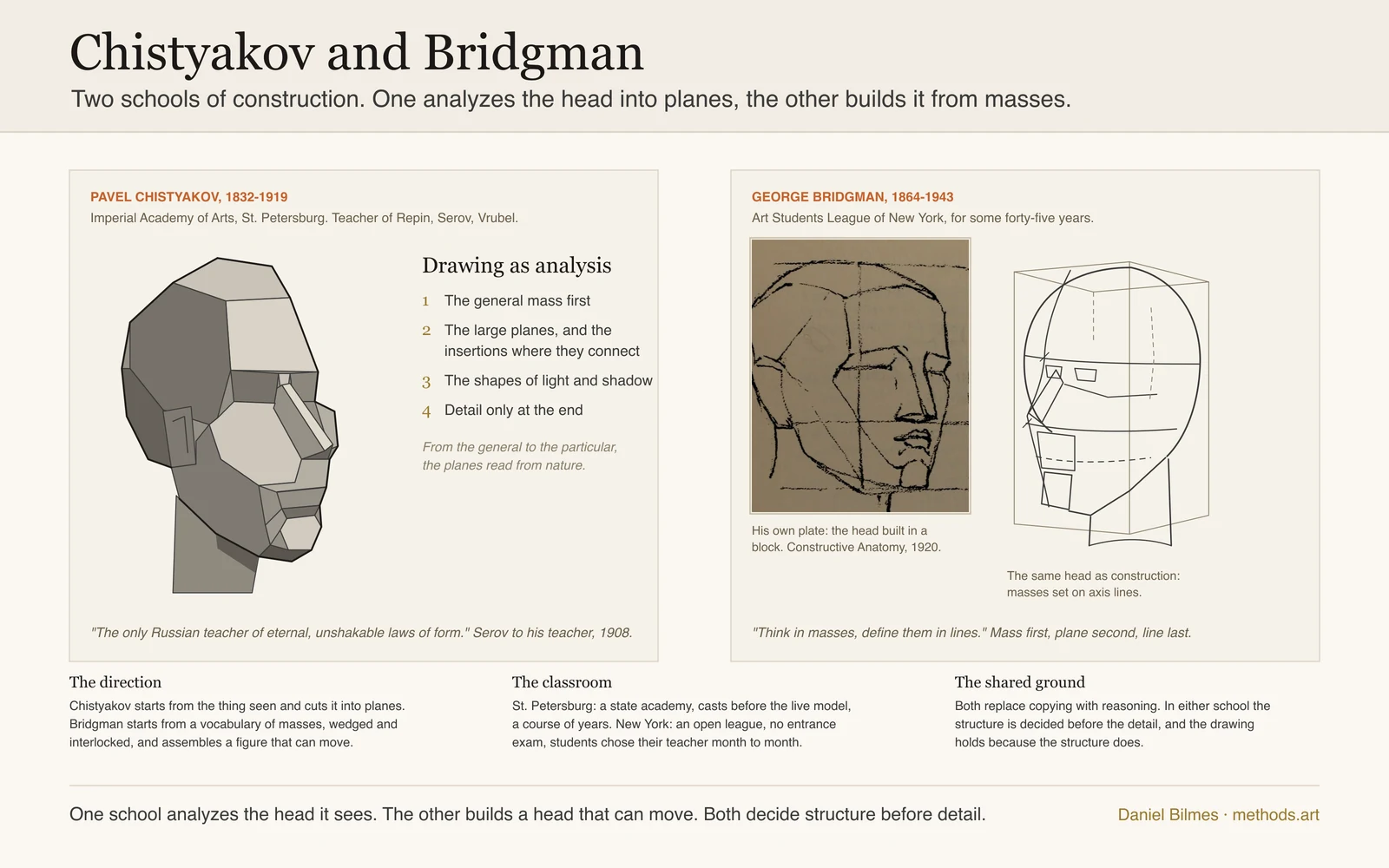
Two schools of construction side by side: Pavel Chistyakov of the Imperial Academy in St. Petersburg, who taught drawing as analysis, the head cut into planes from the general mass to the insertions where the planes connect, and George Bridgman of the Art Students League of New York, who built the head from masses on axis lines, mass first, plane second, line last, with a real plate from his Constructive Anatomy of 1920 beside an original construction, one school analyzing the form it sees, the other assembling a form that can move, both deciding structure before detail.

Plate crop from George Bridgman, Constructive Anatomy (1920). Public domain, Wikimedia Commons (Internet Archive scan). The two drawn heads are original methods.art constructions; the Chistyakov sequence follows the textbooks of his school (Mogilevtsev, Fundamentals of Drawing).

Two schools of construction. The schools: Chistyakov analyzed planes, and Bridgman built masses.

04The plane groups named on one head, front and three-quarter. The forehead slopes up into the cranium, the temples turn sharply from it, and the nose divides the plane of the face, with the line from cheek bone to upper lip breaking it into two smaller planes. Bridgman put the reason plainly: the relations of these masses and planes are to the moulding of a head what architecture is to a house. Chistyakov had set the same watch on the insertions a generation before.

Planes of the face named on an original planar head, front and three-quarter: the forehead plane sloping up and back into the cranium, the temple planes turning sharply from it, the plane of the face divided by the nose, the line from cheek bone to upper lip breaking it into two smaller planes, the wedge of the nose, the cylinder of the mouth, and the block of the chin, with the insertions where plane meets plane, the groups as Bridgman wrote them in 1920 and as Chistyakov and Bargue had taught the same structure a generation before.

An original methods.art diagram. Plane names per Bridgman, Constructive Anatomy (1920); the planar tradition per Chistyakov's school and Bargue's cast plates. No modern planar head is reproduced.

The planes of the face, named. The tradition: Bridgman named the planes, Chistyakov planed the head, and Bargue set the cast heads.

THE LIGHT LANDS ON THE FORM

The light lands on the form

Structure first, then light. A built form turns through the same zones in the same order every time, so the academies taught the light on the simplest form there is, a sphere, before any figure. The three charts below are that canon as Harold Speed and the nineteenth-century ateliers passed it down: the zones of the lit sphere, the anatomy of the shadow it throws, and what four different lights do to the one form.

05One sphere, one light, every zone named. Follow the surface as it turns: the highlight where it faces the light, the halftone as it turns away, the terminator where the light stops, the core shadow just past it, then the reflected light lifting the shadow rim. The law under the chart: reflected light never rises to the value of the lit side.

The lit sphere with every zone named by leader lines: one sphere under one light, the highlight where the surface faces the light, the light and halftone turning away from it, the terminator where the light stops, the core shadow as the darkest band just past the terminator, the reflected light lifting the shadow rim but never rising to the value of the lit side, and the cast shadow on the ground with its darkest note at the point of contact, the zones as the academies and Harold Speed taught them.

An original methods.art diagram. The zones and the reflected-light law follow the academic form-light canon as Harold Speed and the nineteenth-century ateliers taught it.

The lit sphere, every zone named.

06The shadow the form throws, not the shadow it wears. Rays from the source run past the form onto the ground, so the cast shadow is a projection: darkest and sharpest at the point of contact, where the umbra sits, softening into penumbra as it runs out. Leonardo and Burnet named the parts; the chart draws them.

Cast shadow anatomy: a sphere on a ground plane lit from the upper left, its shadow thrown to the far side, dark and sharp at the point of contact where the umbra sits and softening into a paler penumbra as it runs out from the form, with rays drawn from the light source past the top and bottom of the sphere to show the shadow is projected from the source through the form onto the ground, the umbra and penumbra named as Leonardo and John Burnet defined them.

An original methods.art diagram. Umbra and penumbra as defined by Leonardo da Vinci and by John Burnet, A Treatise on Painting (1827).

Cast shadow, umbra to penumbra.

07The same sphere under four lights. Front light flattens it to a thin rim of shadow. Side light opens the full range from highlight to reflected light. Back light drops it to a near silhouette. Top light pools the shadow low under the form. The form never changes; the pattern is the light’s decision, which is why choosing the light is a composition decision first.

Spheres lit differently, a grid of four: front light flattening the form to a thin rim of shadow, side light giving the full range from highlight through core shadow to reflected light, back light dropping the sphere to a near silhouette lit only on its far rim, and top light setting the highlight up top and pooling the shadow low under the form, one line on each for what it does to the value pattern.

An original methods.art diagram, the sphere lit four ways in the atelier drawing tradition.

One form, four lights.

These charts belong to a chapter of a larger plan. See where they sit on the curriculum.

Building the structure before the light, and building both into a process that is yours, is the work the Methods program exists for. If you want to see which painter’s habits sit closest to yours, the free diagnostic reads how you work and points you to the nearest one.