Caravaggio painted direct from live models in a room with every window blacked out but one, taking a single high light from the upper left. He made no preparatory drawing. He scored the cardinal points of the composition straight into a wet reddish-brown ground with the brush handle or an awl, painted the background first, then laid the figures over it while it was still wet. Patches of the bare ground stayed exposed as mid-tones, and final transparent black or light-brown glazes deepened the shadows.
Blacked out every window in the room except one and took the light from the upper left; a 1603 lawsuit records that he knocked a hole through the ceiling to drop high direct light onto the model.
Why it matters · Ambient light fills shadows with reflected color and softens the whole image. Kill it, and the shadow goes truly dark. The high single source is what makes a Caravaggio figure read as carved out of black. The effect is a consequence of the room, not the brush.
Roman Court Records, Trial Testimony (landlady Prudenzia Bruni), 1603
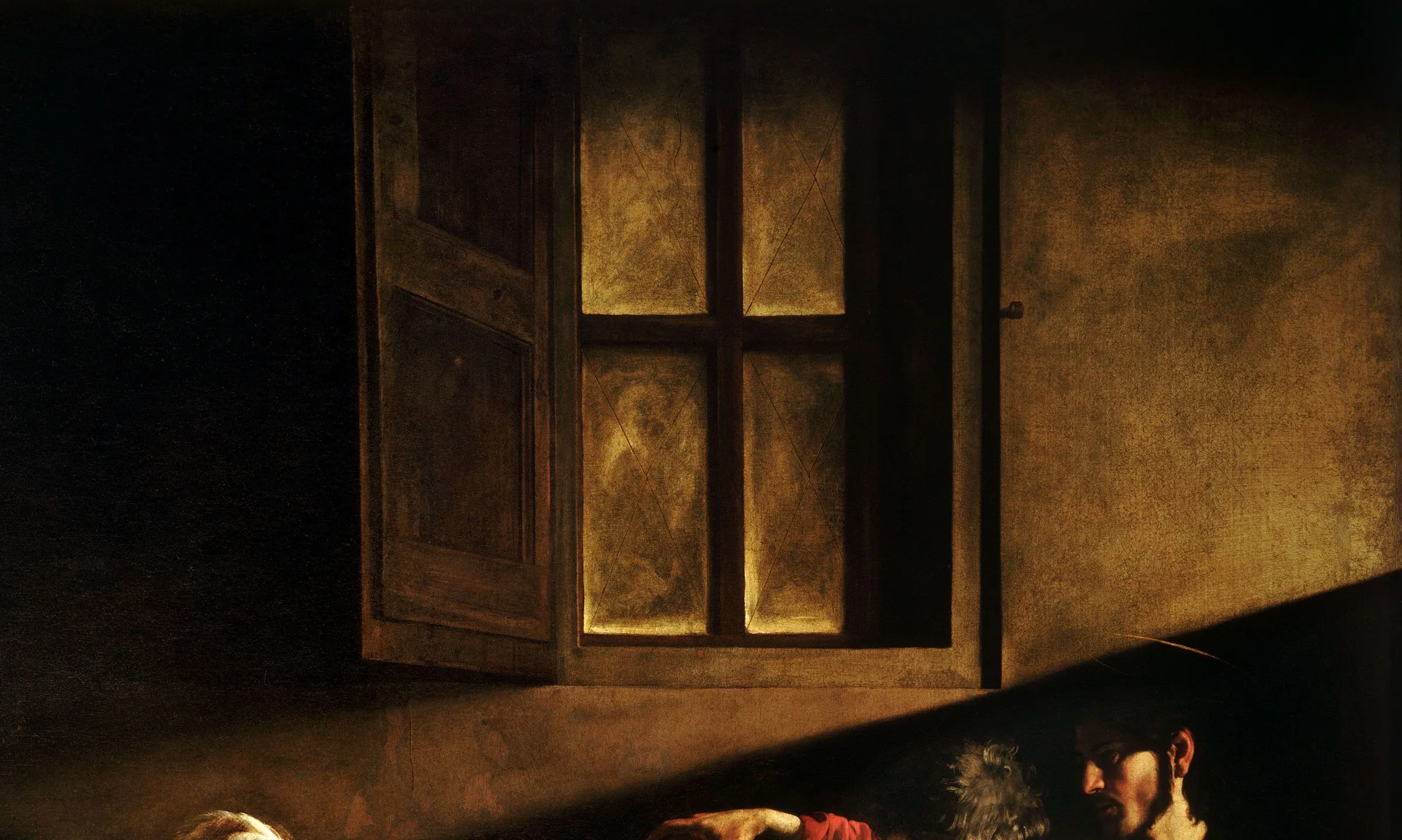
Detail of The Calling of Saint Matthew: the painted window is shuttered and throws nothing. The light comes from one high source outside the picture and lands as a hard wedge on the wall, and everything the wedge misses stays in the dark.
Michelangelo Merisi da Caravaggio, The Calling of Saint Matthew (detail), 1599 to 1600, Contarelli Chapel, San Luigi dei Francesi, Rome. Public domain, Wikimedia Commons.
No preparatory drawing
Bypassed drawing on paper entirely; marked the cardinal points of the composition directly into the wet dark ground, freehand, scoring with the brush handle or an awl to fix proportions.
Why it matters · A drawing transferred to canvas is a plan you then color in. Marking straight into the ground means the proportions get decided in the same act as the painting, with the live model in front of you. The scored incisions are still visible in raking light on many canvases.
Giulio Mancini, Considerazioni sulla pittura, 1621
Paint back to front
Painted the background first, then laid foreground figures over it while it was still wet; arms went over finished sleeves, hair over finished foreheads.
Why it matters · Working front to back means cutting figures out against a background you add later, and the joins show. Building back to front, into wet paint, lets the figure sit physically on top of its world. The order of operations is doing structural work, not just sequencing.
Giulio Mancini, Considerazioni sulla pittura, 1621
Leave the ground showing as a mid-tone
Left patches of the bare reddish-brown ground exposed in flesh and cloth, using the preparation layer itself as a working mid-tone rather than painting over every inch.
Why it matters · If the ground is the color you want a halftone to be, paint it once by not painting it at all. The exposed mestica saves the painter from mixing and placing a value that is already sitting there. The economy is also why the darks stay transparent and deep.
Giulio Mancini, Considerazioni sulla pittura, 1621
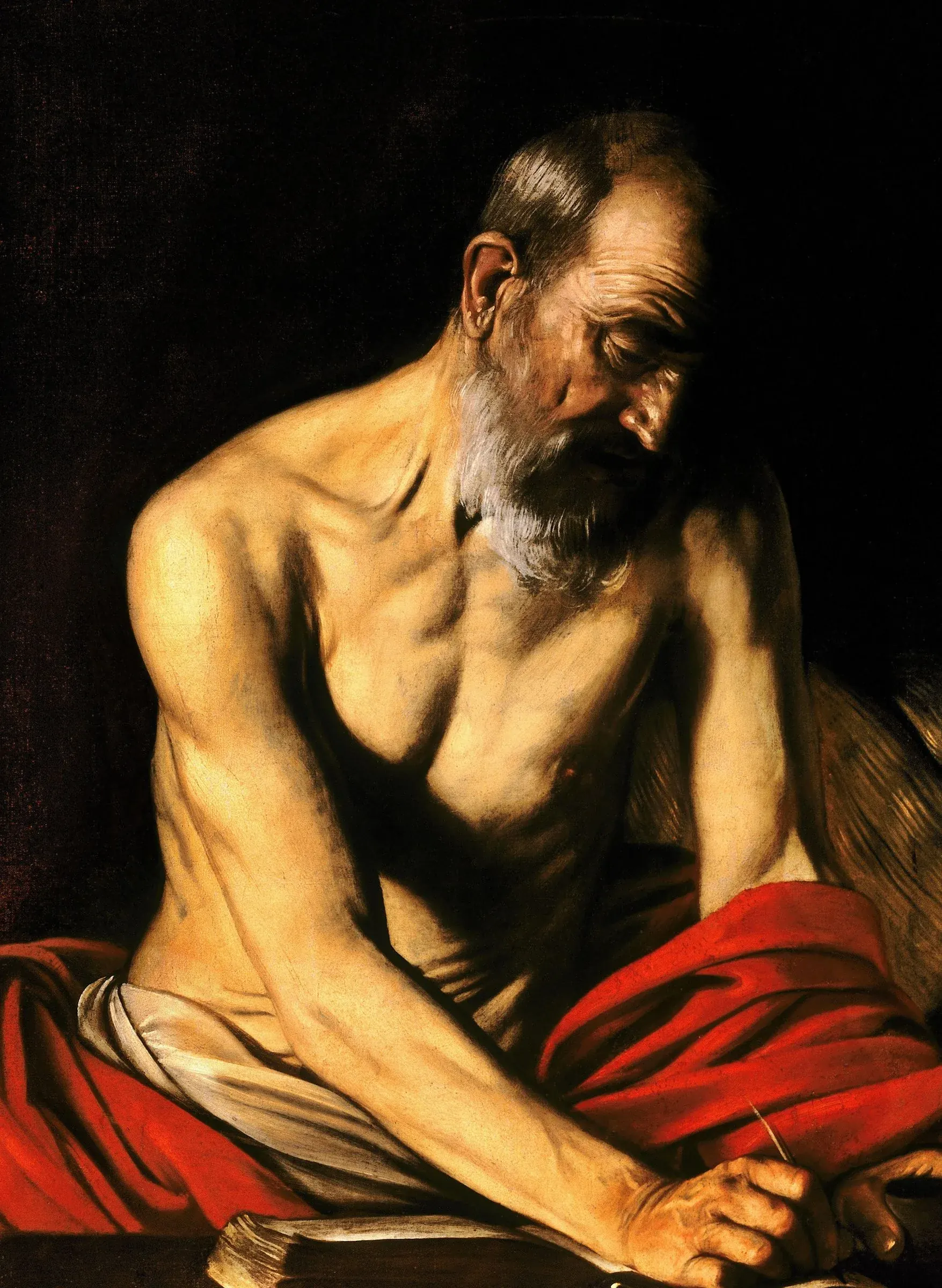
Detail of Saint Jerome Writing: the lit side of the old body is built up in thick opaque paint, and the shadow side thins out until it runs straight into the dark preparation with no edge between them. A good part of the figure is the ground doing the work.
Michelangelo Merisi da Caravaggio, Saint Jerome Writing (detail), circa 1607 to 1608, Oratory of Saint John, Saint John's Co-Cathedral, Valletta. Public domain, Wikimedia Commons.
Ordinary people as saints and gods
Pulled ordinary people off the street to model as saints and gods, painting dirt, swelling, and tan exactly as they were rather than idealizing the flesh.
Why it matters · Treating a figure as a real light-reflecting surface, not an ideal, is the whole difference between his saints and the Mannerist ones around them. The model is whoever was available and looked right, and the truth of the skin is what sells the holiness.
Giovanni Baglione, Le vite, 1642
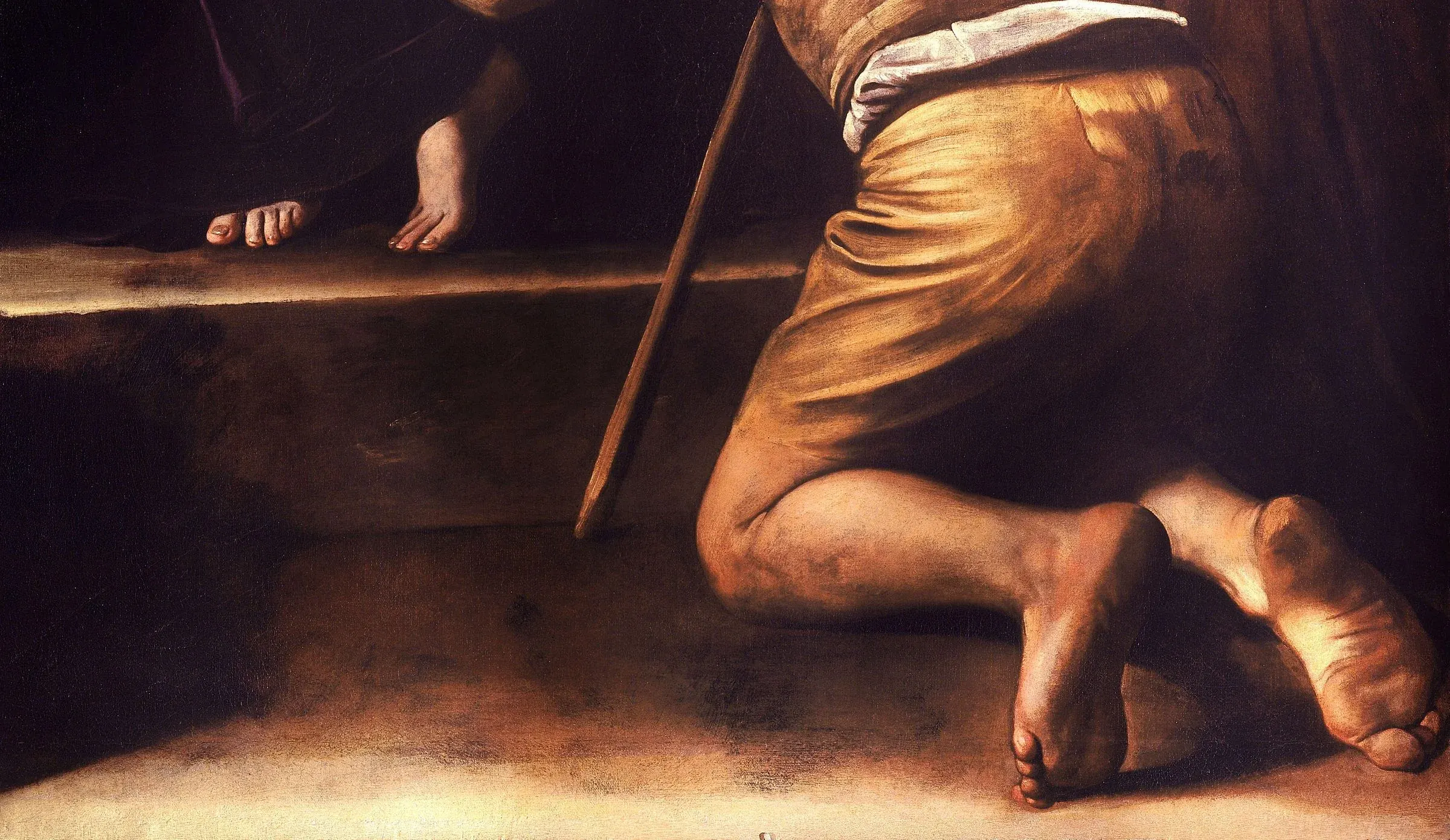
Detail of the Madonna di Loreto: the kneeling pilgrim's bare soles are turned out at the viewer, cracked and grimed, and they get the same careful light as the Madonna's clean feet on the step above. The beggar and the saint are painted by the same rules.
Michelangelo Merisi da Caravaggio, Madonna di Loreto (detail), circa 1604 to 1606, Sant'Agostino, Rome. Public domain, Wikimedia Commons.
Paint over the failure
Edited ruthlessly on the canvas; when an image failed he painted a new one directly over it rather than scraping down or starting a fresh canvas.
Why it matters · The correction happens in the same surface, in the same session, against the same model. Nothing gets precious. A painter who can overpaint a failed figure without flinching keeps moving, where a painter protecting a finished passage gets stuck.
Giulio Mancini, Considerazioni sulla pittura, 1621
His own face in the mirror
Used his own face, observed in a mirror, as the model for figures including the severed head of Goliath and the sick Bacchus.
Why it matters · The cheapest model who will hold any pose and show up every day is yourself. A mirror turns the painter into available reference for the hardest expressions. It is direct-from-life discipline applied to the one face always at hand.
Giovanni Baglione, Le vite, 1642
In the studio
Caravaggio, David with the Head of Goliath, c. 1610, Galleria Borghese (the head of Goliath is a self-portrait)
Studio
Light
A single source from the upper left in a room with every other window blacked out. A 1603 lawsuit from his landlady Prudenzia Bruni records that he knocked a hole through the ceiling to drop high direct light onto models against the blacked-out room, killing ambient reflection in the shadows.
Position
Live models held frozen postures while he painted directly from them. No formal atelier; Mario Minniti lived with him and modeled.
Session length
No disciplined hours. Furious bursts of work, then taverns.
Tools
Thin brush for fine detail · Brush handle and an awl, used to score cardinal points into the wet ground · A large mirror and a mirrored shield (1605 studio inventory) · Eleven pieces of glass (1605 studio inventory)
Notes
The 1605 studio inventory listing a large mirror, a mirrored shield, and eleven pieces of glass has been read as evidence of lenses or mirrors used as a camera obscura. The research presents this as a suggestion, not a settled fact.
Source: Roman Court Records, Trial Testimony (1603); 1605 studio inventory, 1603
Palette
Ground
A light, flexible reddish-brown ground (mestica) of earth pigments in oil, over animal-glue size. Left exposed in places as a working mid-tone in flesh and cloth.
Earths
Earth pigments in the mestica ground
Blacks
Black (Mancini noted the palette skewed to black)
Medium
Oil. Impasto a corpo for the body of the paint, applied thickly with energy; fine details placed with a thin brush. Final light-brown or black transparent glazes laid over the shadows to deepen contrast, sometimes overlapping the figure contours.
Quantity
Not recorded in the research section.
Source: Giulio Mancini, Considerazioni sulla pittura, 1621 — Mancini recorded the dark palette skewing to black. Support and ground facts from the same research section.
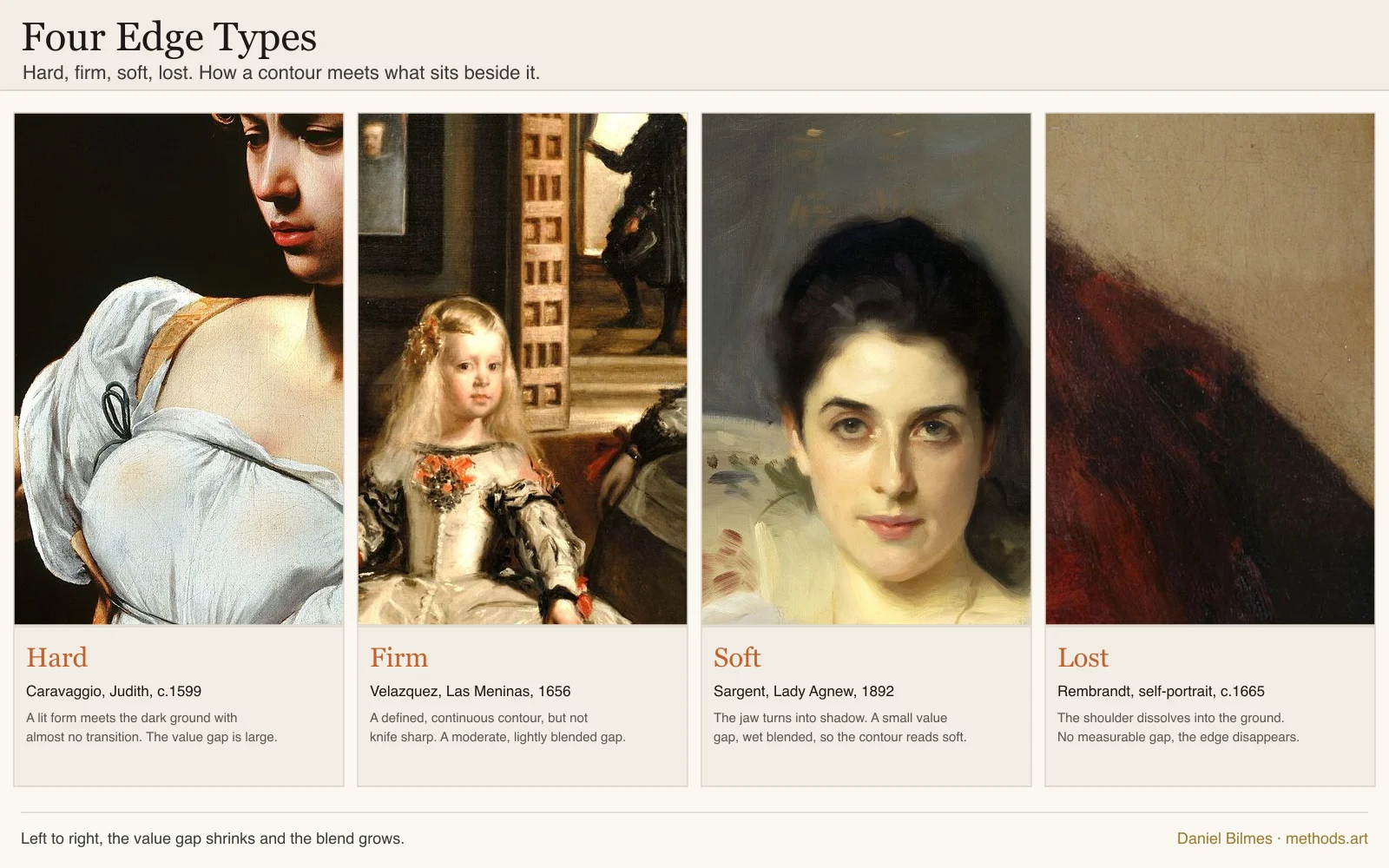
Four edge types, in master paintings
Four edge types in oil painting, from hard to lost: a hard edge in Caravaggio, a firm edge in Velazquez, a soft edge in Sargent, and a lost edge in Rembrandt dissolving into the ground.
The three-value thumbnail: the full value scale collapsed into three brackets (darks, mids, lights), with three famous compositions reduced to three-value thumbnail sketches: Caravaggio's Calling of Saint Matthew, Repin's Barge Haulers on the Volga, and Sorolla's Strolling along the Seashore.
Coarse Roman linen (around twelve by fifteen threads per centimeter), sometimes a heavier olona twill, sized with animal glue and given a light flexible reddish-brown mestica ground of earth pigments in oil.
Why: The ground is warm and mid-valued so it can be left showing as a halftone later. A flexible ground over coarse linen takes the thick impasto without the surface fighting it.
2. Mark the cardinal points
No drawing on paper. The key points of the composition marked freehand straight into the wet dark ground, scored with the brush handle or an awl to fix the proportions.
Why: Proportions get locked in the same act as the painting, with the model present, rather than transferred from a separate plan. The incisions are a structural map, not a contour to fill in.
3. Paint the background
The background laid in first, across the dark ground.
Why: Building back to front means the figures can sit physically on top of a finished world rather than being cut out against it.
4. Lay the figures over wet paint
Foreground figures painted over the background while it was still wet. Arms placed over finished sleeves, hair over finished foreheads.
Why: Painting into wet paint integrates the figure with its surroundings at the join. The overlap is deliberate sequencing, not carelessness.
5. Build the body, leave the ground showing
Impasto a corpo for the mass of the form, fine detail with a thin brush, and patches of the bare reddish ground left exposed as mid-tones in flesh and cloth.
Why: The exposed ground is a value the painter does not have to mix or place. It also keeps the transitions from light into shadow honest, because they run through the actual color of the preparation.
6. Glaze the shadows
Final light-brown or black transparent glazes laid over the shadows, sometimes overlapping the figure contours, to deepen the contrast.
Why: Transparent dark over the established shadow drops the value further without going dead or chalky. This is where the depth of the blacks comes from.
How they studied
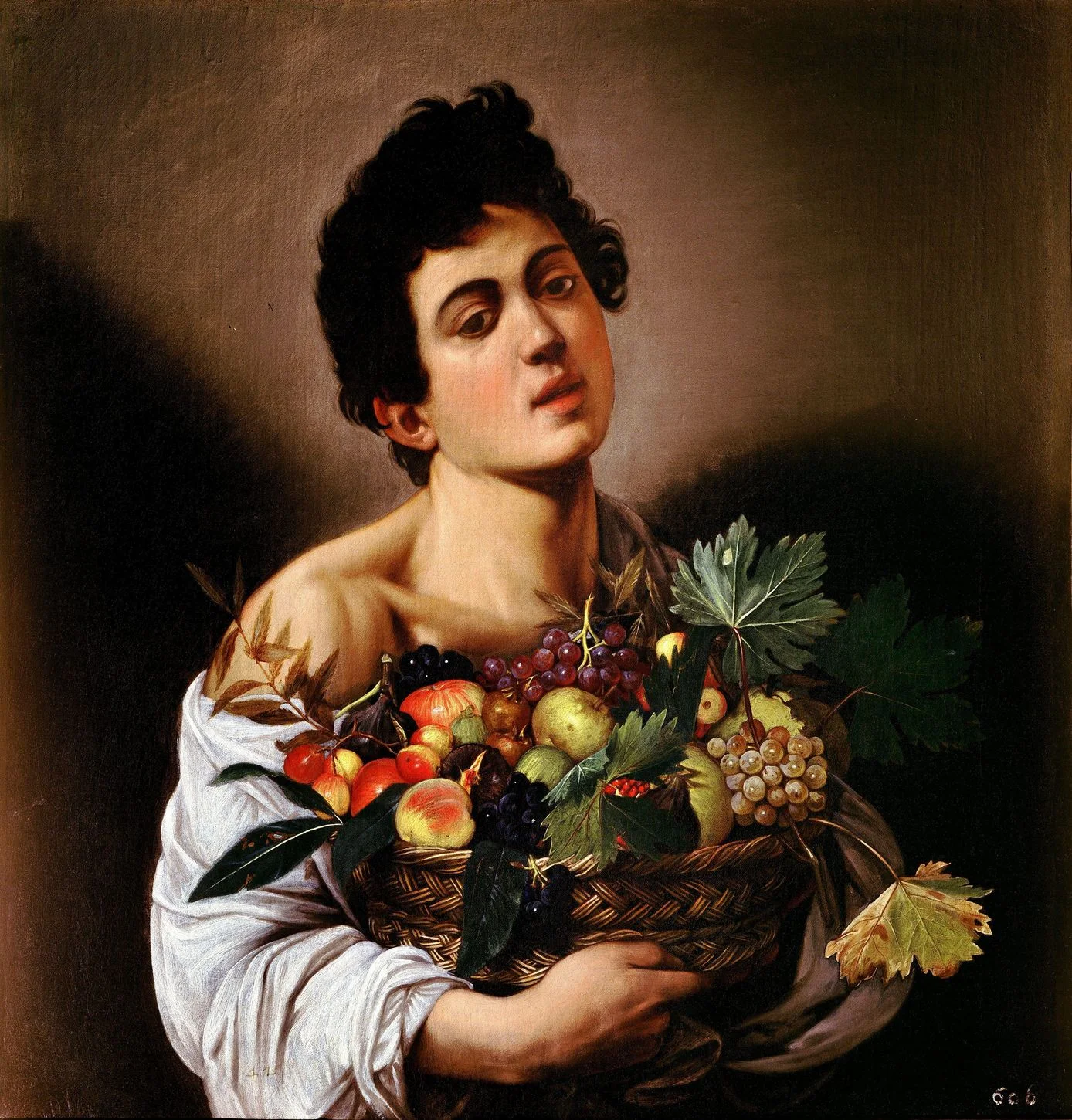
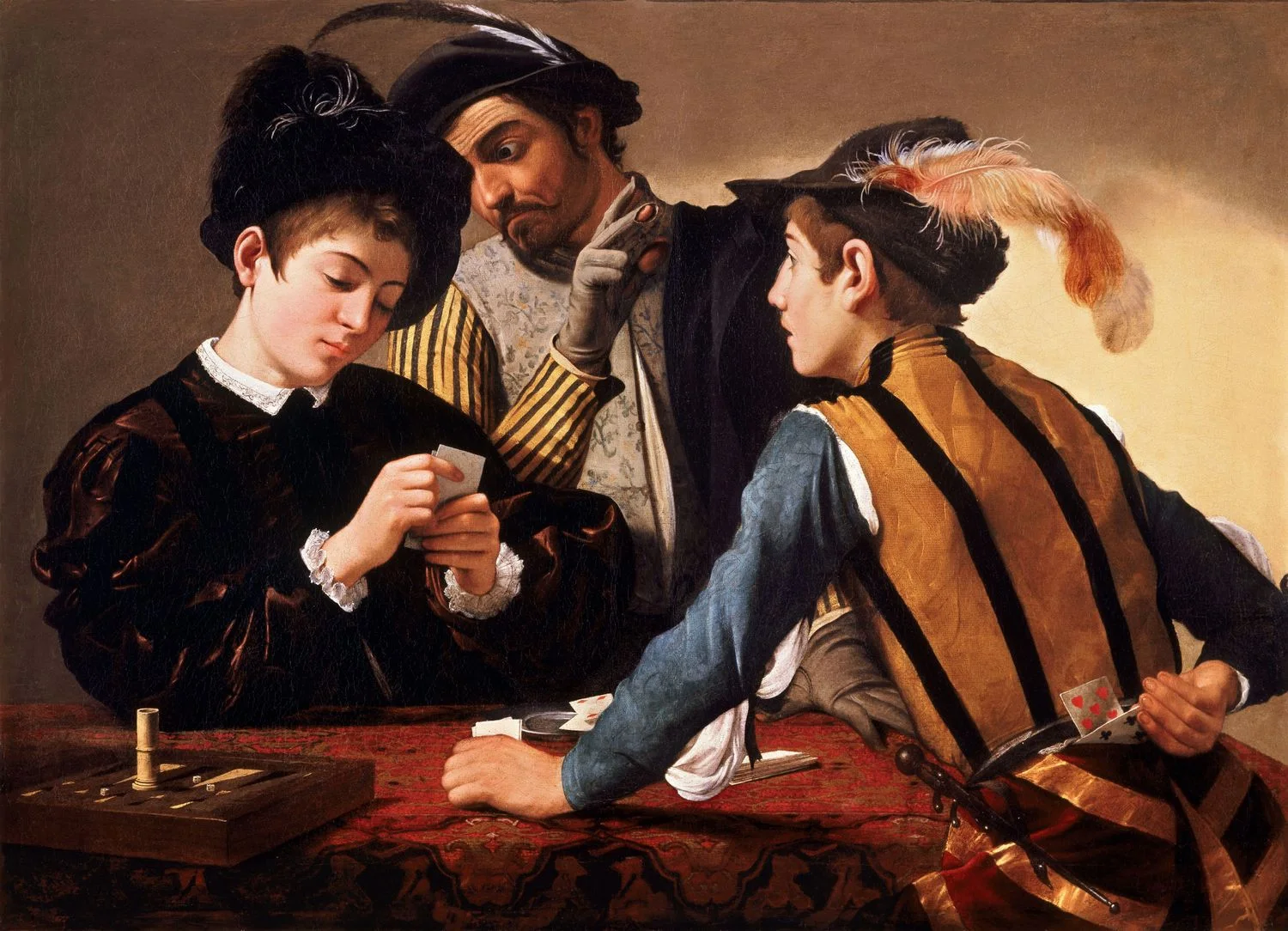
Caravaggio trained young and in the north. In April 1584, at twelve or thirteen, he was bound to the Milanese painter Simone Peterzano for four years, with board and lodging found and the whole craft to be taught in return. The contract turned up in a Milan archive in 1927 and describes Peterzano as a pupil of Titian, which put the boy on the Venetian side of the old argument, colour and brushwork rather than the Roman drilling in disegno. He reached Rome around 1592 with nothing and took work in the large shop of Giuseppe Cesari, the Cavaliere d'Arpino, where his documented job was painting the flowers and fruit in other men's pictures. The Accademia di San Luca, formally founded in Rome in 1593, taught the opposite: drawing from casts and from the posed model, copying Raphael, working toward an ideal. He wanted none of it. No drawing can be firmly given to his hand today, and technical examination finds the planning done on the canvas itself, in brushed lines under the paint and in incisions scratched into the wet priming. The two pictures below stand at the two ends of that formation, the fruit he was paid to paint and the first picture of his own that got him noticed.
Boy with a Basket of Fruit, from the years of workshop piecework: the fruit and the leaves get more care than the boy does, each grape and each blemish studied separately. This is exactly the work he was being paid for at the time, and it is already better than the job needed.
Michelangelo Merisi da Caravaggio, Boy with a Basket of Fruit, circa 1593 to 1595, Galleria Borghese, Rome. Public domain, Wikimedia Commons.
The Cardsharps, the picture that brought him Cardinal Del Monte and got him out of piecework: models hired and posed in the room, dressed from a box of props, the older cheat's fingerless glove and the hidden card set down as plainly as the faces.
Michelangelo Merisi da Caravaggio, The Cardsharps, circa 1595, Kimbell Art Museum, Fort Worth. Public domain, Wikimedia Commons.
Source: The four year apprenticeship contract with Simone Peterzano, Milan, April 1584, found and published by Nikolaus Pevsner in 1927; the documented piecework painting flowers and fruit in the workshop of Giuseppe Cesari; and Larry Keith, Three Paintings by Caravaggio, National Gallery Technical Bulletin volume 19, 1998, on the absence of firmly attributable drawings and the planning done on the canvas.
Up close
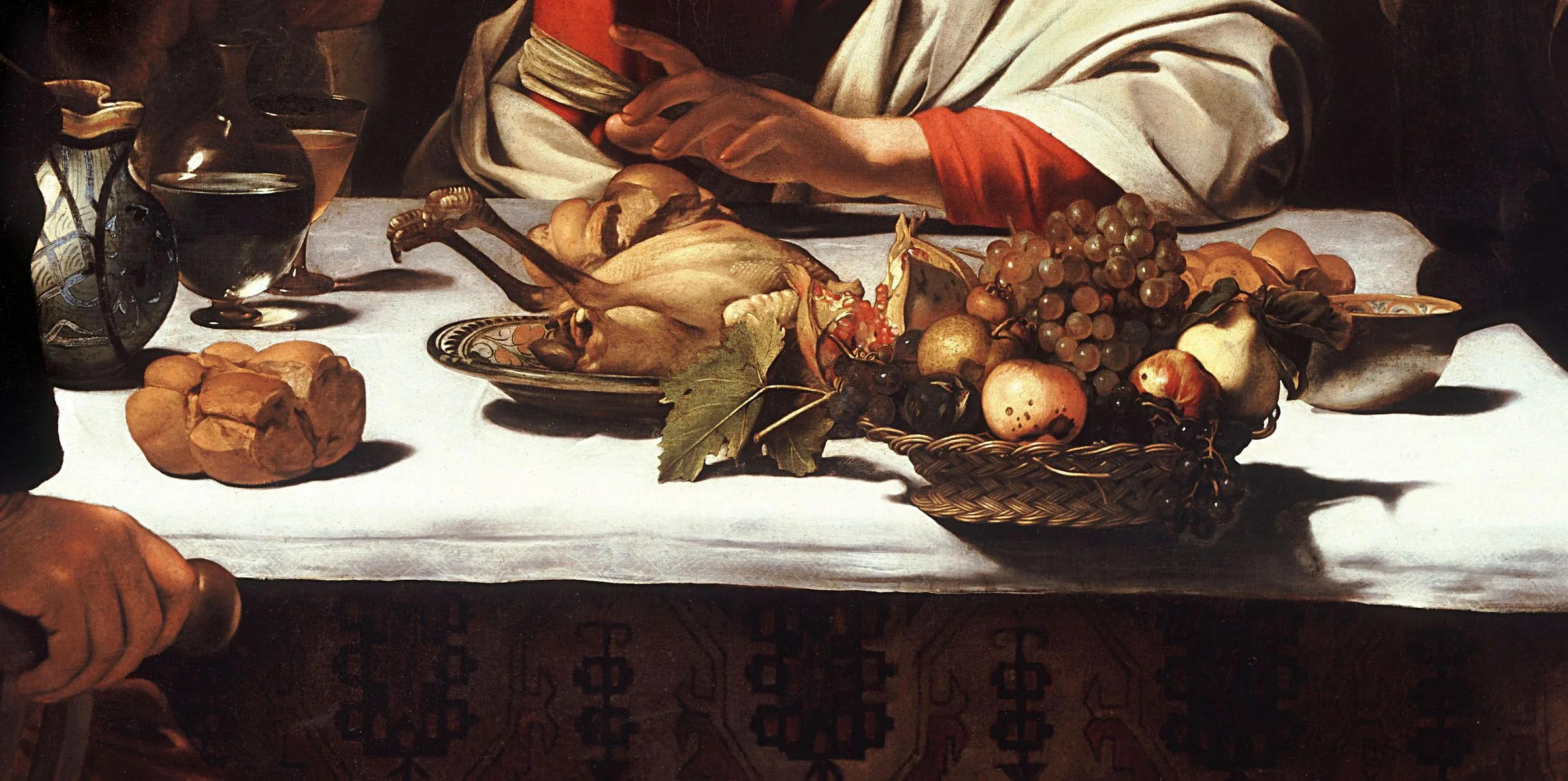
Detail of the Supper at Emmaus: the roast fowl, the split pomegranate, and the basket of bruised and wormholed fruit pushed out over the front edge of the table. Every object throws its own hard shadow across the white cloth, which is what fixes them in the room.
Michelangelo Merisi da Caravaggio, The Supper at Emmaus (detail), 1601, The National Gallery, London. Public domain, Wikimedia Commons.
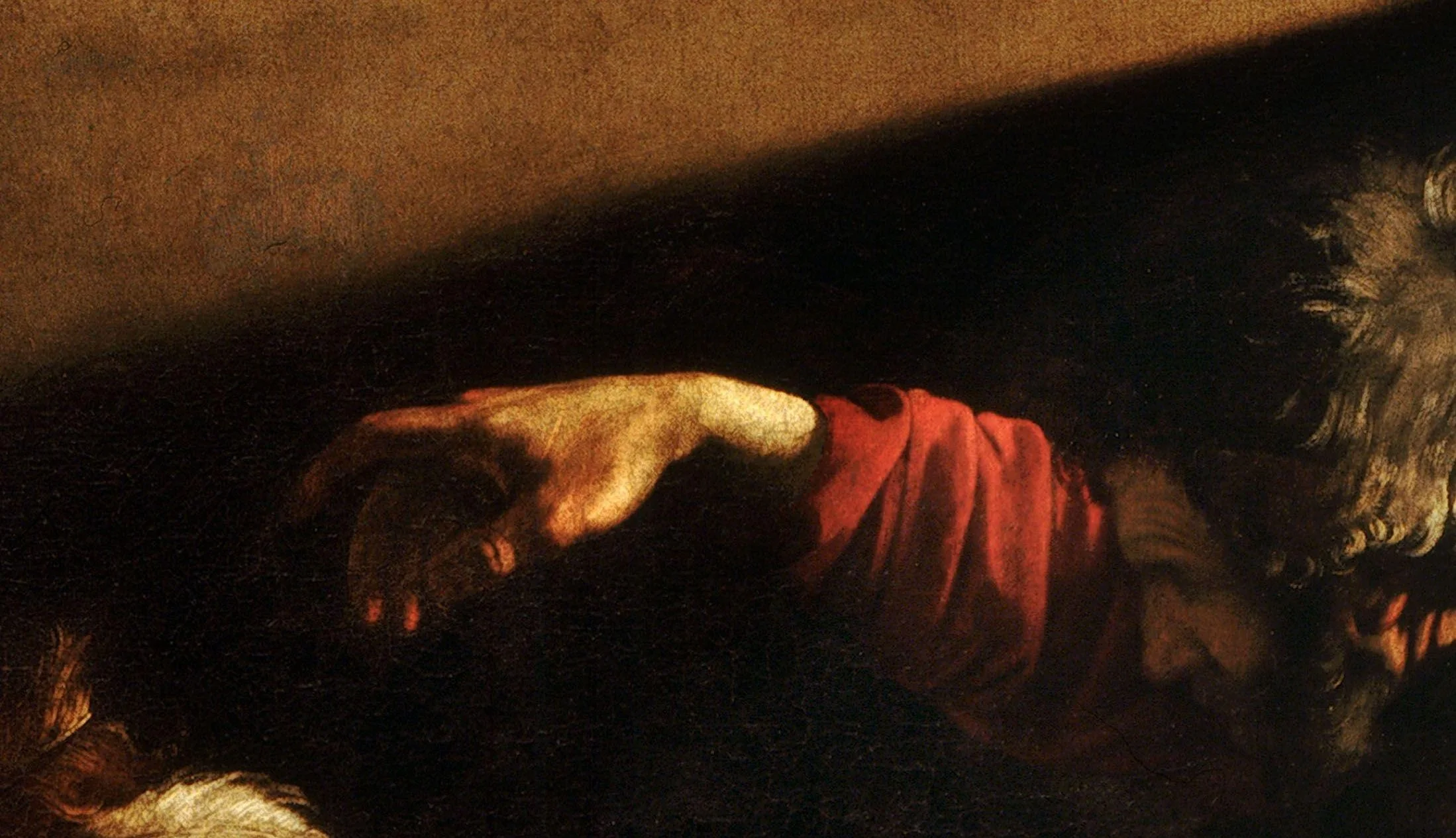
Detail of The Calling of Saint Matthew: the pointing hand is a few strokes of warm light along the knuckles and almost nothing in the shadow, with the edge of the beam cutting the wall above it. The hand is not drawn and filled in, it is found where the light stops.
Michelangelo Merisi da Caravaggio, The Calling of Saint Matthew (detail), 1599 to 1600, Contarelli Chapel, San Luigi dei Francesi, Rome. Public domain, Wikimedia Commons.
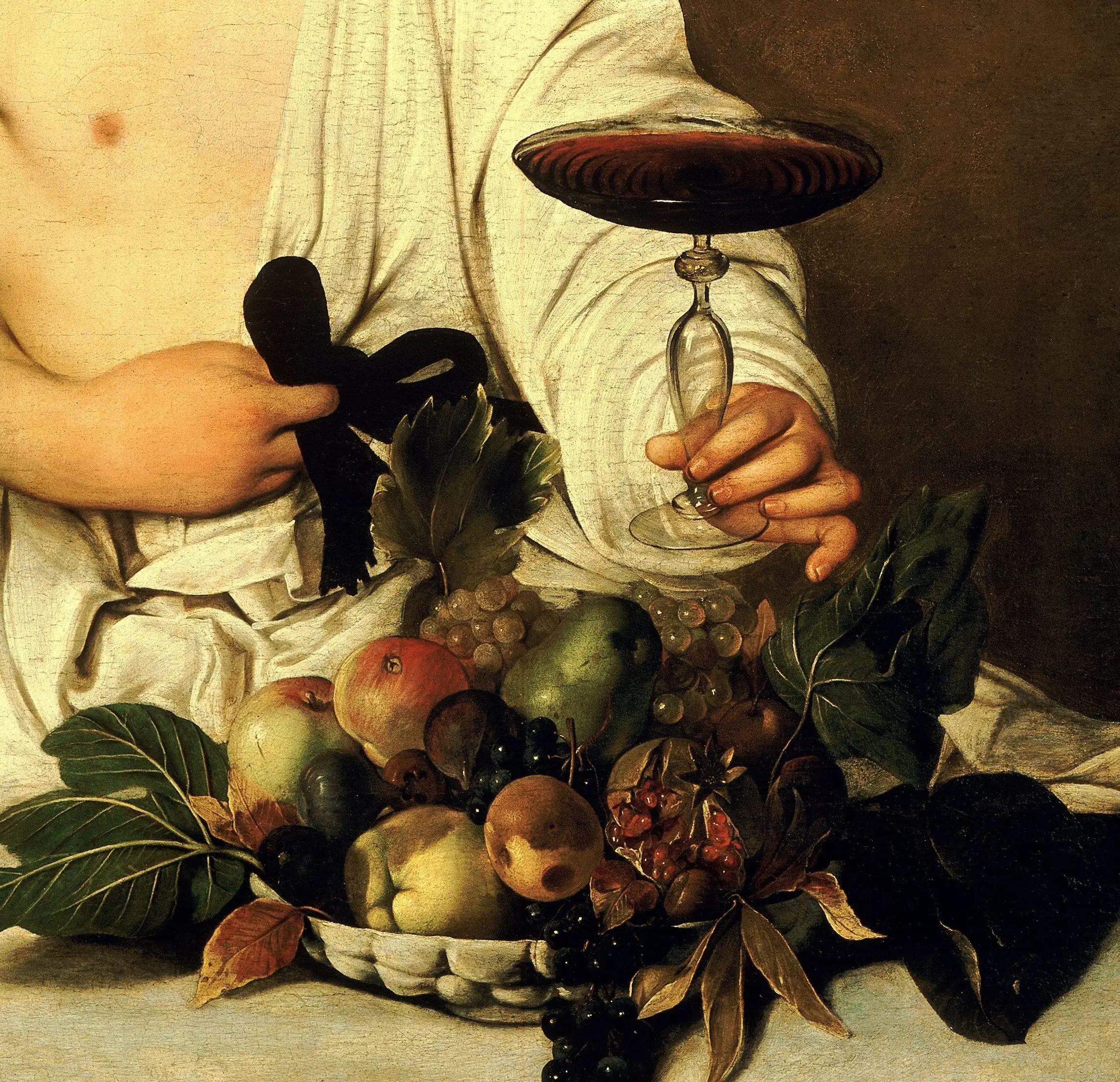
Detail of Bacchus: the wine still swinging in the tilted glass, the bruise on the apple, the split pomegranate, the wormhole and the dry curling leaves. This is the trade he was hired for in Rome as a piecework hand, painting flowers and fruit in another man's shop.
Michelangelo Merisi da Caravaggio, Bacchus (detail), circa 1595 to 1598, Galleria degli Uffizi, Florence. Public domain, Wikimedia Commons.
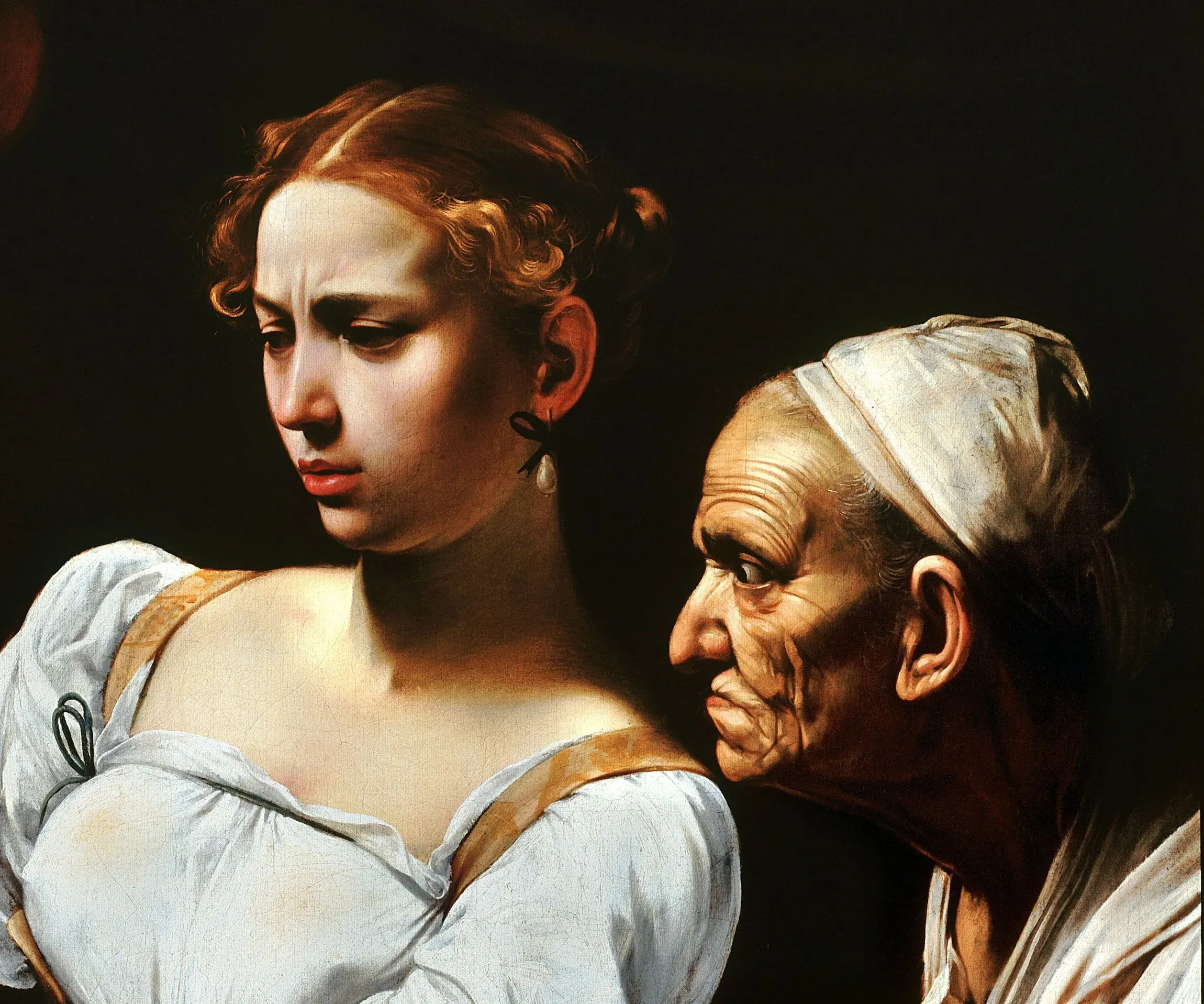
Detail of Judith Beheading Holofernes: two heads lifted out of the black by one hard side light, the young face flinching at what her own hands are doing and the old servant's face beside it, every fold of the skin held in that same light.
Michelangelo Merisi da Caravaggio, Judith Beheading Holofernes (detail), circa 1598 to 1599, Galleria Nazionale d'Arte Antica, Palazzo Barberini, Rome. Public domain, Wikimedia Commons.
Watching him work
“His figures inhabit dungeons, illuminated from above by only a single and melancholy ray. His backgrounds are always dark, and the actors are all placed in the same line, so that there is little perspective in his pictures; yet they enchant us, from the powerful effect which results from the strong contrast of light and shade.”
Luigi Lanzi, translated by Thomas Roscoe, The History of Painting in Italy, volume 2, 1828 [source]
Across media
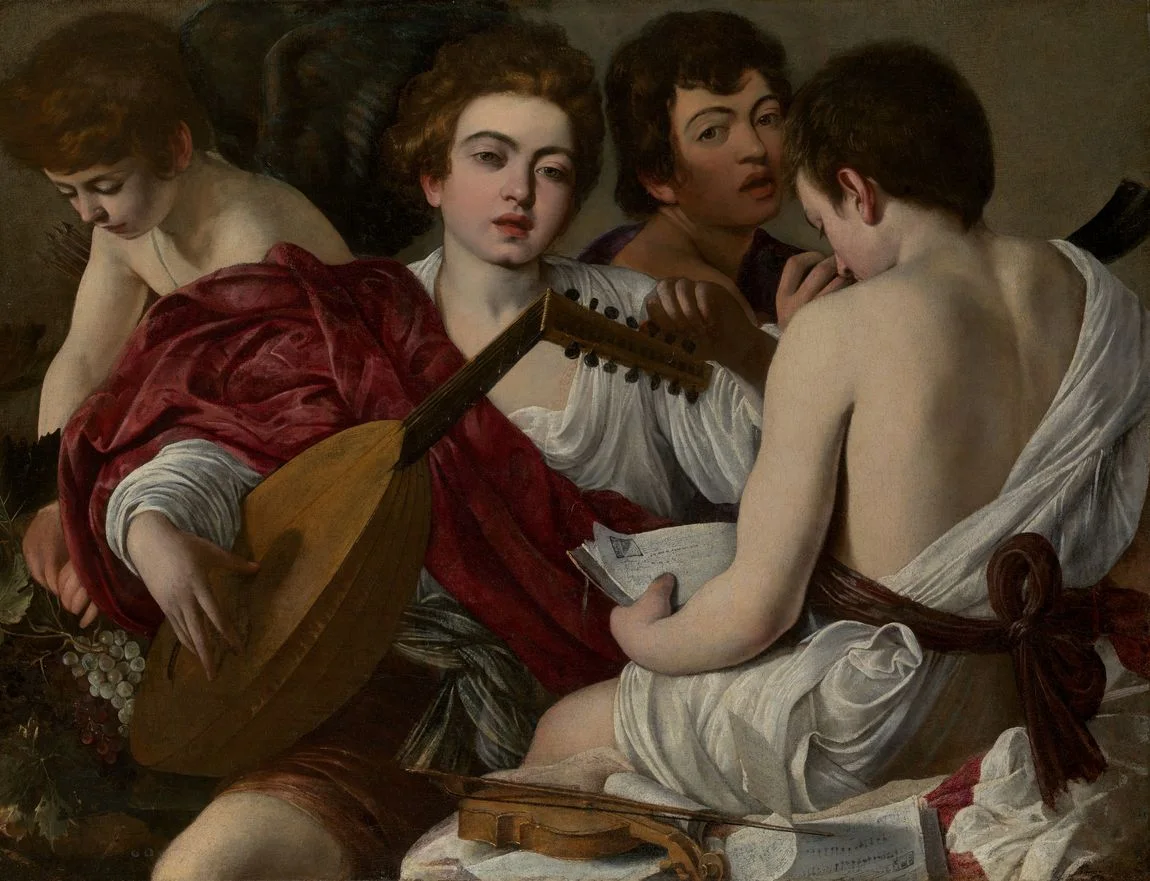
The Musicians, painted for Cardinal Del Monte in the first Roman years: four half length figures posed in the studio in costume with real instruments and a real sheet of music. Technical study has shown the four could not have sat together, so he built the group out of separately posed models.
Michelangelo Merisi da Caravaggio, The Musicians, circa 1595, The Metropolitan Museum of Art, New York. Public domain, Wikimedia Commons.
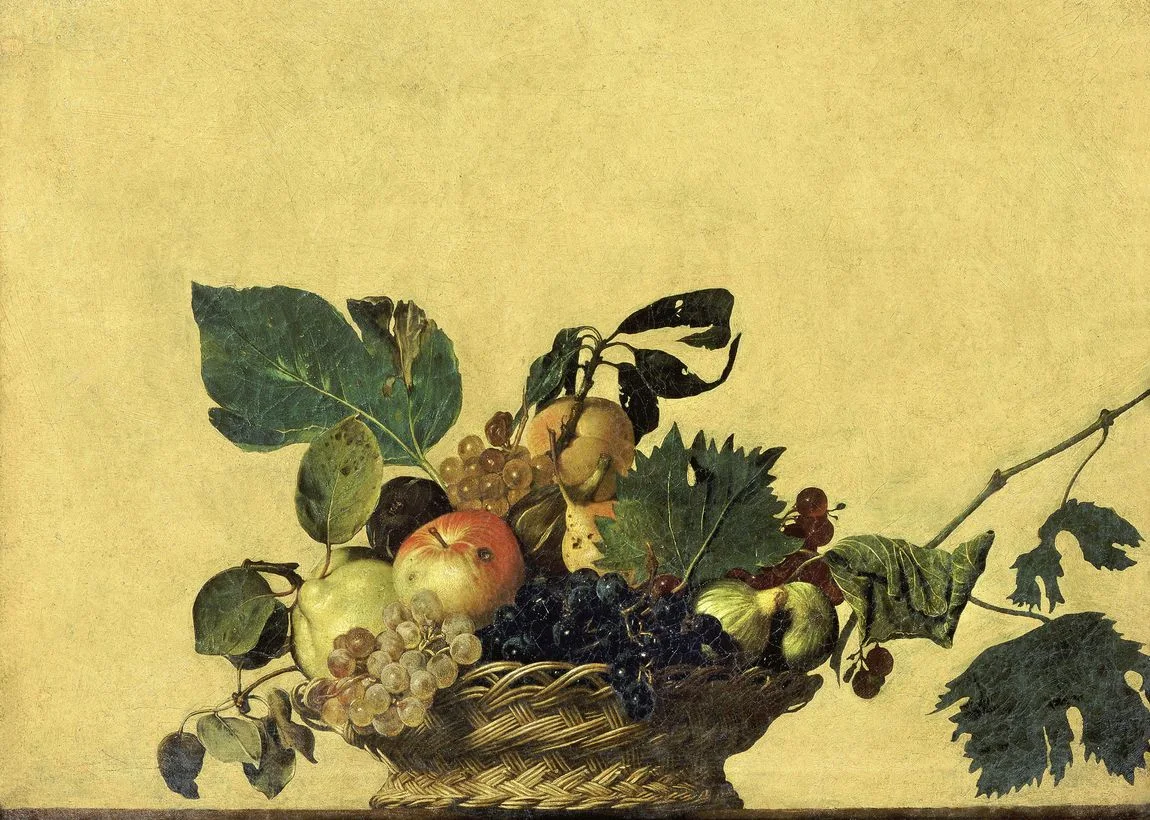
Basket of Fruit, the one independent still life that survives: leaves already curling and dry, a wormhole in the apple, the whole basket set at eye level against a plain light ground. The piecework skill standing on its own with nothing else in the picture.
Michelangelo Merisi da Caravaggio, Basket of Fruit, circa 1597 to 1600, Pinacoteca Ambrosiana, Milan. Public domain, Wikimedia Commons.
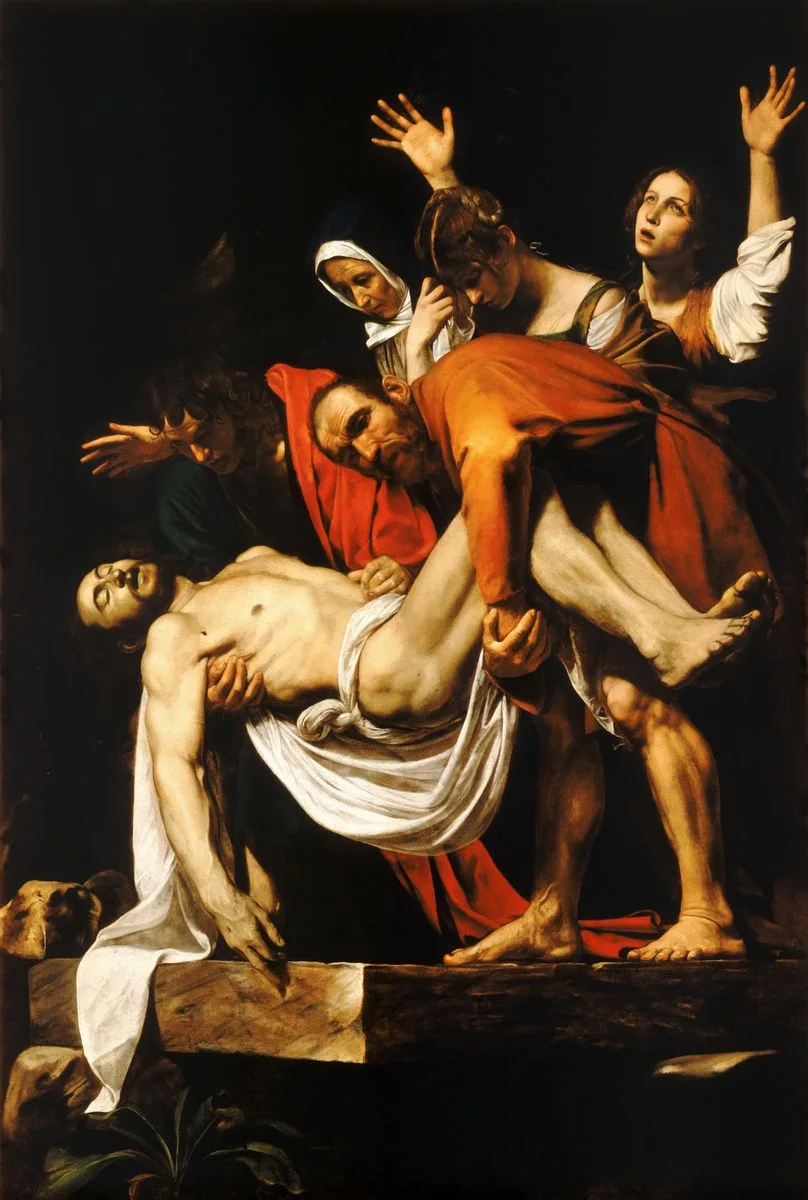
The Entombment of Christ, painted for the Chiesa Nuova in Rome: the studio method carried up to the scale of a public altarpiece, one light on the whole group, and the corner of the stone slab shoved out past the picture plane at the viewer.
Michelangelo Merisi da Caravaggio, The Entombment of Christ, circa 1602 to 1604, Pinacoteca Vaticana, Vatican City. Public domain, Wikimedia Commons.
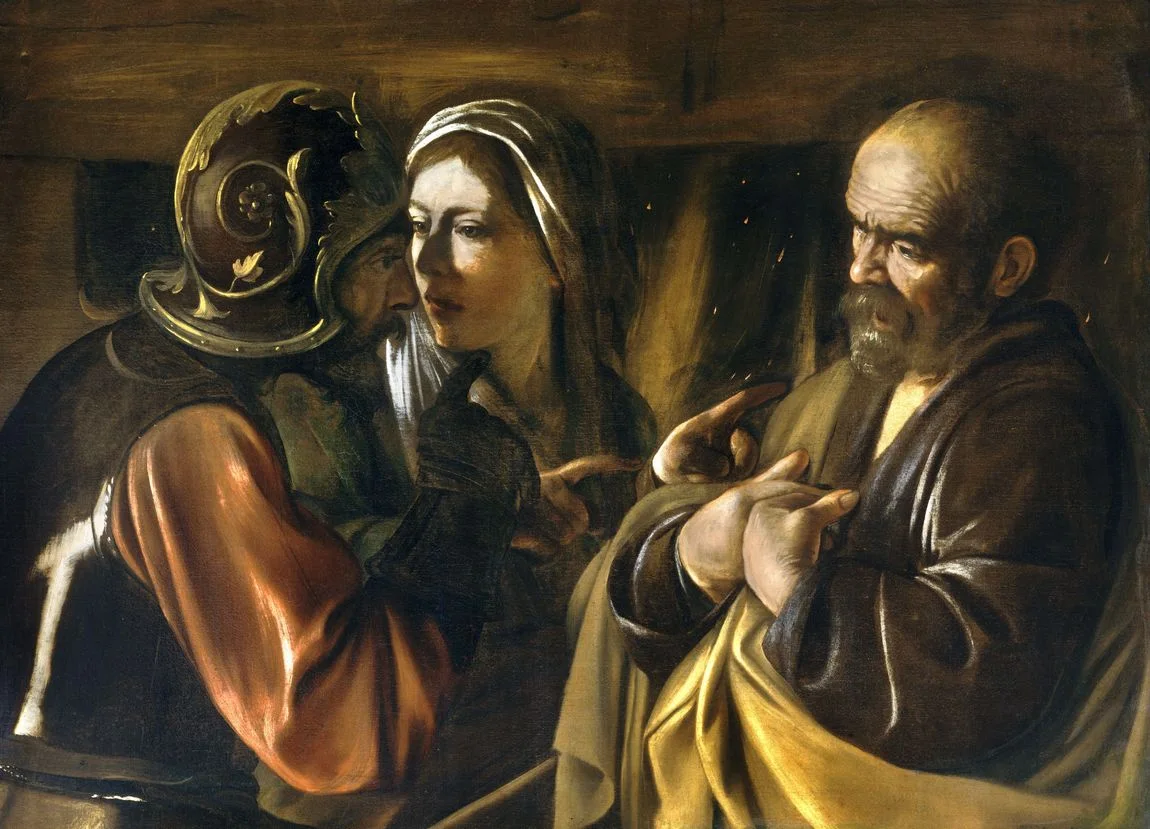
The Denial of Saint Peter, from the last year of his life: three heads and a knot of pointing hands carry the whole story, the paint thin and fast, the helmet and the fire set down in a few strokes. What the picture does not need has been left as ground.
Michelangelo Merisi da Caravaggio, The Denial of Saint Peter, 1610, The Metropolitan Museum of Art, New York. Public domain, Wikimedia Commons.
The record, deeper
The reworks
Under the Supper at Emmaus the breeches of the figure on the right were first painted the same green as the jacket opposite, then changed to black, and his leg was first placed in front of the table carpet and moved behind it while the picture was under way. That is the one change of any size in the whole canvas.
Larry Keith, Three Paintings by Caravaggio, National Gallery Technical Bulletin volume 19, 1998.
The New York Lute Player was begun by transferring the composition of the earlier Hermitage version straight onto the canvas. He painted in a still life of fruit at the lower left, then covered it and changed the foreground, the lute, and the shoulders.
Keith Christiansen, cited in Larry Keith, Three Paintings by Caravaggio, National Gallery Technical Bulletin volume 19, 1998.
X-rays of his Saint Catherine of Alexandria show the hands were first set higher and moved down later, another correction made on the canvas rather than in a drawing.
Technical examination of Saint Catherine of Alexandria, Museo Nacional Thyssen-Bornemisza, Madrid.
The studio
Mancini described the method of the school as lighting from a single high window in a room with the walls coloured black, which gives very bright lights and very dark shadows and throws the figures forward off the picture.
Giulio Mancini, Considerazioni sulla pittura, written about 1614 to 1621.
Bellori wrote that he used a high light falling straight down on the main part of the body and left the rest in shadow, to get force out of the contrast.
Giovanni Pietro Bellori, Le vite de' pittori, scultori et architetti moderni, Rome, 1672.
Mancini also set down the limit of the method. Painting from the model works for a single figure, he wrote, but not for a large narrative, since a roomful of men cannot be held still while one of them laughs or cries or pretends to walk.
Giulio Mancini, Considerazioni sulla pittura, translated in Larry Keith, Three Paintings by Caravaggio, National Gallery Technical Bulletin volume 19, 1998.
A sequestration inventory taken from his rooms in the Vicolo dei Santi Cecilia e Biagio on 26 August 1605 lists the working contents of the room, including props and pictures still in progress.
Sequestration inventory of Caravaggio's rooms, Rome, 26 August 1605.
The materials
The ground under the early and middle Roman pictures is a translucent red brown of calcite, earth pigments, and a little lead white. It is left showing as a ready made middle tone in flesh and hair, and Bellori noticed the habit, recording that he left the priming of the canvas to serve as the middle tones.
Larry Keith, Three Paintings by Caravaggio, National Gallery Technical Bulletin volume 19, 1998; Giovanni Pietro Bellori, Le vite de' pittori, Rome, 1672.
The late pictures sit on a darker ground of mixed earths and calcium carbonate with a little lead white and carbon black, so more of the drama comes out of the preparation itself as the years go on.
Larry Keith, Three Paintings by Caravaggio, National Gallery Technical Bulletin volume 19, 1998, on the Salome of about 1609.
The paint is walnut oil almost throughout, but for the whitest whites, the raised embroidery on the tablecloth in the Supper at Emmaus and a highlight on a shirt sleeve in Boy Bitten by a Lizard, he mixed egg tempera into the oil for a denser, cooler, more opaque white.
Medium analysis reported in Larry Keith, Three Paintings by Caravaggio, National Gallery Technical Bulletin volume 19, 1998.
The incisions are scratched freehand into the priming while it is still soft and mark only the position of the key elements, and the finished pictures often depart from them. Besides fixing the layout they let a model find the same pose again at the next sitting, which is what makes long work from life possible inside a planned composition.
Larry Keith, Three Paintings by Caravaggio, National Gallery Technical Bulletin volume 19, 1998, following Keith Christiansen, Caravaggio and L'esempio davanti del naturale, The Art Bulletin 68, 1986.
Refusals — what they would not do
Refused preparatory drawing entirely; no cartoons, no transfer, marked straight into the wet ground.
Refused memory and imagination as sources; worked entirely direct from live models.
Refused to idealize the flesh; painted dirt, swelling, and tan exactly as they appeared rather than correcting them toward a type.
Refused to protect a failed image; painted a new one directly over it rather than starting a fresh canvas.
Refused ambient light in the shadows; blacked out every window but one to keep the darks free of reflection.
Reference
Primary source
Entirely direct from live models. Ordinary people pulled off the street to pose as saints and gods, dressed in studio props. Flesh and objects treated as light-reflecting surfaces, not ideals.
Photography
Not applicable to the period.
Exceptions
Used his own face, seen in a mirror, as the model for figures including the head of Goliath and the sick Bacchus.
Borrowed theater wings as costume props for Amor Vincit Omnia.
Mancini recorded that his palette skewed to black. He worked in oil, laid the body of the paint thickly (impasto a corpo), placed fine details with a thin brush, and finished with transparent light-brown or black glazes over the shadows to deepen the contrast. Patches of the bare reddish-brown ground were left exposed as mid-tones in flesh and cloth.
Did Caravaggio use preparatory drawings?
No. He bypassed drawing on paper entirely and marked the cardinal points of the composition freehand into the wet dark ground, scoring with the brush handle or an awl to fix the proportions. The incisions are still visible in raking light on many canvases.
How did Caravaggio light his studio?
He blacked out every window in the room except one and took the light from the upper left. A 1603 lawsuit from his landlady records that he knocked a hole through the ceiling to drop high direct light onto the model. Killing the ambient light kept the shadows free of reflection, which is why the darks read so deep.
What did Caravaggio paint on?
Coarse Roman linen, around twelve by fifteen threads per centimeter, sometimes a heavier olona twill. The canvas was sized with animal glue and given a light, flexible reddish-brown mestica ground of earth pigments in oil, which he left exposed in places as a working mid-tone.
How did Caravaggio start a painting?
With the model in front of him, not with a drawing. He scored the key points of the composition into the wet ground, painted the background first, then laid the foreground figures over it while it was still wet. Building back to front let each figure sit physically on top of its world.
Who taught Caravaggio, and whom did he teach?
He apprenticed under the Mannerist Simone Peterzano in Milan from 1584 to 1588 and kept no formal atelier of his own afterward. Mario Minniti lived with him and modeled. His direct-from-life tenebrism spawned the Caravaggisti: Orazio Gentileschi, Jusepe de Ribera, and Valentin de Boulogne.
If this painter is your match
You work direct from what is in front of you and decide the picture on the canvas, not on paper first. The fixes happen in the same surface, against the same model, and nothing gets too precious to paint over.
Borrow this: Black out the room and light your subject from one high source on the upper left. Skip the drawing and mark your proportions straight onto a warm mid-toned ground. Leave that ground showing in the halftones instead of painting every inch. When a passage fails, paint over it.
Giulio Mancini, Considerazioni sulla pittura, 1621. Near-contemporary account. Source for the dark palette skewing to black and the on-canvas working method.
Giovanni Baglione, Le vite, 1642. Biography by a rival painter Caravaggio testified against in 1603. Records the direct-from-life practice and the use of ordinary people as models.
Joachim von Sandrart, Teutsche Academie, 1675. Later German account of Caravaggio's life and method.
Roman Court Records, Trial Testimony, 1603. The 1603 libel trial and the landlady Prudenzia Bruni lawsuit. Source for the blacked-out room, the upper-left light, and the hole knocked through the ceiling.
Vincenzo Giustiniani, Lettera a Teodoro Amideni, 1620. A patron's letter preserving the flowers-and-figures quote.
Larry Keith, Three Paintings by Caravaggio, National Gallery Technical Bulletin volume 19, 1998. Technical examination of Boy Bitten by a Lizard, The Supper at Emmaus, and Salome receives the Head of John the Baptist. Source for the ground composition, the walnut oil and egg tempera whites, the incisions and their function, the pentimento in the Supper at Emmaus, and the absence of firmly attributable drawings.[link]
Giovanni Pietro Bellori, Le vite de' pittori, scultori et architetti moderni, Rome, 1672. Records the high light falling straight down on the main part of the body, and the habit of leaving the priming of the canvas to serve as the middle tones.
Luigi Lanzi, The History of Painting in Italy, volume 2, translated by Thomas Roscoe, London, 1828. The earliest public-domain English wording on the method itself. Source for the witness line, verified word for word against the fetched transcription of the 1828 edition, pages 199 to 200.[link]
Apprenticeship contract with Simone Peterzano, Milan, April 1584, 1584. The four year indenture with board and lodging found and the craft to be taught in return. Found and published by Nikolaus Pevsner in 1927; describes Peterzano as a pupil of Titian.
Keith Christiansen, Caravaggio and L'esempio davanti del naturale, The Art Bulletin 68, 1986. The survey of the documented incisions and their role in letting models resume a pose between sittings.
.jpg)
.jpg?width=900)