Painters
HS

Harold Speed

18721957 · England
Researched by Daniel Bilmes, painter and educator.

Harold Speed taught drawing and painting as trained understanding rather than lucky talent. His method splits drawing into two faculties, line drawing for the mental idea of form and mass drawing for what the eye actually receives, trains visual memory with deliberate away-from-the-model exercises, and defends the slight living irregularity of a handmade line, which he named "dither," against mechanical smoothness. His oil painting proceeds in a settled order: structure in line, a thin monochrome rub-in of the tonal masses, colour laid over the organised values, and edges decided deliberately as the painting's steering. An English academic painter trained at the Royal College of Art and the Royal Academy Schools, where he took a gold medal and travelling scholarship in the early 1890s, he set the method down in The Practice and Science of Drawing (1913) and the book now sold as Oil Painting Techniques and Materials (1924), both public domain and continuously in print for a century.

Signature moves

Separate line drawing from mass drawing

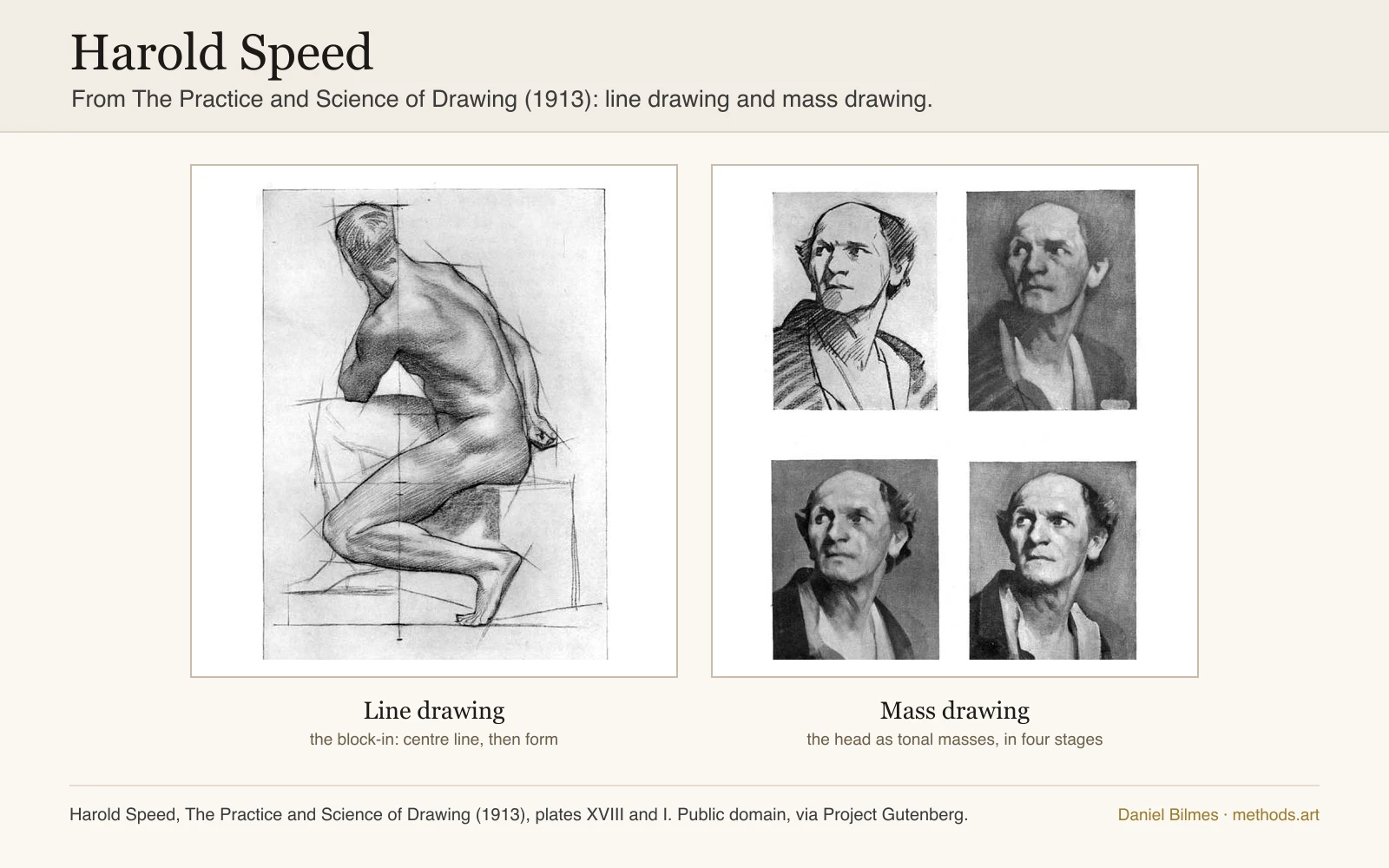
Taught the two as different faculties: line drawing addresses the mental idea of form through contour, mass drawing addresses what the eye actually receives, patches of tone.

Why it matters · Most students fail by mixing the two unconsciously, outlining what should be seen as mass. Naming the split lets you choose the right faculty for the task: line for structure and design, mass for painting, which Speed treats as drawing with the brush in tone.

Harold Speed, The Practice and Science of Drawing, the line and mass chapters, 1913

Keep the dither in the line

Named the slight living variation of a handmade line "dither," and defended it against mechanical smoothness as the carrier of vitality.

Why it matters · It is a precise name for why corrected-to-death drawings go dead. The small tremors of a committed hand carry the drawing's life; sand them out and the accuracy that remains is inert. Naming it makes it teachable: you learn to keep the vibration while controlling the direction.

Harold Speed, The Practice and Science of Drawing ("dither"), 1913

Train the visual memory deliberately

Set structured memory exercises, studying the model, then drawing away from it, so students could carry form in the head rather than depending on constant looking.

Why it matters · A painter who can hold form in memory composes and corrects from understanding instead of transcription. The exercise also exposes what you failed to actually observe, which sharpens the next observation. It is the cheapest training with the highest return Speed offers.

Harold Speed, The Practice and Science of Drawing, the memory-training passages, 1913

Open the painting with a tonal rub-in

Began oil work with a thin monochrome rub-in of the big tonal masses, settling composition and values before committing colour.

Why it matters · The rub-in makes the value structure a decision instead of an accident. Colour laid over a settled tonal statement stays organised; colour improvised into a white canvas has to solve value and hue at once, which is where most paintings first go wrong.

Harold Speed, Oil Painting Techniques and Materials (orig. The Science and Practice of Oil Painting), the painting-order chapters, 1924

Vary the edge as the form demands

Treated edge quality, sharp against soft, found against lost, as an expressive instrument to be decided, not a byproduct of finishing.

Why it matters · Edges steer the eye and describe form turning. Deciding them consciously, the way Speed teaches, is a large part of what separates a painting that breathes from one that reads as uniformly traced.

Harold Speed, Oil Painting Techniques and Materials, on edges, 1924
Studio
Light
A London portrait painter's practice in the academic tradition: north-lit work from the model, alongside decades of teaching and lecturing.
Position
At the easel as a working portraitist and muralist, and before students as a teacher and lecturer; the books grew from the teaching.
Session length
A working portrait career running from the 1890s into the twentieth century, the books published at its midpoint, 1913 and 1924.
Tools
Charcoal and chalk for the drawing instruction · Oil, brush, and the tonal rub-in for the painting method · The model, the memory exercise, and the master study as the standing curriculum
Notes
Speed trained first at the Royal College of Art and then at the Royal Academy Schools, taking a gold medal and travelling scholarship in the early 1890s, and painted portraits and murals professionally throughout. Both instruction books are public domain and have stayed continuously in print in Dover editions, a century of sustained demand.
Source: Harold Speed, author accounts in the two books; Dover Publications editions
Palette
Ground
Toned grounds in the academic manner, with the thin monochrome rub-in establishing the tonal bed for colour.
Whites
Lead-era flake white in the working period the books describe
Earths
The earth pigments of the tonal rub-in: umbers and ochres thinned for the lay-in
Blacks
Used within the academic tonal tradition the books teach; Speed argues value structure first, pigment lists second
Medium
Oil handled in a deliberate order: thin tonal rub-in, then colour laid over the settled masses. The 1924 book is explicitly about craft, materials, and order rather than recipes for effects.
Source: Harold Speed, Oil Painting Techniques and Materials, 1924
Workflow, from blank canvas
  1. 1. Draw the idea in line

    Settle structure, proportion, and design with line drawing, the mental faculty, before painting begins.

    Why: Line carries the idea of the form and the design of the picture; solving it first keeps the painting stage from carrying problems it cannot fix.

  2. 2. Rub in the masses

    Lay a thin monochrome rub-in of the big tonal masses over the drawing.

    Why: Values become a settled decision. Everything after is laid onto an organised tonal bed.

  3. 3. Paint mass, not contour

    Work in patches of tone, drawing with the brush, matching the visual impression rather than outlining.

    Why: Painting is mass drawing in Speed's split: the eye receives tone, so the brush should state tone, with contour kept as a structural memory, not a painted line.

  4. 4. Decide the edges

    Resolve each passage's edges deliberately: sharp where form turns quickly or attention is wanted, soft and lost where it turns slowly or should recede.

    Why: Edges are the painting's steering. Decided edges make the eye travel where the painter intends.

  5. 5. Keep the vitality

    Preserve the dither, the living irregularity of the hand, through the finishing passes instead of sanding the surface to mechanical smoothness.

    Why: Over-correction kills more student work than inaccuracy does. The tremor of a committed hand is what keeps finish alive.

Refusals — what they would not do
  • Refused to let students confuse line and mass, the two faculties he insisted be trained separately.
  • Refused mechanical smoothness, defending the handmade line's dither as the carrier of life.
  • Refused improvised painting order: colour waits until the tonal masses are settled.
  • Refused art-school shortcut culture, arguing craft and observation are trained, in his phrase, by science in service of practice.
Reference
Primary source
The model observed directly, disciplined by structured memory training so that observation becomes understanding rather than transcription.
Photography
Writing in 1913-1924, Speed warns against dependence on mechanical aids; the memory exercises exist precisely to build the faculty photography lets atrophy.
Exceptions
  • Master studies are part of the curriculum: copying to learn the mechanism, in line with the book's analytical spirit.
Lineage

Every teacher and student below sits on the site-wide teacher-student map.

Teachers
  • The Royal Academy Schools · London, early 1890s, after the Royal College of ArtFull English academic training: drawing, anatomy, and painting craft, capped by the gold medal and travelling scholarship that took him to study the masters abroad.
Influences
  • The European academic tradition read analytically: Speed's books constantly test studio doctrine against how seeing actually works.
  • Velazquez and the tonal masters, the standing exemplars of his mass-drawing ideal.
Students
  • Generations of self-taught and atelier painters through the two Dover editions, which remain among the most recommended classical instruction texts a century on.
In their own words
I have ventured to call it "dither."
Harold Speed, The Practice and Science of Drawing, 1913
Speed coining his name for the slight living variation of a handmade line, the quality he defends against mechanical accuracy as the carrier of a drawing's vitality.
Techniques and practices
line-versus-mass-drawing
dither-vital-line
visual-memory-training
tonal-rub-in
deliberate-painting-order
edge-variety
Questions and answers

What is Harold Speed known for?

Two of the most enduring classical art-instruction books ever written: The Practice and Science of Drawing (1913) and Oil Painting Techniques and Materials (1924). An English academic portrait painter, he distilled academic training into analytical teaching that has stayed in print for a century.

What is the difference between line drawing and mass drawing?

Speed's central split. Line drawing expresses the mental idea of form through contour; mass drawing states what the eye actually receives, patches of tone. He trains them separately: line for structure and design, mass as the foundation of painting, where the brush draws in tone rather than outline.

What does "dither" mean in drawing?

Speed's coinage for the slight living variation in a handmade line, the tremor of a committed hand. He argued it carries the drawing's vitality, and that correcting a line into mechanical smoothness kills the work even as it improves the accuracy. The word has entered drawing instruction from his 1913 book.

Is The Practice and Science of Drawing still worth reading?

It remains one of the most recommended classical drawing texts, a century on: in print through Dover, free in the public domain, and still the clearest statement of line versus mass and of deliberate visual-memory training. The prose is Edwardian but the method is fully usable.

What painting order did Harold Speed teach?

Structure first in line drawing, then a thin monochrome rub-in settling the big tonal masses, then colour laid over the organised values, with edges decided deliberately, sharp where form turns fast, lost where it should recede. The order makes values a decision instead of an accident.

If this painter is your match

You want to understand why a method works, not just follow it: line and mass as different faculties, values settled before colour, edges as decisions. And you would rather keep a line alive than sand it perfect.

Borrow this: Run Speed's split for one week: do your structural drawing purely in line, then paint purely in tonal mass with no painted outlines. Finish with his memory exercise, study the subject for five minutes, then draw it away from the model, and keep the dither: correct direction, never the life.

Adjacent painters
Lawrence Alma-Tadema18361912
A Dutch-born Victorian archaeologist-painter who built a private library of five thousand annotated photographs of Roman ruins, reconstructed Pompeiian interiors as full studio sets, and brought every square inch of every canvas to the same degree of forensic resolution.
Andrew Wyeth19172009
A Brandywine painter who inherited N.C. Wyeth's narrative training but abandoned illustration for egg tempera on gessoed panel, worked the same Pennsylvania farms and Maine houses for seventy years, and built each picture through thousands of cross-hatched tempera strokes over weeks or months.
Artemisia Gentileschi15931654
A Baroque painter who ran her own workshops, set the dark brown ground to do the shadow work, and refused to send a drawing before the contract was signed.
William Blake17571827
An English Romantic visionary who refused both oil paint and live models, drew the figures he saw in empty chairs as if they were sitting there, and built his own wooden press because the commercial trade was a fetter to genius.
Primary sources
  1. Harold Speed, The Practice and Science of Drawing, 1913. The drawing text: line versus mass, dither, memory training. Public domain; continuously in print through Dover. [link]
  2. Harold Speed, Oil Painting Techniques and Materials (original title The Science and Practice of Oil Painting), 1924. The painting text: tonal rub-in, painting order, edges, craft and materials. In print through Dover.
  3. Dover Publications, the in-print editions of both Speed texts. A century of sustained demand: both books have remained standard recommendations in classical training since publication.
  4. Royal Academy of Arts, records of the RA Schools in the 1890s. The training context: Speed's gold-medal academic schooling behind the books' authority.
Last researched: 2026-07-13methods.art / painters / harold-speed

Educational reference. Artworks remain © their respective rights holders. Removal requests: daniel@methods.art.

See how every master in the atlas worked, indexed by method →