Leonardo never started on a blank panel. He solved anatomy and composition in sketches on paper, transferred the drawing to the panel by spolvero, then blocked the forms in tone, dark to light. Over the dried block-in he laid up to roughly thirty thin translucent oil glazes and scumbles, dropping the shadow value by degrees so the form turns with no visible line. He worked in soft, controlled light, and he rarely called a picture finished; the Mona Lisa ran about a decade.
Drop the shadow value slowly, with no visible line
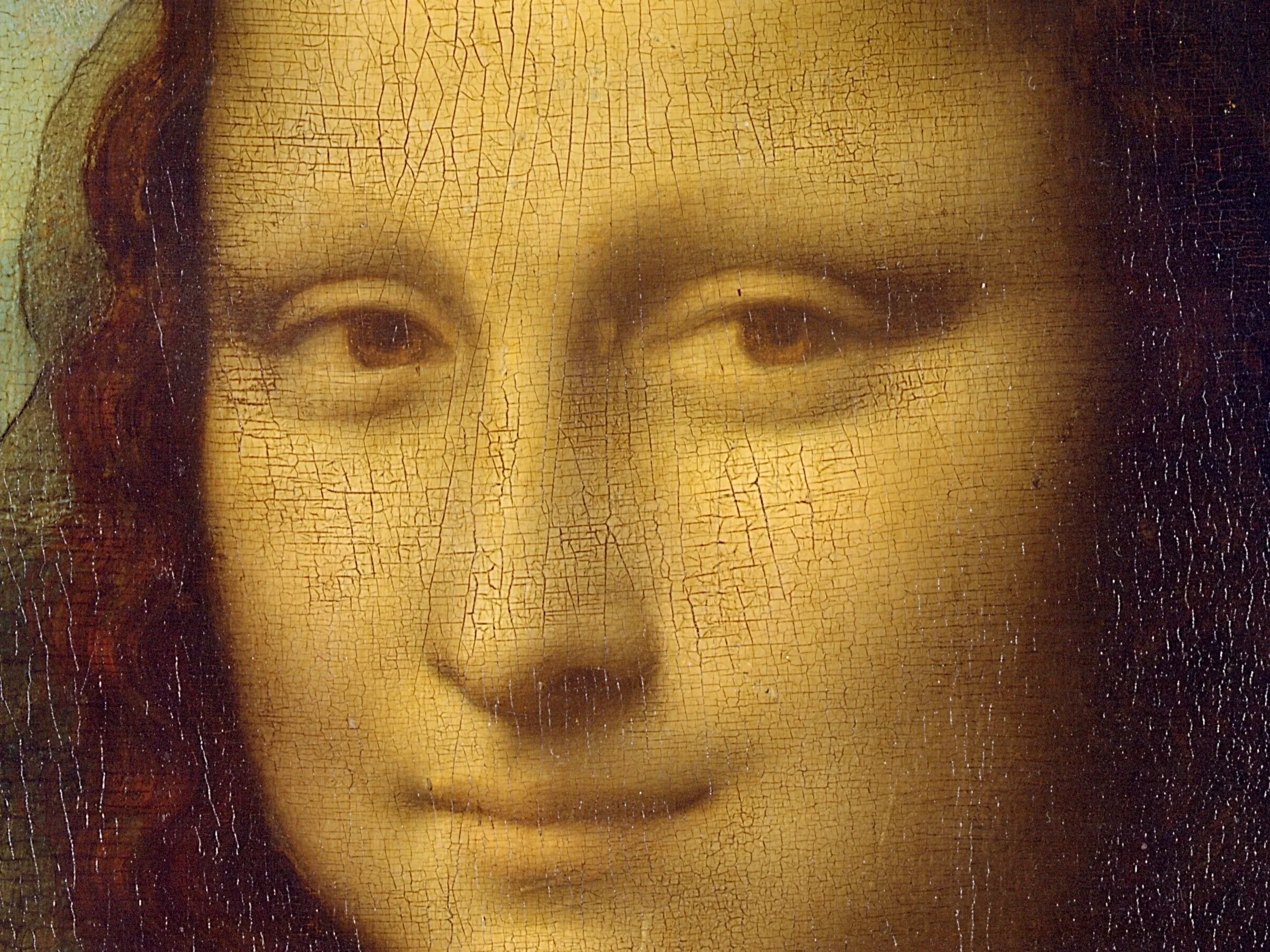
Built the modeling out of up to roughly thirty microscopic translucent oil glazes and scumbles laid over dried underlayers, with a high oil-to-pigment ratio, lowering the shadow value by degrees.
Why it matters · A hard line between light and shadow reads as an edge, not a turn in space. When the value drops across many thin layers instead of one opaque pass, the form turns without ever announcing where the shadow begins. The patience is the whole effect. One layer cannot do it.
Gemini Deep Research, 5 famous painters, 2026 — Compiled from the Materials and technique section.
Detail of the Mona Lisa: there is no line anywhere in this face. The eyelid, the edge of the nose and the corner of the mouth are each made of one value sliding into the next, so the form turns without the shadow ever announcing where it began.
Leonardo da Vinci, Mona Lisa (detail), circa 1503 to 1517, Musee du Louvre, Paris. Public domain, Wikimedia Commons.
Prepare exhaustively, never start blank
Worked out anatomy and composition in sketches on paper first, then transferred them to the panel by spolvero, pricking holes along the lines and pouncing charcoal through them.
Why it matters · The drawing problem and the painting problem are different problems. Solving placement on paper means the panel is never a guessing field. Infrared imaging found this pounced underdrawing beneath the Mona Lisa's forehead and hands, so even the most famous "spontaneous" face sits on a transferred plan.
Gemini Deep Research, 5 famous painters, 2026 — Process from blank canvas section.
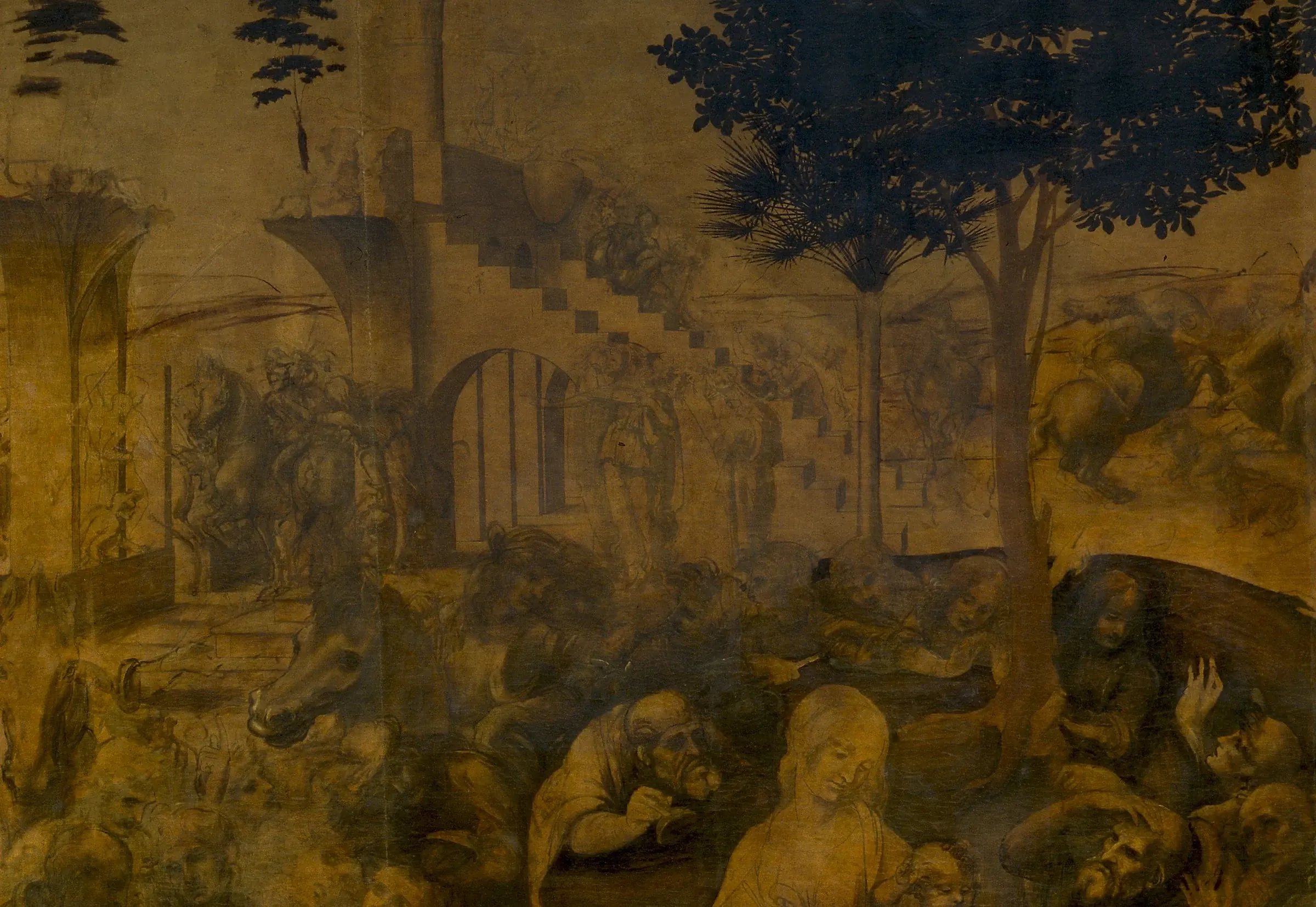
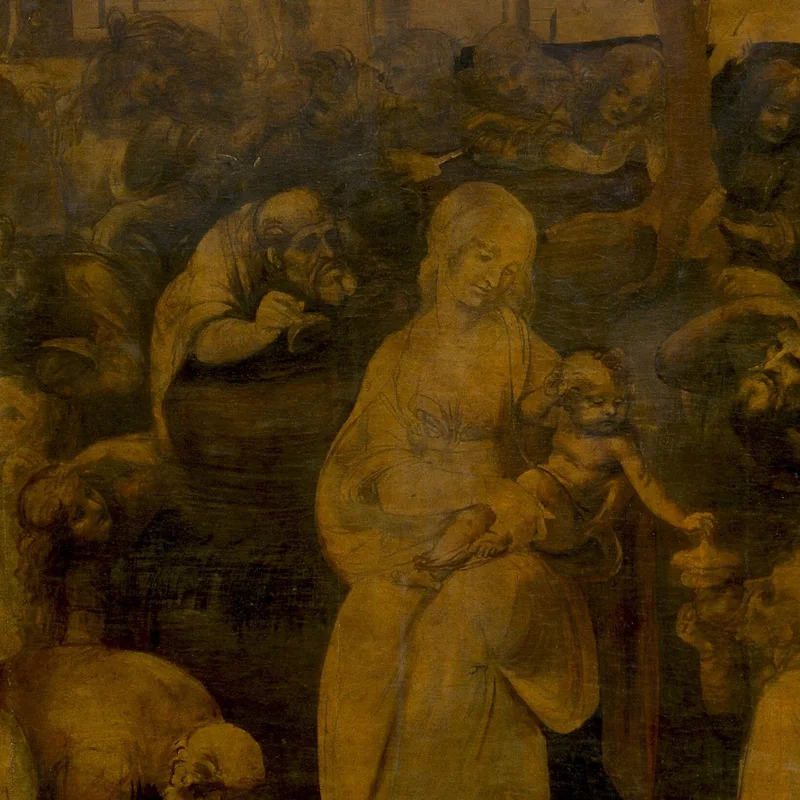
Detail of the unfinished Adoration of the Magi: the panel stops at the brown lay in, so the whole plan stands exposed. Stairs, arches, horses and dozens of figures are drawn and shaded on the panel in monochrome before any color went down.
Leonardo da Vinci, The Adoration of the Magi (detail), 1481, Galleria degli Uffizi, Florence. Public domain, Wikimedia Commons.
Think it out in hatched line, then paint
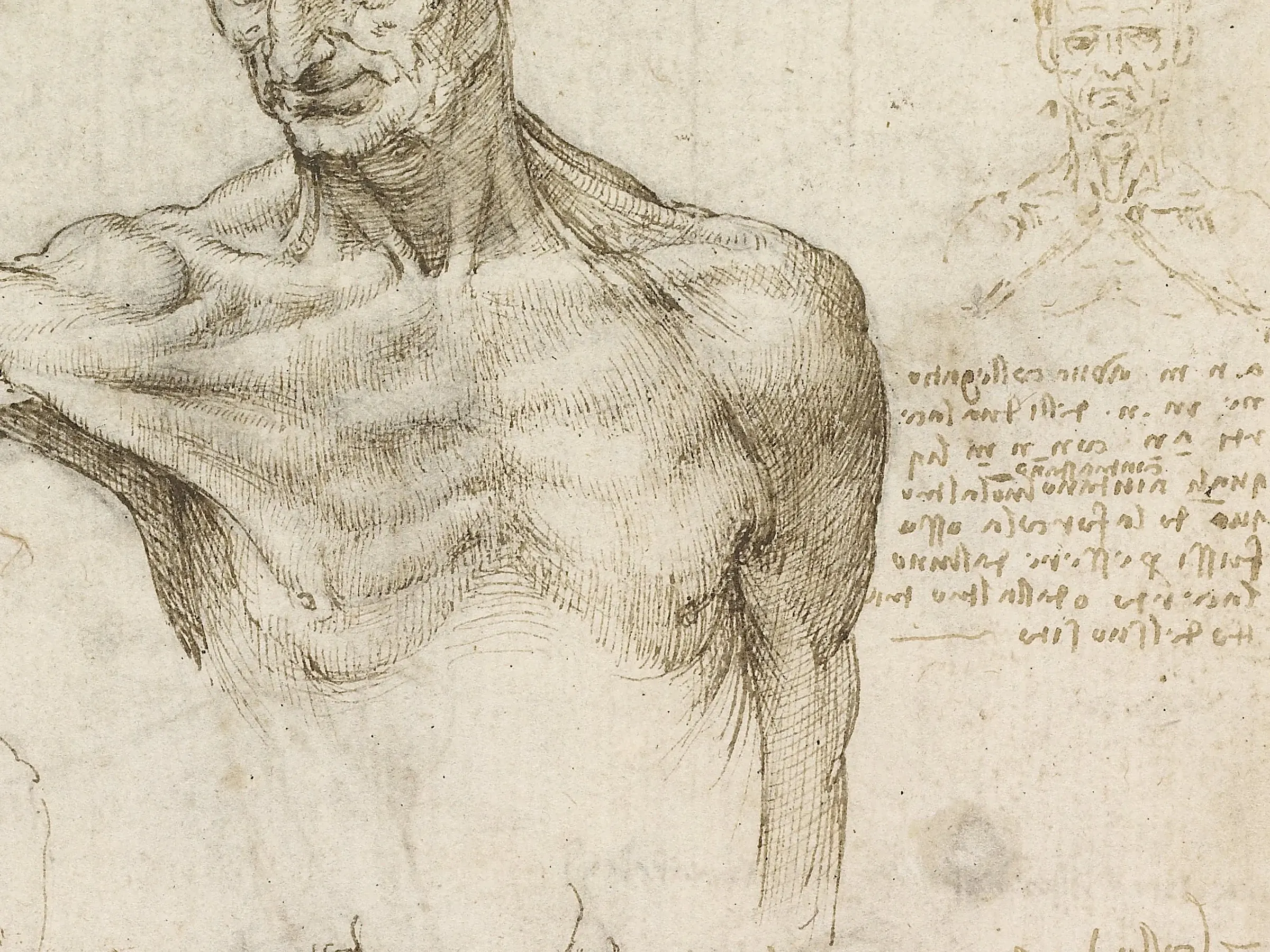
Worked out anatomy, drapery, machines and whole compositions in pen and chalk on paper first, modeling the form in long parallel hatching that all leans the same way, up from the lower left, because he drew with his left hand.
Why it matters · Around twenty paintings survive. Thousands of sheets of drawing do. The drawing was not a rehearsal for the painting; it was where the thinking happened, and the panels are what is left when the thinking stopped. A painter who only draws to set up a canvas never finds out what drawing is actually for.
Giorgio Vasari, Lives of the Most Eminent Painters, Sculptors and Architects, Life of Leonardo (de Vere translation), 1568 — Vasari on the drawing habit: he drew on paper with such diligence that no one equalled him in finish, and Vasari kept one of his stylus heads in chiaroscuro in his own book of drawings.
Detail of an anatomical sheet: the chest and shoulder are modeled entirely in hatching, every stroke leaning the same way, up from the lower left, which is the natural pull of a left hand. The notes beside the figure are written in mirror script, right to left.
Leonardo da Vinci, Superficial anatomy of the shoulder and neck (detail), circa 1510, Royal Collection, Windsor. Public domain, Wikimedia Commons.
Refuse the medium that forbids revision
Rejected buon fresco for The Last Supper because its wet plaster allows no slow reworking, and invented an experimental dry-wall method on a gesso, pitch, and mastic ground instead.
Why it matters · The material has to match how you actually work. Leonardo reworked endlessly, and fresco demands a section be finished in a day. So he chose a method that let him revise. The method failed chemically and began flaking in his own lifetime, which is the honest cost of choosing revision over permanence.
Gemini Deep Research, 5 famous painters, 2026 — Materials and technique section.
Paint when the light is soft, not bright
Diffused the sun with canvas awnings stretched over courtyards and favored dusk or overcast weather for portraits, because the softest shadows gave the most grace.
Why it matters · Hard direct light cuts the face into flat planes of black and white. Soft light keeps the half-tones, and the half-tone is where the modeling lives. If you control the light at the source, the painting is easier before you have made a single mark.
Leonardo, Trattato della pittura (compiled by Melzi), 1651
Work in long bursts, then stop cold
On The Last Supper, Matteo Bandello saw him climb the scaffold at sunrise and paint until dusk forgetting to eat, then on other days stand and stare for hours without a mark, or leave it for three or four days.
Why it matters · Output is not steady, and pretending it should be produces forced work. The staring is part of the painting. The decision of where the next stroke goes can take longer than the stroke. A reader who measures progress only in marks made will quit on the staring days.
Matteo Bandello, Novelle, 1554
Find landscapes in stains on a wall
For invented backgrounds, stared at walls splashed with stains, at ashes and puddles, until he saw mountains, ruins, rocks, and woods in them, then reduced the hallucination to drawn form.
Why it matters · Invention does not have to start from nothing. A random texture gives the eye something to push against, and the mind supplies the rest. The skill is the second half: taking the thing you imagined and pinning it down as actual form. The prompt is free. The reduction is the work.
Leonardo, Trattato della pittura (compiled by Melzi), 1651
Let a picture run for years rather than declare it done
Rarely treated a painting as finished; worked the Mona Lisa over the course of a decade.
Why it matters · Some paintings are not a sprint. Holding a picture open for years means returning to it with a changed eye and finding what the last pass missed. The risk is the opposite of overwork, which is never letting go. Leonardo lived on that edge on purpose.
Gemini Deep Research, 5 famous painters, 2026 — Process from blank canvas section.
In the studio
Leonardo da Vinci, presumed self-portrait, red chalk, c. 1512, Biblioteca Reale, Turin
Studio
Light
Controlled obsessively. Canvas awnings stretched over courtyards to diffuse the sun; dusk or overcast weather preferred for portraits because the shadows are softest and most graceful.
Position
Worked on panel. On The Last Supper he climbed a scaffold at the wall.
Session length
Uneven. Sunrise-to-dusk bursts so absorbed he forgot to eat, alternating with days spent staring without a mark, or leaving the work for three or four days.
Tools
Paper for anatomical and compositional sketches · Pricked cartoons for spolvero transfer (charcoal pounced through pin-holes) · Fine brushes for thin oil glazes and scumbles
Notes
Believed a painter needs isolation and warned that company breeds complacency. Dissected cadavers to learn anatomy directly.
Source: Matteo Bandello, Novelle, 1554 — Eyewitness account of Leonardo at work on The Last Supper.
Palette
Ground
On panel. For The Last Supper, an experimental dry-wall ground of gesso, pitch, and mastic instead of fresh fresco plaster. The method failed chemically and began flaking in his lifetime.
Medium
Thin oil-and-tempera layers on panel. Sfumato built from up to roughly thirty microscopic translucent oil glazes and scumbles over dried underlayers, with a high oil-to-pigment ratio.
Source: Gemini Deep Research, 5 famous painters, 2026 — Materials and technique section. The research does not specify individual pigment names for Leonardo, so those slots are left empty rather than guessed.
Value block-in, stage by stage
Value block-in stages: a head built from two flat value masses, then three, then four, then refined with turned edges. Original methods.art diagram.
Anatomical and compositional studies worked out on paper before the panel was touched.
Why: The composition is solved where it is cheap to solve it. The panel never becomes the place to find the drawing.
2. Spolvero transfer
The resolved drawing pricked with holes along its lines, then charcoal pounced through onto the panel.
Why: Carries the solved drawing to the panel exactly. Infrared shows this pounced underdrawing beneath the Mona Lisa's forehead and hands.
3. Tonal block-in, dark to light
The forms established tonally, building from dark up through opaque mid-tones and lights.
Why: Sets the value structure of the whole panel before any glazing. The modeling has to exist in tone first.
4. Years of dark glazes over the shadows
Many thin, semi-transparent glazes laid over the dried shadows, dropping their value by slow degrees with no visible line.
Why: This is where sfumato happens. The shadow deepens across dozens of layers, so the form turns without an edge. It cannot be rushed into one pass.
5. Rarely finished
The picture held open and reworked, sometimes for years. The Mona Lisa ran across roughly a decade.
Why: A changed eye on a later day finds what the earlier passes missed. Finish is not a fixed point for Leonardo; it is something he kept deferring.
How they studied
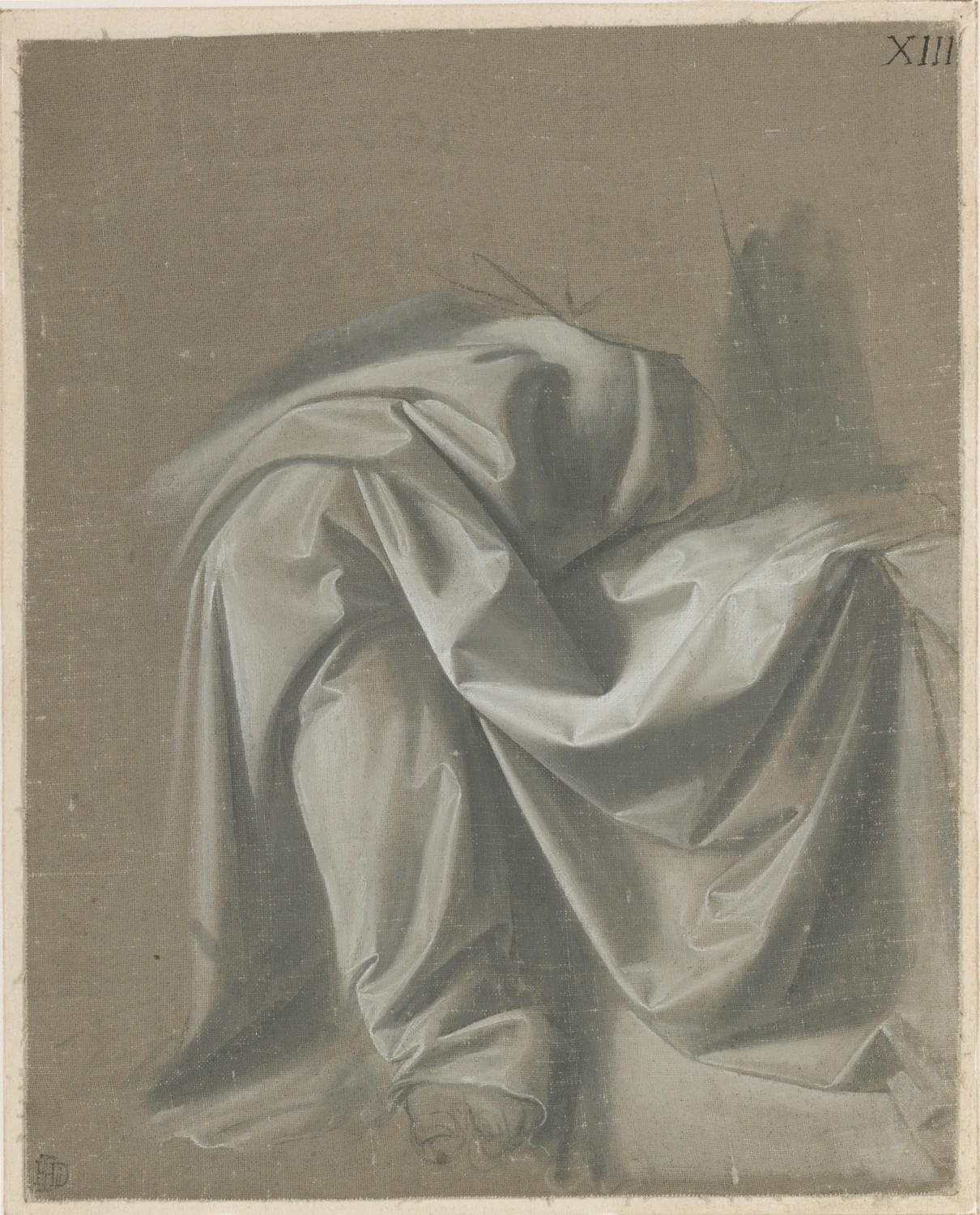
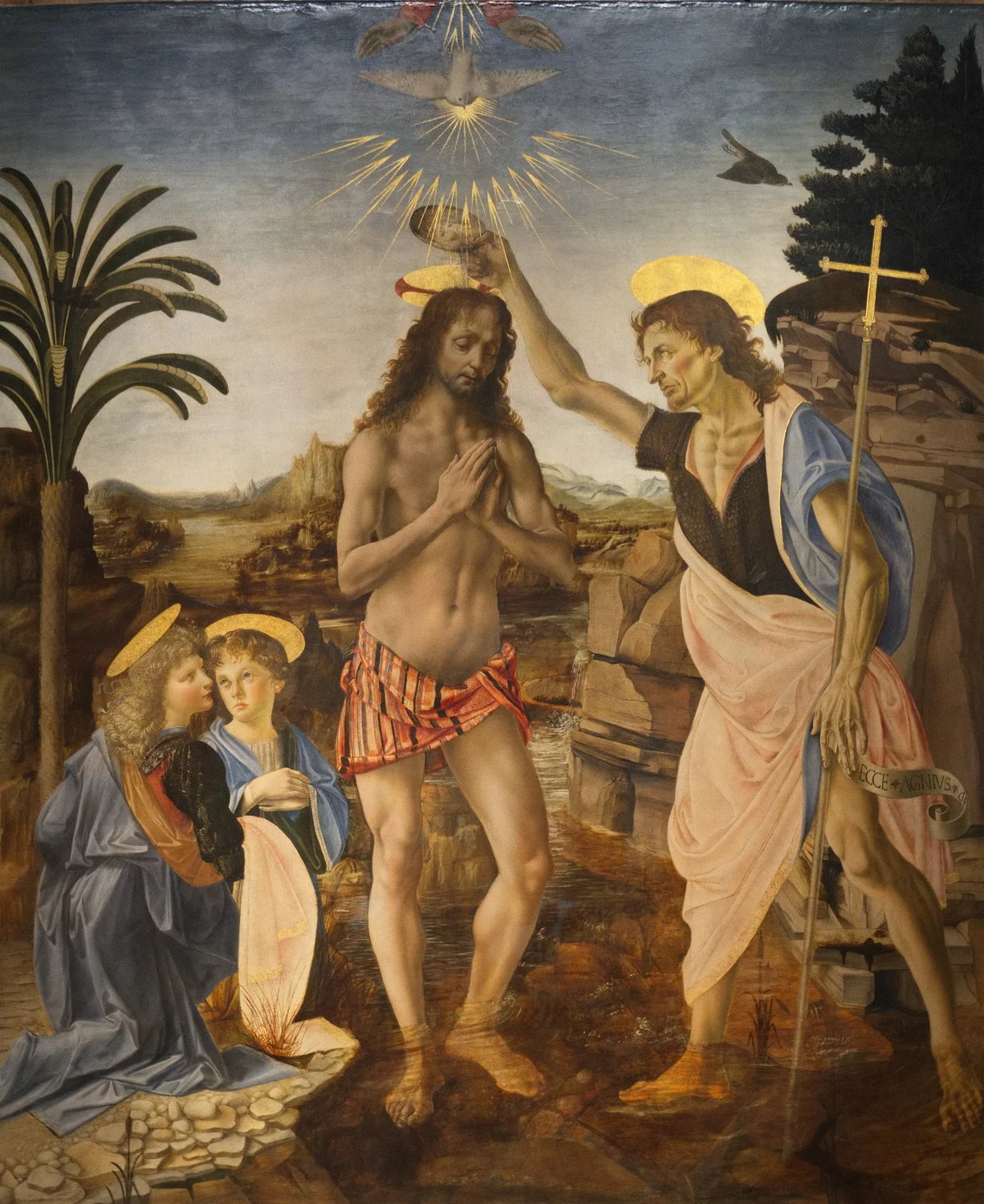
Leonardo learned to paint inside a shop that made everything. At about fourteen he was placed with Andrea del Verrocchio in Florence, a bottega that took in goldsmithing, bronze, sculpture and painting at once, and Vasari says the pupil painted the angel holding the robes in his master's Baptism of Christ. The drill that shows up hardest in the early sheets is the drapery study, and Vasari describes the method exactly: he made models of figures in clay, laid soft cloth dipped in clay over them, then drew the folds on fine linen in black and white with the point of his brush. Draping a clay figure in wet cloth fixes the folds so they hold still for days, and painting them on linen with a brush forces the hand to build a form out of value alone, with no line to lean on. The rest of the training he set himself, and he set it hard. He dissected human bodies to learn what was under the skin, writing that he had dissected more than ten of them to get one true account of the veins, that no single body lasted long enough so he had to work through several by degrees, and that he then repeated the whole thing twice over to learn the differences.
Study of Drapery from the Verrocchio years: brush and grey tempera heightened with white on linen colored grey, the workshop exercise Vasari describes. The cloth was soaked in clay over a clay model so the folds would hold, and the whole form is built in value with no drawn line in it.
Leonardo da Vinci, Study of Drapery, circa 1475 to 1482, Fondation Custodia, Paris. Public domain, Wikimedia Commons.
The Baptism of Christ, made in Verrocchio's shop with master and apprentices working on one panel. The kneeling angel at the far left holding the robes is the part Vasari gives to the young Leonardo, and Vasari adds the story that Verrocchio never touched color again after seeing it.
Andrea del Verrocchio and Leonardo da Vinci, The Baptism of Christ, circa 1470 to 1475, Galleria degli Uffizi, Florence. Public domain, Wikimedia Commons.
Source: The apprenticeship, the angel in the Baptism, and the linen drapery drill: Giorgio Vasari, Life of Leonardo da Vinci, in Lives of the Most Eminent Painters, Sculptors and Architects, 1568, Gaston du C. de Vere translation. Leonardo on his own dissections: Jean Paul Richter, The Literary Works of Leonardo da Vinci, 1883.
Up close
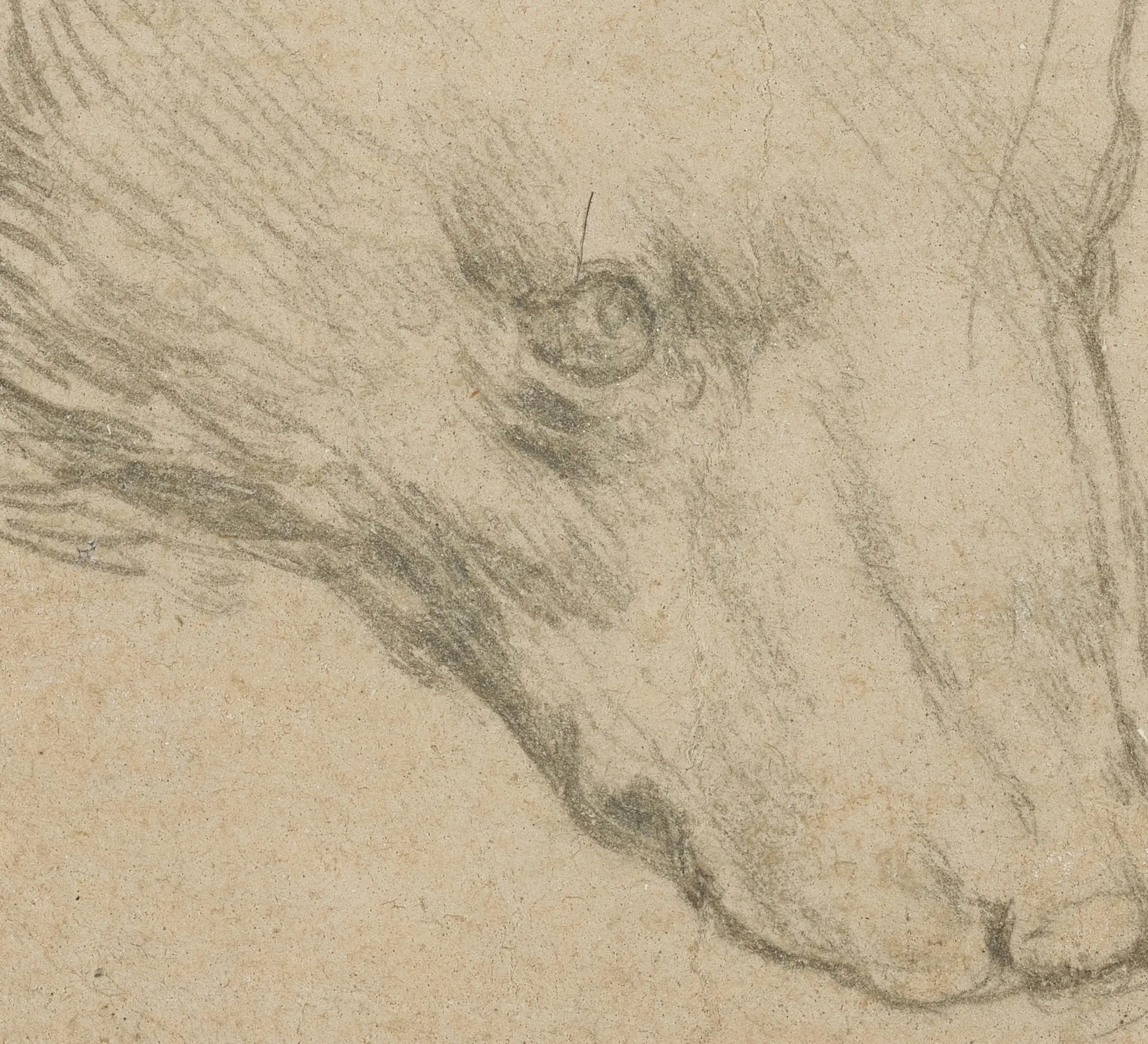
Detail of the Head of a Bear: silverpoint on prepared paper, drawn with a metal stylus that leaves a line nothing can erase. The fur is built from short parallel strokes set one beside the next, and the tone of the prepared paper is doing the work in every light passage.
Leonardo da Vinci, Head of a Bear (detail), circa 1480s, private collection. Public domain, Wikimedia Commons.
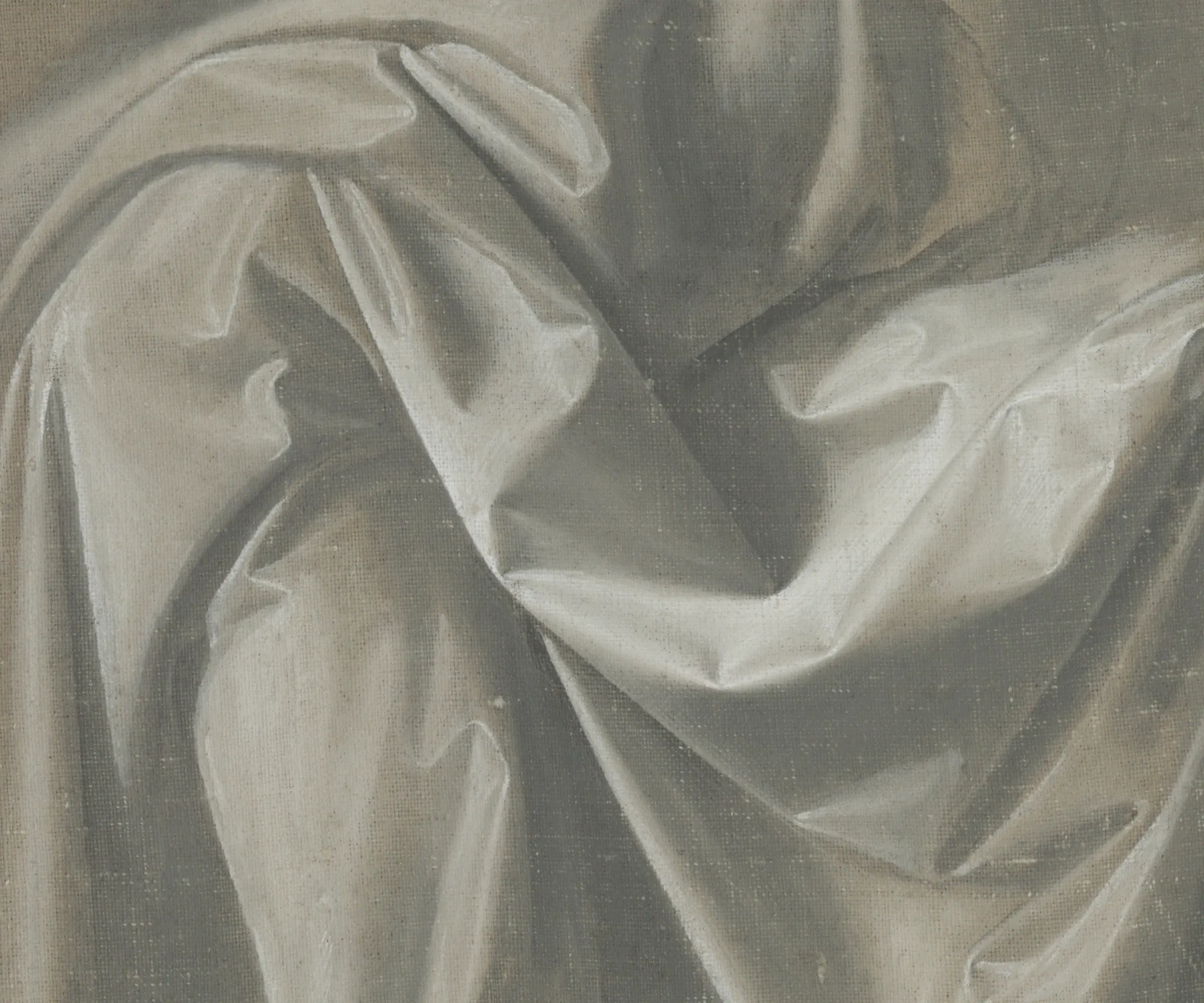
Detail of a drapery study: the cloth is modeled in grey tempera with the brush, the lights put back with white body color, and the weave of the linen it is painted on shows through the thin passages. No drawn line anywhere, only value.
Leonardo da Vinci, Study of Drapery (detail), circa 1475 to 1482, Fondation Custodia, Paris. Public domain, Wikimedia Commons.
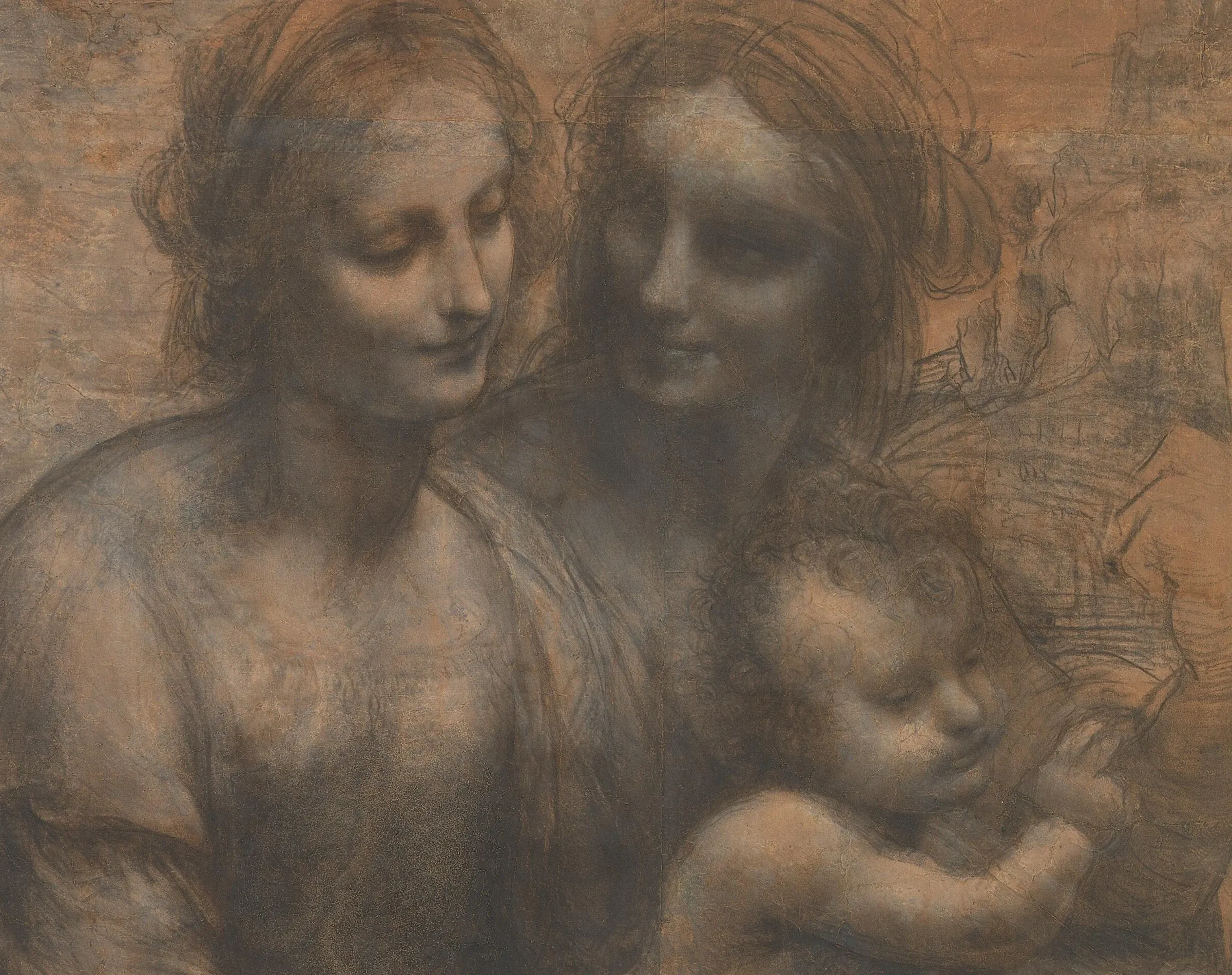
Detail of the Burlington House Cartoon: charcoal on paper at life size, the darks brushed in soft and the lights put back with white chalk. The sfumato of the paintings is already finished here, in a drawing, with no outline holding any of it in.
Leonardo da Vinci, The Virgin and Child with Saint Anne and Saint John the Baptist (detail), circa 1499 to 1500, The National Gallery, London. Public domain, Wikimedia Commons.
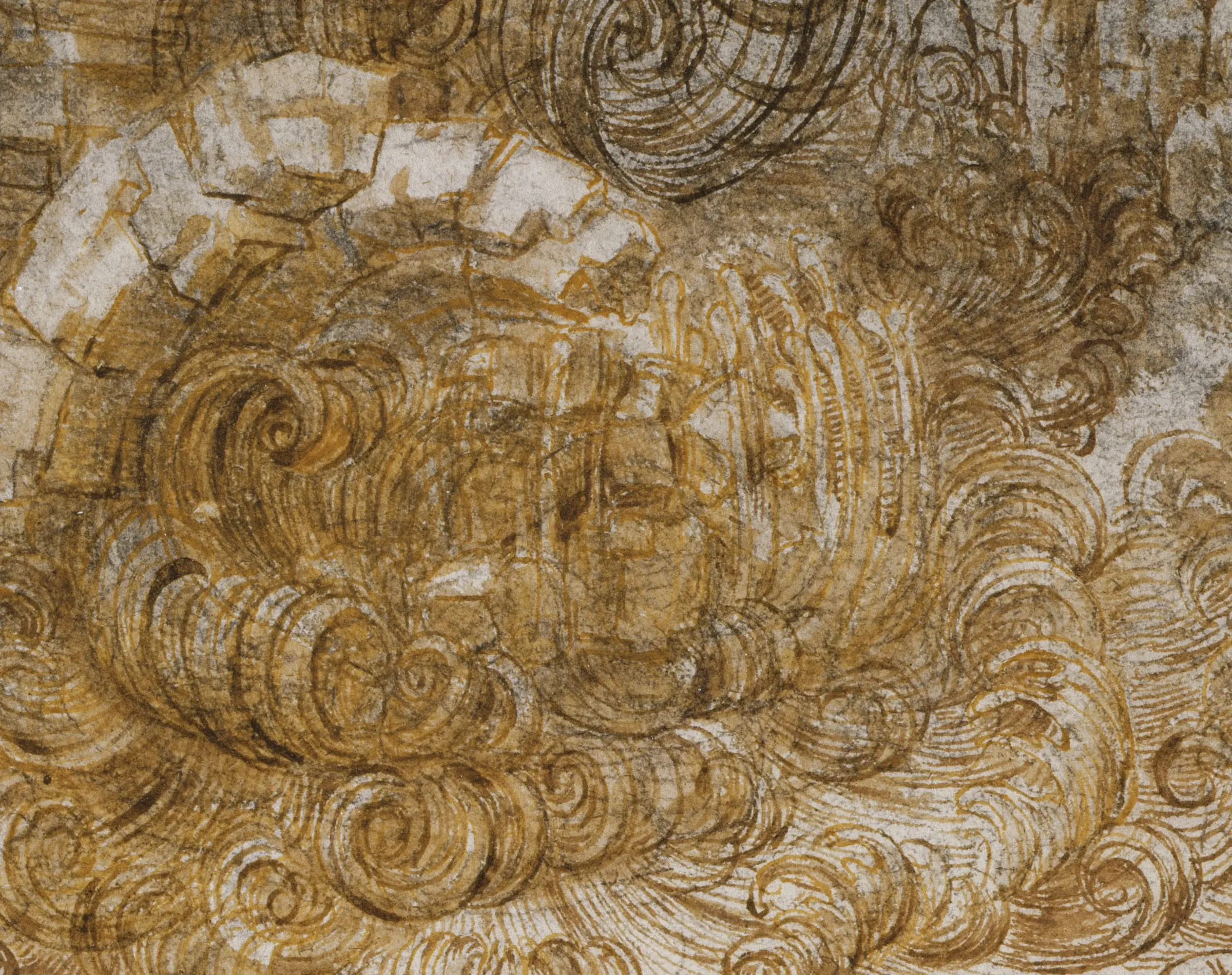
Detail of A Deluge: water and collapsing rock drawn as spirals in pen and ink over black chalk, with wash. He drew a storm the way he drew a shoulder, as a structure with a logic, and the same curling stroke does the work in both.
Leonardo da Vinci, A Deluge (detail), circa 1517 to 1518, Royal Collection, Windsor. Public domain, Wikimedia Commons.
Watching him work
“It was his habit, as I myself was witness on several occasions, to mount the scaffolding before it (for the painting is at some considerable height above the ground) and to remain, brush in hand, from sunrise to sunset, forgetting to eat and drink, and painting without intermission. Sometimes, after this, he would be three or four days together without touching it, and yet he would stay before it an hour or two every day, contemplating it, considering and examining the figures he had created.”
Matteo Bandello, who watched him paint The Last Supper, Novelle (1554), in Eugene Muntz, Leonardo da Vinci: Artist, Thinker, and Man of Science, volume 1, page 184, 1898 [source]
Across media
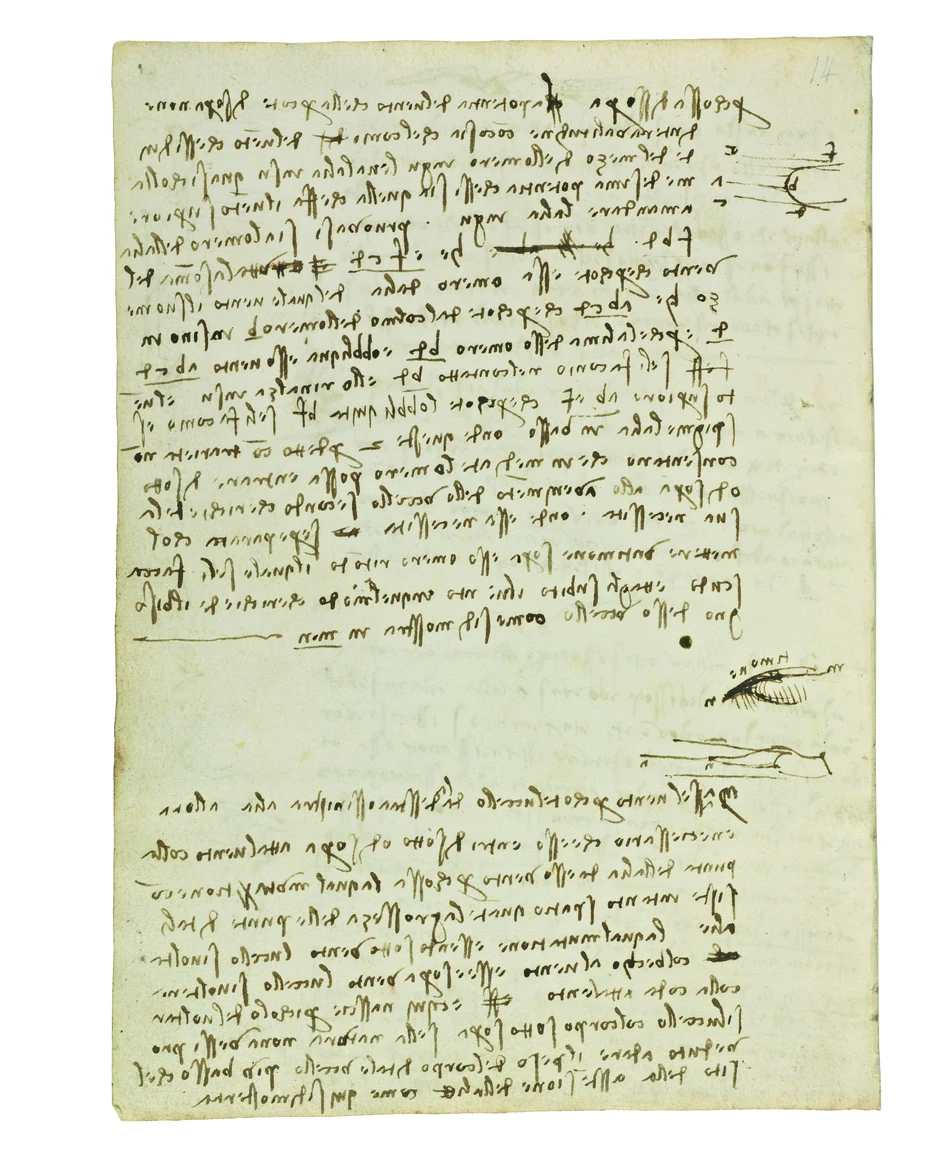
A page from the Codex on the Flight of Birds: the notes run right to left in mirror script, with small diagrams dropped into the margin wherever the words needed a picture. He filled thousands of pages like this one, and on them the drawing and the thinking are the same act.
Leonardo da Vinci, Codex on the Flight of Birds, folio 9 verso, 1505, Biblioteca Reale, Turin. Public domain, Wikimedia Commons.
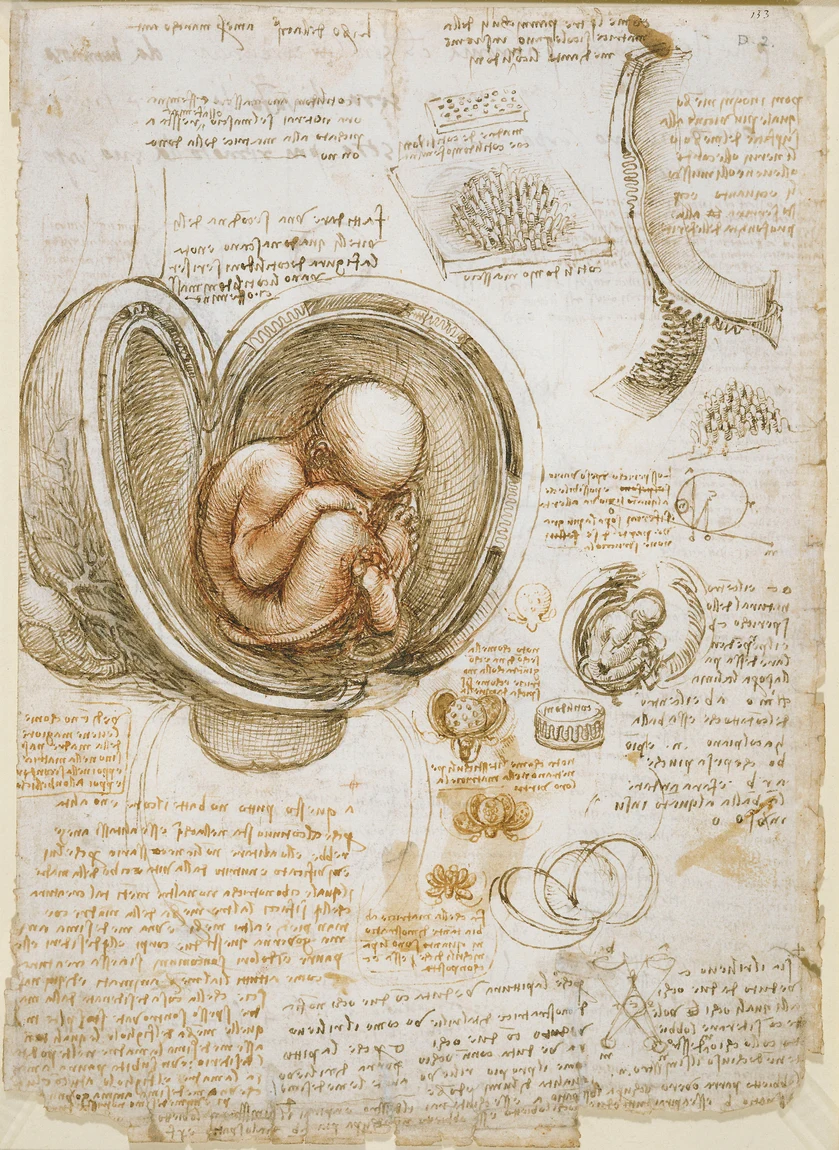
Studies of the foetus in the womb, drawn from his own dissections: the child, the opened uterus, and the notes packed into every clear space left on the sheet. He wrote that he had dissected more than ten human bodies to get one true account of the veins.
Leonardo da Vinci, Studies of the foetus in the womb, circa 1510 to 1513, Royal Collection, Windsor. Public domain, Wikimedia Commons.
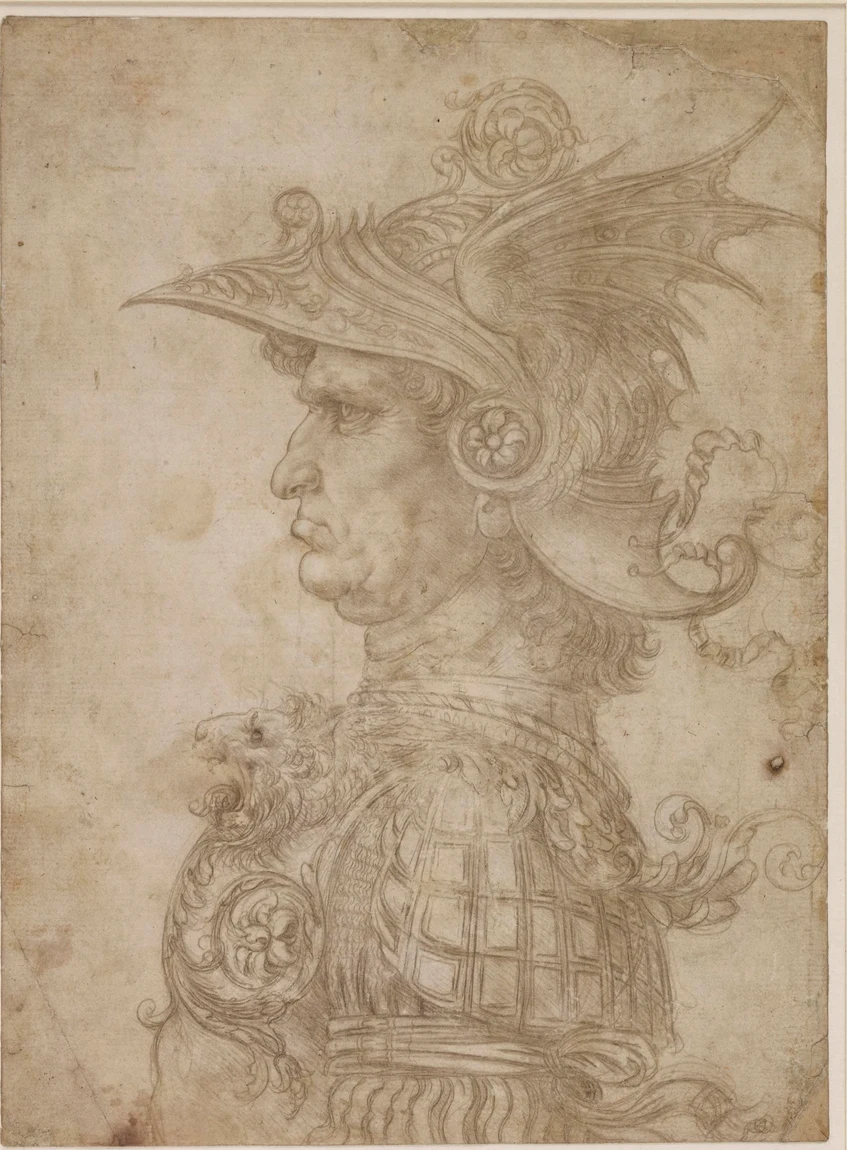
A Bust of a Warrior in Profile, from the Verrocchio years: silverpoint on prepared paper, where nothing can be rubbed out. The winged helmet, the lion on the breastplate and the old soldier's jaw all had to be right on the first pass.
Leonardo da Vinci, A Bust of a Warrior in Profile, circa 1475 to 1480, The British Museum, London. Public domain, Wikimedia Commons.
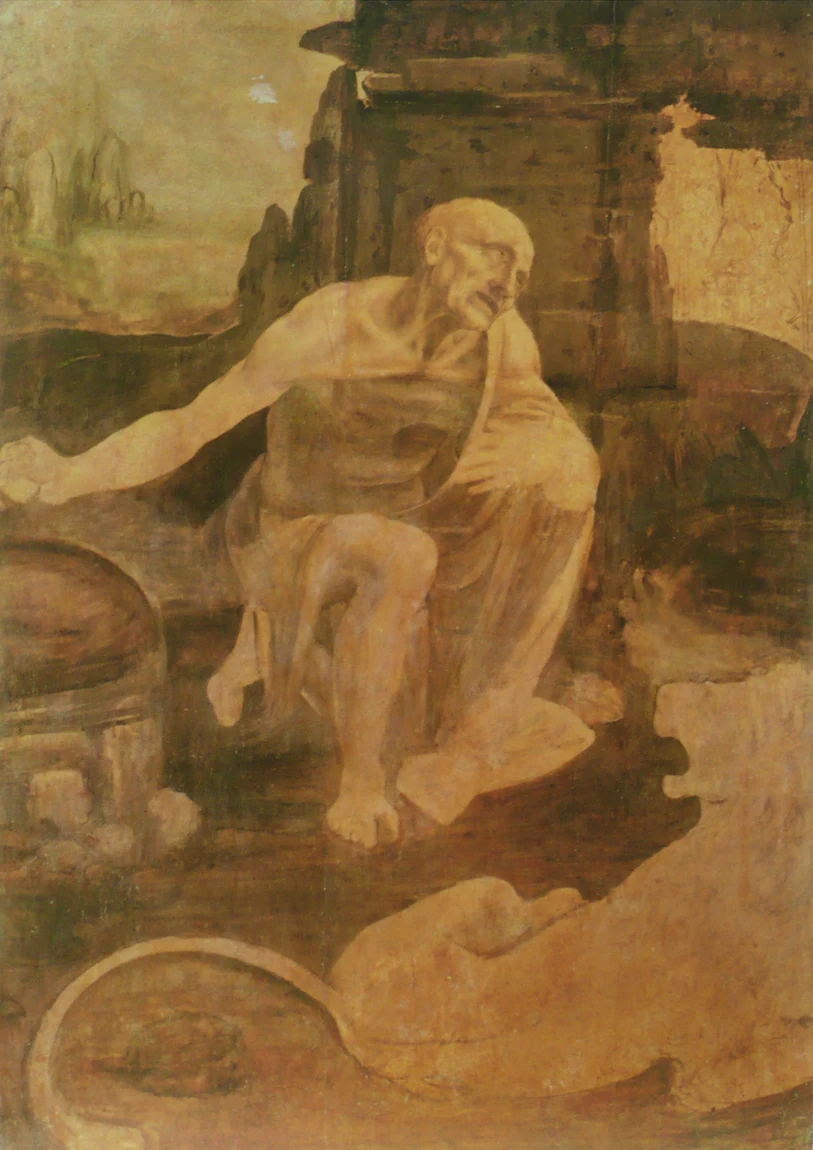
Saint Jerome in the Wilderness, left unfinished: the head and shoulders are carried deep into the modeling while the rock and the lion are still brown lay in. One panel showing the order he worked in, tone first and color last.
Leonardo da Vinci, Saint Jerome in the Wilderness, circa 1482, Pinacoteca Vaticana, Vatican City. Public domain, Wikimedia Commons.
The record, deeper
The money
His whole Florence household ran on eighteen gold florins between the end of June and the start of August in 1504. He kept his own purse. Salai got a florin in the morning, bought bread, wine, eggs, mushrooms, fruit and bran, paid the barber and the shoemaker, and brought back three soldi.
Leonardo's account books, in Eugene Muntz, Leonardo da Vinci: Artist, Thinker, and Man of Science, volume 2, page 135, 1898.
On 8 April 1503 he lent four gold ducats to the miniature painter Attavante.
Eugene Muntz, Leonardo da Vinci: Artist, Thinker, and Man of Science, volume 2, page 136, 1898.
The reworks
The National Gallery imaged its Virgin of the Rocks with macro X-ray fluorescence, infrared and hyperspectral imaging and found an abandoned first composition drawn underneath, with the Christ Child and the angel set higher in the frame and the angel holding the child in a much tighter embrace. The same imaging picked up handprints left in the primer on the panel.
The National Gallery, London, technical imaging published for Leonardo: Experience a Masterpiece, 2019.
The Adoration of the Magi was left at the brown lay in and never painted, which is why the panel survives as a record of the stage he normally covered over. Vasari notes it simply: he began it, and this, also, remained unfinished, like his other works.
Giorgio Vasari, Life of Leonardo da Vinci, 1568, de Vere translation; the panel, Galleria degli Uffizi, Florence.
What they told students
He fixed the order a student should learn in. Perspective first, so every object can be given its proper size. Then an able master, to build a good style of drawing the parts. Then nature, to confirm what the precepts actually meant. Only then time spent looking at the works of the old masters.
Leonardo, A Treatise on Painting, chapter I, John Francis Rigaud translation, 1802.
For drawing from a cast or a relief he gave the order of the marks: tinge the paper to a darkish half tint, put in the darkest shadows next, and lay the principal lights last and sparingly, because small lights are lost to the eye at any distance.
Leonardo, A Treatise on Painting, chapter XVI, John Francis Rigaud translation, 1802.
He set the drawing distance. Stand at three times the height of the object, then fix on one principal line, a perpendicular, and read every part against it: what crosses it, what runs parallel, what runs oblique.
Leonardo, A Treatise on Painting, chapter XIX, John Francis Rigaud translation, 1802.
He kept working in the dark. In bed, in the silence of the night, he retraced in his mind the outlines of the forms he had studied that day, the ones hardest to hold, and said the images became more vivid and stayed in the memory.
Leonardo, A Treatise on Painting, chapter XXI, John Francis Rigaud translation, 1802.
His test for a picture was a flat looking glass, set so it reflects the thing you painted, then the original and the copy compared side by side. He called the looking glass the true master of painters.
Leonardo, A Treatise on Painting, chapter CCCL, John Francis Rigaud translation, 1802.
The studio
Salai came into the household on Saint Mary Magdalen's day in 1490, aged ten. Leonardo had two shirts, a pair of hose and a jerkin cut for him, the boy stole the money set aside to pay for them, and the note in the book ends: thief, liar, obstinate, glutton.
Leonardo's notebooks, in Jean Paul Richter, The Literary Works of Leonardo da Vinci, 1883.
In the Florence years he lived at one time with the Servite fathers and at another with the sculptor Rustici, and probably at Santa Maria Novella, next to the room where he was painting the Battle of Anghiari cartoon.
Eugene Muntz, Leonardo da Vinci: Artist, Thinker, and Man of Science, volume 2, page 135, 1898.
The materials
X-ray fluorescence run on seven Louvre paintings, the Mona Lisa among them, measured the glaze layers at one to two micrometres each, with the whole layered film on the late faces reaching about thirty micrometres. Nothing was scraped off the pictures to do it.
Philippe Walter and others, Angewandte Chemie International Edition, 2010 (Centre de Recherche et de Restauration des Musees de France, with the ESRF and the Louvre).
The linen drapery studies are brush and grey tempera heightened with white body color, painted on linen colored grey and later laid down on paper. The sheet in Paris measures 240 by 193 millimetres, so the whole exercise fits inside a sheet of writing paper.
Fondation Custodia, Paris, inventory 6632.
For drawing he used silverpoint on paper given a ground, a stylus line that cannot be erased and darkens to brown as the silver tarnishes. Vasari owned one of these stylus heads, drawn in chiaroscuro, and kept it in his book of drawings.
Giorgio Vasari, Life of Leonardo da Vinci, 1568, de Vere translation.
Refusals — what they would not do
Refused buon fresco for The Last Supper because its wet plaster allows no slow revision.
Refused to start on a blank panel. Preparation was exhaustive, and transfer came before paint.
Refused steady company in the studio; held that it breeds complacency and that a painter needs isolation.
Refused bright direct light for portraits, choosing dusk, overcast, or a diffusing awning instead.
Refused to call a picture finished on schedule; the Mona Lisa ran for about a decade.
Reference
Primary source
Rigorous direct observation. Dissected cadavers to study anatomy at first hand.
Exceptions
For invented backgrounds, used abstract prompts. Stared at stained walls, ashes, and puddles until landscapes, mountains, ruins, and woods appeared, then reduced what he saw to drawn form.
Andrea del Verrocchio · apprenticed 1466; in the guild by 1472; stayed as assistant to 1477 — Florentine workshop training. Leonardo entered as an apprentice in 1466 and remained as an assistant for years after qualifying.
Students
Francesco Melzi, the pupil who inherited the notebooks and compiled them into the Treatise on Painting (the Trattato della pittura).
In their own words
“He who loves practice without theory is like the sailor who boards ship without a rudder and compass and never knows where he may cast.”
— Leonardo da Vinci, Treatise on Painting (Trattato della pittura), compiled by Francesco Melzi, 1651
“If you have a courtyard, cover it at will with a canvas awning. This light is good. Or paint your sitter in bad weather, or at dusk.”
— Leonardo da Vinci, Treatise on Painting (Trattato della pittura), compiled by Francesco Melzi, 1651
On controlling the light for portraits.
“Look at walls splashed with stains... you will see the likeness of divine landscapes, mountains, ruins, rocks, woods.”
— Leonardo da Vinci, Treatise on Painting (Trattato della pittura), compiled by Francesco Melzi, 1651
On finding invented compositions in abstract textures.
“Acquire accuracy before you attempt quickness.”
— Leonardo da Vinci, Treatise on Painting (Trattato della pittura), compiled by Francesco Melzi, 1651
“Take care that the shadows and lights be united, or lost in each other; without any hard strokes, or lines: as smoke loses itself in the air, so are your lights and shadows to pass from the one to the other, without any apparent separation.”
— Leonardo da Vinci, A Treatise on Painting, chapter CLXXXI, translated by John Francis Rigaud, 1802
Sfumato in his own words, and he is describing a drawing. The chapter is titled Accuracy ought to be learnt before Dispatch in the Execution.
Sfumato, the shadow that deepens with no visible line. He built the modeling out of up to roughly thirty microscopic translucent oil glazes and scumbles laid over dried underlayers, lowering the shadow value by degrees. Because the value drops across many thin layers instead of one opaque pass, the form turns in space without a hard edge.
How did Leonardo start a painting?
Never on a blank panel. He worked out anatomy and composition in sketches on paper, then transferred the resolved drawing by spolvero, pricking holes along the lines and pouncing charcoal through them onto the panel. Infrared imaging found this pounced underdrawing beneath the Mona Lisa's forehead and hands.
What medium and surface did Leonardo paint on?
He painted in thin oil-and-tempera layers on panel, with a high oil-to-pigment ratio in the glazes. For The Last Supper he rejected fresh fresco plaster and painted on a dry wall prepared with gesso, pitch, and mastic. That experimental ground failed chemically and began flaking in his own lifetime.
Who taught Leonardo, and whom did he teach?
He trained in the Florentine workshop of Andrea del Verrocchio, entering as an apprentice in 1466, qualifying for the guild by 1472, and staying on as an assistant to 1477. His pupil Francesco Melzi inherited the notebooks and compiled them into the Treatise on Painting.
What would Leonardo refuse to do?
He refused buon fresco for The Last Supper because its wet plaster allows no slow revision. He refused bright direct light for portraits, choosing dusk, overcast weather, or a canvas awning stretched over a courtyard instead. And he refused to call a picture finished on schedule; the Mona Lisa ran for about a decade.
How did Leonardo light his subjects?
Softly, and under his own control. He stretched canvas awnings over courtyards to diffuse the sun and preferred dusk or overcast weather for portraits, because the softest shadows gave the most grace. Soft light keeps the half-tones, and the half-tone is where the modeling lives.
If this painter is your match
You build a painting in layers and you think in what each layer does to the one beneath it. The shadow that turns without an edge is the whole point, and you know it takes more thin passes than anyone expects. Your risk is the same as his: holding a picture open so long it never gets to stand as finished.
Borrow this: Solve the drawing on paper first, then transfer it so the panel is never a guessing field. Block the form in tone, dark to light. Then deepen the shadows with many thin glazes instead of one opaque pass, and let the value drop by degrees with no hard line.
Leonardo, Trattato della pittura (compiled by Francesco Melzi, published 1651), 1651. Leonardo's own teaching on painting, assembled from the notebooks by his pupil Melzi. The source for his rules on light, on theory before practice, and on finding compositions in stains.
Matteo Bandello, Novelle, 1554. Records an eyewitness account of Leonardo's uneven working rhythm on The Last Supper, the sunrise-to-dusk bursts and the days spent staring.
Pietro da Novellara, Letter to Isabella d'Este (8 April 1501), 1501. Contemporary report on Leonardo's working life.
Leonardo da Vinci, A Treatise on Painting, translated by John Francis Rigaud, 1802. The public-domain English translation of the Trattato, and the source for every chapter number cited on this page: the order of study (I), the toned paper method (XVI), the drawing distance (XIX), the review of forms at night (XXI), lights and shadows lost in each other like smoke (CLXXXI), and the looking glass as the true master of painters (CCCL).[link]
Giorgio Vasari, Lives of the Most Eminent Painters, Sculptors and Architects, Life of Leonardo da Vinci, 1568. Quoted here from the Gaston du C. de Vere translation. Records the Verrocchio apprenticeship, the angel in the Baptism of Christ, the drapery studies drawn in black and white with the point of the brush on fine linen, and the Adoration of the Magi left unfinished.[link]
Jean Paul Richter, The Literary Works of Leonardo da Vinci, 1883. Leonardo's own notebooks in English. The source for his statement that he dissected more than ten human bodies, and for the 1490 household note on the ten-year-old Salai.[link]
Eugene Muntz, Leonardo da Vinci: Artist, Thinker, and Man of Science, 1898. Public-domain English rendering of Matteo Bandello's eyewitness account of the Last Supper (volume 1, page 184) and of Leonardo's 1504 Florence household accounts (volume 2, page 135).[link]