Finishing Touches, the chapter companion
STATUS: the chapter companion. Ten sections keyed to the filmed chapter, with the timecodes filled when the timestamped export lands.
This is the chapter beside the video. The filmed chapter runs from about seventy percent to the end of a painting, and this page holds the same material in a form you can work from at the easel: the system compacted into ten sections, a master standing at the claim that names him, and two diagrams for the parts that are quicker drawn than described.
The anchor sits under all of it. “I try to complete a painting, not finish it.” Finish implies a polish, every form rendered out. “Complete means when it doesn’t need anything else.” Everything in the chapter serves getting a painting to that state without overworking it on the way.

An original methods.art diagram; the seven stages and the footer line in Daniel Bilmes's own words, from the Finishing Touches chapter, 2026. the curriculum map.
The cornerstones of this chapter
Ten principles, one per section. These are what to hold on to once a painting is past seventy percent and you are deciding what to do next.
- 01Stop at seventy percent/Push to about seventy percent, leave out the parts that want thinking about, and let it sit long enough that the next look is an honest one.
- 02One direction per session/A session gets a single direction. One brush and one mix can carry it, and the next session builds on it instead of redoing it.
- 03Glaze to connect/A thin transparent mix laid over a passage and wiped back where the light belongs pulls scattered darks into one shadow without losing what is under it.
- 04Key values against each other/Values get set against the values beside them, and changing one changes what it relates to, so every change is followed by a step back.
- 05Local moves, larger theme/A local adjustment is judged by whether it serves the direction of the session, not by whether the spot looks right on its own.
- 06Know your own tendencies/If your habits leave the same problem late in every painting, build the counter-move into the process and go back and revise the earlier stages.
- 07Thick paint saved for last/Early layers stay smooth so a late glaze is still possible, and the raised paint goes only where the eye is meant to land.
- 08The painting tells you/By this stage there is enough on the surface to read. Observe what it needs instead of projecting a plan onto it, or you solve one thing and cause ten more.
- 09Read it from across the room/The largest shapes and the major form in light decide the picture, so the late work is judged from the far wall rather than at arm’s length.
- 10Complete, not finished/Finish implies polish, every form rendered out. Complete means it has stopped asking for anything else.
The return at seventy percent
- He pushes to about seventy percent, sometimes eighty, and stops when there is enough information to see where the painting is going.
- What he leaves out are the elements he wants time to consider. The stop is planned, not exhaustion.
- Then it sits. He comes back to it “after not working on it for a while,” which is what makes the next look an honest one.
- The return opens with a diagnosis of what this painting needs. In his words, “it’s not arbitrary.”
- His read that day: the picture had gone deep into texture and color, so the larger relationships had to be brought back.
- A different painting with different strengths and different issues gets a different plan. Same principles, new diagnosis.
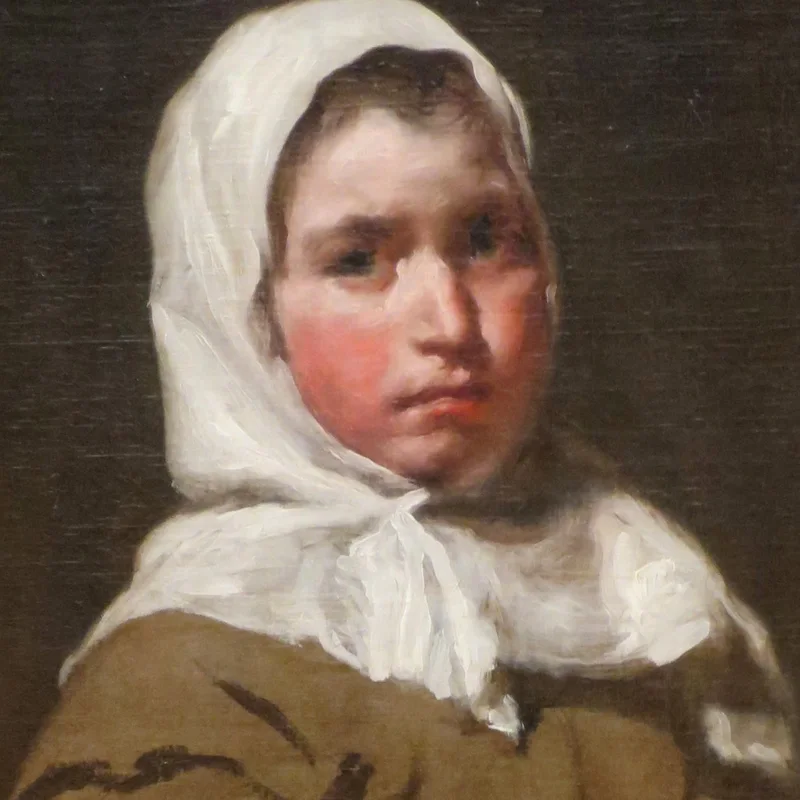
Diego Velazquez, Peasant Girl (La Gallega), c.1645. Public domain, Wikimedia Commons. Velazquez.
One direction per session
- The session gets one direction. His that day was to connect the compositional shadow shapes.
- Connect means seeing the dark shapes abstractly, as graphic shapes inside the picture, rather than as the objects they belong to.
- The line he wanted ran from the background through the head and back into the shadow, one movement all the way through.
- “If anything, I’m connecting things, not separating them.”
- Because the direction is single, the tools stay single. One brush, one transparent mix, and color deliberately off the table for the day.
- He plans it as a campaign, divide and conquer, so each session resolves one unsolved issue and builds on the last instead of redoing it.
- Small contrasts still get separated, but never against the theme. “I don’t want the small contrasts to clash with the larger compositional theme.”

An original methods.art diagram; the connecting pass, the oiling-out caveat and the wipe-back in Daniel Bilmes's own words, from the Finishing Touches chapter, 2026. the curriculum map.
The connecting glaze
- The mix is plain on purpose: ultramarine blue and yellow ochre run cold to warm as one general shadow value, with Oleo Gel added for transparency.
- The more transparent he wants the paint, the more gel goes in. A squeegee picks some up and lays it in.
- A trace of gel goes on the surface too, only over the area he will work that day, so the glaze goes down even on a slightly slipperier ground.
- The caveat is explicit. Oiling out a whole painting “is not really good to do,” so it is barely any, wiped on with a paper towel.
- This is not traditional glazing over a resolved tonal picture. He glazes to connect and complete forms on something that is generally working but not yet settled.
- A dry paper towel wipes the glaze back where he wants light again, and it is not erasing, because the information underneath the last glaze survives.
- Rubber tools pull the smaller pockets of light out, so a form still shows even while the whole passage sits further back in value.
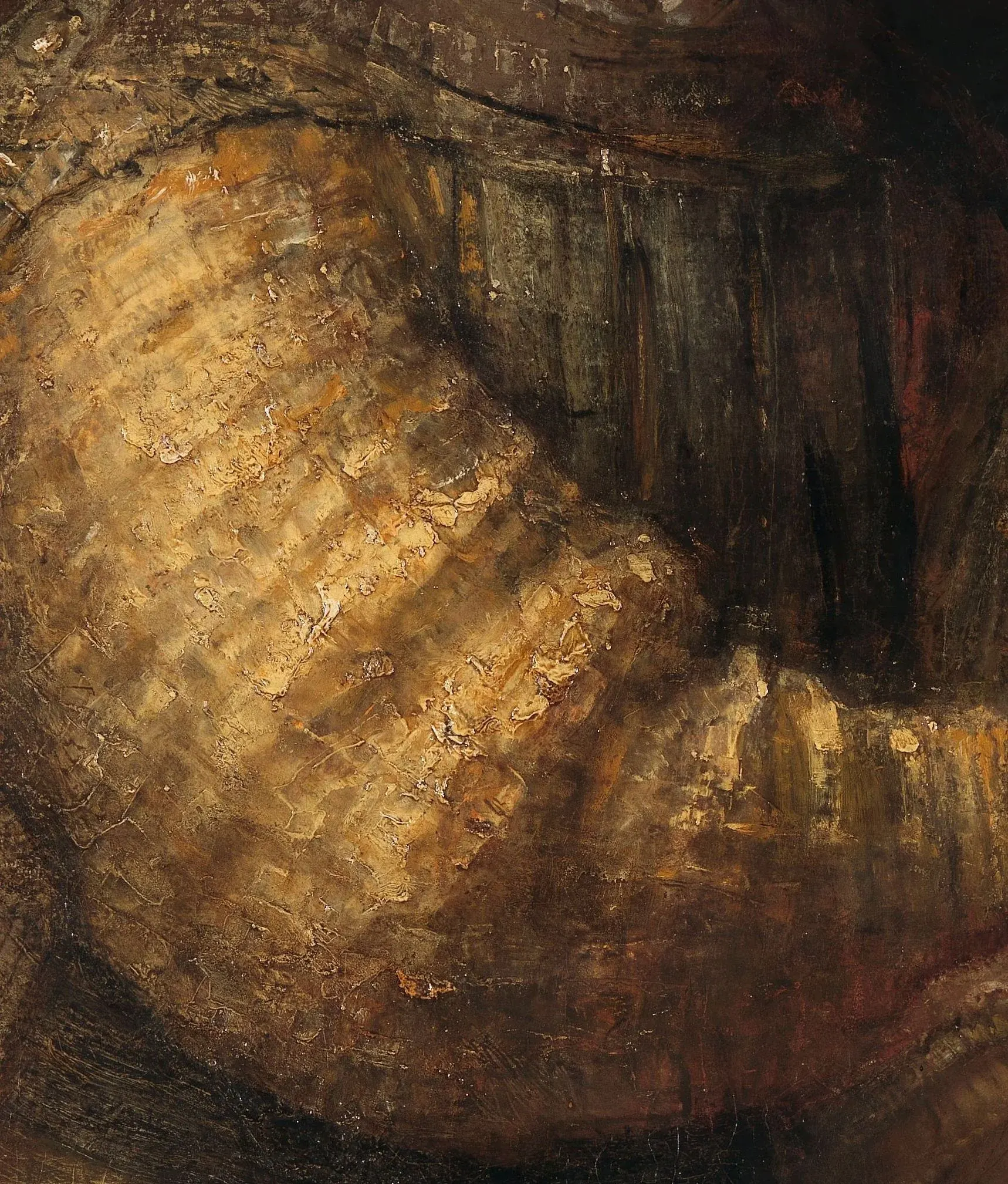
Rembrandt van Rijn, Portrait of a Couple as Isaac and Rebecca, known as The Jewish Bride (detail), circa 1662 to 1666, Rijksmuseum, Amsterdam. Public domain, Wikimedia Commons. Rembrandt.
Keying and calibrating
- With some values clarified, he pushes their neighbours darker or lighter against them. He calls it keying and calibrating.
- Keying is comparative. He is not matching a value to the subject, he is setting it against the values beside it.
- Change one thing and you have changed what it relates to. “By changing one thing, you’re changing how it relates to something else, and that kinda keeps going forever.”
- So every change is followed by a zoom out, to see whether it caused another issue or cost some other relationship its cohesion.
- Vision works this way below awareness. “Sometimes we don’t even realize how much, it’s all about the relationships.”
- One brush, all session. The work is gradual resolution of tonal balances rather than a run of decisive strokes.
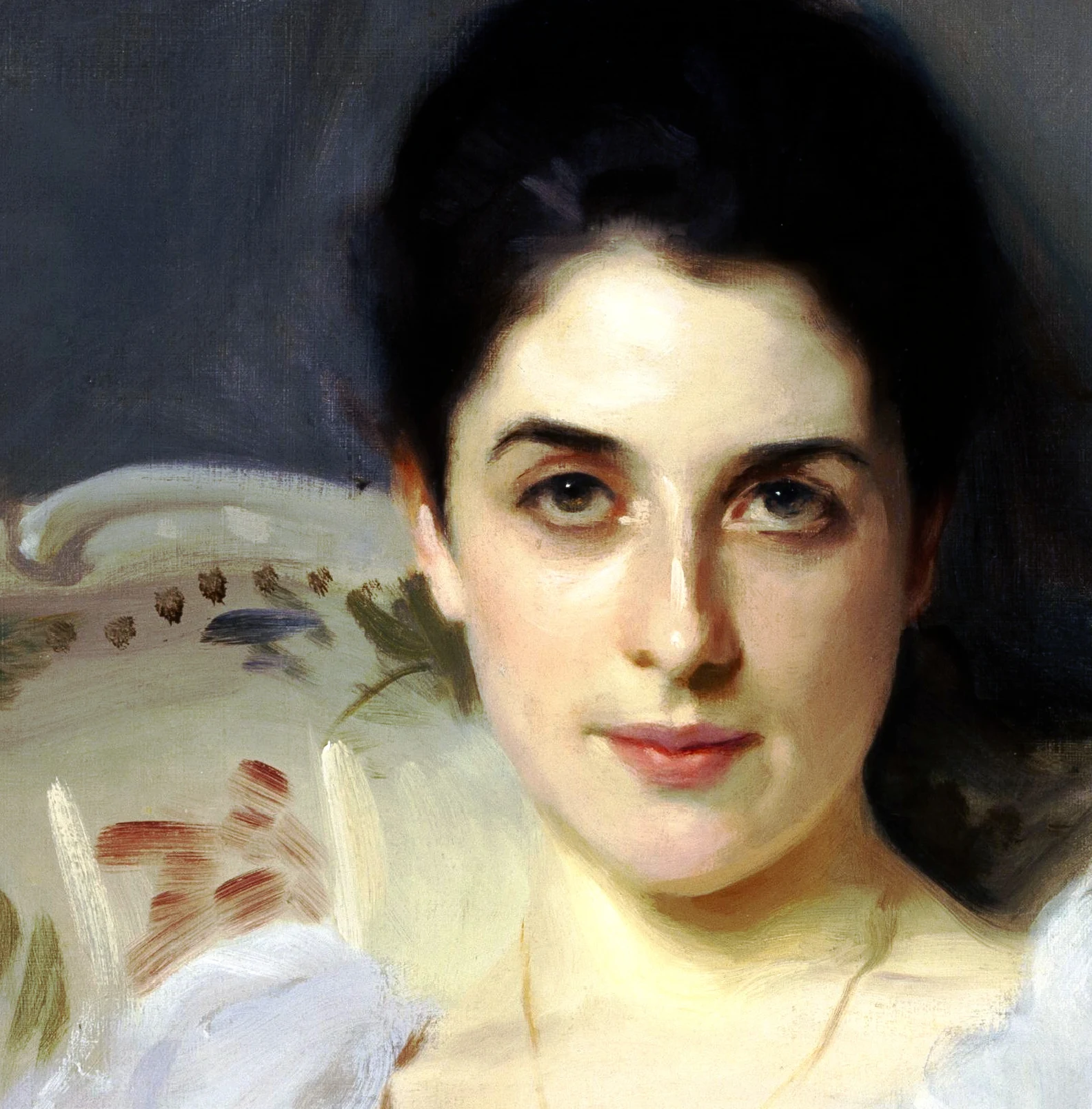
John Singer Sargent, Lady Agnew of Lochnaw (detail), 1892, National Galleries of Scotland. Public domain, Wikimedia Commons. Sargent.
The local manifestation of a larger theme
- He names the premise outright: “local manifestation or local application of my larger theme.”
- “It’s about finding a series of local adjustments based on a larger theme.” Neither the theme alone nor the local fix alone.
- Applied that day: an area reading considerably too light gets pushed darker because the theme is connection, not because the spot is wrong on its own.
- Temperature still enters, under the theme. He keeps some of the blues without letting color become the day’s subject.
- Observed cause is used where it helps. Reflected light off the grasses justified pushing that passage down.
- Every local move is checkable against one question: does this serve the direction I picked for the session?
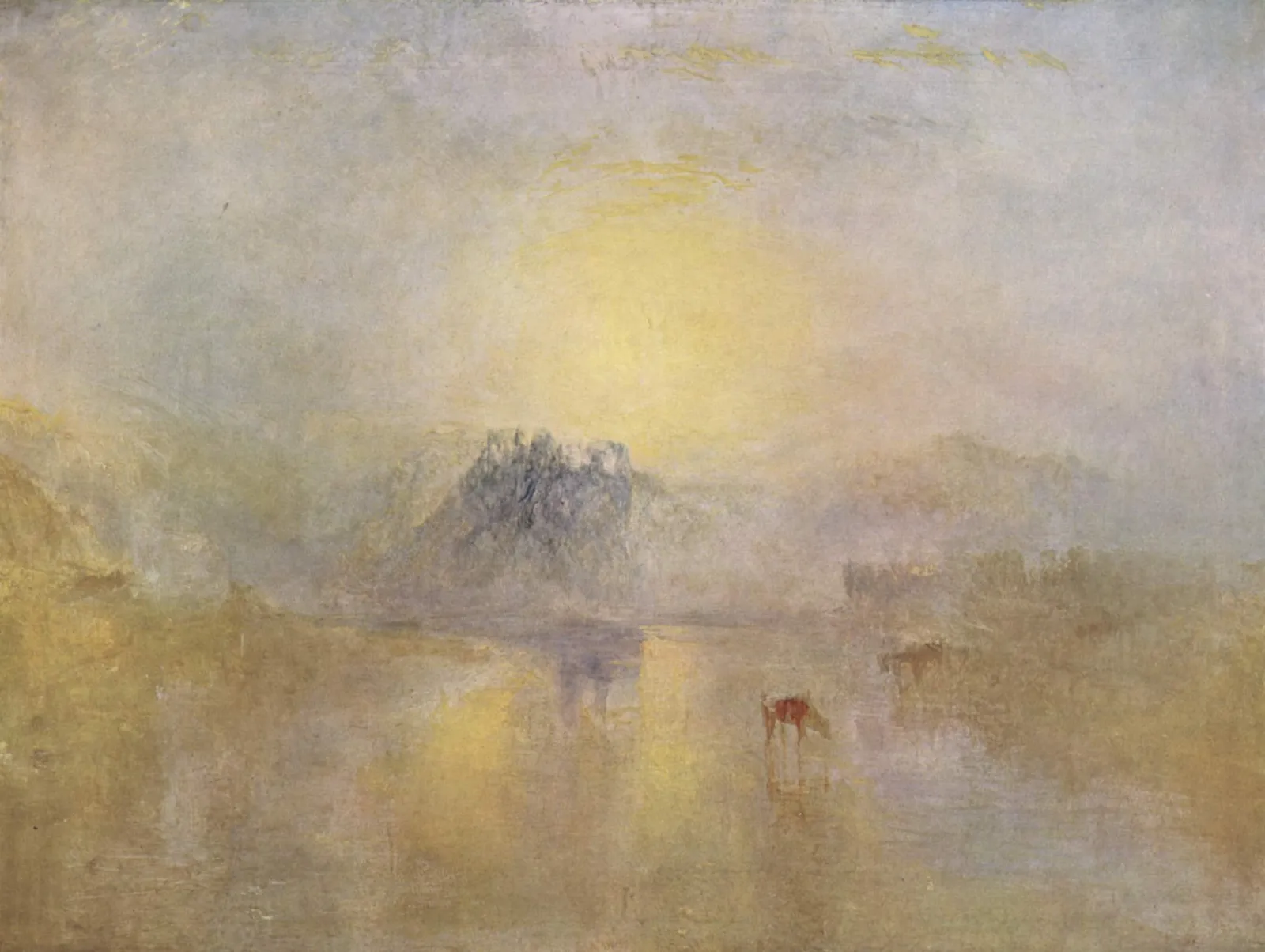
Joseph Mallord William Turner, Norham Castle, Sunrise, circa 1845, Tate Britain, London. Public domain, Wikimedia Commons. No painter record here yet, so this one sits with the curriculum map.
The fragmentation counter-move
- His own habits cause a specific problem. Heavy focus on texture, rhythm and directional strokes leaves a picture fragmented.
- He says it plainly about the painting in front of him: “this is slightly fragmented now.”
- Because he knows it is coming, the counter-move is built into the process rather than improvised at the end. “I just know that that’s gonna happen, so I have to then develop these methods to bring things back together.”
- Know your own patterns. If you consistently do something, change the approach or develop the next step that brings everything together.
- The process is not linear. “It’s also going back and revising some of your approaches.”
- If the same problem shows up late in every painting, rework the earlier stages so you stop arriving there.
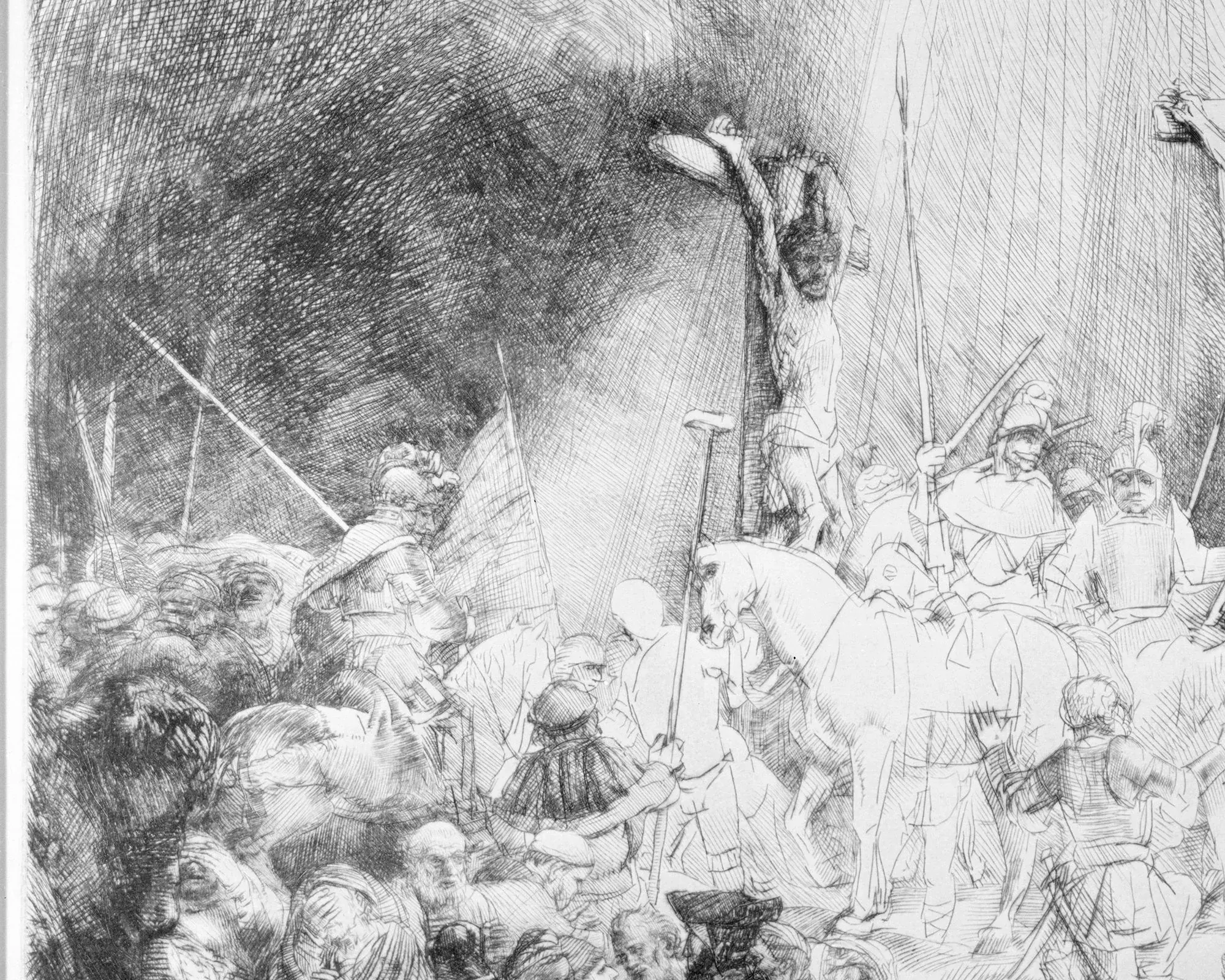
Rembrandt van Rijn, Christ Crucified between the Two Thieves, The Three Crosses (detail, third state), 1653, The Metropolitan Museum of Art, New York. Public domain, Wikimedia Commons. Rembrandt.
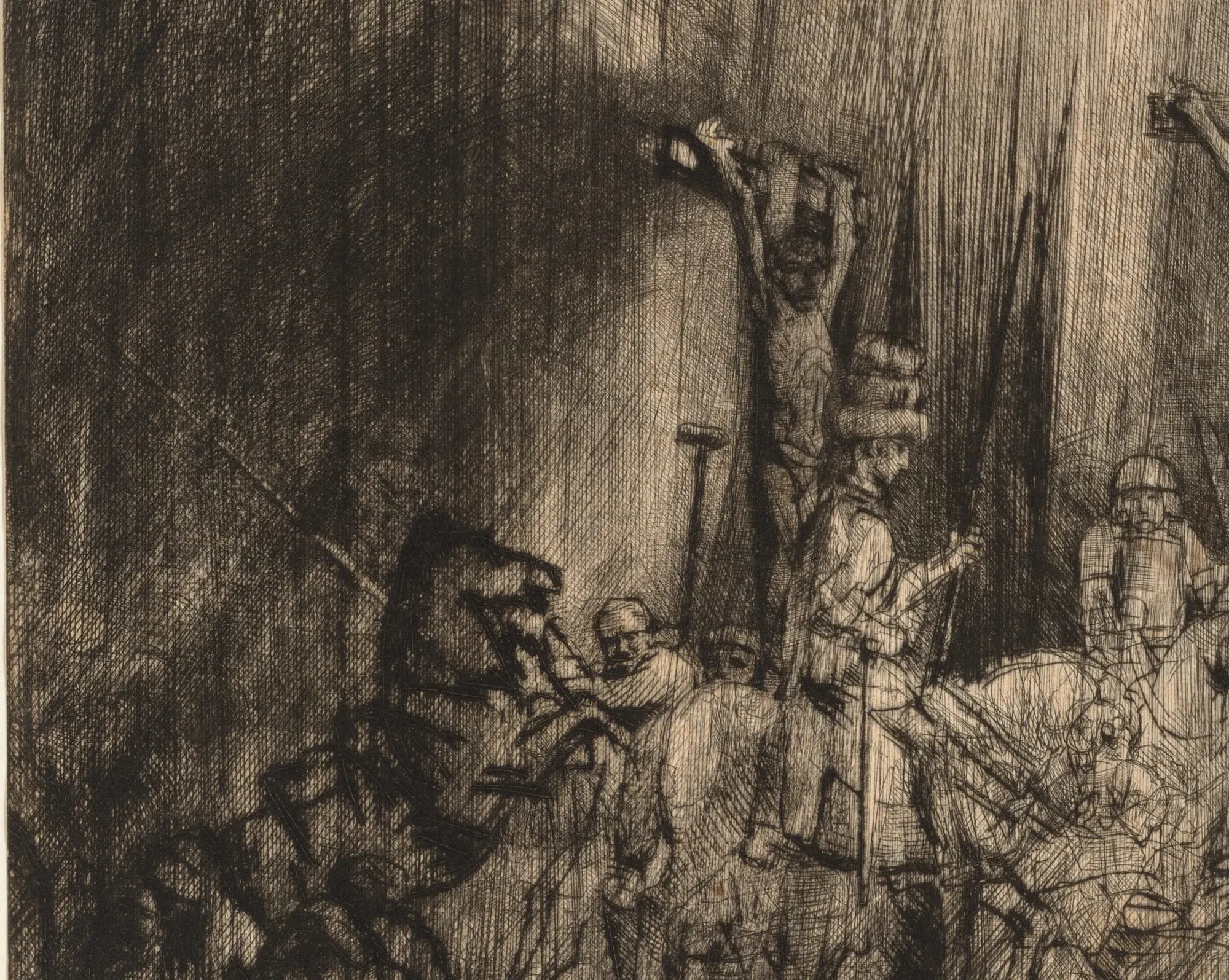
Rembrandt van Rijn, Christ Crucified between the Two Thieves, The Three Crosses (detail, fourth state), 1653 to about 1660, The Cleveland Museum of Art. Public domain, Wikimedia Commons. Rembrandt.
Thick over thin
- The earlier layers went down carefully and without much three-dimensional texture. The surface is “actually pretty smooth to the touch.”
- The texture he means is control in the brushstrokes, their rhythm and direction, not raised paint.
- The reason is mechanical. Impasto makes glazing much harder, so early impasto would close the door on the late connecting pass.
- The general rule holds anyway: paint thicker over thin, so the early strokes should not be too thick.
- The thick paint is saved for the end, “a little bit thicker brushstrokes in the lighter areas where I really want the eye to go.”
- He builds the illusion of form through control rather than through actual thick strokes, and says outright that this is preference, not right and wrong.
- Knowing your own position makes the decisions faster, because much of representational painting is a choice rather than a fact.
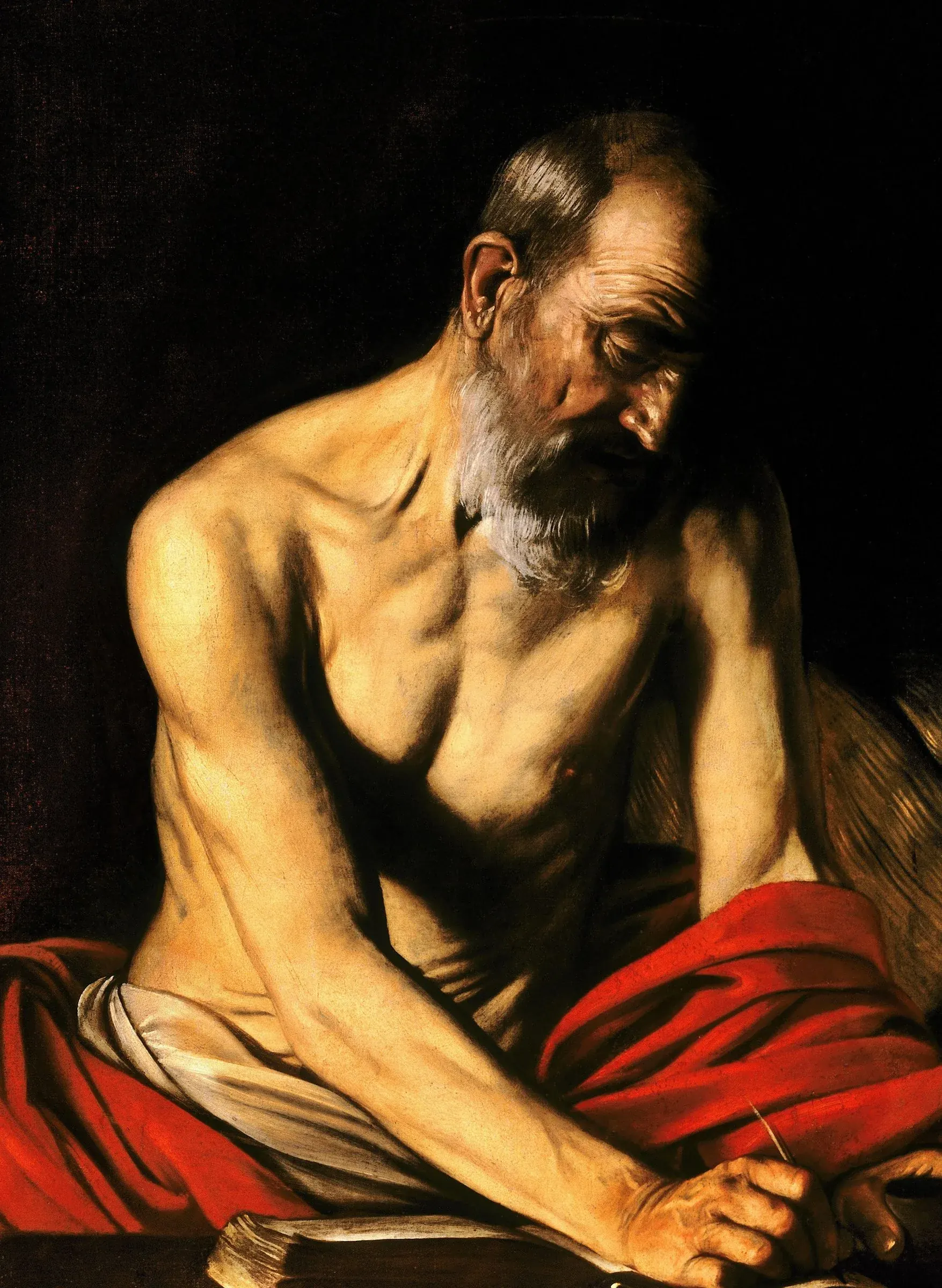
Michelangelo Merisi da Caravaggio, Saint Jerome Writing (detail), circa 1607 to 1608, Oratory of Saint John, Saint John’s Co-Cathedral, Valletta. Public domain, Wikimedia Commons. Caravaggio.
Communion
- He treats finishing as a conversation with the object rather than the execution of a plan.
- “The painting will tell you what it needs if you commune with it towards the end.” By this stage there is enough information on it to be read.
- The instruction is to observe and understand what the painting needs “instead of just projecting,” and he says that observing makes finishing easier.
- Projecting has a signature failure. You “solve one thing and cause another ten problems, and do that indefinitely.”
- “The whole one step forward, two step backwards is really easy to do with finishing.”
- The guard is the big picture. Come in for the local variation of the theme, step back, return to holistic thinking.
- It matters most at the two ends. The middle of a painting is where a single area can reasonably demand all of your attention.
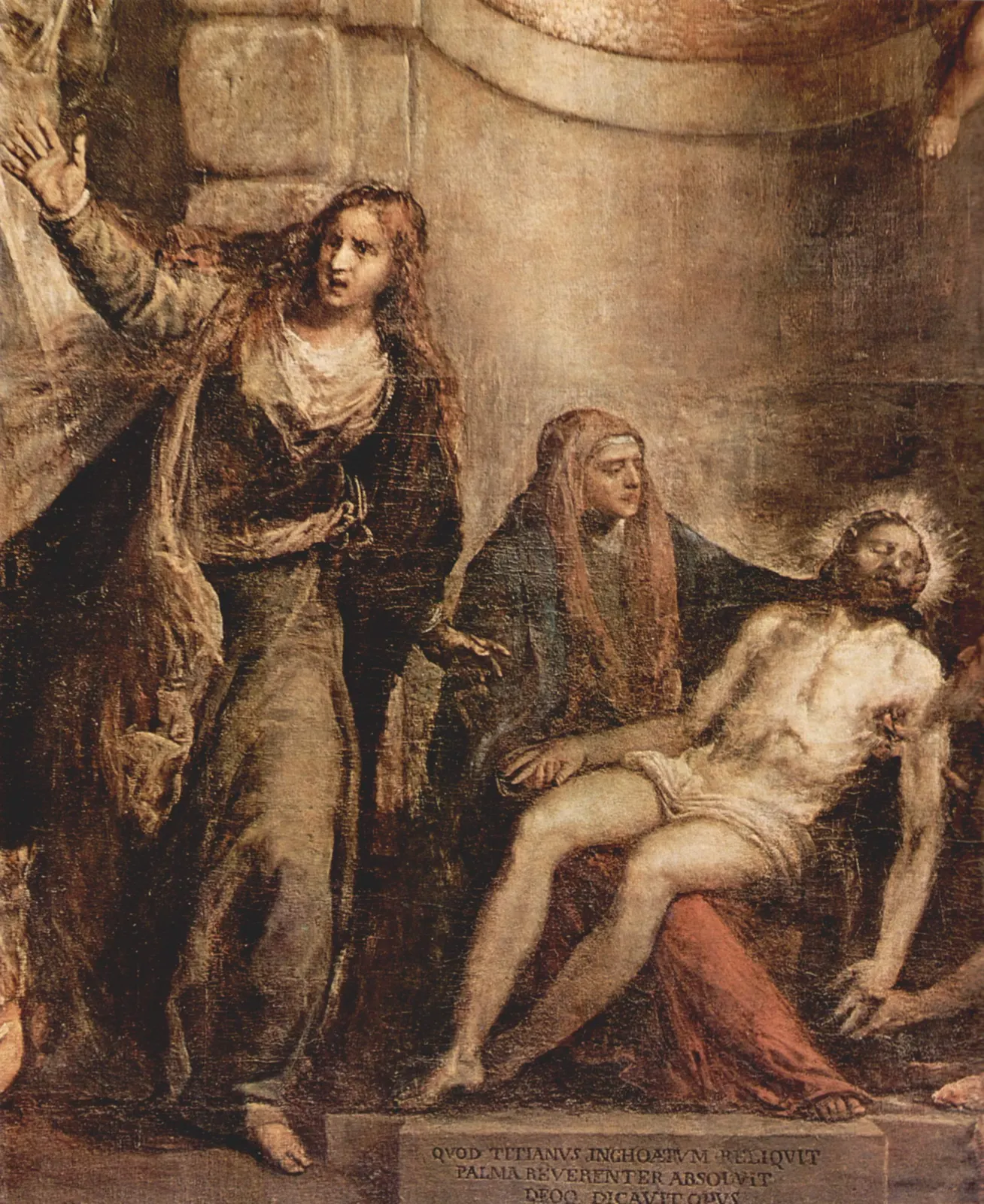
Titian, Pieta (detail), circa 1576, Gallerie dell’Accademia, Venice. The inscription reads Quod Titianus inchoatum reliquit, Palma reverenter absolvit, Deoq. dicavit opus. Public domain, Wikimedia Commons. Titian.
Across the room
- The test that governs the late stage: “the painting needs to read from across the room.”
- The questions at that distance. Do the larger shapes connect, is the major form in light working, are the holistic relationships of light and shadow ones you are happy with.
- Attention follows importance. If a thing is by definition the most important, it needs the focus, or at least needs remembering while you work on other things.
- He names his own risk. He cares about brushstrokes almost too much, and knows he over-focuses on how every small thing interacts.
- The middle of this stage looks worse. Some parts are keyed and others are not, so the picture can look less cohesive for a while.
- The way through the awkward state is to hold the direction. He is adding darker value and connecting, not popping highlights.
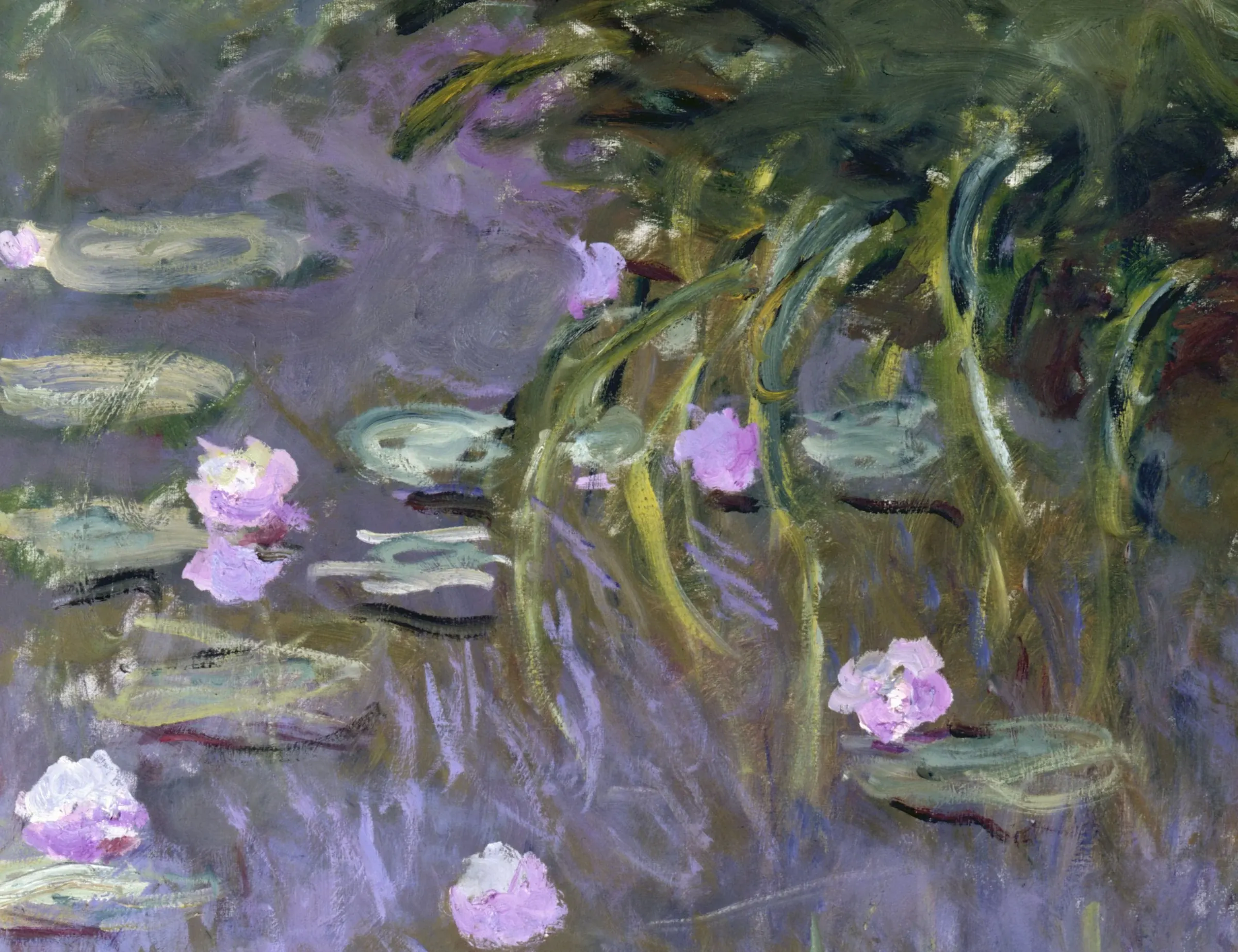
Claude Monet, Water Lilies (detail), 1922, The Toledo Museum of Art, Ohio. Public domain, Wikimedia Commons. Monet.
Complete, not finished
- The anchor: “I try to complete a painting, not finish it.” Finish implies polish. “Complete means when it doesn’t need anything else.”
- Getting there is the same holistic move the painting started with. Big picture at the beginning, local through the middle, big picture again at the end.
- The late technique is not borrowed. His methods “came out of necessity because of other things that I do,” which is what makes it a process rather than a set of tricks.
- The stages feed each other. He kept the early passages light and smooth on purpose, so the late glaze could unify without getting rid of the work already done.
- Deferring is the point. Knowing where you are going lets you leave adjustments for the stage that can make them cheaply.
- The foundation does the enabling. He works on top of information that “even though it isn’t perfect, has enough” for him to understand what is happening.
- So the finish is only available because of how the beginning was built, and a painting is complete when it stops asking for anything.
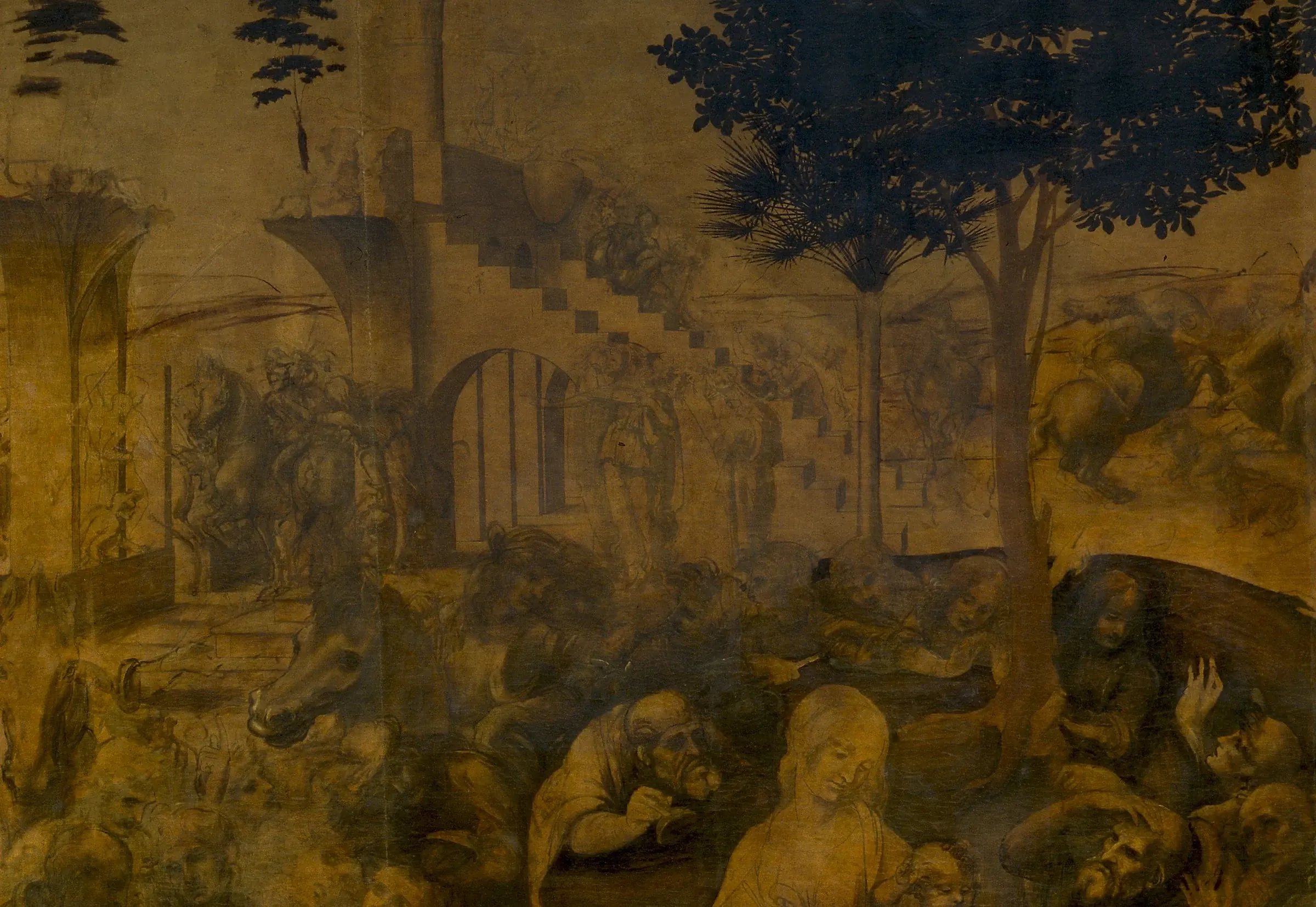
Leonardo da Vinci, The Adoration of the Magi (detail), 1481, Galleria degli Uffizi, Florence. Public domain, Wikimedia Commons. Leonardo.
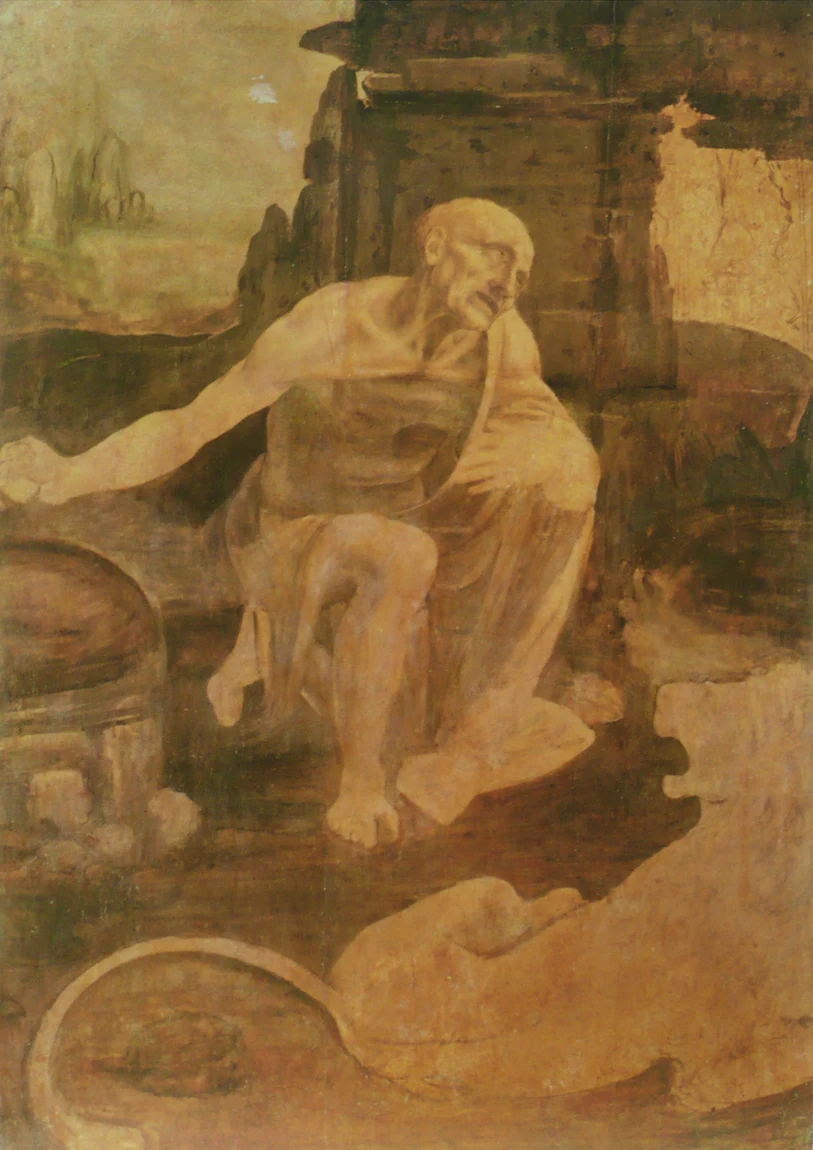
Leonardo da Vinci, Saint Jerome in the Wilderness, circa 1482, Pinacoteca Vaticana, Vatican City. Public domain, Wikimedia Commons. Leonardo.
Self-check
Six statements to run against the painting in front of you. Each one should be true before you call it done.
- The across-the-room test. From the far wall the larger shapes connect and the major form in light is working.
- The one-theme test. You can name the single direction of this session. If you cannot, you were making local fixes with no theme under them.
- The form-bridge test. You found where the form was broken and built a bridge, and no light spot is left lying to the eye about where the form turns.
- The cascade test. After each change you zoomed back out and checked what else the change moved.
- The connection test. The last hour connected more than it separated, and no small contrast is fighting the larger theme.
- The it-doesn’t-need-anything-else test. Name one thing it still needs. If you can, keep going. If you cannot, it is complete.
The assignment
Take a painting of your own that is already past seventy percent. Do not start a new one for this. Before you pick up a brush, write down the single direction the next session gets, in one sentence. Then work only on that, with one brush and one mix if the direction allows it, and stop when the direction is done rather than when the painting looks finished. Put it against the far wall and write down what it still needs.
Two blocks on this page are meant to leave the screen. The cornerstones at the top and the self-check above both fit on one sheet, and they are the parts you use with a brush in your hand. Print them and keep them by the easel.