The Second Day
The premise
The paint decides what you can do to it, and the paint changes overnight. So the day is the unit of the work, and each day has a different job. Daniel’s shorthand: “day two you’re a bridge builder, day one I was a little chaos monkey.” Day one adds. Day two adjusts. Running the two together is how a start gets muddied.
Day one is only adding. “Because the first day is only adding, I won’t stop. I’m not trying to fine-tune.” He masses in the big sections fast, dance music on, running back and forth, and he stops himself before any detail. The reason is cause and effect. “If I start fixating on a small detail early on, I stall out.” Fine-tuning wet paint that is about to move is work you will redo, so the first day builds the foundation and leaves it. The harder he lays it in during the first hours, the more the rest of the process opens up.
Then the paint sets, and a window opens. Thin layers dry first; the thick darks stay wet longest. When the whole start goes tacky, you can lift the darkest darks without wiping the thin layers underneath. Two questions run the second day. “What can I do while the paint is wet that will be more difficult to do after it dries.” And “how can I leave it in a way where I’m excited to come back to it.”
The demonstration
One slide draws the clock. The demonstration is the drying clock itself, three states, each allowing a different move.

An original methods.art diagram; the day-and-paint doctrine and the two questions of the second day in Daniel Bilmes's own words, 2026.
The second day, the drying clock. It also sits on the composition charts.
Wet, the first day. The brush lifts too much to even out a shadow, so flat values are hard to hold. But nothing is committed and the large movements come easiest. Wet is for adding: the massing, the big gestures, the foundation.
Tacky, the second day. The thin passages have set and the thick darks are still movable, which is the whole opening. He works it with the same brushes from day one, uncleaned on purpose. “I haven’t cleaned them so they have the same tackiness as the actual paint on the panel.” A brush that matches the tack pushes paint around instead of lifting it, so he can even a shadow without diluting it with a fresh, wetter mixture. This is when he averages a value “so it ends up being more of one flat shape.” He lifts the darkest spots out of a shadow “so the shadow becomes more one value.” And he carries the masses into cleaner form, the way you would carve firming clay. Adjusting, not adding.
Dry, the third day on. Now a shape is fixed. He glazes to darken (“once this is dry I’m going to glaze some more layers in and darken them”) and can still add, but he cannot relocate. A millimeter trim is easy; moving a feature two inches is a pain to do dry. So the drying clock is also a deadline: the moves that need wet paint have to happen before the panel sets.
Two existing figures sit under this clock. Value block-in, stage by stage is day one’s job, a head massed as two flat values, then three, then four, before any modeling. The shadow shape, the anchor is day two’s target. Under one light the shadow shape holds still, so the tacky window is when he finds it, averages it to one value, and connects it. He leaves it simple enough to trust once it dries.

Value block-in, stage by stage. It also sits on the composition charts.
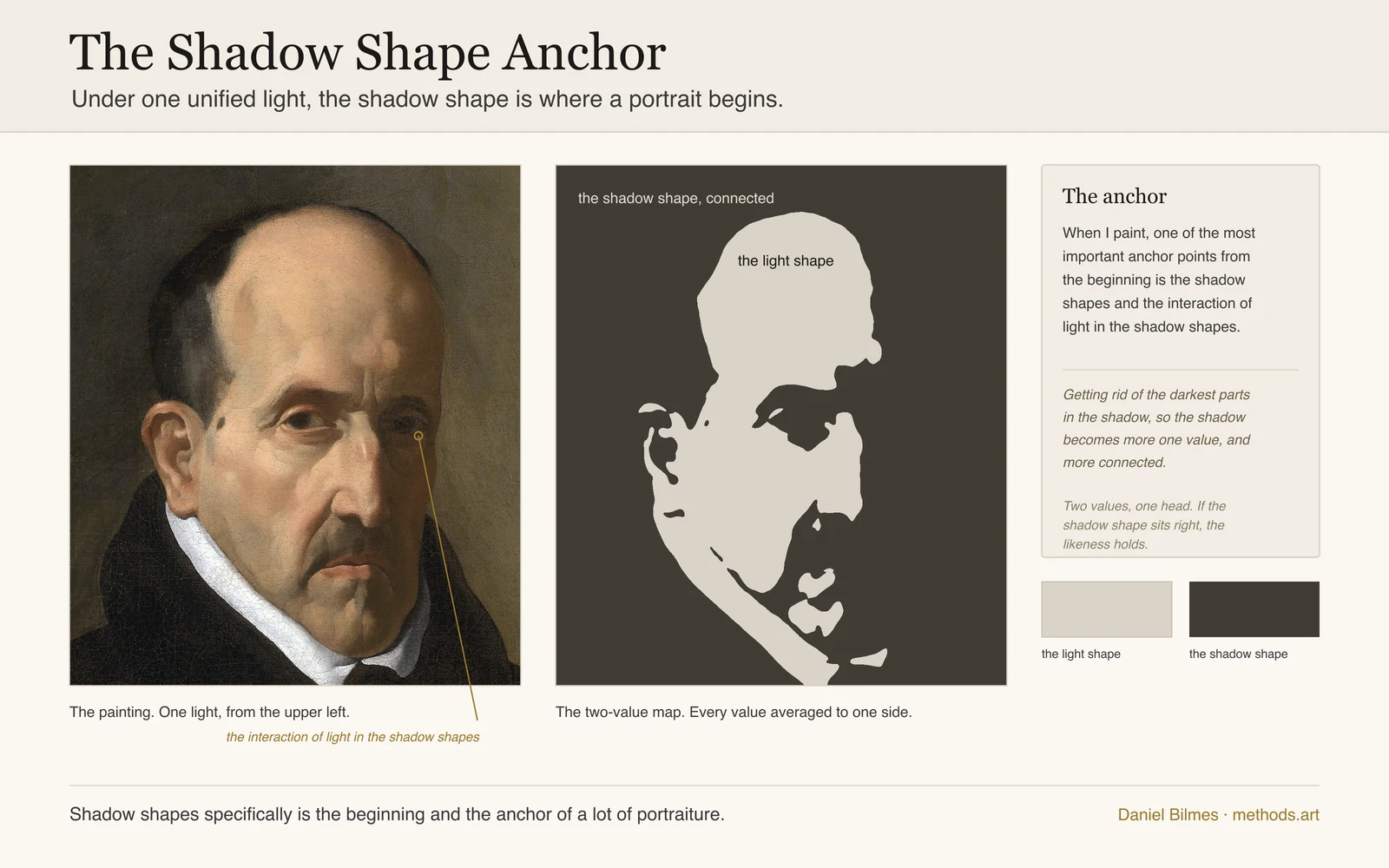
Diego Velazquez, Luis de Gongora (1622), Museum of Fine Arts, Boston. Public domain, Wikimedia Commons. The two-value map is an original methods.art diagram. Shadow-shape doctrine per Daniel Bilmes, 2026.
The shadow shape, the anchor. It also sits on the composition charts.
The master’s example
The registry holds no public-domain plate that documents a painter working an unfinished passage across drying sessions, so this example stands on his own practice, described in the podcast.
His alla prima is not a single sitting. “My alla prima isn’t done in a single session, it’s done as the paint is drying.” With a little medium and a cold studio, the paint will not fully set for days. A small piece becomes a four or five day alla prima, scraped into and added to as it goes tacky and then dry. He calls the old version a four-day bender, and he is honest about the cost: he is a sprinter by nature, and running it too long tipped him into burnout.
The planning is sectional. “The first brush stroke I try to make is the longest brush stroke.” Then he works in sections, one figure’s head one day, the torso the next, because roughly seventy percent of the time is the gradual first pass and the rest is fusing it together. The layering is planned like a military campaign: some areas take ten layers, some get one careful first pass meant to show in the finished work. And the second day is where the options widen. The paint is still movable but tacky, so he can remove a whole passage, remove a third of it, or add to it. That wider set of choices is what the second day buys.
The exercise
A two-day study, small, in oil or acrylic. One head or one simple object under a single lamp.
Materials: a primed board no bigger than a page, one or two bristle brushes, and raw umber with white, or a limited color set. Use titanium white. His demo white is lead, chosen for how it glazes, and lead white is actual lead. It is not a casual material, and nothing in this exercise needs it. A little medium in the mix keeps day one’s paint movable into day two.
Day one, adding only. Mass the subject in large flat shapes: the shadow family, the light family, the darks. Move fast. The rule is a hard stop. The moment you catch yourself fine-tuning a feature, put the brush down. Leave it that simple and let it sit overnight.
Day two, adjusting only. Do not clean yesterday’s brushes; let them carry the same tack as the panel. Now work only what the wet paint allows. Lift the darkest darks out of the shadow so it reads as one value, without dragging the brush through the thin lights. Bridge one border between light and shadow. Nudge a misplaced shape a few millimeters into its right location. Do not start the mouth or a fresh feature you could paint just as well next week; save those for the dry panel.
Thirty to forty-five minutes each day. What to look for: day two should end more cohesive than it began, not busier, and every mark should be one you could not have made as well after the paint dried.
Self-check
- Day one added and nothing else. If you fine-tuned a feature on the first day, name where you stalled.
- You worked day two in the tacky window, not soaking wet and not bone dry, and the state matched the move: lifting where tacky, glazing where dry.
- The darkest darks came out of the shadow without wiping the thin layers, and the shadow now reads as one value.
- Every second-day mark is one that needed wet paint. Anything you could do just as well next week, you left alone.
- His last test: “how can I leave it in a way where I’m excited to come back to it.” Look at the panel and answer honestly.