Monet painted in series, six or more canvases carried to one motif, each swapped out every fifteen or twenty minutes as the light moved past its state, then harmonized later in the studio. He worked in oil on a light ground. The ground reflects light back through the thin upper layers, so the picture holds a permanently higher key. The color went on broken and side by side, for the eye to mix, with lead white in the largest quantity.
Carry multiple canvases to the motif and rotate as light shifts
For Haystacks, Poplars, Rouen Cathedral, the Thames series — carried multiple canvases to the motif. As the light shifted, swapped canvas B for canvas A, sometimes working on a single canvas for only fifteen or twenty minutes before the light had moved past its state.
Why it matters · The series is a chronology of light, not a composite of a place. The individual canvas is not the unit of completion — the series is. Painters who finish one painting per motif misunderstand what the motif is.
Lilla Cabot Perry, Reminiscences of Claude Monet from 1889 to 1909, The American Magazine of Art, 1927 — Perry recorded the two limits in his own words. On one of the Poplars the effect lasted seven minutes, until the sunlight left a certain leaf, and then he took out the next canvas. He held that no painter could work more than half an hour on an outdoor effect and keep the picture true to nature.
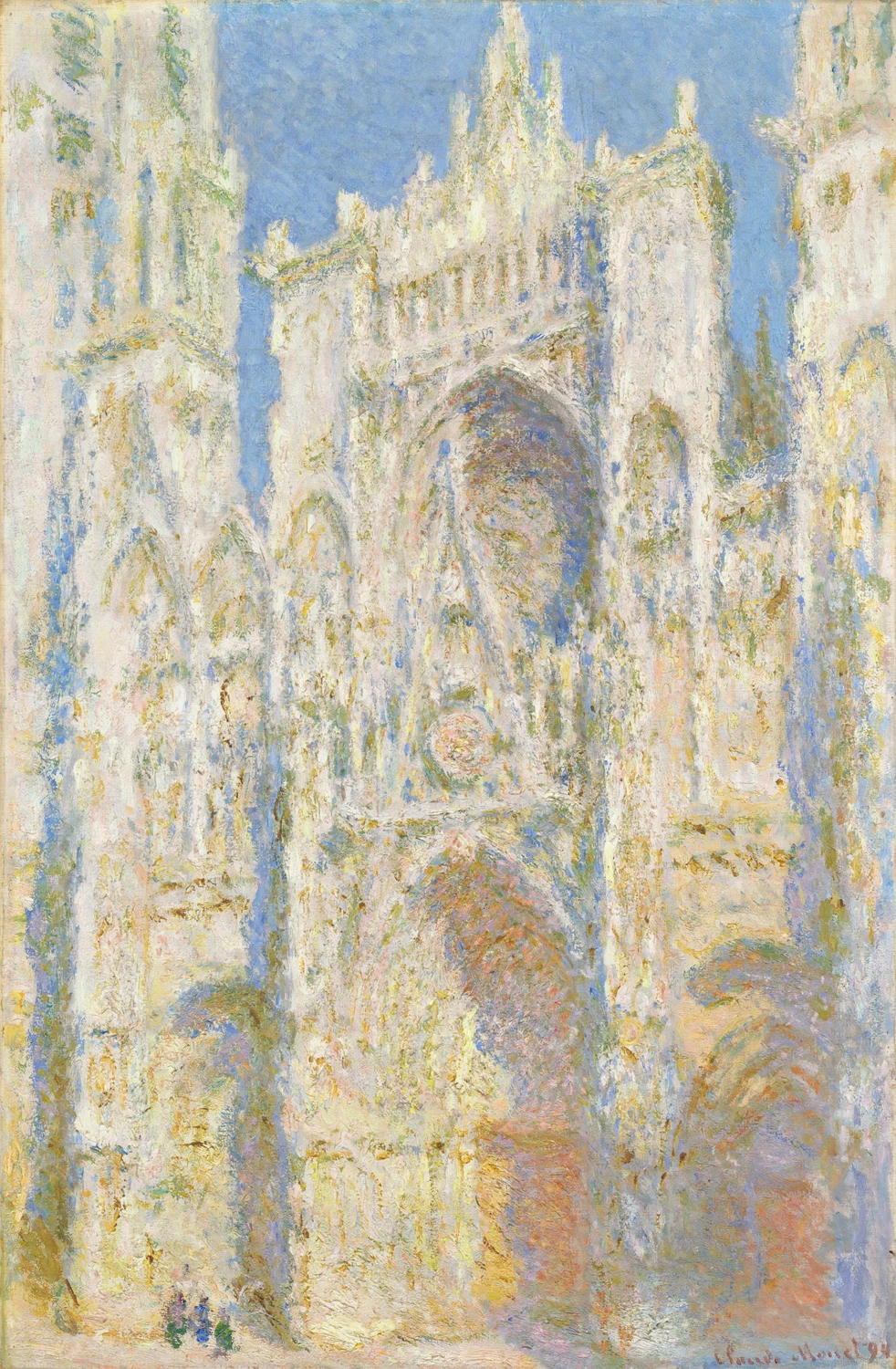
Rouen Cathedral, West Facade, Sunlight: one canvas out of more than thirty of the same front, this one carrying the hour when the sun is full on the stone and the whole facade has gone cream and gold. The morning state of the same doorway is further down this page.
Claude Monet, Rouen Cathedral, West Facade, Sunlight, 1894, National Gallery of Art, Washington. Public domain, Wikimedia Commons.
Cover the whole canvas on the first pass
Told Lilla Cabot Perry that the first painting should cover as much of the canvas as possible, no matter how roughly, so the tonality of the whole is settled at the outset. He proved it with two canvases: one painted once, strokes about an inch apart and a quarter of an inch thick, carried out to the very edge, and one painted twice, where the strokes had closed up and the subject began to emerge.
Why it matters · A canvas with bare patches gives you nothing to judge the next color against, so every early decision is a guess. Once every inch carries a stroke, the second pass is a correction rather than an invention. The rough first cover is what makes the rest of the painting fast.
Lilla Cabot Perry, Reminiscences of Claude Monet from 1889 to 1909, The American Magazine of Art, 1927 — Page 120. Perry watched him bring out both canvases to make the point.
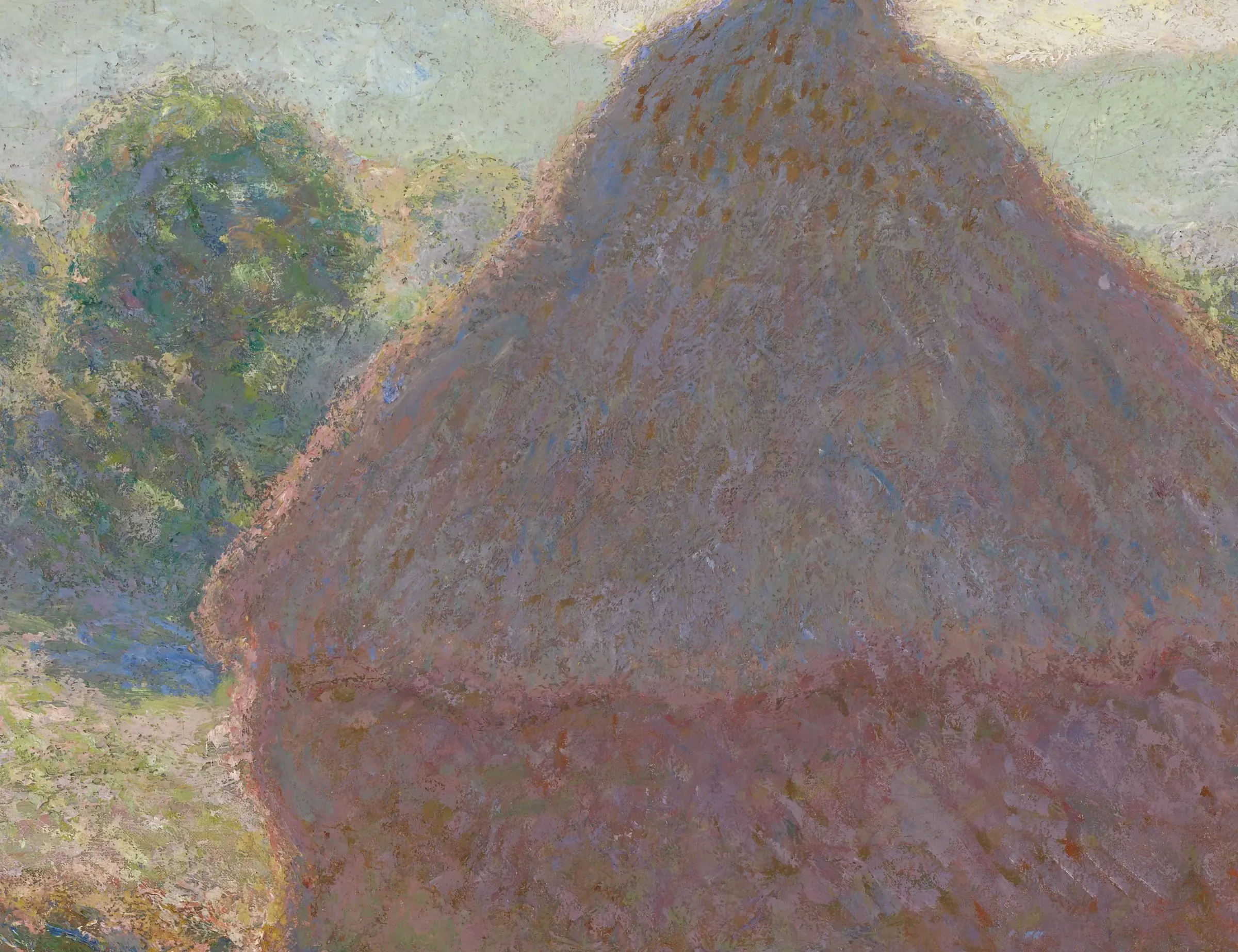
Detail of Meules, midday: the stack is not a brown shape with light on it. It is pink, blue, violet and ochre set down as separate touches that never mix on the palette, and the field beside it is the same mosaic carried out to the edge.
Claude Monet, Meules, milieu du jour (Haystacks, midday) (detail), 1890, National Gallery of Australia, Canberra. Public domain, Wikimedia Commons.
Drag the color on with long flexible brushes
Had long flexible brushes made to order and dragged the color onto the canvas with them, which built the crusted broken surface critics kept comparing to worsted work. His answer was that some Rembrandts had been laid on more thickly still, and that time had smoothed them down.
Why it matters · A loaded brush dragged over a dry crust leaves color on the ridges and lets the layer underneath stay visible in the troughs. That is how one passage holds two colors at once without either going to mud. A short stiff brush stamps the paint down. A long flexible one drags it across.
Lilla Cabot Perry, Reminiscences of Claude Monet from 1889 to 1909, The American Magazine of Art, 1927 — Page 122, on the criticism, the brushes made to order, and the Rembrandt comparison.
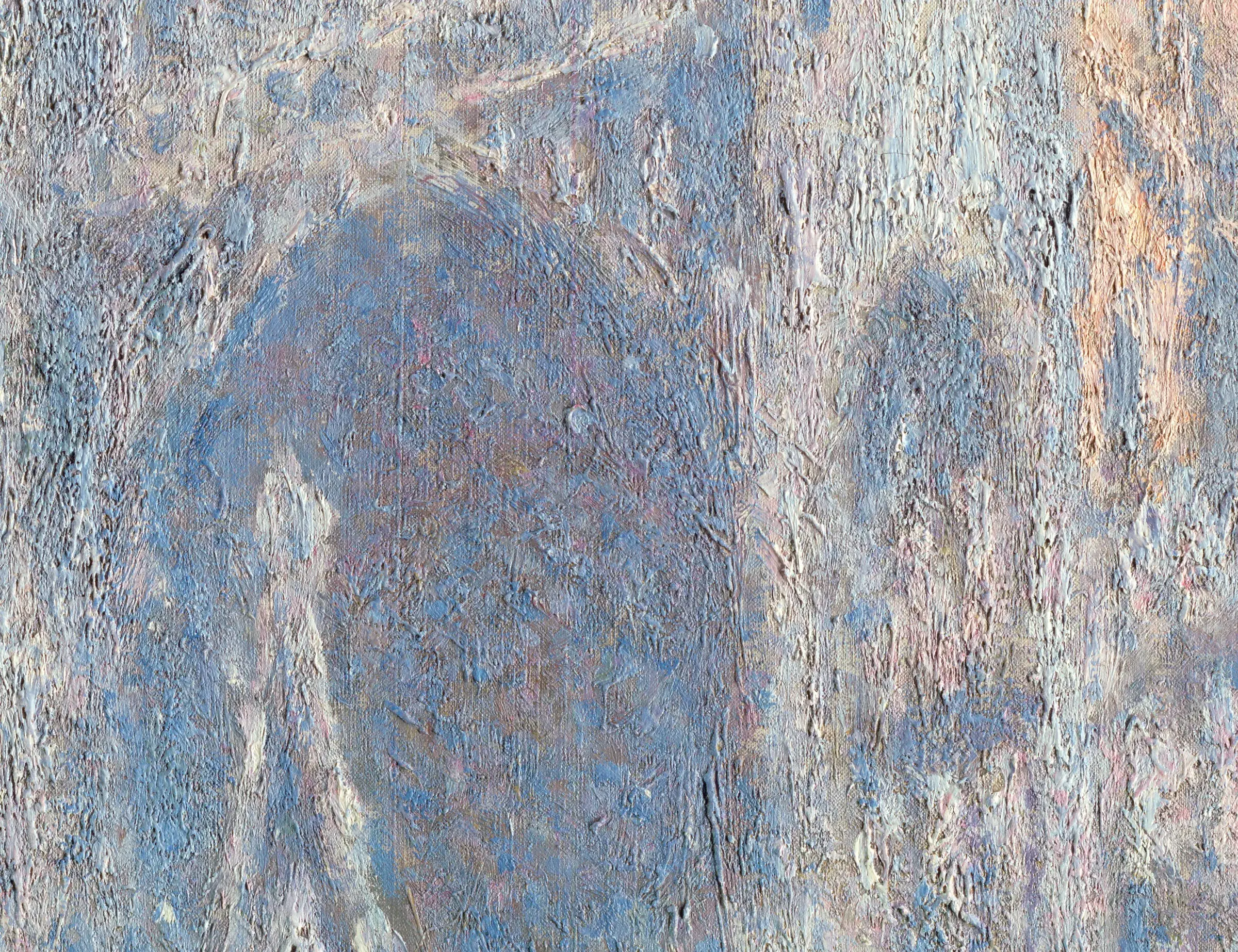
Detail of the Rouen portal in morning light: the ridges of dry paint stand up off the canvas and catch the gallery light on their own. Nothing here is drawn. The arch exists because the dragged strokes change color where the stone turns.
Claude Monet, The Portal of Rouen Cathedral in Morning Light (detail), 1894, The J. Paul Getty Museum, Los Angeles. Public domain, Wikimedia Commons.
Build "mountains of white" — lead white as primary tube
René Gimpel's 1918 Giverny visit recorded "montagnes de blanc" — mountains of lead white — on the palette. Lead white went into almost every mixture for opacity, the warm cast it gave to the upper tonal range, and the characteristic dryness of surface as the lead-oil film cured.
Why it matters · A high-key luminous surface depends on lead white in volume. Painters who reach for white only as final highlight produce dimmer paintings. Monet built lead white into the structure.
René Gimpel, Journal d'un collectionneur, 1918
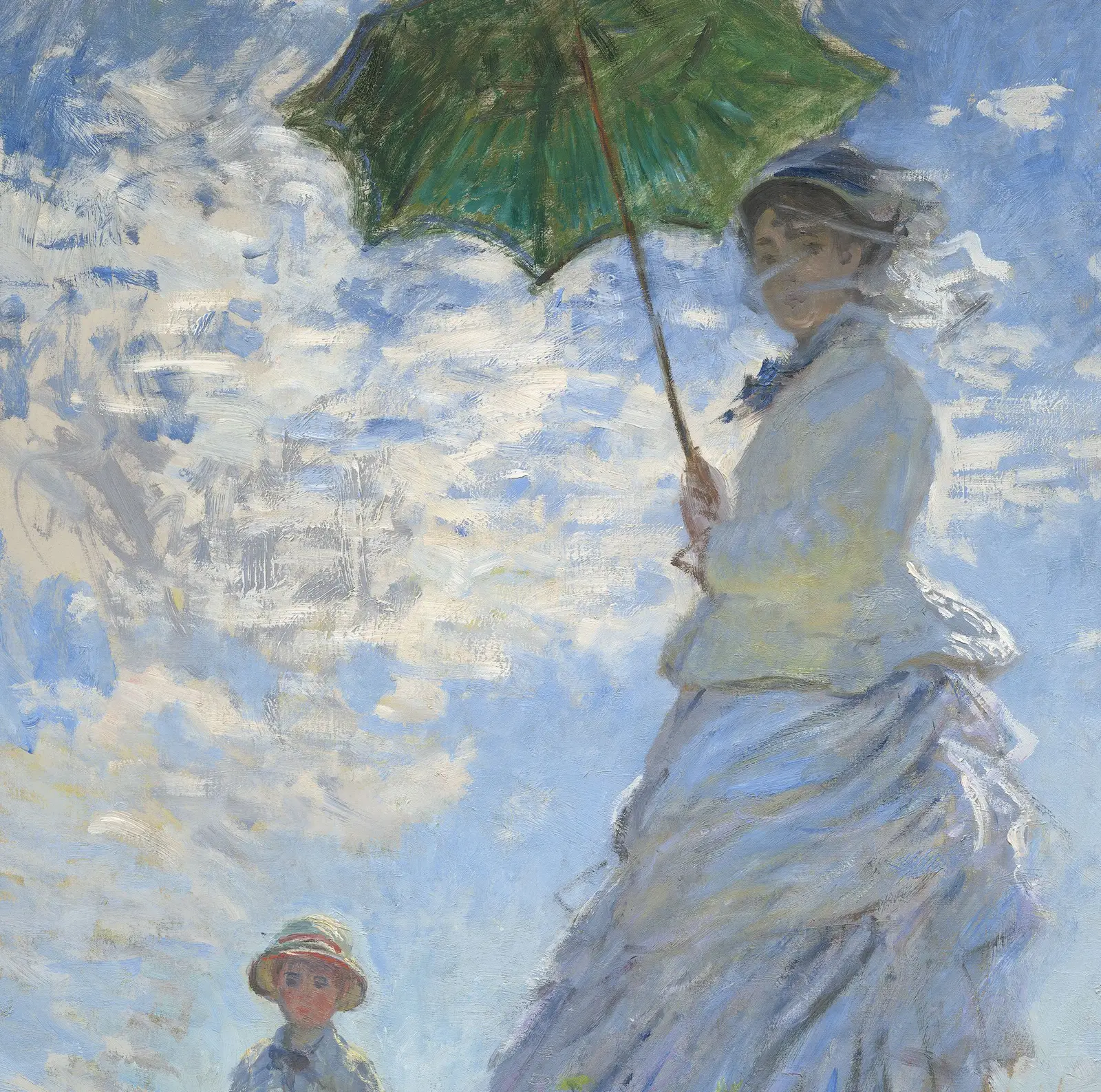
Detail of Woman with a Parasol: white is in everything here. It is dragged through the blue of the sky, it carries the veil across her face, and it runs down the dress in strokes that stay separate. None of it is being saved for a final highlight.
Claude Monet, Woman with a Parasol, Madame Monet and Her Son (detail), 1875, National Gallery of Art, Washington. Public domain (CC0), Wikimedia Commons.
Light ground as chemical pivot
Worked on light-toned grounds (white, cream, pale gray) rather than the warm mid-tone imprimatura of academic practice — the light ground reflects incoming light back through thin upper paint layers, keeping the painting at a permanently higher key.
Why it matters · The chemical pivot of his career. A tinted-ground painting cannot reach the same key. Most painters accept the academic warm imprimatura as default; Monet refused it.
Art Institute of Chicago: Color, Chemistry, and Creativity in Monet's Water Lilies, 2006
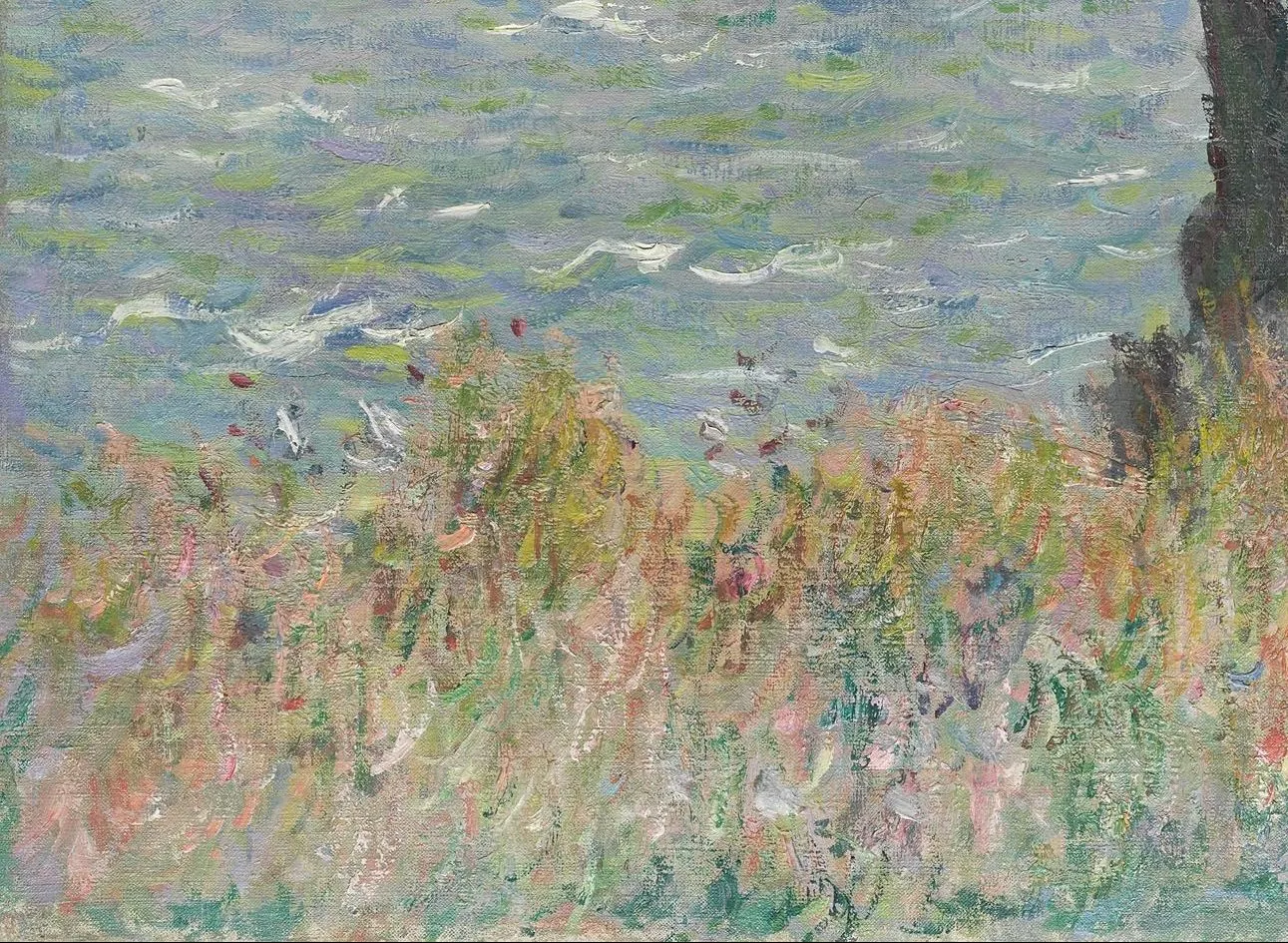
Detail of Cliff Walk at Pourville: the pale ground shows between the strokes all through the grass and the sea, and the weave of the primed canvas reads straight through the thin colour. That light layer under everything is what keeps the picture in its high key.
Claude Monet, Cliff Walk at Pourville (detail), 1882, The Art Institute of Chicago. Public domain, Wikimedia Commons.
Build the motif itself — design the garden as living studio
Bought Giverny in 1890, dammed the Epte to create the water garden, commissioned the Japanese footbridge in 1893, and planted the water lilies, wisteria, willows, and irises specifically as future painting subjects.
Why it matters · The Water Lilies cycle (~250 canvases across the last thirty years of his life) is painting from a motif the painter built. Most painters wait for the right subject; Monet engineered it. The discipline is methodological — treat subject construction as part of the practice.
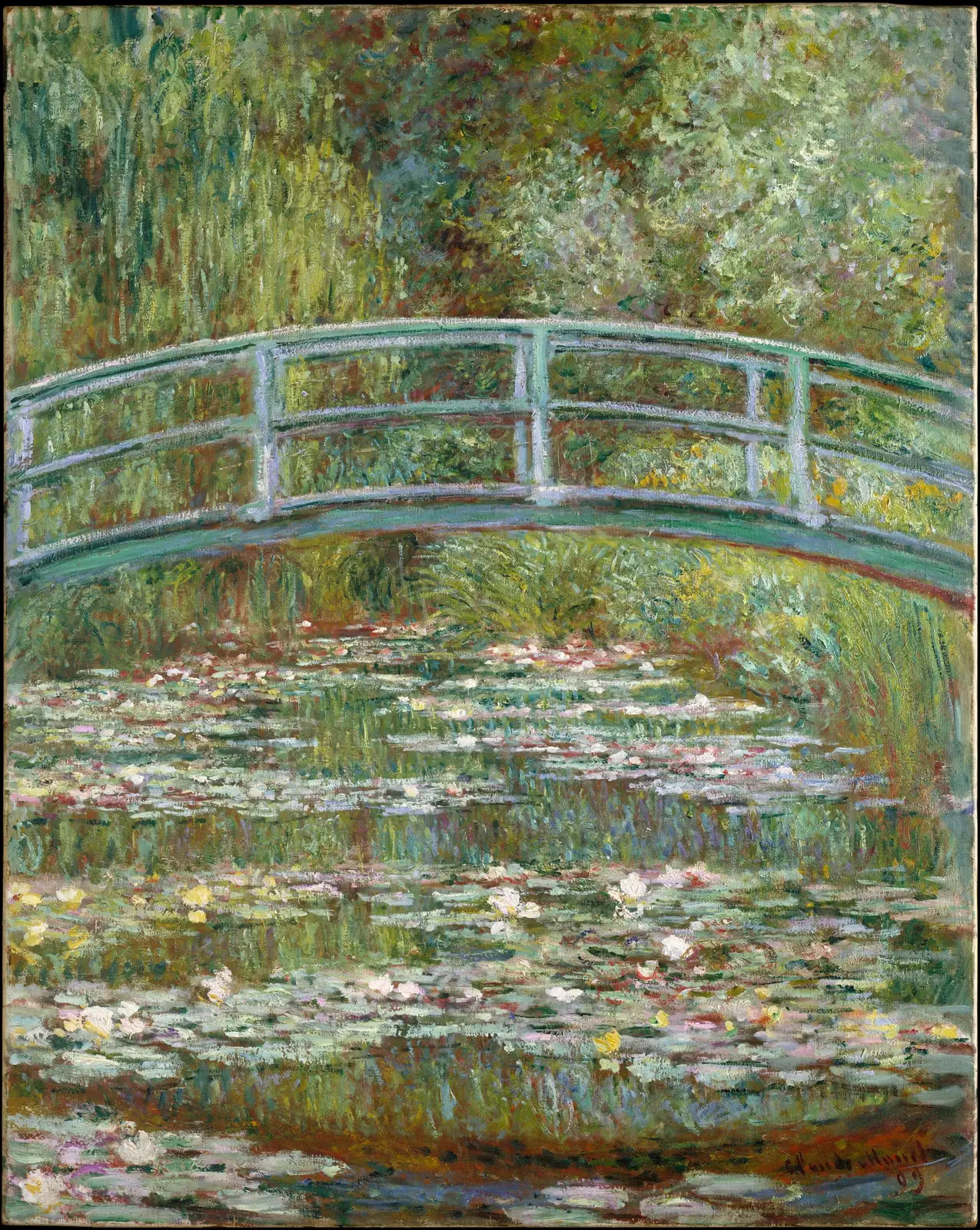
Bridge over a Pond of Water Lilies: the footbridge he commissioned in 1893, over the pond he had dammed and dug, painted six years later. The water, the lilies, the willow and the bridge were all planted or built to his own order before any of them were painted.
Claude Monet, Bridge over a Pond of Water Lilies, 1899, The Metropolitan Museum of Art, New York. Public domain (CC0), Wikimedia Commons.
Wheeled platforms for matching grand-studio canvases
The 1916 grand-studio (built specifically for the Water Lilies murals) housed upright easels on wheeled wooden platforms — several on five casters — so the large canvases could be rolled past each other and matched against one another in sequence.
Why it matters · A multi-canvas series cannot be harmonized in a fixed installation. The wheeled platforms are an engineered solution. Painters who run series without parallel comparison cannot calibrate the chromatic relationships across the set.
René Gimpel, Journal d'un collectionneur, 1918
Studio harmonization — the series finished as a set
In winter and bad weather finished in the studio, harmonizing the series so the relationships across canvases read as coherent. This stage sometimes involved significant repainting — the plein-air record was a starting document, not a finished one.
Why it matters · The plein-air capture is the raw data. The studio harmonization is where the series becomes coherent. Painters who insist on plein-air completion miss the second stage Monet considered essential.
In the studio
Claude Monet in his Giverny studio, photograph, 1920
Studio
Light
Plein-air at the motif (Giverny gardens, Normandy coast, Seine valley, Creuse, Thames, Venice, Antibes, Bordighera). Grand-studio at Giverny built 1916 for Water Lilies — large indoor space with wheeled platforms.
Position
Standing.
Session length
7 a.m. to 6 p.m. with brief food breaks. Single-canvas sessions of 15–20 minutes during light rotation; multi-year per series.
Tools
Multiple canvases brought to motif simultaneously (one per light state) · Upright easels on wheeled wooden platforms (several on five casters) · Jars of dozens of brushes · Lead white in largest quantity ("mountains of white")
Notes
Romantic image of lone Impressionist at his easel is wrong for the mature practice. Giverny operated as small atelier with gardeners, assistants, and custom equipment.
Source: René Gimpel, Journal d'un collectionneur, 1918
Palette
Ground
Commercially prepared fine-weave linen or cotton, primed with light-toned ground — white, cream, or pale gray.
Whites
Lead white (in volume — "mountains of white") · Cerulean and cadmium yellows added in late career
Earths
Yellow ochre
Colors
Cobalt blue · Ultramarine · Violet · Vermilion · Orange · Dark green · Lighter green · Cerulean blue (late) · Cadmium yellows (late)
Medium
Pure tube oil applied unblended or minimally blended, side by side. For final passes often dispensed with the palette and mixed directly on the canvas.
Quantity
Generous; lead white in largest quantity by far.
Source: René Gimpel, Journal d'un collectionneur, 1918
Workflow, from blank canvas
1. Study the motif across seasons
Walked the site (garden, Seine bank, Normandy cliff, Thames embankment) repeatedly over weeks before bringing canvases.
Why: A motif worth painting is worth knowing before paint touches canvas.
2. Plein-air lay-in on light ground
First session placed composition broadly on the light ground in thinned oil, fast, on location.
Why: The composition has to land at the motif before the light moves.
3. Series expansion — additional canvases at additional light states
At second and subsequent sessions, additional canvases added for different light states. Rotated through the stack as the hour moved.
Why: Never worked past the state a canvas was committed to. A canvas that missed its hour was set aside until that hour returned.
4. Studio harmonization
In the studio, away from the motif, adjusted the chromatic key across canvases so the series held as a coherent set of relationships.
Why: The plein-air record is a starting document, not a finished one. The series finishes as a set.
5. Finish — when the "vibration" was reached
A painting was complete when it held its place in the series and the specific atmospheric vibration was reached. Refused over-finish.
Why: The matte slightly unresolved surface was the finished state, not a stage before one.
How they studied
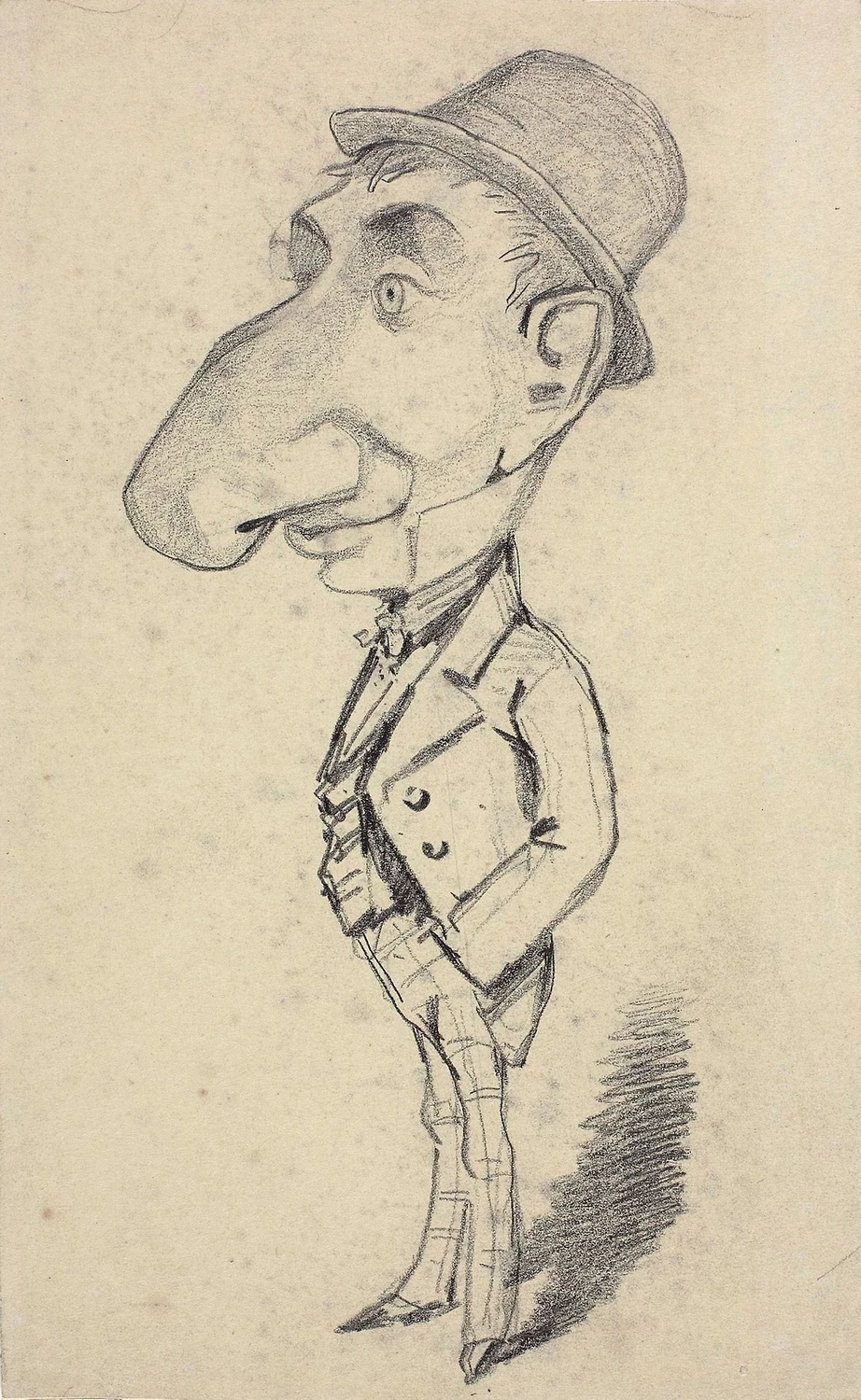
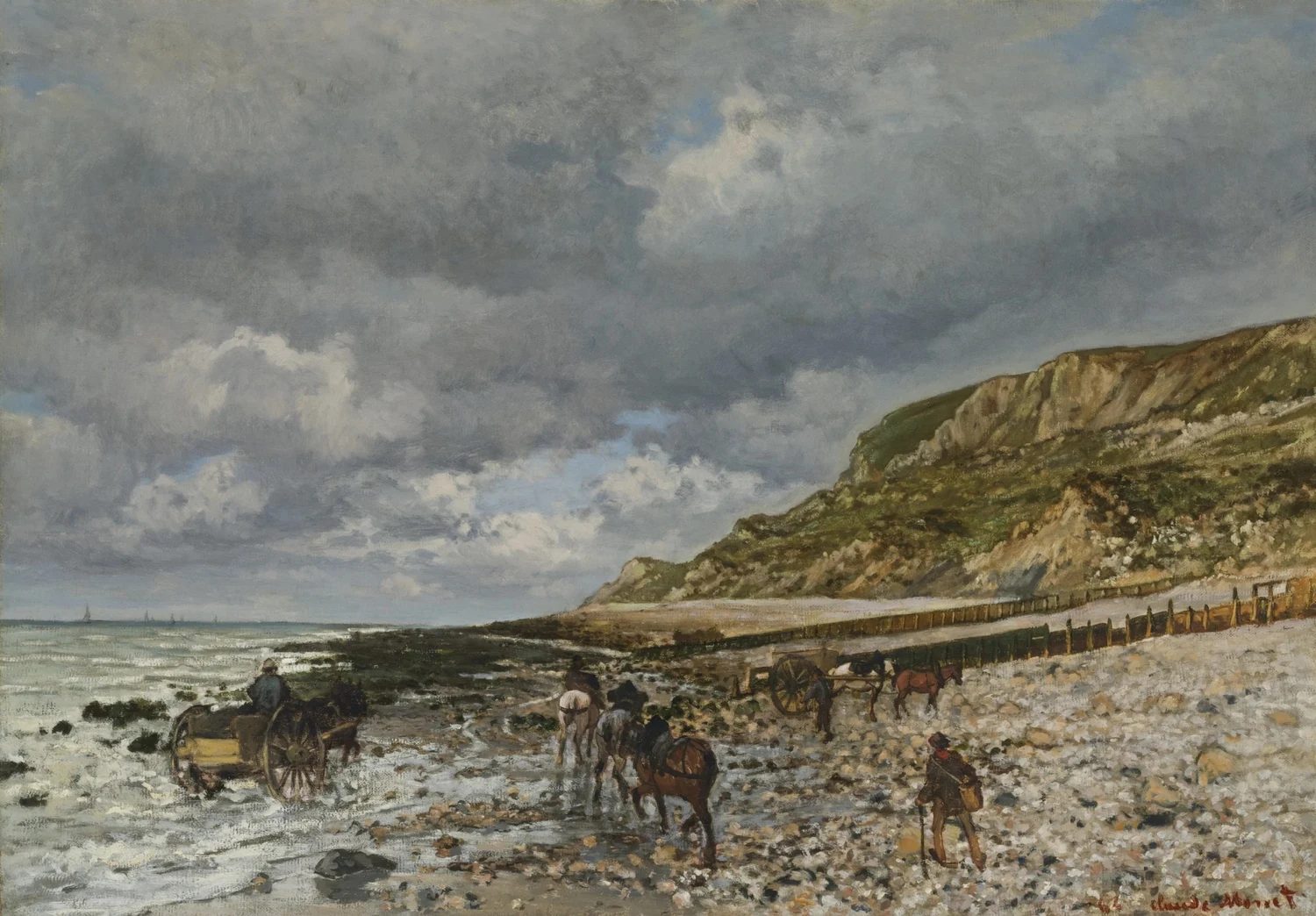
Monet was a caricaturist before he was a painter, and he was one because his family were in trade at Le Havre and opposed him. As a boy in his teens he painted portrait heads of sea captains in one sitting for five francs a head and drew caricatures to sell alongside them. Eugene Boudin saw one of those caricatures in a small shop, sought out the boy who drew it and asked him to come out painting. What happened next Monet told Perry himself, and she wrote it down: at first Monet did not appreciate this unsought privilege and went reluctantly, but, after watching Boudin at work and seeing how closely his landscapes resembled nature, he was only too glad to learn all he could from the older man. That is the whole conversion, and it took place outdoors in front of a working painter, not in a classroom. The formal training came afterwards and was short. He was at Charles Gleyre's Paris atelier from 1862 to 1864, where the lasting value was the other students, Renoir, Sisley and Bazille, and the studio closed in 1864. The two figures below are the trade that fed him and the coast he was painting in the Boudin years, still grey and tonal, years before the light ground and the broken touch.
Caricature of a Man with a Large Nose, from the Le Havre years: the head pushed as far as it will go, the body left almost in outline, and the whole likeness carried on where the chalk presses hard. Drawing for a laugh in a shop window is what taught him to fix a face fast.
Claude Monet, Caricature of a Man with a Large Nose, 1855 to 1856, The Art Institute of Chicago. Public domain, Wikimedia Commons.
Chevaux a la pointe de la Heve, painted at twenty four in the Boudin years: a heavy Normandy sky over a wet beach, carts and horses working the shingle, the whole picture built from earths and greys. This is what he painted before the light ground and the broken touch, which is why the later canvases read as a decision and not a style.
Claude Monet, Chevaux a la pointe de la Heve, 1864, private collection. Public domain, Wikimedia Commons.
Source: The caricature trade, the five franc sea captain heads, and Monet's own account of how Boudin found him: Lilla Cabot Perry, Reminiscences of Claude Monet from 1889 to 1909, The American Magazine of Art, volume 18 number 3, March 1927, pages 123 to 124.
Up close
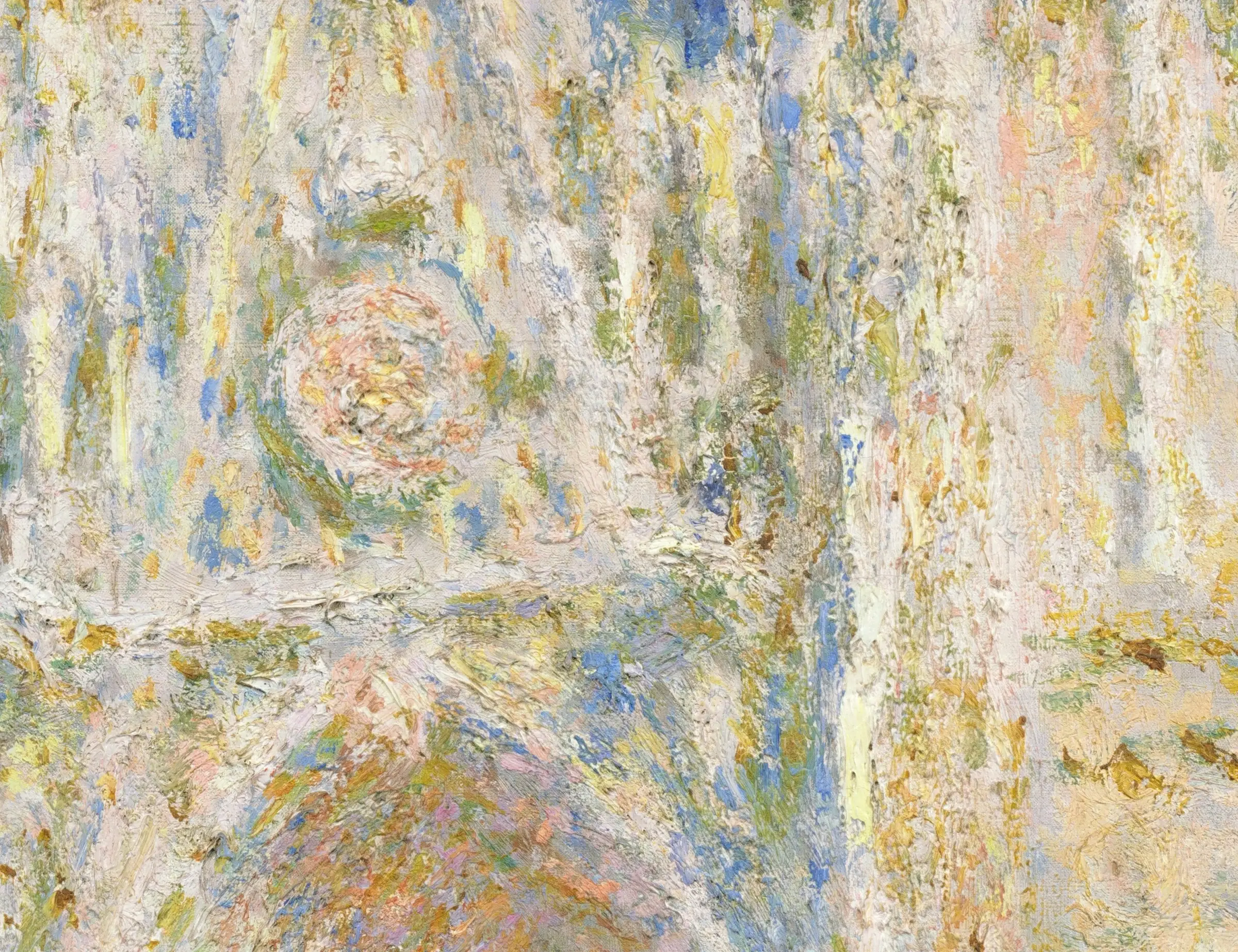
Detail of Rouen Cathedral in full sunlight: the carved stone is a crust of separate touches, blue, green, gold and pink laid over cream, thick enough to throw their own small shadows. Up close there is no cathedral here at all. It comes back the moment you step away.
Claude Monet, Rouen Cathedral, West Facade, Sunlight (detail), 1894, National Gallery of Art, Washington. Public domain, Wikimedia Commons.
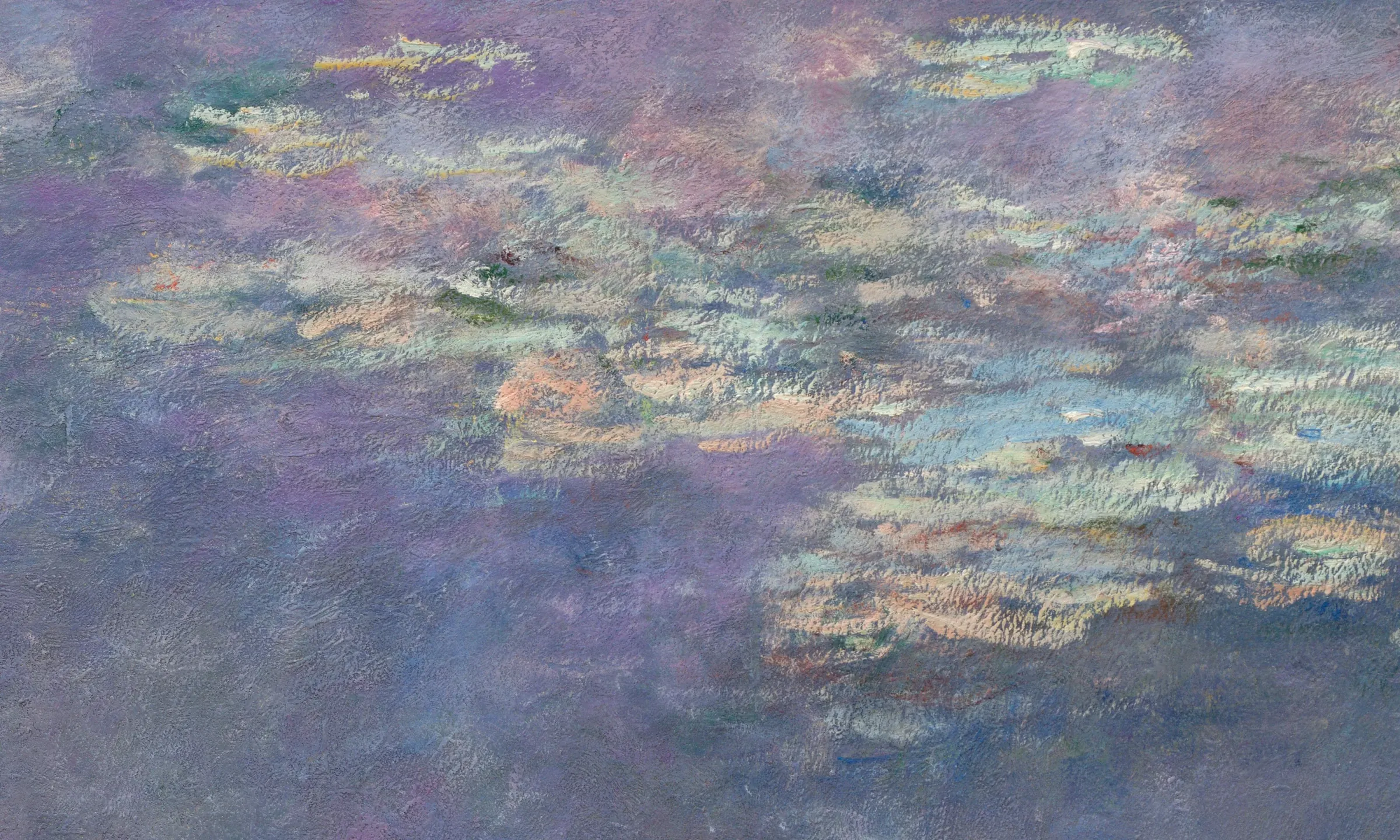
Detail of Water Lilies (Agapanthus): the pads are short flat strokes dropped onto a violet and green field with no outline anywhere. The water is what is left between the touches, which is why the pond reads as depth instead of as a painted surface.
Claude Monet, Water Lilies (Agapanthus) (detail), 1915, The Cleveland Museum of Art. Public domain, Wikimedia Commons.
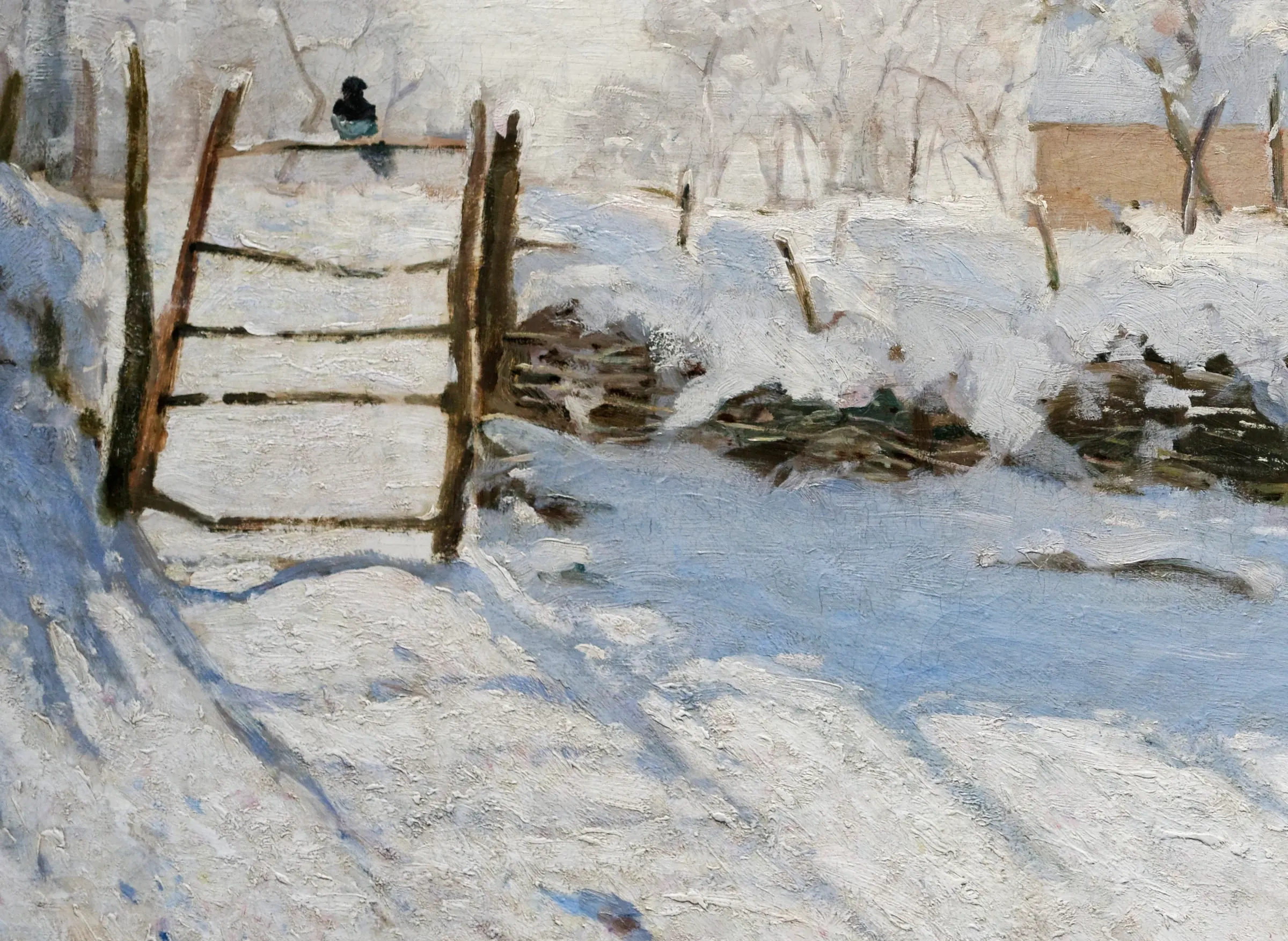
Detail of The Magpie, painted at twenty eight: the snow is still modelled, the gate is still drawn, and the bird is set down in three or four dark notes. Every shadow on that snow is blue and violet rather than grey, which is the one Impressionist habit already fully in place.
Claude Monet, The Magpie (detail), 1868 to 1869, Musee d'Orsay, Paris. Public domain, Wikimedia Commons.
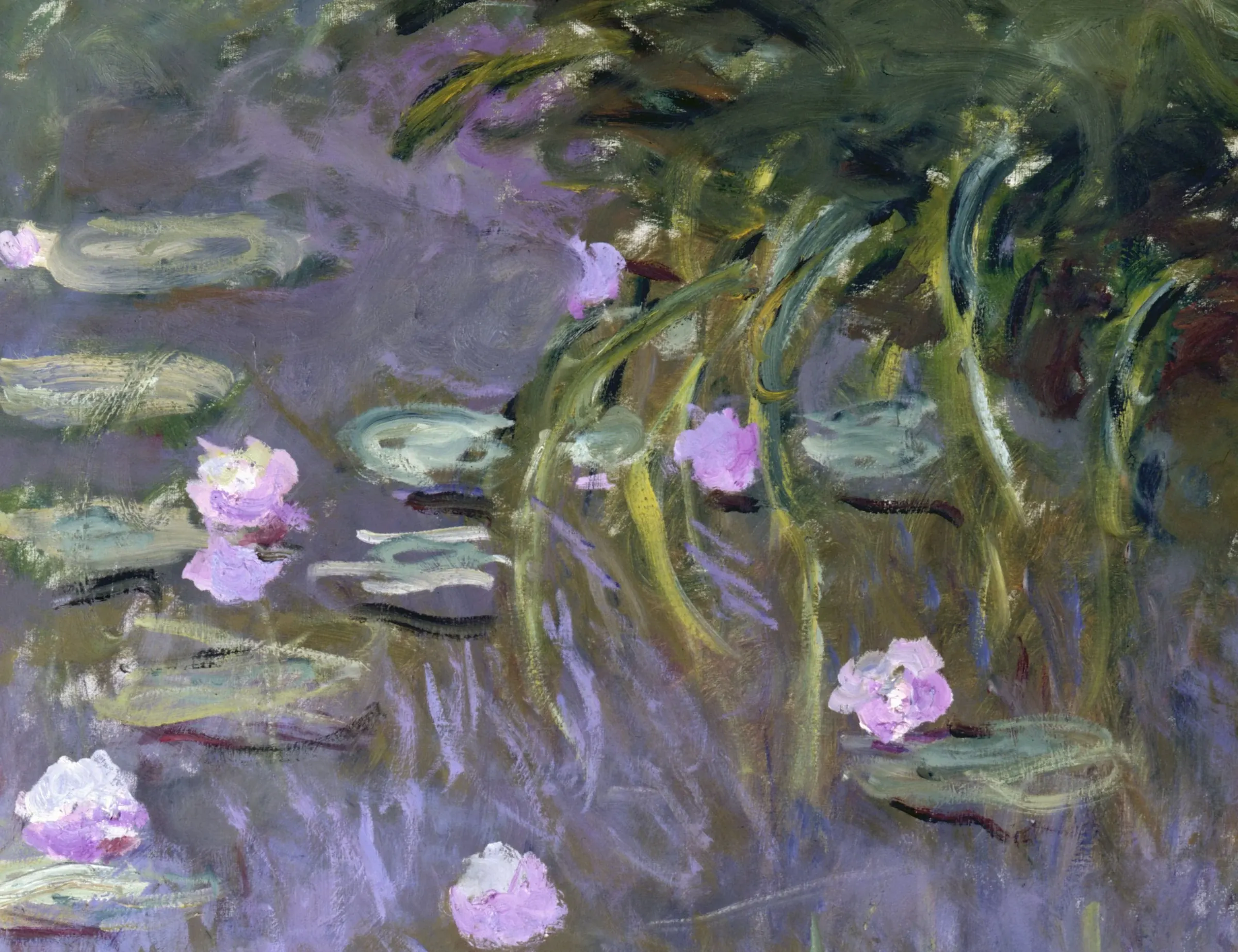
Detail of a Water Lilies of 1922, the same painter at eighty two: nothing is drawn at all. The willow fronds are single dragged strokes, the flowers are loaded dabs of pink and white, and the water under them is scrubbed in long crossing marks. Set this beside the snow above and fifty years of the same practice are visible in the hand.
Claude Monet, Water Lilies (detail), 1922, The Toledo Museum of Art, Ohio. Public domain, Wikimedia Commons.
Watching him work
“When you go out to paint, try to forget what objects you have before you, a tree, a house, a field or whatever. Merely think, here is a little square of blue, here an oblong of pink, here a streak of yellow, and paint it just as it looks to you, the exact color and shape, until it gives your own naive impression of the scene before you.”
Claude Monet, to the painter Lilla Cabot Perry, his neighbour at Giverny, Lilla Cabot Perry, Reminiscences of Claude Monet from 1889 to 1909, The American Magazine of Art, volume 18 number 3, page 120, 1927 [source]
Across media
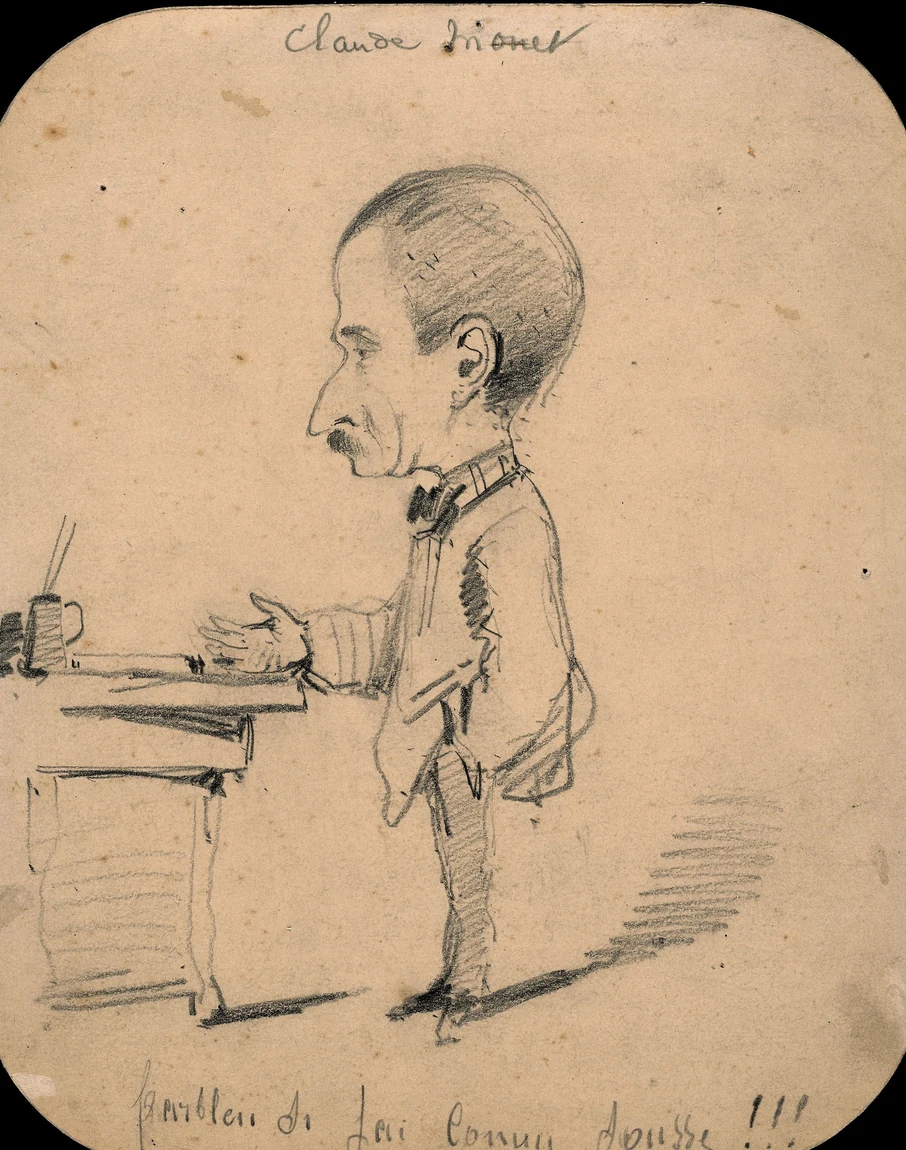
Caricature of a Man Standing by Desk, drawn at about fifteen: a whole figure carried on a profile, a stoop and a pair of hands, with the shading laid in as flat hatching. He sold sheets like this in a Le Havre shop window before he had painted a landscape, and a shop window like it is where Boudin found him.
Claude Monet, Caricature of a Man Standing by Desk, 1855 to 1856, The Art Institute of Chicago. Public domain, Wikimedia Commons.
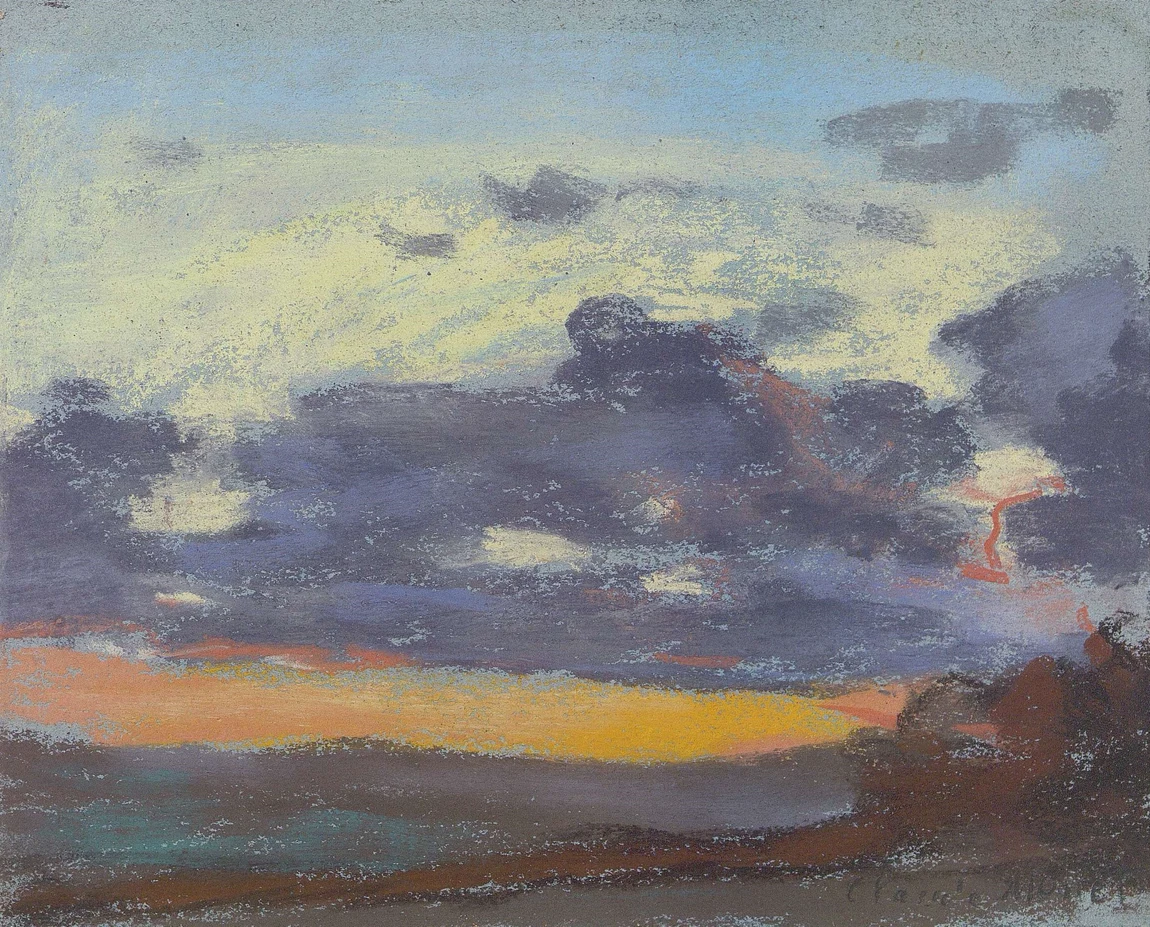
A sky study in pastel, about seventeen by twenty five centimetres: no subject under it, only the cloud bank, the orange band at the horizon and the yellow break where the sun went. Pastel records a sky in minutes, which is the same problem the oil series would set him twenty years later.
Claude Monet, Etude de ciel, circa 1868, pastel on paper, private collection. Public domain, Wikimedia Commons.
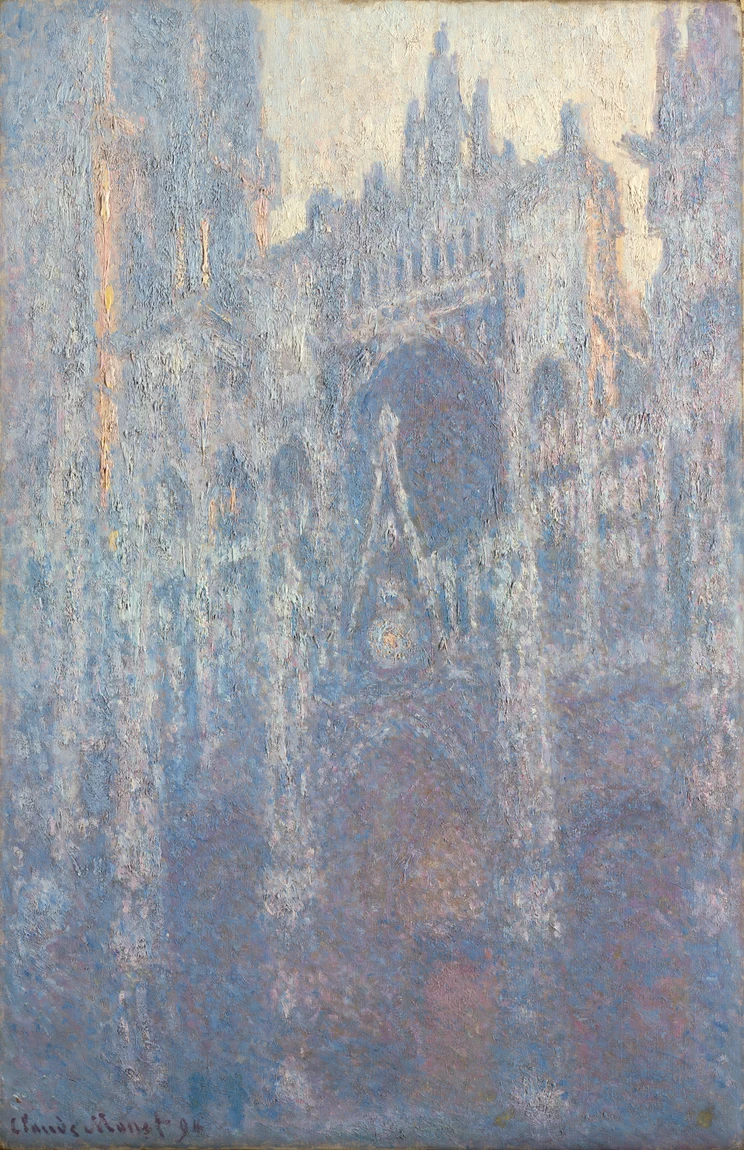
The Portal of Rouen Cathedral in Morning Light: the same doorway as the sunlit canvas at the top of this page, at an earlier hour. Blue and violet run all through the stone and the gold is held back to a few strokes on the upper tower. Two canvases, one motif, and the difference between them is the entire argument for painting in series.
Claude Monet, The Portal of Rouen Cathedral in Morning Light, 1894, The J. Paul Getty Museum, Los Angeles. Public domain, Wikimedia Commons.
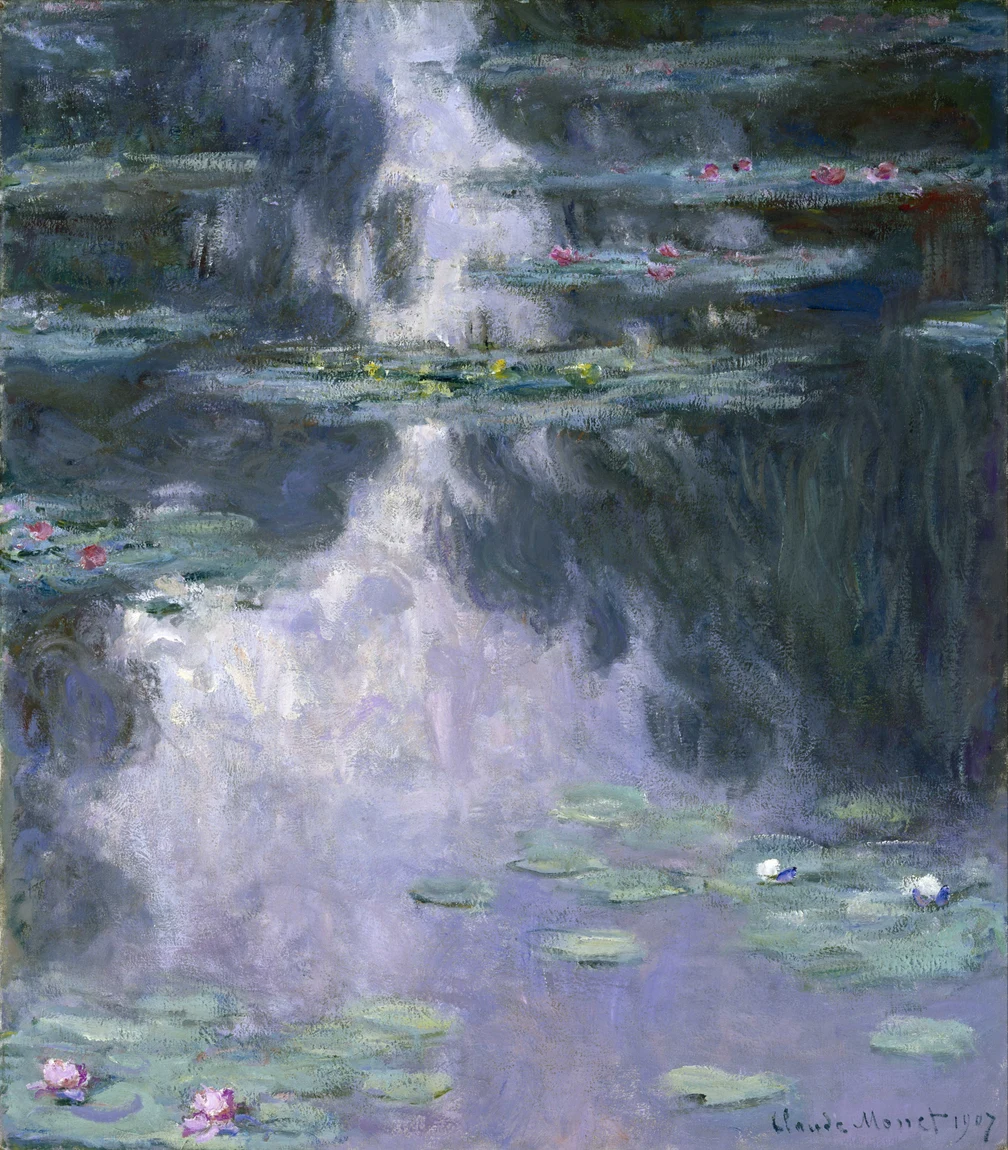
Water Lilies of 1907, painted at the pond he had dug and planted himself: no horizon, no bank, and no sky except as reflection. Once the motif stood in his own garden he could return to it at the same hour every day for twenty years, which is what the pond was for.
Claude Monet, Water Lilies (Nympheas), 1907, The Museum of Fine Arts, Houston. Public domain, Wikimedia Commons.
The record, deeper
The money
In the summer of 1889 a picture could be bought out of the studio at Giverny for five hundred dollars. Perry wrote to friends and relatives in Boston to tell them so. One person answered.
Lilla Cabot Perry, Reminiscences of Claude Monet, The American Magazine of Art, 1927, page 119.
As a boy at Le Havre he painted portrait heads of sea captains in one sitting for five francs a head, and sold caricatures alongside them.
Perry, Reminiscences of Claude Monet, 1927, page 123.
Even after he was painting landscapes fully in his own manner he had the greatest difficulty selling them at fifty francs apiece. The singer Faure bought one for about a hundred francs, brought it back a few days later because his friends had laughed at it, and asked for his money back. Monet kept that picture for the rest of his life and refused every later offer for it.
Perry, Reminiscences of Claude Monet, 1927, page 124.
The reworks
He would not sell a canvas out of an unfinished series, because until the series was done he could not tell whether it was up to his standard. A year or two after refusing one such sale he mentioned in passing that he had burnt over thirty canvases that morning, and admitted that the picture in question was among them. His reason, in his own words: I must look after my artistic reputation while I can. Once I am dead no one will destroy any of my paintings, no matter how poor they may be.
Perry, Reminiscences of Claude Monet, 1927, page 119.
One of the two pictures of his stepdaughter hanging in the studio carried a criss cross rent right through the middle of the canvas, mended so well that nothing showed from the front. He had been dissatisfied with his work that afternoon and had put his foot through it. He happened to be wearing sabots.
Perry, Reminiscences of Claude Monet, 1927, pages 119 to 120.
On another bad day he decided to give up painting altogether and threw the paint box, palette and brushes overboard into the Epte from his boat. By morning he had changed his mind and had no materials. A telegram brought a color man to his shop on a Sunday and a complete new kit went out on the next train to Normandy.
Perry, Reminiscences of Claude Monet, 1927, page 120.
What they told students
He never took pupils. The advice below was given to Lilla Cabot Perry, who painted next door to him for ten summers. He held that the first real look at the motif was likely to be the truest and least prejudiced one.
Perry, Reminiscences of Claude Monet, 1927, page 120.
On painting more boldly, to Perry: Remember that every leaf on the tree is as important as the features of your model. I should like just for once to see you put her mouth under one eye instead of under her nose.
Perry, Reminiscences of Claude Monet, 1927, page 120.
He said no painter could work more than half an hour on any outdoor effect and keep the picture true to nature, and remarked that in this respect he practised what he preached.
Perry, Reminiscences of Claude Monet, 1927, page 123.
Boxed into a space a yard deep at Rouen, he concluded that every young painter should train himself to sit close to his canvas and learn how it would look at a distance, and that with time and practice this can be done.
Perry, Reminiscences of Claude Monet, 1927, page 122.
The studio
He painted the Rouen Cathedral series from the window of a milliner's shop opposite the front. Her clients objected to trying on hats with a man about, so he talked her into letting him build a small enclosure shutting him off from the shop, and worked inside it where he could never get more than a yard back from the canvas. He said he had never really seen those pictures until he brought them home to Giverny.
Perry, Reminiscences of Claude Monet, 1927, page 122.
The Poplars and the Islands in the Seine canvases were painted from a broad bottomed boat fitted up with grooves to hold a number of canvases. Many of the Seine pictures were painted before dawn. He had already worked sixteen or more canvases one after the other, a few minutes at a time, from a small boat on the Epte.
Perry, Reminiscences of Claude Monet, 1927, pages 121 to 123.
In the water garden the same grooved boxes of canvases stood at fixed points around the pond, each with barely room for him to sit, so that he could record the changing light on the lilies and the bridges from a set position.
Perry, Reminiscences of Claude Monet, 1927, page 123.
For the first years Perry knew him he moved his canvases around in a wheelbarrow. By the end he had two motor cars.
Perry, Reminiscences of Claude Monet, 1927, page 125.
The materials
He had long flexible brushes made to order for his own use and dragged the color onto the canvas with them. Critics compared the result to worsted work.
Perry, Reminiscences of Claude Monet, 1927, page 122.
He proved to Perry that thick paint settles. He set two Rouen Cathedral canvases side by side, one kept in its grooved box since the day it was painted, the other hung on the studio wall for two or three years. The hung one had already flattened. The boxed one still stood up in ridges. His point was that some Rembrandts had been laid on more thickly still and that time had smoothed them down.
Perry, Reminiscences of Claude Monet, 1927, page 122.
The pigments the National Gallery identified in The Gare Saint Lazare of 1877 were lead white, chrome yellow, vermilion, red lake, emerald green, viridian, cerulean blue, cobalt blue, artificial ultramarine and ivory black.
David Bomford, Jo Kirby, John Leighton and Ashok Roy, Art in the Making: Impressionism, National Gallery Publications, London, 1990, pages 166 to 171.
That ivory black is the honest limit on the no black story. It was found in trace amounts only, in the deep purple and greenish blue shadows of the station canopy. And late in life, asked how he liked the pale interiors his imitators were painting, he clasped his hands to his head and said that sometimes he wanted to paint black.
Bomford, Kirby, Leighton and Roy, Art in the Making: Impressionism, 1990, pages 166 to 171; Perry, Reminiscences of Claude Monet, 1927, page 123.
Refusals — what they would not do
Refused warm-tinted academic imprimatura — worked on light grounds.
Refused single-canvas completion — series was the unit.
Refused to over-finish — matte slightly unresolved surface was the finished state.
Refused to vary medium — no glaze, no varnish during painting.
Reference
Primary source
Live motif at Giverny and earlier locations (Normandy, Seine valley, Thames, Venice, Mediterranean coast).
Photography
Aware of photography but did not use it as painting reference. The motif was the physical site, revisited across time.
Exceptions
Owned a large collection of Japanese ukiyo-e prints, displayed in the dining room at Giverny — the cropping, flattened spatial planes, and decorative register of the water gardens reflect Hokusai and Hiroshige.
Eugène Boudin · 1856–1857 — Met on the Normandy coast. Boudin insisted Monet paint outdoors directly from the motif — the specific practice Monet would carry into the Impressionist project. "Three strokes from nature are worth more than two days of studio" was the sentence Monet cited as the turning point.
Charles Gleyre · 1862–1864 — Paris atelier. Met Renoir, Bazille, Sisley — the core of what would become the Impressionist group. Gleyre's atelier closed in 1864.
Johan Barthold Jongkind · from 1862 — Dutch marine painter who taught Monet to observe the specific effects of light on water — the technical preoccupation that became the defining subject of Monet's late career.
Influences
Boudin and Jongkind — the plein-air observational foundation.
Japanese ukiyo-e — Hokusai and Hiroshige as compositional and atmospheric reference.
Students
No formal teaching atelier; left no formal students.
Influence ran through the Impressionist group, through Durand-Ruel's promotion in France and the United States, and through the Water Lilies cycle's posthumous reception as the decisive late-nineteenth-century bridge to mid-twentieth-century color-field abstraction. Rothko and the Abstract Expressionists cited the late Water Lilies as foundational precedent.
In their own words
“Covered with colors in little separated heaps: cobalt, ultramarine blue, violet, vermilion, ochre, orange, dark green, another green that is not very light, yellow ochre, and finally yellow of ultramarine. In the middle, mountains of white, snowy peaks.”
— René Gimpel, Journal d'un collectionneur, entry of November 1918, 1918
Gimpel's record of the late palette.
“I've done what I could as a painter. It seems to me that it is not enough — but it is the best I could do.”
— Claude Monet, Letter to Georges Durand-Ruel, 1905
“I want the unobtainable. Other painters paint a bridge, a house, a boat, and that is the end. They are finished. I want to paint the air which surrounds the bridge, the house, the boat — the beauty of the light in which they exist.”
Oil on a light-toned ground (white, cream, or pale gray), with lead white in by far the largest quantity. His palette ran to yellow ochre, cobalt blue, ultramarine, violet, vermilion, orange, and greens, with cerulean blue and cadmium yellows added late in life.
What was Monet's painting technique?
He laid pure tube color on broken and side by side, for the eye to mix rather than blending it on the palette. For final passes he often dispensed with the palette and mixed directly on the canvas.
Why did Monet paint on a light ground?
A light ground reflects incoming light back through the thin upper paint layers, holding the picture at a permanently higher key. He refused the warm academic imprimatura for exactly this reason.
How many canvases did Monet use at once?
For the series (Haystacks, Poplars, Rouen Cathedral, the Thames) he carried six or more canvases to one motif and swapped them every fifteen or twenty minutes as the light moved, then harmonized the set later in the studio.
Did Monet use black?
His documented palette is built on blues, violets, and greens, with lead white in the largest quantity, and lists no black pigment. The colors recorded are yellow ochre, cobalt blue, ultramarine, violet, vermilion, orange, and greens, plus cerulean blue and cadmium yellows added late.
If this painter is your match
You believe the subject of a painting is the light, not the thing the light is falling on — and that the single canvas cannot hold what a motif actually is.
Borrow this: Pick a motif you can return to at the same hour every day for a month. Bring four canvases to it. Work only fifteen to twenty minutes on each — whichever canvas matches the current light state — then swap. Do not finish any of them on site.
René Gimpel, Journal d'un collectionneur: marchand de tableaux, 1963. Paris art dealer's diary of studio visits 1918–1939. November 1918 entry on Giverny is the principal first-person record of the late palette and studio.
Daniel Wildenstein, Claude Monet: Biographie et catalogue raisonné, 1974. Five-volume catalogue raisonné. Definitive documentation of 2000+ catalogued works.
National Gallery Technical Bulletin, Volume 28 — Monet and the Thames Series, 2007. National Gallery London scientific analysis of the Thames canvases (1899–1904). Principal modern source for ground preparation, pigment identification, and layer structure in the late plein-air-to-studio series.
Art Institute of Chicago: Color, Chemistry, and Creativity in Monet's Water Lilies, 2006. Technical analysis of the AIC Water Lilies canvases.
Lilla Cabot Perry, Reminiscences of Claude Monet from 1889 to 1909, The American Magazine of Art, volume 18 number 3, pages 119 to 125, 1927. Perry was an American painter and Monet's Giverny neighbour for ten summers from 1889. The fullest first-hand account in English of how he actually worked: the first pass that covers the whole canvas, the long flexible brushes made to order, the grooved boats and the grooved boxes around the pond, the milliner's cell at Rouen, the seven minute effect on a Poplars, the burnt canvases, the foot through the canvas, and what the pictures sold for.[link]
David Bomford, Jo Kirby, John Leighton and Ashok Roy, Art in the Making: Impressionism, National Gallery Publications, London, 1990. National Gallery technical study of Impressionist painting. The pigment identifications for The Gare Saint Lazare, ivory black included, are at pages 166 to 171, and they are the real evidence behind the no black story.