Homer painted watercolors on site and by subtraction, recovering the whites by blotting, scraping, and sanding the wash back to bare cold-press paper rather than adding Chinese white. His palette was small and Chevreul-grounded: Prussian blue, burnt sienna, Venetian red, yellow ochre, ivory black. Oils he began outdoors and finished standing in his Prout's Neck studio, pure tube paint with no added medium on a light ground, thick lead white scored into horizontal ridges where the wave-tops break. The material came from a seasonal migration: Maine in spring and autumn, the Adirondacks in summer, the tropics in winter.
Avoided opaque Chinese white. Used subtractive techniques: blotting wet pigment with cloth or sponge, wetting dry passages and scraping with the flat of a knife or wooden brush end to recover the white paper, stopping-out with wax in late works.
Why it matters · The whites in a Homer watercolor are mostly the paper, recovered through lifting, not added as paint. White-pigment whites are always slightly grayed; recovered paper is the cleanest white available. Painters who reach for gouache compensate for poor planning of the highest value.
A Vibrant Surface: Investigating Color, Texture, and Transparency in Winslow Homer's Watercolors, Art Institute of Chicago, 2014
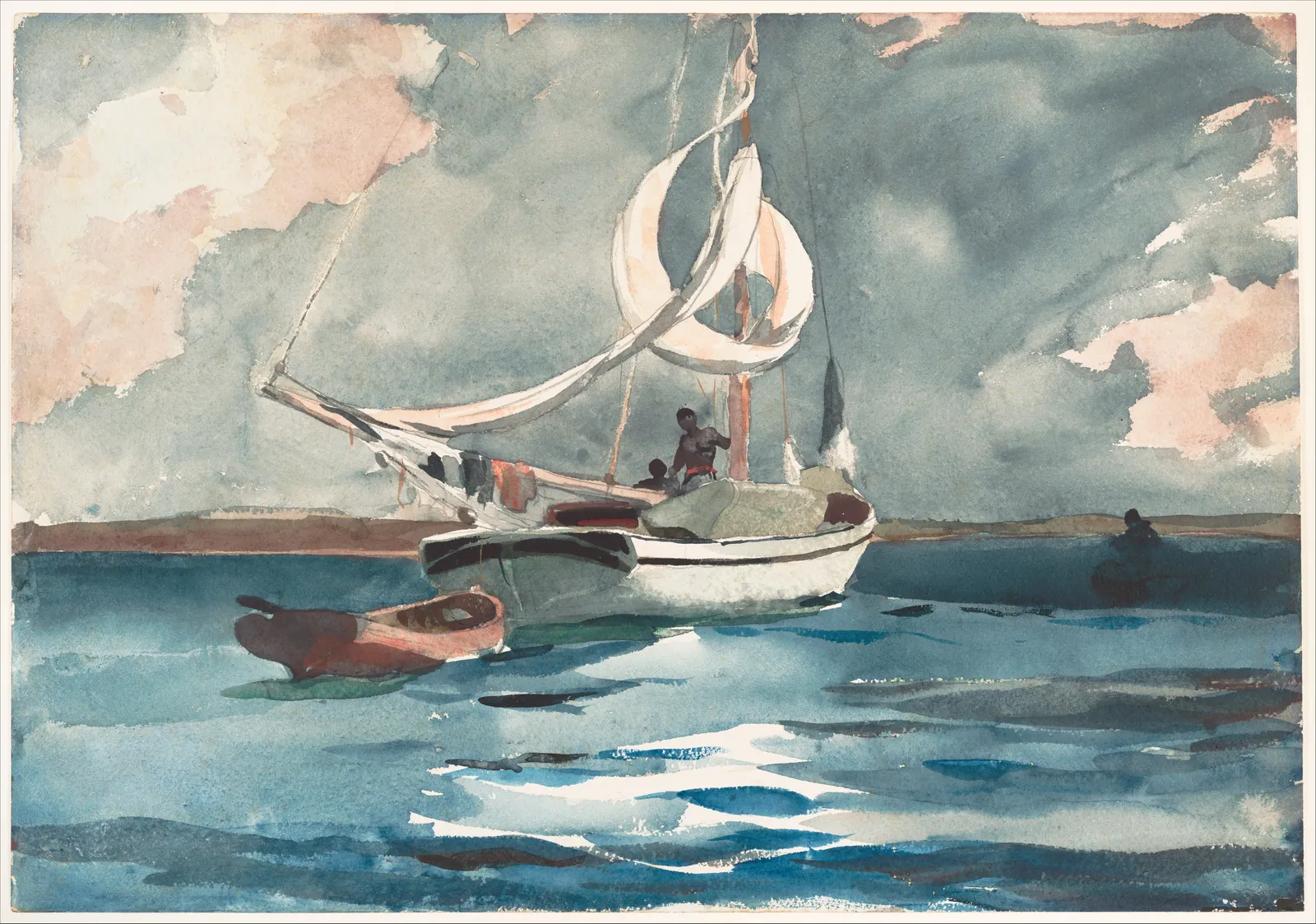
Sloop, Nassau, 1899, on a sheet fifty four centimetres across: the sail, the hull and the broken light on the water are all bare paper. Homer laid the sky and the sea around them and took back what he wanted returned. Nothing on this sheet is lighter than the paper, because nothing needed to be.
Winslow Homer, Sloop, Nassau, 1899, watercolor and graphite on off-white wove paper, 37.8 by 54.3 centimetres, The Metropolitan Museum of Art, New York, 10.228.3. Public domain, Wikimedia Commons.
Score impasto into directional ridges
For oil seascapes used thick pasty lead white in the lights, scored with the palette knife or brush butt into horizontal ridges to catch studio light in the direction of breaking wave-tops.
Why it matters · The optical shimmer of moving water comes from directional impasto, not from blended brushwork. Most painters paint waves through tonal modelling; Homer engineered the surface itself.
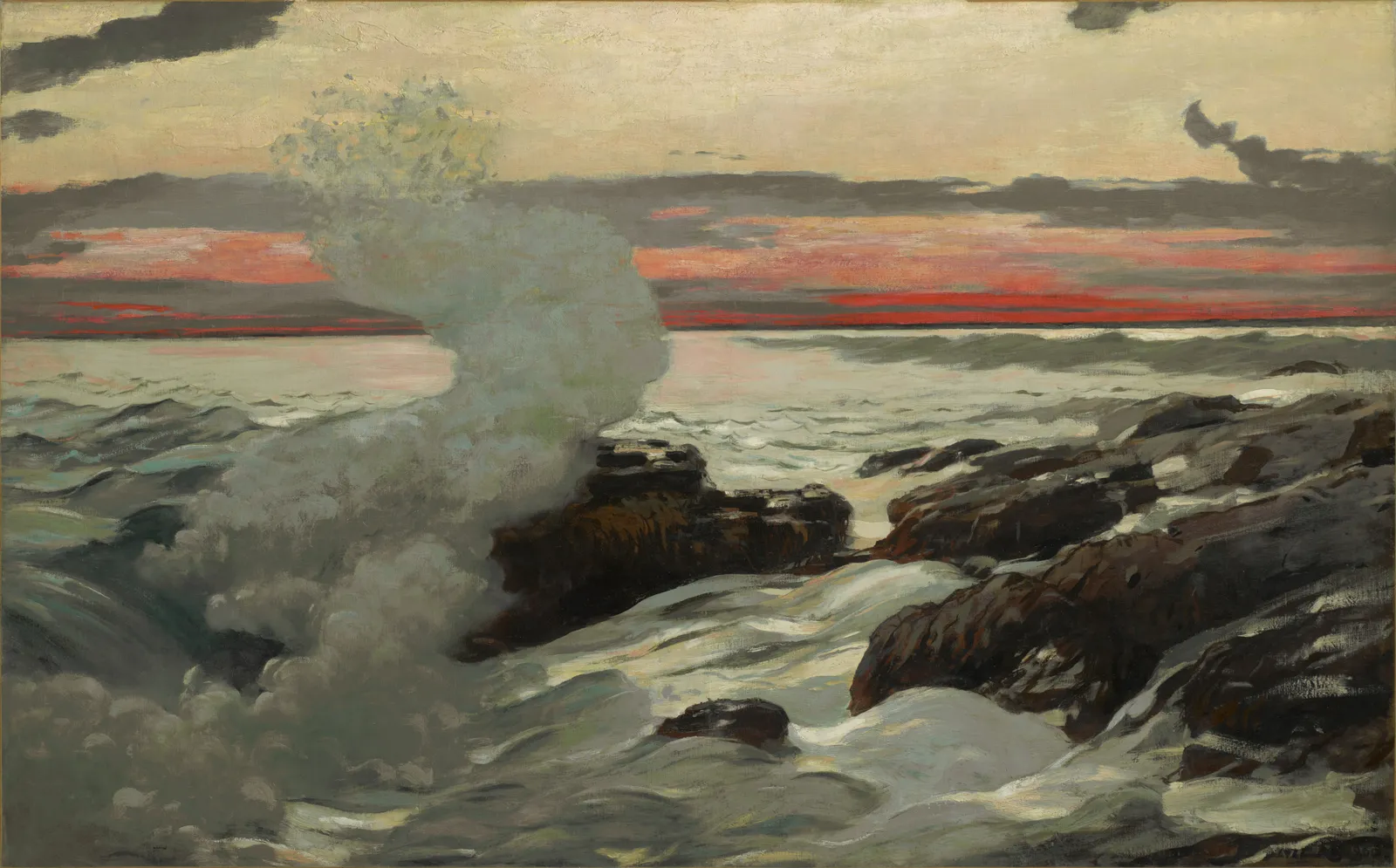
West Point, Prout's Neck, 1900: the burst of spray is the thickest paint on the canvas and the wet rock under it is the thinnest. The lights are loaded until they stand off the weave, the dark ledge is left as a stain, and the red band of sunset behind is one flat stroke.
Winslow Homer, West Point, Prout's Neck, 1900, oil on canvas, 76.4 by 122.2 centimetres, Clark Art Institute, Williamstown, 1955.7. Public domain, Wikimedia Commons.
Run a seasonal migration as research
Maine spring and autumn for oil paintings of the sea; summers in the Adirondacks at the North Woods Club or Quebec at the Tourilli Club for freshwater watercolors; winters in the Bahamas, Bermuda, Florida, or Cuba for tropical watercolors.
Why it matters · The migration was not leisure; it was how Homer collected source material at a rate that supported the winter-in-studio oil production. Painters who stay put run out of motif. Homer's discipline of seasonal travel is the cleanest case for treating geographic research as part of the practice.
Treat Chevreul's color theory as scripture
Owned and studied Chevreul's De la loi du contraste simultané des couleurs for more than forty years; a 1903 letter to his brother Charles called Chevreul "my bible." Built the apparently intuitive watercolor mixtures (Prussian blue with burnt sienna, Venetian red with ivory black) on simultaneous-contrast principles.
Why it matters · The minimal palette is not minimalism; it is Chevreul applied directly. Painters who treat colour theory as academic background miss its instrumental application to specific pigment choices.
Letter to his brother Charles Homer, 1903
Compose outdoors, finish indoors
Stated explicitly: "I prefer every time a picture composed and painted out-doors. The thing is done without [the artist] knowing it." Watercolors executed on site; oils begun outdoors from direct motif studies and finished in the studio.
Why it matters · The painting composed in direct contact with the motif catches relationships the studio composition has to reason through, and the reasoning through is usually a compromise with the truth.
Interview published in Sketches and Studies, 1887
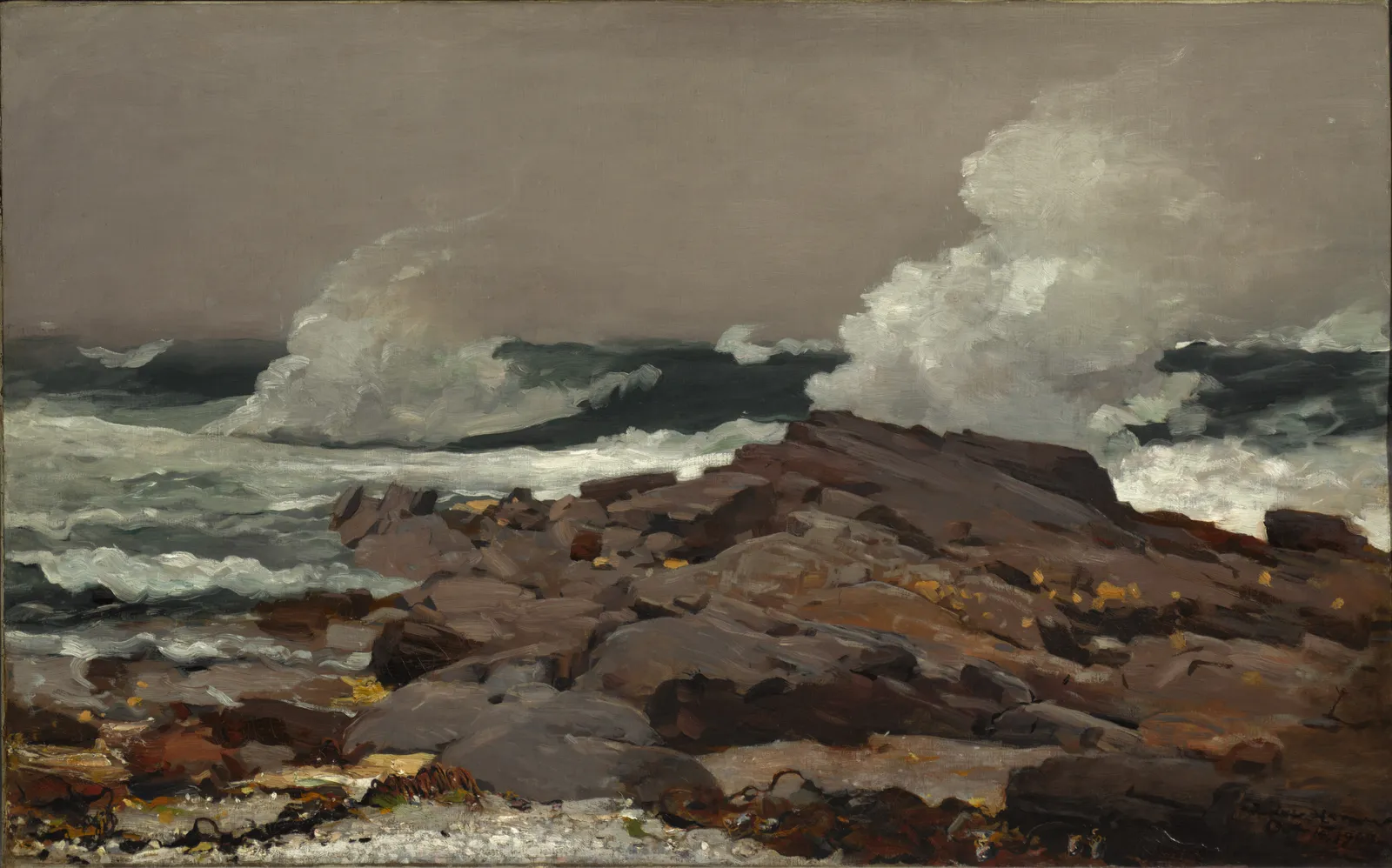
Eastern Point, signed and dated on the canvas itself: Winslow Homer, Oct. 14, 1900. This is the stretch of rock where Downes says the portable painting house was dragged out on runners in heavy weather, and where the shelter let Homer take a viewpoint lower than a man could safely stand on the ledge. The picture records one afternoon, not a kind of afternoon.
Winslow Homer, Eastern Point, 1900, oil on canvas, 76.8 by 123.2 centimetres, Clark Art Institute, Williamstown, 1955.6. Public domain, Wikimedia Commons.
Sand the dry wash back to bare paper for mist and spray
Beyond knife-scraping, Homer abraded dried passages with sandpaper, taking a blue-grey sky wash down to the ivory paper to summon mist, spray, and the bloom of distant light. The paper tooth does the work, abrasion lifts pigment off the high points and leaves it in the troughs, which is what gives the speckled spray its texture.
Why it matters · Conservators found tiny grains of silica from the sandpaper buried throughout the paint surface of his marine watercolours, including Prout's Neck, Breakers, physical proof the abrasion was a deliberate, repeated technique and not later damage. Most painters only add paint; Homer planned where the light lived, protected the paper, and took the rest back out.
A Vibrant Surface: Investigating Color, Texture, and Transparency in Winslow Homer's Watercolors, Art Institute of Chicago, 2014
In the studio
Winslow Homer, The Studio, 1867 — a painter immersed in focused labor (Metropolitan Museum of Art)
Studio
Light
Prout's Neck, Maine, refurbished stable on the family's coastal property, occupied permanently from 1883. Studio survives, restored by the Portland Museum of Art.
Position
Outdoor for watercolours; standing at the easel for oils.
Session length
Seasonal cycle. Maine spring/autumn for oils, Adirondacks/Quebec summers, Caribbean winters.
Tools
Small portable kit for outdoor watercolour: tin paintbox, sheet block of cold-press paper, handful of sable brushes · Winsor & Newton sable mops for watercolour · Standard hog-bristle flats and rounds for oil · Palette knife for scoring impasto into directional ridges · Sponge, cloth, sharp knife for the subtractive watercolour techniques
Notes
Famously reclusive at Prout's Neck. Visitors discouraged. Family enforced privacy. First half of career was urban (Boston illustrator for Ballou's Pictorial; New York correspondent for Harper's Weekly across Civil War and Reconstruction). Second half (1883-1910) is the work he is remembered for.
Source: Helen A. Cooper, Winslow Homer Watercolors, 1986
Palette
Ground
Cold-press paper for watercolour, bare paper as the highest value. Commercial linen primed with white or pale-gray ground for oil (same light-ground principle as the Impressionists in the same years).
Whites
Bare paper (watercolour) · Lead white (oil, pasty, scored with palette knife)
Earths
Yellow ochre · Burnt sienna · Venetian red
Colors
Prussian blue · Cadmium yellow (occasional) · Vermilion (occasional) · Cobalt blue (occasional)
Blacks
Ivory black
Medium
Standard watercolour for the watercolours; pure tube oil for the oils.
Quantity
Restricted minimal, Chevreul-grounded simultaneous-contrast mixtures from a small honest palette.
Source: A Vibrant Surface, Art Institute of Chicago, 2014
Workflow, from blank canvas
1. Selection of the motif
Studied a subject at length before committing paper or canvas to it. Painted scenes "exactly as they appear", but the appearance was specific and chosen.
Why: Selection comes first, then painting. The appearance a picture records is the appearance of a scene already chosen.
2. Minimal pencil sketch
Watercolours began with a brief economical pencil lay-in placing horizon, figure placement, the specific diagonal or vertical that organized the composition.
Why: A detailed academic drawing before paint would freeze the watercolour. Less drawing leaves room for the wash.
3. The wash
Large broad passages of watercolour or thin oil laid in the tonal structure. Wet-in-wet on dampened paper for atmospheric passages (sea spray, fog, humid Caribbean air). Thin earth-color block-in for oils.
Why: The atmospheric register is laid down before any specific detail.
4. The subtractive work
For watercolour: blotting, lifting, scraping, stopping-out. For oil: thick impasto laid into the lights, scored to catch direction-of-light.
Why: White paper recovered where it needs to be, not painted over. Impasto built where the light demands.
5. Finish, "foursquare strength"
A picture was finished when it achieved a stability of composition that did not depend on rhetorical flourish. The heroic solitary figure silhouetted against the sea is the Homer composition type.
Why: The heroic silhouette carries the painting without needing decorative detail.
How they studied
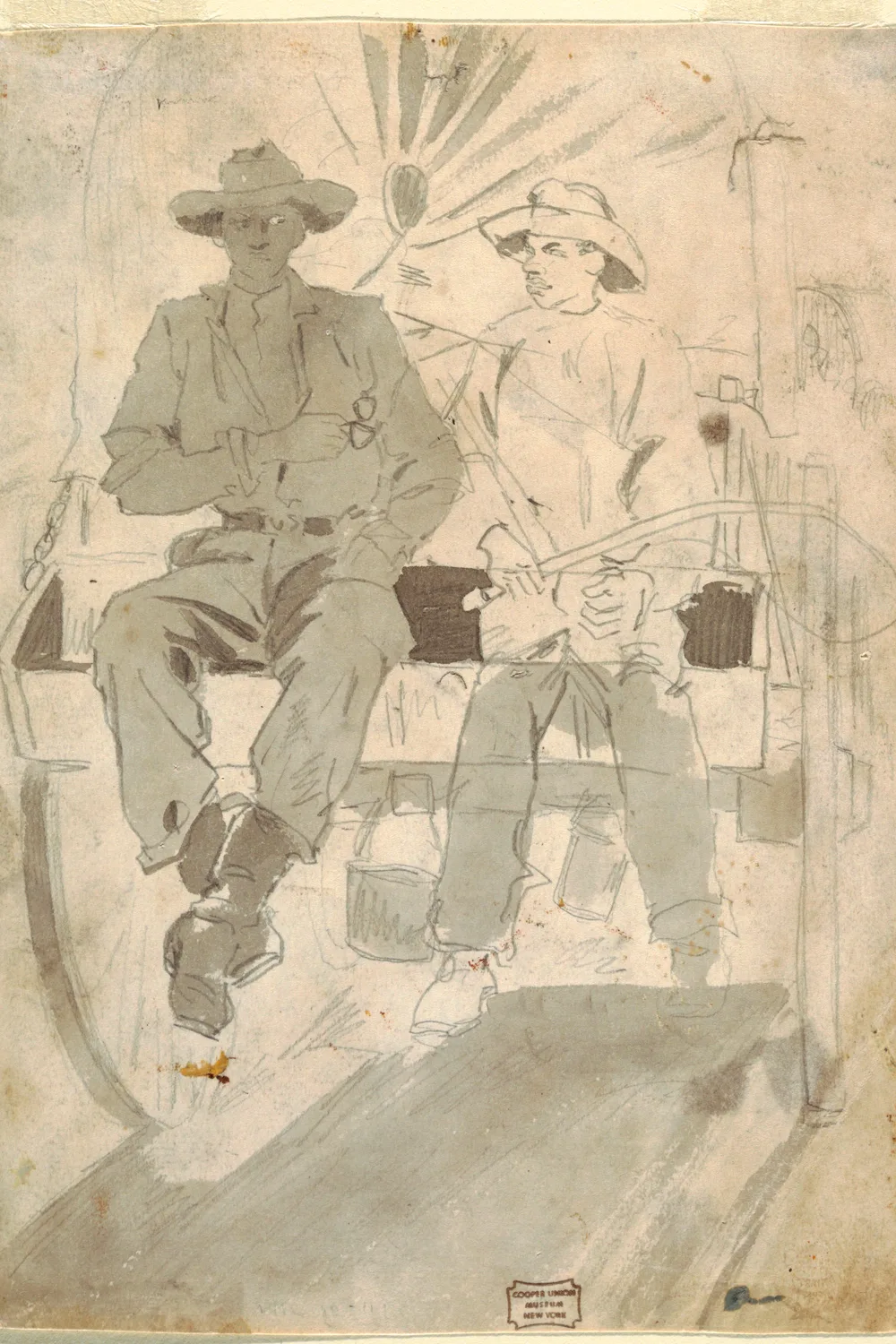
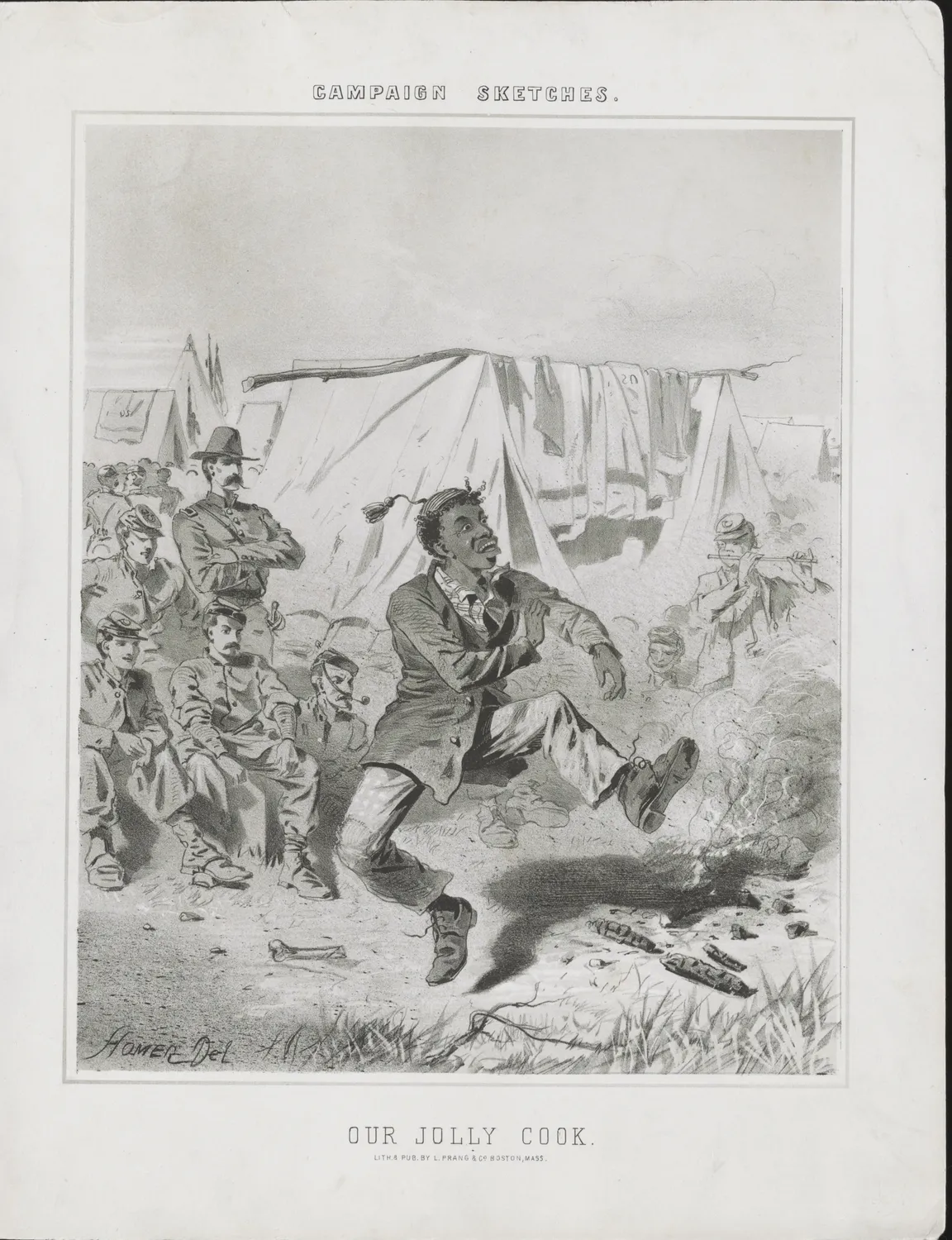
Homer was never taught to paint. His father read an advertisement in a Boston paper, Boy wanted; apply to Bufford, lithographer. Must have a taste for drawing. No other wanted, and at nineteen Homer was taken on trial for two weeks and stayed two years, drawing other people's designs onto the stone. His first jobs were sheet music covers ordered by the Boston publisher Oliver Ditson, Katy Darling among them, and the biggest was putting the portraits of the whole Massachusetts Senate on stone. He called it a treadmill, and when it ended he said he had had a taste of freedom: from the time that I took my nose off that lithographic stone, I have had no master, and never shall have any. What stood in for an academy was seventeen years of black and white work for the illustrated press, four of them following the Army of the Potomac for Harper's Weekly, drawing the thing in front of him against a deadline. His only formal painting lessons were one month with Frederic Rondel in 1861, an hour on Saturdays, how to hold a brush and set a palette. The summer after, he bought a tin box of pigments and oils and went into the country to paint from nature.
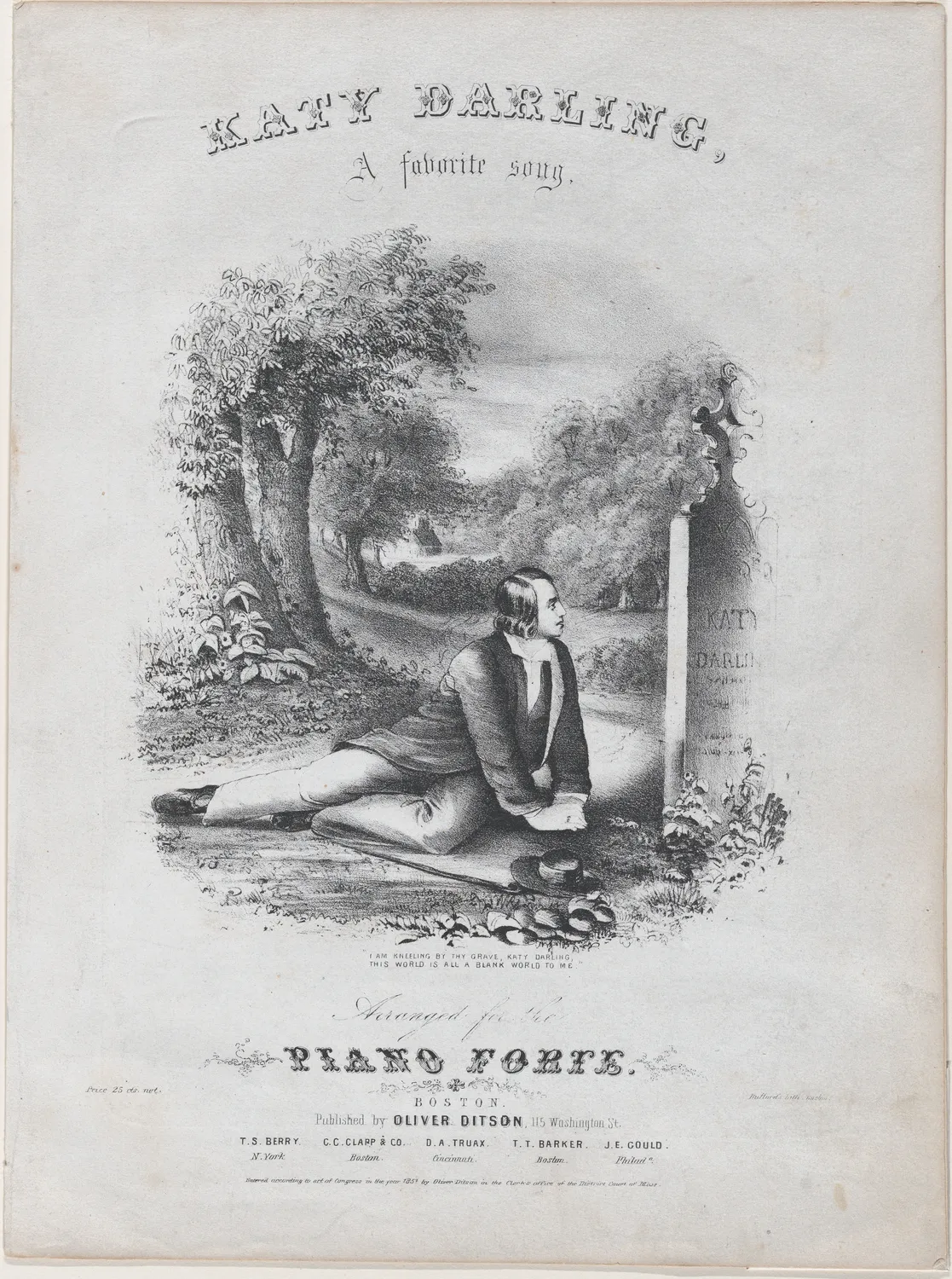
Katy Darling, a sheet music cover of 1857 and one of the first jobs he was given at Bufford's: another man's picture, put on the stone at nineteen. The imprint at the lower right of the sheet reads Bufford's Lith. Boston, and the line under the title names Oliver Ditson of Washington Street. Two years of this and he said he would never have a master again.
Winslow Homer, Katy Darling (sheet music cover), 1857, lithograph, The Metropolitan Museum of Art, New York, 36.85.5. Public domain, Wikimedia Commons.
Two Men in an Army Wagon, drawn in the field in 1862 while he was following the Army of the Potomac for Harper's Weekly. Graphite and a brush of grey wash, nothing else. The wash blocks the two men as flat shapes first and the pencil goes back in for the harness and the wheel.
Winslow Homer, Two Men in an Army Wagon, 1862, graphite, brush and gray wash on cream-colored wove paper, Cooper Hewitt, Smithsonian Design Museum, 1912-12-119, gift of Charles Savage Homer, Jr. Public domain, Wikimedia Commons.
Our Jolly Cook, from the Campaign Sketches of 1863: Homer back on the lithographic stone, this time drawing his own design, with HOMER Del written into the stone at the lower left. The trade he had hated at Bufford's is what let him publish the war under his own name.
Winslow Homer, Campaign Sketches: Our Jolly Cook, 1863, lithograph published by L. Prang and Company, Boston, Library of Congress, Prints and Photographs Division. Public domain, Wikimedia Commons.
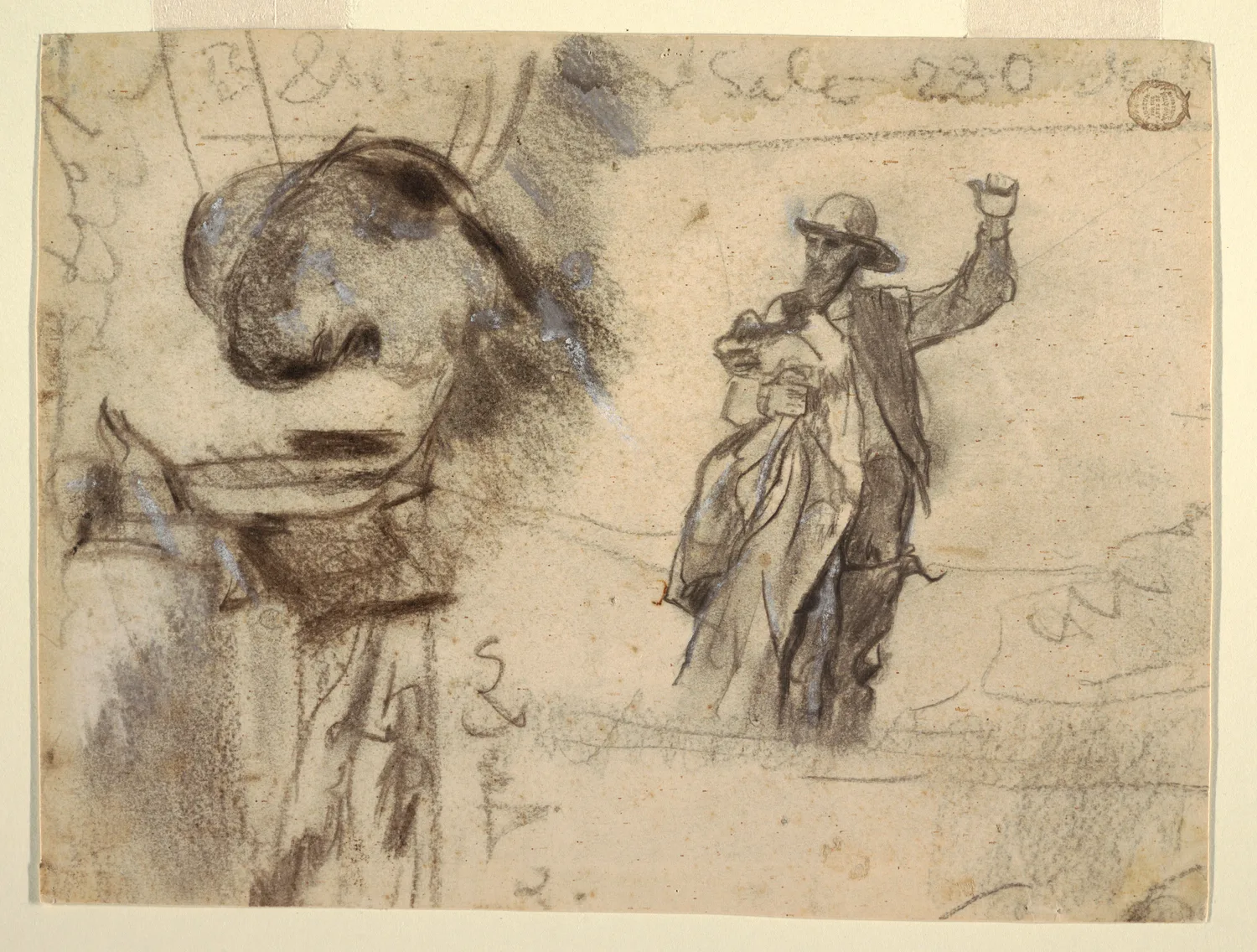
Two studies of a sailor with a raised arm, made about 1895 for The Lookout, All's Well and for The Wreck. Charcoal and black chalk for the dark, white chalk for the wet oilskin catching the light, cream paper left as the middle tone. He was near sixty and still drawing the figure out before he painted it.
Winslow Homer, Two Studies of a Sailor with Raised Arm, 1895 to 1896, charcoal, black chalk and white chalk on heavy cream wove paper, Cooper Hewitt, Smithsonian Design Museum, 1912-12-33, gift of Charles Savage Homer, Jr. Public domain, Wikimedia Commons.
Source: The Bufford advertisement, the two weeks on trial and the two years, the waived three hundred dollar apprentice bonus, the Oliver Ditson covers with Katy Darling named, the Massachusetts Senate portraits, the treadmill line and the no-master line: George W. Sheldon, American Painters, D. Appleton, New York, 1879. The seventeen years of black and white work for the illustrated press, the month of Saturdays with Frederic Rondel and the tin box of pigments: William Howe Downes, The Life and Works of Winslow Homer, Houghton Mifflin, 1911. Medium, date, accession and holding museum for every sheet: read from the holding museum through the Commons file record.
Up close
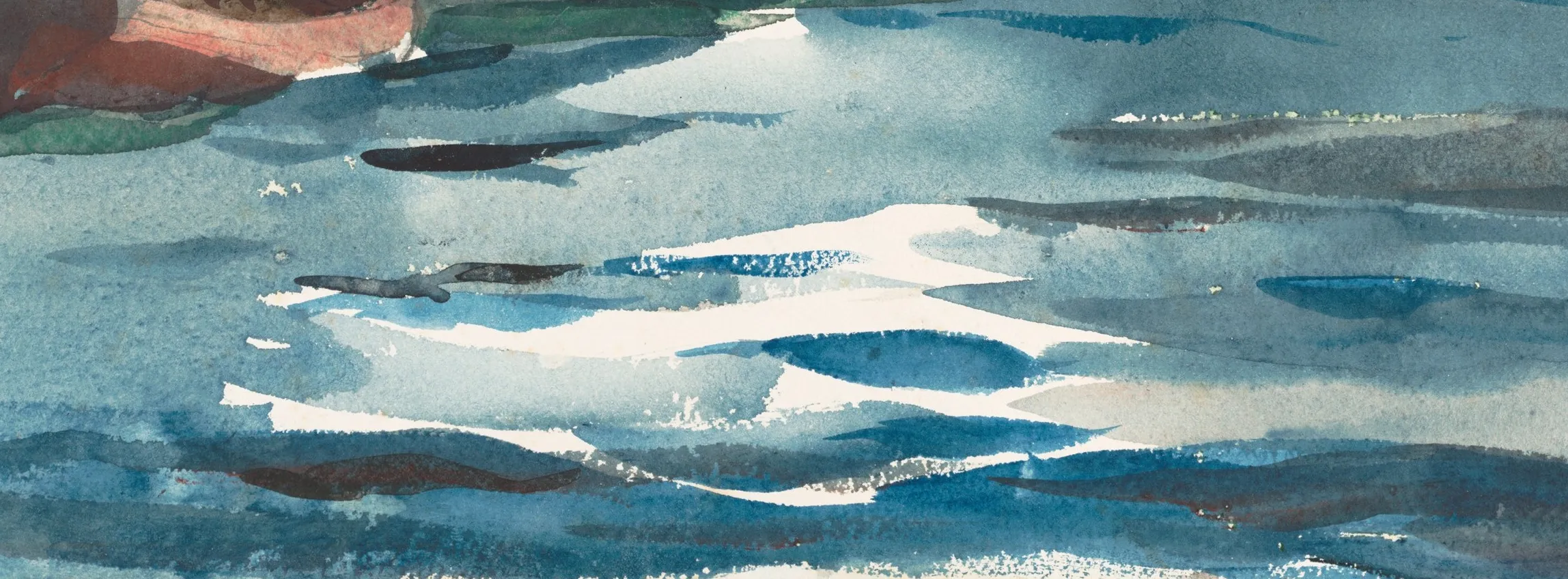
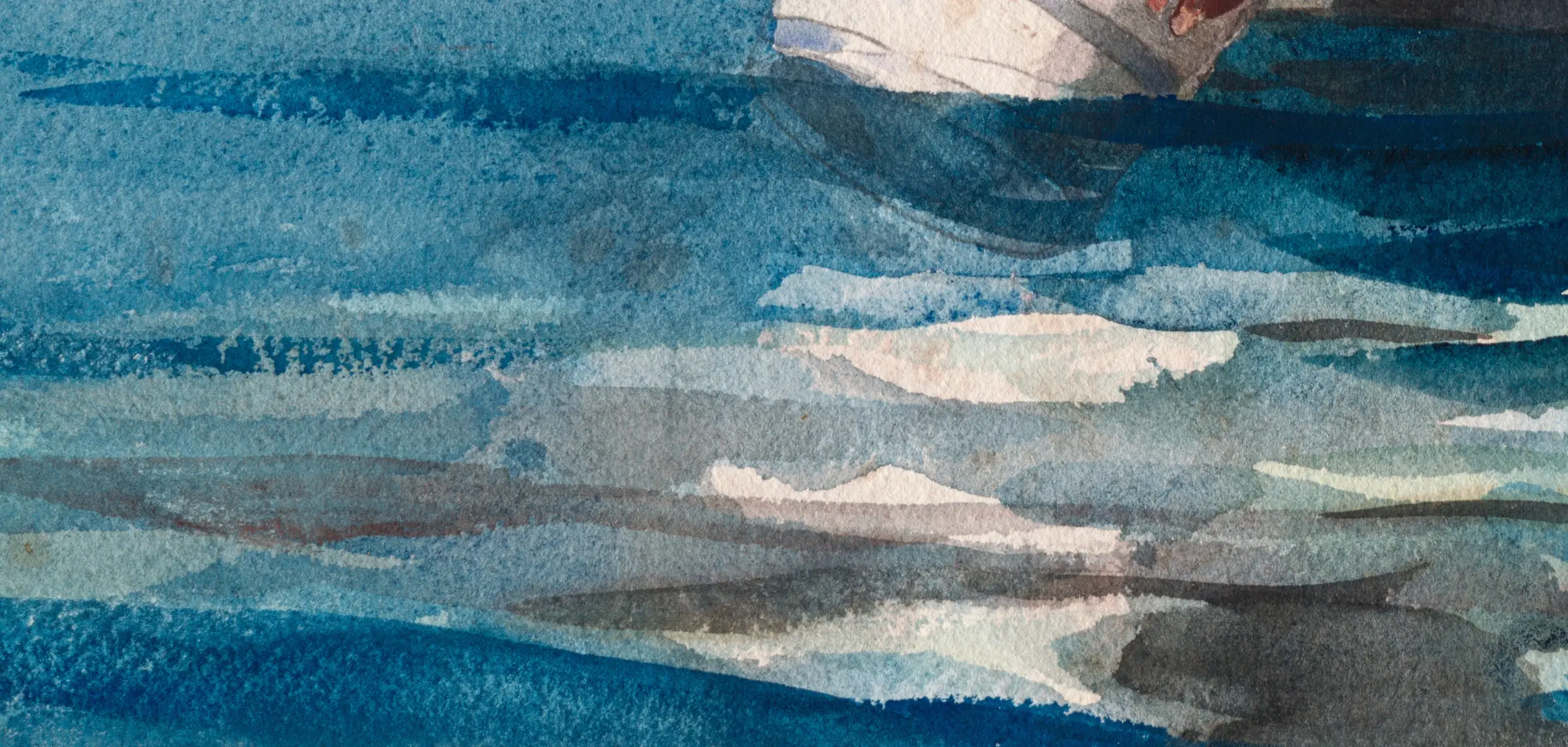
Detail of Sloop, Nassau at the water: every white here is the sheet. The hard edges are where the wash was stopped or lifted clean off, and the speckle running along them is pigment left sitting in the pits of the paper. Nothing white was put on top.
Winslow Homer, Sloop, Nassau (detail), 1899, watercolor and graphite on off-white wove paper, The Metropolitan Museum of Art, New York, 10.228.3. Public domain, Wikimedia Commons.
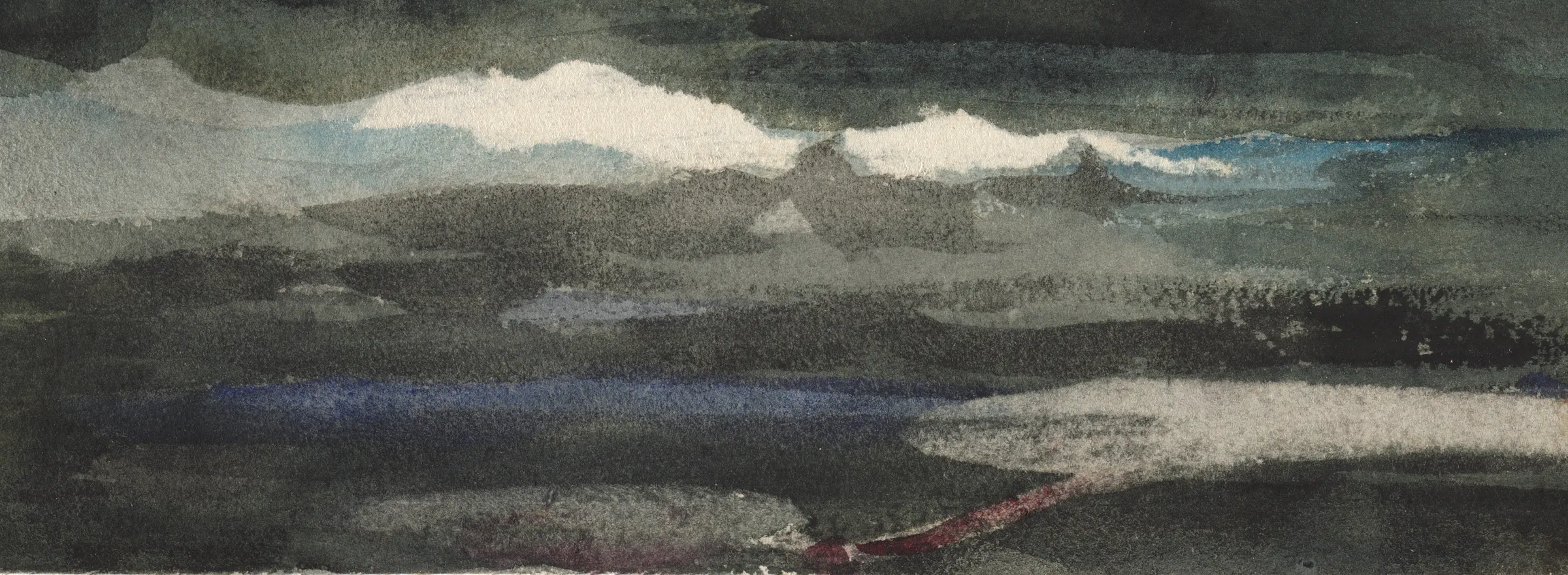
Detail of The Water Fan under the boat. The Art Institute lists this sheet as watercolor with blotting and touches of scraping. The pale bands are the blotting, wet colour pressed back off the paper with a cloth, and they lie flat on the sea instead of floating above it the way added white does.
Winslow Homer, The Water Fan (detail), 1898 to 1899, watercolor over graphite on thick rough twill-textured ivory wove paper, The Art Institute of Chicago, 1972.190. Public domain, Wikimedia Commons.
Detail at the foot of Leaping Trout: two white streaks scraped out of a dark green wash so the far water catches the light. One side of each scrape has a torn edge and the other a soft lifted one, which is how you can tell it was taken out rather than painted in.
Winslow Homer, Leaping Trout (detail), 1889, watercolor over graphite, The Cleveland Museum of Art, 1973.142, anonymous gift. Public domain, Wikimedia Commons.
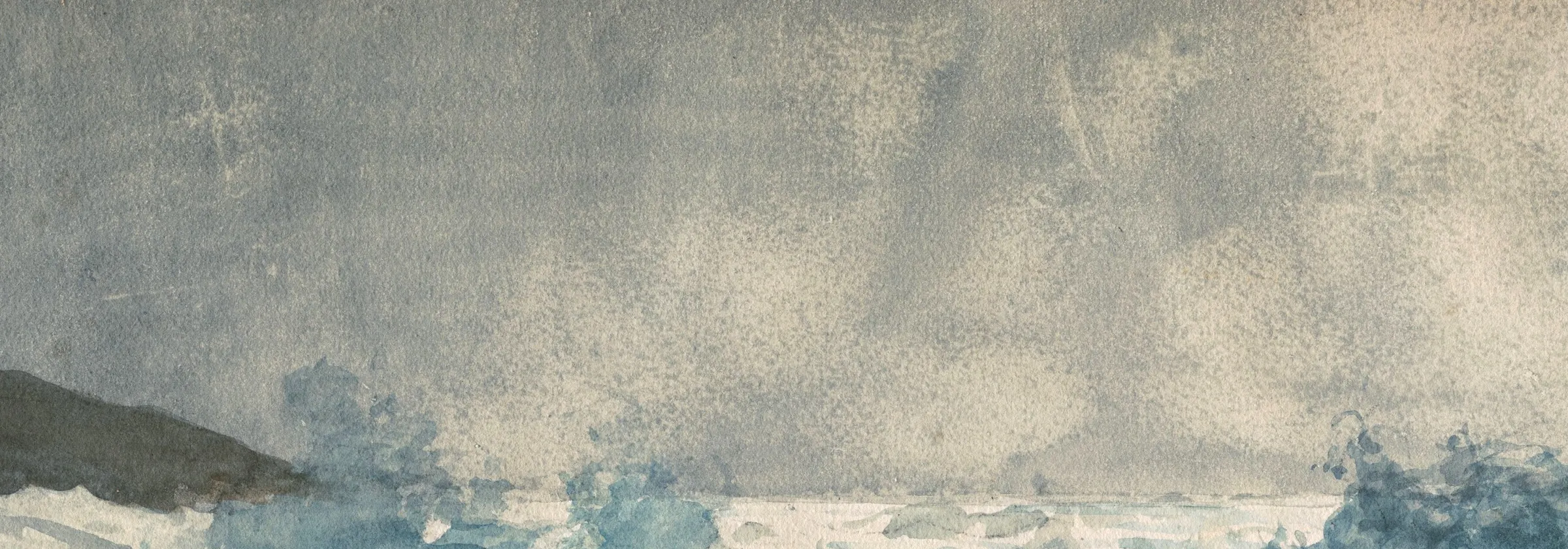
Detail of the sky in Prout's Neck, Breakers. The Art Institute records the sheet as watercolor with blotting and sanding over charcoal. Sandpaper has taken the grey wash off the top of the paper grain and left it down in the pits, and that speckle is the mist. Nothing was painted into this passage after the wash went down.
Winslow Homer, Prout's Neck, Breakers (detail), 1883, watercolor with blotting and sanding over charcoal on ivory wove paper, The Art Institute of Chicago, 1933.1247. Public domain, Wikimedia Commons.
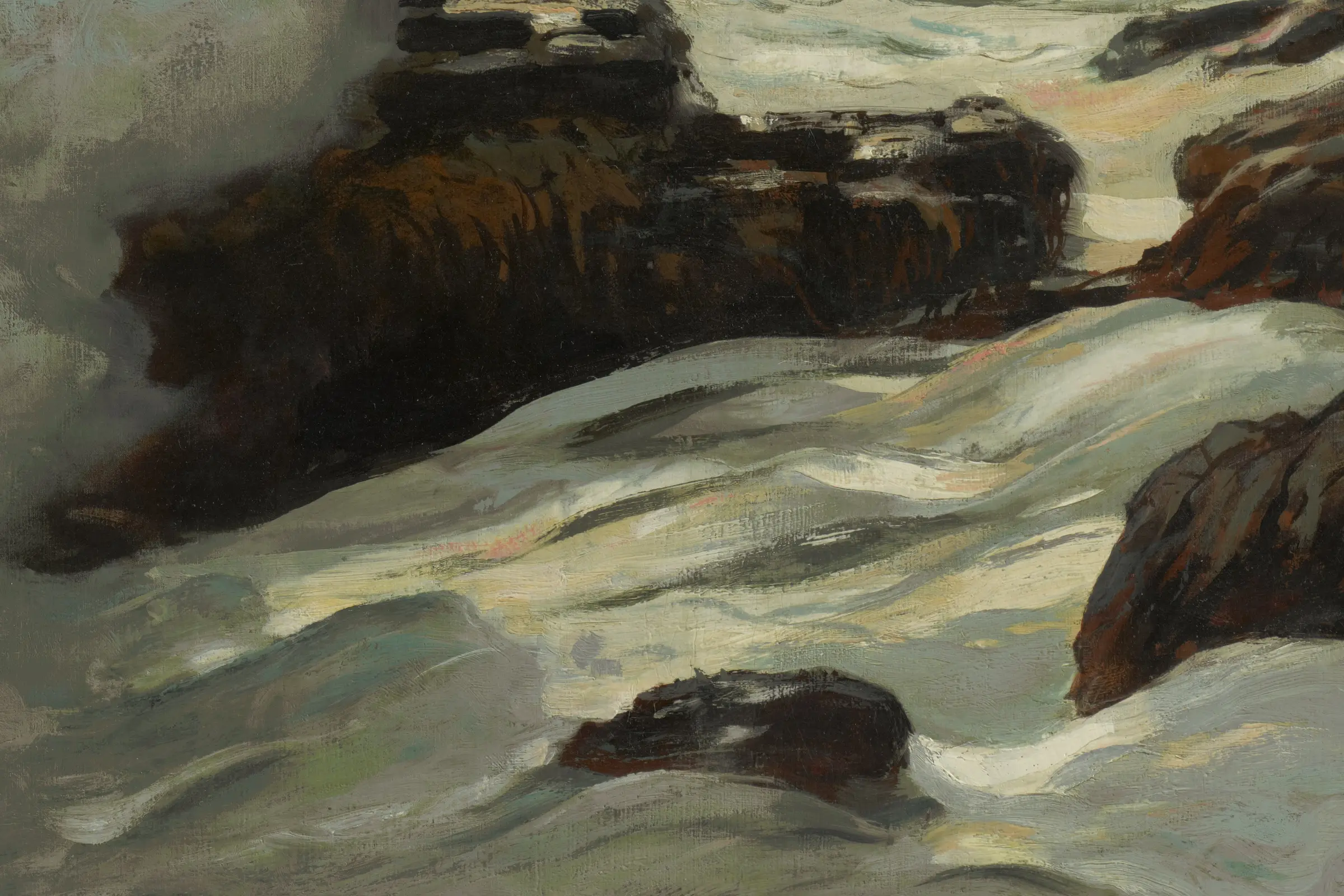
Detail of the surf in West Point, Prout's Neck: the lights are pasty and dragged in the direction the water is running, standing proud of the canvas weave, while the wet rock beside them is thin enough to read the weave straight through. The ridges catch the light in the room the way the foam catches it on the shore.
Winslow Homer, West Point, Prout's Neck (detail), 1900, oil on canvas, Clark Art Institute, Williamstown, 1955.7. Public domain, Wikimedia Commons.
Watching him work
“By noon it was blowing a gale, and the waves were lashing the coast, sending spray high into the air. Nothing could have induced a soul to go forth, save only a mission of mercy; but at three o'clock Homer hurried into my room, robed from head to foot in rubber, and carrying in his arms a storm-coat and a pair of sailor's boots. Come! he said, quickly! It is perfectly grand! For an hour we clambered over rocks, holding fast to the wiry shrubs which grew from every crevice, while the spray dashed far overhead.”
John W. Beatty, director of fine arts at the Carnegie Institute, on a visit to Prout's Neck, Introductory Note to William Howe Downes, The Life and Works of Winslow Homer, Houghton Mifflin, 1911 [source]
Across media
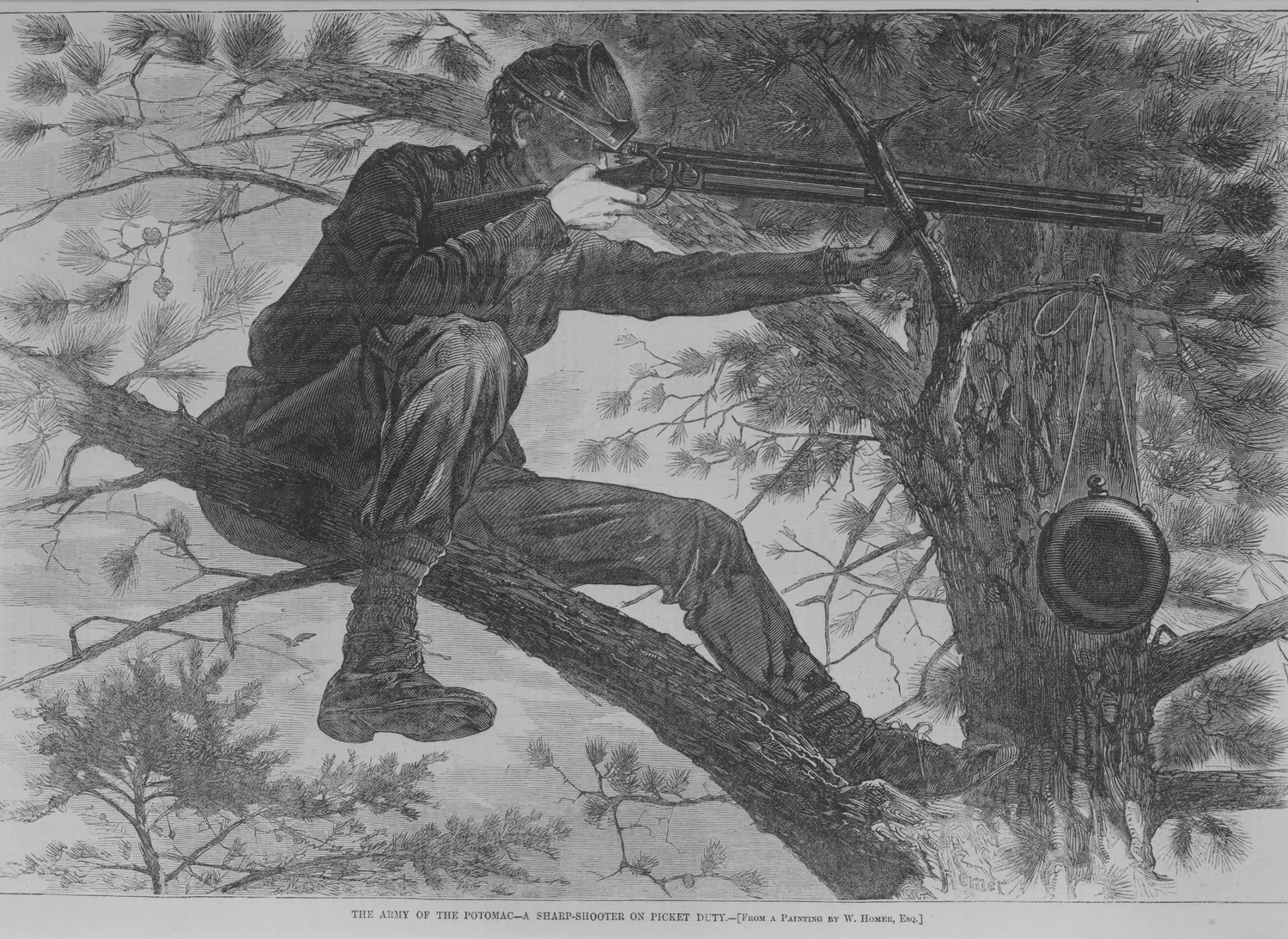
The Army of the Potomac, A Sharp-Shooter on Picket Duty, cut as a wood engraving for Harper's Weekly of 15 November 1862. Homer drew it on the block and a shop engraver cut it. Everything in it is line, no wash and no tone, only how close together the cuts sit. This is the medium he worked in for seventeen years.
After Winslow Homer, The Army of the Potomac, A Sharp-Shooter on Picket Duty, from Harper's Weekly, 15 November 1862, wood engraving, The Metropolitan Museum of Art, New York, 29.88.3(5). Public domain, Wikimedia Commons.
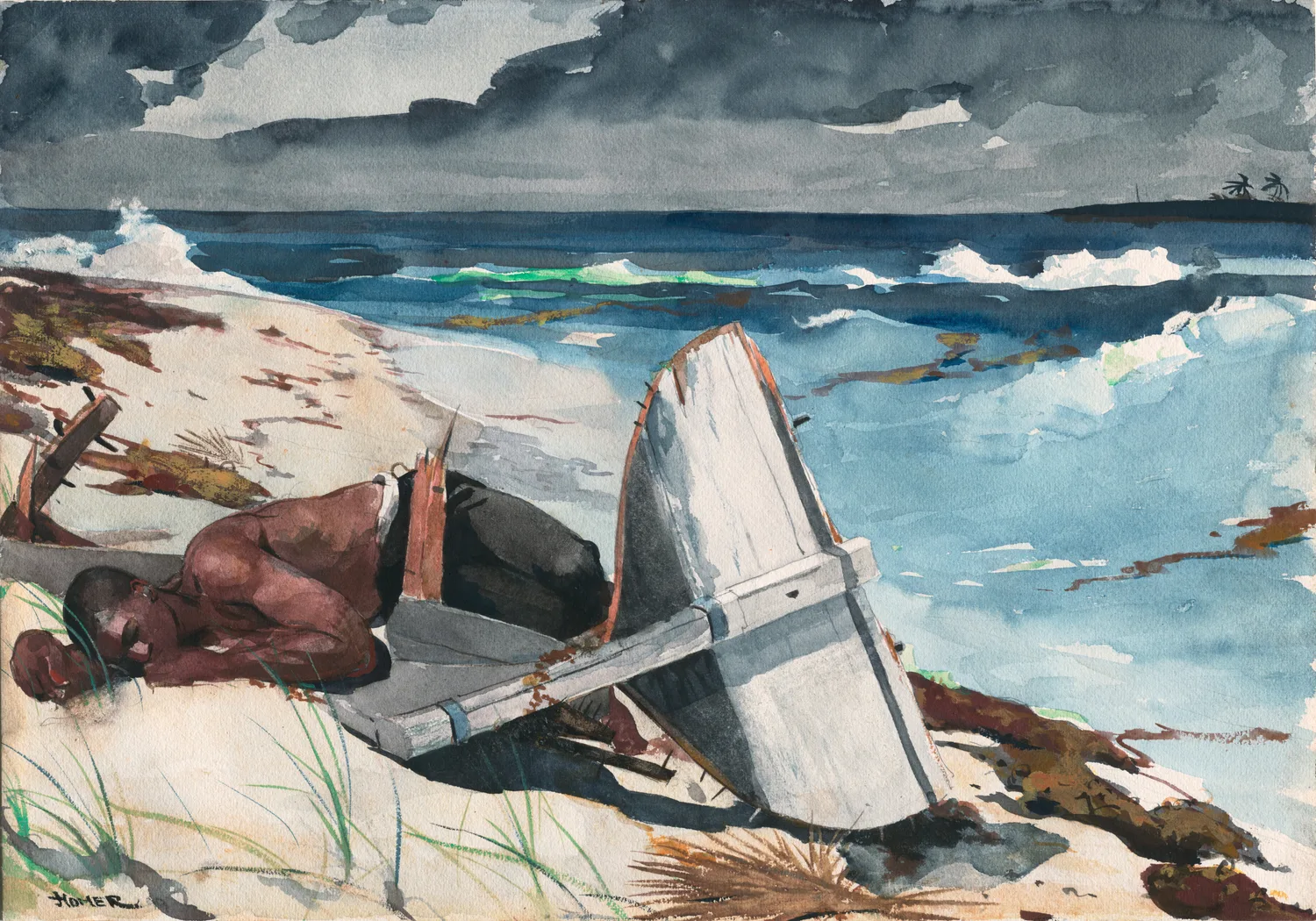
After the Hurricane, Bahamas, 1899, on a sheet thirty seven centimetres by fifty four. The Art Institute records rewetting, blotting and scraping in it. The surf on the reef, the lit edge of the hull and the dry sand are recovered paper, and the storm sky above them went on in two dark passes.
Winslow Homer, After the Hurricane, Bahamas, 1899, transparent watercolor with touches of opaque watercolor, rewetting, blotting and scraping, over graphite, 37.2 by 54.2 centimetres, The Art Institute of Chicago, 1933.1235. Public domain, Wikimedia Commons.
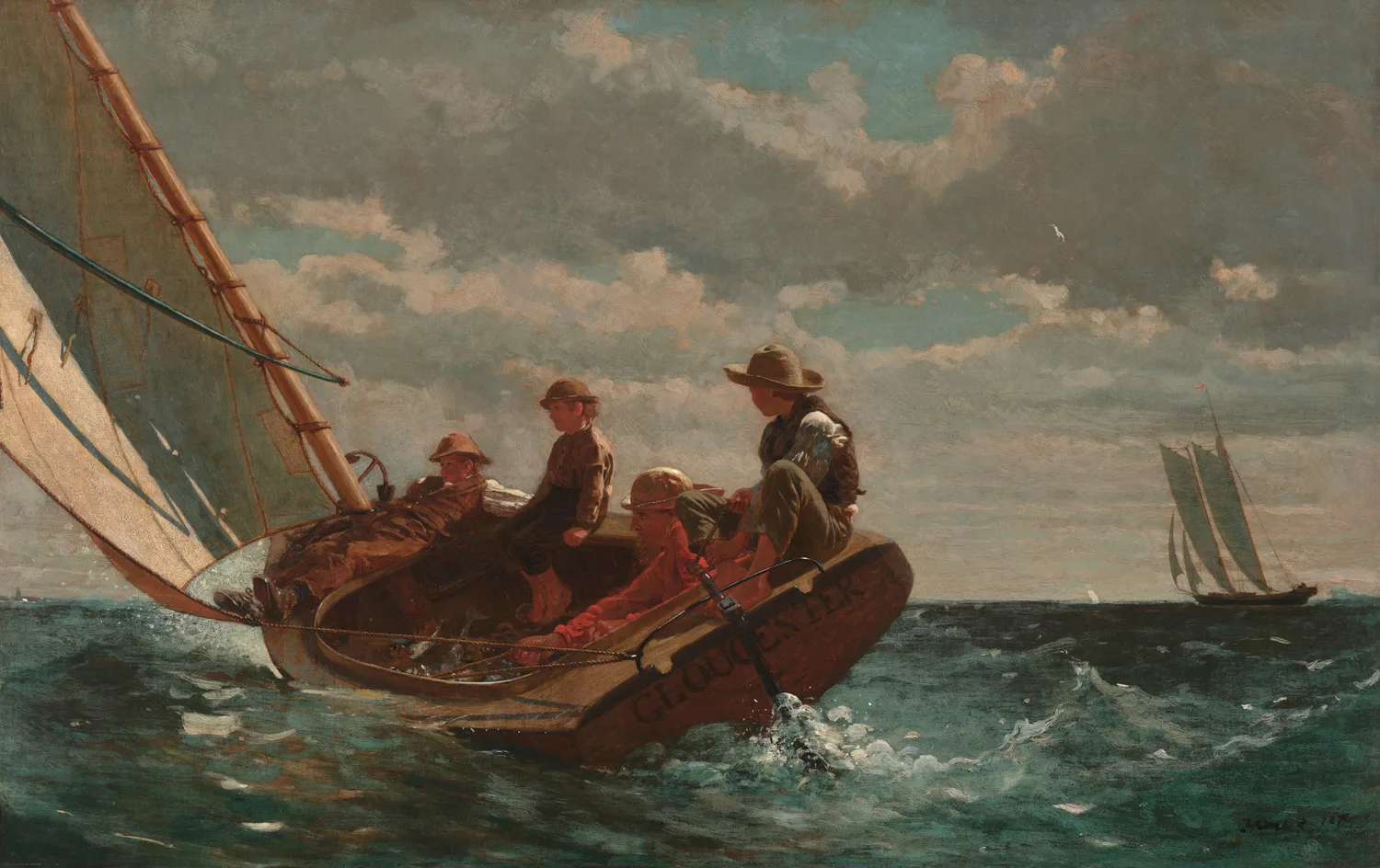
Breezing Up (A Fair Wind), worked on from 1873 to 1876, twenty years before the Prout's Neck seas. Boys and a boat carry the picture and the paint is smooth and level. What comes later takes the figures out and puts the whole weight on the water.
Winslow Homer, Breezing Up (A Fair Wind), 1873 to 1876, oil on canvas, 61.5 by 97 centimetres, National Gallery of Art, Washington, 1943.13.1. Public domain, Wikimedia Commons.
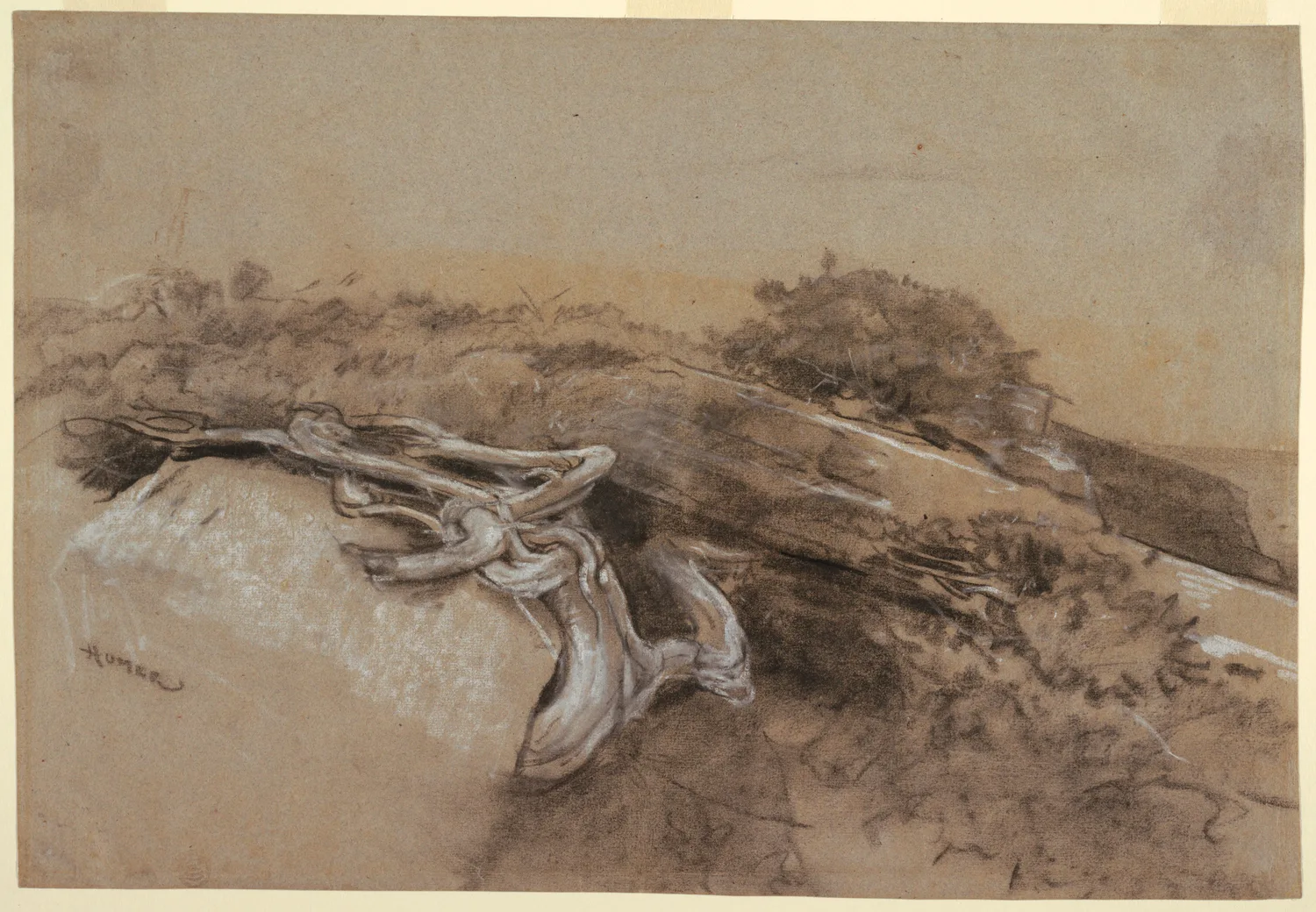
Study of Tree Roots, Prout's Neck, made about 1883, the year he settled in Maine. Charcoal for the dark, brushed white gouache and white chalk for the light, and grey laid paper left doing the middle tone. He drew the ground before he painted from it.
Winslow Homer, Study of Tree Roots, Prout's Neck, Maine, 1883 to 1884, charcoal, brush and white gouache and white chalk on gray laid paper, Cooper Hewitt, Smithsonian Design Museum, 1912-12-90, gift of Charles Savage Homer, Jr. Public domain, Wikimedia Commons.
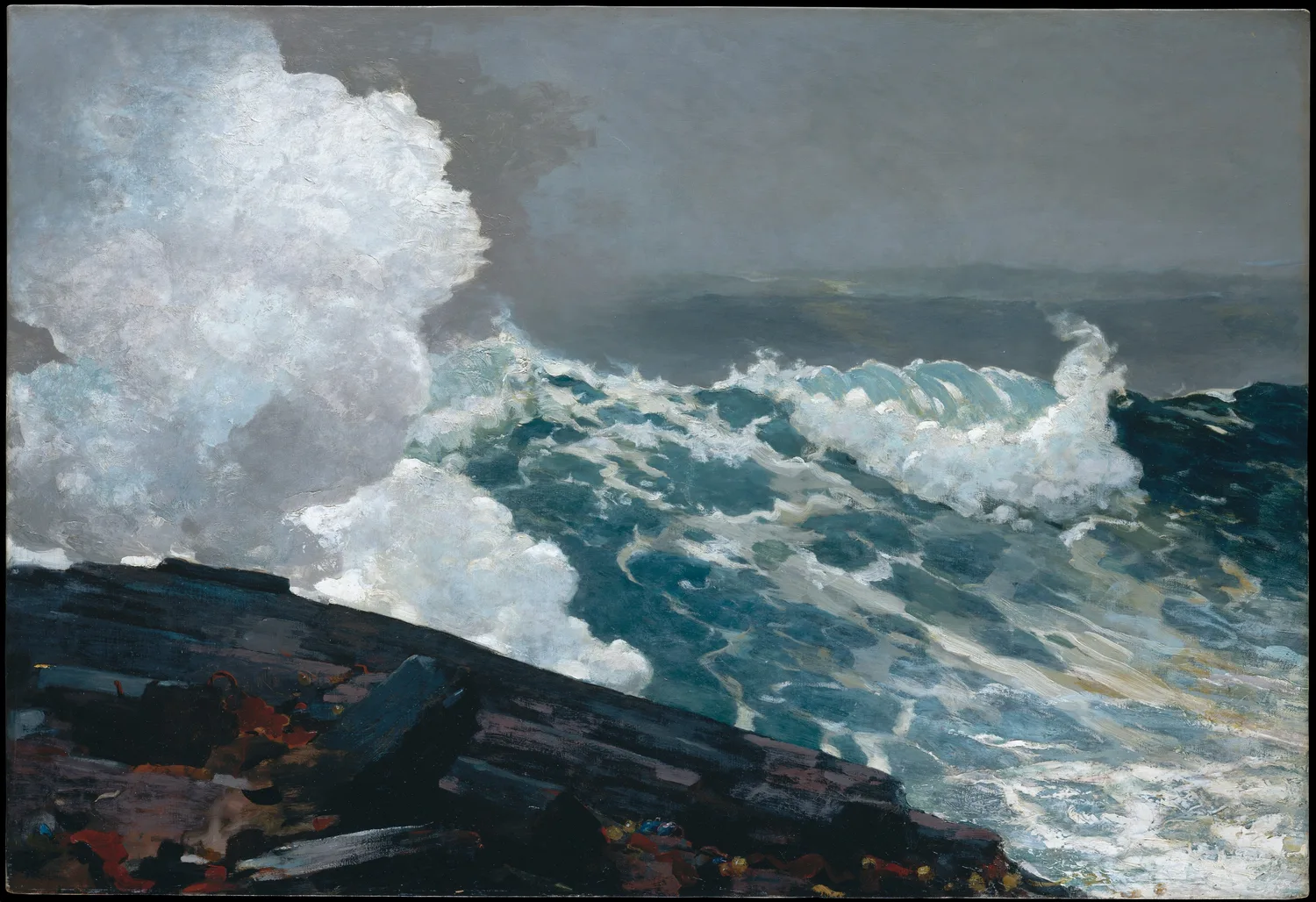
Northeaster. The Metropolitan carries two dates on it in its own record, 1895 and reworked by 1901. There is no boat and no figure in it, so the only thing giving the wave a size is the ledge in the foreground.
Winslow Homer, Northeaster, 1895, reworked by 1901, oil on canvas, 87.6 by 127 centimetres, The Metropolitan Museum of Art, New York, 10.64.5, gift of George A. Hearn, 1910. Public domain, Wikimedia Commons.
The record, deeper
The money
He set his own net prices and told the dealers what to charge. In a letter of 15 March 1902 to M. O'Brien and Son of Chicago: the net price to me on High Cliff is two thousand dollars, the net price to me on The Gulf Stream is three thousand dollars.
Winslow Homer to M. O'Brien and Son, 15 March 1902, printed in William Howe Downes, The Life and Works of Winslow Homer, 1911.
On the picture he made for that firm, 29 October 1902: the price that you will charge is five thousand dollars. The price net to me will be four thousand dollars.
Winslow Homer to M. O'Brien and Son, 29 October 1902, in Downes, 1911.
In September 1902 he found twelve drawings he had not seen for fifteen years and shipped them to the same dealers. As quick sketches from nature, untouched, you cannot beat them. I will take four hundred dollars net for the lot.
Winslow Homer to M. O'Brien and Son, 27 September 1902, in Downes, 1911.
His father told the marine painter William J. Bixbee about a picture Winslow had sent to New York priced at fifteen hundred dollars. The dealers wrote that a buyer had offered twelve hundred and asked whether to take it. Homer replied in one line: make the price nineteen hundred dollars. The old man called it the most unbusinesslike thing he had ever heard of.
William J. Bixbee to William Howe Downes, 2 November 1910, in Downes, 1911.
The Metropolitan Museum bought The Gulf Stream in 1906 through the Wolfe Fund, seven years after he painted it and in the same year he finished reworking it.
The Metropolitan Museum of Art, object record 06.1234, The Gulf Stream, 1899, reworked by 1906.
The reworks
The picture he called the best sea he had ever painted cost him two years of waiting for weather. He wrote in March 1902 that after waiting a full year, looking out every day for it, on the 24th of February, his birthday, he got the light and the sea that he wanted. It was so cold that he had to paint from inside his window and was a little too far away, and although it was making a beautiful thing, it is not good enough yet, and I must have another painting from nature on it.
Winslow Homer to M. O'Brien and Son, 15 March 1902, in Downes, 1911.
He finished it eight months later, in one early sitting. The long-looked-for day arrived, and from 6 to 8 o'clock A.M. I painted from nature on this O'B., finishing it, making the fourth painting on this canvas of two hours each. Four sittings of two hours, spread over two years of watching the sea.
Winslow Homer to M. O'Brien and Son, 29 October 1902, in Downes, 1911.
He would not close a canvas on a study alone. On the same commission in December 1900: I do not think I can finish it before I have a crack at it out of doors in the spring. I do not like to rely on my study that I have used up to date.
Winslow Homer to M. O'Brien and Son, 20 December 1900, in Downes, 1911.
Two of the pictures his name rests on carry two dates each in the Metropolitan's own record. Northeaster is 1895, reworked by 1901. The Gulf Stream is 1899, reworked by 1906. He went back into both of them years after they were done and exhibited.
The Metropolitan Museum of Art, object records 10.64.5 and 06.1234.
Beatty recorded two of his rules on choosing what to paint. The rare thing is to find a painter who knows a good thing when he sees it. And Beatty recalled him saying that he had waited six months for the coming of a particular effect of nature.
John W. Beatty, Introductory Note to Downes, The Life and Works of Winslow Homer, 1911.
The studio
For painting the sea in cold or stormy weather he had a portable painting house built and set on runners. It measured about eight feet by ten on the ground, with a door on one side and a large plate glass window on the other. In a northeaster it was dragged down onto the rocks of Eastern Point and he worked from inside it as long as the light held.
William Howe Downes, The Life and Works of Winslow Homer, 1911, chapter fourteen, The Portable Painting-house.
The shed did two more things for him. It let him work from a point of view lower than would have been consistent with safety to his life and limb on that shore, which is why the horizon sits so high in the late marines. And shut up in it he was secure from intrusion, because he could never quite reconcile himself to people prying at his canvas while he painted in the open air.
Downes, The Life and Works of Winslow Homer, 1911.
The cottage at Prout's Neck gave the whole ground floor to the studio except the kitchen, with a balcony the width of the building on the ocean side. Beatty asked him whether he ever took the liberty of modifying the colour of any part of nature and got a flat refusal, then Homer pointed at that balcony: when he was painting the picture that went to the Luxembourg he had carried the canvas up repeatedly from the rocks below, hung it there, and studied it from a distance.
Beatty, Introductory Note, and Downes, The Life and Works of Winslow Homer, 1911.
He did a great deal of looking before he committed a sheet or a canvas, and sometimes he would spend whole days just looking at the sea without touching a brush. He was an early riser and would often be out walking by half past four on a Maine summer morning, before anybody else was up, so as to be sure of being alone.
Downes, The Life and Works of Winslow Homer, 1911.
The studio held a birch bark canoe brought back from Canada and a great deal of fishing tackle alongside the canvases, costumes and properties. His brother Charles said of him as a fisherman that he did not go in for expensive or elaborate tackle, but he usually caught the biggest fish.
Downes, The Life and Works of Winslow Homer, 1911.
The materials
The Art Institute of Chicago names the subtraction in its own catalogue lines, work by work. Prout's Neck, Breakers of 1883 is watercolor with blotting and sanding over charcoal. The Water Fan of 1898 is watercolor with blotting and touches of scraping over graphite. After the Hurricane, Bahamas of 1899 is transparent watercolor with touches of opaque watercolor, rewetting, blotting and scraping, over graphite.
The Art Institute of Chicago, object records 1933.1247, 1972.190 and 1933.1235.
The papers are named as precisely as the pigments. Breakers is on moderately thick, moderately textured ivory wove paper. The Water Fan is on thick, rough twill-textured ivory wove. The tooth is doing the work: abrasion lifts colour off the high points of the grain and leaves it down in the pits, which is where the speckle in the mist comes from.
The Art Institute of Chicago, object records 1933.1247 and 1972.190.
His elder brother gave him Chevreul on colour and he kept it for the rest of his life. Downes found the copy in the Prout's Neck library almost read to pieces, so worn was it with use.
Downes, The Life and Works of Winslow Homer, 1911.
The first outdoor kit he ever bought was a tin box. Sheldon records that the summer after his month of lessons with Rondel, Homer bought a tin box containing pigments, oils and various equipments and started out into the country to paint from nature.
George W. Sheldon, American Painters, D. Appleton, 1879.
He was, Downes says, one of the first painters in America to take the trouble to carry a canvas several miles to make a study from nature in a place that had interested him. Downes also says he did not always work directly from nature, because his memory for visual impressions was strong enough that at times he could record a scene with no preparation beyond the slightest of notes.
Downes, The Life and Works of Winslow Homer, 1911.
Refusals — what they would not do
Refused opaque Chinese white in watercolour, recovered whites through lifting.
Refused photography as a painting reference.
Refused European grand-tour Old Master copying that shaped his European contemporaries.
Direct observation. Maine, the Adirondacks, Quebec, the Caribbean, the places themselves were his library.
Photography
Rejected as a painting reference. Aware of photography (his brother Charles was a chemist who discussed photographic processes with him) but held that the camera flattened depth and removed atmospheric information.
Exceptions
Spent 1881-1882 in Cullercoats, a fishing village on the English North Sea coast, the critical formative trip of his mature period. Cullercoats watercolours established the coastal-working-people subject matter he would carry through Prout's Neck.
Kept a canoe indoors at Prout's Neck to study reflections and boatman's posture for fly-fishing watercolours, studio reference for outdoor subjects already observed at length in the Adirondacks and Quebec.
Frederick Rondel · 1861 — Boston genre painter. One month of lessons in oil paint mechanics, palette, medium, varnish. Homer considered that enough formal instruction.
J. H. Bufford's lithography shop, Boston · 1855-1857 — Apprenticeship in commercial wood-engraving, the traditional American pipeline into the illustrated magazine world.
Influences
John Ruskin's Elements of Drawing (owned and annotated).
Chevreul's De la loi du contraste simultané des couleurs.
English watercolour tradition (Turner, Cotman, Cullercoats watercolourists).
Students
Took no students; ran no atelier.
Posthumous influence immense. Twentieth-century American realism (Edward Hopper, Ashcan School, Andrew Wyeth, the plein-air American movement) reached back to him as foundational reference. Hopper cited Homer's watercolour method as the model for his own watercolour practice in New England.
In their own words
“When I have selected the thing carefully, I paint it exactly as it appears.”
— Winslow Homer, Recorded working principle
“I prefer every time a picture composed and painted out-doors. The thing is done without [the artist] knowing it.”
— Winslow Homer, Interview published in Sketches and Studies, 1887
“Chevreul on Color is my bible.”
— Winslow Homer, Letter to his brother Charles Homer, 1903
“Homer grabs nature and dabs her on his paper.”
— Anonymous critic, New York Evening Mail review, 1874
Contemporary critical description of the direct-observation method.
How did Winslow Homer get the whites in his watercolors?
From the paper itself. Homer refused opaque Chinese white and recovered his lights subtractively: blotting wet pigment with cloth or sponge, scraping wetted passages back to paper with a knife or the wooden brush end, stopping-out with wax in late works. For mist and spray he sanded dried washes back with sandpaper. Recovered paper is the cleanest white available; white pigment is always slightly grayed.
What palette did Winslow Homer use?
A restricted one, grounded in Chevreul's color theory. Bare paper and lead white for the whites, yellow ochre, burnt sienna, and Venetian red for the earths, Prussian blue, ivory black, and occasional cadmium yellow, vermilion, and cobalt blue. The mixtures (Prussian blue with burnt sienna, Venetian red with ivory black) apply the simultaneous-contrast principles of Chevreul, whose book Homer studied for more than forty years and called "my bible" in a 1903 letter to his brother.
How did a Homer watercolor start?
With a brief pencil lay-in, not a detailed drawing: a few economical lines placing the horizon, the figures, and the diagonal or vertical that organized the composition. Then broad washes laid in the tonal structure, wet-in-wet on dampened paper for atmospheric passages like sea spray and fog. Detail came last, and much of it was subtractive, lifted and scraped out of the wash rather than painted on top.
How did Homer paint the sea in oils?
With the surface, not with blending. On commercial linen primed with a white or pale-gray ground, he laid thick pasty lead white into the lights and scored it with the palette knife or the brush butt into horizontal ridges. The ridges catch light in the direction of the breaking wave-tops. The paint was pure tube oil with no added medium.
Who taught Winslow Homer, and did he take students?
Almost no one, briefly. He apprenticed in commercial wood-engraving at J. H. Bufford's lithography shop in Boston (1855-1857), then took one month of lessons in oil paint mechanics from the Boston genre painter Frederick Rondel in 1861 and considered that enough. He refused academic atelier training, took no students, and ran no atelier; his posthumous influence ran through Edward Hopper, the Ashcan School, and Andrew Wyeth.
Did Winslow Homer use photographs?
No. He rejected photography as a painting reference, holding that the camera flattened depth and removed atmospheric information. He worked from direct observation on a seasonal circuit: Maine in spring and autumn, the Adirondacks and Quebec in summer, the Bahamas, Bermuda, Florida, or Cuba in winter. He kept a canoe indoors at Prout's Neck to study reflections and a boatman's posture for fly-fishing watercolors, studio reference for subjects already observed at length outdoors.
If this painter is your match
You believe the painting composed in direct contact with the motif catches what the studio composition has to reason through. The white of the paper or the light of the ground is your highest value, recovered by lifting, not added as paint.
Borrow this: For your next watercolor, ban opaque white. No gouache, no Chinese white. Any light lighter than your paper has to be the paper itself, recovered by wetting and lifting or wetting and scraping with a knife.
Helen A. Cooper, Winslow Homer Watercolors, 1986. National Gallery of Art exhibition catalogue. Principal modern scholarly reference on the watercolours.
A Vibrant Surface: Investigating Color, Texture, and Transparency in Winslow Homer's Watercolors, 2014. Art Institute of Chicago technical survey. Documents the specific subtractive techniques.[link]
Lloyd Goodrich and Abigail Booth Gerdts, Record of Works by Winslow Homer (5 vols.), 2005. Five-volume catalogue raisonné. Documents more than 650 oils, watercolours, and drawings.
Winslow Homer Studio, Prout's Neck, Maine (Portland Museum of Art). Homer's refurbished-stable studio, preserved and restored since 2006.[link]
William Howe Downes, The Life and Works of Winslow Homer, Houghton Mifflin, Boston and New York, 1911. The first full life, written a year after Homer died and built out of family papers and letters. It prints his correspondence with M. O'Brien and Son of Chicago, which is where the net prices, the year of waiting for the light and the four sittings of two hours come from. Chapter fourteen documents the portable painting house on runners, about eight feet by ten, with its plate glass window, dragged onto the rocks of Eastern Point. The signed Introductory Note is by John W. Beatty of the Carnegie Institute and carries the first-hand account of Homer going out into a gale, the balcony where he judged the Luxembourg picture, and the six months of waiting for an effect.[link]
George W. Sheldon, American Painters, D. Appleton and Company, New York, 1879. Written while Homer was alive and quoting him directly. The source for the Bufford advertisement, the two weeks on trial that became two years, the three hundred dollar apprentice bonus Bufford waived, the Oliver Ditson sheet music covers with Katy Darling named as one of the first, the Massachusetts Senate portraits drawn on stone, the treadmill line, and the statement that from the time he took his nose off the lithographic stone he had no master and never would.[link]
.jpg)