Degas painted in the studio under artificial light (gas-light, oil-lamp, a moonlight simulation he built) because he considered daylight too easy. He started from drawn studies made from the model, traced and modified his own drawings on semi-transparent paper, then transferred the composition to the final support by squaring up or direct tracing. The medium pass varied per work: soft pastel built in five or more layers with fixative sprayed between each, oil paint stripped of its binder on blotting paper and thinned with turpentine (peinture à l'essence), or pastel laid over the tonal ghost of a monotype. He rarely declared a work finished and borrowed pieces back for further work as late as thirty years after sale.
Direct rejection: natural daylight is "too easy" — the high-value outdoor range gives the painter too much information and too little structural problem. The demanding condition was controlled artificial light: gas-light, oil-lamp, the moonlight-simulation he built in his studio.
Why it matters · Most Impressionist contemporaries treated outdoor light as the foundation of modern painting. Degas's position is the cleanest case for treating difficult artificial light as the structural problem. Painters who only paint outdoors miss what the studio chamber teaches.
Recorded by Paul Valéry, Degas, Danse, Dessin, 1938
Peinture à l'essence — wick the binder out of oil paint
Squeezed commercial oil paint onto blotting paper to wick out most of the drying oil binder, then restored viscosity with turpentine or oil of spike lavender. Result: thin, matte, fast-drying paint film with optical quality of distemper but pigment range of oil.
Why it matters · Most painters accept the commercial paint as a finished product. Degas treated it as raw material to be modified for the surface he wanted. Painters who never modify the medium accept whatever surface the tube produces.
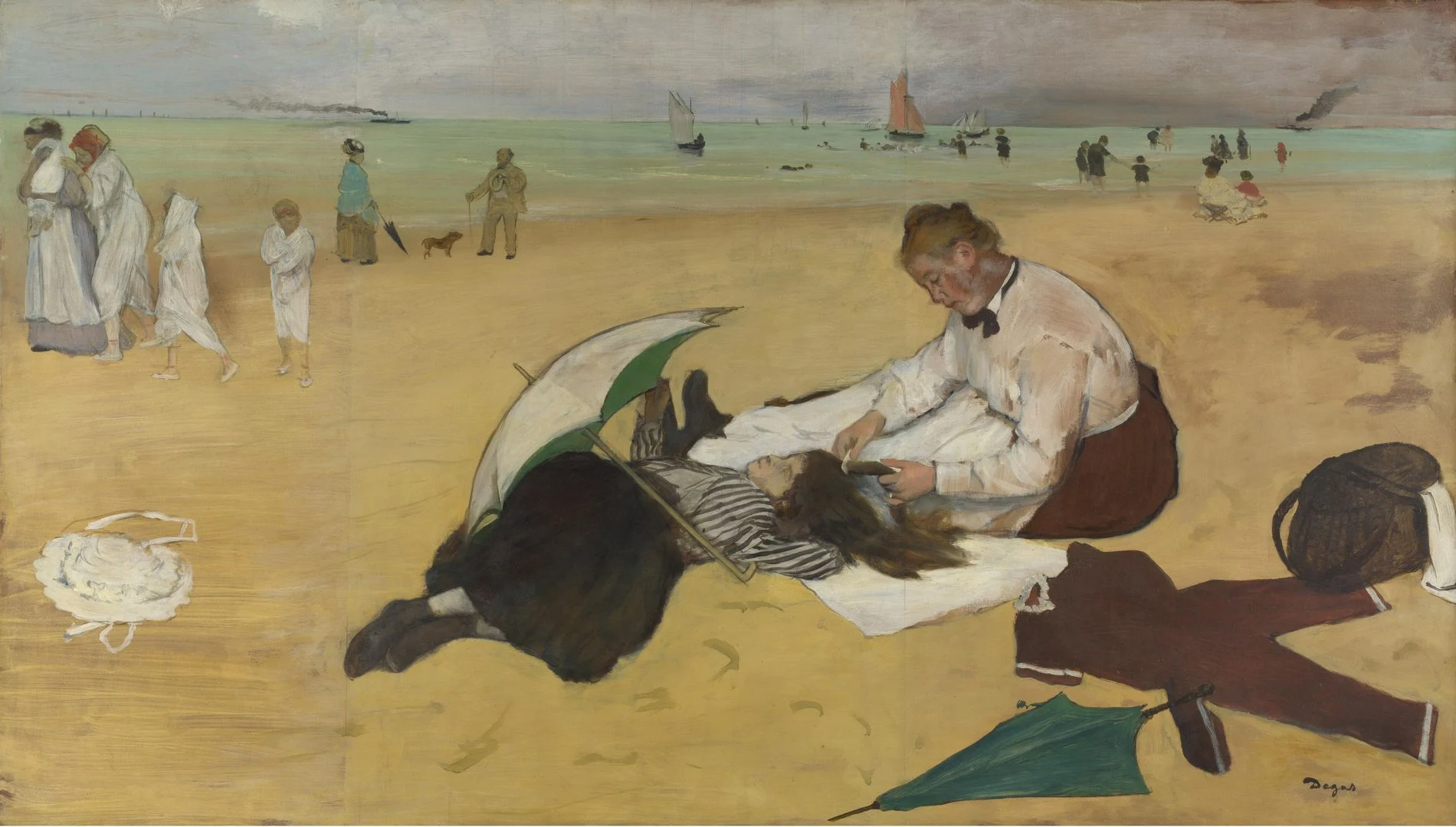
Beach Scene, painted in essence: the oil pulled out of the paint on blotting paper and the pigment thinned with turpentine, so the film dries fast and stays matte. The sand is one flat sheet of colour with the joins in the paper still showing through it. Degas told Vollard he made this picture indoors, with his flannel vest spread on the studio floor for the model to lie on.
Edgar Degas, Beach Scene, about 1869 to 1870, The National Gallery, London. Public domain, Wikimedia Commons.
Layered pastel with fixative between layers
Applied a layer of soft pastel, fixed it with spray fixative (probably shellac-based), applied the next layer, fixed it, and so on. Mature pastels have five, six, or more layers with optical depth pure single-pass pastel cannot produce.
Why it matters · A single pastel layer is a bright sketch. The layered method is a glazing analogue — the depth of an oil painting in a fugitive medium. Painters who use pastel only as single-pass sketch miss the full range.
Musée Thyssen-Bornemisza, Technical Study of At the Milliner's, 2017
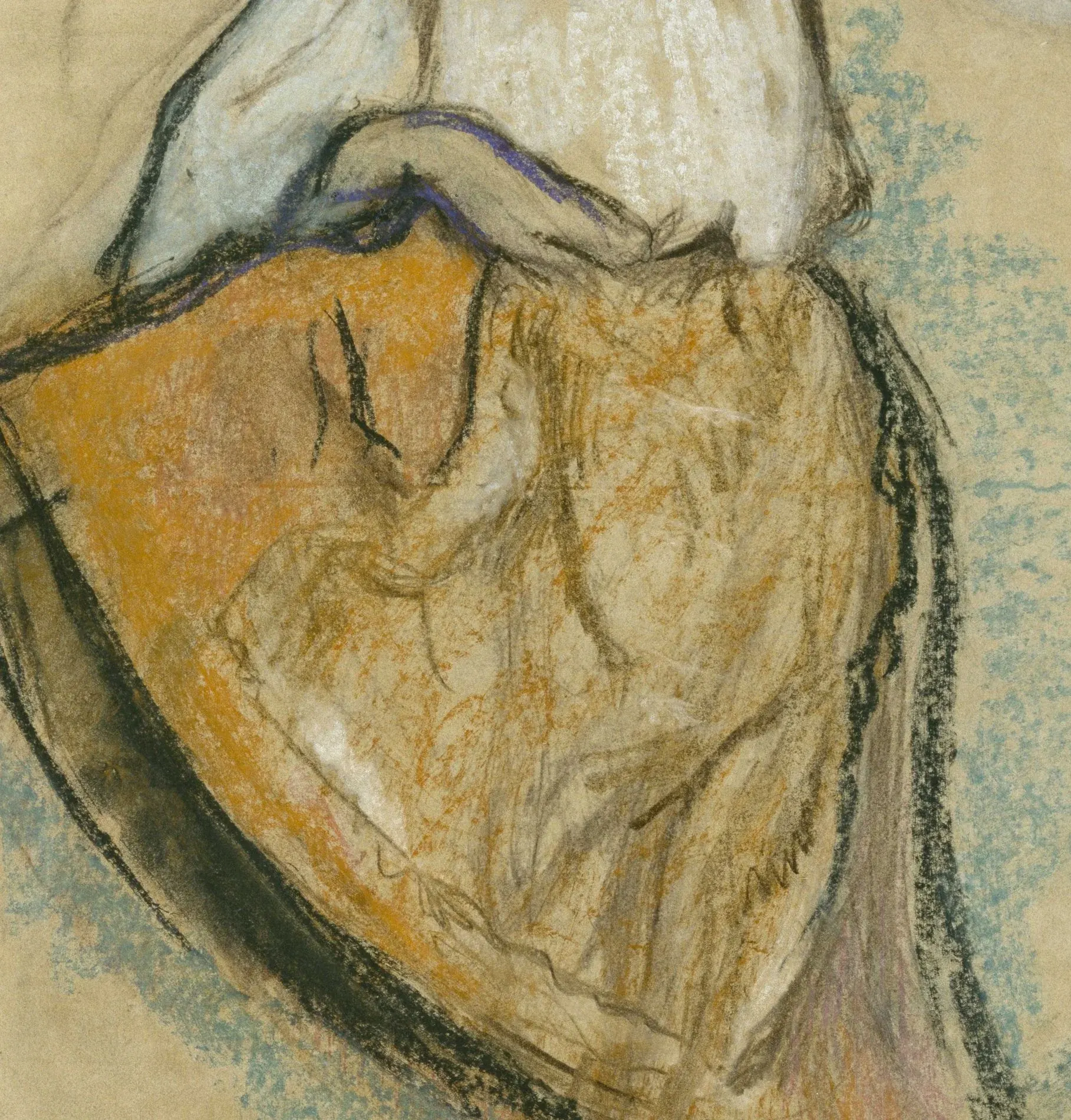
Detail of The Russian Dancer: the orange skirt is not one colour but a stack of them, white and grey dragged over the orange, the paper still showing at the top of every stroke. The black charcoal contour was put back over the whole thing at the end.
Edgar Degas, The Russian Dancer (detail), 1895, The Museum of Fine Arts, Houston. Public domain, Wikimedia Commons.
Trace your own drawings — iterate poses across decades
Traced his own drawings extensively on semi-transparent paper. The tracing was iteration, not duplication. A dancer drawn in 1878 was traced and modified in 1881, retraced and modified in 1885, and the 1885 version re-entered the pool of source material.
Why it matters · Lets the painter redeploy a pose across decades of pictures without the original figure decaying into received convention. Most painters draw a figure once. Degas's system of traced iteration is the cleanest argument for treating drawing as a long-term archive.
Ambroise Vollard, Degas: An Intimate Portrait, translated by Randolph T. Weaver, 1927 — Vollard on the tracings: the public took them for repetition, but the tracing paper was how he corrected himself, each new figure started outside the old outlines so the drawing grew.
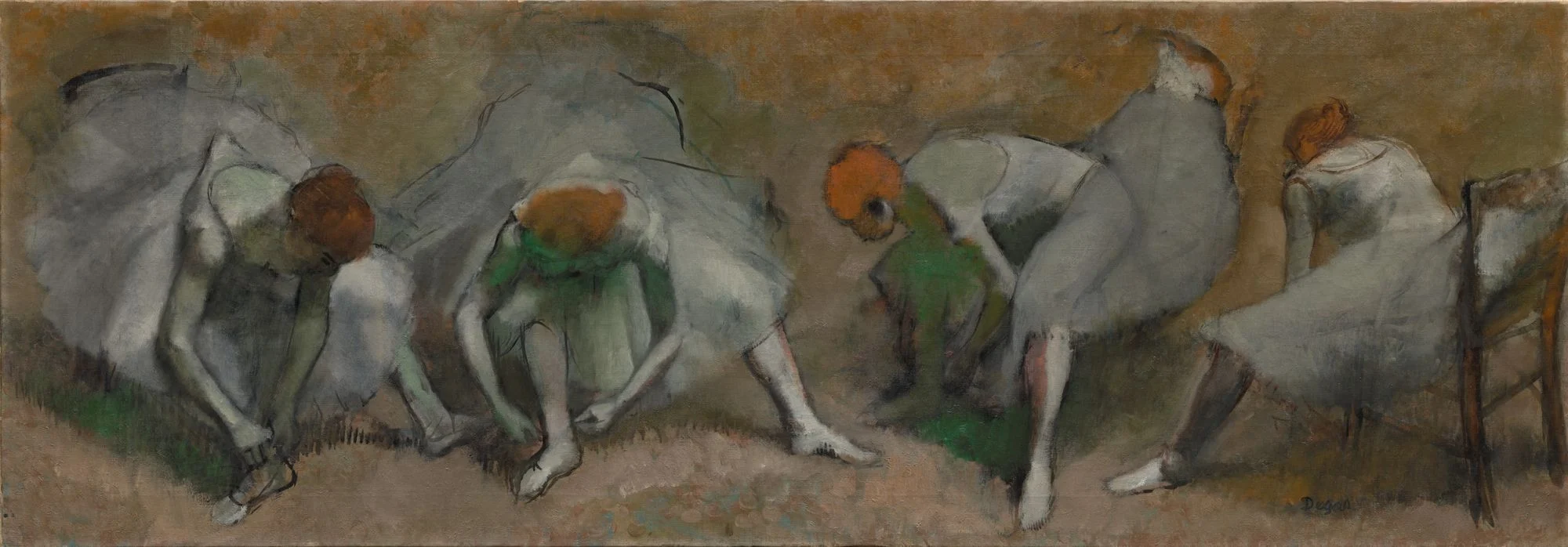
Frieze of Dancers, two metres of canvas: the Cleveland Museum of Art reads it as one dancer seen from four viewpoints, the same bent figure tying the same slipper, moved along the picture. The repetition method is not behind this painting, it is the painting.
Edgar Degas, Frieze of Dancers, 1890, The Cleveland Museum of Art. Public domain, Wikimedia Commons.
Pastel over monotype
Pulled a monotype print (oil-based ink on metal plate, printed on dampened paper) and used the tonal ghost as a structural armature for pastel work laid directly over the dried ink.
Why it matters · The monotype gives a compositional and tonal base the pastel fills in. Many "counterproofs" — second impressions with almost no ink remaining — are almost invisible under the finished pastel. Painters who do not combine media miss what one medium can supply for the next.
Build sculpture and painting in parallel
For dancers and horses, modeled a three-dimensional version of the figure in wax at the same time he was painting the two-dimensional version. The sculpture and the painting informed each other.
Why it matters · The painted figure inherits the sculptural grasp of three-dimensional form; the sculpted figure inherits the specific gesture the drawings had isolated. Painters who never sculpt have trouble making bodies weigh.
In the studio
Edgar Degas, photographic self-portrait, c. 1895 — taken by Degas himself in his Paris studio
Studio
Light
Controlled artificial light: gas-light, oil-lamp, moonlight simulation. Studio backstage of Paris Opéra, racetracks at dawn or dusk for racing scenes, private bathroom interiors.
Position
Studio working — refused plein-air. Worked across many media on a single sheet at times.
Session length
Working method built around iteration over decades. Same motifs (dancers, laundresses, women bathing, horses) returned to repeatedly.
Tools
Bottles of fixative, turpentine, blotting paper, scrapers · Custom shellac-based spray fixative for between pastel layers · Drying prints, monotype plates, wax figures on armatures · Wire armatures from found objects: corks, wine bottles, pieces of wood · Soft pastel sticks · Personal photograph collection (camera + Nadar prints) for poses life models could not hold
Notes
Studio described as a laboratory by visitors (Valéry, Halévy, Sickert). Eyesight deteriorated progressively from the 1880s. Late work in pastel, sculpture, and monotype is in part a direct response to failing vision.
Source: Paul Valéry, Degas, Danse, Dessin, 1938
Palette
Ground
Paper, board, prepared muslin, canvas — chosen by medium. Monotype plates as compositional bases for pastel.
Whites
Lead white
Earths
Standard earth range
Colors
Cadmium yellow · Cadmium orange · Vermilion · Viridian · Emerald green · Cobalt blue · Cerulean · French ultramarine · Adjacent mid-tones rather than strong chromatic contrasts
Medium
Multiple within a single work: pastel, distemper, peinture à l'essence, tempera, monotype, oil. Layered fixative-glazed pastel; essence-stripped oil; oil-based monotype ink.
Source: Theodore Reff, The Notebooks of Edgar Degas, 1976
Workflow, from blank canvas
1. The drawn study
Charcoal, pastel, graphite, ink drawings from the model in the studio under artificial light. Pose studied across many sheets, each with slight variations, until the specific "arabesque" had been internalized.
Why: Multiple studies grouped on a single sheet is the signature Degas sketchbook page.
2. The tracing
Traced his own drawings on semi-transparent paper. Each tracing modified — the previous version re-entered the pool of source material for the next.
Why: Iteration without the original figure decaying into received convention.
3. Transfer and composition
Composed image transferred to the final support (paper, board, canvas, monotype plate) by squaring up or direct tracing.
Why: Composition almost never worked out on the final support from scratch.
4. The medium pass
Pastel, essence, distemper, or oil applied in the layered method the specific medium required. Multiple fixed pastel layers; fast thin essence passes; tonal dead-coloring under final oil colour.
Why: Each medium has its own working logic; Degas matched the method to the medium per work.
5. Sculptural feedback
For dancers and horses, modeled three-dimensional version in wax at the same time as the two-dimensional version.
Rarely declared a work finished. Considered every painting and pastel a "moment in an unfinished longer project." Asked to borrow works back for further work as late as thirty years after sale.
Why: The unit of completion is not the work but the ongoing investigation.
How they studied
Degas trained on line, and he kept training on it long after the schooling stopped. On 7 April 1853, at eighteen, he was granted permission to copy in the Louvre, and he was still copying there in middle age. In April 1855 he entered the studio of Louis Lamothe, a former pupil and loyal follower of Ingres, which is how the Ingres discipline of line reached him at one remove. He met Ingres himself that year, and the account he gave Vollard is not the famous one about drawing lines. He had a letter of introduction, he could not say how excited he was at the prospect of meeting the great Ingres, and just as he was leaving the old man was taken with a dizzy spell and began to reel, so Degas caught him before he fell. The advice that became his motto, to make lines and more lines from nature and from memory, comes down through the memoirs rather than through any record of that visit, and the wording differs between accounts. Then came Italy, from 1856 to 1859, Naples and Rome and Florence, and notebook after notebook of copies. Asked much later how a painter should learn the trade, he told Vollard the painter should copy the masters and re-copy them, and after he has given every evidence of being a good copyist, he might then reasonably be allowed to do a radish, perhaps, from Nature.
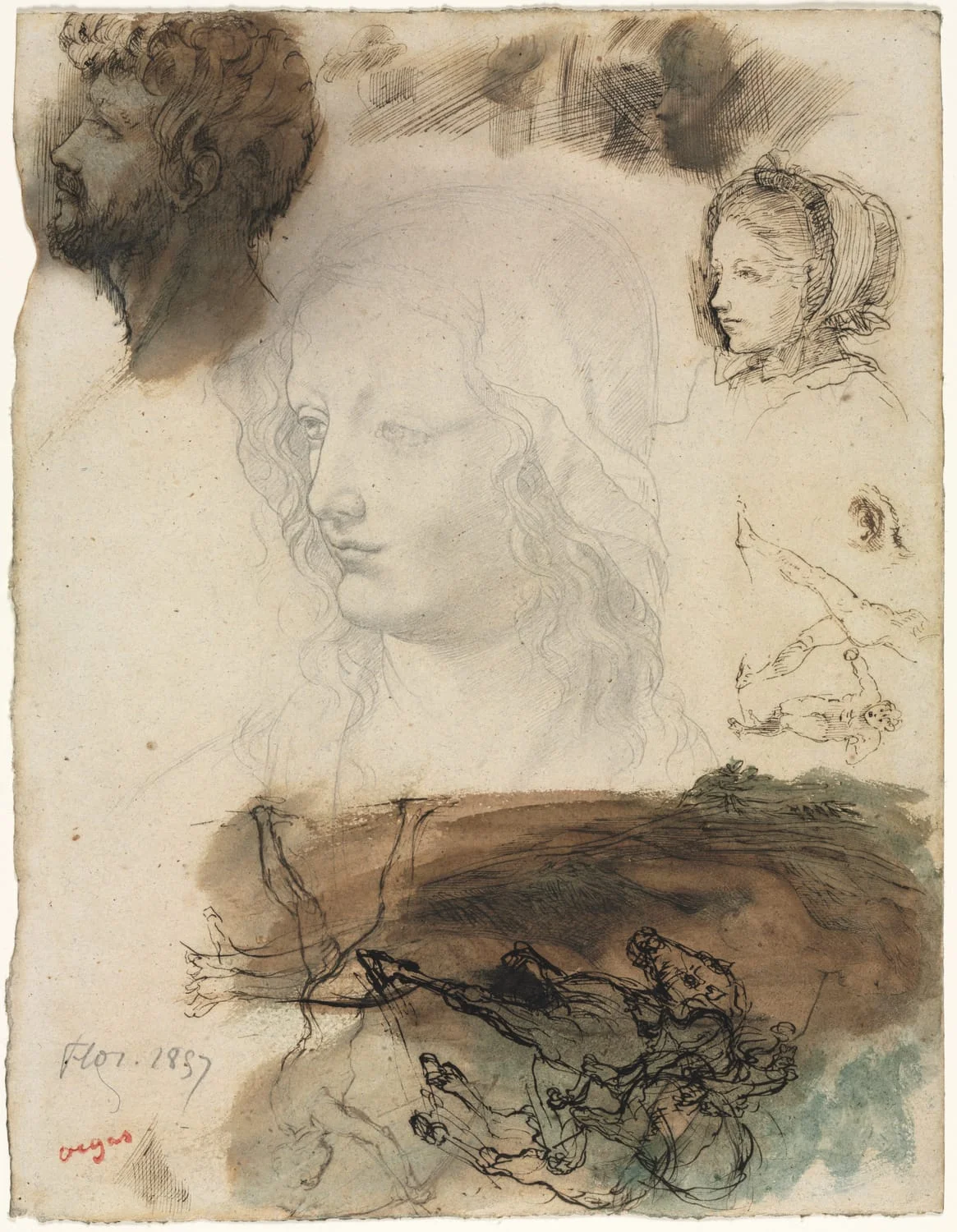
Sheet of Studies and Sketches, from the Florence years: the large head in graphite is copied from a drawing then given to Leonardo in the Uffizi, and the smaller sketches around it are his answers to Florentine sculpture, with a small portrait from life at upper right. He wrote Flor. 1857 on it himself, years later and a year out.
Edgar Degas, Sheet of Studies and Sketches, 1858, The Cleveland Museum of Art. Public domain, Wikimedia Commons.
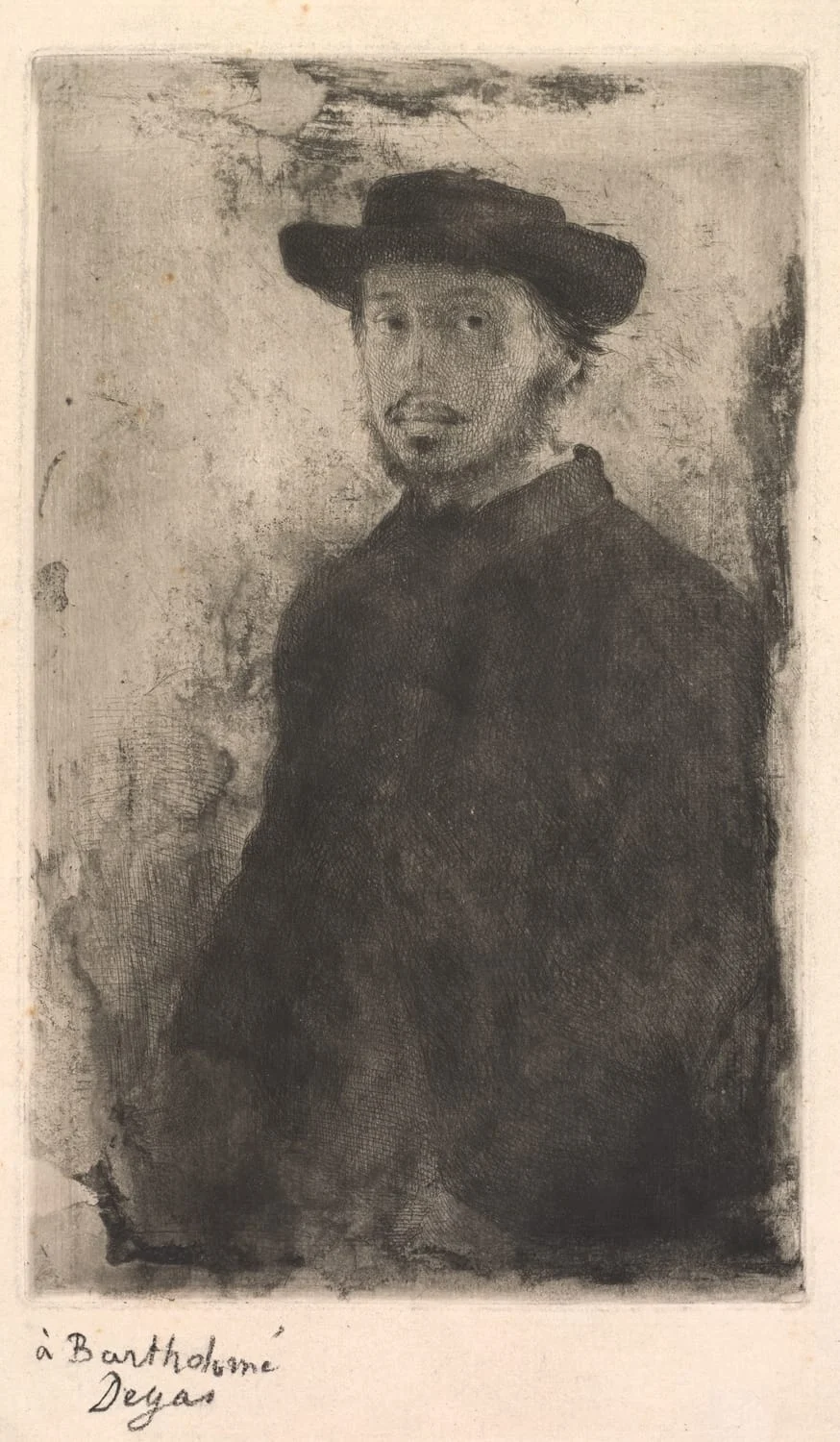
Self Portrait, 1857, the only printed self portrait he ever made. The dark is built by biting the plate again and again and by layers of crosshatching, and he wiped the copper by hand before printing to get the air around the head. He was in his early twenties, twenty years before the monotypes.
Edgar Degas, Self Portrait, 1857, The Cleveland Museum of Art. Public domain, Wikimedia Commons.
Source: The Louvre copying permission of 7 April 1853 and the entry to Louis Lamothe's studio in April 1855: the Degas timeline, National Gallery of Victoria, Melbourne. Degas on the visit to Ingres and on copying the masters: Ambroise Vollard, Degas: An Intimate Portrait, translated by Randolph T. Weaver, 1927. The line attributed to Ingres is reported, not documented from the meeting; it reaches us through Paul Valery, Degas Danse Dessin, 1936, and the wording varies between accounts.
Up close
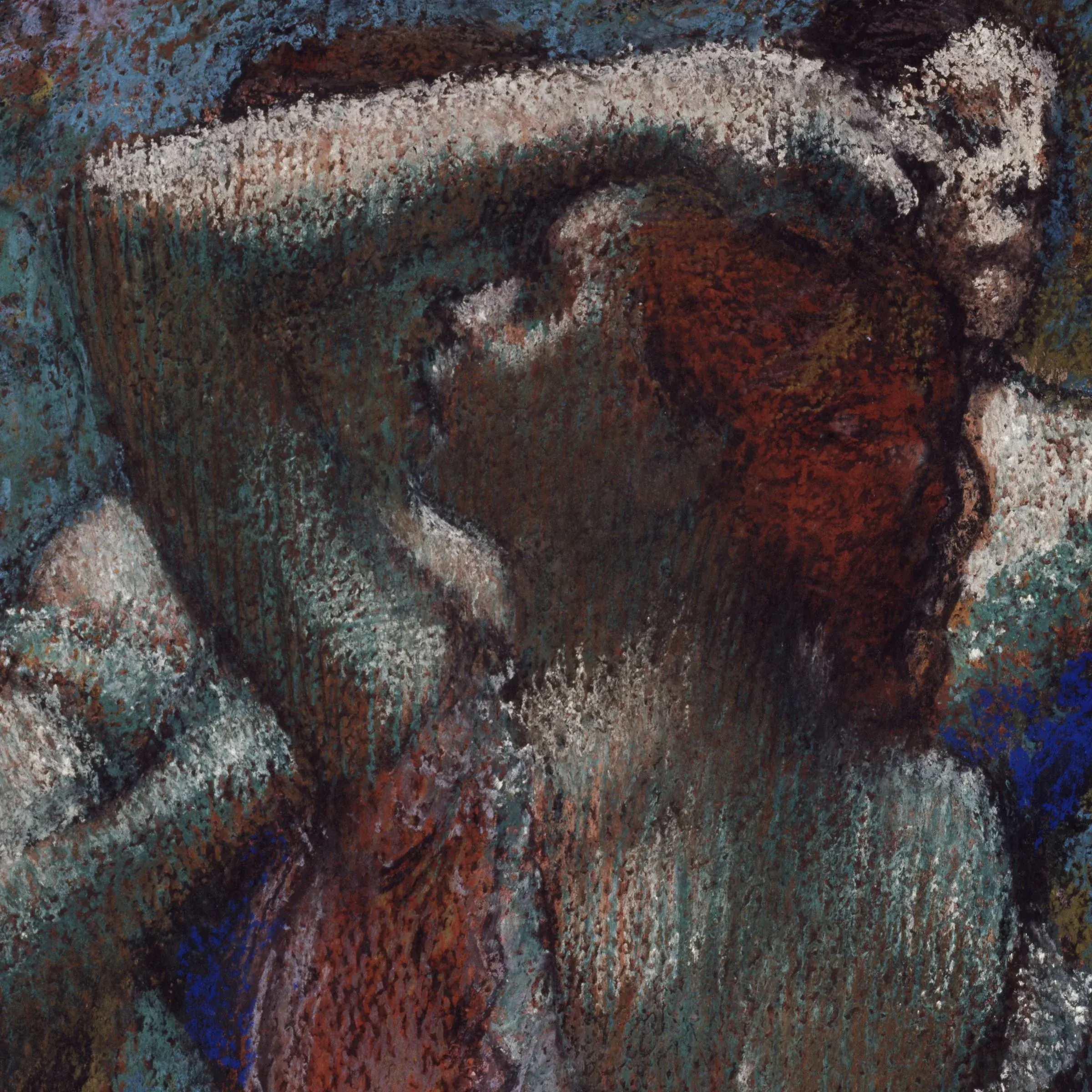
Detail of Dancers: pastel hatched over pastel, green over red over blue, every layer sprayed and set before the next one goes down so it holds instead of smearing. The sheet underneath is tracing paper, which is what most of the late pastels were drawn on.
Edgar Degas, Dancers (detail), 1894 to 1904, Princeton University Art Museum. Public domain, Wikimedia Commons.
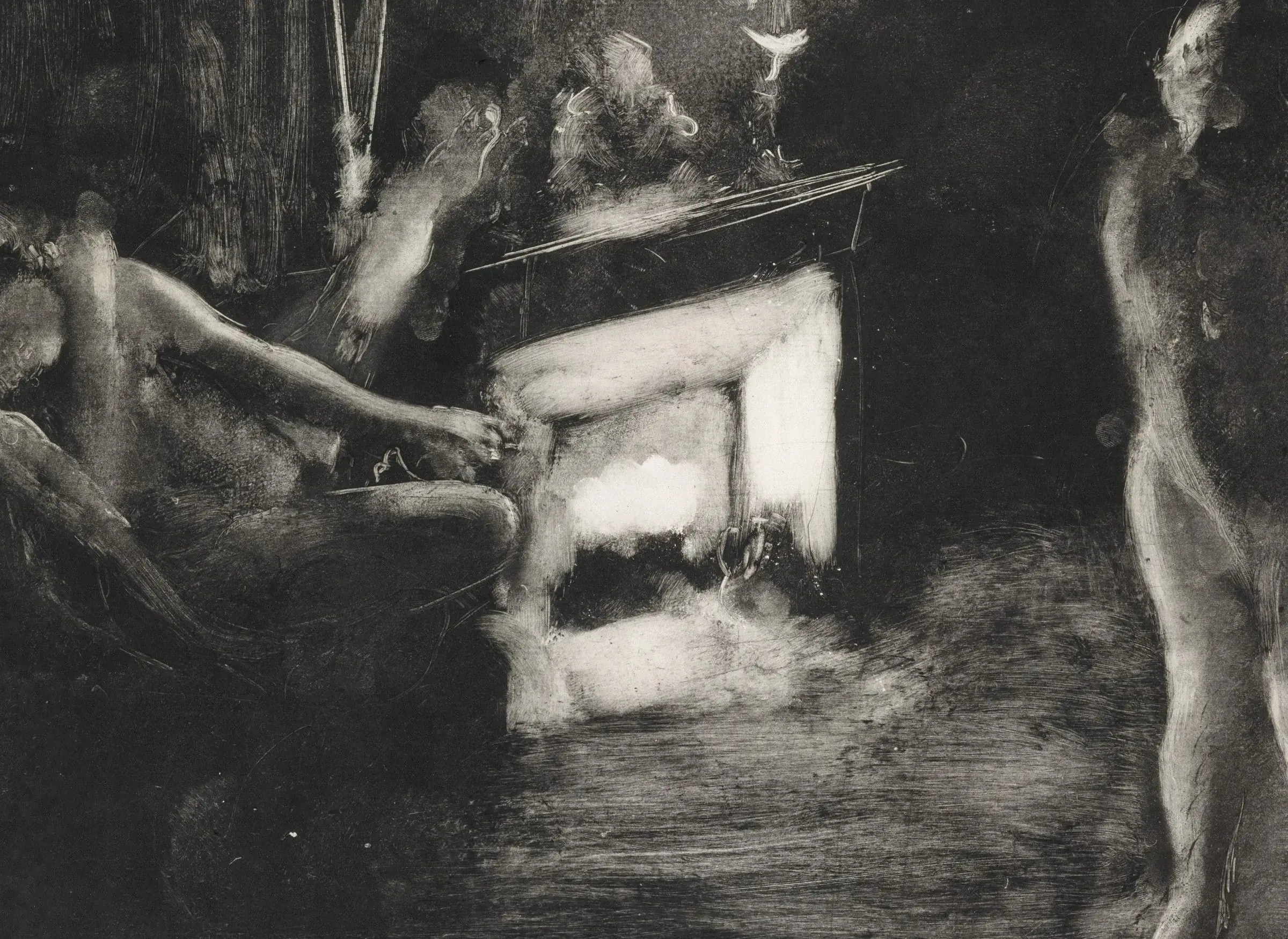
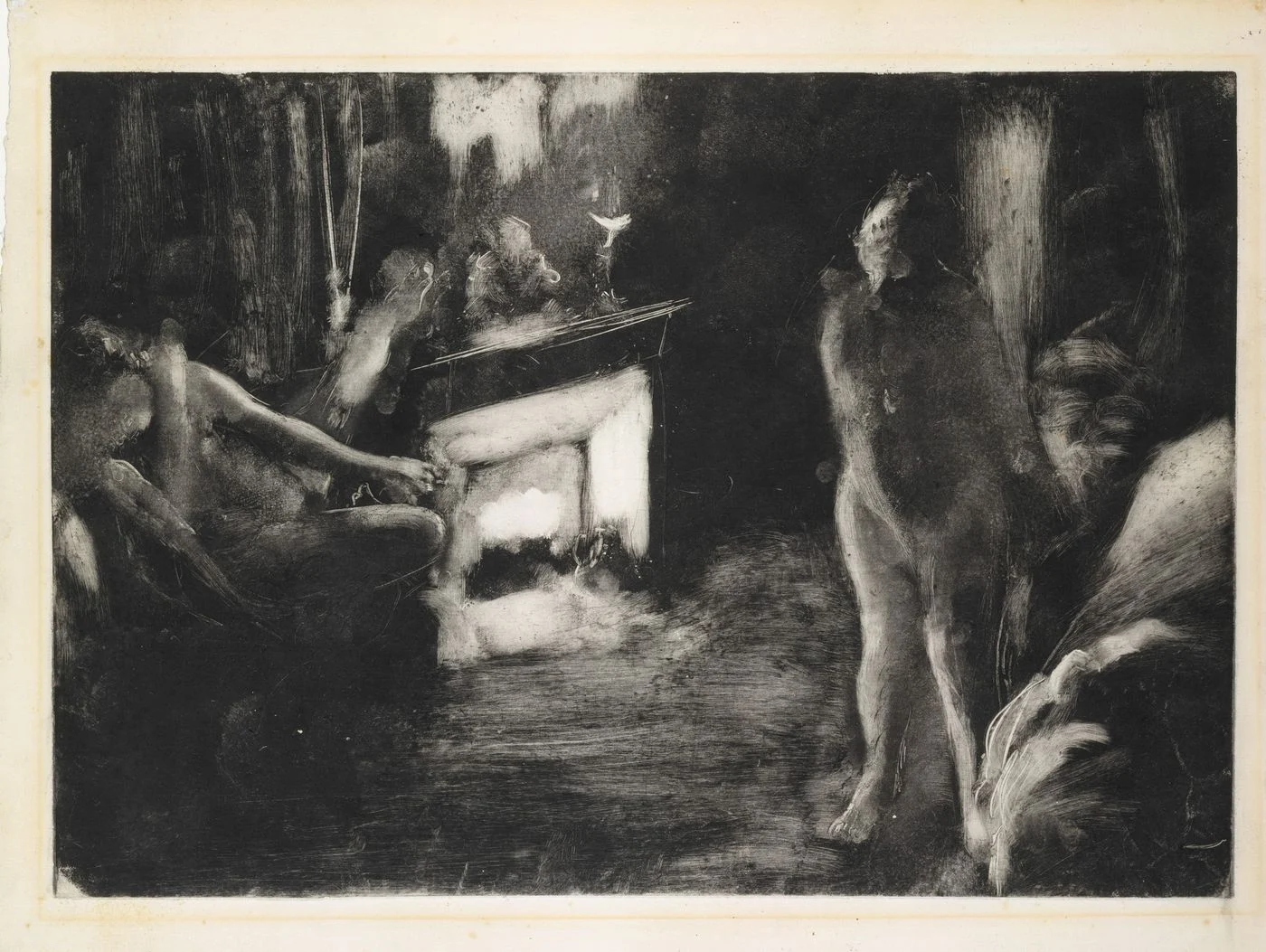
Detail of The Fireside: a monotype pulled from a plate covered in black ink, where every light in the picture was made by taking ink away. The fire, the woman's back and the arm reaching toward it are wiped out with rag, brush and thumb, not drawn in.
Edgar Degas, The Fireside (detail), about 1876 to 1877, The Metropolitan Museum of Art, New York. Public domain, Wikimedia Commons.
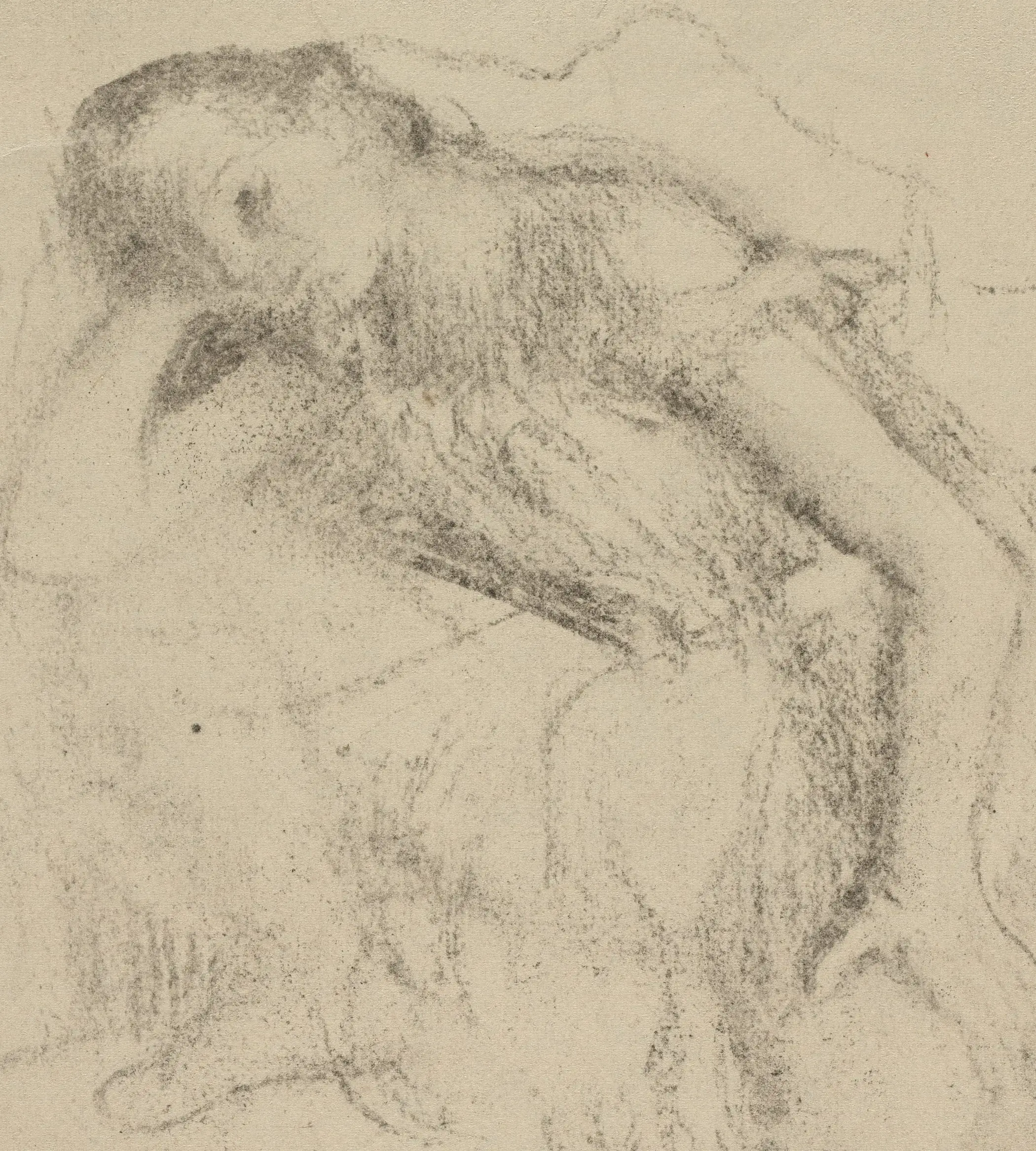
Detail of Dancer at Rest: charcoal alone, the bodice built from short parallel strokes and the paper left doing every light in it. The rejected contours are still lying beside the ones he kept, so the search is visible on the sheet.
Edgar Degas, Dancer at Rest (detail), about 1895, The Cleveland Museum of Art. Public domain, Wikimedia Commons.
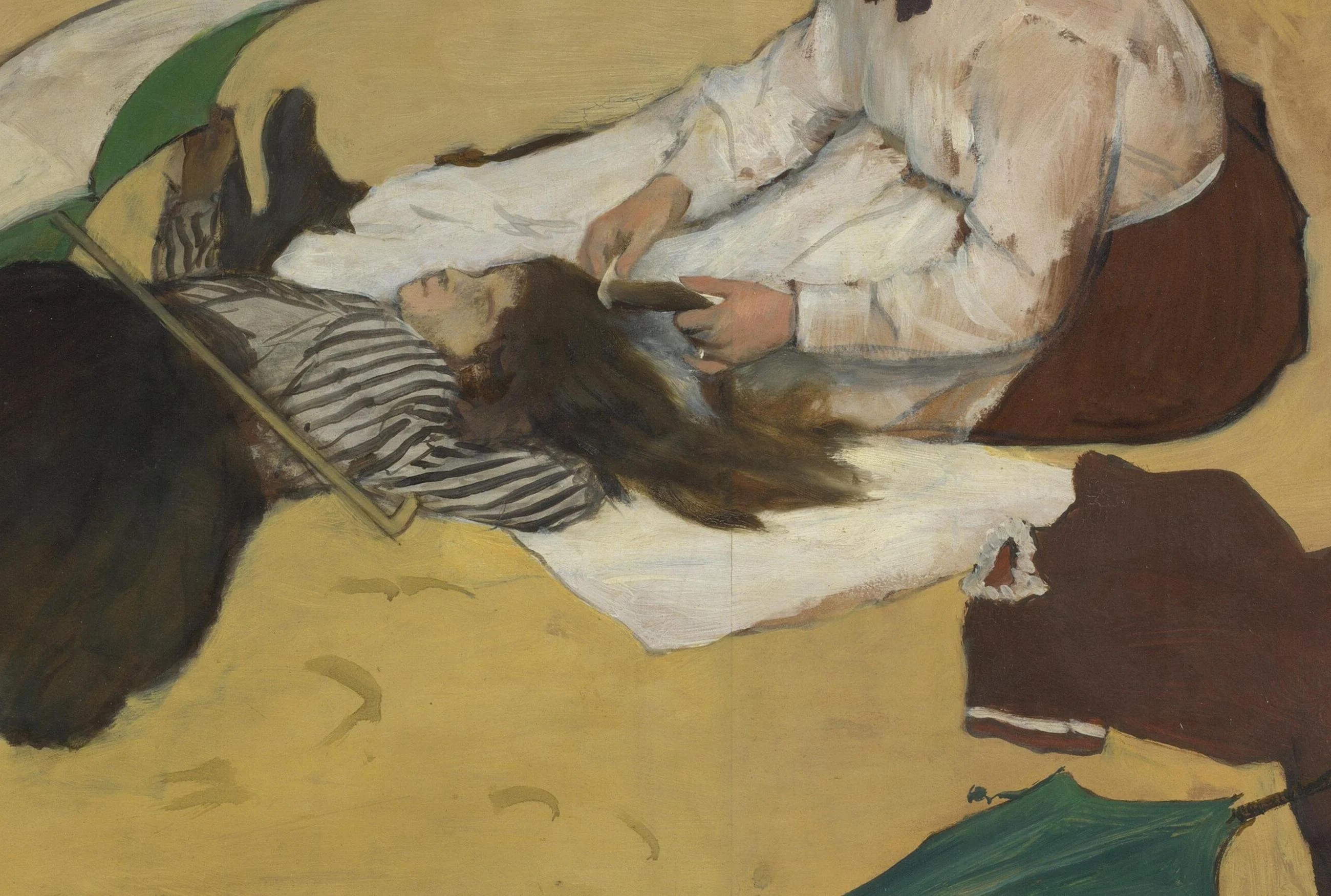
Detail of Beach Scene: essence at close range. The striped bathing dress is a few dry drags, the loose hair one loaded sweep, the sand a thin flat wash with the grain of the paper reading through it, and the join where two sheets meet runs straight down the white cloth.
Edgar Degas, Beach Scene (detail), about 1869 to 1870, The National Gallery, London. Public domain, Wikimedia Commons.
Watching him work
“It is strange, for I assure you no art was ever less spontaneous than mine. What I do is the result of reflection and study of the great masters; of inspiration, spontaneity, temperament, temperament is the word, I know nothing.”
Edgar Degas, to George Moore, George Moore, Impressions and Opinions, London, David Nutt, pages 313 to 314, 1891 [source]
Across media
The Fireside, one of the largest monotypes he made, the plate forty two by fifty eight centimetres: printing ink rolled over metal, the image lifted out of it, then run through a press he owned himself. The plate gives one strong impression, and the faint second pull became a ground for pastel.
Edgar Degas, The Fireside, about 1876 to 1877, The Metropolitan Museum of Art, New York. Public domain, Wikimedia Commons.
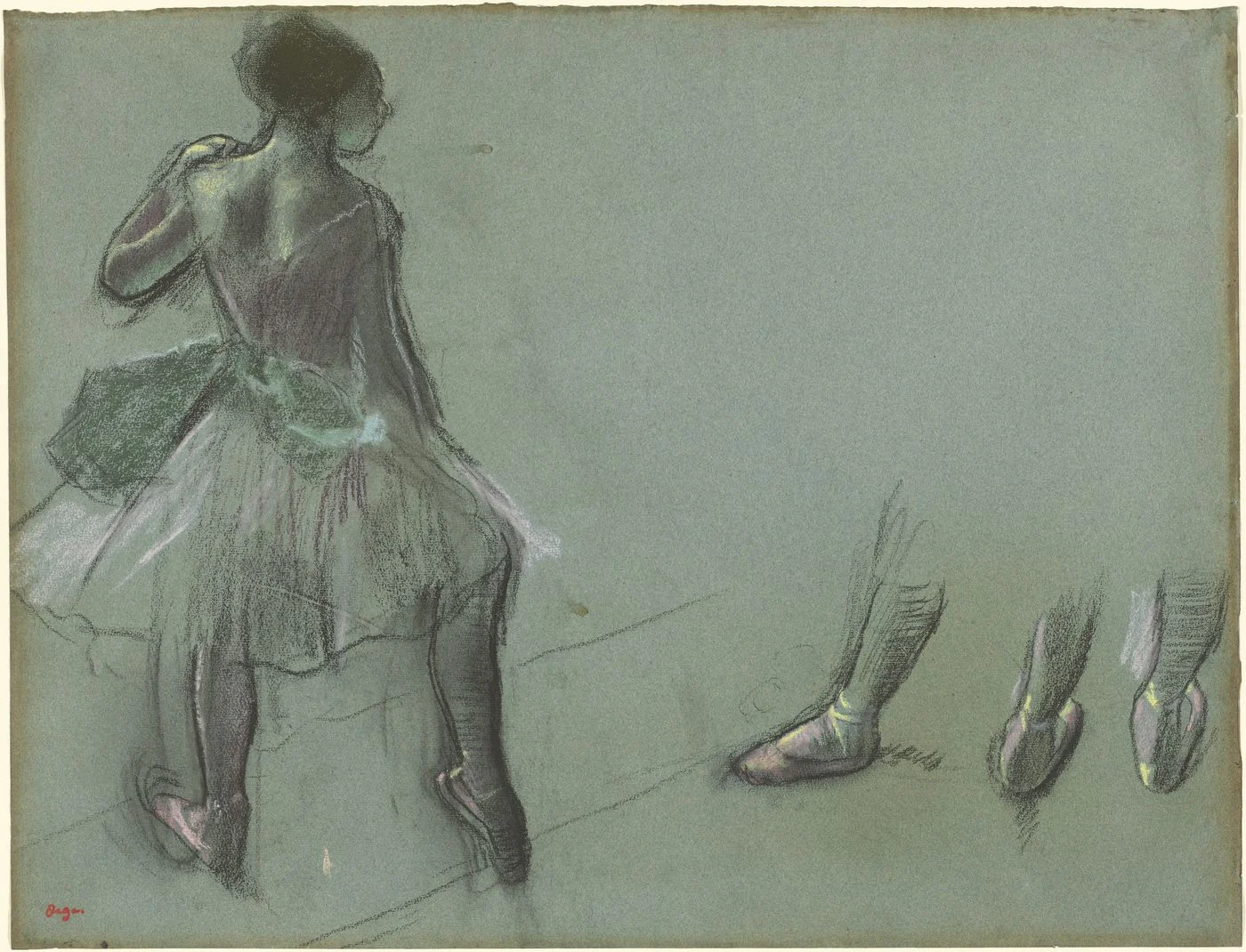
Dancer Seen from Behind and Three Studies of Feet: black chalk and pastel on blue grey paper, with the same foot in its slipper drawn three times across one sheet. He was not illustrating a dancer here, he was learning one shape well enough to use it later.
Edgar Degas, Dancer Seen from Behind and Three Studies of Feet, about 1878, National Gallery of Art, Washington. Public domain, Wikimedia Commons.
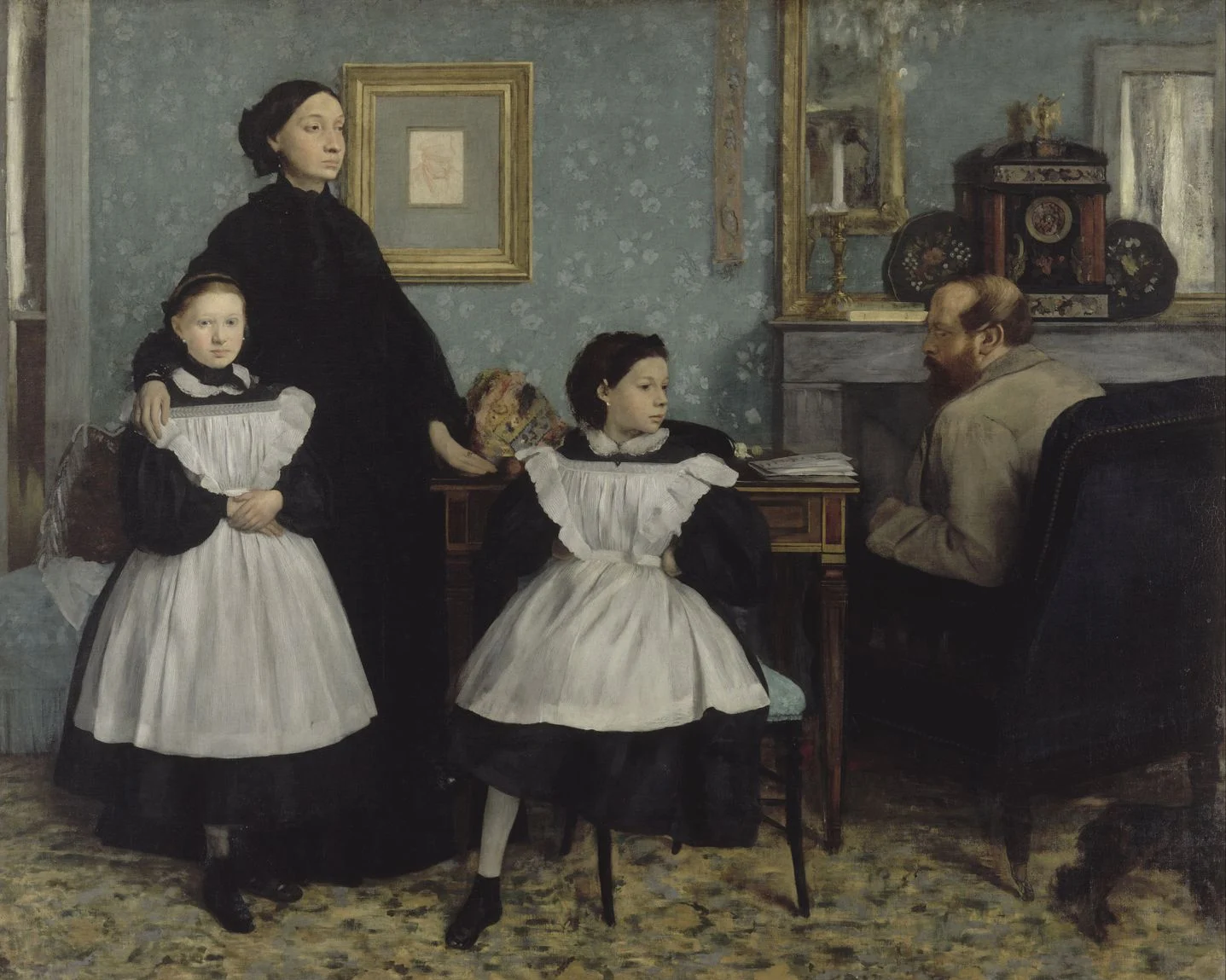
The Bellelli Family, his aunt Laure and her household, drawn in Florence during the Italy years and assembled into the big canvas back in Paris from those studies. This is the classical training still in full command, before the pastels and the monotypes.
Edgar Degas, The Bellelli Family, about 1858 to 1867, Musee d'Orsay, Paris. Public domain, Wikimedia Commons.
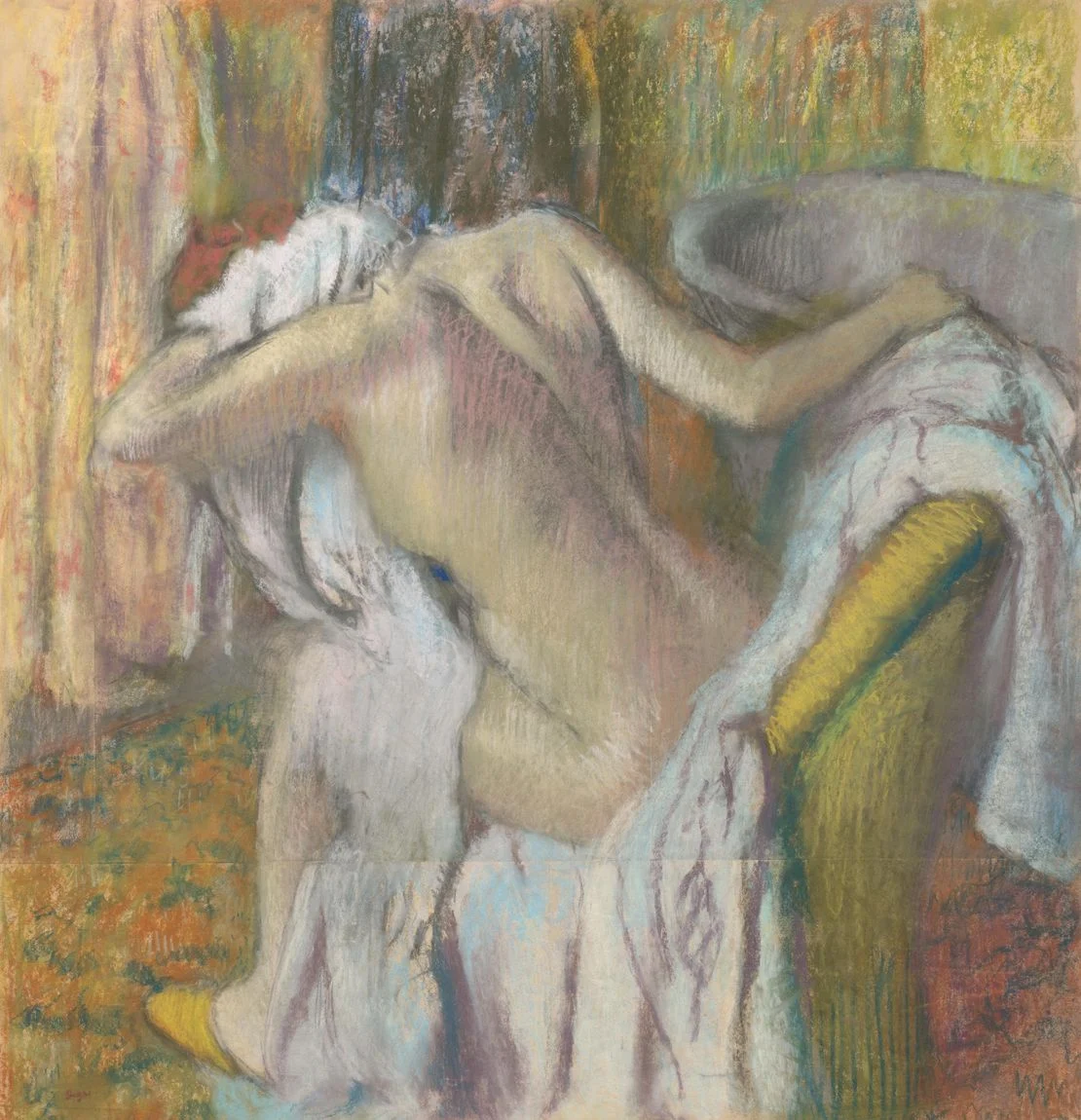
After the Bath, Woman Drying Herself: a late pastel just over a metre tall, on wove paper laid down on millboard, with the joins in the paper still visible across it. The colour goes on in long strokes that never blend, and the drawing is left showing through them.
Edgar Degas, After the Bath, Woman Drying Herself, about 1890 to 1895, The National Gallery, London. Public domain, Wikimedia Commons.
The record, deeper
The money
He left an auction where one of his pictures had just fetched a sensational price and someone remarked on the change from the days when he sold a masterpiece for a hundred francs. Degas asked sharply why he said masterpiece, and said he was sorry those days were over, that he may have been a good horse to bet on but it was just as well he had not known it.
Ambroise Vollard, Degas: An Intimate Portrait, 1927.
Vollard told him he could have all the money he wanted if he would only dig into his portfolios. Degas answered that he hated to sell his work, and that he always hoped eventually to do better.
Ambroise Vollard, Degas: An Intimate Portrait, 1927.
The reworks
He showed Vollard a small wax dancer he had done over for the twentieth time and said one or two days more and it would be ready for the caster. The next day all that was left of her was the original lump of wax. He told Vollard he would not take a bucket of gold for the pleasure of destroying it and beginning again.
Ambroise Vollard, Degas: An Intimate Portrait, translated by Randolph T. Weaver, 1927.
Tracing paper was how he corrected himself, and the correction had a direction. He started the new figure outside the outlines of the old one, so the drawing grew every time it was traced, until a nude no bigger than a hand had become life size and was then abandoned.
Ambroise Vollard, Degas: An Intimate Portrait, 1927.
Infrared reflectography of At the Milliner's found the picture moving under the pastel: wavy lines on the hat stand that ended up further to the right, and a sleeve that had been wider before he narrowed it.
Museo Nacional Thyssen-Bornemisza, technical study of Edgar Degas, At the Milliner's (1882).
One of his own canvases had cracked. He started by asking what the colourmen could have put in the paint, then admitted the fault was his, for having worked over a white lead priming that was still too fresh.
Ambroise Vollard, Degas: An Intimate Portrait, 1927.
What they told students
Gervex was painting an anatomy lecture. Degas asked him whether he had ever seen a student taking notes while the professor is lecturing, and said the man ought to be rolling a cigarette. Vollard says that one change made the picture.
Ambroise Vollard, Degas: An Intimate Portrait, 1927.
On the same painter's Rolla he was blunter. Make it plain the woman is not a model. Where is the dress she has taken off. Put a pair of corsets on the floor near by. The Salon then refused the canvas as indecent, and Degas said nude models are all right at the Salon but a woman undressing never is.
Ambroise Vollard, Degas: An Intimate Portrait, 1927.
A woman told him her son painted and was so sincere about working from nature. Degas asked how old the boy was. Nearly fifteen. So young and already sincere about working from nature, he said, your son is lost.
Ambroise Vollard, Degas: An Intimate Portrait, 1927.
The studio
The studio was a clutter he would not let anyone tidy. A scrap of wrapping paper the size of a piece of confetti came loose and fell on the floor while Vollard was visiting. Degas pounced on it, dug it out of the crack it had lodged in, threw it in the stove, and said he did not like disorder.
Ambroise Vollard, Degas: An Intimate Portrait, 1927.
The day was fixed. Vollard says his life was as ordered and arranged as a sheet of music, that he was in the studio from morning till night, and that when the work went well he hummed some old tune loud enough to be heard on the stair landing.
Ambroise Vollard, Degas: An Intimate Portrait, 1927.
George Moore printed the room in 1891. The door was always strictly fastened and a visitor had to shake it until a voice called from a loophole. Inside there were no Turkey carpets and no Japanese screens, daylight only at the far end where the artist works, the vast canvases of his youth piled up in barricades in the gloom and dust, the great wheels of lithographic presses, and dancing girls modelled in red wax, some of them dressed in muslin skirts.
George Moore, Impressions and Opinions, London, David Nutt, 1891, page 300.
The materials
He would not use shop fixative, because it put a shine on the surface and attacked the colour. He used one made for him by Chialiva, an Italian painter of sheep, and Chialiva died without telling anyone the formula. Vollard names the reason it mattered: the pastels were worked over and over, so each layer had to grip the one under it.
Ambroise Vollard, Degas: An Intimate Portrait, translated by Randolph T. Weaver, 1927, the Technical Details chapter.
Most of his pastels are on tracing paper. Tracing after tracing was the way he worked, so the paper he corrected on became the paper he finished on. Lezin, his framer, glued the sheets down onto bristol board afterwards.
Ambroise Vollard, Degas: An Intimate Portrait, 1927.
He bleached his own pastel sticks before using them. Vollard found him at work on a pastel and Degas said what a devil of a job it is to bleach the colour out of pastel crayons, that he soaked them over and over again and even put them in the sun.
Ambroise Vollard, Degas: An Intimate Portrait, 1927.
The Thyssen conservation department took apart the mount of At the Milliner's. Under the drawing sheet is industrial cardboard seven millimetres thick, faced on both sides with turquoise blue paper, and the drawing paper is attached only at the back, so the surface stays smooth and taut under the pastel stick.
Museo Nacional Thyssen-Bornemisza, technical study of Edgar Degas, At the Milliner's (1882).
Refusals — what they would not do
Refused plein-air painting on principle.
Refused the Romantic/Impressionist self-presentation as spontaneous observer.
Refused to declare works finished — borrowed them back for further work.
Refused to abandon difficult artificial-light subjects in favour of natural-light ones.
Refused single-medium discipline — combined pastel, essence, oil, monotype on single works.
Reference
Primary source
Direct life observation in the studio under controlled artificial light. Backstage at the Paris Opéra (had backstage privileges across decades). Racecourse at Longchamp. Professional models in the studio for the bathers.
Photography
Accomplished amateur photographer from the 1890s onward. Used systematically to study poses live models could not hold — suspended instant of dancer mid-jump, horse mid-gallop. Photograph collection included works by Nadar and by himself.
Exceptions
Personal collection of works by Delacroix, Ingres, Daumier, Manet, Gauguin, Cézanne, Van Gogh, Pissarro — the "Degas collection." Technical reference library as much as aesthetic one.
Ingres line as structural principle — first teacher Louis Lamothe was an Ingres pupil.
Louis Lamothe · from 1855 — École des Beaux-Arts. Lamothe was an Ingres pupil. The Ingres lineage is the decisive formation of Degas's drawing practice — primacy of line, study of figure in controlled light, rejection of impressionistic dissolution of form.
Italian Old Masters (1856–1859) · 1856–1859 — Naples, Florence, Rome. Copying in the Uffizi, particularly Renaissance portraiture and Mannerist figure drawing. The Italian formation gave him a classical armature the Impressionist moment did not overwrite.
Influences
Ingres — through Lamothe, line as structural principle.
Italian Renaissance portraiture and Mannerist figure drawing.
Velázquez and the Spanish tradition (via the Louvre).
Students
No formal atelier; took no paying students.
Walter Sickert — closest working relationship. Spent extended periods in Degas's studio in the 1880s and 1890s. Camden Town painting is the direct transmission of Degas's late studio method to twentieth-century British figurative painting.
Mary Cassatt — close colleague and technical collaborator, particularly in the 1890s monotype and color-print work.
Posthumous lineage runs through Sickert to Lucian Freud and Frank Auerbach. Contemporary figurative atelier movement cites him as a foundational reference for the drawn armature under painting.
In their own words
“Daylight is too easy. What I want is difficult — the atmosphere of lamps or moonlight.”
— Edgar Degas, Recorded by Paul Valéry, Degas, Danse, Dessin
Specific rejection of plein-air painting on technical grounds.
“No art is less spontaneous than mine. What I do is the result of reflection and study of the great masters; of inspiration, spontaneity, temperament, I know nothing.”
— Edgar Degas, Recorded by George Moore, Impressions and Opinions, 1890
Explicit rejection of the Romantic and Impressionist self-presentation as spontaneous observer.
“One must do the same subject over ten times, a hundred times. Nothing in art must seem accidental, not even movement.”
— Edgar Degas, Recorded by Paul Valéry, Degas, Danse, Dessin
Technical rationale for the series method and the tracing system.
“A painting is first of all a product of the imagination of the artist, it must never be a copy.”
— Edgar Degas, Recorded by his friends, various accounts
The position that sits in direct tension with Pissarro's and Monet's direct-observation doctrine.
Lead white, a standard earth range, cadmium yellow, cadmium orange, vermilion, viridian, emerald green, cobalt blue, cerulean, and French ultramarine. He favored adjacent mid-tones rather than strong chromatic contrasts. The medium could be multiple within a single work: pastel, distemper, peinture à l'essence, tempera, monotype, and oil.
What technique is Degas known for?
Layered pastel with fixative between layers. He applied a layer of soft pastel, fixed it with a spray fixative (probably shellac-based), applied the next layer, and fixed that, so mature pastels carry five, six, or more layers with optical depth a single pass cannot produce. He also made peinture à l'essence: he squeezed oil paint onto blotting paper to wick out most of the binder, then restored viscosity with turpentine for a thin, matte, fast-drying film.
Who taught Degas, and whom did he teach?
Louis Lamothe taught him at the École des Beaux-Arts from 1855. Lamothe was an Ingres pupil, and that line (primacy of line, figure study in controlled light) is the decisive formation of Degas's drawing. From 1856 to 1859 he copied Italian old masters in Naples, Florence, and Rome. He ran no formal atelier and took no paying students, but Walter Sickert worked in his studio in the 1880s and 1890s, and Mary Cassatt collaborated with him on monotype and color-print work.
How did Degas start a painting?
With drawn studies from the model in the studio under artificial light: charcoal, pastel, graphite, and ink, the pose repeated across many sheets with slight variations. He then traced his own drawings on semi-transparent paper, modifying each tracing, and transferred the composed image to the final support by squaring up or direct tracing. He almost never worked out a composition on the final support from scratch.
What would Degas refuse to do?
Paint plein-air. He said daylight is too easy and wanted the difficult atmosphere of lamps or moonlight. He also refused to declare works finished (he asked to borrow pieces back for further work as late as thirty years after sale) and refused single-medium discipline, combining pastel, essence, oil, and monotype on single works.
What did Degas paint on?
Paper, board, prepared muslin, or canvas, chosen by medium. He also used monotype plates as compositional bases: he pulled an oil-ink monotype on dampened paper and laid pastel directly over the dried tonal ghost.
If this painter is your match
You believe the painting is one moment in a longer investigation, not an object that finishes. The same subject is worth working for forty years.
Borrow this: Pick a single pose, object, or arrangement and draw it every day for a month. Trace each drawing the next day and modify the tracing. Work across media — charcoal, pastel, ink, gouache. Do not try to finish any of them.
George Moore, Impressions and Opinions (London, David Nutt), 1891. Moore knew Degas in Paris and printed the Degas essay here. Page 300 carries the first hand description of the studio, pages 313 to 314 carry Degas on his own art, and page 312 records that he made numerous drawings and painted from them, never direct from life. Verified against the full text.[link]
Ambroise Vollard, Degas: An Intimate Portrait, translated by Randolph T. Weaver, 1927. Vollard was his dealer and sat in the studio. The copyright page reads COPYRIGHT 1927 GREENBERG PUBLISHER INC, so the English translation is public domain in the United States. Source for the Chialiva fixative, the tracing paper supports and Lezin the framer, the bleached pastel sticks, the wax dancer destroyed after the twentieth reworking, the critiques of Gervex, and the flannel vest under the beach picture.[link]
Museo Nacional Thyssen-Bornemisza, technical study of Edgar Degas, At the Milliner's (1882). Conservation department study. Documents the fixative between successive pastel layers, the semi industrial mount of cardboard and turquoise blue paper, and the compositional changes found by infrared reflectography.
Paul Valéry, Degas, Danse, Dessin, 1938. Valéry was Degas's closest literary friend in the last two decades. The single most important primary literary source on Degas.
Daniel Halévy, My Friend Degas (Degas parle), 1960. Halévy kept a diary of Degas's visits and conversations from 1888 to 1903.
Musée Thyssen-Bornemisza, Technical Study of At the Milliner's (1882), 2017. Conservation department analysis. Documents the layered-pastel-with-fixative method, the paper support, and the sequence of compositional revisions.
Theodore Reff, The Notebooks of Edgar Degas (2 vols.), 1976. Scholarly edition of the 38 surviving Degas notebooks (1853–1886).
Metropolitan Museum of Art: Degas Studies Online. Met online scholarly resources on the Degas holdings — wax sculptures, monotypes, conservation studies of pastels and essences.[link]