Painters
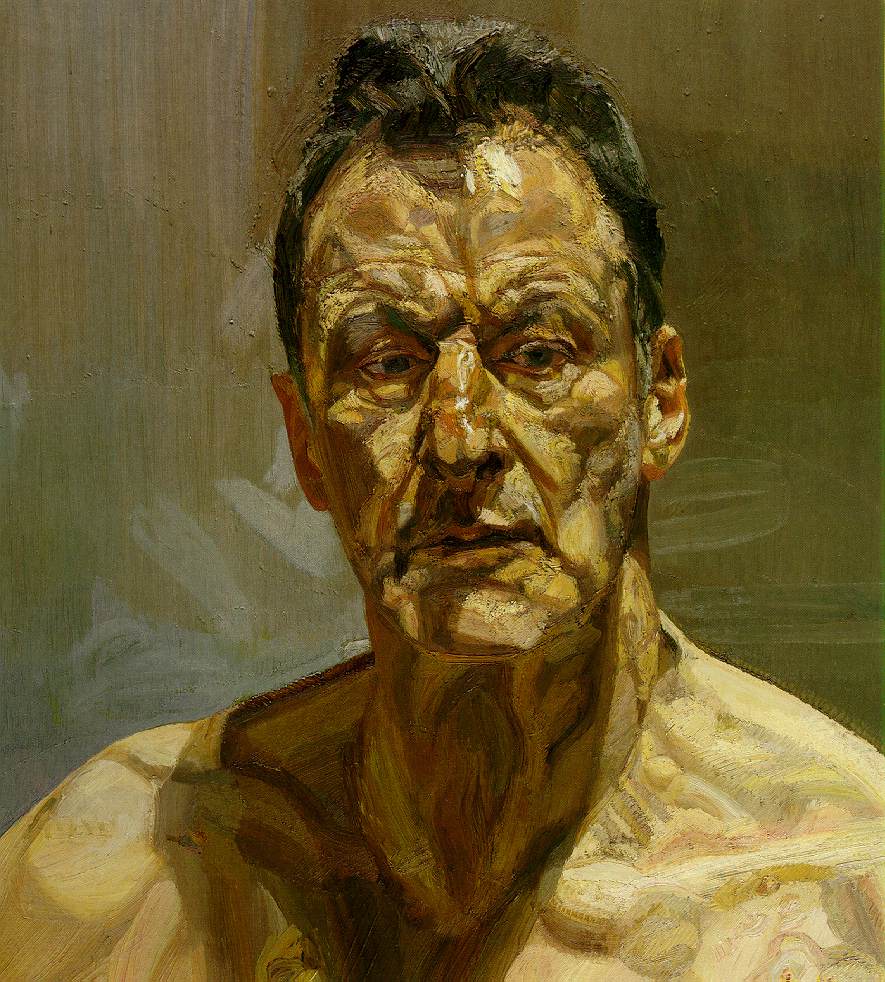
Reflection (Self-Portrait) (1985) by Lucian Freud
Lucian Freud, Reflection (Self-Portrait), 1985 · © The Lucian Freud Archive / Bridgeman Images · educational reference

Lucian Freud

19222011 · England

A British painter who worked exclusively from life in marathon sittings of hundreds of hours, used Cremnitz lead white and pure hog-bristle brushes for his thick late-period flesh impasto, and refused all photographic reference.

Signature moves

Cremnitz white as the structural foundation

Built every flesh passage on a foundation of Cremnitz white — a dense, slow-drying lead carbonate manufactured to a 19th-century specification — long after the pigment had been abandoned by most contemporaries for toxicity.

Why it matters · A pigment is not a substitute for another pigment. Cremnitz white has a body and a refractive index that titanium cannot reproduce. Freud kept it because the flesh he wanted to paint required exactly that material. Painters who substitute on convenience produce the wrong painting.

William Feaver, The Lives of Lucian Freud (Vol. II), 2020

Painted standing, sitter at arm's reach

Worked standing at the easel, with the sitter posed close enough that he could touch the surface he was painting. Eye level matched the sitter's eye level for the entire session.

Why it matters · Distance to the subject is a methodological choice, not an accident. Freud's arm's-reach setup is the structural opposite of Sargent's twelve-foot retreat — both are committed positions about how flesh is to be observed. The middle distance is the one that produces nothing.

One painting at a time, hundreds of hours

Refused parallel commissions. Worked on a single canvas across months and sometimes years, with the sitter present for every session. The painting of David Hockney took 120 hours over four months.

Why it matters · A face does not yield to short attention. The hundredth hour shows you the sitter's attention has dropped its first masks. Freud's discipline was to keep the sitter in the room until that happened. Painters who finish a portrait in a week paint the masks.

David Hockney interview, 2002 — On sitting for Freud — 120 hours over four months.

Charcoal first, paint forward from the drawing

Began every painting with a charcoal drawing of the head or figure on the raw canvas — sometimes worked on the drawing for several sessions before the first paint went down.

Why it matters · The drawing is the painting's structure. Painters who skip directly to color have no skeleton; the paint floats. Freud's charcoal stage was load-bearing. The drawing was the painting before any paint touched it.

William Feaver, The Lives of Lucian Freud (Vol. II), 2020

Refused to paint anyone he did not know

Worked only from sitters with whom he had a personal relationship — children, lovers, friends, neighbors. Turned down major commissions when the sitter was a stranger.

Why it matters · Observation requires intimacy that a photograph cannot supply and that a stranger will not yield. Freud's refusal of commission portraiture was a methodological position about what observation actually requires. Painters who paint strangers paint surfaces.

William Feaver, The Lives of Lucian Freud (Vol. I), 2019
Studio
Light
North-facing skylight, Holland Park studio, London. Bare bulb at night when sittings ran past dark.
Position
Standing at the easel, the sitter posed within arm's reach. Eye level matched to the sitter's.
Working distance
Close — within touching distance of the canvas and the sitter both. The opposite of the academic retreat.
Session length
Two to four hours per sitting; sometimes longer. The same sitter required for every session over months.
Tools
Hog-bristle brushes (long-handled, stiff, square-ended) · Charcoal sticks for the underdrawing · Palette knife for scraping back when a passage failed · Single bare bulb for night work
Notes
The studio was famously filthy — paint-smeared walls, stained rags piled on chairs, the sitter's couch sometimes worked into the painting itself as ground. The mess was deliberate; he refused to clean it.
Source: William Feaver, The Lives of Lucian Freud (Vol. II), 2020 — Feaver was Freud's authorized biographer and a frequent studio visitor across decades.
Palette
Ground
Stretched canvas, prepared white. No tinted ground; the white was visible through thin early layers.
Whites
Cremnitz white (his signature material — lead carbonate, dense, slow-drying) · Flake white when Cremnitz unavailable
Earths
Yellow ochre · Raw umber · Burnt sienna · Terre verte
Colors
Cadmium red · Cadmium yellow · Cobalt blue · Ultramarine
Blacks
Ivory black
Medium
Pure tube oil. Sparing turpentine for the earliest thin block-in only — no medium thereafter. Layers built up wet-into-wet within a session and dry-over-dry across weeks.
Quantity
Generous palette. Refreshed each session. Cremnitz white set out in particular abundance — the late portraits used pounds of it per painting.
Source: William Feaver, The Lives of Lucian Freud, 2020 — Vol. II includes detailed material accounting from late-career works.
Workflow, from blank canvas
  1. 1. Charcoal drawing on raw canvas

    Drew the head or figure directly on the white canvas in charcoal. Worked on this drawing across multiple sessions before any paint went down.

    Why: The structure is established here. Skipping the drawing produces a painting without a skeleton.

  2. 2. Thin block-in with sparing turpentine

    Laid in the masses with thin paint and a small amount of turpentine — establishing tonal architecture before color decisions.

    Why: Value before color. The block-in is the painting's key; everything after sits in this register.

  3. 3. Build the impasto session by session

    Layered Cremnitz-white-loaded paint in increasingly thick passages, working wet-into-wet within each session and letting weeks pass between layers.

    Why: Flesh is built, not described. The thickness records the hours of observation; thin paint cannot hold that record.

  4. 4. Reserve the face for last

    Painted the body, the hands, the surroundings before resolving the face. The face emerged in the final third of the painting's lifespan.

    Why: A face painted first locks in a reading the rest of the painting then has to accommodate. Freud reversed the order — let the body inform what the face is.

  5. 5. Stop when the sitter has been seen

    Ended the painting when the cumulative observation had resolved into something specific — not when every inch was finished to the same level.

    Why: A portrait is finished when its observation has been completed, not when its surface has been polished. Resolving everything equally produces a death mask.

Refusals — what they would not do
  • Refused all photographic reference, including for environment and clothing.
  • Refused commission portraits where the sitter was a stranger.
  • Refused medium other than sparing turpentine for the block-in.
  • Refused to paint multiple canvases in parallel — one painting at a time.
  • Refused to clean the studio — the dirt and stains were part of the working environment.
Reference
Primary source
Live sitter, posed within arm's reach in the studio across hundreds of hours per painting.
Photography
Refused photography. Considered it incapable of supplying the observation he needed.
Exceptions
  • Animal paintings — horses, whippets — were painted from life when possible, but accepted brief reference photographs when the animal would not hold a pose.
Lineage
Teachers
  • Cedric Morris · 1939Briefly studied at Morris's East Anglian School of Painting and Drawing. Morris's loose figurative practice was rejected; the lesson Freud took was the discipline of working from life and the refusal of academic prescription.
  • Goldsmiths College and the Central School · 1942–1943Brief formal training. Freud was largely self-directed; institutional training shaped him through what he refused, not what he absorbed.
Influences
  • Albrecht Dürer — the Northern realist tradition of unsparing portraiture; the silver-point and linear discipline that informs Freud's charcoal stage.
  • Frans Hals and Rembrandt — the wet-into-wet alla prima of the Dutch Golden Age, observed and translated into a slower lifelong sustained-observation practice.
  • Francis Bacon — close friend in the 1950s; the conversation between their two practices shaped both.
Students
  • Did not teach formally. The "School of London" — Auerbach, Kossoff, Andrews, Kitaj — was a peer group with whom Freud worked in close conversation rather than a teacher-student lineage.
In their own words
I want paint to work as flesh.
Lucian Freud, Recorded interview, quoted by William Feaver
I would wish my portraits to be of the people, not like them.
Lucian Freud, Some Thoughts on Painting, Encounter magazine, 1954
My work is purely autobiographical. It is about myself and my surroundings.
Lucian Freud, Recorded interview, quoted by William Feaver
Techniques and practices
cremnitz-white-impasto
hog-bristle-brush
marathon-sitting
standing-painting-practice
No-Medium Direct Oil
Painting in pure oil color straight from the tube, without linseed, turpentine, or glaze medium—a refusal of the thin-layered academic approach.
charcoal-underdrawing
private-sitter
If this painter is your match

You share Freud's instinct that observation requires an intimacy and a duration that most painters refuse to commit to — and the discipline to stay with one painting until the sitter has actually been seen.

Borrow this: For your next portrait, set a calendar for at least eight sittings of two hours each with the same person. Refuse all photographic reference. Begin with charcoal alone for the entire first session. Do not pick up a brush until the second.

Adjacent painters
Isaac Levitan18601900
The Peredvizhniki lyricist who invented the Russian mood landscape by trusting memory over direct observation and finishing paintings by knowing when not to touch them.
Ivan Kramskoy18371887
The intellectual strategist of the Peredvizhniki, whose studio ran on analytical silence, early photographic reference, and the conviction that a portrait was a biography rather than a likeness.
William-Adolphe Bouguereau18251905
The Parisian academic master who ran his studio on a factory schedule—7 AM until dark, no lunch break—and resolved every figure, every fold, and every leaf in preparatory studies before a single brushstroke landed on the final canvas.
Lawrence Alma-Tadema18361912
The Dutch-born Victorian archaeologist-painter who built a private library of five thousand photographs of Roman ruins, reconstructed marble and bronze from the actual excavations at Pompeii, and resolved every canvas as if he were producing forensic evidence that the ancient world looked exactly the way it did.
Shared the workbench
Other researched painters who used at least one of Freud’s techniques.
John Singer Sargent18561925
The late-nineteenth-century portraitist who worked in sight-size from a north-lit London studio, standing, in pure oil color without medium—placing each mark from six to twelve feet away and scraping the canvas to the ground when a passage failed.
Diego Velázquez15991660
The Spanish court painter who built portraits on brown-tinted grounds with economical opaque scumbles and long-handled brushes, leaving the preparation layer visible in the halftones as a working color.
Anders Zorn18601920
The Swedish virtuoso who painted standing in north-lit studios from a four-color palette, built transparency into his darks through red-and-black washes, and resolved skin tones by painting the transition between light and shadow rather than blending it.
Joaquín Sorolla18631923
The Valencian who carried three-yard canvases onto the beach, braced them against the wind with ropes, and painted the transient Mediterranean sun directly—in pure oil color, thick in the lights, thin in the shadows, at the speed the light demanded.
Frans Hals15821666
The Haarlem master who "drew with the brush"—no preparatory drawings, wet-into-wet handling of unblended daubs, and a paint surface so visibly made that contemporaries said his portraits "seemed to live and breathe."
Anthony van Dyck15991641
The Flemish portraitist who ran the highest-volume aristocratic studio in seventeenth-century Europe on a strict one-hour-per-sitter rule, painted heads and hands from life, and handed the clothing off to assistants to finish from the actual garments left in the studio.
Primary sources
  1. William Feaver, The Lives of Lucian Freud, Volumes I & II, 2019. Authorized biography by a frequent studio visitor across decades. The principal source for working practice, sitter relationships, and material choices.
  2. Lucian Freud, Some Thoughts on Painting, Encounter magazine, 1954. Freud's only published statement of artistic position — short, terse, and the source of several of the canonical quotes.
  3. Sebastian Smee, Lucian Freud: 1996–2005, 2005. Catalogue and essay covering the late impasto period.
Last researched: 2026-04-30methods.art / painters / freud

Educational reference. Artworks remain © their respective rights holders. Removal requests: daniel@methods.art.