What You Need to Start Oil Painting (A Working Painter's List)
The four things you need to start oil painting, the six colors and Rosemary brushes I use and why, and what to skip until you know you need it.

To start oil painting you need four things: a surface, a few brushes, oil paint, and a palette. Everything else is specific to a technique, and I would honestly say it is good not to spend much money on materials until you know why you need them. Here is what I actually use and the reason for each, so you can decide what you need and skip the rest. Buy any of it, all of it, or none of it.
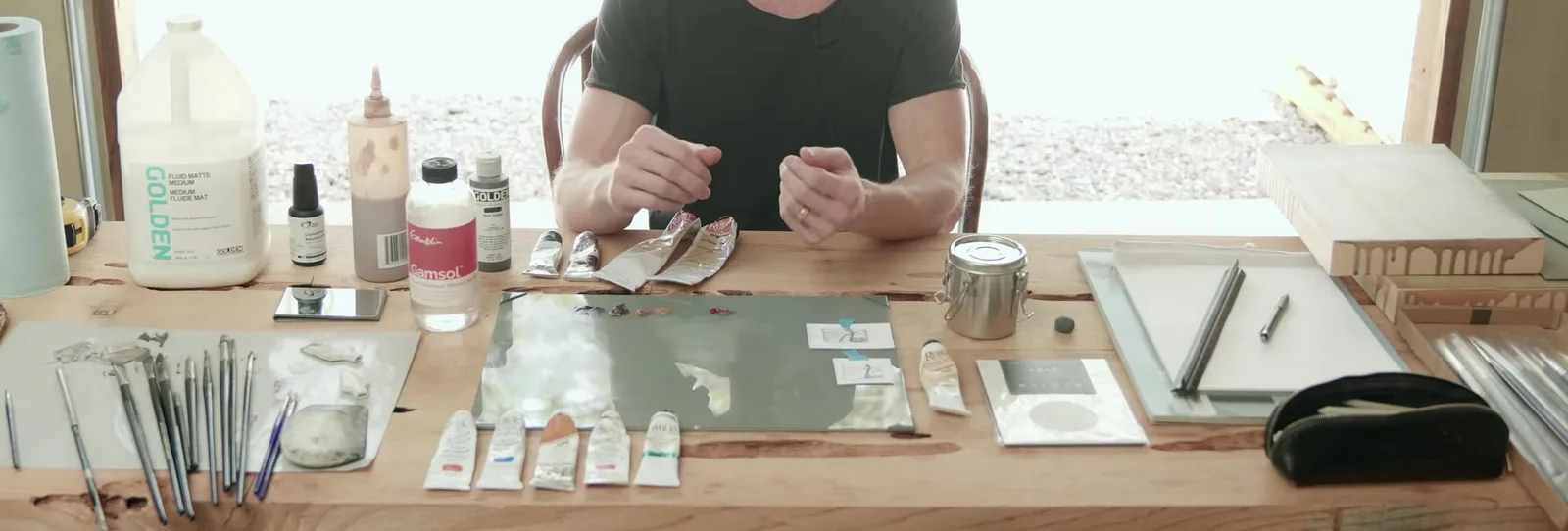
The four things you actually need
A surface. I paint on wood panels I prepare myself, and on RayMar linen panels, which are linen on aluminum. They are light, they travel, and the only prep they get from me is a little alkyd wiped across.
A few brushes. Something stiff to start a painting and something softer to finish it. More on that below.
Oil paint. Fewer colors than you think. My whole palette is six tubes.
A palette. I use a gray tempered glass palette from New Wave. I leave paint on it overnight a lot, it cleans off easily, and a neutral gray is an honest surface to mix on. The same company makes a gray paper pad you can throw away sheet by sheet, which is good for traveling, or if cleaning a palette is the thing that stops you from painting.
My palette, and why each color is there
I start almost every painting with burnt sienna and ultramarine blue. They are my shadow colors, and together they let me push a shadow slightly warmer, cooler, lighter or darker instead of leaving it generic. For burnt sienna I always use Winsor & Newton. For ultramarine I am more open, and I use Gamblin a lot.
The next is yellow ochre deep from Michael Harding, the only yellow ochre I use. I have gone through about twenty tubes. It has more tinting strength than most ochres, so it reads almost like a gold and stays rich when white goes in instead of mixing to gray. Those three, burnt sienna, ultramarine and the ochre, are the colors I use most.
Then two colors carry the chroma: permanent rose (Winsor & Newton) and phthalo green (Gamblin). They are how I push toward the cooler, brighter notes. In the light parts of skin I mix the cools toward violet or green and stay away from blue. Phthalo is very strong, so it goes in by the touch, and with permanent rose it makes something close to a warm blue instead of mud.
For white I use Rublev's lead-titanium white, a mixture that gives me some of the transparency of lead and some of the cover of titanium. It is actual lead, so treat it that way and wash your hands.
The chart at the top of this page is that palette, and the color guide shows how it mixes. If you want the bigger idea behind a short palette, start with what a limited palette is.
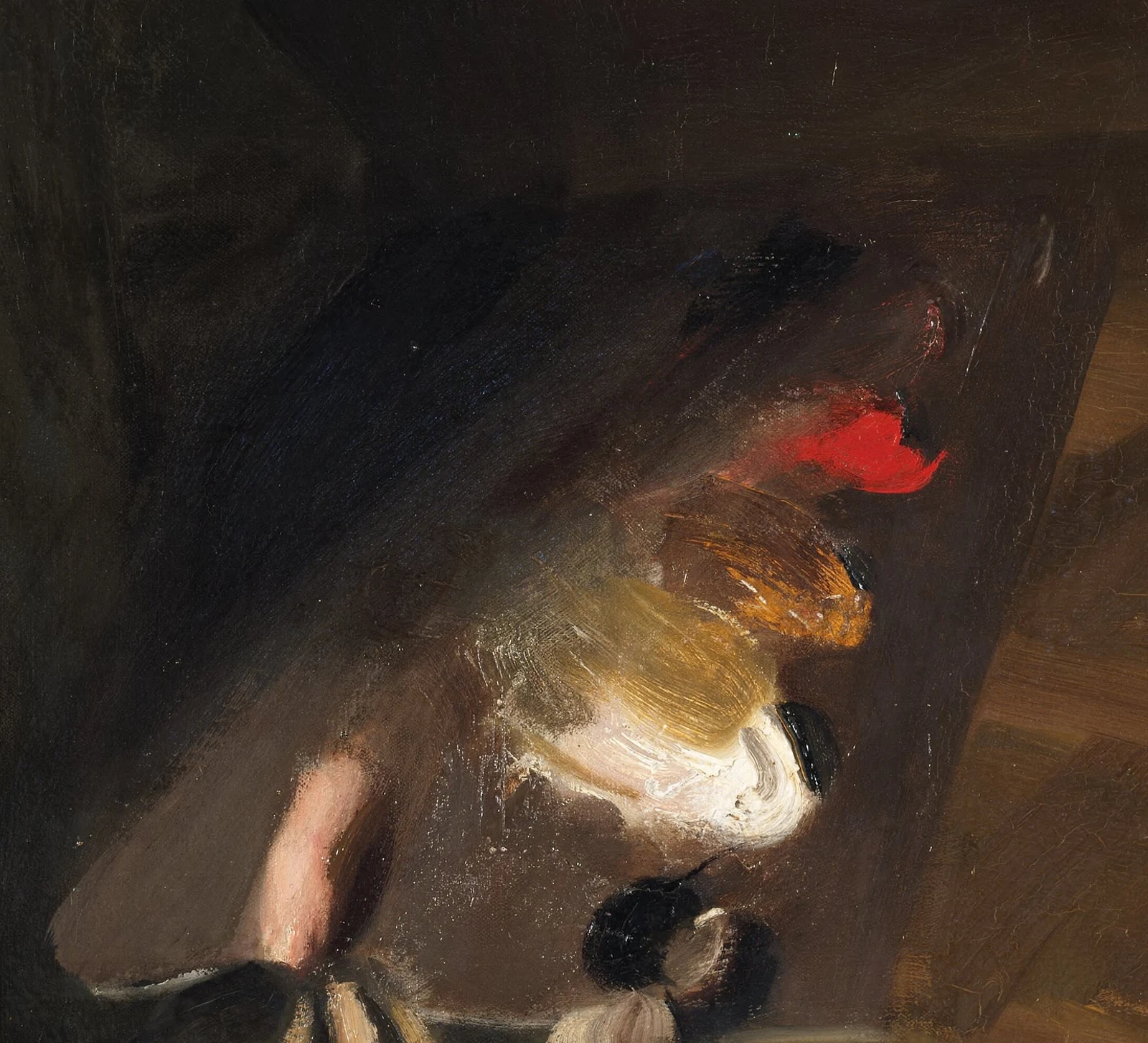
Start with bristle, finish with sable
When you start a painting you want something that moves paint around, so I start with bristle and make big motions. The further into the painting, the softer the fibers: bristle, then something in between, and often a soft synthetic at the very end for a fine point. If I could only use two kinds, they would be bristle and sable, bristle to start and sable for the middle and the finish. I mostly use filberts and rounds and hardly any flats.
All of mine are from Rosemary & Co:
- Series 2035 Chungking pointed round, no. 6. The bristle I start paintings with. I use the whole side of it, not the tip, and it gets better as it wears in.
- Series 91 pure sable filbert, no. 10 and no. 8. The pointed filberts people call cat's tongues, and my favorites for the middle of a painting and for finishing it. On its edge it makes a sharp stroke, laid flat it makes a broad one, and it holds that edge a long time.
- Series 278 Masters Choice long filbert, no. 6. Badger, firmer than sable and softer than hog, so it sits between the brush I start with and the one I finish with.
- Red Dot domed filbert, no. 10. Synthetic, and it behaves a lot like sable. The domed end keeps a stroke from ending in a corner.
- Ivory pointed round, no. 6. Synthetic and springy, for when I need a fine point that holds.
- Shiraz rigger. A long, thin head for one continuous line.
One note if you are in the US: Rosemary cannot currently ship sable there, and of their synthetics the Red Dot domed filbert is the one that behaves most like sable.
I also keep a handful of cheap small detail brushes I bought on sale. Because they were cheap, I am never worried about ruining one, and when I want a clean new detail brush I just grab one.
Fewer mediums than you think
The only medium I really use is Oleogel, from Rublev. It is linseed oil with a thickener, so it behaves like a clear oil paint: same consistency, no drips, and it does not thin the paint down. You can mix an almost transparent color that still handles like paint. There is a walnut oil version that dries slower and comes up a little shinier, which helps in a hot studio. More in the Oleogel review.
I use Gamsol at the start of the day to clean brushes, and that is about it. Keep it in a container you can close. The fumes are not good for you, and I used to wash my hands in it, which I would not do now.
What you can skip for now
A fancy easel. Mine was a gift from my family and it is great for large paintings, but you do not need one. Any easel works, and for years I painted on nails in a wall.
A big reference screen. Any screen works, and printing a reference works too. Better still, work from life as much as you can, especially while you are learning: plants, casts, landscape, figures, whatever you are interested in. Your own drawings make good references as well.
Nice drawing tools. Some of my best studies were done with a random construction pencil I sharpened. What I would keep is a blending stump for compositional sketches, because it puts shadows down as one mass instead of a set of lines, and I like a 2B lead more than HB for tonal studies because it gives you the darks without pressing.
Specialty tools and textures. Rubber shaping tools are fun, and I use them, but no tool fixes a painting. A texture you fall in love with can eat the time the drawing needed. The fundamentals come first: the drawing, the distances, the shapes.
Art materials are expensive. If you cannot afford a lot at once, that is fine. It is not what makes a good painting.
FAQ
What do I need to start oil painting? A surface, a few brushes, oil paint and a palette. Add a medium, and a solvent for cleaning brushes, when you need them. Everything else depends on the effect you are after, so it is worth waiting until you know why you want it.
What colors should a beginner buy for oil painting? Fewer than you think. I start almost every painting with burnt sienna and ultramarine blue, add yellow ochre for the lights, two strong colors (permanent rose and phthalo green) for the cooler, brighter notes, and white. Anders Zorn painted his portraits with four.
What brushes do I need to start oil painting? A bristle brush or two to move paint at the start, and something softer, ideally sable, for the middle and the finish. Filberts and rounds cover most of it. If you only buy two kinds, buy bristle and sable.
Do I need an easel to start oil painting? No. Any easel works, and I painted on nails in a wall for years.
Do I need a medium for oil painting? Not to start. When I use one it is Oleogel, a linseed oil gel that behaves like clear paint, and I keep solvent for cleaning brushes only.
Letters from the studio
An occasional letter, usually a story about how some painter actually worked and what I am painting now. The day after you sign up, a welcome code for the course.
Written by Daniel Bilmes — painter and educator, Los Angeles. Methods.art is the online painting program built around developing your own process, not copying a house style. See the program or work with Daniel one-on-one.