The Calling of Saint Matthew, Walked Through
One canvas explained end to end: the commission, the light shaft and the window that gives no light, the two-group structure, the argument over which man is Matthew, the three-value pattern, and what the radiographs found under the paint.
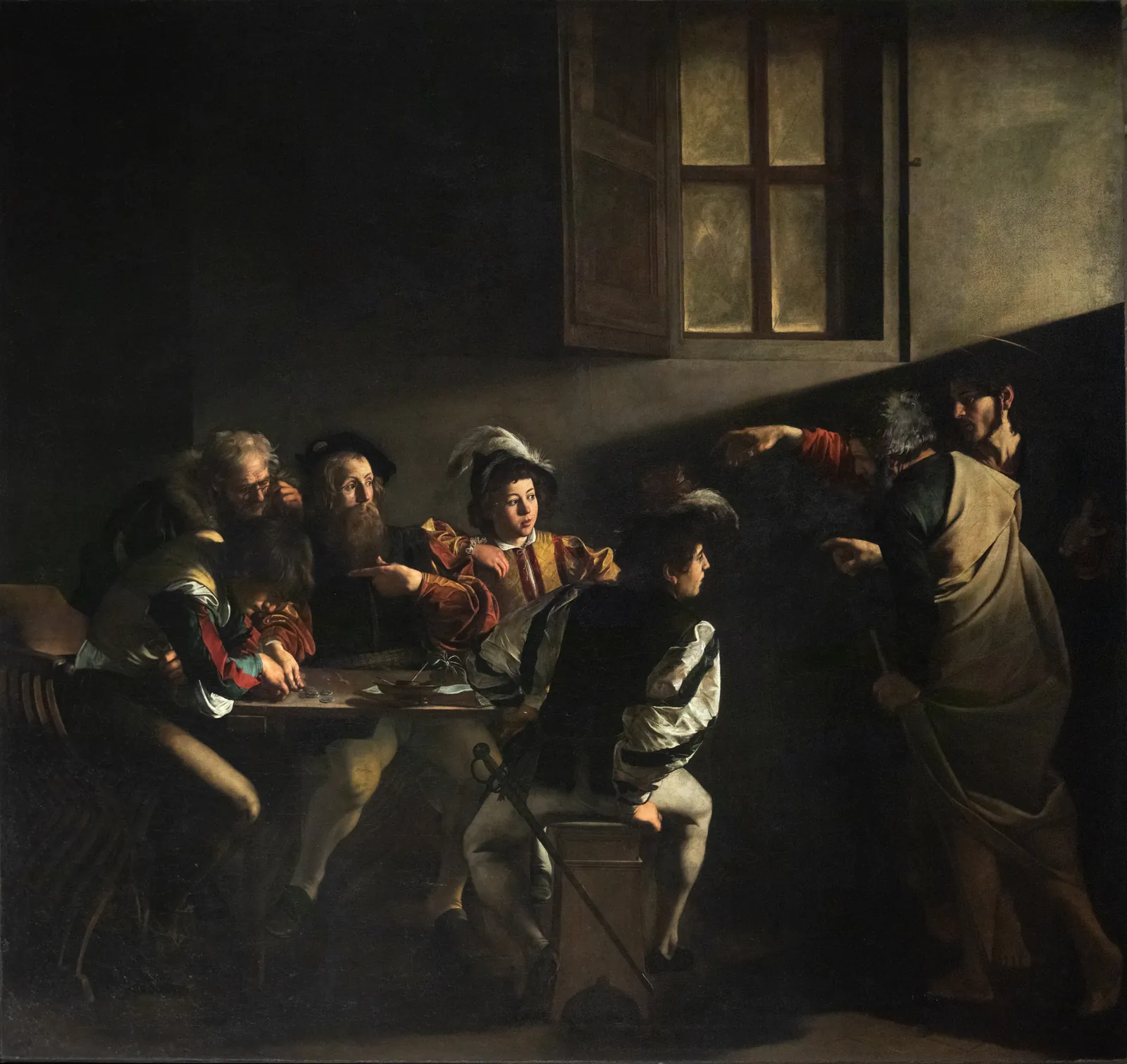
The Calling of Saint Matthew is a canvas about eleven feet square, oil, painted in 1599 and 1600, and it still hangs on the wall it was made for in the Contarelli Chapel of San Luigi dei Francesi in Rome. Almost all of it is dark. One shaft of light comes in high from the right, from outside the picture, and lands as a hard wedge on the back wall. Under it, men in the clothes of Caravaggio's own Rome sit counting money at a table, and two men in robes stand in the dark on the right. One arm crosses the gap, and the hand at the end of it points. One light, two groups, a hand. Take any of the three out and there is no picture.
Here is what it is made of, and what a painter can take from it.
- the commission, and which Contarelli painting actually got rejected (not this one)
- the light shaft, the window that gives nothing, and the two-group structure
- the hand, and the argument over which man at the table is Matthew
- how the picture reads in three values
- the ground, the incisions, and what the radiographs found under the paint
- two exercises for a kitchen table
The commission
A French cardinal, Matteo Contarelli, born Matthieu Cointrel, bought the chapel in 1565. He died in 1585 leaving money and written instructions for scenes from the life of his name saint, and then nothing happened. Girolamo Muziano was chosen and died in 1592 without starting. Giuseppe Cesari, the Cavaliere d'Arpino, took it next, finished the vault fresco by 1593, and never delivered the canvases. So by 1599 a well-funded chapel in the French national church still had bare walls, with the Holy Year coming.
That is what Caravaggio walked into. A contract dated 23 July 1599 put him on both side walls, the Calling and the Martyrdom, for four hundred scudi, and they were unveiled in July 1600. He was twenty-eight, he had never had a public commission, and he delivered both canvases inside a year.
The rejection story that follows him around belongs to a different painting in the same chapel. The Calling was not rejected. The altarpiece was a separate commission, ordered on 7 February 1602, and the first version of Saint Matthew and the Angel went up on 26 May 1602 and came back down. Bellori, writing seventy years later, reported that the priests removed it because the figure had neither decorum nor the look of a saint, sitting with his legs crossed and his bare feet stuck out at the congregation. That is a report, not a receipt, and Sybille Ebert-Schifferer has argued the episode may be a confusion with the rejection of a sculpture meant for the same spot.
The composition, walked
Start with the light, because everything else is downstream of it. One source, high on the right, outside the frame. Its upper edge is a hard straight line running down and to the left across the back wall, and everything above it stays in shadow. That drawn boundary is what you get when nothing in the room bounces light back.
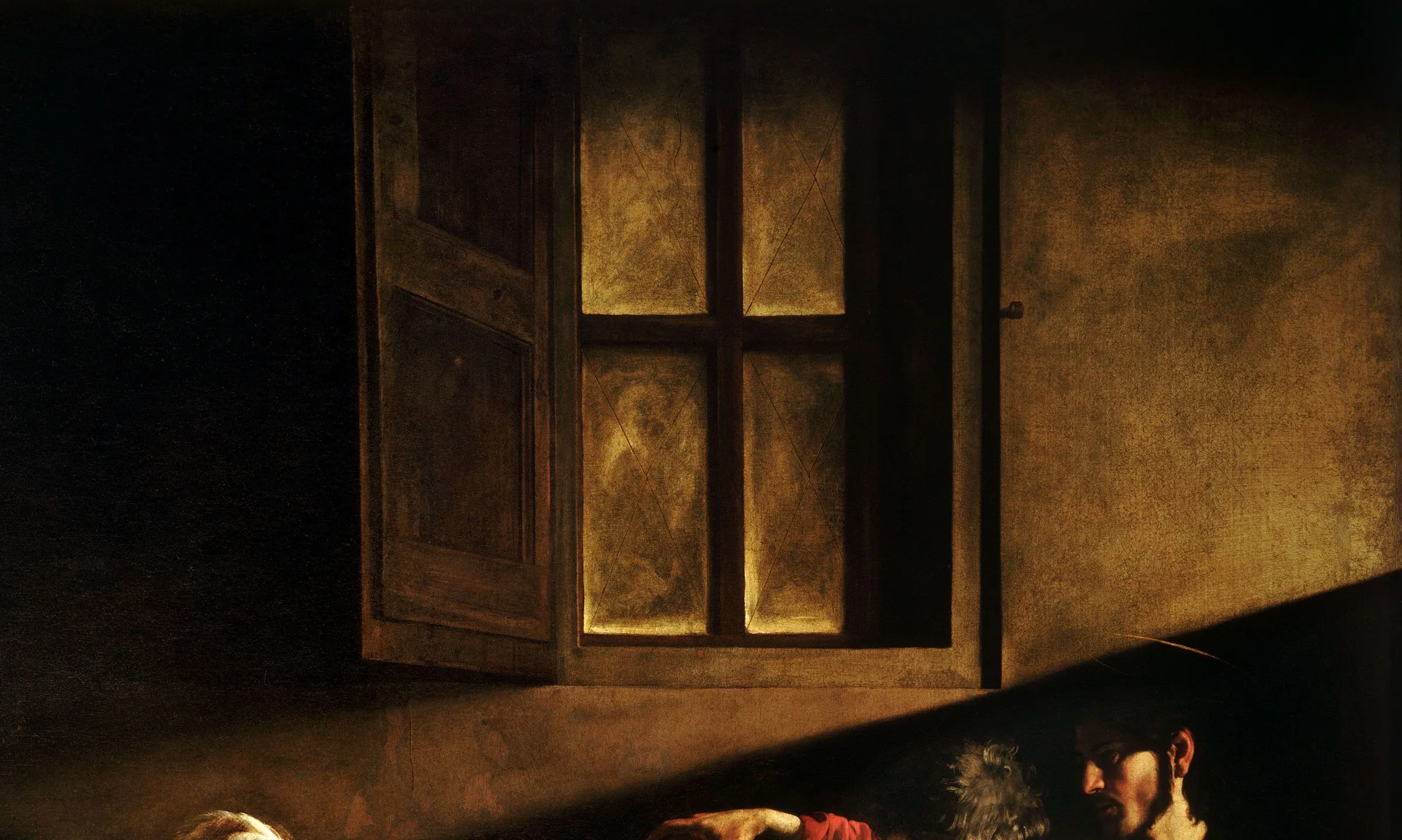
Now look at the window he painted into that wall. It has panes, it has a shutter swung open beside it, and it throws nothing. No pool of light under it, no cast shadow from it. He put a light source in the picture and then refused to use it, which tells you the lighting is a decision rather than a record of a room. The chapel itself is dark, and the direction of the painted beam has often been read as answering its real window high on the right. Take that as a long-standing reading, not a documented intention.

One light draws one border, and that border organizes the rest. The picture divides into two blocks. On the left a horizontal bar of men at a table in plumed hats and slashed sleeves, packed shoulder to shoulder. On the right, standing, two barefoot figures in plain robes that belong to no particular century. Between them a stretch of empty dark wall, crossed by nothing but an arm.
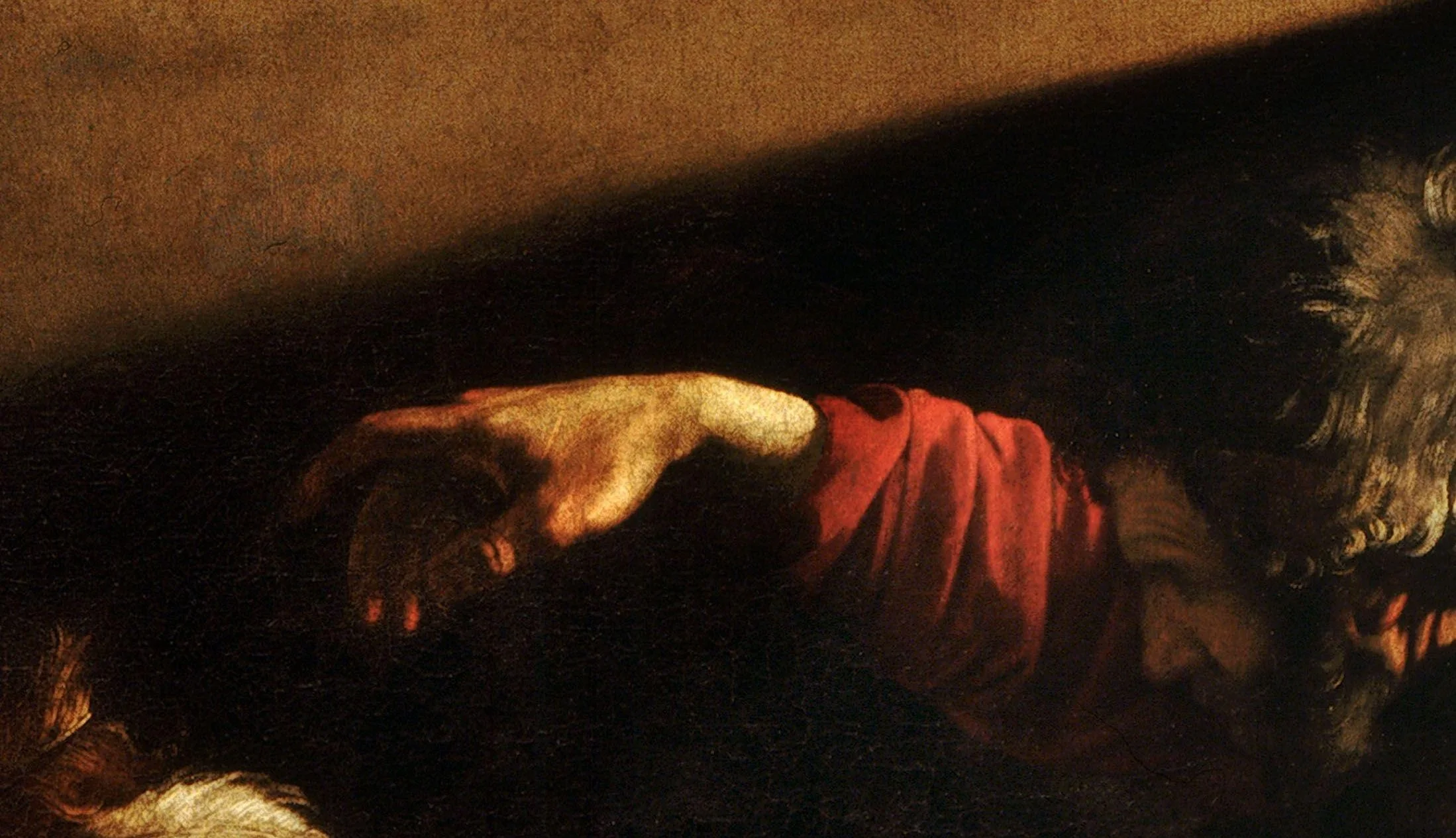
That hand has long been read as a reversed quotation of Adam's from Michelangelo's Creation of Adam, which would make Christ a second Adam. The comparison is in nearly every account of the painting, and I could not trace who published it first, so take it as a reading the literature settled into rather than something Caravaggio recorded. What the hand does is not in doubt. It is the only thing bridging the two halves, and Peter's hand in front repeats the gesture smaller and less certainly.
Then the question the painting will not answer. Which of those men is Matthew?
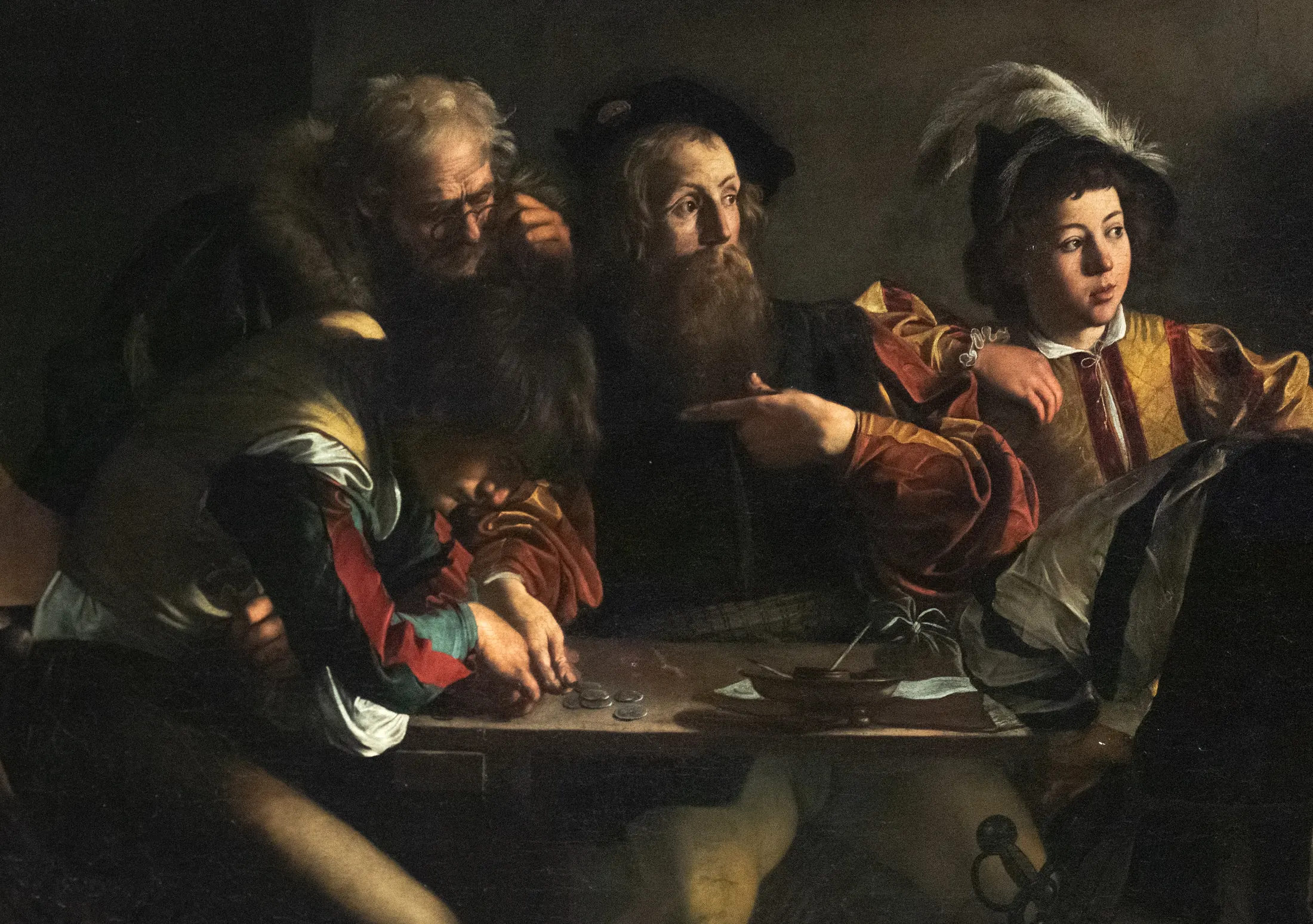
The traditional answer, given for four centuries, is the bearded man in the middle, turning toward the light and touching his own chest as if to say, me? Its strongest support is not in this canvas. It is that the same bearded model appears as Matthew in the chapel's other two paintings. The dissent says he is pointing past himself, at the young man hunched at the end of the table who has not looked up from the money. The art historian Sara Magister argues for that, partly from the line of the light, which extended runs down to the bent young man. Jürgen Müller of the Technische Universität Dresden argued in Florence in July 2025 that Caravaggio misleads the viewer on purpose.
So a picture this famous has kept its central fact unsettled for four hundred years. For a painter that is the more useful lesson. The gesture is legible and the identification is not, because he put the beam and the arm where he wanted the eye to go.
The value pattern
Squint at it, or shrink it to a thumbnail, and the picture collapses into three shapes.

The dark is not background. It is most of the canvas, one connected mass running from the top left corner down through the wall, under the table, and out to the right edge behind Christ. The mid is the lit part of the back wall plus the tabletop. The lights are few: some faces, some sleeves, the boy's white plume, the knuckles of the hand.
That ratio is why the picture carries across a dark chapel. Because the lit notes are few, each one counts, and light nine tenths of a canvas and the eye has nowhere to land. He also keeps them together, so the small lights sit along one band instead of scattering, and that band is what your eye walks. The discipline is Seeing in Three Values, and the decision that produces it is One Light.
The technique on this canvas
It is oil on canvas, 322 by 340 centimeters, a wall-sized picture for a painter who worked from live models in a room. He painted on a warm reddish-brown preparation and left patches of it showing as a ready-made middle tone instead of covering every inch, a habit Bellori noticed and technical study confirms. He made no preparatory drawings on paper. He scored the key points freehand into the soft priming with a brush handle or a stylus, and the technical literature notes he used those incisions sparingly before 1599 and then extended them in the Contarelli side canvases.
The radiographs are the part worth sitting with. Claudio Falcucci re-read the diagnostic imaging of this canvas for Rossella Vodret's Caravaggio 1571 to 2021, published by Silvana Editoriale, and reported two changes. The back wall first had an opening in it, a kind of doorway between Christ and the men at the table, later painted out. And Saint Peter was added afterwards, laid straight over a Christ already painted in full.
So the version we treat as inevitable was arrived at. He built a wall with a door in it, decided the picture was better with an unbroken dark between the two groups, and closed it. Then he laid a second figure over a finished one rather than start again. Radiographs of the companion Martyrdom are reported to show at least two earlier compositions underneath, so the Calling went comparatively smoothly and the one beside it did not.
What to practice
Two things, both small, both doable on a kitchen table.
The first is a three-value thumbnail of this painting at its true ratio. The canvas is 322 by 340, so cut a card about five inches by four and three quarters. Fill it with three values and nothing else, a dark, a mid, a light. No faces, no hands, no plume. Twenty minutes, then stop. The picture is almost entirely one dark shape, and you have to be stingy with the light or the thumbnail stops looking like the painting. That stinginess is the lesson, and it is cheaper to learn on a card.
The second is a one-light study of your own. One lamp, everything else switched off, a couple of objects on a table set near a wall so the beam falls across it at an angle. Then paint the wedge on the wall, not the objects. Get its shape and the hardness of its edge right and the objects mostly land by themselves, because they sit in the same light. If the shadows come out grey and soft, there is too much ambient light in the room. Cover a window, kill the second lamp, look again. The mechanism is in chiaroscuro, the rest of how he worked is on his atlas page, and the order these lessons sit in is the curriculum.
Key takeaways
- Oil on canvas, 322 by 340 cm, under a contract dated 23 July 1599 that paid four hundred scudi for this canvas and the Martyrdom together. Unveiled in July 1600, and it has never left the Contarelli Chapel in San Luigi dei Francesi.
- The rejection story belongs to a different picture. The first Saint Matthew and the Angel altarpiece went up on 26 May 1602 and came down, reported by Bellori as lacking decorum. The Calling was never rejected.
- The window painted into the back wall is shuttered and gives no light. The beam comes from outside the frame, high on the right, and its hard straight edge sorts the picture into two blocks: contemporary Rome seated on the left, two robed figures standing on the right, one arm crossing the dark between them. That hand has long been read as a reversed quotation of Adam's in Michelangelo's Creation of Adam, though who published that first is not clear.
- Which man is Matthew is genuinely unsettled. The bearded man is the traditional identification, supported by the same model appearing as Matthew in the chapel's other two canvases. Sara Magister argues for the young man bent over the coins, Jürgen Müller that the misleading is deliberate.
- Falcucci's re-reading of the radiographs, published in Vodret's Caravaggio 1571 to 2021, reports a doorway first painted into the back wall and then closed, and Saint Peter added later over an already finished Christ.
FAQ
Where is The Calling of Saint Matthew? In the Contarelli Chapel of San Luigi dei Francesi in Rome, a few minutes from the Pantheon. It is still on the wall it was painted for, alongside The Martyrdom of Saint Matthew and the altarpiece, and the church is open to the public. The chapel is dark. Bellori was complaining in 1672 that its darkness kept the paintings from being seen.
Which figure is Saint Matthew in the painting? Specialists do not agree, and the ambiguity may be deliberate. The traditional identification is the bearded man at the center, pointing at his own chest, supported by the same model appearing as Matthew in the chapel's other two canvases. Sara Magister argues instead that he points past himself at the young man hunched over the coins. Jürgen Müller of TU Dresden has proposed that Caravaggio misleads the viewer on purpose.
What technique did Caravaggio use in The Calling of Saint Matthew? Oil on a warm reddish-brown ground left showing in places as a middle tone rather than painted over, with no preparatory drawing on paper. He scored the key points into the soft priming freehand with a brush handle or stylus, worked direct from live models under one hard light with the ambient light killed, and deepened the shadows with transparent dark glazes. Radiographs also show a doorway in the back wall painted out and Saint Peter added over a finished Christ.
Was The Calling of Saint Matthew rejected by the church? No. That happened to the first version of Saint Matthew and the Angel, the altarpiece for the same chapel from a separate commission ordered in February 1602. It was installed on 26 May 1602 and removed, and Bellori reported the objection as a lack of decorum. The two side canvases went up in July 1600 and stayed.
If you want to know whether this way of working, one decided light and a picture built out of the dark, is close to how you already paint, the free Artist Reading names the master painters nearest your habits. The workshop that teaches light and value as decisions made before the first mark opens August 22, and the waitlist hears first.
He painted a window into that wall and then gave it nothing to do. The light you see is the one he chose to put there.
Written by Daniel Bilmes — painter and educator, Los Angeles. Methods.art is the online painting program built around developing your own process, not copying a house style. See the program or work with Daniel one-on-one.