Seven Pesetas
An American painter watched Joaquín Sorolla paint three children in the sea in fifteen minutes, and decided nobody could ever learn it. What the fifteen minutes actually cost: a boyhood at a forge, a first painting sold for seven pesetas, and a seven metre failure he kept in a cellar for the rest of his life.
The beach at Valencia, some summer before 1909. An American painter named William Starkweather set up his easel on the sand. He had come to paint. Mostly he watched.
Nine o'clock found the other man already working. He painted standing, at the water's edge, with his models out in the wash of the sea. The Mediterranean is practically tideless, so he could hold one spot the whole morning without moving. Behind him stood a big piece of canvas stretched on poles and painted black, there to keep reflections off the picture and to screen him from anyone who wandered over to look. At his feet sat Pepe, a Valencian fisherman who carried the canvases on his head, cleaned the palettes, and went and found the models. Pepe posed. So did Pepe's children.
There was no shade at all. The wind coming off the water would not let a sun umbrella stand, so the man worked in the sun, all day, every day of the summer. Starkweather called it a trial by fire for any northern born student who tried to keep up the pace.
Fifteen minutes
Sometimes at five in the afternoon, with six and a half hours of painting already behind him, he would start a second study by the sea and work it until sunset. On one of those evenings, after what Starkweather called a tremendous day, he set up a study of a little girl walking into the sea. He looked at what he had, decided it was too much of a figure study, and put two more children in the water.
Two little girls and a boy waded into the water hand in hand, laughing, making no particular effort to stand still. They were, indeed, washed here and there by the waves. Sorolla painted the three wet figures, gleaming in the gold of the setting sun, in fifteen minutes.
At twilight Starkweather walked down the beach to put his paints away in a shack for the night, and heard groaning in the dark. One of Sorolla's Spanish students was lying face down on the dirt floor. Starkweather thought the boy had sunstroke and was seriously alarmed. The boy turned on him instead. Did you see Sorolla paint those children? Yes. Do you ever think you can learn to paint like that? And then, without waiting for an answer, he shouted that nobody could, not Starkweather, not himself, not anyone, and that Sorolla did not know how he did it either. He paints as a cow eats.
That was the reaction the work kept producing, usually with better manners. Painters who stood near him reached for religion to explain what they had just seen. In February 1909 a New York paper printed the phrase an artist who had painted beside him used for it: he paints with the hand of God.
Here is what that phrase leaves out.
Seven pesetas
Joaquín Sorolla was orphaned before he was three. Cholera took both parents in Valencia. The aunt and the locksmith uncle who took him in had little money, and when the boy made no progress at school and spent his hours drawing in his copy books, the uncle pulled him out of the classroom and put him to work at the forge. He kept drawing anyway, at a drawing school for artisans, well enough that the uncle eventually let him leave the forge for good and enrol at the Real Academia de San Carlos. He was fifteen.
The first picture he ever sold, a landscape, brought seven pesetas. About a dollar and forty cents. In those same years he painted small portrait heads at a dollar apiece. He was also painting on the coarse back of the canvas instead of the smooth prepared side, so the picture would carry the tooth of a heavier and more expensive canvas than the one he could afford.
And the fifteen-minute miracle came after a failure he never threw away.
The picture he could not fix
In Rome, on a scholarship from the city of Valencia, he spent more than a year on the largest picture of his youth, a Burial of Christ nearly seven metres long. He sent it to the National Exhibition in Madrid in 1887. It did not bring him the first medal he was after. He tried to restore it, gave up on that, and left it in the cellars.
He never got rid of it. It was still there in 1979, fifty six years after he died, and when it was finally taken out and examined on 11 June of that year, four fragments were all that could be saved.
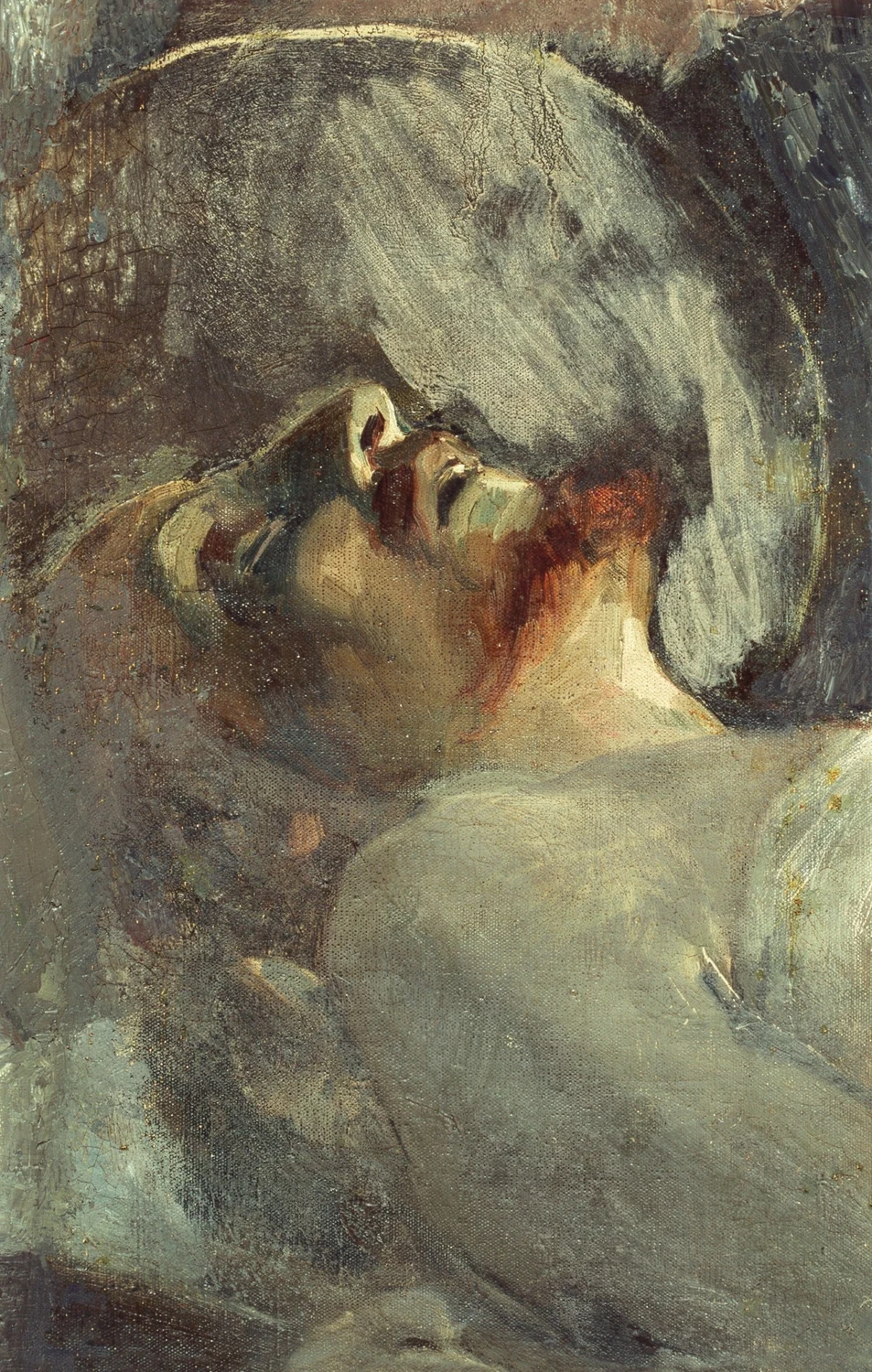
He said later that the Italian years had been effort spent in vain. I do not believe him, and I am not sure he believed himself. You do not keep a thing in a cellar for the rest of your life because it meant nothing to you.
What he built instead
Somewhere between the seven metre failure and the beach, he stopped chasing important pictures and built an order of work instead. Same beach. Same hour. The black screen at his back, Pepe fetching the models, canvases he could actually finish while the light held. Most of the pictures took four to six mornings. Many took one or two.
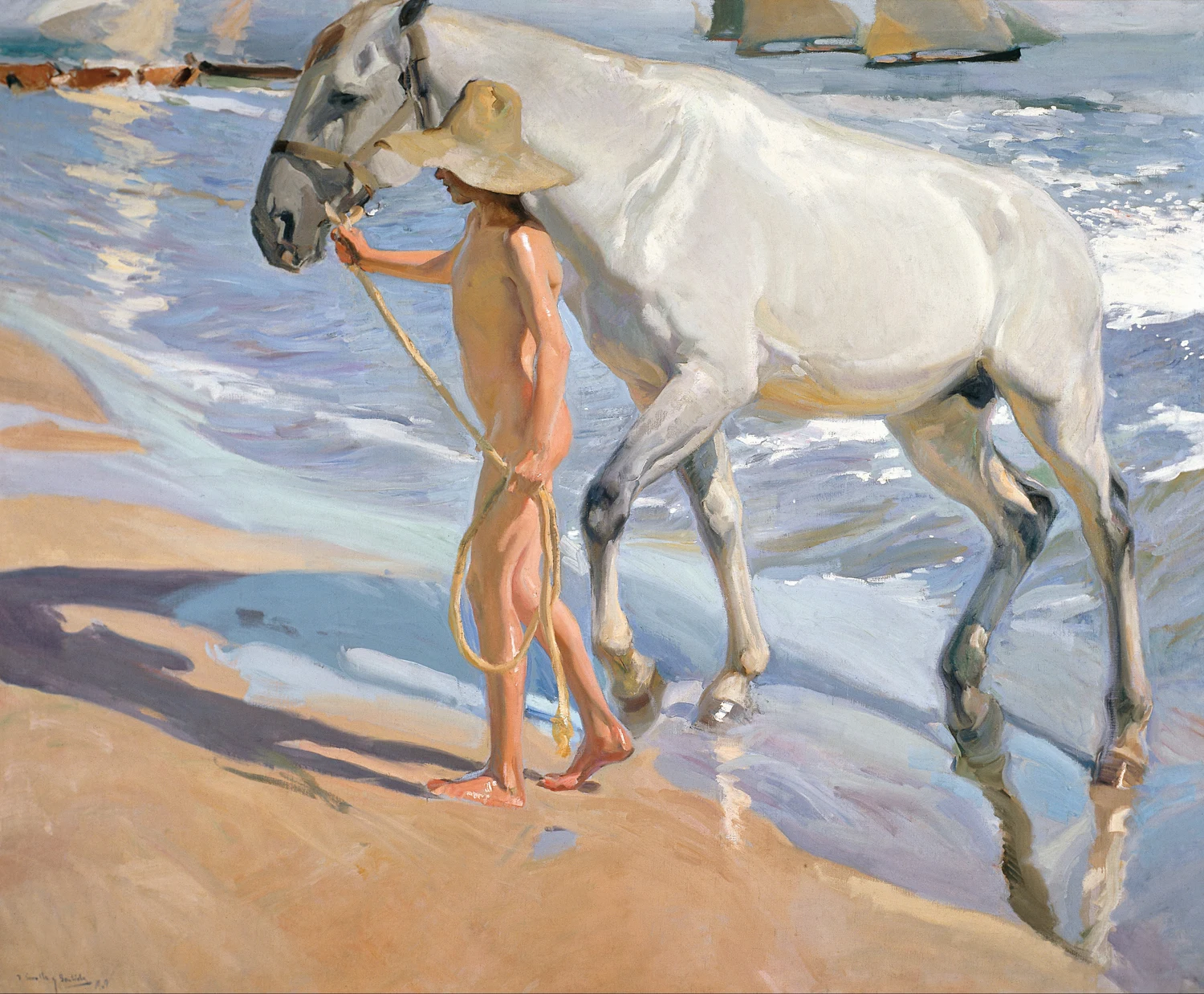
Starkweather, watching from the next easel, wrote that there seemed to be no mistake, no undoing. Sorolla gave the reason himself, and it is about the subject rather than about him. He could not paint at all if he had to paint slowly. Every effect is so transient, it must be rapidly painted.
Starkweather was writing for the exhibition's own book, where the miracle version would have gone down easily. He refused it. He wrote that the ease and brilliancy of the work blinds us at first to all evidence of long and thoughtful training, and that behind the painting stood twenty five years in which Sorolla had painted and smoked a great deal, and eaten and slept a little.
The speed was never the talent. It was the residue of the system.
New York, 1909
The system got its verdict in a month. His exhibition opened at the Hispanic Society in New York on 4 February 1909 and closed on 9 March. A hundred and sixty thousand people walked through it. On the final Sunday alone, 29,461. The Metropolitan Museum bought his portrait of his wife in black straight off the wall.
Seven pesetas to the hand of God, and no magic anywhere in between. An order of work, built by a man who kept his failures where he could still see them.
The question he put to his students, over and over, even to the ones he knew already left no hour unoccupied, was: have you worked?
FAQ
Did Sorolla really paint a picture in fifteen minutes? Yes, and there is a first-hand witness. William Starkweather, an American painter who worked beside him on the beach at Valencia, wrote that Sorolla painted three children wading in the water, lit by the setting sun, in fifteen minutes. What the story usually leaves out is that it happened at five in the afternoon, at the end of a full working day on the sand, and that the composition was a decision he made on the spot to keep the picture from being only a figure study.
How much did Sorolla's first painting sell for? Seven pesetas, about a dollar and forty cents at the time. It was a landscape. In the same poor years he painted small portrait heads at a dollar each, and worked on the coarse back of his canvas rather than the smooth prepared side, so the picture would carry the tooth of a better canvas than he could afford.
What happened to Sorolla's Burial of Christ? He painted it in Rome as a young man, nearly seven metres long, and sent it to the 1887 National Exhibition in Madrid, where it did not win the first medal he wanted. He tried to restore it, abandoned the attempt, and left it in the cellars. It was examined on 11 June 1979 and only four fragments could be saved. They are held at the Museo Sorolla in Madrid.
The beach canvases, the surviving fragment of the Burial, the violet he found inside the shadows, and every source behind this story are set out on the Sorolla record.
From the record, No. 1. True stories out of the sourced records we keep on the masters.
If you want to know which of them your own instincts sit closest to, the painter profile is ten questions.
Written by Daniel Bilmes — painter and educator, Los Angeles. Methods.art is the online painting program built around developing your own process, not copying a house style. See the program or work with Daniel one-on-one.