How to Plan a Large Painting, the Way the Masters Did
How the masters planned big paintings: studies, oil sketches, full-size cartoons, and squaring up. What each step solved, and how to scale a drawing yourself.

Plan a large painting the way the masters did. Settle the composition small, solve the figures in separate studies, and scale the drawing up with a grid or a full-size drawing before any color goes on. The big canvas is where you carry out decisions. It is the worst place to make them.
The reason is cost, and it climbs with the size of the picture. On a study the size of a postcard, moving a figure two inches takes an eraser and a minute. On a canvas four feet wide, the same move means scraping back and repainting passages that were working, and on a big picture a mistake in the drawing usually shows itself hours after the decision that caused it. Every painter who worked large arrived at the same answer: make the expensive decisions where they are cheap.
I plan a painting like a military campaign. On a big picture, most of the campaign happens before the canvas.
Thumbnails first, then a tonal study
My own sequence, the one I film in the course, starts with a few small thumbnails, then a slightly more articulated tonal study, and only then a drawing for the painting itself. Each step answers one question and leaves the rest for later. The thumbnail asks whether the big shapes work together at all. The tonal study asks whether the lights and darks hold the picture up. Neither needs detail, and detail would only get in the way, because the moment a face looks good you stop being willing to move it.
That last point matters more than it sounds. As I put it on camera: "we tend to spend a bunch of time drawing a face and then we realize we have to move it." Size and location come first. A study is where you find out a figure is too big for the horse beside it, or that the horizon cuts the composition in a bad place, and finding that out on paper is cheap. As I said in the same chapter, "it's nice to have the opportunity to deal with some of those failures even in the drawing which is cheaper than in the painting."
How the masters planned their biggest pictures
Raphael drew the School of Athens at full size
The cartoon Raphael drew for the School of Athens survives in Milan, at the Pinacoteca Ambrosiana. It is a drawing in charcoal and lead white on 210 sheets of paper joined together, 285 by 804 centimeters, about nine feet by twenty-six, and it is the largest Renaissance cartoon that has come down to us. Every figure in it is at the size it would be painted.
It was the end of a long chain, not the start. The conservators who restored it describe the sequence. First came small sketches of the whole composition. Then each group was studied in detail and fitted into a second overall drawing, and then the groups were studied again from life models. The last overall drawing, the modello, was squared and carried up to monumental scale on the cartoon. And the cartoon itself was too valuable to sacrifice on the wall. To transfer the design, a second, blank sheet was pricked through it, and that substitute went up to be pounced onto the plaster.


Look at what the cartoon leaves out. There is no architecture in it; that was probably worked out on a second cartoon, now lost. And the brooding figure slumped over a block of marble in the foreground, probably Heraclitus, is missing entirely. Raphael added him late, in the final version, and even then he got a cartoon of his own: under infrared, pounce marks cover the whole figure. The plan stayed open where it needed to, and every change still went through the system.
Rubens painted the plan small and let the workshop enlarge it
On March 29, 1620, Rubens signed a contract to supply thirty-nine ceiling paintings for the Jesuit church in Antwerp. The contract spells out the method. Rubens would make an oil sketch of each subject; Anthony van Dyck and other assistants would paint the full-scale canvases from those sketches; and Rubens would touch them up as needed.
The ceiling of the Banqueting House in London ran the same way, and one of its canvases alone measures 762 by 549 centimeters. The Royal Collection's account is plain about it. The nine canvases were produced in his Antwerp workshop and finished by August 1634, much of the work done by assistants working to his designs. Rubens retouched them and put in the final details, flourishes and highlights himself.
The oil sketch is what made that possible. A small panel carried every decision that mattered, the composition, the light, the color, at a size where Rubens could make them fast and change them freely, and it carried them clearly enough that other hands could enlarge them. Not every big commission went to the workshop, though. The Louvre judges the twenty-four canvases of the Medici cycle entirely his own, contrary to what is often claimed.
Géricault worked out the Raft of the Medusa before he painted it
In July 1816 the French frigate Medusa, bound for Senegal, ran aground on a sandbank off the African coast, and about 150 people were crowded onto a raft built from its wreckage. Fifteen were alive when the brig Argus found them. Two survivors, Corréard and Savigny, published the story.
Géricault got to know both men and had them tell him every detail, and he gathered a full dossier of documents. He found the Medusa's carpenter, one of the fifteen, and had him build a small model of the raft that reproduced every detail of its construction. He rented a studio near the Beaujon hospital in Paris, and the interns and orderlies there supplied him with cadavers and severed limbs to paint. The study of feet and a hand now in Montpellier was made from those fragments, in the winter of 1818 to 1819.


The hardest decision was which moment to paint. The survivors' account offered several, the mutiny on the raft, the killing, the sighting of the ship, and Géricault, his biographer Charles Clément writes, hesitated a long time between them. The drawings and sketches that survive show him trying the violent scenes first. He settled on the instant the men see the Argus on the horizon, the one scene in the story with a little hope in it.
He bought the canvas on February 24, 1818: fifteen by twenty-two French feet, from the dealer Étienne Rey, for 440 francs. By about November he had finished his sketches and studies and had already squared the composition onto the big canvas. Then he shut himself in the new studio and painted the figures straight from the models, usually at the first attempt, Delacroix among them as the man folded over the edge of the raft with his arms hanging. A visitor who watched him work described it: he painted at the first stroke on the white canvas, with no lay-in, nothing but a firmly set line. That is only possible on a canvas that size because every decision except the paint had already been made. The painting went to the Salon of 1819 under the plain title Scène de naufrage, Scene of a Shipwreck.
Courbet could not step back
When Courbet painted A Burial at Ornans, about fifty townspeople posed for its life-size figures, on a canvas 315 by 668 centimeters. His father fitted out a studio for it in the house of Courbet's grandparents in Ornans. Courbet liked the high ceiling and had the window enlarged. He still could not get far enough from the picture to see it. "I'm working blind," he wrote to his friend Champfleury in the winter of 1850. "I have no room to step back."
That is the other half of the problem. On a big canvas, the thing you lose is the whole picture. Velázquez kept long-handled brushes for exactly this; his biographer Palomino says he sometimes used them to paint "with greater distance and boldness," so that up close the painting could not be read, and from a distance it was a miracle. Sargent got the same distance with his feet. People who watched him paint remembered him stepping back after almost every stroke, until his paces wore a track in the studio carpet.
Squaring up a drawing
The grid at the top of this page is the oldest tool for carrying a small drawing onto a large surface. You rule the study into squares, rule the canvas into the same number of larger squares, and copy the drawing one square at a time, marking where each line crosses a square's edges and then joining the marks. It works because a square is small enough to judge by eye. Copying a whole figure at seven times its size is guesswork. Copying the part of an arm that crosses one square is not.
Ferdinand Hodler ruled one over this study for Day (Truth), a drawing less than a foot square for a painting more than six and a half feet tall. The faint grid runs across the whole sheet.
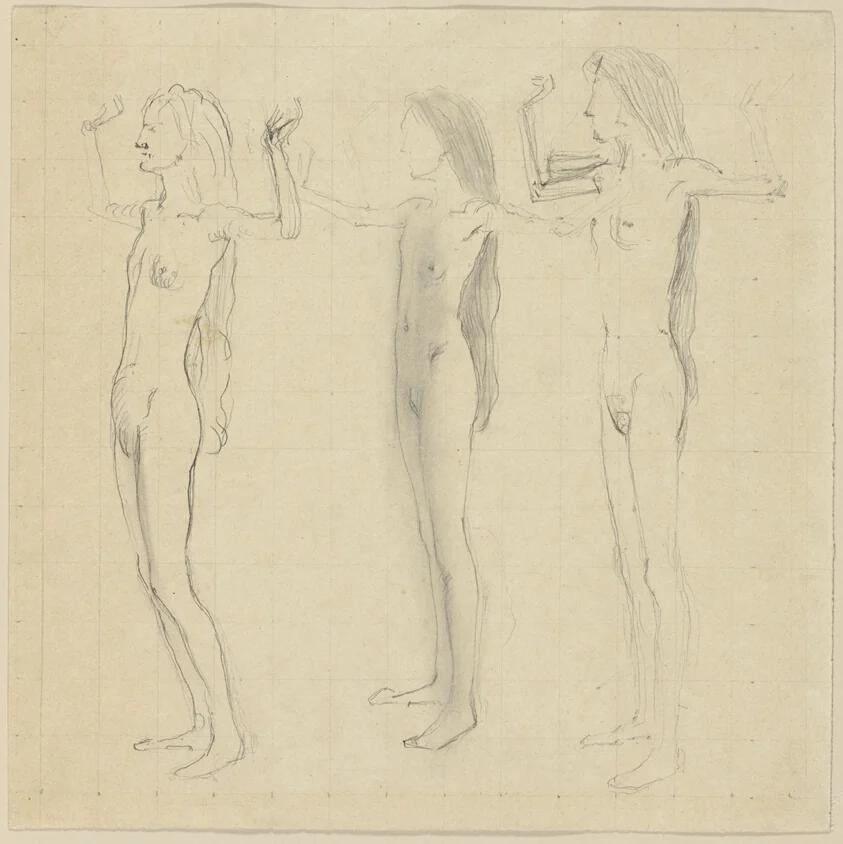
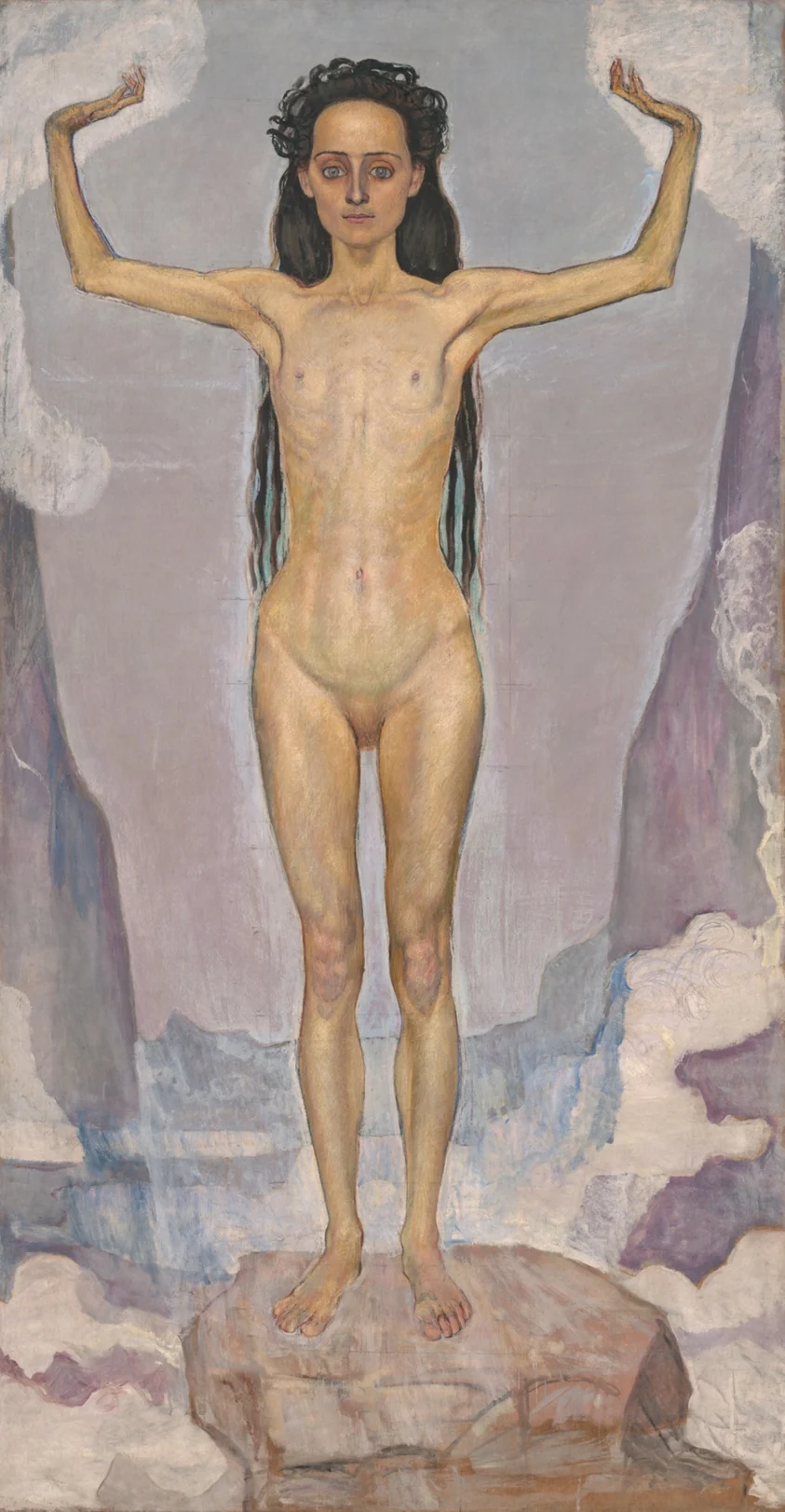
You do not always need the full grid. When I transfer a preliminary drawing onto a panel, I rule the reference every inch and then measure only the points I need: "I'm not doing an entire grid. I just generally transfer the points that I need." A full grid works too, and it may well be easier. Either way, one rule does not bend. The study and the canvas have to share their proportions, or every square stretches and the drawing stretches with it.
The transfer is one more chance to draw
The transfer is where most people go dead. They copy the study line for line, and the big drawing comes out stiff, because copying is a different act from drawing. I find the same thing every time: "if I even have a smaller painting and I'm trying to enlarge it, if I try to copy it, it's worse. It's derivative." So I treat the transfer as the third pass on the drawing, not a tracing of the first.
For a recent panel in the course, I made the preliminary drawing at the exact size of the panel and rubbed compressed charcoal over the back of the sheet (powdered charcoal or graphite works too, but gets everywhere). Then I taped it down so it could not shift, and went over the lines. Not mechanically. The contour gets better on that pass, and I leave some lines broken on purpose where I want an edge to stay soft. The charcoal transfer also stays erasable, which I want, because I move paint around and I would rather lose a line than protect it. If you have finished the drawing and plan to cover it with opaque paint, a permanent transfer (red transfer paper, or the old oil-paint transfer) is the better tool.
Then the drawing goes up beside the panel, and it stays there while I paint.
When to skip all of this
It depends on the picture. A lot of my paintings get no transfer at all. I did the full sequence for that panel because I was weaving one figure together from several reference images of my wife, and the drawing was where I decided what to take from each one. With a reference that needs no adjusting, I would rather find the drawing in paint: "I actually like the way that I paint better when I'm not too worried about saving the drawing." Being too careful at the start of a block-in, as I say in that chapter, brings out the worst in me.
Size changes the math, though. A small panel forgives a wrong start; you can wipe it and begin again in an afternoon. A canvas four or five feet across does not, and the bigger the picture, the more the planning pays for itself.
Questions
What counts as a large painting? There is no official line. A useful one is the point where you can no longer judge the picture from where you stand to paint it, where every look at the whole means a walk backward across the room. Past that point, planning starts paying for itself, and Courbet's complaint becomes your problem too.
What is a cartoon in painting? A full-size drawing made to carry a design onto the final surface. For fresco, the outlines were transferred to the wet plaster by pricking them and dabbing charcoal dust through the holes, a method called spolvero, or by tracing them with a stylus. Raphael's cartoon for the School of Athens is the largest Renaissance example to survive.
What does squaring up mean? Ruling a study into a grid of squares and the canvas into the same number of larger squares, then copying the drawing one square at a time. Museum catalogs describe drawings prepared this way as "squared for transfer," and Géricault squared the Raft of the Medusa onto its canvas before he painted a figure.
How did the old masters scale up their drawings? Usually with more than one method. A grid carried a study up to size; a full-size cartoon was transferred by pouncing or tracing; or an oil sketch went to a workshop that enlarged it, the way Rubens worked on his ceilings.
Should every painting start with studies? No. The planning protects decisions that are expensive to change, and on a small panel almost nothing is. On a big canvas, almost everything is.
The course follows one painting from start to finish, and the drawing-and-transfer chapter is this whole sequence, on camera. The course is open now, and you can see what's inside. If you are not sure whether you are built to plan a painting or to paint it direct, the free Artist Reading places you against the painters in our atlas.
The studies are the decisions you have already paid for. Keep them where you can see them.
Sources
- Electa and the Veneranda Biblioteca Ambrosiana, press kit for the restored Raphael cartoon, 2018 to 2019: the dimensions, the 210 sheets, the planning sequence, the substitute cartoon, and the figures absent from the cartoon.
- Harvard Art Museums, Rubens, Saint Gregory of Nazianzus Subduing Heresy, catalog entry (object 295713): the 29 March 1620 Jesuit contract.
- Royal Collection Trust, The Union of the Crowns of England and Scotland, RCIN 408417: the Banqueting House workshop practice and dimensions.
- Musée du Louvre, collection record for Le Radeau de la Méduse, INV 4884: the wreck, dimensions, dates, the 1819 Salon title, and the canvas bought from Étienne Rey. Musée du Louvre, collection record for Henri IV Receives the Portrait of Marie de Médicis, INV 1772: the Medici canvases judged entirely autograph.
- Charles Clément, Géricault, étude biographique et critique (1879 edition): the raft's 149 passengers, the survivors and the dossier, the carpenter's model, the Beaujon hospital, the hesitation over the subject, the squared canvas, the painting method and the visitor's account of it, and the sitters.
- Musée Fabre, Montpellier, Étude de pieds et de main, inv. 876.3.38.
- Musée d'Orsay and the C2RMF, press kit for the restoration of A Burial at Ornans: dimensions, the Ornans studio, the townspeople who posed, and Courbet's letter to Champfleury of February to March 1850.
- Antonio Palomino, El museo pictórico y escala óptica (1795 reprint): Velázquez's long-handled brushes.
- Evan Charteris, John Sargent (1927): Sargent stepping back after almost every stroke.
- Art Institute of Chicago, Ferdinand Hodler, Study for Day (Truth), 2004.1117, and Day (Truth), 2003.119.
- Daniel Bilmes, the drawing-and-transfer chapter of the methods.art course.
Written by Daniel Bilmes — painter and educator, Los Angeles. Methods.art is the online painting program built around developing your own process, not copying a house style. See the program or work with Daniel one-on-one.