Shape Before Form
The premise
Shapes have a rank. Daniel’s map of it: “The largest shapes are like continents, then you have countries, then states or regions.” Two or three continents carry the picture. The countries live inside them, the regions inside those, and “they don’t have to fit like puzzle pieces.” Shapes “are basically the mapping of things,” and the map is the composition: “Without shape you don’t really have composition, because composition is a breakdown of simplified shape relationships.”
Under one light, the first shapes worth trusting are the shadow shapes. “Shadow shapes specifically is the beginning and the anchor of a lot of portraiture, especially when you have a unified light source.” The border between light and shadow is drawn by the light, so it holds still while everything else stays negotiable. Day two of his Controlling Chaos demo goes straight at it: “finding the shapes of the face, specifically the shadow shapes and light shapes,” before any feature gets its finish.
And the order is the discipline. “I like to solve shapes, distances, and proportions before I think too much about form.” At the easel it compresses to “Location first, then form and nuance.” A modeled eye in the wrong place still has to move, and the modeling moves with it. So the standard for this stage is his: “as accurate as necessary, not as accurate as possible.” Accurate enough to trust. No more.
The demonstration
Four figures carry the doctrine, all on the composition page, in the order the decisions get made.
The first, Continents, countries, regions, takes Velazquez’s Luis de Gongora and maps it three times. The continent map holds two or three shapes, and the sitter is already there; the likeness rides the largest shapes, not the features. Then the countries inside them, then the regions inside those. Each smaller shape lives inside a larger one that outranks it.
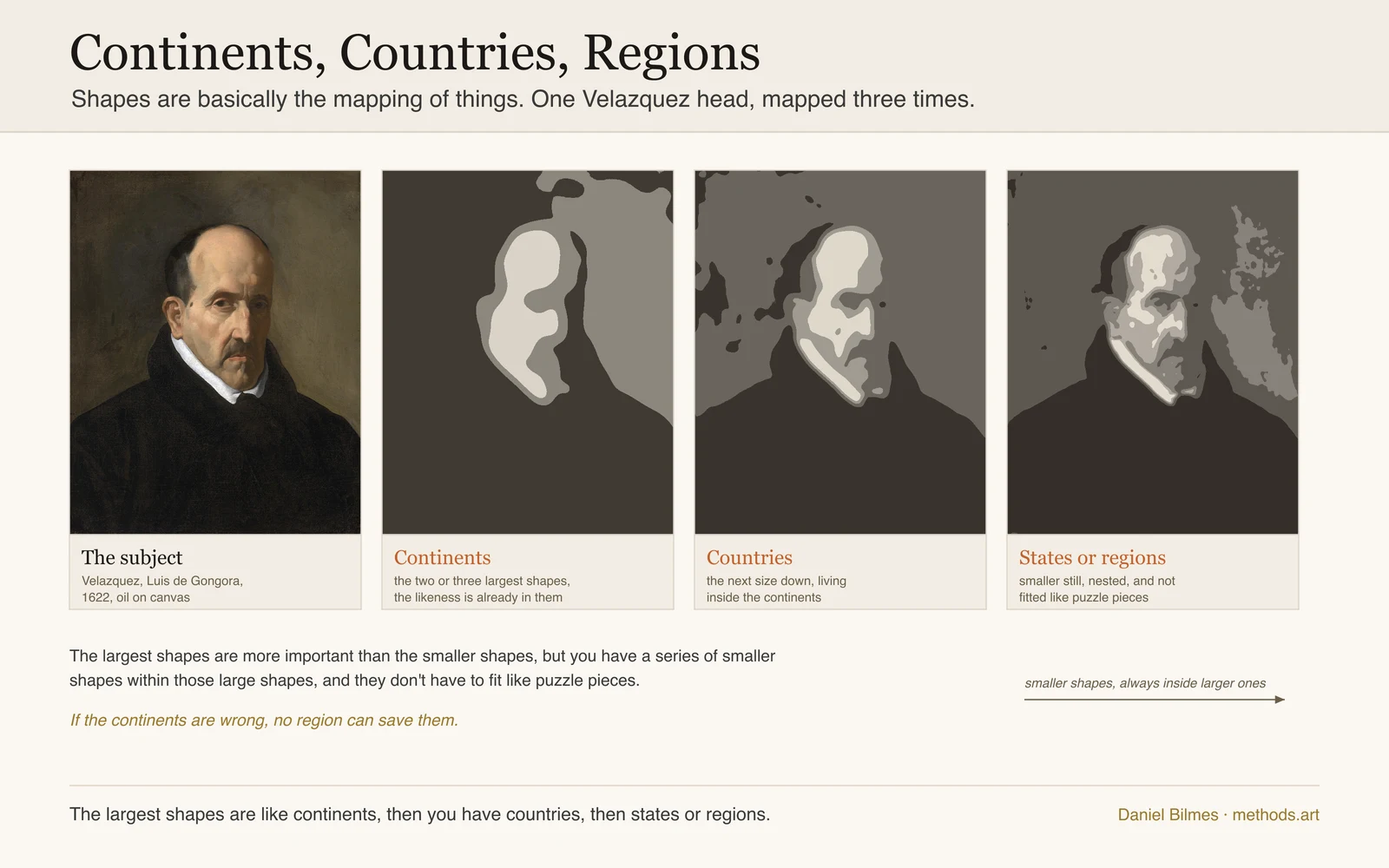
Diego Velazquez, Luis de Gongora (1622), Museum of Fine Arts, Boston. Public domain, Wikimedia Commons. The three maps are original methods.art diagrams. Shape doctrine per Daniel Bilmes, 2026.
Continents, countries, regions. It also sits on the composition charts.
The second, The shadow shape, the anchor, keeps the same head and averages every value to one side or the other until the portrait becomes two connected shapes, one light, one shadow. That is the anchor his doctrine names. The light living inside the shadow stays quiet, held down so the big shape reads as one value.
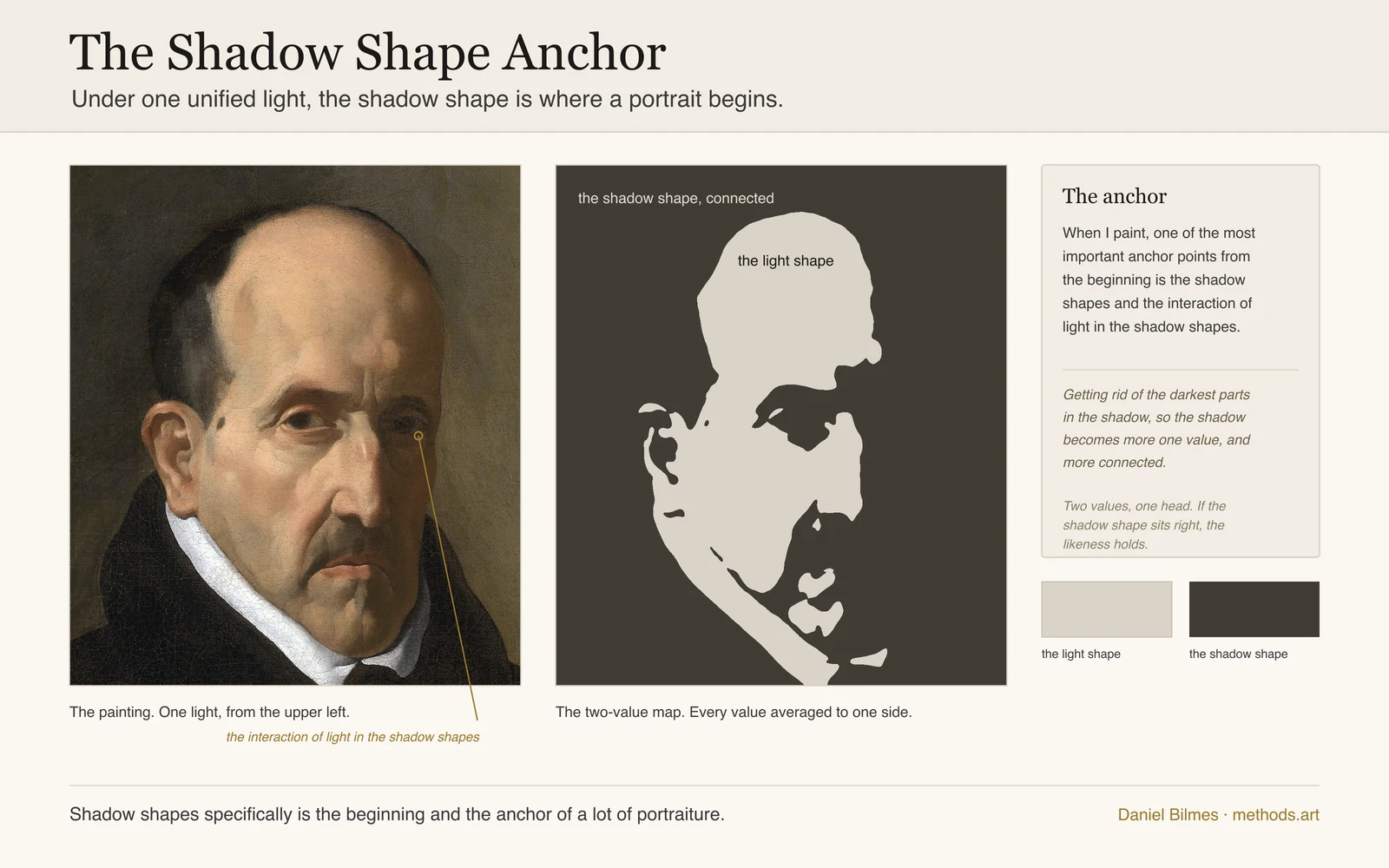
Diego Velazquez, Luis de Gongora (1622), Museum of Fine Arts, Boston. Public domain, Wikimedia Commons. The two-value map is an original methods.art diagram. Shadow-shape doctrine per Daniel Bilmes, 2026.
The shadow shape, the anchor. It also sits on the composition charts.
The third, Shape before form, is the cautionary pair: the same head as accurate flat shapes, distances and proportions measured, then again with the features carefully modeled but sitting in the wrong place. Every rendered feature now has to move. The footer states the order: solve shapes, distances, and proportions before form.

An original methods.art diagram. Shape doctrine per Daniel Bilmes, 2026.
Shape before form. It also sits on the composition charts.
The last, Light shape, shadow shape, drops a simple scene to exactly two flat values. This is Lesson 1’s bracket system seen from the shape side. In his words: “There are also the larger graphic shapes, which end up being the compositional bracket.”

An original methods.art diagram. Shape doctrine per Daniel Bilmes, 2026.
Light shape, shadow shape. It also sits on the composition charts.
The master’s example
Velazquez painted Luis de Gongora in 1622 (Museum of Fine Arts, Boston), and the head survives every reduction the figures put it through. At the continent stage it is still Gongora. At two values it is still Gongora. The features, when they arrive, inherit their places from shapes that were already right. One head carries two figures on the composition page because it proves both claims: the largest shapes carry the likeness, and the shadow shape anchors it.
Bargue’s Cours de dessin (1866-71, with Gerome) turned the order into a syllabus. The cast foot enters as a straight-line block-in, the refined outline comes second, the finished tonal drawing third. Another plate flags a hand’s cast shadows as flat black shapes before anything is modeled. A century of academic painters trained on those plates, and what the plates drilled was rank: shape settled first, finish last. Daniel’s line is the reason the drill aged well: “the integrity of the larger relationships and shapes is really what keeps the piece together,” and that integrity is “hard to establish later in the process.” The earlier, the better.
The exercise
Two parts. Part one is his day-two drill, lifted from the Controlling Chaos demo.
Materials: a printed photo of a head under one clear light, or a study you already made. Vine charcoal or a soft pencil on paper, or one round brush and raw umber on primed paper. In oil, any lights come from titanium white, not lead. Lead white is actual lead, never casual, and nothing in this exercise needs it.
- Squint until the reference splits into a light family and a shadow family. Draw that border first.
- Fill every shadow shape flat, one value. A small light inside a shadow gets what he does on camera: “averaging out the value so it ends up being more of one flat shape.”
- Keep the families whole: “keep those dark shapes connected, keep the light shapes connected.” A map that shatters into islands is recording your habits, not the light.
- Now check locations against distances, features still unmodeled. His checklist: “the corner of that eye, the location of it, is very important,” then “the distance between the eyes, how they line up with the nose.”
- Stop. The map is done when you can “trust those shapes for the rest of the painting.”
Twenty to thirty minutes. What to look for: at arm’s length, beside the reference, the map reads as the same head.
Part two is Harold Speed’s scaffold, condensed from chapter VIII of The Practice and Science of Drawing, Line Drawing: Practical. His premise is the same order: “In setting out a drawing, this fixing of certain salient points is the first thing for the student to do.”
- One object with an irregular outline (a shoe, a jug), or the same head. Charcoal or pencil.
- Draw one vertical line through the subject and decide its length. Speed ran his through the pit of the model’s arm. Every measurement hangs off this line.
- Fix the salient points against it, measured at arm’s length with a pencil or Speed’s knitting-needle, thumb-nail marking the distance. His rule: “It is never advisable to compare other than vertical and horizontal measurements.”
- Block out the spaces “the forms of your drawing are to occupy” in straight lines, the way a surveyor plans a field. Use any straightness in the boundary; note the length of each line and the angles where they cut each other. Watch the background shapes as carefully as the object’s.
- Stop at the scaffold. It “is only a scaffolding,” Speed warns, to be “kicked away as soon as real form expression with any feeling begins.”
Thirty to forty-five minutes. Lesson 1 practiced the tone masses; this is the location scaffold those masses sit on.
Self-check
- Squinted at, the map is two connected families. “Keep those dark shapes connected, keep the light shapes connected.”
- Every shadow shape reads as one flat value. Any light left inside one was averaged out or kept on purpose, and you can say which.
- Erase the regions and the picture survives; erase the continents and nothing does.
- Locations came from measurement. The corner of one eye lines up with the other, and the distances survive a re-measure.
- The wrong-place test: point at your most finished passage and ask whether its shape could still move. If moving it would hurt, the modeling came too early; misplaced work is work you “are going to have to redo.”