Tiepolo solved each monumental ceiling as a small fully finished oil modello on canvas, usually 30 to 60 cm, resolving color, figure placement, lighting, and tone before any plaster. He squared the modello up to a full-scale cartoon and pounced it through pricked holes onto the arricciato. Because buon fresco locks pigment chemically into the plaster as it dries, he painted pigment in water into the wet intonaco one giornata at a time, committing decisively with no correction. He worked from scaffolding alongside his sons Giandomenico and Lorenzo, using lime-compatible pigments: ochres, siennas, umbers, red earths, lime white, smalt, and lapis lazuli for highlights.
Resolve the whole composition as a small oil modello first
Painted small fully finished oil sketches on canvas (typically 30–60 cm) that resolved the entire composition — colour, figure placement, lighting, and tone — at a size where a failed decision cost a day of paint rather than a week of re-plastering.
Why it matters · A monumental commission has to be solved at small scale before the body of the painting is committed. Tiepolo's modelli are the cleanest argument for treating the small oil sketch as the design phase, not as warm-up. Many modelli are now considered independent masterpieces.
Anna Pallucchini, L'opera completa di Giambattista Tiepolo, 1968
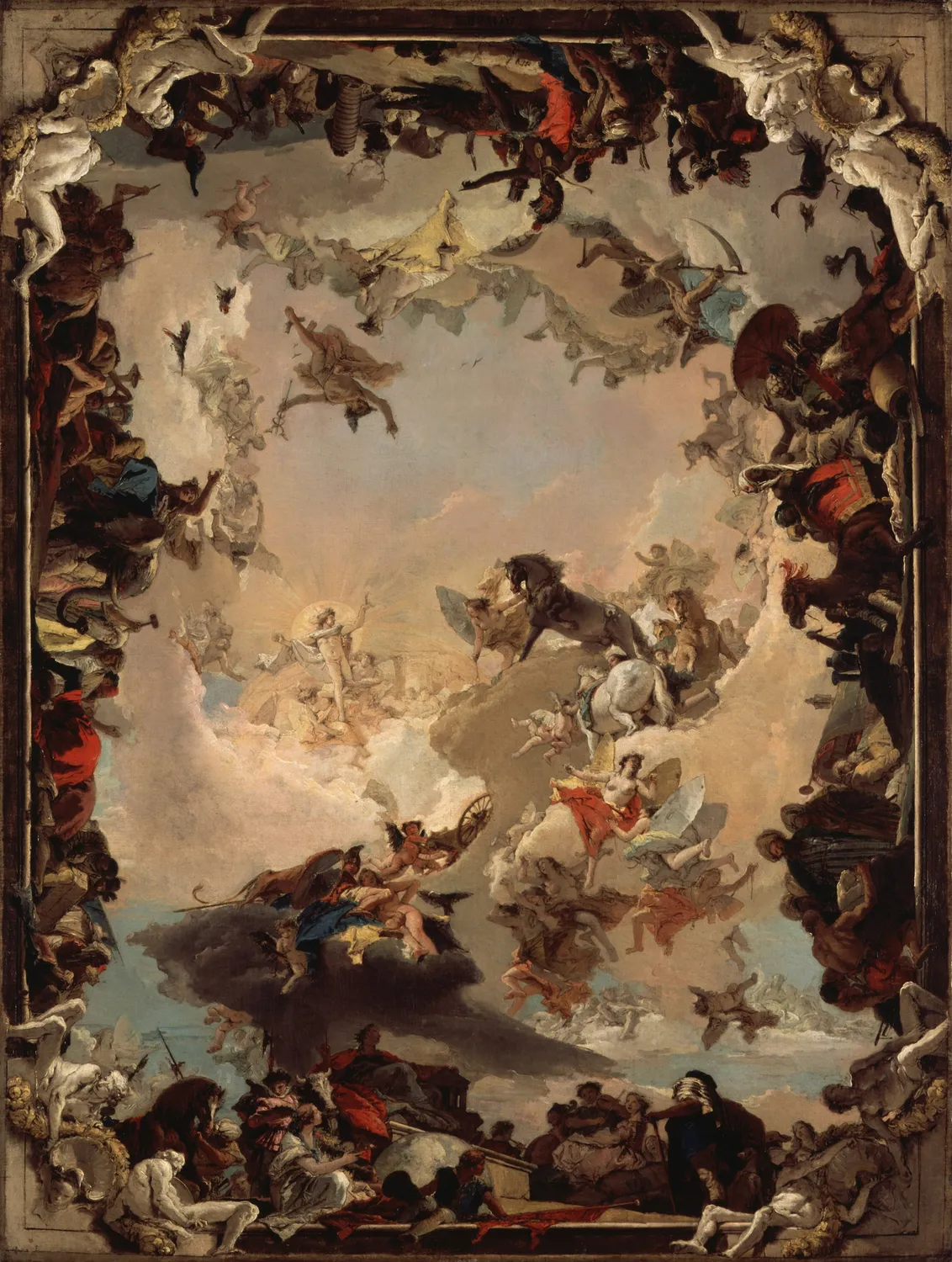
The Allegory of the Planets and Continents, oil on canvas, about one hundred and eighty five centimetres high. A whole ceiling is settled here: Apollo in the open sky, the four continents packed along the border, the light key fixed. The Wuerzburg record dates this sketch to April 1752 and calls it the basis of the commission.
Giovanni Battista Tiepolo, Allegory of the Planets and Continents, 1752, The Metropolitan Museum of Art, New York, 1977.1.3, Gift of Mr. and Mrs. Charles Wrightsman, 1977. Public domain (CC0), Wikimedia Commons.
Work in giornate at fresco speed
Famously fast in giornata — finished areas of figure and architecture in a single working day that would take a less confident painter a week of corrections. Seams between giornate are still visible on his surviving ceilings.
Why it matters · Buon fresco does not allow correction. The pigment locks chemically into the plaster as it dries. The discipline is to commit decisively or to lose the day. Painters who only work in oil rarely understand the cost of a wet-plaster decision.
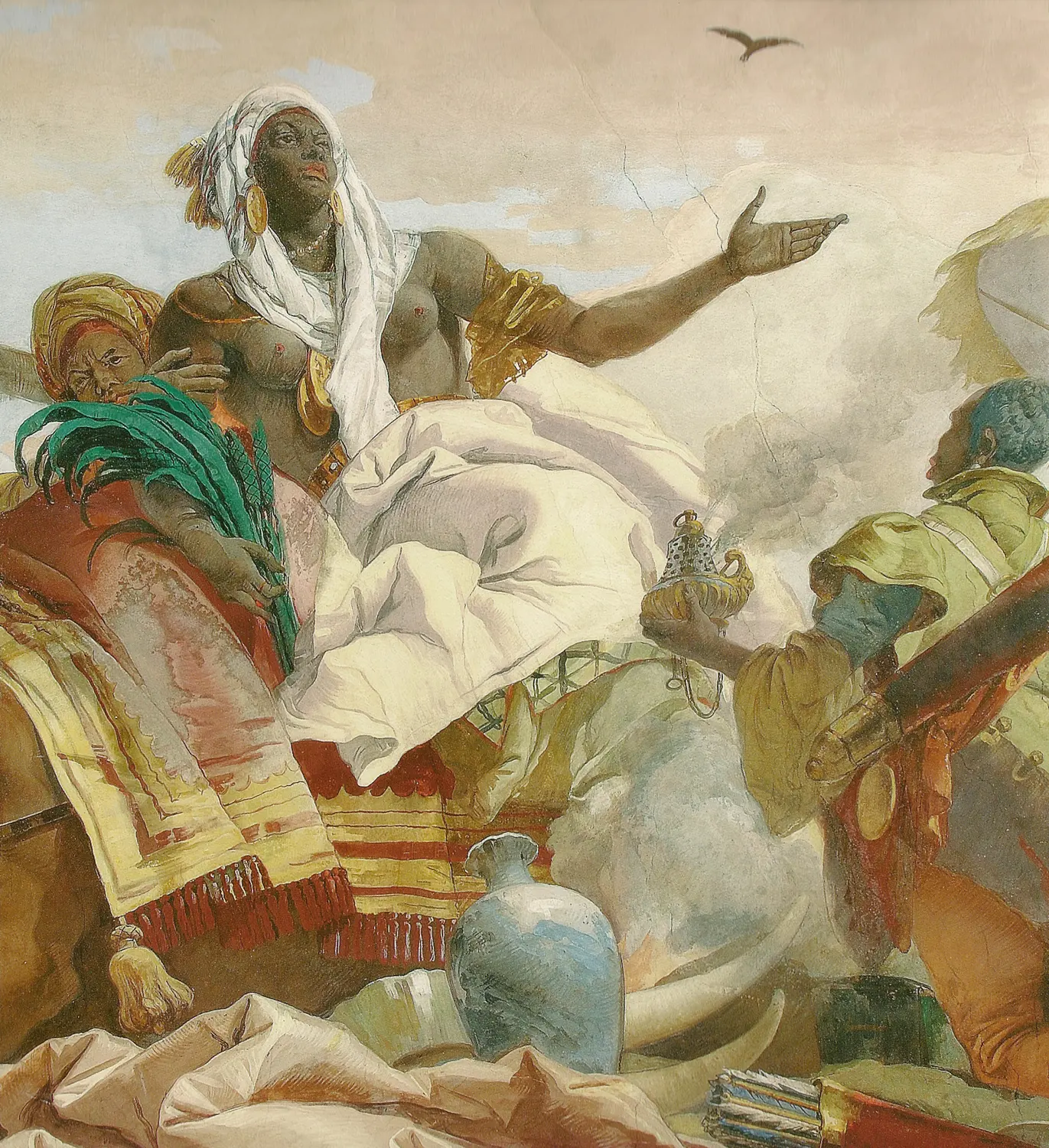
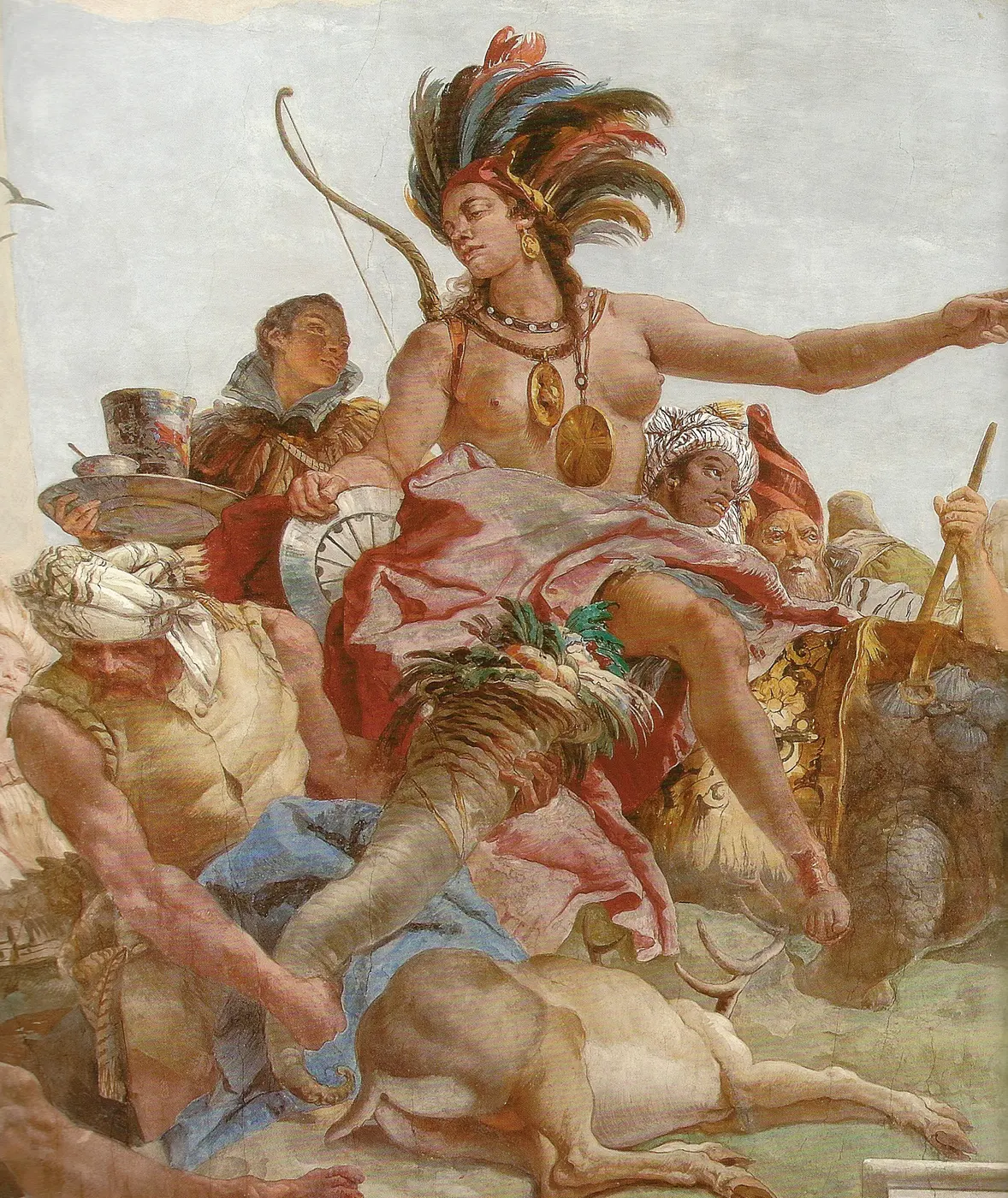
The Africa group on the east side of the Wuerzburg staircase vault, painted in 1752 and 1753 from the design settled on that small canvas. The ground here is wet lime plaster rather than primed cloth, so the fine plaster went up in day sized patches that had to be finished before they set. The Wuerzburg record counts two hundred and eighteen of them across the ceiling.
Giovanni Battista Tiepolo, ceiling fresco in the staircase of the Wuerzburg Residence, east side, the princess of Africa, 1752 to 1753. Public domain (PD-Art), Wikimedia Commons.
Live on the scaffolding for years
For the Würzburg Residenz — the largest fresco ever executed in a single space — Tiepolo and his sons lived in the Residenz from 1750 to 1753 and worked through the ceiling giornata by giornata until it was finished.
Why it matters · A monumental ceiling cannot be painted in a studio. It has to be painted in place, at scale, on physical scaffolding, with the plaster still wet. The years on scaffolds — not in a Venetian studio — were the bulk of his working life.
Tiepolo correspondence with the Würzburg court (1750–1753), 1753
Run the workshop as a family business
Sons Giandomenico and Lorenzo trained inside the workshop, travelled with him on every major commission, and executed substantial portions of the final work alongside him.
Why it matters · A solo monumental practice at this scale is unsustainable. Tiepolo's family workshop made decade-long European campaigns possible. The discipline of training your immediate successor inside the work, not outside it, is the cleanest model for sustained practice.
Build a thousand-sheet drawing archive
Filled thousands of working sheets with figure studies, drapery studies, architectural fragments, putti, and compositional experiments — the same vocabulary recurs across multiple final works.
Why it matters · A ceiling is assembled from a working vocabulary built since adolescence. Tiepolo's drawing archive functions as the painting's reference library — the painter is not inventing each figure, he is selecting from his own developed vocabulary. Painters who do not maintain a drawing archive are inventing every figure from scratch.
Victoria and Albert Museum, Tiepolo Drawings Collection
Master di sotto in sù from imagined viewpoints
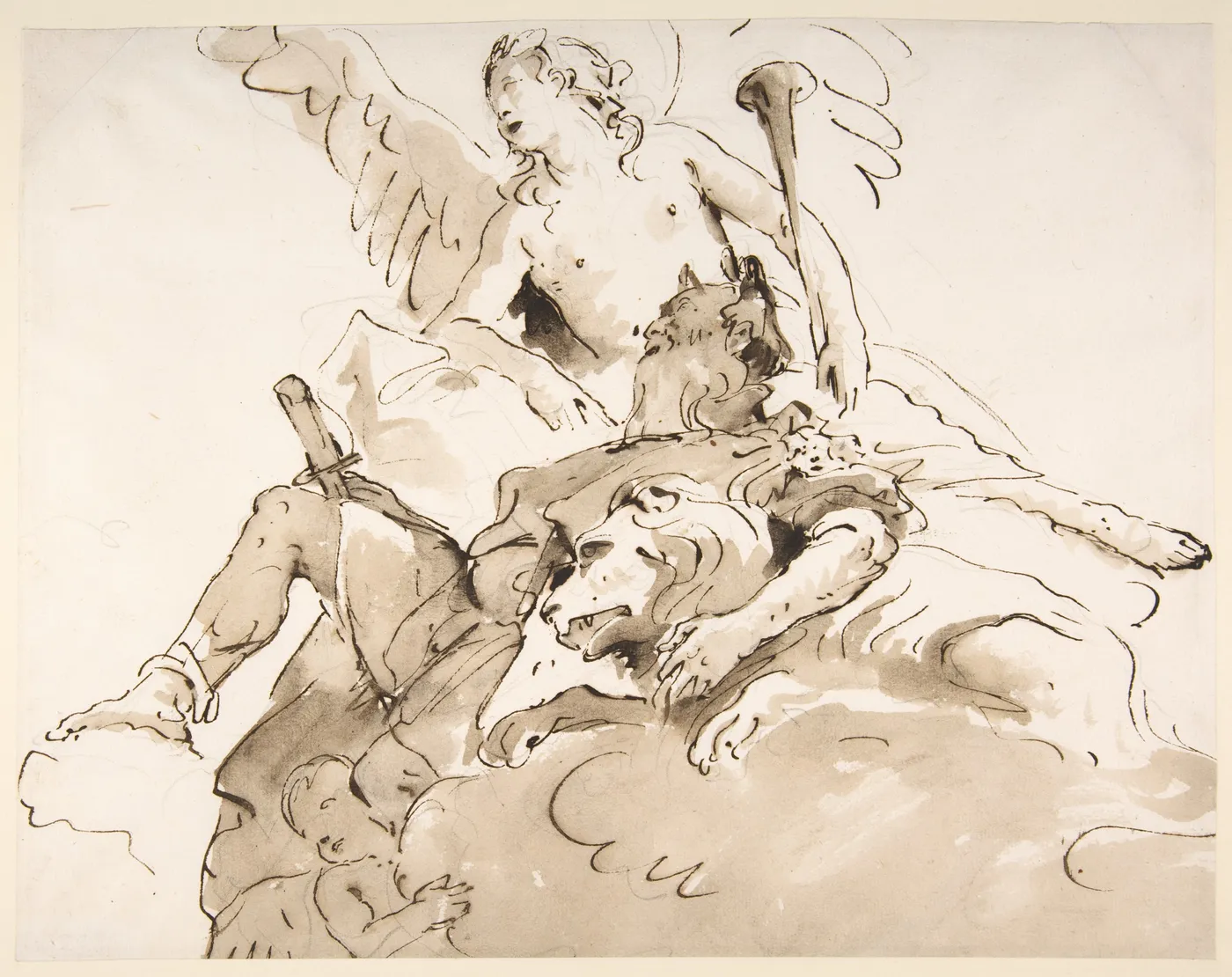
Drew figures seen from below through di sotto in sù perspective — imagined viewpoints most painters never have to deal with — and resolved the geometry on paper before any plaster.
Why it matters · Ceiling painting has its own optics. Foreshortening from below is a specific drafting problem and the only way to learn it is to draw it. Painters who never face the ceiling problem rely on their existing vocabulary of figure construction; ceiling painters develop a second one.
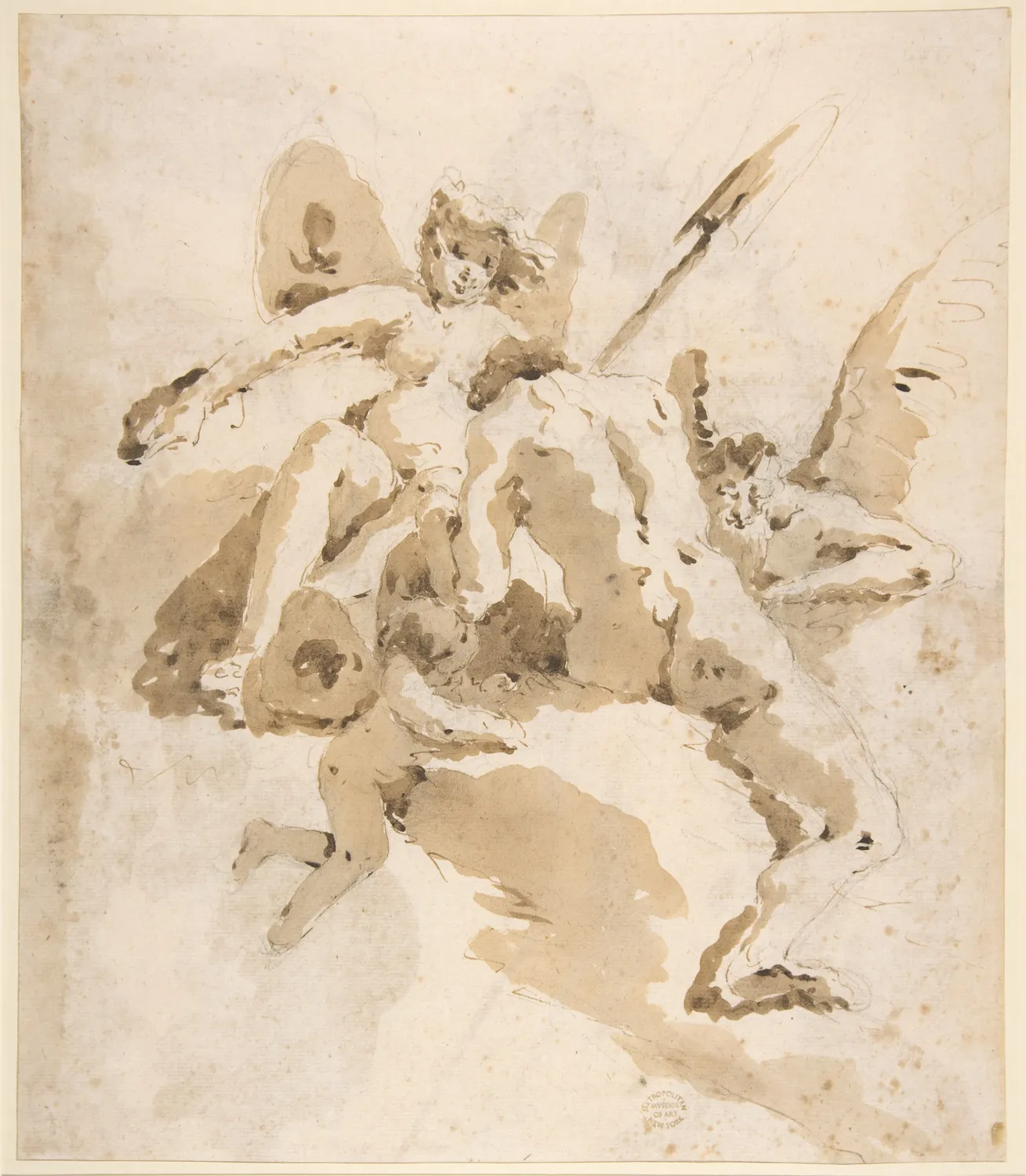
Design for a Ceiling, pen and brown ink with brush and brown wash over black chalk, on a sheet about twenty nine by twenty five centimetres. Every figure is drawn from directly underneath. The soles of the feet come at the viewer, the heads sit small and far back, and the wash carries all the modelling.
Giovanni Battista Tiepolo, Design for a Ceiling (recto), The Metropolitan Museum of Art, New York, 80.3.372, Gift of Cornelius Vanderbilt, 1880. Public domain (CC0), Wikimedia Commons.
Studio
Light
Large workshop in Venice; on the road, scaffolding under whatever light the church or palace provided.
Position
On scaffolding for the monumental work; in the studio for the modelli and altarpieces.
Session length
Years per major commission — Würzburg 1750–1753, Madrid 1762 to his death in 1770. Each ceiling worked giornata by giornata until finished.
Tools
Ink and wash on paper for compositional drawings · Small canvas for oil modelli (30–60 cm) · Pigments compatible with lime — ochres, siennas, umbers, red earths, lime white, smalt, lapis lazuli (highlights), Prussian blue (later) · Cartoon, pricked-hole pouncing apparatus for transferring composition to arricciato · Scaffolding and rolling platforms for working at architectural scale
Notes
Workshop was a family business. His sons Giandomenico (1727–1804) and Lorenzo (1736–1776) executed substantial portions of major late commissions.
Source: Tiepolo correspondence with the Würzburg court (1750–1753), 1753
Palette
Ground
For fresco: arricciato (coarser plaster) with intonaco (fine plaster) applied in giornate. For oil: standard primed canvas.
Whites
Lime white (fresco) · Lead white (oil)
Earths
Ochres · Siennas · Umbers · Red earths
Colors
Smalt · Lapis lazuli (highlights only) · Prussian blue (after it became available)
Medium
Buon fresco: pigment in water, locked into wet plaster as it dries. Secco: dry plaster repaint, less durable. Oil for the modelli — applied in rapid unblended brushwork.
Source: Tiepolo correspondence with the Würzburg court (1750–1753), 1753
Workflow, from blank canvas
1. Ink and wash drawings on paper
Established compositional movement and the extreme di sotto in sù foreshortening on paper.
Why: Figures seen from below need to be drawn from imagined viewpoints. The geometry must be resolved before any plaster.
2. The oil modello
Painted a small fully finished oil sketch resolving colour, figure placement, lighting, and tone at 30–60 cm.
Why: A failed decision at modello scale costs a day of paint; at architectural scale it costs a week of re-plastering.
3. Transfer to architectural surface
Squared up the modello to a full-scale cartoon and pounced the cartoon through pricked holes onto the arricciato.
Why: Locks the composition's proportional structure at full scale before the wet-plaster work begins.
4. Apply intonaco in giornata
Final fine plaster applied in the day's section sized to what could be finished before the plaster set.
Why: Buon fresco only accepts paint while the plaster is wet. The giornata is the unit of commitment.
5. Rapid definitive brushwork
Pigment in water painted into wet plaster (buon fresco). Secco for revisions and details on dry plaster.
Why: Secco is the less durable layer and has been the first casualty in degraded ceilings. Buon fresco binds chemically and survives.
How they studied
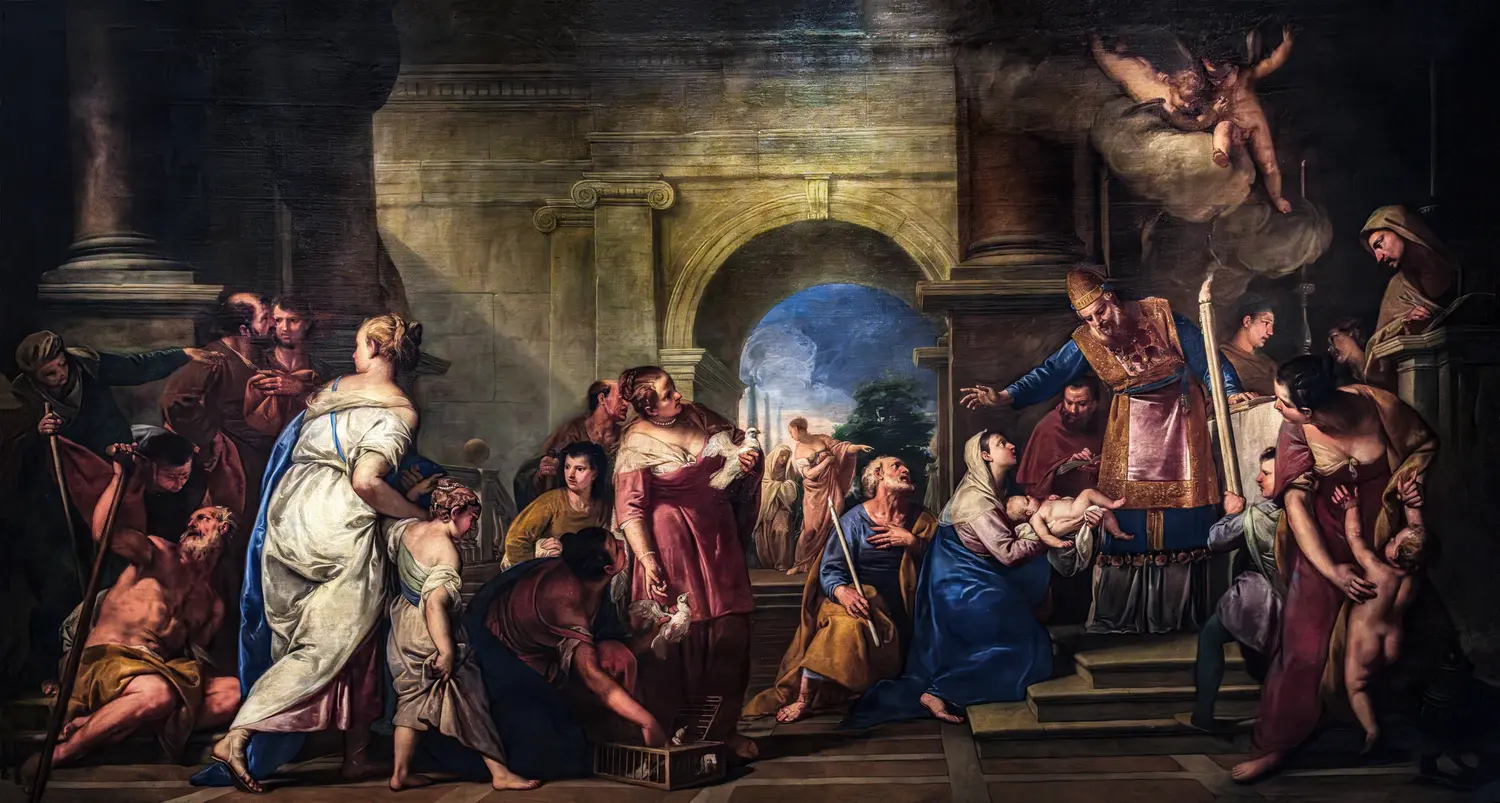
The one contemporary who watched him start says he left his teacher almost at once. Vincenzo da Canal wrote his life of Gregorio Lazzarini in Venice in 1732, when Tiepolo was thirty five, and recorded that Tiepolo had been Lazzarini's pupil although he departed from his diligent manner, since all spirit and fire he embraced a swift and resolute one. Lazzarini ran a respected shop and painted the way the first picture below shows: a dark interior, stone architecture holding everything down, every head and hand carried to a finish. Da Canal names the first evidence of the break, the Apostles that Tiepolo painted above the niches of the Ospedaletto church at nineteen, and the Pharaoh Submerged he put in against other painters at twenty, applauded on the day of Saint Roch when it was shown. The rest of the formation is on paper: by 1732 Da Canal could already write that Tiepolo's drawings were held in such esteem that he was sending books of them to the most distant countries, which means the drawing archive was a working stock and a saleable product before he was forty.
Gregorio Lazzarini, Presentation of Jesus in the Temple, oil on canvas, over five metres wide. This is the manner Tiepolo trained in and then left. The light comes in from the left, the stone architecture pins every figure to the floor, and the finish is even from edge to edge. Nothing in it floats.
Gregorio Lazzarini, Presentation of Jesus in the Temple, circa 1700, Gallerie dell'Accademia, Venice, Cat. 1391. Public domain, Wikimedia Commons.
Apotheosis of a Warrior, pen and dark brown ink with brush and dark brown wash over black chalk, on a sheet about twenty five by thirty two centimetres. The pen fixes the contour and the brush does the rest with a light wash and a darker one dropped over it. The paper is the third value and there is no fourth.
Giovanni Battista Tiepolo, Apotheosis of a Warrior, The Metropolitan Museum of Art, New York, 37.165.26, Rogers Fund, 1937. Public domain (CC0), Wikimedia Commons.
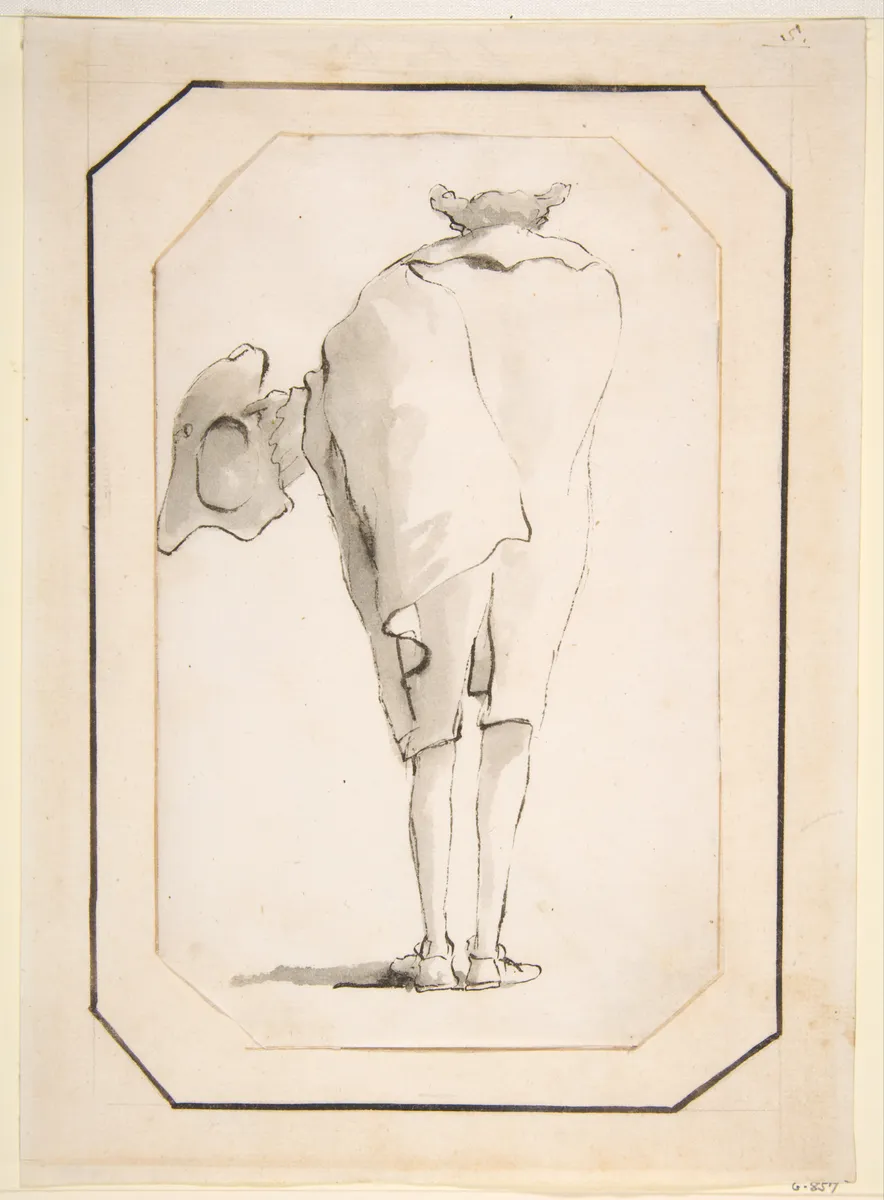
Caricature of a Man Holding a Tricorne, Seen from Behind, pen and black ink with grey wash, on a sheet about twenty by twelve centimetres, made around 1760. He drew the man from behind, which leaves no face to work with, so the whole character has to come out of the slump of the coat and the turn of the heels.
Giovanni Battista Tiepolo, Caricature of a Man Holding a Tricorne, Seen from Behind, circa 1760, The Metropolitan Museum of Art, New York, 1975.1.456, Robert Lehman Collection, 1975. Public domain (CC0), Wikimedia Commons.
Source: The Lazzarini apprenticeship, the departure from the diligent manner, the Ospedaletto Apostles at nineteen, the Pharaoh Submerged at twenty and the books of drawings sent abroad: Vincenzo da Canal, Vita di Gregorio Lazzarini, written 1732, printed Venice 1809, pages xxxi to xxxiv, read in the Internet Archive full text. Medium, date, dimensions and holding collection for each figure: read from the museum record through the Commons file.
Up close
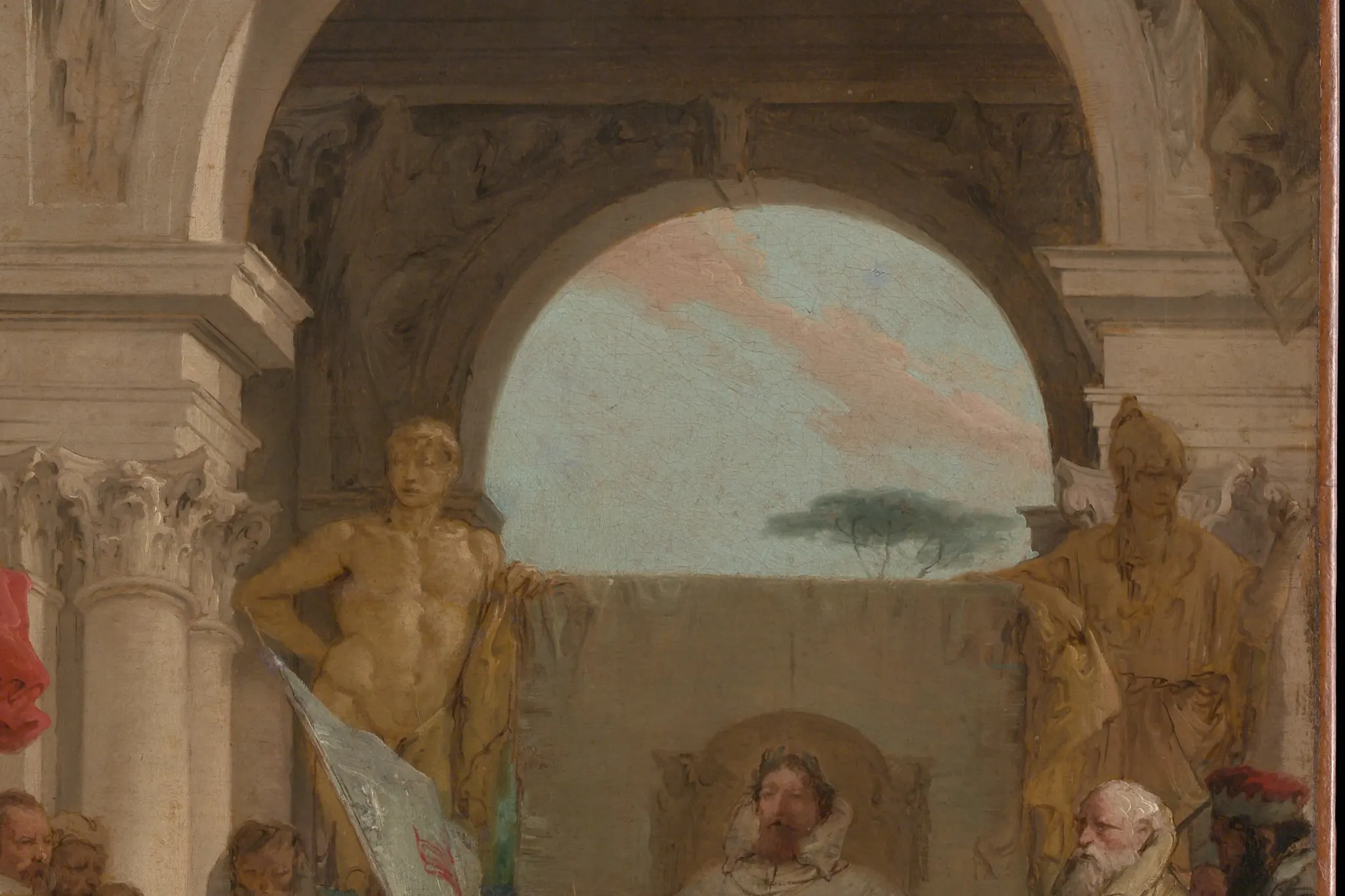
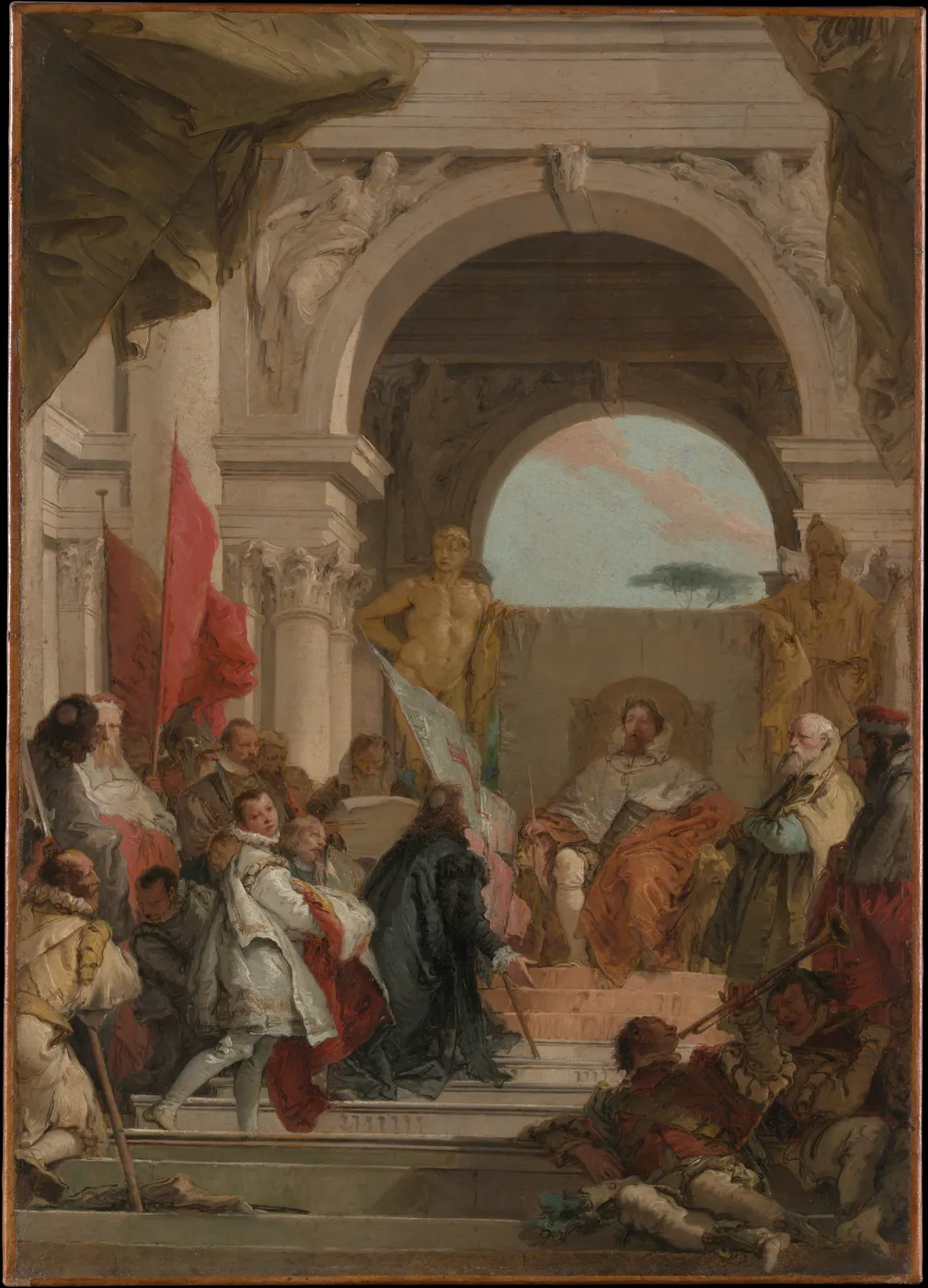
Detail of the Investiture modello, a canvas about seventy two centimetres high: the standing sculpture at the left is four or five loaded strokes and a wipe, the sky through the arch is one flat pass with two pink drags across it, and the distant tree is a single blot. At this size a whole architectural setting gets decided in an afternoon.
Giovanni Battista Tiepolo, The Investiture of Bishop Harold as Duke of Franconia (detail), circa 1751 to 1752, The Metropolitan Museum of Art, New York, 71.121, Purchase, 1871. Public domain (CC0), Wikimedia Commons.
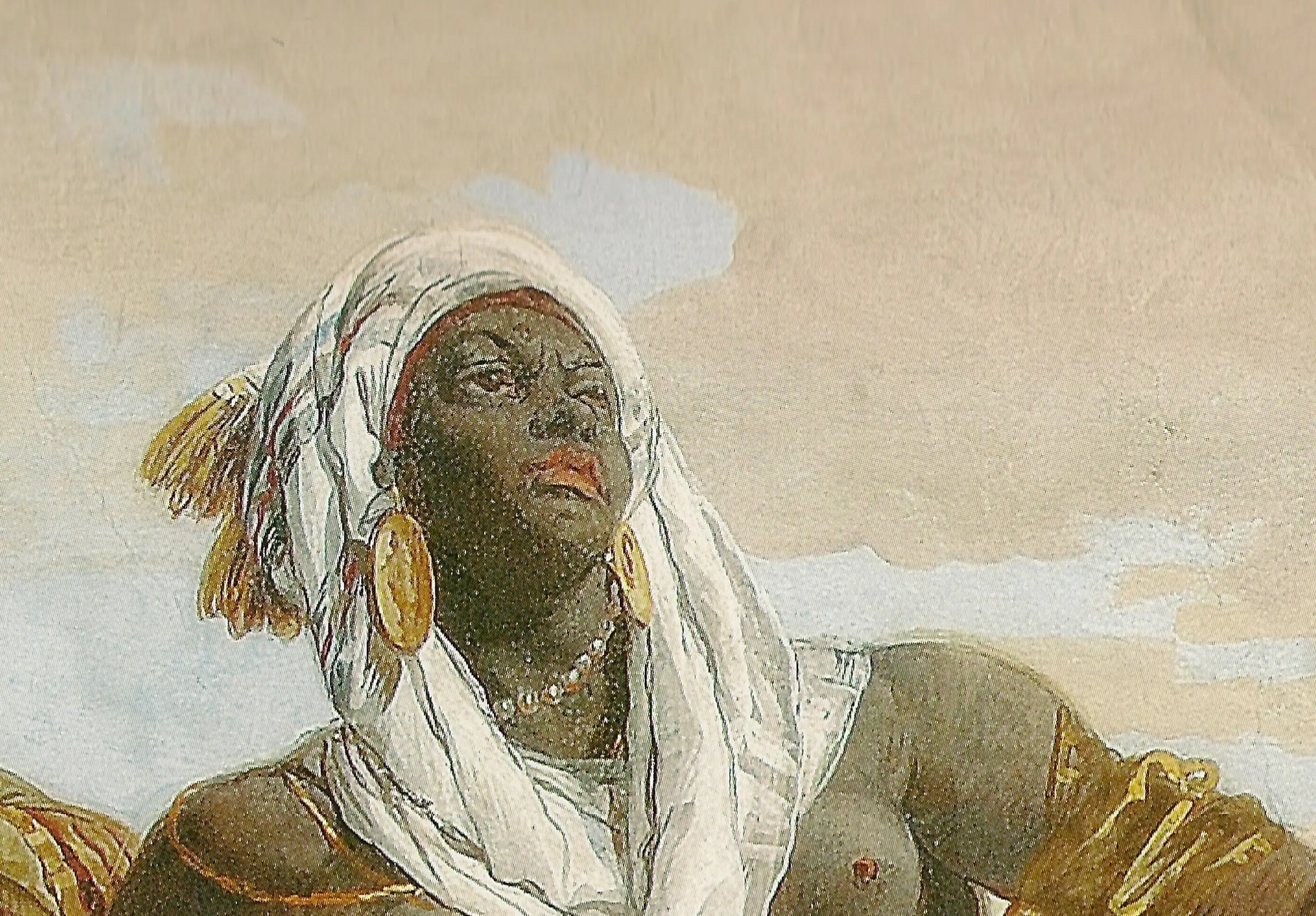
Detail of the Africa group on the Wuerzburg vault: the whole passage is keyed high. The sky behind the head is a warm near white, the clouds are barely darker than the sky, and the darkest note in the picture is the figure herself. Nothing drops to black, which is how a ceiling reads as open air from a floor more than twenty metres below. The fine light lines crossing the plaster are cracks in the vault, closed with lime mortar in the restoration of 2003 to 2006.
Giovanni Battista Tiepolo, ceiling fresco in the staircase of the Wuerzburg Residence (detail), the princess of Africa, 1752 to 1753. Public domain (PD-Art), Wikimedia Commons.
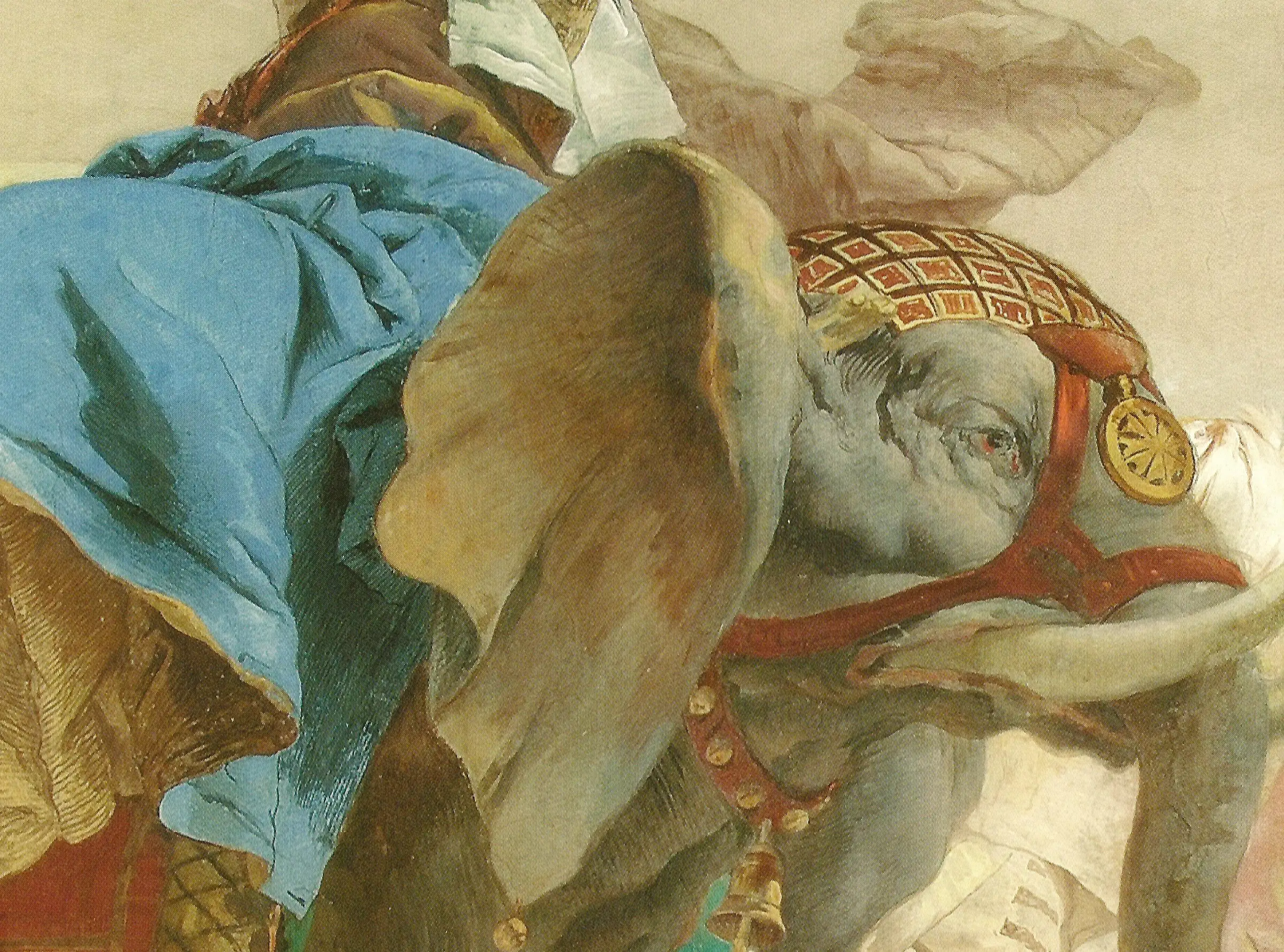
Detail of the Asia group: the elephant is built from a few large flat areas with the drawing left showing at the edges, and the blue drapery beside it goes down in broad strokes and is then left alone. Water ground pigment in fresh lime cannot be reworked once the plaster sets, so the first statement of a shape is the final one.
Giovanni Battista Tiepolo, ceiling fresco in the staircase of the Wuerzburg Residence (detail), the ruler of Asia, 1752 to 1753. Public domain (PD-Art), Wikimedia Commons.
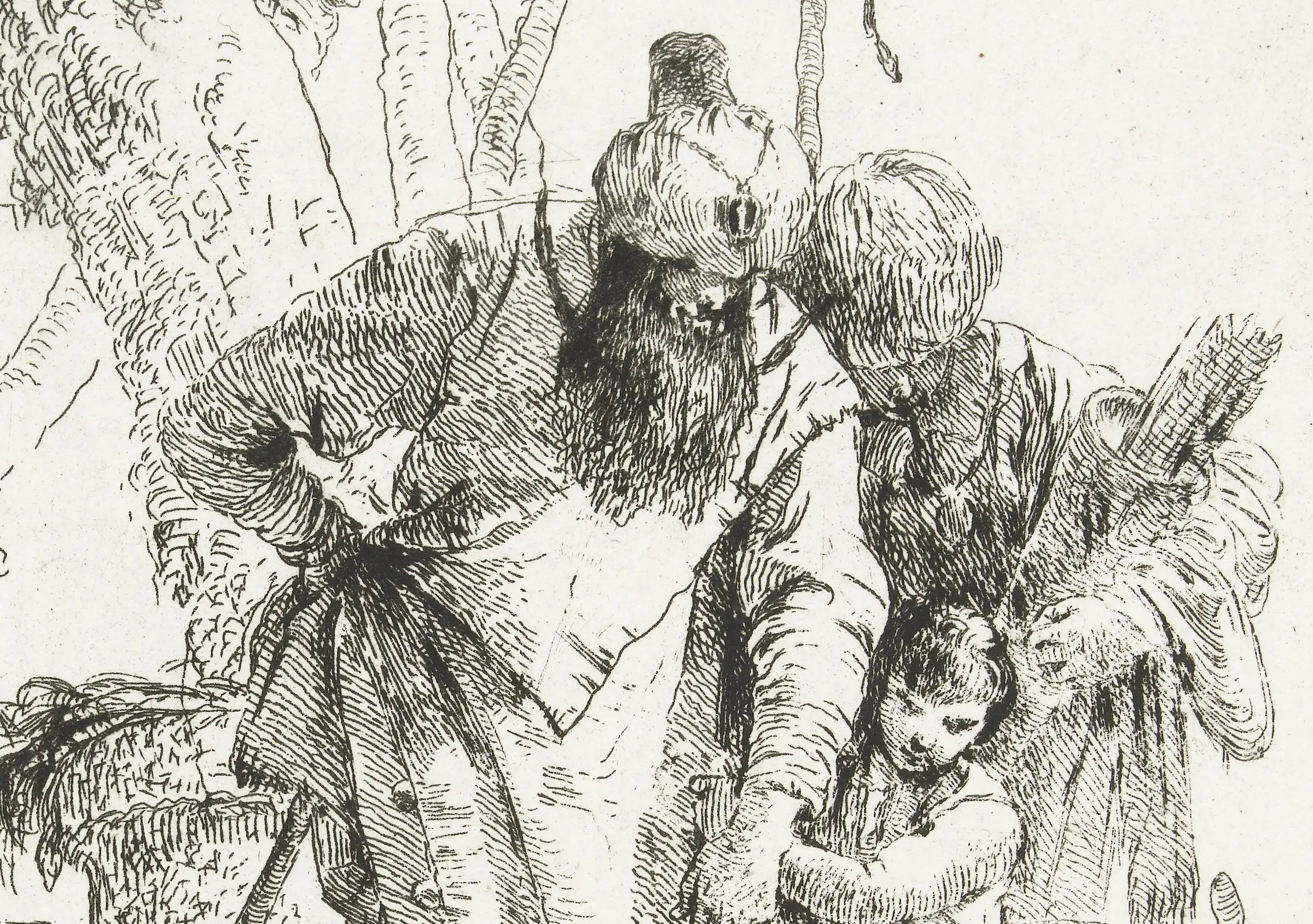
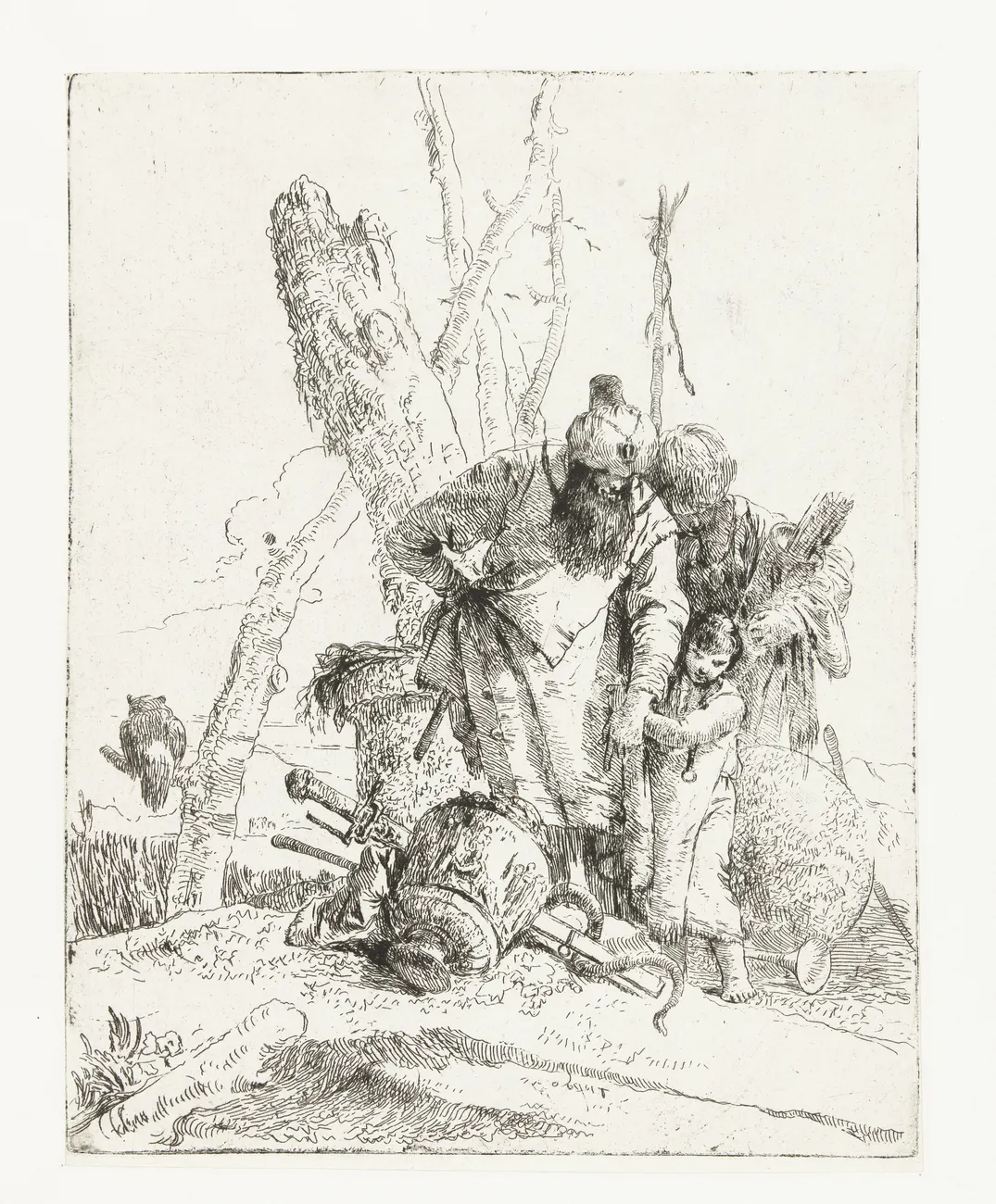
Detail of a Scherzi plate: no wash and no tone anywhere, only bitten line. The beard, the cloth and the bark are all made of parallel strokes laid at different densities, and every light in the picture is bare paper the needle never touched.
Giovanni Battista Tiepolo, Two magicians with a child frightened by a snake, from the Scherzi di fantasia (detail), in or before circa 1750, Rijksmuseum, Amsterdam, RP-P-1950-661. Public domain (CC0), Wikimedia Commons.
Watching him work
“In only ten hours, to meet an engagement, he painted at half life size the twelve apostles receiving communion from the Saviour, a work admired for its incomprehensible speed.”
Vincenzo da Canal, writing in Venice in 1732, when Tiepolo was thirty five, Vita di Gregorio Lazzarini, written 1732, printed Venice 1809, page xxxiv. The Italian reads: In sole dieci ore per impegno dipinse di mezzo naturale i dodici appostoli communicati dal Salvatore, opera ammirata per l'incomprensibile speditezza, 1809 [source]
Across media
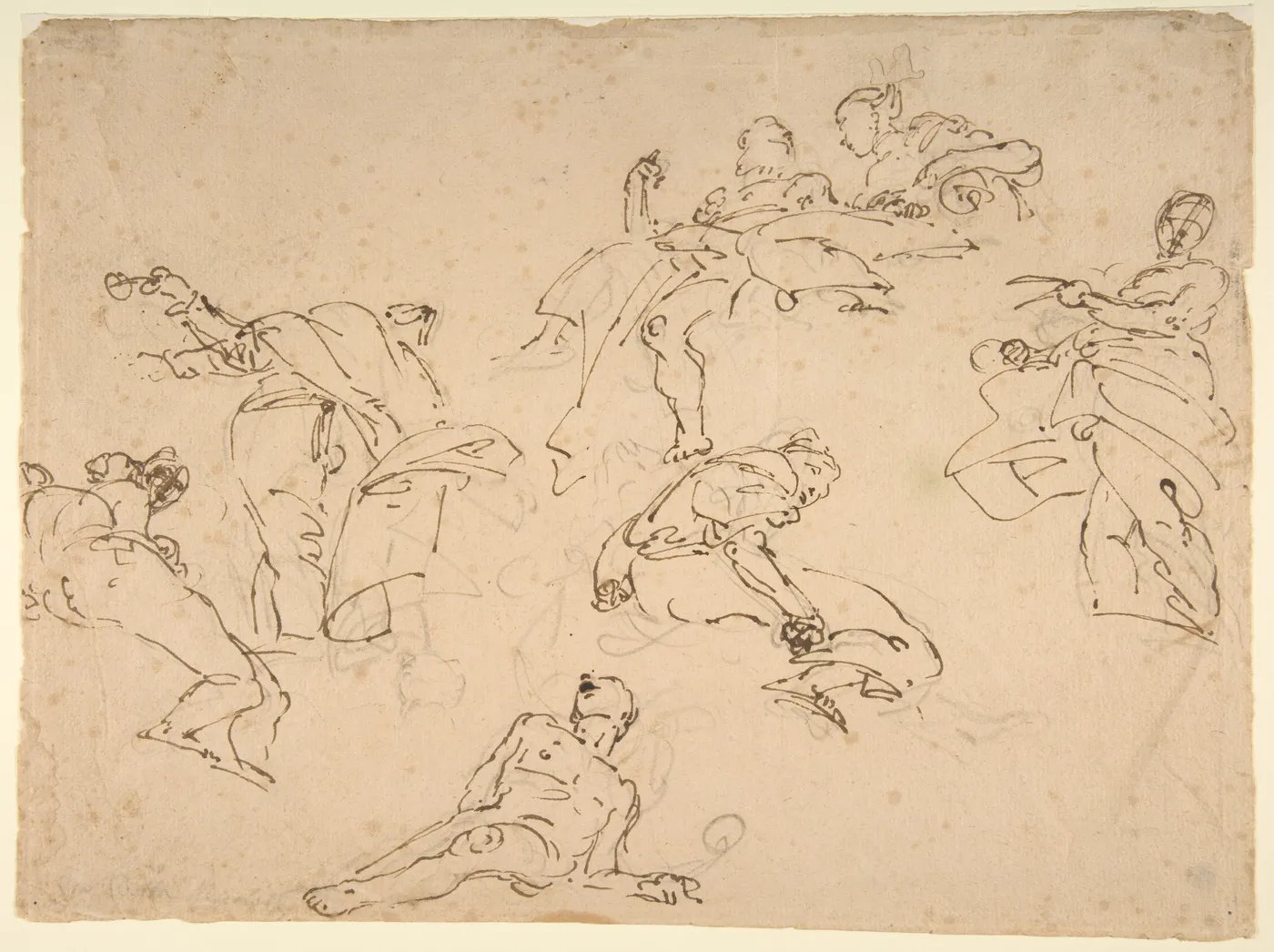
Figure Studies, pen and brown ink over black chalk on beige paper, about twenty five by thirty four centimetres. A sheetful of figures, most of them floating and seen from below, not one of them carried to a finish. This is the stock a ceiling gets assembled from.
Giovanni Battista Tiepolo, Figure Studies, The Metropolitan Museum of Art, New York, 64.38.3, Rogers Fund, 1964. Public domain (CC0), Wikimedia Commons.
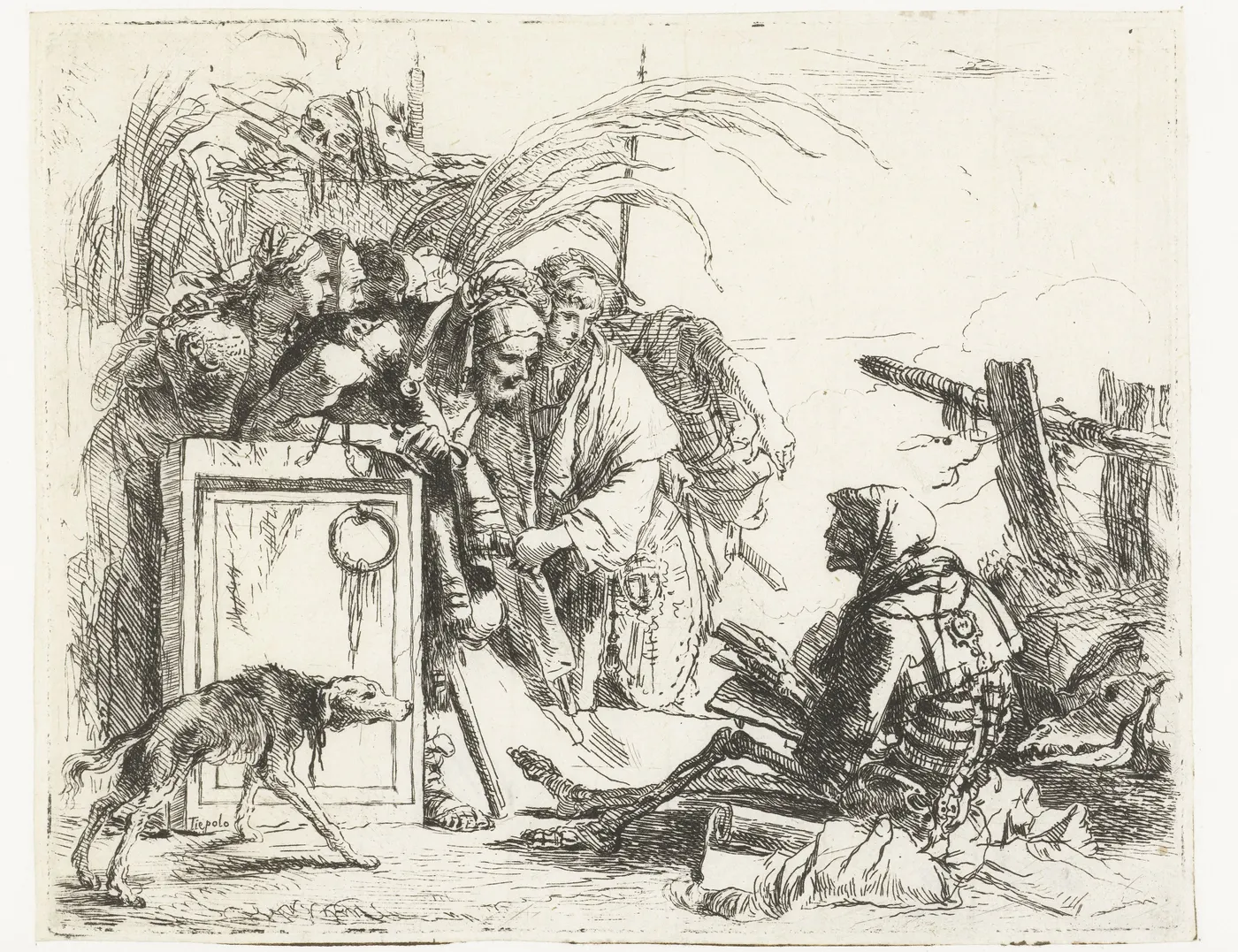
In audience with Death, from the Capricci, etched on a plate about fourteen by eighteen centimetres in or before about 1735. Death sits on the ground at the right addressing a group of figures and a dog. He signed it on the plate itself, at the lower left.
Giovanni Battista Tiepolo, In audience with Death, from the Capricci, in or before circa 1735, Rijksmuseum, Amsterdam, RP-P-OB-12.248. Public domain (CC0), Wikimedia Commons.
Two magicians with a child frightened by a snake, from the Scherzi di fantasia, on a plate about twenty two by seventeen centimetres. The Rijksmuseum set is printed in the first state, before the two editions his son Giovanni Domenico issued after his death, and the missing plate numbers are how that is known.
Giovanni Battista Tiepolo, Two magicians with a child frightened by a snake, from the Scherzi di fantasia, in or before circa 1750, Rijksmuseum, Amsterdam, RP-P-1950-661. Public domain (CC0), Wikimedia Commons.
The Investiture of Bishop Harold as Duke of Franconia, oil on canvas, about seventy two by fifty one centimetres. A modello for one of the Wuerzburg Kaisersaal frescoes, and a finished picture at pocket size: the architecture, the crowd, the light and the colour all settled before anyone mixed plaster.
Giovanni Battista Tiepolo, The Investiture of Bishop Harold as Duke of Franconia, circa 1751 to 1752, The Metropolitan Museum of Art, New York, 71.121, Purchase, 1871. Public domain (CC0), Wikimedia Commons.
The America group on the Wuerzburg staircase vault: a feathered headdress, a bow, a crocodile for a mount. The sky behind is a cool pale grey, and every figure is drawn as if the viewer were lying on the staircase floor looking straight up.
Giovanni Battista Tiepolo, ceiling fresco in the staircase of the Wuerzburg Residence (detail), America, 1752 to 1753. Public domain (PD-Art), Wikimedia Commons.
The record, deeper
The money
Wuerzburg paid the family twelve thousand Rhenish gulden for the work, with a further three thousand as a gratuity. The Bavarian Palace Administration sets that against local wages: roughly sixty times the yearly pay of a mason foreman, and thirteen times the annual salary of Balthasar Neumann, the architect of the building.
Christina Sebastian, Giovanni Battista Tiepolo und sein Meisterwerk in der Residenz Wuerzburg, Blog der Bayerischen Schloesserverwaltung, 27 March 2020.
The two published accounts of that fee do not describe the same thing. The Palace Administration presents the twelve thousand plus three thousand as payment for the family across the three years in Wuerzburg. The Wuerzburg city encyclopedia gives fifteen thousand gulden for the staircase ceiling alone. The totals agree and the scope does not.
Blog der Bayerischen Schloesserverwaltung, 27 March 2020; Deckenfresko im Treppenhaus der Residenz, WuerzburgWiki, the Wuerzburg city encyclopedia.
The colours were bought in the town and the receipts survive. Andreas Burmester and Stefanie Correll traced the Wuerzburg purchases to the Venino family, colour merchants in Wuerzburg, and took the title of their study straight from one of the entries: seventy two florin for colours, white and glue.
Andreas Burmester and Stefanie Correll, 72 Florin for colours, white and glue: The Tiepolos, the Veninos and Wuerzburg, in Studying 18th Century Paintings and Works of Art on Paper, Archetype Publications, London, 2015, pages 58 to 69.
The reworks
The National Gallery in London took the varnish and the old retouching off Saints Maximus and Oswald and found that the retouching had been covering Tiepolo's own underdrawing, which is visible in the paint. The same examination traced how he developed the composition, and the changes move it closer to the larger pictures, which is what gives the small canvas a clear place in the working sequence.
Larry Keith, Giovanni Battista Tiepolo's Saints Maximus and Oswald: Conservation and Examination, National Gallery Technical Bulletin, volume 15, 1994, pages 36 to 41.
Buon fresco is durable and it is not permanent. The roofs of the Wuerzburg Residence were destroyed in March 1945 and the vault over the main staircase took water for years. The fresco was restored in 1948 and 1949, the damp came back, and when the surface was surveyed again the investigators found magnesium sulfates concentrated near the surface, mould across the whole vault, cracks in the vault plaster several centimetres wide in places, and about twenty percent of the total area lying hollow behind the paint.
Bayerische Schloesserverwaltung, Residenz Wuerzburg, Die Restaurierung des Tiepolofreskos im Treppenhaus, on the 2003 to 2006 campaign.
The studio
The court wrote his arrival down. Johann Christoph Spielberger, who kept the protocol at the Wuerzburg court, recorded in December 1750 that the Venetian painter Diepolo had arrived, had brought his two sons and a servant, and had been lodged in the corner rooms in the garden on the Rennweg and given five rooms.
Johann Christoph Spielberger, Wuerzburg court protocol, December 1750, quoted by the Bayerische Schloesserverwaltung, 27 March 2020.
The surface was an unsupported trough vault, twenty three metres up at its highest point, spanning eighteen by thirty metres, and the painting on it covers around six hundred square metres. The Bavarian Palace Administration calls it the largest ceiling fresco ever painted.
Bavarian Palace Administration, Wuerzburg Residence, the Staircase.
There was probably never a full scaffold. The Wuerzburg record describes rolling ladders and trestle stands set on a base platform two to three metres lower, arranged that way so the staging never blocked the view of the vault he was judging.
Deckenfresko im Treppenhaus der Residenz, WuerzburgWiki, the Wuerzburg city encyclopedia, summarising the restoration findings.
The whole campaign fits in three years. The family arrived in December 1750, painted the Kaisersaal in 1751 and 1752, painted the staircase vault in 1752 and 1753, and went home to Venice in November 1753.
Bayerische Schloesserverwaltung, Residenz Wuerzburg; Deckenfresko im Treppenhaus der Residenz, WuerzburgWiki.
The materials
The canvas under a Tiepolo is not one colour. The National Gallery examined Saints Maximus and Oswald and found a double ground, a warm orange brown layer with a warm grey laid over it, and that grey is what the light passages sit on.
Larry Keith, National Gallery Technical Bulletin, volume 15, 1994, pages 36 to 41.
On the Wuerzburg vault the fine plaster went on from the top down, one day's work at a time, and each patch was painted at once. The Wuerzburg record counts two hundred and eighteen of them and describes the transfer: the cartoon was nailed onto the fresh plaster and the drawing pressed through into it while the surface was still half damp, and traces of that survive in places.
Deckenfresko im Treppenhaus der Residenz, WuerzburgWiki, the Wuerzburg city encyclopedia.
The ceiling is not pure buon fresco. The Wuerzburg record calls it a mixed technique, fresco with secco worked over it, because once the lime has set the only way left to cover or refine a passage is thick lime paint on the dry surface.
Deckenfresko im Treppenhaus der Residenz, WuerzburgWiki, the Wuerzburg city encyclopedia.
The copper plates outlived him. The Rijksmuseum holds its Scherzi di fantasia set in the first state, printed before the two editions his son Giovanni Domenico issued after his death, and the way that is known is the absence of the plate numbers the later editions carry.
Rijksmuseum, Amsterdam, object record RP-P-1950-661.
Refusals — what they would not do
Refused to begin a major commission without a fully resolved oil modello.
Refused live-model figure work for ceilings — figures invented from internalized vocabulary, not from staged sitters on site.
Refused the slow corrective approach buon fresco physically prevents.
Refused to work alone on monumental commissions — the family workshop was the production unit.
Reference
Primary source
Internalized knowledge of anatomy, drapery, classical architecture, and perspective absorbed through training and the surviving Venetian tradition. Workshop drawing archive as the working reference library.
Photography
Predates photography. Period engravings, prints, and the workshop's library of reference sheets supplied specific period detail.
Exceptions
Specific period reference (military costume, architectural detail) drawn from engravings and prints rather than from staged physical models on site.
Gregorio Lazzarini · from about 1710 — Late-Baroque academic training in Venice. Gave Tiepolo his compositional foundation.
Influences
Veronese — the decisive influence on Tiepolo's mature style; luminous palette and compositional drama absorbed directly from the altarpieces and ceiling cycles in Venetian churches.
Tintoretto and Titian — the surviving Venetian masters whose visible fluent stroke shaped Tiepolo's oil modello practice.
Students
Son Giandomenico Tiepolo (1727–1804) — significant painter in his own right; developed a more worldly, genre-oriented style that carried the family's technical inheritance into a different subject matter.
Son Lorenzo Tiepolo (1736–1776) — also a workshop painter on the major late commissions.
Tiepolo is the last major figure in the line that runs Veronese → Tintoretto → the eighteenth-century Venetian revival. After him, the Venetian monumental tradition effectively ends.
Pigments compatible with lime: ochres, siennas, umbers, red earths, lime white, smalt, lapis lazuli for highlights only, and Prussian blue after it became available. In buon fresco the pigment goes on in water and locks chemically into the wet plaster as it dries. For the oil modelli he used lead white on standard primed canvas.
What is a Tiepolo oil modello?
A small fully finished oil sketch on canvas, typically 30 to 60 cm, that resolved the entire composition: color, figure placement, lighting, and tone. He refused to begin a major commission without one, because a failed decision at modello scale costs a day of paint while at architectural scale it costs a week of re-plastering. Many of his modelli are now considered independent masterpieces.
How did Tiepolo transfer a composition to the ceiling?
He squared the modello up to a full-scale cartoon, then pounced the cartoon through pricked holes onto the arricciato, the coarser plaster layer. This locked the composition's proportional structure at full scale before any wet-plaster work began.
What is a giornata and why did it matter to Tiepolo?
The giornata is the day's section of fine intonaco plaster, sized to what could be finished before the plaster set. Buon fresco only accepts paint while the plaster is wet, so each section demanded decisive commitment with no correction. Tiepolo was famously fast, finishing figure and architecture in a single day that would take a less confident painter a week, and the seams between giornate are still visible on his surviving ceilings.
Who taught Tiepolo, and who were his students?
He trained under Gregorio Lazzarini in Venice from about 1710, a late-Baroque academic education that gave him his compositional foundation. Veronese was the decisive influence on his mature style. His sons Giandomenico and Lorenzo trained inside the family workshop, traveled with him on every major commission, and executed substantial portions of the late work.
What did Tiepolo refuse to do?
He refused to begin a major commission without a fully resolved oil modello. He refused live-model figure work for ceilings, inventing figures from his internalized vocabulary and thousand-sheet drawing archive instead. He refused the slow corrective approach that buon fresco physically prevents, and he refused to work alone on monumental commissions; the family workshop was the production unit.
If this painter is your match
You share the conviction that a painting at monumental scale has to be solved at small scale first. The final canvas is the execution of a decision that has already been made.
Borrow this: Before your next large painting, resolve the whole composition as a finished oil study at thirty centimeters. Color, light, figure placement. Solve it small. The large canvas becomes an execution problem instead of a design problem.
Tiepolo correspondence with the Würzburg court (1750–1753), 1753. Preserved in the Staatsarchiv Würzburg. Documents Tiepolo's logistics, pigment requests, and working conditions on the Residenz commission — the most detailed surviving record of a Tiepolo working campaign.
Anna Pallucchini, L'opera completa di Giambattista Tiepolo, 1968. The standard catalogue raisonné. Draws on the surviving modelli, drawings, and technical observations from the major ceiling cycles.
Victoria and Albert Museum, Tiepolo Drawings Collection. One of the world's largest holdings of Tiepolo working drawings. Over a thousand sheets covering figure studies, drapery, and compositional experiments.
Vincenzo da Canal, Vita di Gregorio Lazzarini, written in Venice in 1732, printed there in 1809, 1809. The earliest account of Tiepolo at work, written while he was thirty five and still a Venetian local. Checked against the full text. Carries the Lazzarini apprenticeship and the departure from his diligent manner, the Apostles painted at nineteen above the niches of the Ospedaletto, the Pharaoh Submerged put in against other painters at twenty, the books of drawings already being sent to distant countries, and the twelve apostles painted at half life size in ten hours. Da Canal gives his birth year as 1697, which later scholarship corrects to 1696.[link]
Bayerische Schloesserverwaltung (Bavarian Palace Administration), Residenz Wuerzburg: the Staircase, the Restoration of the Tiepolo fresco, and the blog post of 27 March 2020. The authority that runs the building. Source here for the vault dimensions and the largest-ceiling-fresco claim, the December 1750 arrival protocol kept by Johann Christoph Spielberger, the twelve thousand gulden plus three thousand gratuity and the wage comparisons, the March 1945 roof destruction, and the 2003 to 2006 restoration findings including the twenty percent of hollow surface.[link]
Larry Keith, Giovanni Battista Tiepolo's Saints Maximus and Oswald: Conservation and Examination, National Gallery Technical Bulletin, volume 15, 1994. Pages 36 to 41. The double ground of warm orange brown below warm grey, the underdrawing that old retouching had disguised, and the compositional development that places the small canvas in the working sequence.
Andreas Burmester and Stefanie Correll, 72 Florin for colours, white and glue: The Tiepolos, the Veninos and Wuerzburg, in Studying 18th Century Paintings and Works of Art on Paper, Archetype Publications, London, 2015. Pages 58 to 69. The archival trail from the Wuerzburg commission to the Venino family, colour merchants in the town. A German version appeared in Stefanie Correll, Farbwarenhandel um 1800, Munich, 2012.
Object records read directly: The Metropolitan Museum of Art 1977.1.3, 71.121, 80.3.372, 64.38.3 and 37.165.26; Rijksmuseum RP-P-OB-12.248 and RP-P-1950-661; Gallerie dell'Accademia, Venice, Cat. 1391. Medium, date, dimensions, accession and credit line for every figure on this page, read from the holding collection through the Commons file rather than taken from a filename.